Sinitic Civilization-Book 1
Sinitic Civilization-Book 2
Tribute of Yu

Heavenly Questions
Zhou King Muwang's Travels
The Legends of Mountains & Seas
The Bamboo Annals - Book 1
The Scourge-of-God-Tetralogy:
From the Khitans to the Jurchens & Mongols: A History of Barbarians in Triangle Wars and Quartet Conflicts
(available at iUniverse;
Google;
Amazon;
B&N)
|
|
 This website's contents are the result of 20 years' writings --that could be compared to the "archaeological deposits" in a literary sense.
The freelance-style writings on the website were not proof-read.
Portion of the writings, i.e., related to Pre-History, Xia, Shang, Zhou, Qin, and Han dynasties, was extracted, polished, reconciled, and synthesized into
The Sinitic Civilization - Book I which is
available now on
Barnes & Noble,
Amazon,
Google Play|Books
and
Nook.
Book II is
available now on
Amazon
and Barnes & Noble.
Check out this webmaster's 2nd edition --that realigned Han dynasty's reign years strictly observing the Zhuanxu-li calendar of October of a prior lunar year to September of the following lunar year
and
cleared this webmaster's blind spot on the authenticity of the Qinghua University's Xi Nian bamboo slips as far as Zhou King Xiewang's 21 years of co-existence with Zhou King Pingwang was concerned.
To give the readers a heads-up, this webmaster had thoroughly turned the bricks concerning the Sinitic cosmological, astronomical, astrological, historical, divinatory, and geographical records, with the indisputable discovery
of the fingerprint or footprint of the forger for the 3rd century A.D. book Shang-shu (remotely ancient history),
and
close to 50 fingerprints or footprints of the forger of the contemporary version of The Bamboo Annals --a book that was twice modified and forged after excavation.
All ancient Chinese calendars had been examined, with each and every date as to the ancient thearchs being examined from the perspective how they were forged or made up.
Using the watershed line of Qin Emperor Shihuangdi's book burning to rectify what was the original before the book burning,
this webmaster filtered out what was forged after the book burning of 213 B.C.
This webmaster furthermore filtered out the sophistry and fables that were rampant just prior to the book burning, and validated the history against the oracle bones, bronzeware and bamboo slips.
There are dedicated chapters devoted to interpreting Qu Yuan's poem Asking Heaven, the mythical mountain and sea book Shan Hai Jing, geography book Yu Gong (Lord Yu's Tributes), and Zhou King Muwang's travelogue Mu-tian-zi Zhuan, as well as a comprehensive review of ancient calendars, ancient divination, and ancient geography.
One chapter is focused on the Huns, with a comprehensive overview of the relationship between the Sinitic people and the barbarians since prehistory.
The book has appendices of two calendars: the first Zhuanxu-li anterior quarter remainder calendar (247 B.C.-85 A.D.) of the Qin Empire, as well as a conversion table of the sexagenary years of the virtual Yin-li (Shang dynasty) quarter remainder calendar versus the Gregorian calendar, that covers the years 2698 B.C. to 2018 A.D.
Refer to
Introduction_to_The_Sinitic_Civilization,
Afterword,
Table of Contents - Book I (Index)
and
Table of Contents - Book II (Index)
for details.
This website's contents are the result of 20 years' writings --that could be compared to the "archaeological deposits" in a literary sense.
The freelance-style writings on the website were not proof-read.
Portion of the writings, i.e., related to Pre-History, Xia, Shang, Zhou, Qin, and Han dynasties, was extracted, polished, reconciled, and synthesized into
The Sinitic Civilization - Book I which is
available now on
Barnes & Noble,
Amazon,
Google Play|Books
and
Nook.
Book II is
available now on
Amazon
and Barnes & Noble.
Check out this webmaster's 2nd edition --that realigned Han dynasty's reign years strictly observing the Zhuanxu-li calendar of October of a prior lunar year to September of the following lunar year
and
cleared this webmaster's blind spot on the authenticity of the Qinghua University's Xi Nian bamboo slips as far as Zhou King Xiewang's 21 years of co-existence with Zhou King Pingwang was concerned.
To give the readers a heads-up, this webmaster had thoroughly turned the bricks concerning the Sinitic cosmological, astronomical, astrological, historical, divinatory, and geographical records, with the indisputable discovery
of the fingerprint or footprint of the forger for the 3rd century A.D. book Shang-shu (remotely ancient history),
and
close to 50 fingerprints or footprints of the forger of the contemporary version of The Bamboo Annals --a book that was twice modified and forged after excavation.
All ancient Chinese calendars had been examined, with each and every date as to the ancient thearchs being examined from the perspective how they were forged or made up.
Using the watershed line of Qin Emperor Shihuangdi's book burning to rectify what was the original before the book burning,
this webmaster filtered out what was forged after the book burning of 213 B.C.
This webmaster furthermore filtered out the sophistry and fables that were rampant just prior to the book burning, and validated the history against the oracle bones, bronzeware and bamboo slips.
There are dedicated chapters devoted to interpreting Qu Yuan's poem Asking Heaven, the mythical mountain and sea book Shan Hai Jing, geography book Yu Gong (Lord Yu's Tributes), and Zhou King Muwang's travelogue Mu-tian-zi Zhuan, as well as a comprehensive review of ancient calendars, ancient divination, and ancient geography.
One chapter is focused on the Huns, with a comprehensive overview of the relationship between the Sinitic people and the barbarians since prehistory.
The book has appendices of two calendars: the first Zhuanxu-li anterior quarter remainder calendar (247 B.C.-85 A.D.) of the Qin Empire, as well as a conversion table of the sexagenary years of the virtual Yin-li (Shang dynasty) quarter remainder calendar versus the Gregorian calendar, that covers the years 2698 B.C. to 2018 A.D.
Refer to
Introduction_to_The_Sinitic_Civilization,
Afterword,
Table of Contents - Book I (Index)
and
Table of Contents - Book II (Index)
for details.
|
|
Table of lineages & reign years:
Sovereigns & Thearchs;
Xia-Shang-Zhou dynasties;
Zhou dynasty's vassalage lords;
Lu Principality lords;
Han dynasty's reign years
(Sexagenary year conversion table-2698B.C.-A.D.2018; 247B.C.-A.D.85)
|
Epigraph|Preface|Introduction|T.O.C.|Afterword|Bibliography|References|Index
(available at iUniverse|Google|Amazon|B&N)
|
|
THE XIA-SHANG DYNASTIES
|
Paul Kennedy, in "The Rise & Fall Of The Great Powers", claimed that Europe's mountainous geography had guaranteed the disunity and individuality of the European nations, principalities and people. Then, is China lacking the mountains, gorges and deserts that should have precluded the "unification aspiration" of the Chinese people from a continuance? The geographical thesis marks Paul Kennedy's 600-page book invalid automatically.
China had been a united country or possessed inertia for unity because of the same origin of our people as well as the invention and adoption of the pictographic written language.
Further, the Confucian school of thoughts upheld the ancient ancestor worship to the apex, leading to the blood affinity of clans and families, a phenomenon that continued till the 1960s when communist China destroyed all tombs, including that of this webmaster's grandfather.
Our civilization, born out of a mundane society, had survived the impacts and challenges as a result of the establishment of our ancestral belief and morality systems and values.
In the past thousand years, our people and clans were used to saying that we, of the same last name, were from the same family 500 years ago. From the Soong dynasty onward, Prime Minister Fan Zhongyan, as philanthropic activity, had provided a model of purchasing lands for the same clan members. Each and every member of the clan, after success in career or wealth accumulation, would usually return to the hometown to rebuild the family ancestral pilgrimage. In the early 20th century, the father of diplomat Gu Weijun [i.e., Wellington Koo] did the same in buying large patches of lands on behalf of the Gu clan. After Taiwan opened the visitation to mainland China in 1988, hundreds of thousands of compatriots had visited the mainland to do the same. This webmaster's word of advice for our Chinese brothers: Love your cousins. As Zhang Binglin said, the clan affinity was from fetus & placenta. You, as an individual Chinese, could make a change in today's China by spreading the message of love and care for your fellow brothers.
As another ancient Chinese saying goes, it takes 10 years to plant a tree and 100 years to raise a person.
"Raising a person [i.e., an ordinary Chinese person]" is a task that should be undertaken from ground up inside of China. Only after restoring the baseline of China's societal foundation and values [which had been destroyed by the communist regime] would there be possibility of a resurrected Chinese Nation.
|
* In Commemoration of China's Fall under the Alien Conquests in A.D. 1279,
A.D. 1644 & A.D. 1949 *
 U.S.S.R./Comintern Alliance with the KMT & CCP (1923-1927)
 Korean/Chinese Communists & the 1931 Japanese Invasion of Manchuria Korean/Chinese Communists & the 1931 Japanese Invasion of Manchuria
American Involvement in China: Soviet Operation Snow, IPR Conspiracy, Dixie Mission, Stilwell
Incident, O.S.S. Scheme, Coalition Government Crap, Amerasia Case & The China White Paper
* Stay tuned for "Republican China 1911-1955: A Complete Untold History" *
|
|
Zou Rong's Revolutionary Army;
Shin Kyu Sik's
Shrine (Spirit, Kunitama) of Korea
|
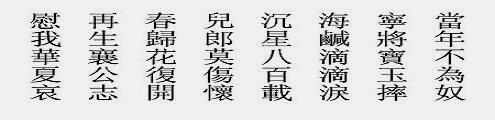
This snippet is for sons and daughters of China:
Heed the sons & ministers' agony and sorrow of our ancestors who died or lived through the Mongol, Manchu and Soviet-Chicom conquest
and
the Yongjia, Jingkang and Jiashen cataclysms !
Jeanne d'Arc of China:
Teenager girl Xun Guan breaking out of the Wancheng city to borrow the relief troops in the late Western Jinn dynasty;
Liu-Shao-shi riding into the barbarian army to rescue her husband in the late Western Jinn dynasty;
teenager girl Shen Yunying breaking into Zhang Xianzhong's rebels on the horseback to avenge on father's death in the late Ming dynasty.
China's Solitary and Lone Heroes:
Nan Jiyun breaking out of the Suiyang siege and charging back into the city in the Tang dynasty;
Zhang Gui & Zhang Shun Brothers breaking through the Mongol siege of Xiangyang in the Southern Soong dynasty;
Liu Tiejun breaking through three communist field armies' siege of Kaifeng in the Republican China time period;
Zhang Jian's lone confrontation against the communist army during the June 3rd & 4th Massacre of 1989.
|
|
|
 While we adopted some commonly-accepted starting and ending years for the Xia, Shang and Zhou dynasties, the authoritative Chinese historian viewpoint is that the earliest substantiated year happened to be the fourteen year long "interregnum"
(841-828 B.C.; 840-827 B.C. per Zhang Wenyu)
of Western Zhou Dynasty, beginning from year 841 B.C., the year when King Liwang of Zhou was ousted by the revolts of the Guoren (i.e., the civilians in the capital vs 'Yeren' the country people in the outskirts) and some royal uncle administered the state affairs till King Xuanwang of Zhou was selected.
As to the reliable historical records, the oracle bones from Shang served the best example of underground records matching written records above-ground, while the excavation from the Xia time period are still under research and point to the fact that some writing system, i.e., the tadpole-style characters, did exist in the earlier Dynasty of Xia. A Chinese research project which started in 1995 had been reported to have pushed the exact date to the year 2070 B.C.E. as the point of origin for Xia Dynasty. Stanford University scholar, David Nivison, had derived the date of 2026 BC, instead, as a result of his own independent studies.
The raw data from the forgery contemporary version [Jin Ben] of The Bamboo Annals pointed to the date of 1978 B.C.E. as the start reign of first Xia king Qi. Prof Zhu Yongchang ([Yongtang]; John Y.D. Tse]), who matched the forgery contemporary version [Jin Ben] of The Bamboo Annals astronomical events with the NASA data, adjusted the Xia lord Qi's date to 1991 B.C.E. and Lord Yu's reign to 2002-1995 B.C.E with rule of 8 years and life of 100 years.
While we adopted some commonly-accepted starting and ending years for the Xia, Shang and Zhou dynasties, the authoritative Chinese historian viewpoint is that the earliest substantiated year happened to be the fourteen year long "interregnum"
(841-828 B.C.; 840-827 B.C. per Zhang Wenyu)
of Western Zhou Dynasty, beginning from year 841 B.C., the year when King Liwang of Zhou was ousted by the revolts of the Guoren (i.e., the civilians in the capital vs 'Yeren' the country people in the outskirts) and some royal uncle administered the state affairs till King Xuanwang of Zhou was selected.
As to the reliable historical records, the oracle bones from Shang served the best example of underground records matching written records above-ground, while the excavation from the Xia time period are still under research and point to the fact that some writing system, i.e., the tadpole-style characters, did exist in the earlier Dynasty of Xia. A Chinese research project which started in 1995 had been reported to have pushed the exact date to the year 2070 B.C.E. as the point of origin for Xia Dynasty. Stanford University scholar, David Nivison, had derived the date of 2026 BC, instead, as a result of his own independent studies.
The raw data from the forgery contemporary version [Jin Ben] of The Bamboo Annals pointed to the date of 1978 B.C.E. as the start reign of first Xia king Qi. Prof Zhu Yongchang ([Yongtang]; John Y.D. Tse]), who matched the forgery contemporary version [Jin Ben] of The Bamboo Annals astronomical events with the NASA data, adjusted the Xia lord Qi's date to 1991 B.C.E. and Lord Yu's reign to 2002-1995 B.C.E with rule of 8 years and life of 100 years.
Caveat: you could not have the best of two worlds, i.e., the precise year from the Stellarium/NASA data and the selective use of the years and events in the forgery contemporary version [Jin Ben] of The Bamboo Annals, namely, the so-called ancient Chinese dilemma in the singular choice of either fish or the bear's paw, or either a person's life or the righteousness in Mencius.
If we take the Jinn Dynasty scholars' words literally to say that the forgery contemporary version [Jin Ben] of The Bamboo Annals merely covered the period from the Xia dynasty to Zhou King Youwang, and then continued on to the then Wei King Xiangwang's 20th year, then the present versions, i.e., edited by the Manchu Qing Dynasty scholars, had chapters covering the time period beyond the Xia dynasty, which could be the add-on, meaning the dates beyond the Xia dynasty were not the original and the five sovereigns' reign years were the result of all later deduction.
* In Commemoration of China's Fall under the Alien Conquests in A.D. 1279,
A.D. 1644 & A.D. 1949 *
U.S.S.R./Comintern Alliance with the KMT & CCP (1923-1927)
Korean/Chinese Communists & the 1931 Japanese Invasion of Manchuria
American Involvement in China: Soviet Operation Snow, IPR Conspiracy, Dixie Mission, Stilwell
Incident, O.S.S. Scheme, Coalition Government Crap, Amerasia Case & The China White Paper
* Stay tuned for "Republican China 1911-1955: A Complete Untold History" *
|
|
Zou Rong's Revolutionary Army;
Shin Kyu Sik's
Shrine (Spirit, Kunitama) of Korea
|
This snippet is for sons and daughters of China:
Heed the sons & ministers' agony and sorrow of our ancestors who died or lived through the Mongol, Manchu and Soviet-Chicom conquest
and
the Yongjia, Jingkang and Jiashen cataclysms !
Jeanne d'Arc of China:
Teenager girl Xun Guan breaking out of the Wancheng city to borrow the relief troops in the late Western Jinn dynasty;
Liu-Shao-shi riding into the barbarian army to rescue her husband in the late Western Jinn dynasty;
teenager girl Shen Yunying breaking into Zhang Xianzhong's rebels on the horseback to avenge on father's death in the late Ming dynasty.
China's Solitary and Lone Heroes:
Nan Jiyun breaking out of the Suiyang siege and charging back into the city in the Tang dynasty;
Zhang Gui & Zhang Shun Brothers breaking through the Mongol siege of Xiangyang in the Southern Soong dynasty;
Liu Tiejun breaking through three communist field armies' siege of Kaifeng in the Republican China time period;
Zhang Jian's lone confrontation against the communist army during the June 3rd & 4th Massacre of 1989.
|
|
|
The demarcation line between the dynasties of Xia-Shang-Zhou and the pre-history lies in the monopolization of power by the son of Lord Yu and his family. Prior to the Xia Dynasty, the various tribes recommended their best men for leadership as the stories of Yao-Shun-Yu reflect. Starting from Xia, the sons or brothers of the Xia king would assume exclusive power, instead.
(Early dynasties, especially the Shang Dynasty, did not strictly pass the power to their sons, but brothers. This is similar to the fashion as used by later nomads like the Huns and the Turks.
Also to be noted is that all lords prior to the Zhou Dynasty were entitled "Di" posthumously, meaning modern sense emperors or overlords. The lords from the Zhou Dynasty humbly called themselves kings in respect for the earlier 'San Huang' [three sovereigns] and 'Wu Di' [five thearchs].)
Looking further up, there were eight legendary overlords from the Chinese prehistory: They were 'San Huang' [Three 'Huang' Sovereigns], and 'Wu Di' [Five 'Di' Thearchs].
The 'San Huang' ['Three Huang'], at the time of First Qin Dynasty Emperor Shihuangdi, were the Heaven 'Huang', Earth 'Huang' and Mt. Taishan Huang.
In the original Chinese legends, the 'Three Huang' were more legendary and mythical figures, while the 'Five Di' or 'Wu Di' would be more real figures.
The Three Huangs denotation was embodying the ancient Chinese religious ideas and it could be compared to the trinity in Christianity. Concretely speaking, the relationship between heaven, land and human beings would be the eternal topics of the ancient Chinese.
After the book burning, there ensued a new interpretation to make the 'Three Huang' attached to some persona to become Fuxi, Yandi (Fiery Lord) and in different orders, the Yellow Lord or someone else.
(Note the important thing about the ancient lord Huangdi's paying pilgrimage to Mt. Taishan, a manifestation that the earliest lords had their center of activities around this mountain, instead of the later Xia nation or the Da-xia land of today's Shanxi Province.
The Zhou kingdom, which never had any kings traveling to Mt. Taishan, had designated the Xu-tian field for substitutive mountain oblation, and furthermore, conferred the Jiang-surnamed Uncle Xu-wen-shu the fief of 'Xu[3]', a descendant of Si-yue, for continuing the oblation of the four tall mountains of the nation.
The prehistoric concept of 'Si-yue' or four mountains meant that Mt. Taishan was merely one of many, not like the sole mountain god. And, it would be in Han Dynasty that Mt. Tai-shan was personified into 'Tai-di' or Mt. Taishan Overlord.)
Now the five 'Wu Di' lords or the Five Di [five lords]:
either like
Huangdi (Yellow Thearch), Gaoyang (Lord Zhuanxu), Gaoxin (Diku), Tang-yao (Lord Yao) and Yu-shun (Lord Shun)
or like
Shaohao, Gaoyang (Lord Zhuanxu), Gaoxin (Diku), Tang-yao (Lord Yao) and Yu-shun (Lord Shun).
There was a weak rule by Zhi, son of Lord Di-ku and half-brother of Lord-Yao, namely, Lord Di-zhi reign 2153-2145 B.C.E. with rule of 9 years per Zhu Yongtang's adjustment of the forgery contemporary version [Jin Ben] of The Bamboo Annals, as well as three years of interregnum by Lord Dan-zhu and Lord Shang-jun before yielding the thrones to Lord Shun and Lord Yu, respectively.
Details about the five overlords are:
Chang-yi4 or posthumously-named Lord Shaohao-di [Jintian-shi]
(B.C.E. ? 2598 - 2515 per Lu Jinggui's obfuscatory chronicling; alternatively, no reign years as Lord Huangdi passed the throne to grandson Lord Zhuanxu direct);
Zhuanxu or Gaoyang-shi
(B.C.E. ? 2514 - 2437 per Lu Jinggui's obfuscatory chronicling; reign 2300-2223 B.C.E. with rule of 78 years per Zhu Yongtang's adjustment of the forgery contemporary version [Jin Ben] of The Bamboo Annals);
Ku or Gaoxin-shi
(Lord Di-ku B.C.E. ? 2436 - 2367 per Lu Jinggui; reign 2219-2157 B.C.E. with rule of 63 years per Zhu Yongtang's adjustment of the forgery contemporary version [Jin Ben] of The Bamboo Annals);
Tang-yao
(Lord Yao, B.C.E. reign 2357-2258 B.C.E. ? per Lu Jinggui's obfuscatory chronicling; 2145-2046 B.C. per the forgery bamboo annals; 2325-2226 B.C. per Seng Yixin; reign 2144-2048 B.C.E. with rule of 97 years and life of 118 years per Zhu Yongtang's adjustment of the forgery contemporary version [Jin Ben] of The Bamboo Annals); and
Yu-shun
(Lord Shun, reign ? 2257 - 2208 B.C.E. per Lu Jinggui; 2222-2173 B.C. per Seng Yixing; 2285-2225 B.C. per Shao Yong; 2042-1993 per the forgery bamboo annals; reign 2044-2006 B.C.E. with rule of 39 years and life of 100 years per Zhu Yongtang's adjustment of the forgery contemporary version [Jin Ben] of The Bamboo Annals).
Ancient Chinese scholars, after the book burning, had committed some mistake in upgrading the human overlords to the category of the Three Legendary 'Huang' so as to create space for their preferred human overlords in the list of the Five Legendary 'Di'.
Sima Qian wrote his history from Huangdi onward; Shang-shu began with Lord Yao; and Zuo Zhuan started the annals with Lu Lord Yin'gong.
Zuo Zhuan, however, repeatedly talked about i) Taihao (i.e., Feng[-wind]-surnamed), ii) Shaodian, as well as iii) Yandi (i.e., Jiang-surnamed) the Fiery Thearch. Those names should be considered 'real'.
Further expounding on those prehistoric figures, the very first Sinitic ancestor was
Huangdi or Youxiong-shi
(The Yellow Thearch ? 2697 - 2599 B.C. per Lu Jinggui; reign 2403-2304 B.C.E. with rule of 100 years per Zhu Yongtang's adjustment of the forgery contemporary version [Jin Ben] of The Bamboo Annals).
According to Sima Qian's tenuous compilation, the Chinese overlords shared the same lineage:
Lord Huangdi (Yellow Thearch) was the son of the tribe of Shaodian (disputed to be the name of a state rather than an person;
the existence of Shao-dian would portend an unknown forerunner Tai-dian, incidentally);
Lord Huangdi had 25 sons, among whom 14 had established their own family names;
one of his son is called Changyi, and Changyi's son, named Gaoyang, is Lord Zhuanxu; and
Lord Yu
(? B.C.E. 2204-2195 ?; 2207-2198 per Lu Jinggui; 2002-1995 B.C.E with rule of 8 years and life of 100 years per Zhu Yongtang's adjustment of the forgery contemporary version [Jin Ben] of The Bamboo Annals)
was said to be the grandson of Lord Zhuanxu as well as the father of the founder of Xia Dynasty.
Ban Gu of Latter Han Dynasty disputed the generation gap between Lord Zhuanxu and Lord Yu, stating that Gun was the fifth generation grandson of Lord Zhuanxu and that Lord Yu would be six generations away from Lord Zhuanxu.
Per a later book, Bai Hu Tong [white tiger compendium], the ancient lords had no known fathers, and hence carried the female character names. Bai Hu Tong went on to state that Lord Yu obtained the 'Si' name as a result of the character sharing a similar meaning as the sprouts of a rice or wheat plant.
The original word, other than the 'Si' word as carried in Sima Qian's book, was 'yi[4]', which meant for the sprout or the rice kernel that Lord Yu's mother ate before giving birth to Lord Yu.
There is no doubt that a Xia dynasty existed before Shang Dynasty
(1765/1765 B.C.E. - 1122 B.C. per Shao Yong; or 1559 - 1050 per the forgery contemporary version [Jin Ben] of The Bamboo Annals)
since the Shang records described extensively events in the prior dynasty.
Jacques Gernet, a brilliant Sinologist, took Hsia (Xia) "very probable
the existence of this dynasty" for the traces of "the first city-palaces and the first manifestations of
Chinese civilization to the end of the third millennium", pointed out that the Shang dynasty and the
earlier Lungshan (Longshan) Culture exhibited a direct succession, as represented in the "very typical
shapes which appear in closely related versions both in the fine black pottery of Shantung (Lungshan)
and in the bronze vessels of the Shang period".
Seng Yixing, in "The New History of Tang Dynasty", derived 1111 BC.
Liu Xin, not fully understanding the Jupiter's sidereal effect and synodic periods, assumed that it took 144 years for the planet to exceed one chronogram. Since the Jupiter took 11.86 years to make one revolution, not 12-year, it would be every 84.71 years for the planet to exceed one chronogram.
As a result of applying the 144-year formula, Liu Xin derived the year 1122 B.C. for Zhou King Wuwang's campaign against the Shang dynasty, with the future astronomers, like Seng Yixing of the Tang dynasty, adopting a similar approach to derive equally wrong years.
One history researcher commented that "to authenticate ancient records, one has to rely on ancient scholars for more accurate records than later scholars." Confucius compiled some records on basis of what he read about the classics that existed before his times, and Confucius commented that he still somehow had access to the ancient classics though he might not have truly understood the essence of those classics.
Historians made repeated reference to Xia, Shang and Zhou as 'San Dai', namely, the Three Dynasties.
Should Confucius believe in the so-called 'Three Dynasties' of Xia-Shang-Zhou, then the existence of a Xia Dynasty could not be negated. (Confucius, who had compiled the ancient records, was responsible for preserving the ancient records in the books he edited, whereas the books from the Zhou Dynasty court and various principalities were largely destroyed by Qin Emperor Shihuangdi's book-burning. Though, Confucius, as he himself had acknowledged, should take the blame for revising the ancient records by keeping the statements that conformed to his filial and moral philosophy and purging those that did not.)
Corroboration abounded to point to various ancient saints:
Lord Yu had travelled across the nine ancient prefectures. Later ruler, like Zhang Shi of Anterior Liang Dynasty, claimed that the Mingsha (echoing sand) Mountain and San-wei (three precarious) Mountain in Dunhuang of today's Gansu Province would be where Lord Yu had travelled the western-most.
Lord Yu's Tributes, Yu Gong, with description of the ancient nine prefectures, was cited for manufacturing the nine bronze (copper?) utensils called 'ding' [cauldron]. The nine utensils, as noted in The Bamboo Annals, passed on from dynasty to dynasty. Zhougong, i.e., Duke of Zhou, under the order of Zhou King Chengwang, fulfilled the wish of King Wuwang in building the city of Luoyi (Luoyang) and moved the nine utensils there. When both Xizhou-jun (Duke Wugong) and last Zhou King Nanwang passed away, the Zhou people fled to the east; Qin retrieved the nine cauldrons from the Zhou court, and shipped them to Xian'yang, with one [or all nine] "ding" accidentally dropped into the Si-shui River.
(Senior scholar, like Prof Wei Chu-Hsien, had doubts about the bronze existence at the times of Lord Yu, but recent excavation did produce some copper items in southern Shanxi Province at the times of Lord Yao, Shun and Yu, namely the famed Taosi Ruins -- which was taken as the Lord Yao's prehistoric Tang-guo State or Dynasty. The ancient classics, on the matter of Chu King Zhuangwang's inquiry into the nine cauldrons, had deliberately avoided the material nature of Lord Yu's cauldrons. Prof Wei Chu-Hsien speculated that it could be of the pottery nature.
See this webmaster's discourse on the nine cauldrons in the section on Zhou Dynasty.)
Another corroborating fact would be Lord Yu's tomb on Mount Kuaijishan in Shaoxing of today's Zhejiang Province. One of the grandsons of Lord Yu, i.e., son Wu-yu of King Shao-kang, was permanently assigned to the Kuaiji land to guard the tomb, and the later Yue Principality was said to have descended from this lineage.
The Japanese, whom the history chronicles repeatedly likened to the tattoo natives of the Yangtze Delta, had an interesting name for one of their four islands, i.e., Kyushu, a name that literally means the "nine prefectures".
The Si-surnamed Xia people, per Shi-ji, were conferred the fiefdoms as Xia-hou-shi, You-hu-shi, You-nan-shi, Zhenxun-shi (or Zhen-shi/Xun-shi), Dan-cheng-shi, Bao-shi, Fei-shi (Bi-shi), Qi-shi, Zeng-shi, Xin-shi, Ming-shi, and Zhen'ge-shi.
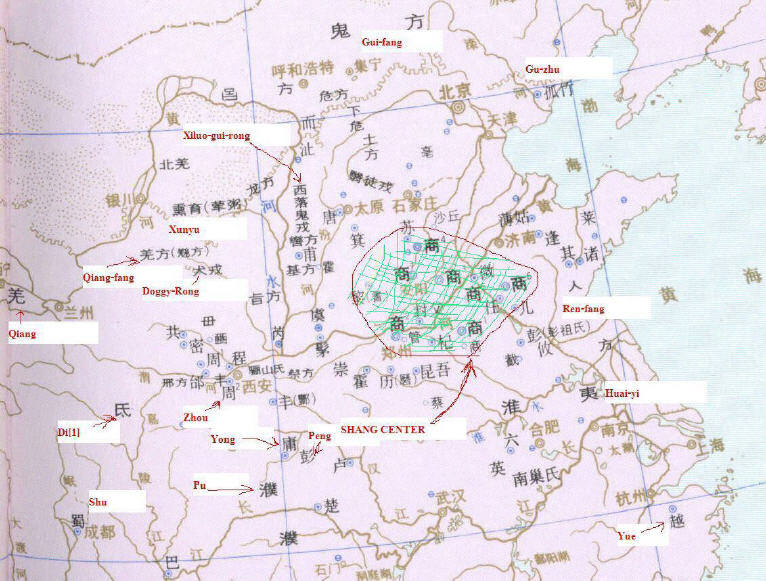
Later, the Xia Dynasty remnants survived as the Qi-guo statelet, located in today's Qi-xian county of Henan Province. The Qi-guo lineage continued onward through the Shang and Zhou dynasties. An ancient proverb about a Qi-guo person worrying about the fall of skies would be related to this country. Another Xia remnant statelet, per Wei Juxian, would be by the name of the Chonghouhu statelet [i.e., Marquis Hu of the Chong-guo Statelet] which was conquered by first Zhou King Wuwang in taking advantage of Chonghouhu people's following last Shang Lord Zhouwang's Shandong Peninsula campaign against the Ren-fang-guo statelet to the east. Zuo Zhuan contained a sentence to the effect that King Zhouwang conquered the Eastern Yi people but lost the kingdom to the Zhou people of the west. [Scholar Wei Juxian claimed that Chonghouhu must have derived from Chong-bo, i.e., the tribe of Lord Yu's father; however, this extrapolation via soundex could be wrong.
The war against Chong-guo, per Huang Yi [magnificent] of Shi-jing, employed the high ladders, the bumping chariots, and the moving towers, resulting in Zhou's victory after taking innumerable prisoners and killing/peeling of the enemy's ears via the 'guo' practice [i.e., taking no live prisoners, killing the enemy troops and cutting off the left ears --an ancient character written with the head part {not the ear part in this case} and pronounced as guo or huo or xu.]
* In Commemoration of China's Fall under the Alien Conquests in A.D. 1279,
A.D. 1644 & A.D. 1949 *
U.S.S.R./Comintern Alliance with the KMT & CCP (1923-1927)
Korean/Chinese Communists & the 1931 Japanese Invasion of Manchuria
American Involvement in China: Soviet Operation Snow, IPR Conspiracy, Dixie Mission, Stilwell
Incident, O.S.S. Scheme, Coalition Government Crap, Amerasia Case & The China White Paper
* Stay tuned for "Republican China 1911-1955: A Complete Untold History" *
|
|
Zou Rong's Revolutionary Army;
Shin Kyu Sik's
Shrine (Spirit, Kunitama) of Korea
|
This snippet is for sons and daughters of China:
Heed the sons & ministers' agony and sorrow of our ancestors who died or lived through the Mongol, Manchu and Soviet-Chicom conquest
and
the Yongjia, Jingkang and Jiashen cataclysms !
Jeanne d'Arc of China:
Teenager girl Xun Guan breaking out of the Wancheng city to borrow the relief troops in the late Western Jinn dynasty;
Liu-Shao-shi riding into the barbarian army to rescue her husband in the late Western Jinn dynasty;
teenager girl Shen Yunying breaking into Zhang Xianzhong's rebels on the horseback to avenge on father's death in the late Ming dynasty.
China's Solitary and Lone Heroes:
Nan Jiyun breaking out of the Suiyang siege and charging back into the city in the Tang dynasty;
Zhang Gui & Zhang Shun Brothers breaking through the Mongol siege of Xiangyang in the Southern Soong dynasty;
Liu Tiejun breaking through three communist field armies' siege of Kaifeng in the Republican China time period;
Zhang Jian's lone confrontation against the communist army during the June 3rd & 4th Massacre of 1989.
|
|
|
Still more Xia remnants survived as the Yu-guo, Ji-guo and Tang-guo statelets that survived in today's Shenxi/Shanxi provinces till the Zhou Dynasty time period. In the original Sinitic homeland of southern Shanxi Province, there was enduring legends of Uncle Tang, with the Tang statelet at one time collaborating with the Shang dynasty remnants against the new Zhou rule. In the early Zhou dynastic time, Tang-guo was eliminated, with the people being forced to relocate to southwest of today's Shenxi and the land yielded to a Zhou prince as the Jinn principality. Some descendants of 'Tang-shu' or uncle Tang could have gone to live among the barbarians, resulting in this group of people being part of the latter Ji-surnamed Chi-di barbarian group.
Also, Zhou King Youwang died in the hands of an allied barbarian invasion, with the element of a Zeng-guo state, i.e., descendants of Lord Yu of the former Xia dynasty. More, Zhou King Youwang took in Bao-si, a woman from the 'Si' family of the Xia heritage, who was adopted by a civilian couple of the Bao-guo fief.
In Zuo Zhuan's Lu Lord Xigong 15th year, a statement was made to the effect that the Xu state, which was commonly taken to be Xu-yi or the eastern Xu barbarian state [that produced numerous rebel kings against the Zhou rule], was what the ancient 'zhu-xia' [various Xia] was, meaning that the Xu had descended from the ancient Xia Dynasty states.
More Xia people remnants could have fled to the northwestern border area.
There was some unfounded claim that the Sanxingdui Bronze Excavation in today's Sichan basin could have been the works of the Xia dynasty refugees.
Zeng Guangdong, at regenerating-universe.org/Chain_of_DNA.htm, expounded his family's 5000 years old unbroken chain of DNA. Zeng stated that "the name of our clan, Zeng, may be traced to the time when Emperor [overlord] Shao Kang of Xia Dynasty created his second son Prince Qu Lie [as] the ruler of the State of Zeng ... about 1850 B.C.E. ... In the 6th year of Duke Siang [lord or Marquis Siang: common mistake in attributing clan title of gong to duke instead of grandpa] of the State of Lu, ... 567 BC... the Zeng State was plundered and destroyed by the State of Ju. The Prince of Zeng named Wu fled to the State of Lu and remained there in the service of Lu. He dropped the [ear] part (which denotes the domain) from our surname Zeng. This was the beginning of our surname becoming Zeng without the domain in the script, and it remains ever since. Four generations from Wu came Xi alias Dian ... and the 5th was the "Sage of Source", namely Zengcius or Zeng San [Zeng-zi; Zeng Shen]. Both father and son were students of Confucius, thus our family shines ever since ... " Zeng validated his clan history via excavation in 1978 of a tomb belonging to the Marquis Zeng-Yi-hou "who was buried in 433 B.C.E. at the old site of the State of Zeng in Hu Bei [Hebei] Province."
The lineage of history is cited repeatedly in China's 24 Histories.
Shang Dynasty itself was made into the principality of Soong by the succeeding Zhou Dynasty
(1121 - 256 BC;
1106-771 B.C. per Zhang Wenyu; 1044-256 B.C. per Cao Dingyun; 1122-256 B.C. per Liu Xin; 1116-256 B.C. per Huangfu Mi; 1111-256 B.C. per Seng Yixing; 1050 - 256 per the forgery contemporary version [Jin Ben] of The Bamboo Annals) . Confucius at one time returned to his ancestral Soong Statelet and spent considerable time studying the Shang "Li" [ritual or formality or system], which continued on in Soong long after Shang's demise.
(Some scholar, like Wei Chu-hsien and Wang Guowei, pointed to the existence of Soong before the Shang times and claimed that Soong or Shang, pronounced in a similar tone, could have meant for the same people.)
|
|
|
|
|
|
|
Sovereigns & Thearchs;
Xia-Shang-Zhou dynasties;
Zhou dynasty's vassallage lords;
Lu Principality lords;
Han dynasty's reign years
(Sexagenary year conversion table-2698B.C.-A.D.2018; 247B.C.-A.D.85)
|
|
The Sinitic Civilization - Book I is
available now at
iUniverse,
Barnes & Noble,
Amazon,
Google Play|Books
and
Nook.
The Sinitic Civilization - Book II is
available at
iUniverse,
Amazon
and Barnes & Noble.
Check out the 2nd edition preface that had an overview of the epact adjustment of the quarter remainder calendars of the Qin and Han dynasties, and the 3rd edition introduction that had an overview of Sinitic China's divinatory history of 8000 years.
The 2nd edition, which realigned the Han dynasty's reign years strictly observing the Zhuanxu-li calendar of October of a prior lunar year to September of the following lunar year, also cleared this webmaster's blind spot on the authenticity of the Qinghua University's Xi Nian bamboo slips as far as Zhou King Xiewang's 21 years of co-existence with Zhou King Pingwang was concerned, a handicap due to sticking to Wang Guowei's Gu Ben Bamboo Annals and ignoring the records in Kong Yingda's Zheng Yi.
Stayed tuned for Book III that is to cover the years of A.D. 86-1279, i.e., the Mongol conquest of China, that caused a loss of 80% of China's population and broke the Sinitic nation's spine.
Preview of annalistic histories of the Sui and Tang dynasties, the
Five Dynasties, and the two Soong dynasties
could be seen in
From the Khitans to the Jurchens & Mongols: A History of Barbarians in Triangle Wars and Quartet Conflicts
(The Barbarians' Tetralogy - Book III: available at iUniverse;
Google;
Amazon;
B&N).
(A final update of the civilization series, that is scheduled for October 2022, would put back the table of the Lu Principality ruling lords' reign years, that was inadvertently dropped from Book I during the 2nd update.)
|
|
T.O.C.-Book-I
Jupiter and the Iplanet Time Reckoning xv
Twenty-eight Lunar Lodges xvi
Table of Twenty-eight Lunar Lodges and Their Degrees based on the
Distance of Respective Determinative Stars xvii
Section Three: The Xia Dynasty
Chapter X: The Xia Dynasty - Start of the Three
Dynasties 165
The Xia Land - the Central State ('Zhong-guo')
168
The Xia Dynasty Founder-kings 172
The Xia Dynasty's Domain 177
Chapter XI: The Xia Dynasty's Chronological
History 179
Debunking Excessive Forgeries on Xia King Qi3 in The Bamboo
Annals with Poem Asking Heaven
181
Usurpation of the Xia Throne by You-qiong-shi and
Han-zhuo 183
Legendary Figures Xi-he2, & the Pierced Authenticity of Yin4
Zheng of Shang-shu 187
The Xia Dynasty's Summary Years Having Source in Han Dynasty's
Forgery Books 202
Jie - the Last Xia King 205
Chapter XII: The Xia Dynasty's
Demise 215
Alternative Stories in Regards to Xia King Jie's Final
Demise --Debunking Sophistry Books & Auctioned Qinghua
University Bamboo Slips 218
Chronology
Chronology of the Three Dynasties (Xia, Shang and
Zhou) 587
A Timeline of Chinese Dynasties with Corroborated Reign Years
& Eras 591
References on the Calendars & the Calendar Terms:
Reference on the Calendar Terms 594
The Conversion Table for the Qin Empire's Zhuanxu-li
Calendar 596
The Conversion Table for the Virtual Yin-li (Shang
Dynasty) Calendar 598
|
|
The Xia Dynasty
The Xia Dynasty (21-16th c. BC; ? 2207 B.C.E. - 1766 B.C. per Lu Jinggui's obfuscatory chronicling; 1978-1559 from Qi to Jie per raw data from the forgery contemporary version [Jin Ben] of The Bamboo Annals; 1991-1559 B.C.E. per Zhu Yongtang's adjustment of the forgery contemporary version [Jin Ben] of The Bamboo Annals) has been called the first dynasty. It was established by Qi(3), the son of Lord Yu.
Lord Yu was the person famous for being the man who mastered the floods.
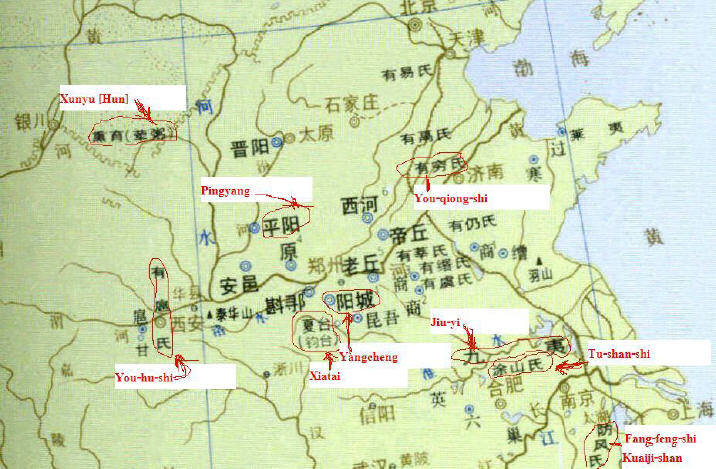
Qi3 was born by a Tu-shan-shi woman, but Yu the Great dared not enter his home to see his new-born son while he was under Lord Shun's order to quell the flooding. The Tu-shan-shi woman, in history, was repeatedly touted as the embodiment of the nine-tail fox, which the later Yue Principality also adopted as the founding mother in their legends. Tu-shan, per Ba Zhi of Hua Yang Guo Zhi, was located in the Jiang-zhou prefecture, which was today's Chongqing of Sichuan Province or the ancient Ba-guo state, a place very much disconnected from the Sinitic China in one sense [but could be wrongly postulated to be in today's Chuxian, Anhui Province]. Per Guo Yu, at the time the Xia reign prospered, 'rong', a word which was used for designating Zhu-rong [virtues shining line fire] but had the underlying two parts meaning a pottery and a snake, appeared on Mt. Chongshan, which was to say that some propitious dragon accompanied the rise of the Xia dynasty, with the Zhu-rong-shi people producing numerous guardian gods or counts in the ensuing years. (The mountain from which the title of Count Chong-shan derived might not be today's Mt. Songshan in Shenxi Province.)
(Caveat: Prof Zhu Yong Tang (John Y.D. Tse), using the astronomical data, completely re-aligned the Xia kings' reign years, with Xia King Qi3's years adjusted to 1991-1976 B.C. from 1978-1963 B.C., albeit doing the "useless work" in the terms of physics.)
The name 'Xia', alternatively speaking, was commonly taken to have origin from the title of Count Xia that Lord Yu received from Lord Yao as conferral of the land in Yangdi.
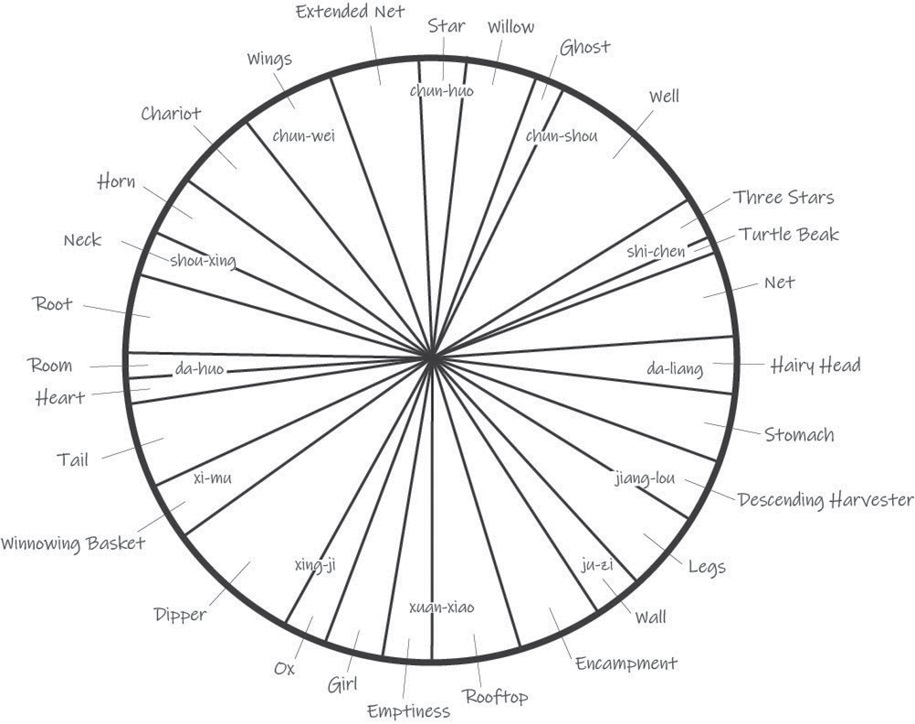
Though, the name should have existed before that, as seen in Daxia (the grand Xia land) where Gaoxin-shi (Di-ku) assigned the 4th son (Shi-chen) as a fief, who came to represent the star of 'shen-xing' {three stars of Alnitak, Alnilam and Mintaka}, known as white tiger in Chinese or the Orion in the west.
History also
repeatedly claimed that the land north of the Yellow River was the ancient Da-xia or Xia Major land
–with Da-xia being interpreted as the newfound Xia land in contrast with the original Xia Minor land.
Furthermore, at the beginning, prior to Lord Yu's conferral, there was the so-called Fuxia city that was built by Lord Shun, with the 'xia' suffix meaning a settlement in the opinion of this webmaster.
Yangdi or Yangcheng was commonly taken to be in today's Shanxi Province.
Compromising theory would be to point out that 'yang' also meant for 'tang' in the ancient times, and hence Yangcheng or Yangdi would be still located north of the Yellow River, somewhere in today's southern Shanxi Province, i.e., the land of 'da xia' or the Great Xia land, that Lord Yao obtained from Gaoxin-shi (Di-ku) but subsequently appropriated the place of Yangdi for the future Lord Yu as a fief enjoying the title of Count Xia.
There was a dispute about where Yangcheng or Yangdi could be, with one claim about the Xia people's origin in today's Henan Province, or further west, like the Sichuan basin as described by Shan Hai Jing.
Yangdi and Yangcheng, according to recent archaelogical findings, were aligned along the upper and middle Ying-shui River, initially staying in Yangcheng (about the place of Wangchenggang of Dengfeng) before relocating to Yangdi (Wadian, Yuzhou, Henan).
Following veteran archaeologist Xia Nai's directives,
An Quanhuai and Liang Fawei were responsible for excavating the ruins of Yangcheng (Wangchenggang) and Yangdi (Wadian), respectively.
In today's Dengfeng Municipality of Henan Province, to the centerfold south of both Luoyang and Zhengzhou and further to the south of Dengfeng, there would be a Yu-zhou city, with Lord Yu's name inscribed. Scholar Liu Qihan (Liu Qihua) pointed out that it was not Lord Yu but Lord Yu's son Qi who would make the Xia capital in Henan Province after crossing the Yellow River to defeat the same-Si-surnamed You-hu-shi people at the Battle of Gan (i.e., today's Zhenzhou of Henan Province).
Later people built a Gan-ting pavilion in this place.
The You-hu-shi people's land was called Hu[4]-xia in history, which was also the land of the Chong-guo state that the Zhou king had eliminated as part of the campaign against the Shang dynasty.
This, however, could be wrong as history pointed out that the You-hu-shi people were located near the ancient Xing-ze lake or today's Xingyang while Lord Qi's Xia people were located to the south of You-hu-shi, and that after the victory over the You-hu-shi people, Lord Qi, per Lu Lord Zhaogong's 4th year of Zuo Zhuan, called for an oblation assembly of vassals at Juntai, namely, the Jun-tian [i.e., central heaven] terrace, which was ascertained to be today's Yuxian County, Henan.
History, for thousands of years, talked about today's southern Shanxi as Daxia or the grand Xia land. With the Xia dynasty kings' activities mostly centered in today's Henan Province, Lord Yu or Count Xia's link to the Daxia or the grand Xia land was hence tenuous. Lord Yu's activities, alone, scattered across the Chinese continent, not merely today's southern Shanxi or northern Henan. The only evidence of Lord Yu's operation base being in today's southern Shanxi or the Great Xia land would be from the description of the shipment of the tributes in Yu Gong: The Yuan-rong barbarians, who carried the name of an ancient river called by Yuan-shui and were noted as the He-yi barbarians in Yu Gong, to the west of the legendary Mt. Panzhong-shan and the bird-rat-same-cave [i.e., bat cave] mountain, travelled along the Yuan-shui River {Xiqing ying Yuan(Huan) er lai}, then floated on the Qian-shui River {fu yu Qian}, then cross-hopped into the Mian-shui River {yu yu Mian}, then entered the Wei-shui River {ru yu Wei}, and finally sailed in the Yellow River {luan yu He} for the Xia Dynasty capital city which was apparently located north of the Yellow River line.
Though, Lord Yu's son, i.e., Qi, had operated in today's Henan Province, south of the Yellow River.
Qi himself, in the 11th year reign according to the forgery contemporary version [Jin Ben] of The Bamboo Annals, had exiled his unfilial son, called by 'Wu-guan' (i.e., the 5th son) in The Bamboo Annals and Yi Zhou Shu and cited by Mo Zi, to the Great Xia land of 'xi he'.
When Wu-guan rebelled in the 15th year reign, the king sent Count [Da-]Peng-bo (Shou-shi) to quelling the rebellion.
Wu-guan was said to have rebelled in the 'xi-he' area, i.e., west of the ancient West Yellow River Bend (i.e., east of today's Eastern Yellow Bend and in the Zhang-he River area).
The king's crackdown on the son or sons' rebellion was a riddle, something that could determine which books were forgeries, and which were not.
The Chang Mai chapter of Yi Zhou Shu mentioned
the rebellion of five sons while
the forgery contemporary version [Jin Ben] of The Bamboo Annals talked about the fifth son.
The interpretation of Qu Yuan's poem Tian Wen could determine which books were forgeries, and which were not, as well.
The "great western wilderness" section of Shan Hai Jing, in the area south of the Red River and west of the Kumtag Desert, there was Xia King Kai (i.e., Qi3, which was the writer's avoiding the taboo of offending Han Emperor Jingdi's name of Liu Qi[3]), with two snakes wrapped around the head and two dragons flying him on the back, who rose to the heaven three times to be a guest and brought 'jiu-bian' (nine elegies) and 'jiu-ge' (nine songs) down to earth.
Guo Pu of the Jinn dynasty corrected the Han dynasty historians' interpretation of the sentence about Xia King Qi3 in Qu Yuan's poem Tian Wen, stating that the word 'bin' meant that the Xia king surrendered the beauties ('pin2', i.e., the same 'bin' radical word with a female part signific) to the high lord.
This was a rare hermeneutic error on the part of Guo Pu since he already applied the same 'bin' word to Shang ancestor-king Wang-hai's touring the You-yi-shi land as a guest.
Hao Yixing of the Qing dynasty correctly interpreted the poem to state that King Qi3 repeatedly rose to the sky to be a guest and was awarded the heaven's songs, which then turned into Qu Yuan's counter-theme in the latter part of stanza in the quatrain, namely, questioning why the king caused the sons to agitate around (i.e., the rebellion of five sons and the crackdown by Count Peng-shou in the Chang Mai chapter of Yi Zhou Shu) and his mother to have the caesarean birth, and why after the king's death, the Xia kingdom disintegrated.
In the Li Sao poem, Qu Yuan reiterated the theme about the five sons' losing the kingdom and homeland for successor-king [Tai]Kang's indulgence in recreation.
Qi's successors did not seem to have returned to the Daxia or the grand Xia land as the political center.
Xia King Taikang's brothers, per Shi-ji and Li Sao, were recorded to have made five songs, i.e., Luo-rui Wu-zi Ge, a forgery chapter in Shang-shu, along the bank of the Luo River.
This meant that at one time, the Xia capital, after the founding lord Qi, was next to the Luo River. There could be different capital sites in Xia's history, but the ultimate Xia capital city for last Xia King Jie could be north of the Yellow River, i.e., Xia King Jie's official capital city Zhenxun --before the king crossed the river to the south to be possibly with the Kunwu-shi people[, with this city of Zhenxun located on the southern bank of the Yellow River when taking into consideration the changing Yellow River rivercourse in history]. Zhenxun (Zhen-xun), a place where Xia King Xiang established his capital city while in competition with the Hou-yi and Han-zhuo clique that usurped the Xia throne at one time, could be the same as Diqiu (i.e., the lord's hill or mausoleum), i.e., Overlord Zhuanxu's Ruins, which was an ascertained fact from the dialogue between Wey Lord Chenggong and minister Ning-wu-zi in Lu Lord Xigong's 31st year of Zuo Zhuan, which was about the Wey lord's dreaming about his ancestor's complaint that the Xia king had robbed his sacrificial food after the relocation of the Wey capital city to Diqiu, i.e., today's Puyang, Henan. The Xia kings, like the Shang kings, apparently moved around the country multiple times, with most of the activities taking place south of the Yellow River. The final demise of King Jie of the Xia dynasty happened north of the Yellow River. The Bamboo Annals delineated a situation that the Shang people came from the north side of the Xia people, conquered numerous statelets around the Xia center, including the area to the southwest of the Yellow River inflexion, and finally defeated the Xia king along the northern bank of the Yellow River.
Tian Changwu, the editor of "The Hua Xia Civilization" anthology, compromised the issue of Lord Yu's point of origin by stating that the Xia people might have two tribes, with i) father Gun developing in southern Shanxi Province where they were previously subordinate to Lord Yao and ii) son Lord Yu developing in western Henan Province by means of an alliance with Lord Zhuanxu's tribe.
Lord Yu, per Tian Changwu, adopted 'xuan yu' (snake-headed fish, i.e., black fish) as the totem and developed in today's Dengfeng-Yuxian areas of western Henan Province while his father Gun continued with the dragon [more likely snake] totem.
Tian Changwu further stated that Lord Yu's tribe would later absorb his father's native Xia people in today's southern Shanxi Province.
Tian Changwu could be wrong here, depending on where the 'Chong' [i.e., equivalent 'Song' character which meant extremely high] Mountain, from which Gun derived the conferred title of Count Chong-bo, was: today's Mt. Songshan south of the Yellow River or Mt. Huo[tai]shan north of the Yellow River.
(The character 'Gun' was a combination of two words: black and fish.
Senior scholar Wei Chu-Hsien pointed out that the ancient Gun legends in "Shan Hai Jing" implied a possible migration of Gun's people to the American continent since Gun's body, after his execution [or exile] death on feather mountain, turned into 'huang xiong' [the American Brown Bear] in the waters.
More about Wei Chu-Hsien's research into the ancient Chinese linkage to America is temporarily uploaded to ming.htm page
Per Lu Lord Zhaogong's 7th year records of Zuo Zhuan, the feather mountain and the feather pond where Gun's spirits mutated into a brown bear would be actually the 'Xia jiao' or the Xia capital city's outskirts where the oblation temple was, some pilgrimage that the lords of the three dynasties visited in reverence.)
Per "Shi Ji", Lord Yu, after mourning Lord Shun for three years, said goodbye to Lord Shun's son (Shangjun) and left Yangcheng for Pingyang. Vassals deserted Shangjun for Lord Yu. Lord Yu hence proclaimed the state of 'Xia-hou' and adopted the last name of 'Si4'. (Alternative surname and clan name records stated that it was Lord Yao who had confirmed the surnames onto his ministers including Yu [Xia's ancestor], Shang-ancestor-Qi4, and Hou-ji [Zhou's ancestor] et al. Note that the Xia kings were named by 'hou', as seen in Lu Lord Xigong's 32nd year of Zuo Zhuan, on which occasion there was a reference to the tomb of Xia-hou-gao [Xia king Gao, namely, the grandfather of last Xia King Jie] on the southern hill of Mt. Xiaoshan.)
Ten years later, Lord Yu died in Kuaiji (Shaoxing, Zhejiang Province), near the mouth of the Yangtze Delta. Yi(4), a successor designated by Lord Yu, was given the job as an overlord. After three years of mourning, Yi(4) gave the post to Qi(3), the son of Lord Yu. Yi4 left for south of the Songshan (often inter-exchangeable to the Chong character) Mountain of Henan Province. [Note that the ancient classics, i.e., The Bamboo Annals, claimed that Qi(3) killed Yi(4).] When the Dong-yi tribes disobeyed Qi(3), Qi sent the armies to defeat the You-hu-shi clan at Gan (Zhenzhou of Henan Province, but do note that the ancient Gan-shui was closer to Luoyang of Henan Province, i.e., the heartland of Sinitic China) and hence solidified the Xia Dynasty rule.
Luo Xianglin claimed that the Xia people had asserted control over the rest of people via two inventions: copper and citadel. The ancient classics accredited Gun with the idea of building the walled cities and forts.
Luo Xianglin cited the ancient books "Lü Shi Chun Qiu", "Tai Ping Yu Lan", "Huai Nan Zi" & "Wu Yue Chun Qiu" in stating that Gun, i.e., Lord Yu's father, first built a castle with a wall as high as nine 'ren' [1 'ren' being equivalent to 7 or 8 Chinese feet].
Gun, like an engineering minister, was empowered with repairing the Yellow River during the 61st year of Lord Yao per the forgery contemporary version [Jin Ben] of The Bamboo Annals.
Luo Xianglin cited the ancient book "Yue [Yue principality] Jue [splendid] Shu [book]" [more likely meaning "Yue [Yue principality] Jue [extinct records] Shu [book]" per Wei Chu-hsien] in stating that in the ancient times, Xuanyuan-shi, Shennong-shi & Hexu-shi utilized stone as weapon; Lord Huangdi utilized Jade as weapon; and in the Xia times, Lord Yu utilized copper as weapon, hence piercing the Longmen [dragon gate] Gorge of the Yellow River. ("Yue Jue Shu" distinction between Xuan-yuan-shi and Lord Huangdi also verified a possibility that Xuan-yuan-shi and Lord Huangdi were not the same person.)
Hua/Xia's Origin & Developments
As scholar Liu Qihan (Liu Qihua) pointed out, 'hua' and 'xia', pronounced the same way as [hwer] in the Yangtze Delta dialects, would mean for the group of people dwelling to the north of the ancient South Yellow River Bend and to the east of the ancient West Yellow River Bend (i.e., today's Eastern Yellow Bend).
(Beware of morphology extrapolation of what this webmaster cited here as to the pronunciation of 'hua' and 'xia', i.e., common errors among non-Chinese enthusiast for Chinese history, with one such fallacy of equating 'hua' [slippery] to 'hua' [flowery] seen at
http://encyclopedia.lockergnome.com/s/b/Huaguo.
The Chinese character 'hua', similarly, was abused by non-Chinese enthusiast for Chinese history.
Should Southern Liang Dynasty [AD 502-557], in inscriptions on Liang chih-kung-t'u, fail to speculate more on the "Hua-guo" [Avar or Hephthalites] other than a claim that it was possibly a country founded by the descendants of a Western Territory chieftain called "San-hua" [three slippery] who followed General Ban Yong of Han Dynasty in campaigns, then who are you to claim that this 'Hua' [slippery] was the same as China's Hua [flowery] or Zhou Dynasty's vassal "hua-guo"? )
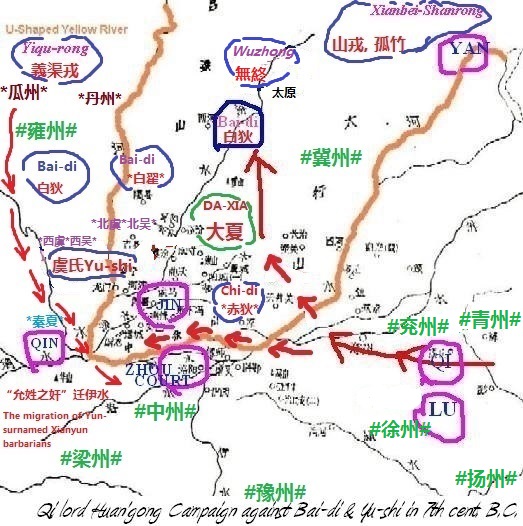
The ancient West Yellow River Bend is the same as today's East Yellow River Bend. The ancient Yellow River Bend did not equate to today's inverse U-shaped course with the North Bend lying inside the Inner Mongolia Autonomous Region, but the U-shaped Bend with the South Bend in today's southern Shanxi Province and then a south-to-north turn in Hebei Province for exit into the sea.
Liu Qihan (Liu Qihua)'s 1982 dissertation, on basis of "Gan Shi" (i.e., Oath of War at Gan) in "Shang Shu" (i.e., Remotely Ancient Histories), proposed the opposite movement of the Xia people, i.e., that the Xia people, the direct descendants of Huangdi (the Yellow Overlord) with the dragon totem, originally dwelled in southern Shanxi Province and then expanded eastward and southward, across the South Bend, into today's Henan Province: the Xia people, under Qi (Lord Yu's son), defeated the You-hu-shi people at the Battle of Gan, built cities and capital in today's Henan Province, endured power struggle with the people led by Hou-yi and another apparently Yi-nature people led by Han-zhuo (Han-zu), and stayed on in today's Henan Province for hundreds of years till Shang-tang overthrew the Xia rule.
Liu Qihan (Liu Qihua) stated, on basis of the craftsmanship on the excavated potteries, that the Xia people's development could be embodied by three stages of evolution, i.e., Taosi (2400-1800 B.C.) of southwestern Shanxi Province, Dongxiafeng (2200-1700 B.C.) of southeastern Shanxi Province, and Erlitou Culture (1900-1500 B.C.) in Yanshi of Henan Province. Liu Qihan (Liu Qihua) also noted that copper utensils were both discovered in Dongxiafeng and Yanshi Erlitou, stating that Erlitou Culture, dated the 3rd phase of Erlitou (Yanshi, Henan Province), must have been under Xia people who in turn had received inputs from early cultures in Shanxi-Henan provinces.
Liu Qihan (Liu Qihua) further pointed out that by the 4th phase, the Yanshi excavation pointed to the dilapidation of Xia palaces in this area as a result of attacks by the Shang people. Liu Qihan (Liu Qihua) always upheld the theory that Qi, Lord Yu's son, had his capital established at Xunyi, i.e., today's Yanshi of Henan Province and the seat of Erlitou Culture.
(According to recent archaelogical findings, Erlitou's bronze materials came from multiple sources, including the copper mine in today's Daye of Hubei in the Yangtze area and mount Zhongtiaoshan on the northern Yellow River bank, where the Great Xia land or newfound-Xia-land was.)
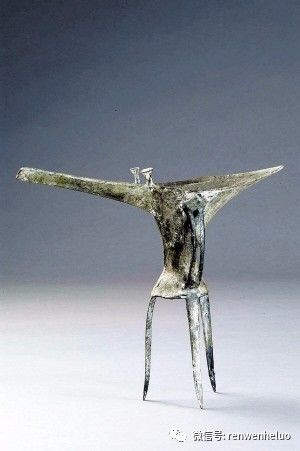 At the Yanshi-Erlitou site, there was excavated in 1975 some bronzeware artifacts including a three-leg 'jue' drinking cup with the nipple-like nails' pattern (Ru-ding-wen Qing-tong Jue), which was a ritual and sacrificial vessel.
Liu Qihan (Liu Qihua), to rebut the viewpoint that phases III & IV of the Erlitou excavation might belong to the early Shang people, stated that it was the opposite way around, that is, the Xia people of III & IV phases of Erlitou influenced the Erligang 'shengwen' (i.e., jormon) potteries in today's Zhengzhou of Henan Province.
(See Stunning capital [Erlitou] of Xia Dynasty unearthed for details on the ongoing excavation since 1959.)
At the Yanshi-Erlitou site, there was excavated in 1975 some bronzeware artifacts including a three-leg 'jue' drinking cup with the nipple-like nails' pattern (Ru-ding-wen Qing-tong Jue), which was a ritual and sacrificial vessel.
Liu Qihan (Liu Qihua), to rebut the viewpoint that phases III & IV of the Erlitou excavation might belong to the early Shang people, stated that it was the opposite way around, that is, the Xia people of III & IV phases of Erlitou influenced the Erligang 'shengwen' (i.e., jormon) potteries in today's Zhengzhou of Henan Province.
(See Stunning capital [Erlitou] of Xia Dynasty unearthed for details on the ongoing excavation since 1959.)
What went into oblivion in China’s history was the Shimao Culture (about 2300-1800 B.C.) that
predated the literature-corroborated Da-Xia (great Xia) Sinitic civilization by just a few hundreds of
years in history.
Shimao, bing classified under the development stage of
the Longshan Culture, possessed a city with the outer walls and inner walls that spanned the range
of 2000 and 2840 meters long. Unfortunately, very little was known about the Shimao people other
than
the 'fei-zu li' (three-fat-legs) cookers, a type of pottery also seen in the Laohushan
(tiger mountain) Culture, that was in turn
a mixed type of the Yangshao and Miaozigou cultures, with the latter ascribed to the N-haplotype
people, i.e., the Finno-Ugric people who once populated the entire belt of today’s Inner Mongolia.
While both Shimao and Taosi matched with Shao Yong’s divinatory Xia dynasty chronicling in Huang Ji Shi Jing (Qi 2187 B.C. to Jie or Di-Lügui 1766 B.C.), it conflicted with archaeological periodization for the Xia (Erlitou: Dongxiafeng 2200-1700 B.C./Yanshi 1900-1500 B.C.) and Shang (Erligang: 1510-1460 B.C.) ruins. The Xia dynasty was known in literature to have ended in the You-Xia-zhi-ju land south of the Yellow River, i.e., about the areas of Erlitou and Erligang, with the Reign Year Periodization Project's unsubstantiated archaeological years 2070- 1600 B.C. being similarly aligned as the forgery bamboo annals' years of 1978-1557 B.C. The only way to reconcile the numbers would be to realistically shorten the 16 Xia kings' summary years to about 300 years or less to make the case that Xia had left both Shimao and Taosi for the You-Xia-zhi-ju land at about 1800 B.C. under purportedly threats from the northern people who could be "uncooked" Laohushan-type people, the "uncooked" paleo-Northwestern people, or the Q1a1-M120 haplotype people from the west - that was purportedly seen in the Lijiaya Culture, a culture similar to Zhukaigou (Zhaimao, with a snake-grain pattern pottery of Northwestern China) of the paleo-North-China type (who were speculated to have later driven by the Shang people to southern Siberia to be ancestors of the Huns, bringing with them the Sinitic round bottom jar potteries, the three-leg potteries, the battle hatchets, the bronze arrows, the white jade circular wrist wear, and the spears, etc., features of the Karasuk Culture, 1400-800 B.C.) but containing the paleo-Central-Plains type skulls (i.e., non-Q1a1-M120 people).
The Zhou people were archaeologically speculated to have origin from today's Shanxi for the link to the Guangshe Culture –- which was in turn a derivative of the Youyao-type (You'ao-type per Haan Jianye) Laohushan Culture, i.e., the mixed group of the N-haplogroup Finno-Ugric people and the paleo-North branch of the O-haplogroup Sino-Tibetans.
This webmaster is found to possess about 15% ancient Eurasian hunters' gene, specifically, N1a (N-M96 (N-CTS7095, N-P189)), a branch of the Finno-Ugric people.
Chronology of Archaeological Discoveries (see prehistory.htm):
                                       ---------------------------------------------------------
                                          Yangshao Culture (4000-3000 B.C.)
                                       ---------------------------------------------------------

                     Banpo Type Type --> Dongzhuangcun Type --> Miaodigou Type --...--> Xiwangcun Type

       --------------------------------------------------------             --------------------------------------------------------------
        Miaodigou Culture II (3000-2500 B.C.)                 Longshan Culture Taosi Type (2500-1900 B.C.)
       --------------------------------------------------------             -------------------------------------------------------------

           Early Stage --> Middle Stage --> Late Stage                          Early Stage --> Middle Stage --> Late Stage

                                                                                           Taosi (2400-1800 B.C.)                     Dongxiafeng Type (2200-1700 B.C.)

                                       ---------------------------------------------------------
                                                         Erlitou Culture
                                       ---------------------------------------------------------

                    Dongxiafeng Type Of Erlitou Culture (2200-1700 B.C.)         Yanshi Type of Erlitou Culture (1900-1500 B.C.)
There is no dispute as to the Xia people's final demise in today's Henan Province. Liu Qihan (Liu Qihua) validated the demise of Xia Dynasty in Henan Province by citing the ancient statement that the "Xia Dynasty ended when the Yi-shui and Luo-shui rivers ran dry", a statement carried in The Bamboo Annals.
Though, the last Xia lord Jie set his capital in the original land of 'zhong guo' or the central statelet, namely, the Da-xia or the grand Xia land in today's southern Shanxi Province, south of the Fen-he River, to be exact. The Bamboo Annals, which was ignored by the Confucians since its excavation in Jinn Dynasty, had the complete story as to the Shang army's battling the Xia army at Mingtiao or today's Mt. Zhongtiaoshan, north of the Yellow River.
After Shang Dynasty overthrew Xia, the remnant Xia people were said to have fled northward and westward, and majority of them returned to their ancestral home in southern Shanxi Province. (Wang Guowei speculated that some of those Xia people who fled northward and westward would become the Yuezhi (?) in the west and the Huns in the north. Note that Wang Guowei's speculation as to Yuezhi would throw the discussion into an ethnicity and race dispute unless the Yuezhi people were indeed related to the Sinitic people as this webmaster had expounded in the sections on the Huns. It is understandable that Wang Guowei might have blundered in the early 20th century since the Loulan mummies were not known at that time. This webmaster had expounded the You-yu-shi vs Yuezhi fallacy at the hun.htm section and pointed out that the You-yu-shi clan had continued on in today's Shenxi area till at least the time when Qi Lord Huan'gong launched westward campaign against the Bai-di barbarians in 651 BC.
Or, more correctly speaking, the words 'Xi Yu' or 'Xi Yu' as referred in Guan Zi, which was where Wang Guowei's extrapolated on, had nothing to do with the You-yu-shi people at all, but the remnants of the Yu-guo state or the Northern Wu state.
It appeared that the descendants of the original Sinitic Chinese were marginalized towards the north, where they could have mixed up the with the Di3 barbarians, while the Di barbarians, should we look at the geographical location, dwelled exactly in the original Xia people's domain.
Scholar Luo Xianglin's Assertion
Scholar Luo Xianglin, in "History of the Chinese Nationalities" (Chinese Culture Publishing Enterprise Co, Taipei, Taiwan, May 1953 edition), stated that ancient China possessed the five tribal groups of Xia, Qiang, Di[1], Yi, and Man[2], which has the same origin.
The same origin validation could be seen in Zheng Yu of Guo Yu, wherein Shi-bo, in a dialogue with Zheng Lord Huan'gong, expounded the distinction between the Sinitic principalities [related to the Zhou royals, the brothers of the Zhou royals' mothers, and the nephews and uncles on the mothers' side] from those related to the Maan, Jing, Rong and Di barbarians, not counting the Yi barbarians who were taken to be beyond the eastern statelets of Qi, Lu, Cao, Soong, Teng, Xue, Zou, and Ju. For the barbarians, Shi-bo apparently made a case of identifying the Sinitic cliques ruling the barbarians from the barbarians themselves. Shi-bo, in the passage on the 'Jing' or Chu barbarians [who were counted among the southern 'Maan' group], explicitly listed the lineage of the 'Jing' or Chu ancestors, stating that Chu lord Xiong Yan had born four sons Bo-shuang, Zhong-xue, Shu-xiong and Ji-xun, with names bearing the Sinitic brotherly order, among whom the 3rd son fled to be a ruler among the southern 'Pu' [i.e., the later Hundred Pu] people and the 4th son took over the lordship in the spirits of ancient ancestors Chong-li -- also taken to be two brothers of Chong and Lih[2] -- with the Lih line tacking on the hereditary fire guardian [minister] post known as 'Zhu-rong' [i.e., virtues shining like fire]. Shi-bo's point was that in extrapolating on the achievements of descendants of Yu-mu [lord Shun's line], Xia-yu [lord Yu], Zhou-qi [Zhou ancestor Qi or Hou-ji], it was claimed that inevitably Zhu-rong's descendants, who had produced Count Kunwu[-shi] in the Xia dynasty and Count Da-peng and Count Shi-wei[2] in the Shang dynasty, should see the Mi-surnamed Chu people asserting themselves in the Zhou dynasty time period. Altogether, Shi-bo pointed to the Jiang-surnamed people [i.e., descendants of Bo-yi{-fu} who assisted overlord Yao as protocol minister], Ying-surnamed people [i.e., descendants of Bo-yi who assisted overlord Shun as interior minister], and Jing-Mi-surnamed Chu people as possible contestants for the Zhou dynasty's rule -- another Sinitic theme of power rotation.
Per Luo Xianglin, the Xia people first originated in Mt. Minshan and the upperstream River Min-jiang areas of today's Sichuan-Gansu provincial borderline. The Xia people then split into two groups, with one going north to reach the Wei-shui River and upperstream Han-shui River of Shenxi Province and then east to Shanxi Province by crossing the Yellow River.
(The second group, per Luo Xianglin, went south to populate the southern Chinese provinces as the 'Yue' people.
Luo Xianglin's linking the Yue people to the Xia people was based on the common lexicon 'yue' which meant for excavated ancient "stone axe".
Luo of course did not have the DNA knowledge that the Yue people along the coast were of the O2 haplogroup type while the Sinitic people were mostly of the O3 haplogroup.
The ruling Yue clique, similar to those of the Wu Principality as having derived Zhou King Wenwang's elder brother, could be of the Xia Sinitic Chinese.
The Yue Principality also adopted the nine-tail fox as the founding mother in their legends, similar to the story of Lord Yu marrying with a Tu-shan-shi woman who, in history books, was repeatedly touted as the embodiment of the nine-tail fox.)
* In Commemoration of China's Fall under the Alien Conquests in A.D. 1279,
A.D. 1644 & A.D. 1949 *
U.S.S.R./Comintern Alliance with the KMT & CCP (1923-1927)
Korean/Chinese Communists & the 1931 Japanese Invasion of Manchuria
American Involvement in China: Soviet Operation Snow, IPR Conspiracy, Dixie Mission, Stilwell
Incident, O.S.S. Scheme, Coalition Government Crap, Amerasia Case & The China White Paper
* Stay tuned for "Republican China 1911-1955: A Complete Untold History" *
|
|
Zou Rong's Revolutionary Army;
Shin Kyu Sik's
Shrine (Spirit, Kunitama) of Korea
|
This snippet is for sons and daughters of China:
Heed the sons & ministers' agony and sorrow of our ancestors who died or lived through the Mongol, Manchu and Soviet-Chicom conquest
and
the Yongjia, Jingkang and Jiashen cataclysms !
Jeanne d'Arc of China:
Teenager girl Xun Guan breaking out of the Wancheng city to borrow the relief troops in the late Western Jinn dynasty;
Liu-Shao-shi riding into the barbarian army to rescue her husband in the late Western Jinn dynasty;
teenager girl Shen Yunying breaking into Zhang Xianzhong's rebels on the horseback to avenge on father's death in the late Ming dynasty.
China's Solitary and Lone Heroes:
Nan Jiyun breaking out of the Suiyang siege and charging back into the city in the Tang dynasty;
Zhang Gui & Zhang Shun Brothers breaking through the Mongol siege of Xiangyang in the Southern Soong dynasty;
Liu Tiejun breaking through three communist field armies' siege of Kaifeng in the Republican China time period;
Zhang Jian's lone confrontation against the communist army during the June 3rd & 4th Massacre of 1989.
|
|
|
The Xia Land = Zhong Guo (the Central Statelet)
The 'Xia' people, in another sense, would also imply a more restrictive meaning for the people who dwelled in today's southern Shanxi Province, plus those in the land of Xi-rong (the Western Rong nomads) or Xi Yi (Western Aliens) or Xi Qiang (Western Qiang) to the west.
The San-tu place (Luhun, Songxian, Henan), Si-yue (mountains west of the Xie-yi fief or Nanyang, Henan), Yangcheng (Dengfeng, Henan), Dashi4 (Yangcheng, Henan), Jingshan (Yunyang, Hubei; or another Jingshan in Fuping, Shenxi), and Zhongnan (Wugong, Shenxi) were called the precarious spots of the nine prefectures per Lu Lord Zhaogong's 4th year of Zuo Zhuan or specifically the mountain area to the west of the Xie-yi fief (Nanyang, Henan) per Fu Sinian's analysis of the "Xie-xi zhi jiu-zhou" in Zheng Yu of Guo Yu. Gu Jiegang pinpointed today's southeastern Shenxi and western Henan as the land of the nine prefectures.
The original nine prefectures, i.e., the mountain area next to the Songshan mountain and the You-Xia-zhi-ju habitat, were the Xia people's original homeland, and the Great Xia land north of the Yellow River was the new-Xia land per Xu Zhongshu.
In another word, the Sinitic people, whose whereabouts were noted in the ancient classics Wu [five] Zang [viscera of mother Earth] Shan [mountain] Jing [records], originated from the Sichuan-Gansu borderline to the west, and migrated to the east, leaving the traces throughout the five mountain ranges. Note that Lord Yu was born in a place called 'Shiniu' (i.e., the ancient Chang-mang statelet, between Sichuan, Henan and Shenxi provinces).
Scholar Liu Qihan (Liu Qihua) tackled the issue of 'xi' or west. His validation pointed to the land of 'he qu' (i.e., the inflexion point of the Yellow River Bends) as the 'land of the west', i.e, later land between Qin and Jinn principalities. He also validated the ancient Chinese prefecture of 'ji-zhou' as equivalent to the ancient term 'zhong-guo' for China, and listed multiple ancient classics to lock down the land of original China as being the domain of southern Shanxi Province. (Liu Qihan (Liu Qihua) pointed out that original places for Taiyuan and Jinyang etc. would be in southern Shanxi Province, and that those cities did not get appropriated to northern Shanxi Province until after Jinn Lord Daogong quelled various 'Di2' barbarian statelets in the north. Liu Qihan (Liu Qihua) further stated that after the split of Jinn into Haan-Zhao-Wei principalities, southernmost Wei statelet still got the privilege to be called Jinn due to the fact that Jinn historically inherited the ancient Xia land that was termed 'ji-zhou' the Ji4 prefecture or 'zhong-guo' the central statelet.)
Ancient classics, like "Zhan Guo Ce", "Shuo Wen", "Han Shu", paraphrased 'Xia' as meaning the central statelet. "Zhuang Zi", in the section on "Tian Di Bian" (i.e., article on heaven and earth), mentioned a dialogue between Zhunmang and Yuanfeng in regards to Zhunmang's sailing into the East Sea and polarized 'zhongguo' (central statelet) and 'si hai' (four seas). Xu Hao, in comments on "Shuo Wen", stated that Yi & Di barbarians began to invade China at the times of Xia people and that then Chinese were hence named Xia-ren or Xia people. Liu Qihan (Liu Qihua) listed similar parallel antagonism of 'ji-zhou' and 'si hai' in "Chu Ci" (Chu Principality Poems) and "Huai Nan Zi" to validate the exact location of the land of 'Xia' as equivalent to ancient 'ji-zhou' prefecture, i.e., southern Shanxi Province. Similarly, Liu Qihan (Liu Qihua) cited similar parallel antagonism of 'zhongguo' (central statelet) versus 'si yi' (four groups of barbarians) in Zuo Zhuan for same sense interpretation.
(Note that Scholar Wang Zhonghan cited "Guan Zi" in stating that it would be around the middle of Warring States time period that Qi Principality editors adopted the terms of four barbarians as might have existed at the time of Guan-zi [Guan Zhong] of Spring & Autumn time period of Eastern Zhou Dynasty.)
Liu Qihan (Liu Qihua) pointed out that after the demise of Xia, whoever stayed in Shanxi/Shenxi provinces continued to call themselves 'Xia' people. First Zhou King Wenwang eulogized the eastward flowing of the Fen-shui River to Lord Yu's accomplishment, and numerous Zhou Dynasty records stated that they were descendants of Xia Dynasty founder Lord Yu. Wei Principality, who inherited the southernmost Jinn land of southern Shanxi Province, described themselves as "riding in the Xia-chariots" and claiming to be the "Xia King". A Qin Principality official also denoted himself as Xia-zi (i.e., a son of the Xia people) because his mother was a Qin-ren (i.e., the Qin people), i.e., the self-designated Xia people.
Now, we need to point out that the Xia character had changed in its meaning. At the very beginning, there was the so-called Fuxia city that was built by Lord Shun. This was earlier than Lord Yu's enjoying the conferral as Count Xia. In Lord Yu's Tributes, Yu Gong, we further have the land of Lei-xia turning into a lake. There, the character 'xia' apparently meant for the Xia settlements. With the establishment of Xia Dynasty, the Xia settlements multiplied in the central plains, forming into the "Zhu-xia" or various Xia entities. Per Shen Shanzeng, there were no real sense fiefdoms in either the Xia era or the Shang era. The country of China was a loose confederation of the "Zhu-xia" or various Xia entities and the non-Xia entities. Further, per Shen Shanzeng, the non-Xia entities, during the Xia timeframe, should be properly termed 'Yi-Di' and likely a designation for the emerging Shang power, with 'Yi2' meaning the non-Xia tribes/countries to the east and the 'Di2' element pointing to the north. This was how Shen Shanzeng interpreted the Confucius statement in regards to the demise of the Xia people's lords being worse than the lack of rulers among the barbarian 'Yi-Di' people. And, per Shen Shanzeng, the 'Xia' definition was restricted in the Zhou dynasty time period, with the Zhou court terming the Ji-surnamed statelets by "Zhu-hua" while the non-Ji-surnamed vassals termed "Zhu-xia". This was seen in a statement from Lu Lord Xianggong 4th year, to the effect that Jinn Lord Daogong, a marquis, was dissuaded by minister Wei Jiang (Wei Zhuang-zi) from attacking Baron Jiafu (Zi-jiafu) of the Wuzhong statelet with a claim that the Jinn state would lose the Zhu-hua statelets to the Chu Principality to the south while attacking the barbarian statelet to the north. In the authentic section Xiao-kuang of Guan Zi, there was a statement to the effect that Qi Lord Huan'gong had built the south-to-north [Cai-Yanling-Peixia-Lingfuqiu], and west-to-east [Wulu-Zhongmou-Ye-Gaiyu-Muqiu] defense lines to guard the Zhu-xia statelets against the Rong-di barbarians (Rong to the west and Di2 to the north) and the non-Sinitic Chu statelet to the south. The 'Zhu-xia' characters, other than Guan Zi and Zuo Zhuan, were also seen in Guo Yu, Lü-shi Chun-qiu, Xun Zi, while the Hua-Xia characters were seen in Shang-shu and Zuo Zhuan.
The Xia Dynasty's Totem - Dragon
Scholar Gao Wei pointed out that the colored potteries from the Taosi Excavation of the Longshan Culture, dated 2400-2500 B.C.E. approx, had shown a winding dragon (i.e., two golden-ring Bungarus snakes, with one snake containing the medicinal herbs for the treatment of a wounded snake, i.e., the grass knot which was wrongly taken as the Shucha-shaped tongue per Wei Wencheng who cited Yi Yuan [alien garden], Shennong Bencao Jing, and Bao Pu Zi etc. for substantiation).
The male snake's head was in the outer ring, the body inward rolling, the tail at the bottom of the plate, while
the female snake had the tail intersecting with the male one in the center of the plate's bottom.
Almost all luxurious Taosi excavation in southern Shanxi Province had produced at least one piece of pottery with the dragon [or snake] totem.
In Wei Wencheng's opinions, the ancient Chinese eulogized the snakes' intertwining pattern as a form of the marriage celebration, or a form of perpetuity of marriage with husband and wife buried together.
 This would point to this place of excavation (i.e., southern Shanxi Province) as the original site of the early Xia people, i.e., Da Xia.
The Xia Culture, having interaction with the bird-totem [misnomer] Dong-yi people to the southeast, had posed an academic challenge as to the nature of the ancient Chinese ethnicity. Consensus would be to treat the Longshan Culture in today's Shanxi and western Henan as equivalent to the Xia Dynasty timeframe or at least 'xian xia' [i.e., the Anterior Xia Dynasty]. The Xia people, who later moved from today's Shanxi to Henan Province and founded the dynasty of Xia, certainly brought with them the important dragon totem, a mark that would also be observed among the Huns of Mongolia and the Tungus of Manchuria for the thousands of years to come.
Chinese classics had mentioned two dragon-related clans, i.e., the Huan-long-shi clan during Lord Shun's reign and the Yu-long-shi clan during Xia Dynasty. Here, 'huan' meant for raising or husbandry, 'yu4' meant for driving or controlling, while 'long' meant for dragon.
Both clans appeared to have the hereditary skillsets at mastering the dragons (i.e., crocodiles).
Per Zuo Zhuan, Liu-lei, a descendant of Tao-tang-shi, learnt the skills of dragon taming from Huan-long-shi, and then received the appointment from Xia King Kong-jia to become the Yu-long-shi ancestors.
According to Fan-xuan-zi of the Jinn Principality of the Zhou Dynasty time period, his ancestors were the Tao-tang-shi clan beyond Lord Shun's time, Yu-long-shi during the Xia Dynasty time period, Shi3-wei2-shi during the Shang Dynasty time period {after Shang founder king Tang conquered the [Shi3-]Wei, Gu4 and Kunwu states}, and Tang-du-shi during the Zhou Dynasty time period.
The Xia people hence was taken as the original ethnic Chinese whose name was carried on for the next 4500 years as 'hua', 'xia' or 'huaxia'. To clarify the nature of the Xia people further, this webmaster will cite
Prof Wei Chu-Hsien's interpretation of ancient classics "Shi Zi" (approx 338 B.C.E. works) in authenticating the ethnicity of Chinese in the Xia land against the barbarians in four directions. Both "Shi Zi" and "Shan Hai Jing" stated that there were Guan-xiong-guo in the south, Chang-gu-guo (Chang-gong? long arm) in the west, Shen-mu-guo (deep eye socket) in the north, and the eastern and northeaster statelets under Yuhu and Yujing [east-sea and north-sea seagods in the east and northeast per "Shan Hai Jing"]. Here, as a side note, this webmaster will, once and for all, settle the issues in regards to Huangdi or the Yellow Overlord, i.e., i) the semantic error in translating the overlord for 'di4' into emperor; ii) the racial supremacist appropriation in attaching the Caucasian tag to Huangdi. The "Shi Zi" and "Shan Hai Jing" records of the deep eye socket people to the north of Huangdi was a corroboration that the Huangdi people were not of deep-socket eyes. (Shi-zi was the teacher of Qin Reformer Shang Yang, and he went into hiding in today's Sichuan Province and completed the classics Shi Zi after Shang Yang was executed by Qin King Huiwenwang.
As to ethnicity of the 'Rong' people, this webmaster had expounded the ethnic nature of the various Rong people in the hun.htm section, cleared the dispute in regards to the Rongs, and proven that the Rong people, being mainly the Sino-Tibetan speaking Qiangic people, shared the same blood-line with the Xia Chinese but differed in 'Culture' such as cuisine, clothing, money and language.)
'Dong-yi' (Eastern Alien) & 'Xi-yi' (Western Alien)
Some history annals claim that Lord Shun was a 'Yi' (not misnomer Dong-yi) and that Lord Yu was a Xi-yi.
This could be interpreted as an ancient conventional way of 'birthplace naming' or an ancient convenient way of attaching some early historical figures to the domains of some later groups of people.
For thousands of years, the Chinese used to claim the ancestry place as their point of origin.
This applies to the Hakka people who, having dwelled in southern China for over one thousand years,
still claimed northern Chinese prefectures as their point of origin. As a result of ancient Chinese's ancestor worshipping, the Chinese clans present a unique way of identification of surnames and Gene-tree Y-chromosome.
Sima Qian thought that Lord Yu was born in today's Yuxian County, Henan Province,
but other ancient historians had claimed that Lord Yu came from the land of the Western Rong or Western Qiang tribe
as Lord Yu was also named 'Rong-yu'.
This webmaster believed that those were wrong interpretation. There was no such concept as the "Western Rong" or the "Western Qiangs" during Overlord Yu's reign. It was the later people who attached the tag of the land of the "Western Rong" or the "Western Qiangs" because the original land, where Lord Yu was born, had become the dwelling place of the newer groups of people called by the "Western Rong" or the "Western Qiangs".
Now the "eastern" Yi designation. Note that the Hunnic rebel Liu Yuan had claimed that the Zhou dynasty kings had origin from the 'Eastern' Yi people.
This webmaster believed that it was because the Zhou ancestors served as the agricultural ministers of the Xia dynasty and lived in the eastern and central China.
At the very beginning, there was no 'east' connotation to the Yi people as the people living in the eastern Chinese coast, i.e., the offspring from the two clans of Tai-hao-shi and Shao-hao-shi, were categorically called by 'Yi', a word that semantically meant the people carrying bows, not to do with the later denotation as the 'Eastern Barbarians".
During Zhou Dynasty
(1121 - 256 BC;
1106-771 B.C. per Zhang Wenyu; 1044-256 B.C. per Cao Dingyun; 1122-256 B.C. per Liu Xin; 1116-256 B.C. per Huangfu Mi; 1111-256 B.C. per Seng Yixing; 1050 - 256 per the forgery contemporary version [Jin Ben] of The Bamboo Annals) , as a result of confrontation between the Zhou people who were from the west, and the remnant Shang people who were the natives dwelling in the middle China and along the eastern coast, the records began to carry passages after passages of fighting between the pretentious 'Central Kingdom' Zhou people and the so-called barbarians (i.e., rebels) in the originally Shang Dynasty land to the east.
Should we interpret 'Yi' & 'Xi-yi', as well as the western Rongs in this perspective, then there would be no dispute as to Lord Shun and Lord Yu sharing the same lineage and heritage as Huangdi the Yellow Lord even though Lord Shun was called by a misnomer Yi and that Lord Yu was a misnomer Xi-yi.
* In Commemoration of China's Fall under the Alien Conquests in A.D. 1279,
A.D. 1644 & A.D. 1949 *
U.S.S.R./Comintern Alliance with the KMT & CCP (1923-1927)
Korean/Chinese Communists & the 1931 Japanese Invasion of Manchuria
American Involvement in China: Soviet Operation Snow, IPR Conspiracy, Dixie Mission, Stilwell
Incident, O.S.S. Scheme, Coalition Government Crap, Amerasia Case & The China White Paper
* Stay tuned for "Republican China 1911-1955: A Complete Untold History" *
|
|
Zou Rong's Revolutionary Army;
Shin Kyu Sik's
Shrine (Spirit, Kunitama) of Korea
|
This snippet is for sons and daughters of China:
Heed the sons & ministers' agony and sorrow of our ancestors who died or lived through the Mongol, Manchu and Soviet-Chicom conquest
and
the Yongjia, Jingkang and Jiashen cataclysms !
Jeanne d'Arc of China:
Teenager girl Xun Guan breaking out of the Wancheng city to borrow the relief troops in the late Western Jinn dynasty;
Liu-Shao-shi riding into the barbarian army to rescue her husband in the late Western Jinn dynasty;
teenager girl Shen Yunying breaking into Zhang Xianzhong's rebels on the horseback to avenge on father's death in the late Ming dynasty.
China's Solitary and Lone Heroes:
Nan Jiyun breaking out of the Suiyang siege and charging back into the city in the Tang dynasty;
Zhang Gui & Zhang Shun Brothers breaking through the Mongol siege of Xiangyang in the Southern Soong dynasty;
Liu Tiejun breaking through three communist field armies' siege of Kaifeng in the Republican China time period;
Zhang Jian's lone confrontation against the communist army during the June 3rd & 4th Massacre of 1989.
|
|
|
Appropriation of the Xia Name
On the West Yellow River Bend, there was the ancient Xiazhou Prefecture which still bears the ancient name of 'Xia'.
Today, it is called the 'Ning-xia Muslim Autonomous Region', with the 'xia' embedded inside. A city by the name of Lingwu still existed close to Ningxia's provincial capital, Yingchuan.
There were numerous Xia statelets in the Chinese history.
The Huns at one time set up this kingdom called 'Xia' along the western Yellow River bend, and the Tanguts, in the same place, proclaimed their 'Xixia' or Western Xia Dynasty as well.
Xia [AD 407-431], set up by Helian Bobo of the Tie-fu Huns, had derived its name from the fact that the Huns were recorded to be of the Xia-hou origin, namely, the Xia Dynasty descendants. Helian Bobo, in his eulogy about the founding of Xia, traced his ancestors to Da Yu or Lord Yu. The Tanguts, who were of the Tuoba & Qiangic heritage, established their Western Xia in about the same place (around the West and north Yellow River Bends) and in the same name.
(After reflecting on the two episodes for a dozen years, this webmaster came to realize that some passages about the Xi-xia land in Zhou King Muwang's travelogue, Mu-tian-zi Zhuan, could be actually the latter-day add-on.)
From this Hunnic Xia and Tangut Xia perspective, we could say that the 'Hua' or 'Xia' designation would be more of the 'barbarian' nature in the west than the later Shang Chinese who belonged to the original native people in the east, i.e., either the descendants of the ancient overlord Taihao of the wind-surname or the two related clans which were offshoots of the ancient lord Gaoxin-shi, with one being of the Uncle Tang-shu lineage].
The Xia Chinese vs the Huns, and the Qiangic Tibetans vs the Tokharian Yuezhi
Above, we mentioned Wang Guowei's possible blunder in attributing the remnants of the Xia people to the Huns in the north and the Yuezhi in the west.
See Wang Guowei's theory of invaders coming from the East while traders from the West for understanding the nature of the nine Zhaowu clans of the Yuezhi.
More detailed accounts about Yuezhi would come after Zhang Qian's visit to Central Asia, unfortunately.
"Kuo Di Zhi (Gua Di Zhi)" stated that the Yuezhi country included ancient Liangzhou, Ganzhou, Suzhou, Yanzhou and Shazhou, i.e., today's Gansu and Shenxi Provinces.
Hence there was the speculation that in the West Yellow River Bend area could also be found the Yuezhi people, which might not be true.
The place names like Liangzhou, Ganzhou, Suzhou, Yanzhou and Shazhou were all products of late Han Dynasty.
"Kuo Di Zhi (Gua Di Zhi)" was a much later book that could have error in extrapolating the presence of Yuezhi beyond the Western Corridor. Further, some historian [maybe just me, after hiccup in this webmaster's thoughts], who believed the Yuezhi country more likely centered around Turpan [Urumqi] as evidenced by Lake Koko Nor [Lop Nur, i.e., Luobupo] mummies, had expressed doubts about Sima Qian's "Shi Ji" as far as the sentence in regards to Yuezhi's original dwelling place is concerned: Sima Qian claimed that Yuezhi, before the migration, lived between Qilian Mountain and Dunhuang hill, and that satellite Yuezhi statelets, after migrating to Central Asia, still adopted as their clan name the ancient city of 'Zhaowu' [??? said to be today's Zhaowu-cun Village in Linze-xian (bordering the lake) County, which was renamed in Jinn Emperor Wudi's era from Zhaowu-xian County under the Zhangye-jun Commandary that was set up in 111 B.C.E].
http://www.taklamakan.org/allied_comm/commonv-1-8.html carried an article by Takla entitled "The Origins of Relations Between Tibet and Other Countries in Central Asia", stating that "according to the researches of Sir Aurel Stein [i.e., the arch thief of China's Dunhuang Grotto treasures] on the origins of the people of Khotan, most were the descendants of the Aryans. They also had in them Turkic and Tibetan blood, though the Tibetan blood was more pronounced. He discovered ancient documents at a place called Nye-yar in Khotan and he has stated that the script of these documents contained no Pali, Arabic (Muslim) or Turkic terminology. All were Tibetan terms and phrases."
P.T. Takla stated further that "according to Wu Hriu(2), the facial features of the people of Khotan were dissimilar to those of the rest of the Horpa nomads of Drugu (Uighurs belonging to the Turkic people) and similar, to an extent, to the Chinese. Khotan in the north-west was called Li-yul by the ancient Tibetans. Since Khotan was territorially contiguous with Tibet, there are reasons to believe that the inhabitants of Khotan had originated from Tibet."
The Tibetans, clearly descendants of the Sino-Tibetan-speaking Qiangic San-Miao people, had their influence reaching the southern Chinese Turkistan in addition to the He-xi Corridor [i.e., the corridor to the west of the western Yellow River Bend].
Concluding this episode, this webmaster's unchanged belief is still that the Sino-Tibetan-speaking Qiangic San-Miao people first reached the He-xi Corridor of today's Gansu Province 4000 years ago and onward to the Khotan area of southern Chinese Turkistan.
The Tokharian, possibly related to the Indo-Scythians, reached the areas of Lake Koko Nor and later Dunhuang Grotto thereafter.
In the 3rd century BC, the Hunnic Chanyu ordered that his rightside virtuous king attack the Yuezhi as punishment for disturbing peace at the Chinese border. Majority of the Yuezhi fled to the Amu Darya river region, and some fled across the mountains to live among the Qiangic people in the south.
Successors of the Huns, led by Helian Bobo of the Tie-fu Huns, established a Xia Dynasty lasting through A.D. 407-431. Helian Bobo's acknowledgement and tracing of his ancestry in a common origin as the Chinese clearly spelled out the fact that it was the Xia Chinese who had first raided to the west rather than the other way around.
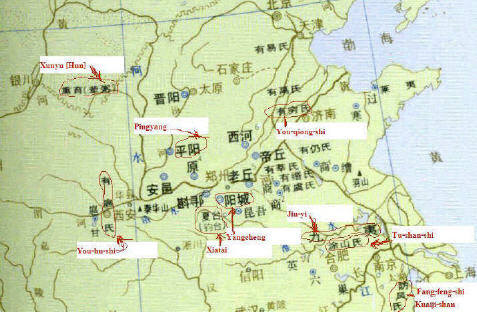 Lord Yu's Domain
Scholar Chen Shaoli mentioned that it might not be a coincident that in Henan's Yuxian County there is an ancient village called 'wang-cheng-gang', i.e., the hill of a king's castle.
However, Lord Yu was not restricted to the Yellow River Bend, and he was recorded to have travelled across the country.
Sima Qian's Shi-ji, in the section on Xia Dynasty, systematically described the ancient nine Chinese prefectures in details, covering the grade or quality of soil, the minerals, animals, plants and agricultural products, the rivers and mountains, and the tributes from the local prefecture to the central court (i.e., Chinese dynasties).
Shan Hai Jing, i.e., the Records of Mountains and Seas, was said to be the work of Lord Yu after he spent 13 years surveying the nation.
Scholar Hu Yueqian expounded on the marriage of Yu with a Tu-shan-shi woman. Hu Yueqian speculated that Lord Yu must have lived close enough to the Tu-shan Mountain, somewhere to the northeast of today's Shouchun or Huaiyuan County, Anhui Province and on the east bank of the Huai-shui River. Zuo Zhuan stated that tens of thousands of 'guo' or statelets (tribes) had come to Mt. Tu-shan to pay respect to Yu after the flooding was successfully controlled. This pointed to the fact that Lord Yu did have his dwelling to the south of the Yellow River, if Tu-shan was really located near today's Chuxian, Anhui Province, something that would conflict with Liu Qihan (Liu Qihua)'s assertion that it would be Lord Yu's son who would later expand into Henan Province.
Without ascertaining the difference of the ancient Youchao and today's Youchao-hu Lake, Hu Yueqian, who wrongly validated the Xia people's influence in today's Anhui Province by means of an alliance with the Tu-shan-shi tribe by citing the fact that last Xia King Jie, with his queen Meixi [a You-shi-shi woman], had fled to You-chao for seeking asylum, correctly pointed out that the remnant Xia nobles were relocated to Ruzhou [Jiaxian County of today's Henan Province]. (Hu dramatized the Xia people's fate by implying that the Shang people exiled them to the designated land as the Qi-guo statelet without reading into The Bamboo Annals which carried a statement that Shang-tang, upon the death of deposed Xia king Jie, had prohibited drinking as a show of mourning, which alternatively implied a sympathy of Shang-tang with Jie for the two dynasties' common origin as the Sinitic people who descended from the Yellow Lord.
Hu Yueqian, here using the double soundex appropriation of the Tu-shan name to Chuxian and the Nan-chao name to the Chaohu Lake of Anhui Province, could be totally wrong. See below for the Shang Dynasty founder-king's battle against the last Xia king for the possible location of Nanchao where the Xia king was exiled.)
This, however, could be a narrow-minded explanation since the Xia rule apparently spread across the whole domain of China, with the first part of the Xia dynastic rule centered in today's Henan-Shandong, while the latter part of the Xia dynastic rule centered in today's Shanxi Province, while the Shang people [who overthrew Xia] were originally conferred the land of the Yellow River flow course to the north and subsequently moved to the south of the Yellow River to conquer the 'Jing' and 'You-luo' people before crossing the Yellow River again to the north to defeat Xia.
In Today's Shaoxing, Zhejiang Province, namely, the ancient Kuaiji Commandary, there is a monument in remembrance of Lord Yu. Kuaijishan Mountain would be where Yu convened the vassals.
Per Kong-zi Shi-jia of Shi-ji, at Kuaijishan, legends stated that Lord Yu ordered to have the Fangfeng-shi chieftain executed for his late-coming to the meeting, a figure that Confucius was said to have commented to be the ancestors of the later tall-leg Chang-di barbarians --something that was probably first made up in Guo Yu in the context of the Wu-Yue War and a concocted Wu State foot messenger sent to Confucius, not knowing that Confucius was in the middle of a 14-year exile.
Lord Yu was buried on Kuaijishan Mountain when he died. There was an ancient claim that during the Soong Dynasty, the Kuaiji people, when rebuilding the Yu Pilgrimage, dug up some one hundred pieces of jade articles ('gui') that were considered instruments of the power conferral for vassals.
Sima Qian, in comments about the length of the Min-Yue & Dong-Yue Statelets (see Vietnamese & Southerners section for details), said the 'Yue' People must have inherited Lord Yu's spirits. One claim would put all Yue people, i.e., the Bai Yue or Hundred Yue people, in the same lineage as Lord Yu's descendants. Min-Yue & Dong-Yue were related to the so-called 'Gu-yue' or Ancient Yue Statelet located in Hangzhou, Zhejiang Province. After Han Emperor Wudi defeated Min-Yue of Fuzhou and Dong-Ou or Eastern Ou (Dong-Yue) of Wenzhou, there existed a remnant statelet called Xi-Ou or Western Ou.
Also to be noted would be the fact that the early Chinese history recorded that the people from the ancient Wa Japan claimed that they were the descendants of 'Tai Bo' and called themselves by the ancient title of 'Da Fu'.
Tai Bo wanted to yield the succession to his brother because the ancient mandate said that the son of Tai Bo's brother (Ji Li) would be the future lord of the Zhou people. Ji Li's son would be Ji Chang, i.e., Zhou King Wenwang posthumously.
The ancient books also recorded that Wa Japan must be situated to the east of Kuaiji Commandary. Chen Shou's San Guo Zhi recorded that the rice culture people living on the western coast of Japan around the 2nd-3rd centuries were recorded to have tattoos over their body, in a similar fashion to the Zhejiang people in the Yangtze Delta where the descendants of King Shaokang of Xia Dynasty had lived. (My speculation is that the ancient Wa Japanese with the Tai-Bo lineage had been wiped out or assimilated into the later immigrants from Korea. An Zhimin, at
carleton.ca/~bgordon/Rice/papers/zhimin84.htm
, wrote about "EFFECT OF PREHISTORIC CULTURES OF THE LOWER YANGTZE RIVER ON ANCIENT JAPAN", with speculation about pre-Han-Dynasty contacts.)
The Xia Chronology
Sima Qian's "Shi-ji" and The Bamboo Annals both cited the traditional saying that Xia Dynasty, with and without kings, had lasted 471 years. Ban Gu's "Han Shu" stated that Xia-hou-shi, with 17 kings, had lasted 432 years.
Scholar Huang Shilin cited the recent excavation of a Western Han Dynasty tomb in Mt Yinqueshan area, Linyi, Shandong and the discovery of ancient classics "Liu Tao" in rebutting the traditional view.
"Liu Tao" historically claimed that the Xia Dynasty possessed 31 kings from Yu to Jie. Scholar Huang Shilin hence concurred with The Bamboo Annals' statement that the Xia Dynasty possessed more years than the Shang Dynasty though it recorded only 17 kings. By setting the Shang-tang overthrow of Xia King Jie in the 18th cent BC, Huang Shilin speculated that the start of Xia would be somewhere like the 24th cent B.C.E. by adding up 629 years of the Shang Dynasty duration.
Per the forgery contemporary version [Jin Ben] of The Bamboo Annals, the Xia Dynasty ended in the year 1559 B.C.E. while the start would be the 1st year of Lord Qi 1978-1961 B.C.E., or Lord Qi 1991-1969 B.C.E. according to Purdue Professor Zhu Yongtang's adjustment of the forgery contemporary version [Jin Ben] of The Bamboo Annals, who adjusted the records by evening out the different imperial mourning years that were in conflict with the stem-branch years, and synching up with NASA's astronomical data etc.
(Scholar Kwang-chih Chang proposed in the 1980s an emphasis on the horizontal diagnosis of the Xia-Shang-Zhou people instead of vertical, which was to acknowledge the existence of a certain 'Anterior Xia', 'Anterior Shang' and 'Anterior Zhou'. Scholar Hu Yueqian proposed that the Xia studies must be built upon the Shang studies because of the close relation between the two groups of people.)
|
Yu's son, Qi(3), founded the Xia Dynasty. After Qi's death, his son, Tai-kang, succeeded him. Tai-kang made Zhenxun as his capital. Tai-kang moved the Xia capital city to Zhenxun from Yangcheng.
However, Tai-kang was fond of hunting and did not take care of business. When Tai-kang, in the first year's reign, went to south of the Luo-he River for hunting, Hou-yi (from the You-qiong-shi clan, a legendary figure famous for his long arms and shooting down the suns [as recorded in Shan Hai Jing] as well as shooting out the left eye of He-bo or the Yellow River god [as recorded in Jiu Ge of Chu-ci]), a tribal leader of the [? misnomer] Yi people, staged a coup d'etat and lined up his forces on the north bank of the Luo-he River to force Tai-kang into exile. Five Tai-kang brothers and their mother made five songs on the north bank of Luo, respectively, calling for the return of Tai-kang. This was the historical Wu-zi Zhi Ge or the five sons' poems. (Alternatively speaking, this time period of the Xia dynasty was called Five Brothers' Turmoil, which was to say that King Hou-yi was able to take power by taking advantage of the turmoil among the five brothers, with the five sons' poems being products of pre-Confucian and Confucian political correctness.
Furthermore, out of the remaining five brothers' songs, which were most likely later forgeries, one particular song carried a sentence to the effect of claiming a succession of the Great Xia legacy, "wei [only] pi [that] Tao-tang [Overlord Tao or Tao-tang-shi], you [there was] ci [this] ji-fang [the Grand Xia land]", albeit lacking the description of any Xia Dynasty activity north of the Yellow River during the early part of the Xia Dynasty rule.)
|
Xia Dynasty
The Bamboo Annals raw forged dates
(with Shang-style stems per Zhang Junshi)
|
| Ch'i/Qi 1978-1963 per raw data in The Bamboo Annals |
| T'ai-k'ang/Taikang [with 'geng' stem] 1958-1955 |
| Chung-k'ang/Zhongkang [with 'geng' stem] 1952-1946 |
| Hsiang/Xiang 1943-1916 |
| Shao-k'ang/Shaokang [with 'geng' stem] 1875-1855 |
| Chu/Di Zhu [with 'ding' stem] 1852-1836 |
| Hui/Di Kui (Fen) 1833-1790 |
| Wang/Di Mang 1789-1732 |
Hsieh/Di Xie 1730-1703 |
Pu-chiang/Di Buxiang/Bujiang 1702-1644 |
Chiung/Di Jiong 1643-1626 |
Chin/Di Jin 1622-1615 |
K’ung-chia/Di Kongjia [with 'jia' stem] 1612-1604 |
Kao/Di Gao 1601-1599 |
Di Fa 1596-1590 |
Lü-k’uei/Di Lügui (Jie) [with 'gui' stem] 1589-1559 |
|
|
It was said that the You-qiong-shi clan derived its name from the place of Qiongshi [infinite stone], which was a Xia people's place that Hou-yi took over after relocating from the Chu2 place.
The character 'qiong', meaning infinite or exhausting itself, was also used for denoting a legendary place called by Qiong-sang or the infinite mulberry place in Shan Hai Jing, or Shaohao's Ruins in today's Qufu.
Also note that Hou-yi carried the ancient 'hou4' prefix, which meant imperial-grandiose, and when used in a suffix position, was the Xia king title equivalent.
Limited records from Lu Lord Xianggong's 4th year of Zuo Zhuan pointed out that Hou-yi moved to Qiongshi from Chu2, a place that was speculated to be near Huaxian, Henan, which implied that Hou-yi dwelled in the Sinitic China's domain.
The Chu2 place naming could be seen in an assassin's name, Chu-zhi-mi (Chu Mi, ?-607 B.C.) whom Jinn Lord Ling[2]gong sent to kill minister Zhao Dun.
Later historians, like in such book as Di-wang Shi4-ji, claimed that the You-qiong-shi, as 'she zheng' [minister of arrow and bows], was conferred the land of Chu2 by Overlord Di-ku.
The citation context for Lu Lord Xianggong (r. B.C. 572-542)'s 4th year of Zuo Zhuan, i.e., 569 B.C., was related to Jinn minister Wei-zhuang-zi's dissuading the Jinn lord's hunting hobby and his intention to attack northward against Viscount Jiafu (Zi-jiafu) of the Wuzhong statelet.
Wei Jiang cited the story of You-qiong-shi and Hou-yi in Xia Xun (Xia Dynasty's mottos) to admonish the Jinn lord on the ancient lords' loss of reign while indulging in hunting of 'yuan [wilderness] shou [beasts]', with a possible hint that the supply of the tiger and leopard's skin could be supplied by the Wuzhong barbarians through the maintaining a friendly relationship to the north.
According to Wei Jiang, [king] Hou-yi took in Han2-zhuo who was a son banished by [king] Hou-han of the Bo-ming-shi clan, with bo-han2 meaning Count Han2.
Hou-yi made Han2-zhuo his prime minister.
Here Hou-yi and Hou-han2 appeared to be independent kings of the ancient world, which was to say the non-Xia states, like the non-Ji-surnamed states in the Zhou Dynasty time period, did not observe the one king system.
In Wei Jiang's citation of Yu-ren Zhi Zhen motto [written by Zhou Dynasty minister Xin-jia], Hou-yi was called by 'di [overlord] Yi [{misnomer eastern} barbarians] Yi [Hou-yi]'.
Hou-yi made Taikang's brother (Zhongkang) a [puppet] king.
Per The Bamboo Annals, Hou-yi was in control of the capital city of Zhenxun, while Xiang (Zhongkang's son) dwelled in Zhen'guan, meaning the co-existence of two Xia capital cities.
Lu Lord Xigong's 31st year of Zuo Zhuan, however, talked about Wey's relocation to Diqiu, which was known as Overlord Zhuanxu's Ruins, with a dialogue between Wey Lord Chenggong and minister Ning-wu-zi talking about Xia Lord Xiang's taking the Wey lord's ancestral oblation sacrificial materials, which was to say that the Xia king had at one time treated Diqiu as his capital city, a place that could be related to Zhen'guan.
Xia King Xiang launched numerous campaigns against the 'Si-yi' (four barbarians), lasting seven years.
During Xia King Zhong-kang's 5th year rule, there was an astronomical record in the forged contemporary version [Jin Ben] of The Bamboo Annals, which was speculated to be about the solar eclipse, namely, the 'chen' (i.e., sun and moon) not meeting in the 'fang [house or room]' constellation or asterism of the sky.
The 'chen', which was used in different contexts to mean sun, moon, stars, or specifically the Northern Dipper, was interpreted here to be either sun or moon missing from what its expected place in the sky.
On basis of this purported sun eclipse record, Prof Zhu synched up the forgery contemporary version [Jin Ben] of The Bamboo Annals records with
the actual Solar Eclipse that happened in 1961 B.C.E.; and adjusted the raw The Bamboo Annals year 1948 B.C.E. for Xia King Xiang's 5th year to 1961 B.C., not knowing that his efforts could be futile as the celestial signs, like the five planets' movement, and the sun eclipse, i.e., the one that was said to have happened in Xia King Xiang's 5th year, could be all made up by the later people.
The Yin4 Zheng texts, which cited an even more ancient and unknown book called Zheng Dian (administrative canons), stated that "whoever reported the calendar dates to be early would be killed at the order of the lord, and whoever reported the dates to be late than the astral calendar would be killed as well" --both cases using the Warring States terminology 'zhe' to suffix the persons in the two cases, a manifestation that this chapter of Shang-shu was indeed forged by Mei Yi (Mei Ze), magistrate of the Yuzhang-jun commandery of the Eastern Jinn Dynasty, or actually Mei Yi's indirect tutor Huangfu
Mi who made this pseudepigrapha in the name of Kong An'guo.
(Xun-zi, in Jun-dao or the king's way, claimed to have cited [Shang-]Shu in stating the exact sentence that whoever reported the time early would be killed without amnesty, and whoever reported the dates late would be killed as well.
What could be construed was that Xun-zi's citation of Shang-shu could be relatively new Shang-shu chapter from the late Zhou dynasty time period.
However, Mei Yi of the Eastern Jinn dynasty might have interpreted the context of this 'time reporting' statement to be related to what Sima Qian claimed to be Xia Dynasty minister Xi-he2's dereliction of duty in managing the calendar, and hence inserted it under the Yin4 Zheng chapter.
If Mei Yi (Mei Ze) or Huangfu Mi forged the record on Yin[4]
Zheng, the sources of additional flesh and bone could be Zuo Zhuan and Shi-ji. However, Zuo Zhuan
did not specify a time, like 'ji-yue' or September on the Zhou calendar, nor mentioned a name like
Marquis Yin[4]-hou.
The origin of both or all related forgeries lied in Zuo Zhuan's description in Lu Lord Zhaogong's 17th
year or 525 B.C. of what Xia Shu stated about the Xia dynasty kings' practice of making sacrifice on the occasion of a sun eclipse
--which was a general reference.)
Hou-yi, after Zhongkang's death, would stage another coup to overthrow Zhongkang's son, Xiang.
Xiang was said to have fled to the Shangqiu area for asylum under the protection of the Zhen-guan & Zhen-xun tribes.
Later, Han-zhuo (Han2-zhuo), i.e., a subordinate under Hou-yi, would usurp power by killing Hou-yi and usurped the You-qiong-shi throne.
Han-zhuo was said to have killed Hou-yi's son as well after Hou-yi's son refused to eat the meat made of his father's flesh.
Per the forgery contemporary version [Jin Ben] of The Bamboo Annals, it was Han-zhuo, a minister under Hou-yi, who killed Hou-yi during Xiang's 8th year [1936 B.C.E. or 1948 as adjusted by Prof Zhu] and was then to continue the usurpation of the Xia throne.
Han-zhuo, someone who was banished by his native tribe but taken in or adopted by Hou-yi, was said to be from some Yi tribe on the easternmost Shandong peninsula coastline.
Han-zhuo took over Hou-yi's woman and born two sons, Han-jiao and Han-yi, who were renowned for their strength. To prevent the Xia or Hua-xia people from claiming power again, Han-zhuo would send one of his sons to killing Xiang by routing the Zhen-guan & Zhen-xun tribes --which were wrongly speculated to be on the Shandong peninsula to the east.
Per the forgery contemporary version [Jin Ben] of The Bamboo Annals, Xiang was killed by Han-zhuo in the 28th year of Xiang, namely, 1916 B.C.E. or 1928 adjusted by Prof Zhu Yongtang on basis of the forgery contemporary version [Jin Ben] of The Bamboo Annals. Hence, the Xia dynasty lost 40 years without a king per the forgery contemporary version [Jin Ben] of The Bamboo Annals, from 1916 to 1876 B.C.E.
Xiang's woman, who was from the You-ren-guo [? You-nai-shi) clan, fled to her home and born Shao-kang the next year. Shao-kang [l. 2118-2068 per Chu Bosi; also see the forgery contemporary version [Jin Ben] of The Bamboo Annals records for the reign years of 1875-1855, birth year 1915 B.C.E.] would survive by escaping to the You-yu-shi tribe where the descendants of Lord Shun lived.
Yu-si, lord of the You-yu-shi tribe, gave two Yao-surnamed daughters to Shao-kang per Zuo Zhuan and Li Sao.
A Xia remnant minister, Mi, fled to the You-li-shi clan [with the li4 word meaning cauldron], and he organized the remnant Zhenxun and Zhenguan forces and finally defeated Hanzhuo according to the Lu Lord Xianggong's 4th year of Zuo Zhuan. Shao-kang killed Han-zhuo [Han-zu] in 1876 B.C.E. or 1888 per Zhu Yongtang's adjustment of the forgery contemporary version [Jin Ben] of The Bamboo Annals. That was the 41st reign year of Han-zhuo.
According to the Lu Lord Aigong's 1st year of Zuo Zhuan, Shao-kang killed Han-jiao in the Guo-di land and sent son Zhu (Ji-zhu) to the Ge-di land to have Han-yi killed.
Mi erected Shao-kang as the new Xia lord.
With the re-launch of Xia, Shao-kang, in his 3rd year reign, re-established the agricultural post of "Tian-ji" or "field official inheriting the Hou-ji title", a title that was last held by Bu-zhu, an ancestor of the later Zhou people.
Shao-kang was said to be the same person as the legendary Du-kang, i.e., the progenitor of 'shu jiu' sorghum wine brewing.
In year 11 (per the forgery bamboo annals), King Shao-kang ordered Marquis Shang-hou Ming to fix the flooding of the Yellow River, with a hint that the Shang people had a mandate to reign in the land of the Yellow River flow course.
Marquis Shang-hou Ming was said to have drowned on the job.
In year 21, Shao-kang passed away.
Shao-kang's son, Zhu (Yu), was said to have first invented the shields to counter the sharp arrows from the Yi people who were renowned for hunting and shooting. Shan Hai Jing claimed that Mou-yi, a minister under the Yellow Overlord, with the 'yi' suffix, first invented the bows and arrows; and in the Hai Nei Jing section of Shan Hai Jing, it was claimed that [overlord] Shao-hao born son Ban who first invented the bows and arrows.
Here, all the invention stories were Warring States fables or sophistry.
Zhu relocated the Xia capital to Laoqiu (old hill).
In year 8 (per the forgery bamboo annals), Zhu campaigned against the East Sea, reached San-shou, and captured a fox with nine tails.
In year 13, Marquis Shang-hou Ming died in the [Yellow] River.
Zhu's son would be Hui (Kui; Fen).
During the 3rd year, the Nine Yi people attacked the Xia dynasty. The Xia king borrowed an army from Count Luo-bo, i.e., count of the Luo-he River.
Hui's son would be Mang; Mang's son would be [Di-]Xie; [Di-]Xie's son would be Buxiang.
Buxiang attacked the Jiu-yuan-guo tribe.
Buxiang's brother would be Jiong; and Jiong's son would be Jin (Yin-jiang).
The forgery contemporary version [Jin Ben] of The Bamboo Annals recorded that Jin (Yin-jiang) dwelled in Xi-he (to the east of today's Eastern Yellow River Bend and in the Zhuo-Zhang-he River area). Ten suns were spotted in the skies during the 21st year.
After Jin would be cousin Kongjia.
Kongjia would be fond of 'gui shen' (ghosts and gods) and indulged himself lasciviously. The Xia-hou-shi virtues declined, and vassals challenged the Xia rule.
During his reign, someone called Liu Lei was hired for raising dragons (i.e., crocodiles).
Kongjia's son would be Gao; Gao's son would be Fa; and Fa's son would be Lügui (Jie).
The above historical events pointed to the eastern Henan Province and western Shandong Province, the traditional land of the ancient Tai-hao people and the Yi people, as the theater of struggles between the Xia people and the Yi (misnomer Dong-yi) people.
Prof Zhu Yongtang of Purdue, having pointed out that the Heavenly Stems and Earthly Branches in the forgery contemporary version [Jin Ben] of The Bamboo Annals could be latter-day add-ons - just as Sima Qian's Shi-ji might have similar add-ons of the Heavenly Stems and Earthly Branches - used the NASA data to rebut the errors by folks like David Pankeniers et al.
Prof Zhu believed that the forgery contemporary version [Jin Ben] of The Bamboo Annals was correct from last Xia King Jie up to the records of Xia King Shaokang, with all astronomical events matched with the NASA data.
With data from the Stalman and Gingerich Solar and Planetary Longitudes for Years 2500 to 2000,
Professor Zhang Peiyu's Five Planets Conjunction 2500 -1500 BC,
NASA Espenak's Solar Eclipse Paths: 2004 World Atlas of Five Millennium of Solar Eclipse Paths (2000 BCE to 3000), Prof Zhu adjusted the Xia years with three full mourning years, adjusted the year for King Shao-kang's restoration, and synched up the forgery contemporary version [Jin Ben] of The Bamboo Annals records with the Solar Eclipse 1961 B.C.E.; raw The Bamboo Annals year 1948 B.C.E.), Crisscross of Five Planets (1576 B.C.E.), and
Conjunction of Five Planets in a Cluster (1953 B.C.E.; raw The Bamboo Annals year 1945 B.C.E.) to give the adjusted dates shown below:
Yu 2002-1995 plus three year mourning;
Qi 1991-1976 plus three year mourning;
Tai-kang 1972-1969 plus three year mourning;
Zhong Kang 1965-1959 plus three year mourning;
Xiang 1955-1928 with no mourning;
Shao-kang 1888-1868 plus three year mourning;
Zhu 1864-1848 plus three year mourning;
Fen 1844-1801 plus three year mourning;
Mang 1797-1740 plus three year mourning;
Xie 1736-1712 plus three year mourning;
Bu-xiang 1708-1650 with no mourning;
Pian 1649-1632 plus three year mourning;
Jin 1628-1621 plus three year mourning;
Kong-jia 1617-1609 plus three year mourning;
Gao 1599-1603 plus three year mourning;
Fa 1599-1593 plus three year mourning;
Kui 1589-1559.
David Pankeniers, and Zhu Yongtang/John Y.D. Tse of Purdue, et al., apparently did not give a definition as to how wide a celestial range should be for defining the conjunction, criss crossing or one line alignment, i.e., a subjective call. This webmaster's point was that the usage of astrological and astronomical records in China's prehistory was unscientific, something that would contradict all the established records on the coherent and sequential events that happened during all kings and lords' reign years. In another word, you could not have the best of two worlds, i.e., the precise year from the Stellarium/NASA data and the selective use of the years and events in the forgery contemporary version [Jin Ben] of The Bamboo Annals, namely, the so-called ancient Chinese dilemma in the singular choice of either fish or the bear's paw, or either a person's life or the righteousness in Mencius.
For example, should you buy the five planets' conjunction in 1059 B.C., then the forgery contemporary version [Jin Ben] of The Bamboo Annals would give you the year 1038 B.C. for the Zhou's overthrow of Shang, not 1046 as the forgery Xia-Shang-zhou project said.
See this webmaster's discourse in the Zhou Dynasty section
(1121 - 256 BC;
1106-771 B.C. per Zhang Wenyu; 1044-256 B.C. per Cao Dingyun; 1122-256 B.C. per Liu Xin; 1116-256 B.C. per Huangfu Mi; 1111-256 B.C. per Seng Yixing; 1050 - 256 per the forgery contemporary version [Jin Ben] of The Bamboo Annals) .
Jie - the Last Xia King
After four hundreds of years, the Xia Dynasty ended in the hands of King Jie who was said to have mistreated his people. Per the forgery bamboo annals, during the 10th year reign of King Jie, an earthquake led to the drying-up of the Yi-shui and Luo-shui rivers. In this year, five stars were observed to be in the sky at the same time. During the 11th year reign of Xia King Jie, an assembly of vassals was done at the Ren [i.e., You-ren-shi] place. The lord of the You-min-shi people fled the scene. Hence the Xia king eliminated the You-min-shi state. Per the forgery contemporary version [Jin Ben] of The Bamboo Annals, during the 13th year reign of Xia King Jie, the Xia king relocated the capital city to the south of the Yellow River from Zhenxun. This would probably allow him to edge closer to the Kunwu-shi people at the [Jiu-]Xu land near today's Xuchang, Henan. The Xia king's palace was said to be near the Yi-shui River area.
During the 14th year reign (per the forgery bamboo annals), Jie campaigned against Mt. Minshan, obtained a woman, and abandoned queen Mo-xi. Jie, earlier, obtained Mo-xi as a bribe after attacking the You-shi-shi tribe. Jie further obtained two beauties, Wan and Yan, from the ancient Shu-guo statelet.
This showed that the Xia king, after crossing the river, had expanded towards the southwestern direction.
The forgery contemporary version [Jin Ben] of The Bamboo Annals stated that Shang-tang, during the 15th year reign of Xia King Jie [or Shang-tang's 2nd year], moved to live in the Bo land, i.e., his ancestor's capital city.
Shang-tang's conflict with Count Ge-bo's Ge-guo state, in today's Ningling, Henan, could have only ensued after this relocation.
During the 17th year reign (per the forgery bamboo annals) of Xia King Jie [or Shang-tang's 4th year], Shang emissary Yi Yin came to the Xia capital city. Yi Yin did not return to the Shang land till three years later.
The queen, in revenge, was said to have adultery with Yi-yin, i.e., Shang-tang's spy.
Per Jinn Yu of Guo Yu, Jinn Principality sorcerer Shi-su, in commenting on Jinn Lord Xian'gong's taking in a Li-ji barbarian woman, predicted the turmoil of Jinn by likening the Jinn lord to Xia King Jie's taking Mo-xi [after conquering You-shi-shi tribe {and two beauties, Wan and Yan, from the ancient Shu-guo statelet}], Shang King Zhou-wang's taking Da-ji [after conquering the You-su-shi clan] and Zhou King Youwang's taking in Bao-si.
The person who overthrew Jie would be called Shang-Tang [l. 1824-1753 B.C.E. per Chu Bosi; 1589-1547 per the forgery contemporary version [Jin Ben] of The Bamboo Annals], whose ancestor (Shang-ancestor-Xie4, i.e., son of Lord Di-ku) had worked under Lord Yu in controlling the floods.
Shang-tang's name was Lü, also known as Tianyi.
During the 21st year reign (per the forgery bamboo annals) of King Jie, Shang-tang began to campaign against various opponents, defeating You-luo and Jing in the central plains of China, i.e., somewhere at a place called Mt. Jingshan [which could be later extrapolated to be near the Han-shui River area, i.e., south of the Qin-ling Ridge].
Shuo Yuan, a Han Dynasty book, claimed that Shang-tang more than twice tested Jie's response by stopping the surrender of tributes. When Xia lord Jie was able to rally an army [which was consisting of the {mercenary} Nine Yi people], Shang-tang apologized to the Xia lord, and when the Xia lord was unable to invoke the Nine Yi people to his aid, then Shang-tang began the campaign against Jie.
Jie once called upon Shang-Tang and imprisoned him in the Xiatai prison [said to be located in Yangdi, Henan Province or the same as Juntai, near Yuxian, Henan], during the 22nd year reign per the forgery contemporary version [Jin Ben] of The Bamboo Annals.
Possibly as a result of Shang-tang's attacking the You-luo and Jing states in the central plains of China during the 21st year reign of Xia King Jie [or Shang-tang's 8th year], the Xia king put Shang-tang under house arrest at Xiatai (i.e., the Xia terrace) when Shang-tang came to the Xia court, and would not release him till the year after. After Jie released Shang-Tang, Shang-Tang rallied the Xia vassals the next year.
In Jie year 26 (per the forgery bamboo annals), Shang-tang eliminated the Wen statelet.
In Jie year 28 (per the forgery bamboo annals), Kun-wu-shi, possibly under Jie's order, attacked Shang, and the Shang army attacked Wei[2] and Gu4.
Chang Fa of Shang1 Song4 in Shi-jing claimed that Shang-tang first eliminated the Peng-surnamed Wei3 and Si-surnamed Gu4 states before tackling the Si-surnamed Kunwu-shi people, namely, 'Wei-Gu ji fa, Kunwu Xia-Jie'.
In all, among Zhu-rong's descendants, there were Count Kunwu[-shi] in the Xia dynasty and Count Da-peng and Count Shi-wei[2] in the Shang dynasty, and the Mi-surnamed Chu people in the Zhou dynasty.
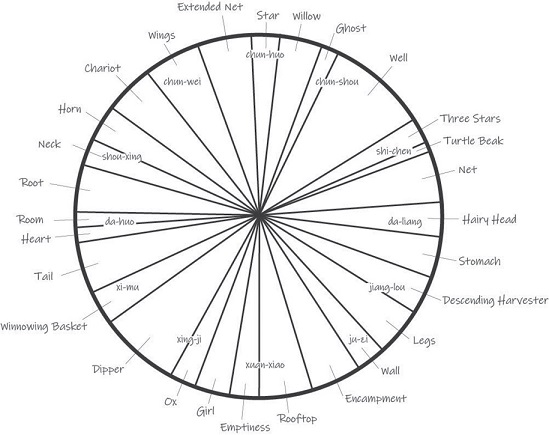 The Wei3 state, also known as Shi3-wei2 [or Xi1-wei2-shi which preceded the legendary Fuxi in Zhuang-zi's fable Da-zongshi of Zhuang Zi], was commonly taken to be located in today's Huaxian County of Henan, north of the Yellow River.
In Lu Lord Zhaogong's 11th year of Zuo Zhuan, there was a reply from Chang-hong to Zhou King Jingwang, in which the remotely ancient state of Shi3-wei2 was taken to be a lunar lodge among the 28 mansions of the Constellation, i.e., the 'ying2-shi4' (encampment) mansion.
The Gu state was said to be located in Fanxian of Shandong, further to the east.
The Kunwu state was first located in today's Puyang of Henan before it relocated to the Jiu{old}-xu place, namely, today's Xuchang of Henan.
In the Zhong Ci San-jing (subsection three) section of Shan Hai Jing, there was a sentence about the location of 'kunwu-zhi-shan', namely, the Kunwu mountain, somewhere on the southern bank of the Yellow River and near the Yi-shui River and the Luo-he River.
Note that the Kunwu ancestor was taken by the Chu people to be their second-remotest ancestor, called by Huang{grandiose}-kao{late}-bofu{elder uncle}-kunwu, who relocated to the Jiu-xu [old Xu] land, south of the Yellow River, during the late Xia dynasty time period.
The Wei3 state, also known as Shi3-wei2 [or Xi1-wei2-shi which preceded the legendary Fuxi in Zhuang-zi's fable Da-zongshi of Zhuang Zi], was commonly taken to be located in today's Huaxian County of Henan, north of the Yellow River.
In Lu Lord Zhaogong's 11th year of Zuo Zhuan, there was a reply from Chang-hong to Zhou King Jingwang, in which the remotely ancient state of Shi3-wei2 was taken to be a lunar lodge among the 28 mansions of the Constellation, i.e., the 'ying2-shi4' (encampment) mansion.
The Gu state was said to be located in Fanxian of Shandong, further to the east.
The Kunwu state was first located in today's Puyang of Henan before it relocated to the Jiu{old}-xu place, namely, today's Xuchang of Henan.
In the Zhong Ci San-jing (subsection three) section of Shan Hai Jing, there was a sentence about the location of 'kunwu-zhi-shan', namely, the Kunwu mountain, somewhere on the southern bank of the Yellow River and near the Yi-shui River and the Luo-he River.
Note that the Kunwu ancestor was taken by the Chu people to be their second-remotest ancestor, called by Huang{grandiose}-kao{late}-bofu{elder uncle}-kunwu, who relocated to the Jiu-xu [old Xu] land, south of the Yellow River, during the late Xia dynasty time period.
Kunwu could be later mixed up with Kunlun, i.e., the future fairy and legendary names in The Legends of Mountains and Seas, such as the Kunwu jade, and the Kunlun hill, the Kunlun ruins, and the Kunlun Mountain.
In the sea section of Legends of Mountains and Seas, it was claimed that the Kunlun hill was the god's capital city down on the earth, where the mountain guardian god Lu-wu, with nine tails, tiger's claws and body and a human face, dwelled.
The mountain subsections one and two of the said book, which was more reliable, possibly implied that the intersection area of Mt. Lüliang-shan and Mt. Guancenshan was where the Kunlun hill was [while subsection three hinted at the god's capital city to be further to the north of the Yanmen [swan gate] Mountain, on a mountain in the middle of the Tai-ze Lake.
(Though, in Qu Yuan's timeframe, the two words of kunlun and kunwu could not have been mixed up as the Chu poet, who used the 'huang-kao' characters for his own father [versus huang-kao-bofu for the elder uncle], made the claim in Li-sao that he was a descendant of lord Zhuanxu, i.e., the progenitor that produced Zhu-rong, and further repeatedly talked about the Yellow Lord and the Kunlun Ruins in his poems.
In Tian Wen, Qu Yuan questioned about the xuan' [suspension-in-the-sky] garden on Mt. Kunlun, asking where the 'kao' [the mountain's spine end] was: "kun-lun xian {xuan} pu, qi kao an zai".)
During Jie's 28th year, Xia Dynasty's higher official in charge of history, rituals and musician, Tai-shi-ling ('tai shi') Zhong-gu [a name recorded by Lü-shi Chun-qiu], fled to the Shang people with the Xia 'tu shu' [maps and books from the library or classics].
Tai-shi, together with Tai-fu and Tai-bao, were called by the Three Grand-dukes in the ancient times.
(In the Shang times, 'tai-shi' was more likely ministers in charge of the music and rituals while 'nei-shi' was in charge of archives.
And 'shao-shi' was a title not seen in the Shang dynasty time period yet.)
During the 29th year reign of Xia King Jie [or Shang-tang's 16th year], Shang-tang defeated the Gu state.
Three suns were seen in the sky in this year per the forgery contemporary version [Jin Ben] of The Bamboo Annals --an event that was not worthy of corroboration with the records in the modern astronomical software and an event that was commented by Zhu Yong Tang (John Y.D. Tse) to be ten years too early.
The very origin of three suns' matter, as seen in Tang Dynasty astrology book Kai-yuan Zhan Jing, were said to come from some Han dynasty forgeries, namely, from among the six categories of 'jing' [longitude] learning edited by Confucius and the derivative sets of interpretation books that were known as the Han dynasty 'wei' [Latitude] series.
In year 29 (per the forgery bamboo annals), Count Fei-bo (? Fei Chang, carrying the 'fei' character which was pronounced 'bi4' in the ancient times --a state that was first pegged to Yi4 or Marquis Fei-hou/Bi-hou, i.e., successor to Lord Yu), or Bi-bo (Bi-chang), defected to Shang from Xia.
Zhang Hua, author of Western Jinn Dynasty book Bo-wu Zhi (an encyclopedia of earthly things), made up a story of Fei-chang/Bi-chang inquiring with Feng Yi, the Yellow River god, about which one of the two suns, one rising and one sun setting, represented the Xia dynasty versus the Shang dynasty, and when being told the result, fled to Shang with his whole clan.
No matter it was the three suns or the two suns, the evidence strongly pointed to the forgery contemporary version [Jin Ben] of The Bamboo Annals as a forgery.
In October of the 29th year reign of Xia King Jie [or Shang-tang's 16th year], i.e., the winter time, Xia King Jie began the operation of chiseling through the mountains to reach the Yellow River. The speculation was that the Xia king was imitating Lord Yu's flood control to divert the water. During the 30th year reign of Xia King Jie [or Shang-tang's 17th year], per the forgery contemporary version [Jin Ben] of The Bamboo Annals, Mt. Qu2-shan, which was speculated to be some mountain near today's Gongyi, Henan, collapsed, which might have something to do with mountain chiseling and tunneling projects. Xia minister Guan-long-pang, a descendant of the dragon [crocodile] taming tribe, was killed by the Xia king for admonition.
(The matter related to chiseling and Mt. Qu2-shan could be seen in Liu Tao, a Warring States military book that was written in the name of Zhou Dynasty military counsellor Jiang Ziya.
As commented by 20th century erudite Wang Guowei, the forgery contemporary version [Jin Ben] of The Bamboo Annals had no value because every entry could be found to have source in other books, with the only addition in the tagging of the years or reign years for the lords and kings.)
Jie was said to have killed minister Guan Longpang (Guan Long) for admonition during the 30th year reign of Xia King Jie [or Shang-tang's 17th year].
The death of Guan Longpang could have something to do with King Jie's irrigation and mountain leveling projects.
* In Commemoration of China's Fall under the Alien Conquests in A.D. 1279,
A.D. 1644 & A.D. 1949 *
U.S.S.R./Comintern Alliance with the KMT & CCP (1923-1927)
Korean/Chinese Communists & the 1931 Japanese Invasion of Manchuria
American Involvement in China: Soviet Operation Snow, IPR Conspiracy, Dixie Mission, Stilwell
Incident, O.S.S. Scheme, Coalition Government Crap, Amerasia Case & The China White Paper
* Stay tuned for "Republican China 1911-1955: A Complete Untold History" *
|
|
Zou Rong's Revolutionary Army;
Shin Kyu Sik's
Shrine (Spirit, Kunitama) of Korea
|
This snippet is for sons and daughters of China:
Heed the sons & ministers' agony and sorrow of our ancestors who died or lived through the Mongol, Manchu and Soviet-Chicom conquest
and
the Yongjia, Jingkang and Jiashen cataclysms !
Jeanne d'Arc of China:
Teenager girl Xun Guan breaking out of the Wancheng city to borrow the relief troops in the late Western Jinn dynasty;
Liu-Shao-shi riding into the barbarian army to rescue her husband in the late Western Jinn dynasty;
teenager girl Shen Yunying breaking into Zhang Xianzhong's rebels on the horseback to avenge on father's death in the late Ming dynasty.
China's Solitary and Lone Heroes:
Nan Jiyun breaking out of the Suiyang siege and charging back into the city in the Tang dynasty;
Zhang Gui & Zhang Shun Brothers breaking through the Mongol siege of Xiangyang in the Southern Soong dynasty;
Liu Tiejun breaking through three communist field armies' siege of Kaifeng in the Republican China time period;
Zhang Jian's lone confrontation against the communist army during the June 3rd & 4th Massacre of 1989.
|
|
|
The Campaign that Overthrew Xia King Jie
Taking advantage of the natural disasters and the Xia court upheaval, Shang-tang campaigned against Kunwu, a stalwart which could be said to be embodiment of one of the three suns that appeared in the sky the previous year.
The forgery contemporary version [Jin Ben] of The Bamboo Annals had a short description about some disaster in the Ling-sui tunnel during the winter, which might also have something to do with the water diversion project.
During the 31st year reign of Xia King Jie [or Shang-tang's 18th year], Shang-tang initiated the campaign against Xia-yi, i.e., the Xia land, from the Er[-sui] tunnel area. If the Xia-yi place was the Great Xia land on the northern Yellow River riverbank, then Shang-tang's military campaign here was a diversionary attack that was synchronized with the attack against Kunwu. It was possible that the Xia king had crossed the Yellow River to the north by this time, and hence the Er-sui tunnel campaign.
In Jie year 31, Shang-tang defeated Kunwu.
Kunwu was at the Jiu-xu or the old Xu land, i.e., today's Xuchang, Henan.
Shang-tang then defeated Jie at the ruins of You-song (Yuncheng, Shanxi Province).
The You-song-shi land was also written as You-rong-shi in Yin Ben-ji of Shi-ji, where 'rong' was later used for designating the barbarians.
The campaign was depicted with a sentence to the effect that Shang-tang's army rose from 'Er', which was alternatively written as 'Er-sui' (the Er tunnel) in Tang-shi4 Xu or Ling-sui (i.e., the You-ren-shi/You-song-shi/You-rong-shi tunnel) in Zhou Yu of Guo Yu, at the tip of the west-to-east Zhongtiaoshan mountain range, somewhere near Mt. Shouyang-shan at the Yellow River inflexion.
(Zhou Yu,
a sophistry book of the Warring States time period, mentioned the nature of the Ling-sui disaster
in the context of a discussion between Zhou King Xiangwang and the nei shi official Guo[4] who claimed that the Xia dynasty prospered when [Zhu-]Rong descended
onto Mt. Chongshan and had its demise when the 'Hui-lu' fire god appeared at the Ling-sui tunnel
[or the mausoleum --should we interpret the 'sui' character to mean the Zhou dynasty kings' prevalent tunnel
burial customs {versus the vassals' method of suspending the coffin}]. The 'Ling-sui' wording could be the source for the forgery version of The Bamboo Annals that was excavated in 279 A.D.
but was subsequently lost.
As this webmaster also expounded in Mu-tian-zi Zhuan, 'sui' could be a mountaintop narrow tunnel passageway with open sky.)
The Er tunnel could be what Wu Qi referred to in his dialogue with Wei Marquis Wuhou as a 'yang-chang' road or the sheep intestine-like mountain road, that demarcated where the last Xia king dwelled, namely, in a place surrounded by the Yellow River to the left, the Tai-hua mountain to the right, the Yi-que terrace (i.e, the vista mountaintops washed by the Yi-shui River between two mountain ridges) to the south, and the sheep intestine road to the north.
The You-song-shi land was also written as You-rong-shi in Yin Ben-ji of Shi-ji, where 'rong' was later used for designating the barbarians.
In this sense, Xia King Jie could be using today's Luoyang city as a capital city but was forced to flee across the Yellow River --after Shang-tang eliminated the Kunwu-shi people, i.e., the Xia imperial guards at today's Xuchang, Henan.
Jie fled to Mingtiao (the ancient Puzhou prefecture) where he was defeated again by Shang-Tang.
Shang-tang made an oath of war [i.e., Tang Shi4] at the outskirts of Mingtiao, namely, today's Zhongtiaoshan Mountain on the north bank of the Yellow River.
Lu Yu of Guo Yu stated that after this defeat, Jie fled to Nanchao.
Shang-Tang continued on to defeat Jie at Sanzong (or Sanchun), which could be historically wrongly taken to be a different place, like {?} Dingtao or Jiyin of the ancient Caozhou prefecture in today's Shandong.
Huai Nan Zi, in the Xiu-wu [diligent military preparation] Xun section, said that Shang-tang laid a siege of Jie at Nan-chao and later exiled Jie to Lishan.
Per the forgery contemporary version [Jin Ben] of The Bamboo Annals, Shang-tang defeated Jie during the 31st year reign of Jie or the 18th year reign of Shang-tang.
The forgery contemporary version [Jin Ben] of The Bamboo Annals stated that Shang-tang exiled Jie to Nan-chao, where Jie died two years later at a place called Tingshan (pavilion mountain).
(As far as Mingtiao was concerned, Shui Jing Zhu stated that [near today's Lishan-zhen Town of Yuanqu, Shanxi; and between Gucheng and Yangcheng,] there was the Jiao-shui River flowing south into a canyon, and about 40-li distance could be found Lord Shun's well, to the east of which was Gu-zhong [tomb of old blind man Gu or Shun's father on top of today's Mingtiao-ling Ridge at Tongshan of Yuanqu], south of which was Zhufeng, the north of which was Mt. Lishan, southeast of which was Leize lake, and the northeast of which was the tilling fields.
There was an alternative Mingtiao to the west of the Shui Jing Zhu nameplace, and it would be where Lord Shun's Gui-shui River was, i.e., near the Puzhou exit to the Yellow River inflexion.
Still one more wrong claim would pinpoint Mingtiao to be near today's Fengqiu, Henan.
Nan-chao or Mt. Nanchao-shan could be today's Mt. Lüliang-shan, or the ancient E4 land, which was the fief of Marquis E'hou of the late Shang dynasty as well as the equivalent of the Yu2-guo/Yu2-fang state --since Yin Ben-ji of Shi-ji listed the three marquis of Xibo-Chang [Ji Chang or Zhou King Wenwang], Jiu-hou and E4-hou while The Bamboo Annals used the order of Jiu-hou, Hou-hou [Xibo {Count of the West} or Zhou King Wenwang] and Yu-hou [with the Yu2-fang character inscribed].)
The dynasty name of 'Xia' did not go away. There would ensue a short Hunnic dynasty called Xia, lasting through A.D. 407-431. The Huns claimed that they were the descendants of Xia-hou (namely, the Xia descendants) people, and the Uygurs claimed descent from Chunwei, the son of last Xia lord. Sima Qian mentioned that Jie was banished to today's Henan Province and died there years later. Jie's son took over his father's dowager queen and fled northward to become ancestor of the later Huns on the steppe.
(Liu Qihan (Liu Qihua) pointed out that the Xia people, similar to the Huns and Turks, had adopted the ancient 'concubine inheritance system', i.e., the successors of nobles or lords would take over their fathers' concubines and wives instead of forcing those women to be buried live with their late husbands.)
Still another dynasty carrying the Xia name would be the later Xixia Kingdom (i.e., Western Xia, A.D. 1032-1227) led by the Dangxiang (i.e., Tanguts). History recorded that there evolved eight Qiangic tribes by the time of Five Dynasties (A.D. 907-960), with one tribal group carrying the old Tuoba name. The Tuoba Qiangic people claimed that the founder of Xia Dynasty (21-16th c. B.C.) came from the Western Rong area, namely, the dwelling place of the Qiangs. Danggxiang's Xia could very well derive from the title of Duke of the Xiazhou [Xia-zhou] Prefecture as conferred by Tang Dynasty's emperor, not the legends about Lord Yu's origin from the Western Rong area, a name that was much recent than the matter of facts.
Note that the concept of 'west' for the Xia dynasty derived from the fact that the Tanguts built the Grand Xia dynasty along the Western Yellow River Bend, i.e., about the area where Helian Bobo's Huns launched the Hunnic Xia dynasty at the capital city of Tongwan-cheng (Jingbian, Shenxi).
There was no earlier concept of a 'west' or 'western' Xia entity or dynasty in China's history.
The terminology of 'xi-xia' (i.e., Western Xia) or the denotation of 'xi-xia-shi' (i.e., the tribe or land of the Western Xia people) in Zhou King Muwang's travelogue, i.e., Mu-tian-zi Zhuan, was a latter-day annotation.
Similarly, the 'xi-xia' or western Xia state [that was conquered by {Tao-}tang-shi] in the Shi-ji jie [annotation] section for the book Yi [extant] Zhou Shu [Zhou Dynasty's history] was a latter-day fable talk --as seen in the ludicrous juxtaposition of numerous ancient human characters and place-naming, such as i) Yi-qu-shi for the Yiqu-rong barbarians and ii) Ban-quan-shi for the legendary Fiery Lord who were defeated at Banquan in the hands of the legendary Yellow Lord.
In contrast with the late 'xi-xia' (i.e., Western Xia) concept, there was an earlier terminology of 'dong-xia' (i.e., Eastern Xia) for the Dong-xia-zhou Prefecture, that was designated by Western Wei Dynasty Emperor Feidi in A.D. 554 for the locality of Yanzhou (Yan'an, Yenan).
Though, 5000 years ago, Lord Yu tamed the Yellow River from the point of 'ji-shi', at the intersection of the Northern Yellow River Bends, and not further than that or beyond that, not anywhere close to some sensational geologist' claim of a latter-day appropriated 'ji-shi' location in the Yellow River Nine Winding area, where a purported earthquake-induced dam first intercepted the water and then collapsed to cause the epic flood.
You could say you heard about it right here.
This webmaster had fixated on the 'ji-shi' location after correctly reading and analyzing the Chinese classics back and forth for twenty years.
|
|
|
|
|
|
|
Sovereigns & Thearchs;
Xia-Shang-Zhou dynasties;
Zhou dynasty's vassallage lords;
Lu Principality lords;
Han dynasty's reign years
(Sexagenary year conversion table-2698B.C.-A.D.2018; 247B.C.-A.D.85)
|
|
The Sinitic Civilization - Book I is
available now at
iUniverse,
Barnes & Noble,
Amazon,
Google Play|Books
and
Nook.
The Sinitic Civilization - Book II is
available at
iUniverse,
Amazon
and Barnes & Noble.
Check out the 2nd edition preface that had an overview of the epact adjustment of the quarter remainder calendars of the Qin and Han dynasties, and the 3rd edition introduction that had an overview of Sinitic China's divinatory history of 8000 years.
The 2nd edition, which realigned the Han dynasty's reign years strictly observing the Zhuanxu-li calendar of October of a prior lunar year to September of the following lunar year, also cleared this webmaster's blind spot on the authenticity of the Qinghua University's Xi Nian bamboo slips as far as Zhou King Xiewang's 21 years of co-existence with Zhou King Pingwang was concerned, a handicap due to sticking to Wang Guowei's Gu Ben Bamboo Annals and ignoring the records in Kong Yingda's Zheng Yi.
Stayed tuned for Book III that is to cover the years of A.D. 86-1279, i.e., the Mongol conquest of China, that caused a loss of 80% of China's population and broke the Sinitic nation's spine.
Preview of annalistic histories of the Sui and Tang dynasties, the
Five Dynasties, and the two Soong dynasties
could be seen in
From the Khitans to the Jurchens & Mongols: A History of Barbarians in Triangle Wars and Quartet Conflicts
(The Barbarians' Tetralogy - Book III: available at iUniverse;
Google;
Amazon;
B&N).
(A final update of the civilization series, that is scheduled for October 2022, would put back the table of the Lu Principality ruling lords' reign years, that was inadvertently dropped from Book I during the 2nd update.)
|
|
T.O.C.-Book-I
Jupiter and the Iplanet Time Reckoning xv
Twenty-eight Lunar Lodges xvi
Table of Twenty-eight Lunar Lodges and Their Degrees based on the
Distance of Respective Determinative Stars xvii
Section Four: The Shang Dynasty
Chapter XIII: The Shang Civilization
223
The Origin of the Shang People 223
Shang Ancestor Kings & China's Homeric Iliad
226
Shang Dynasty Founder-king Shang-tang 229
The Year of the Cheng-Tang Revolution & the Yin-li
(Shang Dynasty) Calendar 236
The Launch of the Shang Dynasty 238
Chapter XIV: The Shang Dynasty Chronological
History 242
Shang King Tai-jia, Minister Yi Yin, and Shang-shu Article Yi-de
(One Heart/Mind) 242
Shang Kings' Temple Titles Debunking The Bamboo Annals As
Ghostwriting Masterpiece 245
The Shang Erligang (two league hill) Culture 246
Chapter XV: The Shang Dynasty's
Demise 257
Disputes Related to the Shang Dynasty's Summary Years
262
The Zhou People's Succeeding the Mandate Of Heaven
263
Chronology
Chronology of the Three Dynasties (Xia, Shang and
Zhou) 587
A Timeline of Chinese Dynasties with Corroborated Reign Years
& Eras 591
References on the Calendars & the Calendar Terms:
Reference on the Calendar Terms 594
The Conversion Table for the Qin Empire's Zhuanxu-li
Calendar 596
The Conversion Table for the Virtual Yin-li (Shang
Dynasty) Calendar 598
|
|
The Shang Dynasty
According to Sima Qian's Shi Ji, the ancestor of the Shang people was named Shang-ancestor-Xie4, a son of Lord Diku, i.e., Gaoxin-shi.
The Zi-surnamed Shang-ancestor-Xie4 had the offspring clans such as You-yin-shi, Lai-shi, Soong-shi, Kongtong-shi, Zhi-shi, Bei-yin-shi and Muyi-shi per Yin Ben-ji of Shi-ji.
Legend said that Shang-ancestor-Xie4 was born after his mother, Jian-di (a Yousong-shi woman with a 'di' suffix [a later 'barbarian' designation of the ethnic, tribal origin], a statelet said to be located in Yuncheng of Shanxi Province), swallowed an egg of a black bird (swallow).
Bai Hu Tong stated that the Shang Dynasty ancestor obtained the 'Zi' [egg] character as a result of their maternal ancestor swallowing the egg of a bird.
Lord Yao conferred Shang-ancestor-Xie4 the post of 'si tu' and the last name of 'Zi'.
(The name of Lord Di-ku in either Da-Dai Li-ji or Guo Yu could be a latter-day invention.
Latter Han Dynasty scholar Zheng Xuan, in commenting on the order of the ancient lords' receipt of sacrifice, as was noted in either the book Da-Dai Li-ji or Guo Yu, made a succinct point that Da-Dai Li-ji or Guo Yu could be wrong in that
the You-yu-shi people should make the outskirts oblation for Lord Zhuanxu, not Lord Yao;
the Xia-hou-shi people should make the outskirts oblation for Lord Zhuanxu, not Gun;
the Shang people should make the outskirts oblation for Shang-ancestor-Xie4, not Shang ancestor Ming.
That is, other than Shang-tang and Shang-ancestor-Xie4, no other earlier ancestor was mentioned.)
The paleoanthropological studies showed that the three dynasties of Xia, Shang and Zhou had
different origins, with the Shang people exhibiting the majority paleo-North-China components and
minority paleo-Northeast-China components.
Yuan Haibing of Jirin University, who reanalyzed
the Yin-xu skulls, speculated that a minority group of the Shang nobility people possessed the
features of the paleo-Northeast-China type with high crania, i.e., the people with the N-M231 gene,
for example.
Genetic analysis showed that
among the Upper-layer Xiajiadian Culture people, the components were roughly 33.3% N1a1a, 22.2%
O2a2b1a1, 22.2% O3*, and 11.1% C. The physical anthropological studies of the Ping’an’bu skulls
from Zhangwu of Liaoning showed that the Lower-layer Xiajiadian Culture people belonged to the
East Asia type at the time of the Xia dynasty. Similarly, the Upper-layer Xiajiadian Culture people
shared similarity with the East Asia type, being closer to the paleo-Northeast-Asia (i.e., N-M231, for
example) and paleo-South-China type than to the North Asia type.
For further details, see this webmaster's book The Sinitic Civilization.
(Zhu Hong, citing the remains from Taigu of Shanxi and the middle and small-size Shang tombs,
separately pointed out that the differences between the paleo-Central-Plains and the paleo-North-
China types from the Xia-Shang times were merely the relative measures of the same mid-size and
high forehead crania, i.e., specifically the relative face length from nose bridge to jaw, the relative
flatness of the upper face, the relative width of the nose, and the relative thickness of lips, while the
measures of the paleo-North-China type were considered to be in the middle on all accounts.)
|
Shang Dynasty
The Bamboo Annals raw forged dates
|
| Ch'eng-t'ang (T’ien-yi, Tang) 1589-1547 |
| Wai Bing (Wai-bing, oracle Bu-bing) 1546-1545 |
| Chung-jen (Zhong-ren) 1544-1541 |
| T'ai-chia (Tai Jia) 1540-1529 |
| Wo-ting/Wu-ling (Wo Ding) 1528-1510 |
| Hsiao-geng (Xiao-geng/Tai-geng, oracle Da-geng) 1509-1505 |
| Hsiao-chia (Xiao Jia) 1504-1488 |
| Yung-chi (Yong Ji, after Da-wu on the oracle bones) 1487-1476 |
| T'ai-wu (Tai Wu, oracle Da-wu and before Yong-ji) 1475-1401 |
| Chung-ting (Zhong Ding) 1400-1392 |
| Wai-jen (Wai Ren) 1391-1382 |
| Tsien-chia (He Dan Jia) 1381-1373 |
| Tsu-yi (Zu Yi, oracle Ju-yi with Zhong-zong temple title and 75 years of reign per Shang-shu) 1372-1354 |
| Tsu-hsin (Zu Xin, oracle Ju-xin) 1353-1339 |
| Ch'iang-chia (Wo-jia/Kai-jia, oracle Qiang-jia) 1339-1335 |
| Tsu-ting (Zu Ding, oracle Ju-ding) 1334-1326 |
| Nan-keng (Nan Geng) 1325-1320 |
| Hu-chia (Yang Jia, oracle Tuan-jia) 1319-1316 |
| P'an-keng (Pan Geng) 1315-1288 |
| Hsiao-hsin (Xiao Xin) 1287-1285 |
| Hsiao-yi (Xiao Yi) 1284-1275 |
| Wu-ting (Wu Ding) 1274-1216 |
| Tsu-keng (Zu Geng, oracle Ju-geng) 1215-1205 |
| Tsu-chia (Zu Jia, oracle Ju-jia) 1204-1172 |
| Lin-hsin (Lin Xin, Feng-xin) 1171-1168 |
| K'ang-tin/Keng-tin (Geng-ding, oracle Kang-[ju-]ding) 1167-1160 |
| Wu-yi (Wu Yi) 1159-1125 |
| T’ai-ting/Wen-wu-ting (Tai Ding) 1124-1112 |
| Ti-yi (Di-Yi, Yi Li)) 1111-1103 |
| Hsin/Di-Xin (Xin, Shou, Zhou-wang) 1102-1050 |
|
|
Lord Shun conferred Shang-ancestor-Xie4 the land of Shang (later Shangluo County) for aiding Yu in flood control.
Should it be actually the Shangluo county of Shenxi, from which the name of county had its origin, then this Shang ancestral land would conform with some positional writings from the ancient times that would make the 'bo' land, i.e., King Shang-tang's capital city, to be somewhere to the west of today's Luoyang city, Henan, rather than the eastern direction that was commonly and possibly wrongly taken to be at today's Shangqiu, Henan Province.
Successor Marquis Xiang-tu was said to have moved eastward, and King Shang-tang's capital city was said to be at the ancestral place, i.e., Lord Di-ku's Ruins.
(Wang Guowei disputed ancient historians Zheng Xuan and Huangfu Mi's pinpointing Shangluo as the Shang fief, stating that the Soong principality's land of Shangqiu meant for the 'Shang' fief's Ruins as the character 'qiu' meant for the same as some ruins.
Wang Guowei further validated the Soong principality's name to be same as 'Shang' by citing Zuo Zhuan, i.e., the passage on E-bo and the chen-xing star in Lu Lord Zhaogong's 1st year, the passage on E-bo, Xiang-tu and the fire star [i.e., Mars] in Lu Lord Xianggong's 9th year, and the passage on the Fire Star's Ruins in Lu Lord Zhaogong's 17th year, not to mention numerous other interchangeable usages of 'Shang' and 'Soong' in Zuo Zhuan.)
A Shang descendant, by the name of Marquis Xiang-tu, was recorded by the forgery contemporary version [Jin Ben] of The Bamboo Annals to have invented the horse-pulled carts during the 15th year of Xia Dynasty King Xiang, and further relocated to the former Shang fief of 'Bo', i.e., the Shangqiu place with dispute on its exact locality, from the land of Shang (? Shangluo).
Shi-jing, in section Chang Fa of Shang1 Song4, eulogized Xiang-tu as someone who expanded his influence to the overseas {? the Yellow Sea and beyond}, by taking advantage of Xia King Tai-kang's loss of the rule to Hou-yi.
Lü-shi Chun-qiu, a fable, further claimed that the Shang tribe had tamed elephants and used them as weapons against the Eastern Yi people along the coast, which would link up the Shang people with the tropical area of today's southwestern China.
Ancient Tao-tang-shi's fire minister, i.e., E-bo, was assigned to Shangqiu for making sacrifice
to the Mars and used the Mars to make the calendar and seasons (agricultural seasons), i.e., the 'huo
(fire/Mars) ji (calendar)' method that the Shang dynasty ancestor-king Xiang-tu inherited.
Zuo Zhuan stated that the Soong's location was at the Dachen
[Tai-chen] {Shang Dynasty} Ruins, namely, the Da-chen-xing {namely, the Mars} constellation.
The 3rd generation grandson of Xiang-tu, i.e., Marquis (Yin-hou) Ming, who was assigned the job of managing the Yellow River, died in the waters while on the job, for which Cao Pi of the Wei Dynasty of the Three Kingdoms time period equated him to Hou-ji's dying in the mountains while working as the agricultural minister.
A fourteen generation descendant of Shang-ancestor-Xie4 would be Tang (Shang-Tang), also named 'Tian Yi' or the 'Heavenly Yi'.
Since 'Heaven' was considered a Di4, Shang-Tang was called the 'Heavenly Yi'.
The character 'Tang(1)' means purging the evils, literally speaking.
(During the Xia and Shang dynasties, the lords were called 'Wang' or King, but named 'Di4' or modern sense overlord or emperor posthumously.)
According to Guo Yu and Mencius ("Mencius"), the Shang people took pride in Lord Shun being their ancestor.
The book Li-ji, in the Ji Fa section, had a minor change, to the effect that the Yin-ren or the Shang people treated Lord Di-ku as god, not Lord Shun as in Guo Yu.
Di-ku, again, was a name not seen in Zuo Zhuan --which meant that Guo Yu, Li-ji, and Sima Qian's Shi-ji etc., might be based on the sophistry era books of the Warring States time period of the Zhou dynasty.
Lord Shun, someone who had generational gap conflict with predecessor Yao and successor Yu, was described by Sima Qian to be from Lord Zhuanxu's line, not from Lord Diku's line, which could only mean that what the Zhou dynasty classics' record on the Shang dynasty's sacrifice for Lord Shun could be a mistake, while the Shang oracle bones extensively talked about sacrifice for some ancestor called Lord Di-jun.
Limited history records contained another account about the Shang Dynasty ancestors, which claimed that one of their founder-kings, Wang-hai, herded buffalos near the Yi-shui River, near today's Peking.
This could mean that the early Shang people, as shown on The Bamboo Annals, had their original activities further to the north of the Xia people, while the Xia people, as embodied by both Lord Yao and Lord Shun, were recorded to have started their activities in today's Shanxi-Hebei provinces or the Da-xia [Great Xia] land, to the north of the wind-surnamed tribes of the central plains.
(Note that Qin Emperor Shihuangdi ordered stone inscription to be erected, stating that he had reached as far as the land of Da-xia to the north.)
The origin of the Shang Dynasty could be a puzzle as there were 5-6 discourses on where the Shang Dynasty founders came from. One interesting angle pointed to the Shang Dynasty ancestor-king Wang-hai [i.e., King Hai] herding the animals, like buffalo, or trading the buffalos, in the You-yi-shi land.
This shed light on the origin of the Shang ruling clan, i.e., someone not necessarily agricultural as the Zhou dynasty's founders were.
(The 'yi' character was said to be equated to the 'Di[2] character which was later used for the northern barbarians. Qu Yuan, in poem Tian Wen {asking heaven} of Chu-ci, mentioned that 'Hun-wei' {Wei} attacked the You-di tribe. This 'Di' might not be the same 'Di' as the Rong-di of western China [whom the Zhou ancestors fought against], or the Wuzhong/Qun-di {the grouping of Di} [whom the Jinn Principality fought against near today's Taiyuan, Shanxi].
[More, the name Yi could be a wrong appropriation as in the ancient times, the Yi-shui River could merely refer to some river in today's Tangxin and Anxin of Hebei Province, not somewhere near today's Yi-xian County, i.e., Peking.)
Only a few books, The Bamboo Annals, Tian Wen (Qu Yuan's poems), & Shan Hai Jing, plus the oracle bones, talked about Wang-hai (i.e., King Hai, or Cheng2, or Gai1, or He2).
This webmaster believes that Shan Hai Jing, in the part on the seas, not on the mountains which were about the mountain ranges of Sinitic China, could be some imaginary add-on after let's say Qu Yuan's poems Tian Wen.
The artificial marks were detectable about the cause and effect of the two books, with some paragraphs of the seas' section of Shan Hai Jing being written as some extended interpretation of Tian Wen.
The forgery contemporary version [Jin Ben] of The Bamboo Annals stated that during the 12th year of Xia King Xie, Wang-hai, who was a son of Marquis Yin-hou, was killed by You-yi-shi while "fu-niu" or herding buffalos [on which scholar Guo Pu had a different explanation: the character with 'niu' or the buffalo denotation, was actually a woman named 'Pu-niu', and the killing was related to Wang-hai's lascivious activities with the woman].
Here, herding buffalos could be actually the two brothers Wang-hai and Wang-heng working as a buffalo chauffeur for the You-yi tribal leader so as to get close to the queen.
Qu Yuan's poem Tian Wen {asking heaven} hinted that the two brothers danced to infatuate the queen; that brother Wang-heng, being jealous of Wang-hai's adultery with the buxom You-yi-shi queen, hired a You-yi-shi herdsman to kill Wang-hai on the bed; that son Wei of Wang-hai trekked behind Wang-heng's [second] trip to You-yi-shi; that Wang-heng himself was later killed by the You-yi-shi king; and that son Wei borrowed an army from the neighboring Count of the Yellow River to exterminate the You-yi-shi nation.
This could be termed China's Homeric Iliad, an intriguing story that Latter Han Dynasty scholar Wang Yi failed to decipher [for lack of understanding Shan Hai Jing] and Jinn Dynasty scholar Guo Pu incompletely interpreted [on basis of then-excavated The Bamboo Annals records], but something the early Republican China scholars, such as Wang Guowei et al. [who at one time went to the 'doubt ancient' camp, with some {such as Dr. Hu Shi} having doubts about the very existence of persona Qu Yuan], managed to get a glimpse after sorting out the Shang royal lineages through the oracle bones.
The forgery contemporary version [Jin Ben] of The Bamboo Annals stated that Marquis Yin-hou, i.e., named Wei, also known as Shang-jia or Shang-jia-wei [carrying the 'jia' stem, a hallmark of the Shang people], launched a campaign against You-yi-shi during the 16th year reign of Xia King Xie by borrowing the troops from legendary human-face and fish-body He-bo (called by Bing-yi [icy Yi] in Hai Nei Bei Jing of Shan Hai Jing, Wu-yi in Mu-tian-zi Zhuan or Chao-bo [tidal uncle] in Guo Pu's Tu Zan) or Count of the Yellow River - a same name vassal known as 'he-zong-shi' [the Yellow River ancestral clan] in Zhou King Muwang's travelogue Mu-tian-zi Zhuan, and reported the victory to the Xia court after killing King Mianchen of the You-yi-shi statelet.
Though, He-bo, i.e., Count of the Yellow River, could be somewhere near today's Yexian County, where the ancient Yellow River turned north to merge with the Zhang-he [Zhuo-zhang-shui] River before continuing north to flow into the Hu-he and Hutuo-he rivers, a place known as Ji-mo [sacrifice for the elder uncle], where Ximen Bao of the Wei Principality had at one time stopped the sacrifice of virgin girls by throwing a sorceress and her accomplices into the water.
The sacrifice of virgin girls, 'niu2 [sinking] bi4 [favorite concubine]' on the oracle bones, was ascertained to be a Shang Dynasty practice for pacifying the Yellow River flooding.
Here, it was deduced that the 'bo' [elder uncle] character had corrupted into the 'mo' character in 'Ji-mo', which was the name used for designating the Hui-Mo group of migrants into the Korean peninsula.
Guo Pu, paraphrasing the Eastern Overseas Wilderness section of Shan Hai Jing, claimed that He-bo assisted the You-yi-shi king in the escape to be ancestors of the Yao-min people.
(For further readings of China's epics, also compare with
China's Homeric Odyssey.)
* In Commemoration of China's Fall under the Alien Conquests in A.D. 1279,
A.D. 1644 & A.D. 1949 *
U.S.S.R./Comintern Alliance with the KMT & CCP (1923-1927)
Korean/Chinese Communists & the 1931 Japanese Invasion of Manchuria
American Involvement in China: Soviet Operation Snow, IPR Conspiracy, Dixie Mission, Stilwell
Incident, O.S.S. Scheme, Coalition Government Crap, Amerasia Case & The China White Paper
* Stay tuned for "Republican China 1911-1955: A Complete Untold History" *
|
|
Zou Rong's Revolutionary Army;
Shin Kyu Sik's
Shrine (Spirit, Kunitama) of Korea
|
This snippet is for sons and daughters of China:
Heed the sons & ministers' agony and sorrow of our ancestors who died or lived through the Mongol, Manchu and Soviet-Chicom conquest
and
the Yongjia, Jingkang and Jiashen cataclysms !
Jeanne d'Arc of China:
Teenager girl Xun Guan breaking out of the Wancheng city to borrow the relief troops in the late Western Jinn dynasty;
Liu-Shao-shi riding into the barbarian army to rescue her husband in the late Western Jinn dynasty;
teenager girl Shen Yunying breaking into Zhang Xianzhong's rebels on the horseback to avenge on father's death in the late Ming dynasty.
China's Solitary and Lone Heroes:
Nan Jiyun breaking out of the Suiyang siege and charging back into the city in the Tang dynasty;
Zhang Gui & Zhang Shun Brothers breaking through the Mongol siege of Xiangyang in the Southern Soong dynasty;
Liu Tiejun breaking through three communist field armies' siege of Kaifeng in the Republican China time period;
Zhang Jian's lone confrontation against the communist army during the June 3rd & 4th Massacre of 1989.
|
|
|
Shang-jia or Shang-jia-wei, should we adopt the seven generation discontinuance of the blood affinity --a standard to allow the inter-Shang-clan same-generation non-direct-descendant "moiety" marriage, would be counted as the forebears-father of Shang dynasty founder Shang-tang, with the oracle bones corroborating the existence of Shang-jia-Wei, Bao-yi, Bao-bing, Bao-ding, Zhu-ren, Zhu-gui, and then Tian-yi (Da-yi/Shang-tang).
The most direct hint as to the nature of the Shang people and the 'Jiang3', 'Ren4' and 'Su4' surnames, etc., could be found in Zuo Zhuan, wherein a prophesy (prophecy) statement was made to the effect that Tang-shu or Uncle Tang, a fief conferred by Zhou King Chengwang onto Shu-yu (Uncle Yu) in the early Zhou dynasty rule for the southern Shanxi land of Tang, would inherit the spirits of the Shang dynasty [after it was to be overthrown by what happened to be the successor Zhou dynasty] for the inherent reason that the Shang people could be of the same family as clans of the 'Jiang3', 'Ren4' and 'Su4' surnames, namely, lineages from the ancient Jiang-surnamed Yandi [or the Fiery Lord] tribe and the Feng[-wind]-surnamed Taihao tribe [versus the Ji-surnamed Huangdi or the Yellow Lord tribe that substituted the rule of the former].
(Lu Lord Xigong's 21st year stated that the clans of 'Ren', 'Su', 'Xuqu {Xugou}' and 'Zhuanyu' [i.e., ordained to guard Mt. Mengshan] were Feng-surnamed, i.e., the wind surnamed statelets; that they worshipped the pilgrimage of Taihao and Youji [i.e., the river god of the ancient Ji-shui River, near today's Ji'nan, Shandong Province]; and that they served the various Xia lords in a subordinate position.)
If this is not enough, Zuo Zhuan, in section on the 1st year of Lu Lord Zhaogong, carried a record about the four sons of Gaoxin-shi, saying the elder son (E-bo) and the 4th son (Shi-chen), for their constant fighting against each other, were forced to separate, with the elder son relocating to Shangqiu to become the ancestors of Shang while the fourth son relocating to Daxia [the grand Xia land] to become the ancestors of Tang.
Since Gaoxin-shi (Di-ku) actually was the father of Yao, the source of Uncle Tang could be said to be the same.
The alternative saying was that lord Yao was a junior son who first assisted elder brother Zhi; that Lord Yao was conferred the land of Tang and called himself Tao-tang-shi, and that Lord Yao substituted the elder brother as the overlord.
Zuo Zhuan, however, further stated that elder son (E-bo) acted as the fire guardian for Tao-tang-shi. Give and take here, someone from the Gaoxin-shi lineage carried on the Uncle Tang hereditary title till Zhou King Chengwang dispatched Yu (Shu-yu) to the Tang land to be the new ruler, after quelling the rebellion of the Shang dynasty remnants - who shared the brotherly or blood relationship with the Shang dynasty royal house apparently.
Incidentally, some writings took E-bo to be the same person as Shang-ancestor-Xie4, which would pit Gao-xin-shi, a clan name, to be Lord Di-ku, a single person.
Zuo Zhuan's writings on E-bo, however, merely said that E-bo was a fire official under Tao-tang-shi (a clan, versus Lord Yao, a person), which was equated to the planet Mars of the Scorpion constellation among the 28 Constellations (lunar lodges) for its brightness like fire. His brother, Shi-chen, was equated to 'shen-xing' {three stars of Alnitak, Alnilam and Mintaka}, known as white tiger in Chinese or the Orion in the west, situated in a constellation that would never have a chance to be seen together with Mars. (This is the Greek equivalent of the Orion and Hera story.)
Shang-tang
Shang-Tang was conferred the post of fang bo (i.e., leading vassal Count) by the Xia king.
Though, The Bamboo Annals, as well as the oracle bones, had called their ancestors by 'king', instead, which was to say that the Shang people's position to the Xia kingdom might not be subordinate.
At the Xia-Shang times, the vassals were designated by the character 'fang' (i.e., domain), including Gui-fang (? the steppe barbarians) to the north or west, Qiang-fang (i.e., the Qiangic shepherds) to the west, Ji-fang (the Xia remnants) to the north (? southern Shanxi Province), Tu-fang (the mud domain) to the north (? in central Shanxi), Hu-fang (the tiger domain) to the south (? in the Han-shui River area), and Ren-fang (the human domain) to the east (along the Huai-shui River and on the Shandong Peninsula), plus some domain that was to designate the ancient Ba and Shu people in the Sichuan basin.
The Shang oracle bones also contained numerous references to the military campaign against the ancient Shu and Ba land, i.e., the statelet in today's Sichuan basin.
Ancient title for 'Count' might not be of same level as that in Europe and should be higher than marquis in Shang-Zhou times.
(Scholar Fu Sinian studied the bronze inscription, i.e., jin wen, from the Zhou times and concluded that the ancient five rankings of duke, marquis, count, viscount, and baron did not conform with the bronze inscriptions or classics such as Shang Shu or Shi Jing. Fu Sinian stated that duke-gong, count-bo, viscount-zi, and baron-nan were originally used within a royal family as rankings; governmentally, 'bo' or count was the leader of a conferred fief while 'hou' or marquis was for denoting the vassal guarding border posts.)
Shang-Tang first campaigned against Ge-bo (Count of Ge). Shang-Tang obtained a minister called Yi Yin (aka Yi Zhi) from the You-xin-shi land after paying five [? three per Chu Bosi] visits to him.
Per Lü-shi Chun-qiu, Yi Yin was born in the land of Kongsang or the empty mulberry, moved to live along the Yi-shui River, and per Meng Zi, then tilled the fields in the You-xin-shi's wilderness.
Shang-tang respectfully called Yi Yin by Ah Heng.
Qu Yuan's poem stated that the You-xin-shi tribe gave Yi Yin to Shang-tang as a slave, piggybacked to the bride.
The You-xin-shi clan had the same Si4 surname as the Xia people, with the later Zhou King Wenwang possessing one wife by the name of Tai-si.
(Should Shang-tang be able to intermarry with the You-xin-shi people, then there was some ground to state that Shang-tang's original homeland city of 'bo' was to the west of today's Luoyang city, rather the commonly-accepted land of Yanshi in today's Henan.
This is where historian Lü Simian differed from historian Wang Guowei.
Lü Simian cited limited records in history about Shang-tang's observing eastward in the direction of the Luo-shui River area from 'bo', such as the Luo-zi Ming section on Heh Yan's annotation of The Analects.
Situated to the east of the Yanshi-Shangcheng Ruins would be the Erligang (two league hill) Culture,
with a Shang-cheng Ruins discovered in 1955 in today's Shang-cheng district of the Zhengzhou city
--that came to be known as the Zhengzhou Shang-cheng Ruins and was speculated to be Shang King
Zhong-ding's site. The Erligang archeological site (1510-1460 B.C.), which was ascertained to be of
the late Neolithic Age and early Bronze Age, was first discovered in 1951, with the ruins divided
into the lower layer and the upper layer while the two layers were further divided into the early and
late stages. The absolute age of the Erligang Culture was later than i) the Xia people's Erlitou Ruins
of Yanshi and ii) the Shang people's Yanshi-Shangcheng Ruins of Yanshi to the west.)
While Yi Yin was rightside prime minister, Zhong-hui acted as leftside prime minister.
As recalled by the Xue-guo people, during 510-509 B.C. Zhou capital city reconstruction and fortification project, the Xue people's ancestors included Xi-zhong as the engineering (vehicle) minister ('che zheng') for the Xia dynasty, and Zhong-hui's service for Shang founder ruler Shang-tang.
Zhong-hui, in Shang-shu, had a sentence to the effect of making a commandment in regards to the You-xia (Xia) people's loss of power as a result of the ruler pretending to take actions under the mandate of heaven.
Zhong-hui and the later Xue-guo land would be situated in eastern China, somewhere in Tengxian on the Shandong peninsula, which was also a place noted as a stopover during Shang-tang's triumphant return from the campaign against Xia King Jie, i.e., something that would cause confusion over the Sanzong place where the last battle against Jie was waged.
When last Xia Dynasty King (Jie) was corrupt and lascivious, a vassal called Kunwu-shi rebelled. Or the Kunwu-shi people were actually defending Xia from the Shang rebels.
Shang-tang first assembled the vassals and quelled the Kunwu-shi rebellion, and then campaigned against Xia King Jie in the name of 'shang di' (i.e., Lord Highness). Shang-tang defeated Jie at the ruins of You-song-shi (Yuncheng/Puzhou/Yongji/Anyi, Shanxi Province); Jie fled to Mingtiao (the ancient Puzhou prefecture at the Yellow River inflexion area) where he was defeated again by Shang-Tang; Shang-Tang continued on to defeat Jie at Sanzong or Sanchun (wrongly said to be Dingtao or Jiyin of the ancient Caozhou prefecture); and Jie fled to You-chao [which was wrongly taken to be the Chaohu Lake of today's Anhui Province to the southeast].
Per the sophistry books or the so-called 'bing-jia' [military strategician school] and the vertical-horizontal alliance school, the actual final battle against Jie, per Lü-shi Chun-qiu, was a detour of the Shang army to the west gate of the Xia capital city [i.e., 'Kuang-xia' or splendid Xia, without its actual locality pinpointed] as a result of Xia queen Mo-xi's disclosure to spy Yi Yin of Jie's dream about two suns fighting in the sky, with the western sun winning over the eastern sun. Historians, to reconcile the sequence of events, claimed that Yi Yin must have made a second trip to the Xia capital, which had to be the Luo place where the queen was left by the Xia king, which was an apparent fallacy as the time span between Yin Yin's trip to the Xia capital city and the final campaign was like eighteen years apart. Qinghua University, using the recent collected bamboo slips, purportedly verified the Shang-shu records on Yi Yin's pronouncement (i.e., Yi Gao), which talked about the Shang campaign to overthrow Xia (i.e., You-xia) from the western direction. Lü-shi Chun-qiu further stated that Shang-tang chased the Xia king to Da-sha, i.e., the great desert, where Jie was killed --in contrast with The Bamboo Annals and Shi-ji etc. about the Xia king's final fate. (No matter Luo-zi Ming's west-to-east direction or Lü-shi Chun-qiu's east-to-west detour, the forged west gate/east gate stories or the west sun/east sun stories appeared to be all latter-day derivatives, i.e., things that did not touch on the most important event of the Shang campaign, which was the victory over the Kunwu-shi people in today's Xuchang area. The nature was of the same as the sophistry discourse of events of the Warring States time period. Worse than the sophistry books or the so-called 'bing-jia' [military strategician school] and the vertical-horizontal alliance school would be the 'chen-wei' prophecy category book called Shang-shu Zhong Hou of the Han Dynasty time period, - which scholar Zhu Yizun believed was manufactured during usurper-emperor Wang Mang's Xin (new) Dynasty, plus the seven categories of 'Wei'-suffixed forgery books of the Han Dynasty time period. Previously, Shang-tang's observing the Luo city from the west, as seen in the Luo-zi Ming section on Heh Yan's annotation of The Analects, was already pierced. Also rebutted would be the insertion or add-on paragraph in the forgery contemporary version [Jin Ben] of The Bamboo Annals about the origin of Shang-tang's name 'Tian-yi' or the heavenly lord born on the Yi4-ri day by mother named Fu-du, a woman's name apparently forged, to the effect that Shang-tang travelled eastward to Luo4 [the Xia king's capital city] to inspect on Overlord Yao's 'tan2' [altar], wherein the two yellow fish jumped around in the waters, and saw that a black bird flew over to mutate into a black jade, and a black turtle came up to the surface with red words stating that 'Cheng-tang' was to substitute 'Xia-jie'.
* In Commemoration of China's Fall under the Alien Conquests in A.D. 1279,
A.D. 1644 & A.D. 1949 *
U.S.S.R./Comintern Alliance with the KMT & CCP (1923-1927)
Korean/Chinese Communists & the 1931 Japanese Invasion of Manchuria
American Involvement in China: Soviet Operation Snow, IPR Conspiracy, Dixie Mission, Stilwell
Incident, O.S.S. Scheme, Coalition Government Crap, Amerasia Case & The China White Paper
* Stay tuned for "Republican China 1911-1955: A Complete Untold History" *
|
|
Zou Rong's Revolutionary Army;
Shin Kyu Sik's
Shrine (Spirit, Kunitama) of Korea
|
This snippet is for sons and daughters of China:
Heed the sons & ministers' agony and sorrow of our ancestors who died or lived through the Mongol, Manchu and Soviet-Chicom conquest
and
the Yongjia, Jingkang and Jiashen cataclysms !
Jeanne d'Arc of China:
Teenager girl Xun Guan breaking out of the Wancheng city to borrow the relief troops in the late Western Jinn dynasty;
Liu-Shao-shi riding into the barbarian army to rescue her husband in the late Western Jinn dynasty;
teenager girl Shen Yunying breaking into Zhang Xianzhong's rebels on the horseback to avenge on father's death in the late Ming dynasty.
China's Solitary and Lone Heroes:
Nan Jiyun breaking out of the Suiyang siege and charging back into the city in the Tang dynasty;
Zhang Gui & Zhang Shun Brothers breaking through the Mongol siege of Xiangyang in the Southern Soong dynasty;
Liu Tiejun breaking through three communist field armies' siege of Kaifeng in the Republican China time period;
Zhang Jian's lone confrontation against the communist army during the June 3rd & 4th Massacre of 1989.
|
|
|
The Launch of the Shang Dynasty
Shang-tang, who made Bo his capital, moved to live in the Xia capital.
Shang-tang named his country by Yin or 'blackness' as a result of the prediction of the demise of Xia by two sacred animals: a black bird transforming into a black jade, and a black turtle carrying the sentence about Tang substituting Jie --some passage in the forgery contemporary version [Jin Ben] of The Bamboo Annals, that appeared to be some latter-day necromancy-nature modification in this webmaster's opinion.
This episode on the two black-colored animals posed some serious challenge to the origin of the word 'yin' for the Shang dynasty, that purportedly was to begin with successor lord Pan-geng, nevertheless the fact that the forgery contemporary version [Jin Ben] of The Bamboo Annals, from beginning to end, had designated the Shang ancestral lords as Marquis Yin-hou.
Per the forgery contemporary version [Jin Ben] of The Bamboo Annals, Shang-tang [pretentiously] prohibited the singing and dancing the year Jie passed away.
13 years later, Shang-tang passed away during his 29th year reign.
Two years before his death and per the forgery bamboo annals, Shang-tang moved Lord Yu's nine cauldrons to Shang-yi, i.e., the grandiose Shang settlement city or the legendary 'bo' place [that would pose the challenge to the future historians who had to make distinction between the western 'bo' and eastern 'bo and went further to claim that the future Shang kings called their respective capital city names by the same character 'bo'.]
Ancient classics claimed that Shang-Tang had conducted altogether 11 major campaigns before he took over the overlordship of China.
Scholar Luo Xianglin claimed that the Shang people had asserted control over the Xia people via advanced weaponry: bows.
The Xia Chinese remnants, in the opinion of Wang Zhonghan, would evolve into the Gui-gang [ghost domain] "barbarians" who were to fight against the Shang Dynasty for hundreds of years till being subdued and then acting as a vassal together with Zhou people's ancestor Count Xi-bo.
Wang Zhonghan here equated the character 'jiu' in 'Jiu-hou' to the character 'gui' in Gui-fang, which should be the later 'kui' or 'wei' surname. (In ancient China, there was no derogatory connonation in the 'gui' or ghost.)
An alternative writing pointed out that Marquis Jiu-hou derived from the Jiu-wu-shi people, not Gui-fang.
The ancient family lineage books claimed that Marquis Jiu-hou's people derived from the Jiuwu-shi clan, which was to say that they might not be equivalent to the Gui-shi people or the Kui-shi people.
Though, there was in existence the so-called nine Huai-surnamed clans which were piggybacked to Uncle Shu-yu the Jinn lord, with the Huai having a similar soundex to the Gui or Wei surname, both later known as the Red Di people.
The nine clans possessed a king of themselves, with son Jia-fu of the nine Huai-surnamed clans supporting the exiled Jinn Lord E'hou as a lord at the E4 land in 717 B.C. against the Quwo Jinn lineage. This E4 land was right at the ancient overlord Shun's Gui1-shui River area, namely, today's Fen-shui River and the Yellow River triangular area.
Here, we have four evolving characters of 'gui1', gui, jiu and huai, i.e., the descendants of Lord Shun carrying the Gui1 surname, the Gui-fang adversary fighting against the Shang kings, the Jiu-hou marquis serving as one of the vassal ministers at the Shang court, and the nine Huai-surnamed clans affiliated with the deposed Shang dynasty rule.
With the Zhou people being a part of the Shang lordship system, there was no more record about the campaigns against the Gui-fang people.
Zhou King Wuwang had apparently taken the Gui1-shi people as the descendants of Lord Shun, and made them to inherit the Lord Shun lineage after overthrowing the Shang dynasty ruling.
After overthrowing the Shang rule, there was no more record on Marquis Jiu-hou but the nine Huai-surnamed clans with a king of their own.
In reconciliation, this webmaster would make a few points,
that the Zhou people could be related to the Gui-fang people;
that the remnant Xia people dwelling in the Da-xia land had very much retained the Gui1 or Gui1-shi surname from the beginning, while also noting the fact that a son of the ancient lord Gaoxin-shi had taken the same land as his fiefdom of Tang and enjoyed the Tang-shu or Uncle Tang hereditary title for thousands of years, till Uncle Shu-yu of the Zhou royal line was to hijack it as the Tang or Jinn fief;
and
that the Jiu-hou marquis' people could be the same as the nine Huai-surnamed clans whose [independent] king had offered sanctuary to the Jinn marquis during the later Quwo power struggle.
For further discussions on the Barbarians & the Chinese, please refer to
The Shang Dynasty Lineage
Shang Dynasty passed the power to brothers mostly. It would be the 14th-generation King Kang-ding (Geng-ding), a brother of King Lin-xin, who was to pass the throne to son Wu-yi, never a brother afterwards. Three generations ahead, King Xiao-yi passed the throne to son Wu-ding who in turn passed the throne to son Wu-geng; however, the son renewed the previous practice of passing to brothers or cousins, with the power rotation roughly in the control of the three generation members.
The interesting thing about the overlords (Di4) of Shang Dynasty would be their using the names of 10 Celestial Stems for their given names, including "jia, yi, bing, ding, wu, ji, geng, xin, ren, gui".
When Shang-Tang died, his son, Tai-ding, already died. Tai-ding's brother, Wai-bing, was selected. Three years later, Wai-bing's brother, Zhongren, was enthroned. 4 years later, Yi Yin selected Tai-ding's son, Tai-jia, as the 'Di' (overlord).
Mencius stated that Wai-bing had two years and Zhong-ren four years, while the Yi Xun(Yi Yin Mottos) section of Shang-shu skipped Wai-bing and Zhong-ren altogether.
During the third year of Tai-jia's rule, Yi Yin exiled the lord outside of the capital, to a Tong-gong [tung tree palace] palace, and took over reign as 'Shang Regent-Protector' for three years. After Tai-jia repented over his deeds, Yi Yin welcomed the Shang king back to the capital. Yi Yin wrote three sections of 'Tai-jia Mottos' to praise Tai-jia's virtues. Yi Yin named Tai-jia's imperial title as 'Tai Zong' (i.e., grand ancestor). Yi Yin died during the reign of Wo-ding (Tai-jia's son), and Shang Dynasty buried Yi Yin at 'Bo' the capital, using the lord's rituals. This was of course the Confucius' version, which was to advocate a wise ruler society.
Alternative records, including "Zhu Shu Ji Nian" [The Bamboo Annals], claimed that Yi Yin exiled the lord to the Tong-di place, during the first year; during the 7th year reign, Tai-jia sneaked back to the capital and killed Yi Yin.
However, excavation from the Shang Ruins had exhibited a high respect for Yi Yin in the burial.
Li Xueqin, in his dissertation on The Bamboo Annals and the Xia Dynasty", claimed that The Bamboo Annals was biased in its description of usurpation & tyrants and might have fabricated the historical events to serve the purpose of the belligerent Warring States time period, with the anti-history stories like Yi Yin's adultery with last Xia Lord Jie's queen Mo-xi or like Yi Yin's exiling Shang King Tai-jia for 7 years and subsequent Tai-jia's execution of Yi Yin in revenge.
Shen Yue, whose name appeared in the comment sections of The Bamboo Annals, possibly disputed the entry about Tai-jia's killing Yi Yin to be a latter-day add-on.
That is, after the Yongjia Cataclysm of the Western Jinn Dynasty, Shen Yue, a historian of the southern dynasties, already had experienced the loss of The Bamboo Annals and was attempting to piece together the lost book again.
Excavation from the Shang Ruins had exhibited a high respect for Yi Yin in the burial.
Li Xueqin stated that the Shang oracle bones had high compliments for Yi Yin and The Bamboo Annals was deliberately mutating the history to serve the purpose of usurpation. In Li Xueqin's opinion, The Bamboo Annals' accounts of first Xia King Qi3's killing Yi (Bo-yi) or the usurpation of Shun vs. Yao & Yu vs. Shun should be questioned for its authenticity.
(Note that the stories about Shang King Tai-jia and Shang minister Yi Yin in The Bamboo Annals did not deviate too much from the Confucian morality, while the usurpation stories related to Lord Yao, Shun and Yu, were mostly the matter covered in the fiction Ji-zhong Suo Yu, not The Bamboo Annals.
Other than Mu-tian-zi Zhuan, which was unscathed by the turmoil of the dynastic substitution or the arguments of the Confucian court ministers and remained as was in its original form, both The Bamboo Annals
and
Ji-zhong Suo Yu
were long lost and went through recompilation.
The Bamboo Annals, written in or before 299 B.C.E., excavated from a Wei king or royal member's tomb in A.D. 279 (alternatively said to be discovered in year A.D. 280 or later, i.e., during Emperor Jinn Wudi's reign), was sorted into 75 volumes in total.
Ji-zhong Suo Yu, which
had corroborated Han-fei-zi's claim,
was a collection of mysterious novels rampant in the Warring States period, covering monsters, weird words, anecdotes, court secrets, sorcery, dreams, etc.)
However, the truth could be that The Bamboo Annals was correct, whereas the other interpretation, as represented by Confucius-edited books [i.e., the survivor of Qin Shihuangdi's book burning), could be a revision.
The forgery contemporary version [Jin Ben] of The Bamboo Annals said that Shang King Tai-jia was generous to Yi-yin's sons after killing Yi-yin, allowing them to inherit the assets and estate of Yi-yin. In another word, Tai-jia was truly a generous king, and he took out Yi-yin but made a propaganda saying he gave Yi-yin a 'state funeral'.
The Bamboo Annals had several records which were proved to be true while Sima Qian et al were wrong. The oracle bones proved that The Bamboo Annals was right about the correct designation of Tai-zong for one Shang king. The Qi principality's bronze excavation proved that The Bamboo Annals was right about the reign years of a Zhou vassal while all the rest of the records were wrong.
* In Commemoration of China's Fall under the Alien Conquests in A.D. 1279,
A.D. 1644 & A.D. 1949 *
U.S.S.R./Comintern Alliance with the KMT & CCP (1923-1927)
Korean/Chinese Communists & the 1931 Japanese Invasion of Manchuria
American Involvement in China: Soviet Operation Snow, IPR Conspiracy, Dixie Mission, Stilwell
Incident, O.S.S. Scheme, Coalition Government Crap, Amerasia Case & The China White Paper
* Stay tuned for "Republican China 1911-1955: A Complete Untold History" *
|
|
Zou Rong's Revolutionary Army;
Shin Kyu Sik's
Shrine (Spirit, Kunitama) of Korea
|
This snippet is for sons and daughters of China:
Heed the sons & ministers' agony and sorrow of our ancestors who died or lived through the Mongol, Manchu and Soviet-Chicom conquest
and
the Yongjia, Jingkang and Jiashen cataclysms !
Jeanne d'Arc of China:
Teenager girl Xun Guan breaking out of the Wancheng city to borrow the relief troops in the late Western Jinn dynasty;
Liu-Shao-shi riding into the barbarian army to rescue her husband in the late Western Jinn dynasty;
teenager girl Shen Yunying breaking into Zhang Xianzhong's rebels on the horseback to avenge on father's death in the late Ming dynasty.
China's Solitary and Lone Heroes:
Nan Jiyun breaking out of the Suiyang siege and charging back into the city in the Tang dynasty;
Zhang Gui & Zhang Shun Brothers breaking through the Mongol siege of Xiangyang in the Southern Soong dynasty;
Liu Tiejun breaking through three communist field armies' siege of Kaifeng in the Republican China time period;
Zhang Jian's lone confrontation against the communist army during the June 3rd & 4th Massacre of 1989.
|
|
|
After Wo-ding will be brother Tai-geng. Tai-geng's son will be Xiao-jia. Xiao-jia's brother was Yong-ji. Vassals refused to pay respect to Yong-ji. Yong-ji's brother was Tai-wu. Tai-wu used Yi Yin's son, Yi She, as prime minister. The Shang prestige improved, and vassals came to pay respect again. Tai-wu was given the imperial title as 'Zhong Zong' (i.e., the middle ancestor) per Shi-ji, which could be an error since The Bamboo Annals, a book written before the book burning, stated that Shang King Zu-yi was given the 'zhong zong' title.
The sequential order of middle ancestor [with no identifier], high ancestor [with no identifier], and Zu-jia (ancestral Jia) in Wu Yi4, also seen in Lu Shi-jia of Shi-ji, was disputed by Wei Yuan of the Qing dynasty to have inverted and misplaced grand ancestor Tai-jia (great Jia) with 33 years of reign at the bottom as Zu-jia (ancestral Jia) and behind high ancestor Wu-ding.
There was very likely some circular logic involved here among the triangular relationship of Shang-shu (i.e., the Wu Yi chapter), Shi-ji and The Bamboo Annals (i.e., forgery Jin Ben).
The Bamboo Annals (i.e., forgery Jin Ben) could be right about the sequence of titles like Tai-wu as the grand ancestor [which was an erroneous comment entry on the bamboo annals] and
Zu-yi as the middle ancestor, but committed forgery in commuting the reign of 75 years to the grand ancestor (i.e., Tai-wu).
The forger of the forgery contemporary version [Jin Ben] of The Bamboo Annals was smart enough to have allocated 33 years of reign to Zu-jia, exhibiting itself as a bona fide ghostwriting masterpiece.
Lin Xin's Zong-miao Yi [in Han Shu], in making Tai-jia, Tai-wu and Wu-ding into three ancestor kings, did not appear to know the double-wall Shang-shu; or ancient Shang-shu was not 'old' enough to record Zu-yi as the middle ancestor Shang king --that was in the original bamboo annals cited by Tai-ping Yu-lan. The forgery bamboo annals commuted the reign of 75 years to Tai-wu, not expecting the oracle bones to turn up to validate Zu-yi as middle ancestor, but did follow Shang-shu in giving high ancestor Wu-ding a reign of 59 years (not 55 years in Shi-ji). Yan-zi Chun-qiu had a list of prominent Shang kings including Shang-tang, Tai-jia, Wu-ding and Zu-yi, albeit inverting Zu-yi and Wu-ding.
 Tai-wu's son would be Zhong-ding. Zhong-ding relocated the Shang capital to Ao or Xiao (Aocang/Zhengzhou, Henan Province), from Bo, as a result of the pressure from the vassals. Brother Hedan-jia was his prime minister.
In 1974, during the height of madman Mao Tse-tung's atomic bomb shelter dugout movement, at Duling of Zhengzhou, namely, the northeastern part of the Shang-cheng Ruins, two square cauldrons called Shang Ruding-wen Fang Ding, as tall as 1 meter and 0.87 meter and bearing the 'tao-tie' monster motif and the nipple-like nails' pattern, respectively, were excavated.
Zu-yi (son of brother Hedan-jia) moved to Geng (Gengxiang, Pishi-xian County, Henan Province).
Zhong-ding cracked down on the Lan-yi rebellion.
Tai-wu's son would be Zhong-ding. Zhong-ding relocated the Shang capital to Ao or Xiao (Aocang/Zhengzhou, Henan Province), from Bo, as a result of the pressure from the vassals. Brother Hedan-jia was his prime minister.
In 1974, during the height of madman Mao Tse-tung's atomic bomb shelter dugout movement, at Duling of Zhengzhou, namely, the northeastern part of the Shang-cheng Ruins, two square cauldrons called Shang Ruding-wen Fang Ding, as tall as 1 meter and 0.87 meter and bearing the 'tao-tie' monster motif and the nipple-like nails' pattern, respectively, were excavated.
Zu-yi (son of brother Hedan-jia) moved to Geng (Gengxiang, Pishi-xian County, Henan Province).
Zhong-ding cracked down on the Lan-yi rebellion.
After Lord Zhong-ding died, brother Wai-ren was enthroned.
The Pi-ren and Shen-ren people rebelled.
After Wai-ren would be brother Hedan-jia who usurped the throne and relocated the capital city to Xiang (Huangxian, Henan). At the time of Lord Hedan-jia, the Shang Dynasty declined a third time in prestige.
Hedan-jia campaigned against Lan-yi, Ban-fang, and the Pi-ren and Shen-ren people.
The lord's allies were Count Peng of the Da-peng-shi clan and Count Wei3 of the Shi3-wei2-shi clan.
After Hedan-jia would be Zu-yi, namely, son of Zhong-ding.
Zu-yi relocated the capital city to Xing, or alternatively speaking, per The Bamboo Annals, first to Geng (Wenxian, Henan) and then to Pi (Dingtao, Shandong).
Wu-xian was his prime minister.
Gao-yu was conferred the title of Marquis Bin-hou for the western frontier.
At the time of Lord Zu-yi, the Shang Dynasty rose in prestige.
Zu-yi also received the imperial posthumous title as 'Zhong Zong' (i.e., the middle ancestor).
After Zu-yi would be his son Zu-xin. After Zu-xin would be brother Wo-jia. After Wo-jia would be the son of brother Zu-xin, i.e., Zu-ding. After Zu-ding would be Nan-geng, i.e., son of brother Wo-jia.
Nan-geng relocated the capital to An (Qufu, Shandong) to the south, for which he was called by the southern Geng.
After Nan-geng would be son of brother Zu-ding, i.e., Yang-jia. At the time of Lord Yang-jia, the Shang Dynasty declined in prestige once again.
Shi-ji claimed that Yang-jia relocated the capital city to Bei-meng, namely, north of the Yellow River, which was in conflict with a revised version of The Bamboo Annals that credited successor Pan-geng with the move.
In the 3rd year, Yang-jia attacked Dan-shan-rong, and took over Dan-shan.
Historians commented that Shang declined ever since Lord Zhong-ding due to the frequent deposing and usurpation of lords among brothers and nephews.
After Yang-jia would be brother Pan-geng. Pan-geng crossed the Yellow River to the south and per Shi-ji, relocated
the capital city back to Bo (Yanshi, Henan), i.e., Shang-Tang's old city at [Xi-]bo (western Bo).
Shi-ji pointed to this 'Bo' as the Yin-di place of Bo, namely, 'bo zhi yin-di', which was situated to the south of the Yellow River.
Here, Shi-ji/Shang-shu conflicted with The Bamboo Annals.
The dispute was about where the 'Yin' locality was, and whether it was to the south or the north of the Yellow River.
One version of The Bamboo Annals ('ji zhong guben') said that Pan-geng moved to Yin from An.
The other version of The Bamboo Annals ('guben zhushu jinian') literally stated that Pan-geng relocated to Bei-meng from An, and called his regime by Yin, which later historians wrongly pinned at a place about 30-li distance to the south of Ye[-cheng], or to the north of the Yellow River [but along the Huan-shui River and on the southern riverbank].
Namely, a place close to Anyang, where the oracle bones were discovered underground.
More, the place was called by Bei-meng or the northern Meng in this version of The Bamboo Annals, annotated to the effect of being a lasting capital city for the next 273 years, an erroneous number possibly belonging to the later historians' [not necessarily Jinn Dynasty historian Shu Xi's] annotation to The Bamboo Annals chronicle as there ensued many more relocation of the capital cities, with the Shang Dynasty's final demise at the site of Chaoge (Qixian, Henan), to the northwest of the disputed localities along the Yellow River.
Using the common sense, the Bei-meng fixation was wrong.
The Pan-geng section of Shang-shu talked about Pan-geng's efforts at persuasion conducted against the Shang royals and citizens for the purported fifth relocation of the capital city.
In archaeology, Pan-geng's dynasty was named Yin.
While still a minister, Pan-geng had proposed to lord Yang-jia to relocate the capital over the lasciviousness of life at the place of Geng (?) - which was another place naming that needs more discourse.
What could be reconciled was that Pan-geng first assisted Yang-jia in the move to Bei-men north of the Yellow River, then crossed the river to the south to be at Yin-Bo of Shi-ji Ji-jie (or the misnomer Bo-Yin in Pan-geng of Shang-shu) during his reign, and then some successor-king moved the capital city back to north of the Yellow River again, i.e., Yin-Xie in Shi-ji Suo-yin.
Yang-jia, Pan-geng, Xiao-xin and Xiao-yi were four brothers, and sons of Shang Lord Zu-ding.
Successor rulers Xiao-xin, Xiao-yi and Wu-ding continued to dwell at Bo-yin.
(Bear in mind that the Shang people never called themselves by 'Yin'. Hence, the forgery bamboo annals could not be from the Shang dynasty's archives of the 2nd millennium B.C. and could be said to be at most write-up by the Zhou people on the premise that the original bamboo annals of the 3rd century B.C. was not forged.)
The Shang Dynasty
(1765/1765 B.C.E. - 1122 B.C. per Shao Yong;
or 1559 - 1050 per the forgery contemporary version [Jin Ben] of The Bamboo Annals) ruled the integral parts of today's northern and central China.
Cai Dongfan stated that the Yellow River was first worked on by Lord Yu and eight hundred years after, the Shang people began to experience the flooding again.
The Shang people had altogether relocated their capital more than eight times, possibly related to the Yellow River flooding, or as historians stated, related to the historical custom of rotational palaces among the ancient Chinese.
The dynasty moved its capitals in history, to modern Loyang, modern Zhengzhou, and finally to Anyang [called Yin at the time] under Pan-geng the 20th king. During the times of Shang-Tang, its capital city was located at Bo, commonly taken to be at today's Shangqiu, Henan Province, but could be wrong as positional writings from the ancient times would make the 'bo' land to be somewhere to the west of today's Luoyang city, Henan.
Bo was the place where Lord Diku, the father of Shang-ancestor-Xie4, had dwelled as the capital.
After Pan-geng would be brother Xiao-xin. At the time of Lord Xiao-xin, the Shang Dynasty declined in prestige. After Xiao-xin would be brother Xiao-yi.
After Xiao-yi would be son Wu-ding (Zi Zhao) who abandoned the Bo capital city on the southern Yellow Riverbank for the north.
Wu-ding moved the Shang capital city to Mei-yi (Mo-yi) [Hebi, Henan], i.e., the grain barn city by the Mei-shui and Qi-shui Rivers, and then moved to the former Shang capital city of Bei-meng.
Later, lord Di-xin (Zhou-wang) named Mei-yi to Chaoge, semantically Zhaoge (morning song) per Shi-ji [which juxtaposed the last Shang king's "Chaoge" northern music with Lord Shun's southerly "Nan Feng" ('southerly winds') poem percussed by the fabled five-chord zither].
Chaoge was what Jinn Shu called by Mei-yi, and what Shi-jing said to be the land of Mei ('mei zhi xiang'), where there was the ancient Qi-shui River, which converged with Ao-shui or Fei-quan (fat spring), and the Qi-chuan Plains, where the bamboo was known to have grown till Han Emperor Wudi's timeframe.
Chaoge was unlikely named after Zhaoge-shan (morning song mountain) as the later poets thought in juxtaposing the morning songs' words with the evening chord music, but vice versa, just like Japan's Wakayama (Mt. Yamato Song) place could be either a mutation from mount Okayama (Gangshan) or derived from the Waka river bund in poetic anthology Manyoshu, not vice versa.
Wu-ding was eager to look for the saints to manage the country; Wu-ding did not talk much for three years; and Wu-ding located a saint by the name of Fu Shui (also called by Shao4) in the wilderness, a place called by Fu-xian (the Fu precarious place), and made him a prime minister.
Shi-ji stated that the Shang king sent 'bai-gong' (an official in charge of craftsmanship and artisans) to seeking talents in the wilderness, discovered saint Fu Shui ('Fu Yue') working as a coolie in the Fu-xian (the Fu precarious place, and taken to be today's Pinglu, Shanxi), and made him a prime minister, for which Fu Shui was called Xu1-mi2, a term for coolie. Fu Shui, a legendary saint who was pronounced 'Fu Yue', was also called by Shao4. The forgery bamboo annals stated that in year 3, Wu-ding obtained a minister by the name of Fu; and in year 6, gave the mandate to Fu-shui, and personally inspected on the sacrifice and livelihood matter.
Mo Zi wrote Fu-xian, i.e., the Fu precarious fort, as Fu-yan, and claimed that Fu Shui ('Fu Yue') dwelled at the Beihai-zhi-zhou [the North Sea continent or island]. Shi Zi was cited to have mentioned the north sea sophistry story, as well -a common source of origin that was shared by the Fu-shui Zhi Ming bamboo slips. Fu Shui was said to have mutated into 'bu-yu', which meant for the no-talking or mute nation, which Lee Mosol, in "Ancient History of the Manchuria: Redefining the Past", interpreted to be the Fuyu barbarians who invaded Korea to have founded the Koguryo and Paekche kingdoms. A soundex word 'Hu2bu4yu3-zhi-guo' (Hu barbarian 'no giving [talking]' nation) could be seen in the great northern wilderness section of Shan Hai Jing. Among the auctioned Qinghua University bamboo slips, there was an article termed Fu-shui Zhi Ming, i.e., the mandate for Fu-shui, which was a Warring States forgery or sophistry writing. The bamboo slips wrote the name as 'Fu-duo2', with the 'duo2' character having the 'dui' radical -which implied that the proper pronunciation for the name should be Fu Shui, not Fu Yue. Fu-shui Zhi Ming talked about the Shang king's hiring Fu Shui for a campaign against Yi4-zhong, i.e., Shi1-zhong4 or a mutant word for Shi3[wei2] (pig), on the pretext that Shi1-zhong killed one of his two piggy sons against the high lord's will, and that for the campaign, Fu Shui departed the Yi1[-di] place -which was not an incidental word carrying the 'wei2' radical and the fief signific. In Lü-shi Chun-qiu, the 'Yi1' place was juxtaposed with Zhou King Wuwang's Qishan homeland as Shang-tang's homebase. Fu-shui Zhi Ming claimed that Shi1-zhong4's other piggy son was to become an ancestor of the Chi-fo-zhi-rong (red floating) barbarians. The words 'Yi4' (or Shi1) and 'Yi1' [with radical Wei2] appeared to be a Warring States split-words game --that was built on the Guo Yu statement that the Shang dynasty eliminated the Dapeng and Shi3wei2 states, an entry that was later forged into the contemporary version of The Bamboo Annals under Shang King Wuding's 43rd year and 50th year, respectively. Shi3-wei2 was seen as a Zhu-rong descendant in Guo-yu, a Xia dynasty stalwart that Shang-tang campaigned against in Shi-jing, and a lunar lodge among the 28 mansions of the Constellation, i.e., the 'ying2-shi4' (encampment) mansion in Zuo Zhuan.
(For further details, check out this webmaster's book The Sinitic Civilization.)
The Shang prestige rose again.
Wu-ding was entitled 'Gao Zong' (i.e., the highest ancestor).
During Wu-ding's reign, the prominent Peng-zu-shi 'hou-bo' or marquisdom state was eliminated per Chu Shi-jia of Shi-ji, with the ranking of Count per Zheng Yu of Guo Yu.
[Zhou] Yi stated that Lord Gao-zong campaigned against Gui-fang, and Hou Han Shu, in its Xi-qiang Zhuan (section on the Western Qiangs), stated that it took Wu-ding three years to campaign against and defeat the Xi-rong and Gui-fang barbarians.
Hence, Shi-jing eulogized the Shang's accomplishments with the sentence that the Di and Qiang [barbarians] people dared not renegade on paying the pilgrimage to the Shang king.
Poem Shang1 Song also claimed that the Shang king had campaigned against the Jing-chu (i.e., Jing-mann) barbarians, in addition to the Xi-rong and Gui-fang barbarians, with the possibility that the Jing-chu barbarians at the Shang times belonged to the ancient Mon-khmers, a name that the Chu Principality had adopted for their statelet name.
The actual sentence was written as 'da [glorious] bi [that] Yin-wu [Shang Dynasty's martialness], fen [vigorously] fa [campaign against] Jing-Chu'.
In the oracle bones, there was a record about the Shang wars against "Mi4", namely, the Mi-surnamed Chu ancestors who belonged to the same Kunwu-shi lineage.
(Later historians, in books like Tong Dian etc., traced the origin of the western barbarians to the San-miao exiles, and pointed out that those barbarians, known as 'quan [doggy] yi [barbarians]' at the time, had intruded to the east when Xia King Tai-kang lost his throne, to be dealt a defeat in the hands of successor Xia king Xiang, but reaching the Mt. Qishan area after last Xia King Jie was overthrown by Shang, to be dealt another defeat in the hands of Shang founder-king Tang. Further, the Quan-yi barbarians did receive some conferral of rankings from Xia King Hou-xie, namely, some records jotted down in The Bamboo Annals.)
Wu-ding's wife would be the famous female warrior of China, Fu-Hao, who had led a campaign against the ancient Tu-fang "barbarians" in the north (either on the northern steppe or still in Shanxi Province, and more likely the Xia remnants. Fu-hao, to campaign in the north, must have passed through Ji-fang, i.e., southern Shanxi Province where the Xia remnants dwelled.)
 Fu-Hao was authenticated by the tomb excavation which was a result of determination and perception of a female archaeologist that something deep under the Shang Ruins in Anyang must be lying. That turns out to be Fu-Hao's tomb.
In 1976, a piece of bird-shape wine vessel bronzeware at a height of 45.9 centimeters and with words Fu-hao in the mouth, called Fu-hao Xiao [owl] Zun [vessel], was excavated from the Fu-hao tomb.
Good websites discussing about Fu-hao would be:
Fu-Hao was authenticated by the tomb excavation which was a result of determination and perception of a female archaeologist that something deep under the Shang Ruins in Anyang must be lying. That turns out to be Fu-Hao's tomb.
In 1976, a piece of bird-shape wine vessel bronzeware at a height of 45.9 centimeters and with words Fu-hao in the mouth, called Fu-hao Xiao [owl] Zun [vessel], was excavated from the Fu-hao tomb.
Good websites discussing about Fu-hao would be:
http://www.span.com.au/100women/12.html
http://www.ayyx.com/e-fhm.htm
Interesting about her tomb would be bronze utensils made in today's Sichuan Province to the west. It shows the kind of close relations the Shang people had with the people at the perimeter.
Also noted by Scholar Zhan Quanyou (The Culture of Nan-zhao & Da-li Statelets, 2002 edition, Sichuan People's Press, Chengdu, Sichuan) would be the fact that the ancient Yunnan Province people could be the sole supplier of tin for the bronze of the Shang Dynasty and succeeding dynasties.
We simply could not discount the ancient people's knowledge and contacts with each other.
(In the section on China & America, we provided scholarly research into the possibility that the Shang people might have migrated towards the American continents after their defeat in the hands of Zhou. Do note that Wei Chu-hsien, who attempted to validate an opposite movement of the Yangtze River Chinese towards the north and northwest by deciphering the literal meaning of the town of Wuxi [literally meaning "no tin"], had claimed that the tin of the Shang Chinese came from a hill near Wuxi in the Yangtze River mouth [where tin mine was said to have been exhausted in the 3rd century BC], not from Southwestern China. Wei, who had contribution to the excavation of the Liangzhu Culture in the 1930s, did not get to know the Sanxingdui bronze culture in Sichuan Province which apparently served as a venue for the tin of Southwest China to reach the Yellow River.)
After Wu-ding would be son Zu-geng.
 Zu-geng was known to have made the huge square cauldron Hou-mu Wu Ding for his mother Fu-jing, that weighed 832.85 kilograms.
This cauldron was discovered by peasant Wu Peiwen of the Wuguan-cun Village in Anyang of Henan in 1939 but was then buried underground by the villagers again after a Japanese airfield commander issued a warning against the Japanese kempeitai's attempt at the relics.
After Zu-geng would be brother Zu-jia. Zu-jia was lascivious and Shang declined again. After Zu-jia would be son Lin-xin. After Lin-xin would be brother Geng-ding.
Geng-ding moved the capital city to [Xi-]bo.
After Geng-ding would be son Wu-yi.
During the first year reign or 1159 B.C., the forgery contemporary version [Jin Ben] of The Bamboo Annals stated that the Bin people relocated to Qi-zhou, namely, the Zhouyuan plains at Mt. Qishan.
Per Hou Han Shu, the Yi people along the coast migrated to the Huai-Dai area, i.e., the Huai-he River and Mt. Taishan area, intruding into the Sinitic hinterland further to the west.
Shang King Wu-yi, during February of his 2nd year, led an army to countering the Yi-fang invasion and was impeded by the Yu-fang army at today's Suixian.
The next year, King Di-yi defeated Yu-fang and reached You-guo at the Huai-shui River, i.e., the Shang frontier post or today's Yongcheng of Anhui, and combined forces with Marquis You-guo [who descended from a Shang king's son according to the analysis of the excavated bronzeware] to defeat the Yi-fang [Shi-fang] army.
Zu-geng was known to have made the huge square cauldron Hou-mu Wu Ding for his mother Fu-jing, that weighed 832.85 kilograms.
This cauldron was discovered by peasant Wu Peiwen of the Wuguan-cun Village in Anyang of Henan in 1939 but was then buried underground by the villagers again after a Japanese airfield commander issued a warning against the Japanese kempeitai's attempt at the relics.
After Zu-geng would be brother Zu-jia. Zu-jia was lascivious and Shang declined again. After Zu-jia would be son Lin-xin. After Lin-xin would be brother Geng-ding.
Geng-ding moved the capital city to [Xi-]bo.
After Geng-ding would be son Wu-yi.
During the first year reign or 1159 B.C., the forgery contemporary version [Jin Ben] of The Bamboo Annals stated that the Bin people relocated to Qi-zhou, namely, the Zhouyuan plains at Mt. Qishan.
Per Hou Han Shu, the Yi people along the coast migrated to the Huai-Dai area, i.e., the Huai-he River and Mt. Taishan area, intruding into the Sinitic hinterland further to the west.
Shang King Wu-yi, during February of his 2nd year, led an army to countering the Yi-fang invasion and was impeded by the Yu-fang army at today's Suixian.
The next year, King Di-yi defeated Yu-fang and reached You-guo at the Huai-shui River, i.e., the Shang frontier post or today's Yongcheng of Anhui, and combined forces with Marquis You-guo [who descended from a Shang king's son according to the analysis of the excavated bronzeware] to defeat the Yi-fang [Shi-fang] army.
In year 3 (per the forgery bamboo annals), the Shang king gave Lord Zhou-gong, by the name of Tanfu, a mandate, and the official sanctioning of the Qi-yi fief.
Wu-yi were said to have relocated the capital to the north of the Yellow River.
In year 3, the Shang king relocated the capital city to He-bei, or north of the Yellow River, from the Yin place.
In year 15, the Shang king relocated the capital city to Mei, i.e., Mei-yi (Mo-yi) [Hebi, Henan], i.e., the grain barn city by the Mei-shui and Qi-shui Rivers.
During his 15th year reign, the Shang king campaigned against the Yi-fang state, reached Gu (Yancheng, Shandong) and Qi (Linzi, Shandong).
The next year, the King returned to the capital city of Mei (Chaoge) after winning a victory over the Yi people.
Per Hou Han Shu, during Wu-yi's reign, the Yi people along the coast migrated to the Huai-Dai area, i.e., the Huai-he River and Mt. Taishan area, intruding into the Sinitic hinterland further to the west.
The oracle bones carried numerous records about Shang King 'Yi' waging the wars against the Eastern Yi people, a fight that continued through the end of the Shang dynasty, with the last Shang King Zhouwang commented to have won the victory over the Yi people to the east and lost his life to the Zhou people to the west.
Since the oracle bones talked about King Yi's wars in the year 10 plus 5 'si' (year), namely, the 15th year, it became a daunting task to attribute the war to
Shang King Wu-yi (Wu-zu-yi, reign 1159-1125 B.C. per the forgery contemporary version of The Bamboo Annals)
or Shang King Ti-yi (Yi Li/Wen-wu-di-yi, reign 1111-1103 B.C. per the forgery contemporary version of The Bamboo Annals) since the latter had a reign of nine years, only.
There was one interesting thing in the oracle bones that might tie the action to Shang King Wu-yi (Wu-zu-yi), which was about the king's returning to the new capital city of Mei (Chaoge) after winning a victory over the Yi people.
Using the generic 'Yi' for the Shang king, the oracle bones claimed that
the Shang king, during February of his 2nd year, led an army to countering the Yi-fang invasion and was impeded by the Yu-fang army at today's Suixian;
the next year, the king defeated Yu-fang and reached You-guo at the Huai-shui River, i.e., the Shang frontier post or today's Yongcheng of Anhui, and combined forces with Marquis You-guo [who descended from a Shang king's son according to the analysis of the excavated bronzeware] to defeat the Yi-fang [Shi-fang] army;
during his 15th year reign, the Shang king campaigned against the Yi-fang state, reached Gu (Yancheng, Shandong) and Qi (Linzi, Shandong);
and
that the next year, the King returned to the capital city of Mei (Chaoge) after winning a victory over the Yi people.
(The compromise would be to make a claim that both Shang King Wu-yi (Wu-zu-yi) and Shang King Ti-yi (Yi Li/Wen-wu-di-yi) had campaigned against the Eastern Yi people, with the oracle bones not being differentiated as to the exact Shang King 'Yi'.
This was because the Shang ally, namely, Marquis You-guo of the You-guo state, appeared to be a staunch ally who fought on behalf of the last Shang King Zhouwang, a figure more likely fit in with the timeline of Shang King Ti-yi (Yi Li/Wen-wu-di-yi, reign 1111-1103 B.C. per the forgery contemporary version of The Bamboo Annals) than
Shang King Wu-yi (Wu-zu-yi, reign 1159-1125 B.C. per the forgery contemporary version of The Bamboo Annals).
Zhou ancestor, i.e., Gu-gong-tanfu, was recorded in the forgery contemporary version [Jin Ben] of The Bamboo Annals to have died in the Shang king's 21st year or 1139 B.C.
In Shang King Wu-yi's 24th year, the Zhou army campaigned against the Cheng2 state, fought a battle at the Bi land, and defeated Cheng2.
In year 30 (per the forgery bamboo annals), the Zhou army campaigned against Yiqu and captured the Yiqu-rong lord.
In year 34, the Zhou people's leader, i.e., Duke Zhou-gong, by the name of Ji-li, came to the Shang court.
In year 35, the Zhou people campaigned against the Xiluo-gui-rong barbarians.
Lord Wu-yi was despotic; and in year 35, Shang King Wu-yi, while hunting between the Yellow River and Wei-shui River, was stricken and killed by lightning for his disdain of the Heaven. (Historians speculated that the Shang lord was killed by the Zhou people while campaigning against them, in the area to the west of [Xi-]bo.)
After Wu-yi would be son Tai-ding (Wen-ding). After Tai-ding(Wen-ding) would be son Yi-li. At the times of Yi-li, Shang declined.
The Zhou people began to attack Shang Dynasty during the 2nd year reign of Shang King Di-yi (Yi-li) according to the forgery bamboo annals.
The forgery bamboo annals stated that in year 3, the Shang king ordered Nan-zhong to campaign against the Kun-yi barbarians and build the Shuofang fort. David S. Nivison, while recognizing the possible forgery entry of Nan-zhong's campaign and fortification as from Zhou King Xuanwang's era, i.e., the 9th-8th centuries B.C., which was feedback from E.L. Shaughnessy, still bought into the second part of the bamboo entry, which stated that in the summer[-prefixed {adding-legs-to-snake}] month of June, there was an earthquake in the Zhou people's land. Nivison thought that the first part of the entry about Nan-zhong was misplaced but the second part was vindicated by the earthquake record in the Zhi-yue Pian (music making) of Lü-shi Chun-qiu, which talked about Zhou King Wenwang's falling sickness for five days and the accompanying earth shaking during June of the Zhou lord's 8th year. It was pure convenience on the part of the forger of the contemporary version of The Bamboo Annals to insert sophistry book Lü-shi Chun-qiu's entry on Zhou King Wenwang's 8th year under Shang King Di-yi's 2nd year. The forgery bamboo annals stated that Shang King Yi-li (Di-yi) died after a reign of nine years. (More, check out this webmaster's book The Sinitic Civilization.)
Yi-li's elder son was called Wei-zi (Zi Qi2/Zi Kai) who was not conferred the crown prince status because Wei-zi's mother was not of a noble background. (Ancient classics, Suo Yin, claimed that the title of Wei[1] for Wei-zi was the conferred land of Wei[1] for the elder prince.) The junior son of lord Yi-li would be Xin, i.e., Lord Zhou4 or Zhouwang.
Per Lü-shi Chun-qiu, Wei-zi and Xin [Zhouwang] were born by the same mother but the woman was still a concubine when bearing Wei-zi while becoming a queen pregnant with Xin.)
Wei-zi and Xin had a brother in the middle, Wei-zhong-yan.
Brother Wei-zhong later succeeded Wei-zi's Zhou-conferred Soong Principality.
The name 'Wei' derived from Wei-zi's Shang dynastic fief in today's Lucheng, Shanxi.
(According to tyrant Mao Tse-tung's talk with Wu Zhipu in 1959, Wei-zi had betrayed Shang by sending two people to having liaison with the Zhou army for the overthrow of the Shang rule.
This was of course the tyrant's imagination contrived after reading the Warring States sophistry books.
What happened was that in the autumn of 654 B.C., as recorded in Zuo Zhuan, the Chu king attacked the Xu3-guo state to deflect Qi Lord Huan'gong and the vassals' attack against the allied Zheng state, which caused Xu2-guo Lord Xigong to see Chu King Chengwang with apology in the winter, with the Xu2-guo lord bringing along a coffin, wearing the white mourning clothes, having his hands bound to the back and the mouth containing a jade.
Chu minister Pang-bo explained to the Chu king that this was Shang Dynasty Aetheling Wei-zi (Zi Qi)'s formality when surrendering to Zhou King Wuwang.
Later in 538 B.C., when Chu King Lingwang attacked the Lai4-guo state, Lai4-guo lord copycatted Xu2-guo Lord Xigong's way of surrender.)
The Year of the Cheng-Tang Revolution, the Shang Dynasty Reign Years, and the Yin-li Calendar
Shang-Tang claimed that Lord Highness (Heaven) instructed him to campaign against Xia Lord Jie because of Jie's corruption, lasciviousness and cruelty. Later, Confucius would term it by the 'Cheng-Tang Revolution' or 'Shang-Tang Revolution', a word that would be used by Dr. Sun Yat-sen in his efforts at overthrowing the Manchu rule. With the advice of Yi Yin, Shang-Tang successfully defeated Xia Dynasty and banished the last king of Xia, Jie, to today's Anhui Province. Jie's son would later flee to the northern plains to become ancestors of the Huns. Yi Yin would later live to the age of 100 years and he became mainly responsible for advising the four Shang kings.
There were several sets of data about the year Shang-tang overthrew the Xia dynasty, including the record in the Yin-li calendar, the 629 summary years deducted from Liu Xin's Santong-li calendar during the late Western Han dynasty, 496 summary years from the purported ancient version [Gu Ben] of The Bamboo Annals around the Sui-Tang dynasties, 644 summary years from Shao Yong's book of historic divination book Huang Ji Jing Shi during the Northern Soong dynasty, and 508 summary years from the forgery contemporary version [Jin Ben] of The Bamboo Annals.
(For more details, stay tuned for the release of this webmaster's book The Sinitic Civilization.)
The Mandate Of Heaven
The last Shang ruler, King Zhouwang, was said to be a despotic ruler.
Wei Zi of Shang-shu and Jiu [wine] Gao of Shang-shu both blamed the Shang king on the statewide wine intoxication, which later mutated into the horrific description of the various cruel deeds that the Shang king was said to have carried out, like sailing a ship in the unrealistic wine pond.
The bronze inscription from the Da Yu2 [Yu2-guo/Yu2-fang] Ding cauldron correctly stated that the Shang people were indulging in drinking, which led to the loss of the fighting spirits of its army.
Later, the Qin empire appropriated the name northward to designate today's Taiyuan area, where the Muma-shui [trojan horse] River originated, as the Yu2-xian county that was subject to the Taiyuan-jun Commandary.
King Zhouwang killed one marquis (Jiu Hou) and Jiu Hou's daughter because the queen (Jiu Hou's daughter) was not lewd to him.
Another marquis, Er Hou, was killed when he tried to protect Jiu Hou. Count Xibo (i.e., Ji Chang) sighed about the killings, and hence was imprisoned by Shang King Zhouwang. Shang King Zhouwang would kill Xibo's elder son, Bo-yikao, and made a dish out of Boyikao's flesh for Xibo to eat. Shang King Zhouwang laughed when Xibo ate it without knowing that it was his son's flesh. Xibo was set free only after Xibo's minister bribed Shang King Zhouwang by presenting a beauty.
(There was speculation of equating Jiu-hou to the Gui-fang statelet; however, the surname books pointed to the ancient Jiu-wu-shi clan to be the origin of Jiu-hou, which had their descendants including the 'Chou' or 'Qiu' last name.
As to Gui-fang, it was listed together with the Xi-rong barbarians against whom Shang King Wu-ding, i.e., Gao-zong, campaigned against per Yi, meaning that it was a group of the western barbarians, not northern.)
Prince Bigan, son of last Shang Lord Zhouwang, would be deposed for trying to admonish Zhouwang into correcting his deeds. When Count Xibo invaded the Shang vassal called the Qiguo Statelet and attacked the Mixu Statelet, Zu Yi, a Shang minister, expressed the worry that the 'Mandate Of Heaven' might change. Zhouwang rebutted Zu Yi, saying that the 'Mandate Of Heaven' was with him the minute he was born.
After Xibo (Zhou King Wenwang) passed away, Zhou King Wuwang would rally eight hundred Shang vassals on the bank of the Yellow River, Mengjin. The vassals said to Wuwang, "Shang Lord Zhouwang could be campaigned against by now." Wuwang said, "You guys did not know the 'Mandate Of Heaven' yet."
Shang Lord Zhouwang's brother, Wei-zi, fled the capital.
Per Shang-shu, it was Ji-zi who gave the escape suggestion to Wei-zi. Ji-zi had his Shang fief at Ji (Taigu, Shanxi; or the ancient Yangyi, near Taiyuan).
Zhouwang's uncle, Prince Ji-zi, pretended to have gone mentally ill, but he was still imprisoned by King Zhouwang at Ji-zi-tai (Xihua, Henan) and would not be set free till the Zhou liberation.
Zhouwang's son, Prince Bigan, seeing the departure of Wei-zi, would try to admonish Zhouwang again, but was ordered to be killed by Zhouwang to see whether Bigan's heart had 9 compartments as the saints were said to possess.
This was an extra description by Sima Qian, while Shang-shu was ambiguous about the actual saint that the Shang king killed to see the heart's ventricular while juxtaposing this atrocious act with the cutting of an old man's leg to examine the bone marrow to determine the man's tolerance of the cold river water.
Wei-zi, Ji-zi ('tai-shi') and Bi-gan ('shao-shi') were touted as the three Shang saints by Confucius in the Wei Zi section of Lun Yu.
Confucius eulogized the three ministers of Shang Dynasty as three saints.
It was said that Ji-zi passed on the Xia dynasty Lord Yu's classics, Hongfan Jiuchou [i.e., nine state and societal administration essence], to Zhou King Wuwang during a subsequent meeting, after Zhou overthrew Shang.
Alternatively speaking, in lieu of being set free from the Shang prison, Ji-zi (Xu-yu), during the Zhou invasion of Shang, was said to have escaped into the Ji-shan Mountain (Qizi-shan, Lingchuan), and after declining Zhou King Wuwang's invitation, was said to have fled to the land to the east, where he practiced the eight clauses of administration.
Zhu Shu Ji Nian claimed that 'fu-shi' [fatherly imperial tutor], i.e., Ji-zi, had taken over the Gu-zhu [lonely bamboo] land to be king among the Yi [barbarian] people. (Tang Dynasty emperor Gaozu later named the Khitan Liao land as the 'Ji[1]-zhou' prefecture.
Guzhu, a Shang Dynasty vassal, was discovered on the excavated bronzeware in the southwestern Manchuria area.
Er Ya, an encyclopedia, pointed out that Guzhu, Bei-hu [northern dwelling], Xi-wangmu [queen mother of the west] and Ri-xia [under the sun] were the four wildernesses.
Refer to discussion of the original destination of Ji-zi being none other than the 'Yang-yi' (brightness Yi2) people's land on the Shandong peninsula
before a further sea-crossing to either today's southern Manchuria or today's Pyongyang on the Korean peninsula.)
Ji-zi, who was invited back to the Zhou court from the eastern land, was recorded to have written a poem "Mai [wheat and other grains] Xiu [blossoming and earing up] Ge [song]" [recorded in Soong-Wei-zi Shi-jia of Shi-ji] when observing the dilapidated Shang palaces at Chaoge (Qixian), north of the Yellow River, which was a poem putting blame for the Shang demise onto 'jiao-tong' [inducingly handsome boy], i.e., his nephew Shang lord.
(The Zhou dynasty equivalent poem would be Shu Li of Shi-jing, which was an elegy of the dilapidated Western Zhou dynastic capital city of Haojing.)
When Shang's [?new] chief/deputy [music/imperial tutor] ministers, Tai-shi and Shao-shi, fled to Zhou with Shang's ritual instruments, Zhou King Wuwang said it was time to campaign against Shang Lord Zhouwang.
Lü-shi Chun-qiu stated that it was Shang Dynasty's 'nei shi', by the name of Xiang-zhi, who fled to Zhou with the maps and laws ('fa').
After losing the Battle of Muye, Shang Lord Zhouwang was said by Sima Qian in Shi-ji to have committed suicide by setting his palace (Lutai, i.e., the deer platform) on fire and jumping into fire at the time Wuwang of Zhou invaded the Shang capital, Chaoge (today's Hebi).
Shang-shu, Haan Fei Zi, Lü-shi Chun-qiu and The Bamboo Annals pointed out that Zhou King Wuwang caught Shang King Zhouwang, while Xun Zi and Shi Zi mentioned that the Zhou lord viciously killed the Shang king.
Some historians disputed the records about the wars between Shang and Zhou since the dead and defeated would have no chance to let their side of the story be heard.
Zhouwang's stories of tyranny and lasciviousness, together with his queen Da-ji (Da Ji), would be the target of criticism in a popular mythic novel, Feng Shen Bang (List of the Conferred Gods).
His wife, together with the wife of last Xia Lord Jie in the past and the wife of King Youwang of Western Zhou Dynasty in the future, would be condemned as the "female disaster water" that is ironically the immortal topic of all decadent dynasties in China's history.
Da-ji was from the You-su-shi clan of the Xia dynasty time period.
Per Jinn Yu of Guo Yu, Jinn Principality sorcerer Shi-su claimed that Da-ji had adultery with Shang minister Jiao-ge, similar to Xia King concubine Mo-xi's adultery with Yi Yin and Zhou King Youwang concubine Bao-si's adultery with Guo-shi-fu, something the sorcerer later emphasized to be the root cause of the demise of the three dynasties of Xia, Shang and [Western] Zhou.
Su Fensheng, a 'si ke' minister serving Zhou King Wuwang, namely, could be from the You-su-shi clan, with his descendants enjoying the title of Viscount Su-zi of the Wen state.
Though, some leftover passages in Sima Qian's Shi-ji painted Shang King Zhouwang as someone who was intelligent and strengthful, and who accomplished the feats of ruling the eastern part of China in a series of military campaigns.
We could see from the history chronicle that the Shang king had a reign of over half a century, an unprecedented record of ruling, which meant that he must had been wise enough to have carried on for so long.
Historians claimed that Shang King Zhouwang won the war against the Yi people to the east but lost his life to the Zhou people to the west.
Shang King Zhouwang was recorded to have mounted several campaigns against the Yi people.
Wei Chu-Hsien rephrased the Shang-Zhou transition story as following: Last Shang King Zhouwang campaigned against the 'Ren-fang-guo' statelet on the Shandong Peninsula. After defeating Ren-fang-guo, Zhouwang led a few soldiers back to the capital of Chaoge for the lunar new year celebration. Upon hearing of Zhouwang's return with a light force, Zhou Lord Wuwang marched towards the Shang capital within six days and nights and encountered Shang King Zhouwang at the outskirts of Muye where the Zhou army defeated Shang's drunken soldiers. Shang King Zhouwang committed suicide. Zhou Lord Wuwang made Shang Prince Lufu inherit the Shang heritage and then went back to the west. After Wuwang died, Zhou Duke Zhougong assumed the post of a regent for Zhou King Chengwang. In the old Shang capital area, Shang Prince Lufu died. Shang Prince Lufu's son, Prince Wugeng, conspired with the brothers of Zhou Wuwang in rebelling against Zhou Regent Zhougong. (Some confusion here was whether Lufu and Wugeng was the same person or two. But Wugeng was killed, and per Yi Zhou Shu, Zhougong went to the Wey land to campaign against the Shang remnants' rebellion;
Zhougong defeated the rebellion by the three uncles; and Shang prince Lu-fu fled north.)
Zhougong defeated the rebellion and furthermore campaigned against the Shang remnants who were left by Shang Lord Zhouwang on the Shandong Peninsula's Ren-fang-guo statelet. The Shang remnants, per Wei's wild imagination, hence fled towards two directions, one branch to the Taiwan Island and the other branch to North America via the Bering Straits. Those Shang people who arrived in North America stationed two chieftains on the east and west sides of the Bering Straits and conferred onto the two chieftains the titles of east-sea and north-sea kings. The east-sea and north-sea kings, according to Wei, would then become the gods in the revised book "Shan Hai Jing".
Scholar Luo Xianglin claimed that the Zhou people had asserted control over the Shang people via the advanced weaponry of chariots.
The Shang & Zhou Relations
Often neglected would be the oracle or divination inscription on the bronze utensils left by the Zhou people at Mt Qishan.
During the earlier reign of Shang King Woding, the Zhou people were often campaigned against by the Shang Dynasty. But later on, Zhou began to submit to Shang and assist Shang in the numerous campaigns against the "barbarians" (? the Xia remnants) in today's Shanxi Province. Xu Zhuoyun cited Chen Mengjia's research in pointing out that Zhou Taiwang, during Shang Lord Wuyi's reign, relocated to Mt Qishan under the pressure of the Doggy Rong; that Zhou lord Jili, during the 34th year reign of Shang King Wuyi [per the forgery contemporary version [Jin Ben] of The Bamboo Annals], paid pilgrimage to the Shang court; that Jili defeated the Xiluo-Gui-rong barbarians and captured 20 Di[2] kings the next year on behalf of Shang but Shang King Wuyi was killed by a lightning around the Wei-shui River; that Jili campaigned against Yanjing-rong but got defeated during the 2nd year reign of Shang King Taiding; that Jili, two years thereafter, defeated Yuwu-rong and received the imperial conferral as 'mu shi' (shepherd chancellor) from Shang King; that Jili first campaigned against Shihu-rong during the 7th year reign of Shang King Taiding and against Yitu-rong during the 11th year reign; that Jili was killed by Shang King Wending (Taiding) thereafter; and that the Zhou people began to attack Shang Dynasty during the 2nd year reign of Shang King Di-yi (Yili).
Xu Zhuoyun speculated that the Shang King most likely died in the hands of the Zhou people rather than a lightning in a similar cover-up as later Zhou King Zhaowang's death on the Huai-shui River which was a complication of conflicts with the southern barbarians [who were in fact much civilized people residing in today's Han-zhong basin, i.e., the Sichuan-Hubei-Shenxi borderline area, a possible ally of the Shu & Ba statelet in today's Sichuan].
However, the Shang-Zhou relationship had improved since Jili's successor, i.e., Zhou King Wenwang, had again married with a Shang princess.
Both the mother and the wife of Zhou King Wenwang, per scholar Fu Sinian, were princesses of the Shang royal house.
The Zhou people were conferred the title of 'Xi Bo' (Count of the West) by Shang Dynasty King Zhouwang as a buffer state against the western barbarians.
Zhou King Wuwang's alliance against Shang pointed to the fact that the Zhou people, by the timeframe of the 11th century B.C.E., had basically surrounded the Shang people from north, west and south.
In the Wu-cheng section of Zhou Shu of Shang-shu, a statement was made to refer to the alliance of people from the Hua [Mt. Hua-shan] land of the west, the Xia people of the central plains, the 'Man' people of the south and the 'Mo' people of the north, all converging under the banner of the Zhou leadership.
Having belief and confidence in the ancient Chinese interpretation of classics, this webmaster will list the following quote to corroborate the fact that Shang was already surrounded by the Zhou people before its demise: During the Three Kingdom Era, Generalissimo Cao Cao of the Latter Han Dynasty, when advised to usurp Han after murdering two Han empresses consecutively, stated that Zhou King Wenwang had refrained from taking over the Shang throne even though Zhou had already acquired majority of the land and fiefs of Shang Dynasty.
Duke Soong Wei-zi
King Wuwang of Zhou initially allowed Shang King Zhouwang's son, Wugeng, to stay on as a ruler of the Shang people, and to continue Shang's family hereditary line. (Wei Juxian stated that Wugeng was the son of Shang Prince Lufu; however, Lufu and Wugeng could be the same person according to different writings.) After the death of Zhou King Wuwang, Archduke Zhou assumed regency for the young nephew king. In the old Shang capital, Wugeng conspired with Zhou King Wuwang's brothers in a coup and hence got executed by Archduke Zhou. Archduke Zhou hence selected the elder brother of Zhouwang, Wei-zi, to inherit the Shang family line in the land of Soong as a duke ('Shang4 Gong1', namely, the highest ranking duke, whereas the 'gong' word in other Zhou fiefdoms was merely a respectful and honorific title for 'lord'). After the death of Duke Soong Wei-zi, Wei-zi's brother, Weizhong, inherited the dukedom. Weizhong would be the ancestor of Confucius (i.e., the fourteenth grandfather of Confucius).
King Bo Of The Rong People
One more legacy of the Shang people would be a group of people in Gansu-Shenxi areas.
(In Zhou King Muwang's travelogue, around 1000 B.C.E. timeframe, we could see the Shang Dynasty remnants being assigned the land of the Northern Yellow River Bend.)
Qin Lord Wengong would defeat the Rong and gave the land east of Qishan back to Zhou court. Another group of Rong people defeated by Qin Lord Ninggong would be ruled by 'King Bo'. This would be a Xirong lord by the title of 'Bo' in a place called 'Dang(4) She' where the character 'dang' was said to be a mutation of the Shang Dynasty founder, 'Shang-Tang'.
Ancient classics said that this group of people claimed heritage from Shang-Tang and used the ancient Shang capital name 'Bo' for the title of their king. Ancient scholar Xu Guang claimed that 'Dang' should be pronounced as 'Tang' for Shang founder, while 'She' was meant for Du-xian county.
Qin Lord Ninggong (r. B.C.E. 715-704) would defeat King Bo and drove King Bo towards the Rong people during the 3rd year reign, i.e., in 713 BC. Ninggong conquered King Bo's Dang-shi clan during the 12th year reign, i.e., 704 BC. Ninggong died this year and was buried on Mount Xishan, i.e., Qinlingshan of Chencang.
The compositions of the Rong were complicated. We had touched upon the categories of Western Rong, Doggy Rong, and Rongdi Rong in the Hun section. In light of King Bo, we could say that some descendants or affiliates of Shang would be related to the King Bo's Rong people. (Huangfu Mi of Jinn Dynasty had doubts about King Bo's ancestry in Shang-Tang. Huangfu Mi of Jinn Dynasty treated King Bo as a branch of 'Xi-yi' or Western Yi aliens.)
The Shang Civilization
Shang China had been known to the later Chinese due to the discovery of the 'oracle bones' in the late 19th century. The oracle bone discovery very much dealt a blow to the national-nihilists, as represented by Wang Guowei, follower of John Dewey's positivism. It is widely believed that the Shang Chinese had used the similar materials, bamboos, for writings and recordings. Unfortunately, those perishable materials did not last long. (Recent excavation show that some kind of paper, made of straws and tree coating, was already in use during the Warring States time period, pointing to the possibility that the ancient Chinese did not necessarily use bamboos, only, for their writings.)
The tombs excavated would provide an excellent picture of the life and society of Shang China. Human funeral objects point to a very differentiated society, the bronze utensils a high degree of metallurgy, and the bows an art of war quite sophisticated. The Shang Chinese bows would come to be known as the 'Turkish bows' in the west. In the prehistory.htm section, we mentioned that 'Yi' designation means the Eastern Yi barbarian people who carried the bows.
Shang has a very advanced agriculture, with millet, wheat, and barley being the primary crops grown. In addition to the crops, silkworms, pigs, dogs, sheep, and oxen were raised. The Shang dynasty was advanced in metallurgy: bronze, weapons, and tools. Artistic pottery was also excavated from the Shang tombs. The Shang dynasty, like the previous Xia Dynasty, was an aristocratic society, with a king ruling over the nobility who were responsible for providing military personnel in times of war as well as tributes for supporting the royal family. Underneath the aristocratic class would the priest class in charge of religion (the ancestor worship and worship of gods). Further below would be the civilians (denoted the Guoren, the city people, in the later Zhou dynasty) and the slaves/prisoners who were frequently buried alive as sacrificial objects.
Shang China's Polytheism & Sacrificial Activities
Shang China, on basis of the oracle bones, was noted for ancestor worship and worship of gods.
The interpretation of various oracle bones, used as diviners, pointed to reverence for ancestors, prediction of harvest and hunting, and more importantly, the prediction as to success of wars to be launched.
Shang upheld polytheism and semi-human gods like the ancient Greeks. Conventional history would make a distinction between the polytheism reverence of the Shang people and the Heaven reverence of the Zhou people. This distinction could also be seen in Confucius' saying that Shang people revered and embraced 'gui shen', i.e., 'gui' for ghosts or spirits and 'shen' for gods and lords, while Zhou people revered them but kept a distance from 'gui shen'. Confucius' saying had played a significant role in shaping the mundane nature of Chinese society.
Alternatively speaking, Shang China was a step backward in the development of the human civilization as great sacrifice of human lives was exerted to the worshiping activities.
|
|
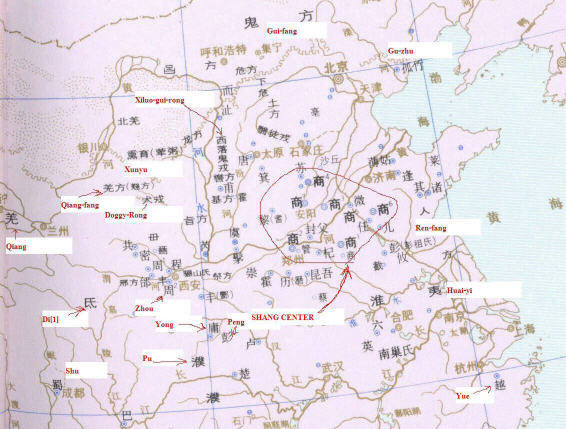
The Shang Chinese apparently had much sophisticated knowledge about remote lands. Scholar Wei Juxian [Wei Chu-Hsien] analyzed the character 'long' for dragon and derived a conclusion that it was originally in the form of 'king snake' which the ancient Indian circus people brought over to Shang China. Wei Chu-Hsien also analyzed the character for phoenix to derive a conclusion that ancient Indonesians had brought 'jile-niao' peacock kind of red bird to China.
Wei Chu-Hsien stated that Shang Chinese, on basis of oracle words "feng (phoenix people) lu (surrender) bai (hundred)", had at one time received hundreds of turtles from the ancient Indonesians and Malaysians as tributes and later used the turtle shell for inscribing the oracle characters.
Some experts did pick up Wei Juxian's hint and researched into the origin of the turtle shell to derive a conclusion that it might have come from Southeast Asia.
The Shang Chinese had already begun an expansion towards the perimeters of China. They designated four rulers in different directions, with the ancestor of the later Zhou Chinese being conferred the title of 'Xi Bo', i.e., Count of the West.
The Shang army would be probably the only army allowed on the domain to protect it from barbarians. Charles Hucker, in "China's Imperial Past", mentioned that Shang might have altogether 25 fiefs or statelets under its direct control. The number of fiefs or statelets certainly did not count the vassals as far as Sichuan Province - the land of the Sanxingdui Bronze Civilization, which was recently speculated to be related to the Xia Chinese refugees. Zhou King Wuwang, during his campaigns against Zhou, had at one time rallied Shang's 800 vassals. The Shang ruler, as commander-in-chief, led this army in campaigns against northern barbarians as well as against those aliens in the Yangtze River area.
Shang Dynasty's Totem - Bird
One important thing about the Shang people is their totem, a bird called 'Xuan', interpreted as either swallow or phoenix. (Guo Moruo claimed that 'xuan-niao' was the phoenix.) Note that the literal meaning of 'xuan' is black, leading to
orion.it.luc.edu/~cwinter/blshang2.htm
by Clyde Winters who vehemently advocated a ludicrous school of thought that the Shang Chinese were of the Negroid origin.
The totem bird's color had nothing to do with the race or color of skin/hair.
(Wei Chu-hsien did commit a fatal mistake in extrapolating on the tin decipher for the city of Wuxi ["no tin"] and polarized the Xia-Shang dynastic substitution as a fight between Mongoloid [Negroid to be in Wei's apparently blown-away alternative writing] and Caucasoid, i.e., a fallacy that scholar Luo Xianglin opposed. Do note that Wei was a student of Wang Guowei who fallaciously proposed the notion of linking 'Hua' to the Avars and 'Xia' to the Tu-huo-luo kingdom in Central Asia. Should Wei have adopted 'black fish' of the Yangtze Deta as the god of "dark-skinned" Shang people who moved to the Yellow River with the tin from Wuxi hill, then how could he reconcile the ancient claim that the father of Yu, i.e., Gun of the Xia people, was named 'black fish'? )
The Shang Dynasty people were linked to the Yi tribal group. Tai-hao-shi, invariably and mistakenly linked to the mythic figure Fuxi in the last 2000 years, was said to be the ancestor of the Feng[wind]-surnamed tribes.
Zuo Zhuan repeatedly stated that Tai-hao-shi, whose ruins ware at the later Chen-guo fief, had such family names as 'Ren4' and 'Su4' around the domain of today's Henan-Shandong provinces. (Shandong Province, however, was possibly mistaken to also be the birth-place of Huangdi, i.e., the Yellow Lord, with the naming of Shouqiu likely misappropriated to Shandong from that in the Da-xia or Grand Xia land of today's southern Shanxi Province.)
Shao-hao-shi (junior 'Hao' clan), said to be the offspring of earlier Tai-hao-shi (i.e., the senior 'Hao' clan), had included various bird-totem sub-clans such as Feng-niao-shi (phoenix), Xuan-niao-shi (black bird), Qing-niao-shi (green bird), Zhu-jiu-shi, and Shuang-jiu-shi etc. Feng-niao-shi, per Zuo Zhuan, was put in charge of the calendar as a minister because the phoenix bird knew the change and whims of the times.
The Feng[4]-niao-shi (phoenix) wording could have corrupted into one of the Nine Yi people, namely, the Feng(1)-yi or the Wind Yi, that carried the ancient Taihao wind-surname. Or, the other way around, in that the same soundex for Feng[1] or wind could have corrupted into the word Feng[4] for phoenix. Or, the two words were inter-exchangeable.
In light of the excavated three-leg sun bird, there would be a good chance that the character for Feng[1] or wind could have derived from the other same soundex word for phoenix, with the later scholars getting mistaken about the origin of the wind-denotation character and giving an illogical explanation related to Tai-hao-shi and wind.
Scholar Wang Zhonghan pointed out that i) Tai-hao-shi and Shao-hao-shi, dwelling around Mt. Taishan and the coast - known in the ancient times as 'hai [sea] dai [Mt. Taishan]', might have absorbed some elements from the Huangdi tribe of the Yellow River line; and ii) that the character 'Yi' had appeared as the Shi-fang statelet in Shang Dynasty's oracle bones; and iii) that by the late Spring & Autumn time period, numerous Eastern Yi groups still existed in today's Shandong-Jiangsu provinces and around the Huai-shui River.
Among above-mentioned bird totem people, Xuan-niao-shi meant for the Shang people.
In the land of the east, close to and strictly speaking, more than 8-9 groups of the 'Yi' people were recorded in the ancient times, invariably endorsing 'bird' as their totems. The totem names would be in various colors, like white bird, yellow bird and etc.
As pointed out by scholar Zhang Fan in his article, "A Research Into the Shang Totems and the Confucius' Ancestry", Lord Yu, per "Mo Zi", had spread teachings to the nine Yi people in the east.
Section on the Dong-yi in Ban Gu's Hou Han Shu stated that the Yi people included such subgroups as Quan-yi [doggy Yi], Yu-yi, Fang-yi, Huang-yi [yellow Yi], Chi-yi [red Yi], Bai-yi [white Yi], Xuan-yi [black Yi], Feng-yi [wind Yi], Zi-yi, and Yang-yi [sun Yi] etc., hence incorporating 'Yi' all around ancient China on an inclusive scale.
Zhang Fan cited another scholar's research in stating that the colors of yellow, white and red etc. was for designation of the clothing of the Yi people.
The Bamboo Annals included the additional Huai-yi [the Huai-shui River Yi] and Lan-yi [blue Yi]; and Yu Gong (Lord Yu's Tributes) of Shang-shu mentioned Lai-yi [the Laizhou prefecture Yi].
Yu Gong, in fact, was more precise in making the distinction among the Yi people, listing the Dao-yi (island Yi) in the ancient Ji-zhou prefecture [who came from today's Liaodong Peninsula by sea, using the Jie-shi mountain around today's Mountain and Sea Pass as the beacon tower equivalent, and sailed into the ancient Yellow River for surrendering tributes], the Yu-yi [sea corner Yi] and Lai-yi [the Laizhou prefecture Yi] in the ancient Qing-zhou prefecture, the Huai-yi [the Huai-shui River Yi] in the ancient Xu-zhou prefecture, the Niao-yi -bird totem Yi] in the ancient Yang-zhou prefecture, plus the He-yi in the ancient Liang-zhou prefecture.
(Note that the ancient book Yu Gong made a difference between the Dao-yi and Niao-yi while the two characters later corrupted into each other to mean the wrong Yi group, i.e., the island Yi in today's southeastern Manchuria being swapped to be the bird totem Yi in the Yangtze River area.
In the modern times, the Jie-shi mountain, i.e., Mt. Jieshi, was disputed to be somewhere on today's Shandong peninsula, which was wrong.
Cao Cao, returning from his triumphant campaign in today's southern Manchuria in the autumn of A.D. 207, came to Mount Jieshi, i.e., the ancient landmark for the seafarers to enter the Yellow River river course, wrote a poem Guan Cang-hai (observing the expanse of the seas), stating that the sun and moon traveled in the seas as if having their home there and that the starry Milky Way shined on the seas as if having their home there: 'ri-yue zhi xing, ruo chu qi zhong; xing-han can-lan, ruo chu qu li'.)
The 'Yi' discourse was apparently an ancient Chinese categorical assumption of the lexicon meaning of a single character.
More, interesting records in Zuo Zhuan section on the 17th year of the Lu Principality's Lord Zhaogong carried a dialogue between Tan-zi and the Lu lord in regards to the Shaohao-shi's practice of using the bird suffix for the titles of court ministers. Tan-zi's reply was that Shaohao-shi, who was his ancestor, had adopted the symbol the same way as Huangdi-shi's using the cloud suffix, Yandi-shi's using the fire suffix, Gonggong-shi's using the water suffix and Taihao-shi's using the dragon suffix. The point here is that the ancient people did not really make a distinction between the bird totem people and the Sinitic people. The ancient people merely treated the symbols as metaphysical embodiment of a dynasty.
Using Viscount Tan-zi's example, we could see that the Shaohao-shi people had adopted the phoenix as a totem, with three layers of tribes and clans. While we know that the ancient Taihao-shi people were Feng-surnamed or wind-surnamed, the Shaohao-shi people carried the 'ji' (3) surname. We do have an exhaustive list of the 'shi'-suffix tribes and clans, with the first layer being the Phoenix totem, the second layer being the tribes of Fengniao-shi (phoenix), Xuanniao-shi (black bird, i.e., swallow), Bozhao-shi [or Bolao-shi; dujuan {cuckoo}], Qingniao-shi (green bird), and Danniao-shi (red bird), the third layers being the eagle-suffixed, and the chicken-suffixed or the peacock-suffixed clans.
The first tier birds were in charge of calendar and seasons, while the eagle tier in charge of administration of people, and the peacock tier in charge of the engineering, plus "jiu-hu" who were the nine agricultural officials.
In this webmaster's opinion, the Sinitic people or the mixed-Sinitic/Hmong-mien people, after dwelling in the historical land of the Nine Yi people, had become some quasi-Yi people, the same way as the Xia-lineage Qi-guo lord had behaved.
Alternatively speaking, the Neolithic Era ancient Chinese, from the coast to today's northwestern China, always upheld the phoenix as a symbol, as seen in the excavated potteries carrying the three-leg birds coupled with the sun image.
Shang's totem would be a topic during Zhou's succession of Shang as the sentence "Phoenix Singing on Mount Qishan (Zhou's homeland)" went, meaning the power totem would change hands. (Today's dragon dancing, as seen in Chinatowns during the spring festivals, is a much later phenomenon. It would be Haan Fei the legalist who described to Qin's First Emperor Shihuangdi the kind of prickly skin a dragon had. Han Dynasty's first emperor Liu Bang would be said to be an incarnation of a red dragon who cut a white snake into two halves while he was on the road of taking refuge after he set free convicts of the Qin Empire. Complicating the matter of the dragon reverence would be the fact that early Huns called their city of pilgrimage 'long cheng', i.e., dragon city, and they had an annual gathering for revering dragons. Should we say the Huns were true descendants of dragon?)
The Chinese Ethnicity
Often misinterpreted would be two words in "Shi Ji": 'Qian Shou' and 'Li Min'. 'Qian Shou' means dark head. 'Qian' would be used as an alias for Guizhou Province in the south, and it means dark or black. 'Li Min' or 'Limin' means the people whose face had turned darkish and became brown. Both terms were used for designating the lower level people. There were a few wild claims, including Clyde Winters', saying that the Chinese people being ruled were of the Negroid origin and that the 'Li Min' term validated this fact. Clyde Winters cited a late Chinese scholar called Kwang-chi Chang, i.e., Guangzhi Zhang, in supporting his claim. This webmaster read through Zhang's article on the early dynasties and noticed only one definite statement in regards to the 'dwarfs' or pygmy people who had at one time shown their presence on the Chinese continent. Clyde Winters' claim was fallacious the same way as those who claimed that the rulers of China, Zhou or Qin, were of the Caucasoid origin and they ruled the Mongoloid people. This webmaster deems both sayings as fallacious.
The fallacy could have origin in the incomplete research done by ROC-era archaeologist Li Ji who published a book on the skulls of sacrificial victims buried in the Shang tombs, with a claim of five types of people including the so-called proto-Caucasoids and proto-Pacific-negroids [but none of the Chinese type]. Scholar Yang Ximei continued the line on those skulls excavated in 1935; however, their colleagues and students, like Yu Jinquan and Zang Zhenhua, reversed their predecessor's conclusion to state that the measure on the skulls using the pure visual judgment was incorrect, and on basis of the shovel-shaped teeth, concluded that those Shang tomb victims were all Mongoloid in the sense of physical anthropology.
Thus, Kwang-chi Chang's base was invalidated, as well as Clyde Winters' ridiculous claim that was built on top of Kwang-chi Chang's statement.)
"Shi Ji" recorded that Qin's second emperor (Huhai) had once rebutted Li Shi's loyalty by citing Lord Yu's hard work on behalf of Lord Shun. Hu-hai said that Lord Yu had spent years travelling around the country for sake of flood control and that Lord Yu's face had turned 'li hei', that is, the kind of brownish darkness. Also on record would be Li Shi's self account by calling himself a 'qian shou' or 'qianshou', i.e., a civilian. "Haan Fei Zi" said that the working people possessed hardened palms and 'li' face as a result of hard work and that they should be ascribed big contributions to the society. Records in the 4-5th century continued to use the word 'li' or 'zheng li' (steaming or sweating li people) for designating the masses. (The character 'zheng', per Chinese dictionary, means a huge number, but this webmaster would rather interpret it on basis of its original meaning, i.e., steam. This character was also used for the relationship between a man or emperor and his father's concubine.)
To dispel 'hair' extrapolation, some good examples could be illustrated to show that the Qin/Zhou Chinese were not color-blind people.
The blackness, coined in 'Qian Shou' and 'Li Min', was related to the skin, not the hair.
When Qin lord Mugong repented over his mistake in invading the Zheng Principality which had led to the ambush disaster at the Battle of Xiao'er, he used the characters 'huang fa po po' (white hair turning yellowish) to describe the high age of his two counsellors, Jian Shu and Baili Xi. Both old men, 80-90 years old, had objected to Mugong's war against Zheng in the first place.
The second example would be the reference to the Daoist founder, Lao-zi, as Huang Lao.
Lao-zi was recorded to have grown the yellow beard and he was called Huang Lao or the Yellow Elderly.
This shows that the ancient Chinese did know the difference between 'huang' (yellow) and black. The universal feature of 'black' hair was not something that would have deserved a special coding in the terms of 'Qian Shou' and 'Li Min'.
In classics "Zuo Zhuan", during the 28th year reign of Lu Lord Zhaogong, a statement was made to infer that in the old times, a You-ren-shi woman bored a beautiful daughter, with 'zhen[3] hei[1]' (i.e., dense and black) hair.
This was related to the enumeration of a list of beauties by Shu-xiang's mother to dispel his son's plan to marry beauty Xia-ji's daughter. Hou-kui, a Xia Dynasty 'yue zheng' or music/ritual administrator carrying the 'hou4' prefix, married a You-ren-shi beauty called by 'xuan qi' [dark-hair wife], and born son Bo-feng who was called 'feng1 shi3' or a big pig, for the greediness, a son who caused the demise of the Hou-kui's lineage after B-feng died in the hands of Hou-yi [who usurped the Xia throne].
'Qian Shou' and 'Li Min' meant nothing other than brownish dark skin as a result of sunlight exposure, not hair.
The Shang Dynasty Descendants at the Perimeter
Other than the Soong statelet where Shang Prince Wei-zi was to continue the Shang heritage as a fief under the Zhou Dynasty
(1121 - 256 BC;
1106-771 B.C. per Zhang Wenyu; 1044-256 B.C. per Cao Dingyun; 1122-256 B.C. per Liu Xin; 1116-256 B.C. per Huangfu Mi; 1111-256 B.C. per Seng Yixing; 1050 - 256 per the forgery contemporary version [Jin Ben] of The Bamboo Annals) rule, we mentioned a group of the Rong people under King Bo in western China.
Additionally,
Shang Prince Ji-zi purportedly took a large number of the Shang people for the land of "Yang-yi" (i.e., sun Yi) or "Ming-yi (i.e., brightness Yi).
Ji-zi was to found the ancient country of Chaoxian (Korea) in southern Manchuria and North Korea.
In the Book of Changes, the clear reference was the conferral of the land of Korea onto Shang Dynasty Prince Ji-zi, with the words stating that Ji-zi was in the land of 'Ming-yi', i.e., the brightness Yi people --which could be the 'Yang-yi' or the Sun yi living along the Shandong coast during the 3rd-2nd millennia B.C.E., one of the Nine Yi people, with nine meaning nothing other than numerous in Chinese,
similar to the Yuezhi's nine Zhaowu clans in central Asia or the Nine Name Hu Clans.
Ji Zi devised eight clauses of teachings for his people, with his dynasty lasting over 40 generations.
Note that in Zhou King Muwang's travelogue Mu-tian-zi Zhuan, there was an inference to the effect that the Shang Dynasty remnants were assigned the fief of the Northern Yellow River Bend as Count 'he-bo', the guardian god of river.
Those Shang people, who lived at the river bend at Zhou King Muwang's time, could be the same as
the "Mo" ["He"] people who were recorded by
Shi Jing
to
have relocated to Manchuria under the pressure of the "Xianyun" barbarians (i.e., predecessors to the Huns).
In the "Mo" ["He"] or "Mo-Hui" land of Manchuria, the Koguryo people and the Fuyu predecessor were successively recorded by San Guo Zhi, Liang Shu and Bei Shi to have adopted the Shang Dynasty's practice and customs, namely, treating the month of lunar December as the start of the new year and lunar October the time for the sacred heaven-praying ceremony, as well as wearing the white-colored clothing and decoration. Alternatively speaking, the barbarians who had moved into today's Manchuria might have adopted the Shang customs which were prevalent in the area of today's southern Manchuria, as were embodied by the Guzhu statelet and Ji-zi Chaoxian statelets etc.
Ah Xiang
|
|
|
|
|
|
|
Sovereigns & Thearchs;
Xia-Shang-Zhou dynasties;
Zhou dynasty's vassalage lords;
Lu Principality lords;
Han dynasty's reign years
(Sexagenary year conversion table-2698B.C.-A.D.2018; 247B.C.-A.D.85)
|
|
The Sinitic Civilization - Book I is
available now on
iUniverse,
Barnes & Noble,
Amazon,
Google Play|Books
and
Nook.
The Sinitic Civilization - Book II is
available at
iUniverse,
Amazon and Barnes & Noble.
Check out the 2nd edition preface that realigned the Han dynasty's reign years strictly observing the Zhuanxu-li calendar of October of a prior lunar year to September of the following lunar year, and the 3rd edition introduction that had an overview of Sinitic China's divinatory history of 8000 years.
The 2nd edition preface had an overview of the epact adjustment of the quarter remainder calendars of the Qin and Han dynasties, and the 3rd edition introduction had an overview of Sinitic China's divinatory history of 8000 years.
The 2nd edition realigned the Han dynasty's reign years strictly observing the Zhuanxu-li calendar of October of a prior lunar year to September of the following lunar year.
Stayed tuned for Book III that is to cover the years of A.D. 86-1279, i.e., the Mongol conquest of China, that caused a loss of 80% of China's population and broke the Sinitic nation's spine.
Preview of annalistic histories of the Sui and Tang dynasties, the
Five Dynasties, and the two Soong dynasties
could be seen in
From the Khitans to the Jurchens & Mongols: A History of Barbarians in Triangle Wars and Quartet Conflicts
(The Barbarians' Tetralogy - Book III: available at iUniverse;
Google Play|Books;
Amazon;
B&N).
(A final update of the civilization series is scheduled for October of 2022, that would put back the table of the Lu Principality ruling lords' reign years, that was inadvertently dropped from Book I during the 2nd update.)
|
|
Now, the Scourge-of-God-Tetralogy.
Book III of
The Barbarian Tetralogy, i.e., this webmaster's barbarism series, is released in October of 2022 by iUniverse. This barbarism series would be divided into four volumes covering the Huns, the Xianbei, the Turks, the Uygurs, the Khitans, the Tanguts, the Jurchens, the Mongols and the Manchus.
Book I of the tetralogy would extract the contents on the Huns from
The Sinitic Civilization-Book II,
which rectified the Han dynasty founder-emperor's war with the Huns on mount Baideng-shan to A.D. 201 in observance of the Qin-Han dynasties' Zhuanxu-li calendar.
Book II of the Tetralogy would cover the Turks and Uygurs.
And
Book IV would be about the Manchu conquest of China.
From the Khitans to the Jurchens & Mongols: A History of Barbarians in Triangle Wars and Quartet Conflicts
, i.e., Book III of
the Scourge-of-God-Tetralogy,
focused on the Khitans, Jurchens and Mongols, with the missing one-year history of the Mongols' Central Asia campaigns rectified.
This webmaster, other than the contribution to the Sinology studies in rectifying the Huns' war to 201 B.C., and realigned the missing one-year history of the Mongol Central Asia war, had one more important accomplishment, i.e., the correction of one year error in the Zhou dynasty's interregnum (841-828 B.C. per Shi-ji/840-827 per Zhang Wenyu) in
The Sinitic Civilization-Book I, a cornerstone of China's dynastic history.
|
The Scourges of God: A Debunked History of the Barbarians (available at iUniverse|Google Play|Google Books|Amazon|B&N)
From the Khitans to the Jurchens & Mongols: A History of Barbarians in Triangle Wars and Quartet Conflicts
(The Barbarians' Tetralogy - Book III)
Epigraph,
Preface,
Introduction,
Table of Contents,
Afterword,
Bibliography,
References,
Index
|
|
|
|
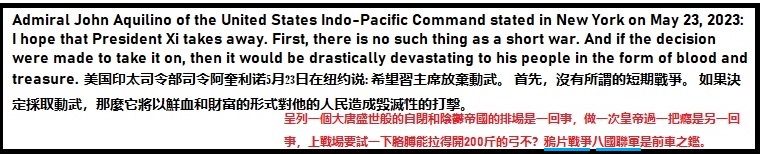
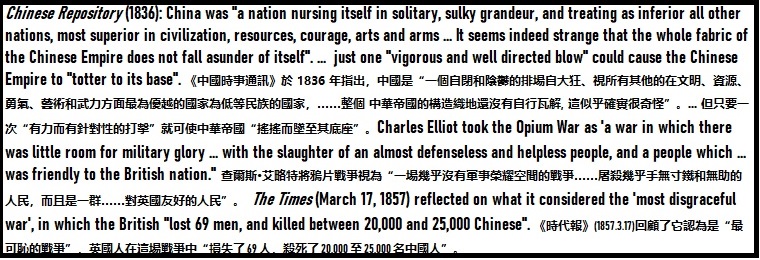
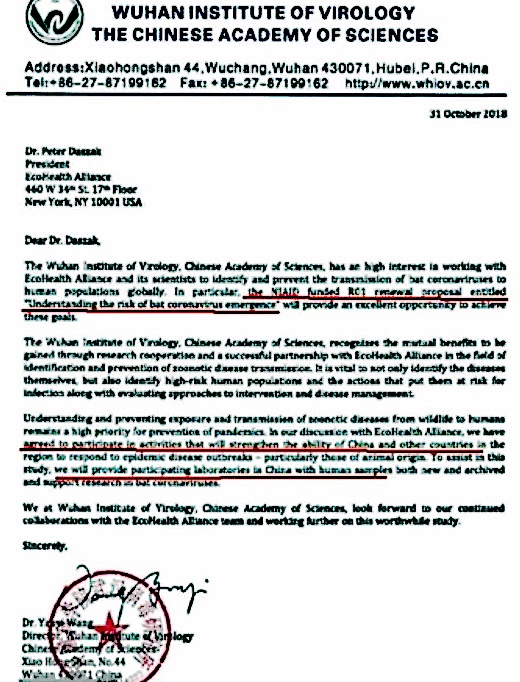
 ***
***


![Though, Anna Wang [Anneliese Martens], in her memoirs, expressed jealousy over Gong Peng by stating that the Anglo-American reporters had flattered the Chinese communists and the communist movement as a result of being entranced with the goldfish-eye'ed personal assistant of Zhou Enlai](GongPeng.jpg)