Sinitic Civilization-Book 1

Sinitic Civilization-Book 2

Tribute of Yu

Heavenly Questions
Zhou King Muwang's Travels

The Legends of Mountains & Seas
The Bamboo Annals - Book 1

The Scourge-of-God-Tetralogy:
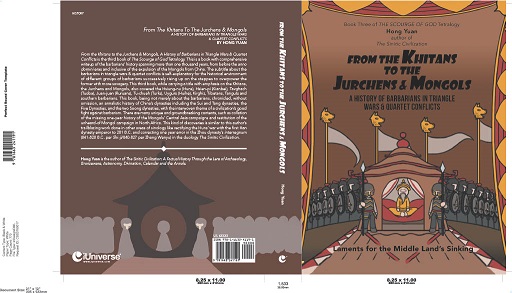
From the Khitans to the Jurchens & Mongols: A History of Barbarians in Triangle Wars and Quartet Conflicts
(available at iUniverse;
Google;
Amazon;
B&N)
|
|
THE SIXTEEN NATIONS
Han Dynasty had inherited the domain of the Qin Empire, and it would wage zigzag warfare with the Huns for centuries, but a breach similar to the Visigoths destroying the Roman Empire would not come till the 4th century when the so-called 'Five Nomadic Groups' ravaged China as a result of disintegration of Western Jinn Dynasty (A.D. 265-316). Historians blamed it on General Ts'ao Ts'ao who relocated the Huns to today's Shanxi Province during the Three Kingdoms Period (A.D. 220-280). By A.D. 317, all of China north of the Yangtze River/Huai River had been overrun by the nomadic people: the Xianbei from the north and northeast; some remnants of the Xiongnu (Huns, including the Jie-hu affiliate) from the north and northwest; and the Qiang and Di [1] people Tibet from the west and the southwest. This situation was resolved by the Tuoba who united northern China into Wei Dynasty (A.D. 386-534).
The Hunnic-Xianbei rebellion against the Jinn Chinese led to the turmoil in northern China called the 'Sixteen Nations' or the 'Five Nomadic Groups Ravaging China' (i.e., Wu Hu Luan Zhong Hua). The rebellion was the result of internal turmoil among the Jinn Chinese princes. The late Jinn China period was known as the 'Turmoil of Eight Sima Kings'. The eight Jinn princes were named Sima, carrying the last character 'ma' (meaning 'horse'). When Sima princes almost finished off each other, Wang Jun, a border general at today's Beijing, colluded with the Xianbei in the attempt of fighting back against Sima Ying who previously attempted to kill Wang Jun by sending an assassin. Liu Yuan, a Hun hostage, was released by Sima Ying for organizing the anti-Xianbei forces among the Southern Huns. Soon after that, Liu Yuan proclaimed the founding of Hunnic Han Dynasty (A.D. 304-329). The Huns went on to route the two Jinn capitals of Luoyang and Xi'an, respectively.
With the demise of the Jinn court at Luoyang and Chang'an, the majority of the Han-ethnic Chinese from "zhongzhou" [central prefecture], about 60-70% per Biography on Wang Dao in Jinn Shu (The History of Jinn Dynasty), fled to the south of the Yangtze River.
Li Hun and Chen Wu, rallying anti-Jiehu forces, fought against the barbarians in the attempt at rescuing Emperor Huaidi, the abducted emperor.
Li Hun fought on against Shi Le's Jie-hu barbarians till A.D. 313, when he was killed at the Battle of Shangbai.
The Chinese, other than moving to southern China, fled to the perimeters in hordes, with some fleeing into the Sichuan basin to be part of Chen-han of the Di[1] barbarians, some fleeing to Manchuria, and some fleeing to the Western Corridor to join some Chinese general on the Silk Road, who set up Anterior Liang (A.D. 317-376).
For the remnants left in northern China, the Chinese, under the massacre of the barbarians, organized militia for defense. According to excavated books from the Kumtag humming sand dunes ("mingsha shishe yishu", edited by Luo Zhenyu) from the Dunhuang Grotto in the desert of the Western Corridor, there were no more than 40 military leaders building and defending the forts in North China, with the strong ones possessing 4 to 5 thousand families and the weak ones numbering 100 to 500 families. This would yield about less than 1 million ethnic Chinese stranded in North China.
This was the situation after major armed bands had vacated North China for the territory south of the Huai River.
After Xi Jian, Zu Ti (Zu Di) and Su Jun et al., left North China, armed bands under the leadership of Li Hun and Chen Wu et al., calling themselves by "qi [beg] huo [life] jun [army]", continued the fight against the barbarians.
Serving under Chen Wu and Chen Chuan brothers would be the Ran family from which was produced Ran Min, a hero comparable to General Xiang Yu who overthrew the Qin Dynasty.
Ran Min ultimately exterminated the 'Central Asian' Jie-hu barbarians to secure the domain of North China for the Sinitic Chinese.
North China hence entered the turmoil time period of
the 16 Nations (A.D. 304-420) or the historical time period called the "Five Hu [Nomadic Groups] Ravaging China", with the five groups being the Huns, Jie-hu, Xianbei (including Wuhuan & Tuoba), Qiang, & Di [including a varied Di group called Ba-di in the Sichuan basin].
Various nomadic groups, including the Huns, Jiehu, Xianbei (Wuhuan & Tuoba), Qiang, & Di[1], established short-lived dynasties.
(The [Western] Jinn court selected a new emperor one year later and re-established its capital in Chang'an (today's Xi'an, Shaanxi province), only to be sacked again in A.D. 316.)
The Chinese south of the Yangtze had failed to reconquer the northern region. General Zu Ti crossed the Yangtze River but failed to hold on to the gain. The notable thing about this time period is that there were still several Chinese strongholds in today's Hebei/Shandong provinces and in the western Silk Road corridor, that were cut off from the court in southern China.
Cui Hong (478-525), whose ancestor followed Southern Yan lord Murong De to south of the Yellow River, authored the 100-volume book "Spring and Autumns [Annals] about the Sixteen Nations", after which the terminology "the Sixteen Nations" came into being.
Five Hu [Nomadic Groups] Ravaging China
When Western Jinn Dynasty (A.D. 265-316) reunited China, Hunnic King Zuoxianwang sent his son Liu Yuan to Jinn Dynasty to be a hostage, which was a norm laid out by Cao Cao in the late Han period. Liu Yuan spent most of his time in the Chinese court and was a very ambitious man who was suspected by one Chinese minister as well as protected by another minister. When Liu Yuan's father died, he was allowed to go back to the Hun tribes for the funeral in A.D. 304. Then, he returned to the court to fulfill his mission as a hostage. After a Jinn Dynasty border general (Wang Jun) invited the Xianbei and Wuhuan (proto-Tungus people) in attacking Sima Ying at Ye, Liu Yuan requested with the Jinn emperor to go back to the Hun tribes for organizing the
counter-Xianbei forces. With Sima Ying's approval, Liu Yuan returned to the Huns, and helped Jinn in defeating the Xianbei and the Jinn rebel Wang Jun.
Thereafter, Liu Yuan was appointed Da-dudu (i.e., "grand marshal") of the five Hunnic Tribal Groups.
Soon after that, Liu Yuan proclaimed the founding of Hunnic Han Dynasty (A.D. 304-329) in Zuoguocheng (leftside tribal statelet's city, i.e., Lishi of Shanxi), took control of Bingzhou (Shanxi) and went on to route the two Jinn capitals of Luoyang and Xi'an, respectively. (Liu Yuan claimed to King of Han in A.D. 304, pronounced himself emperor in A.D. 307, and officially launched the Han-guo statelet in Pingyang in A.D. 308.)
Hunnic King Youxianwang Liu Xuan proposed that Liu Yuan proclaim himself to be the great Hunnic emperor.
Liu Yuan,
like all other Hunnic kings, had adopted the family name "Liu" of Han emperors, agreed to the proposal and proclaimed the founding of the dynasty of Hunnic Han, meaning a posterior dynasty of Han against Jinn (A.D. 265-316) and Wei (A.D. 220-265) which usurped Han, in the sense of succession. Liu stated, "The great Chinese saint, Lord Yu, was originally a Xirong (western Rong) and the Zhou kings (1122? BC - 221 B.C.) were from the Dongyi (eastern Yi), where is the logic that the emperors must be of the same ethnical origin?"
In A.D. 311, the Huns under successor Liu Cong captured Luoyang, the capital of [Western] Jinn Dynasty, and caught Emperor Huaidi who enthroned in 306 and pronounced the era of Yongjia. This came to be known in the Chinese history as the "Cataclysm of Yongjia", namely, the first disaster that the Sinitic Chinese suffered in the hands of the barbarians. In A.D. 316, the Huns captured the new Jinn emperor, Mindi, in Chang'an (present Xi'an), ending the Chinese rule in North China.
After Liu Yuan's death, the Huns under Liu Yuan's son, Liu Cong, took over the Jinn capital Luoyang in A.D. 311.
Shi Le, a Jie-hu [i.e., the lowest ranking Huns] under Hunnic Han (alternatively named Zhao) Dynasty, set up Posterior Zhao Dynasty. Ran Min (Liang Min in the Japan-preserved Chinese history book), the adopted son of Shi Le, after dozens of years of service under the Jiehu, rose up to kill all Jie-hu and set up a Chinese Wei Dynasty, alternatively called Ran Wei Dynasty.
Ran Min at one time killed about 200 thousand Jie-hu and history said he killed whoever looked like Jie-hu because of high nose bridge and growing abnormal mustache and whiskers.
By killing the Jie-hu barbarians, Ran Min saved the Sinitic Chinese from being eliminated by the Caucasoid Central Asian Jie-hu barbarians.
A Xianbei by the name of Murong Jun, who answered the Jie-hu call to fight Ran Min, defeated Ran Min's Ran Wei Dynasty, caught Ran Min live and killed him, and set up Anterior Yan (A.D. 337-370).
Murong Chui,
i.e.,
Murong Jun's brother
and Murong Huang's fifth son,
defeated the northern expedition led by Eastern Jinn China's General Huan Wen. But Murong Chui was not trusted by the nephew emperor. Hence, Murong Chui fled to Fu Jian's Di[1] nomads. Fu Jian, whose ancestor served under the Jiehu, defeat Anterior Yan Dynasty and set up Anterior Qin (A.D. 351-394).
After the fall of Anterior Qin as a result of the collapse of the barbarian alliance's campaign against the Eastern Jinn court at the A.D. 383 Battle of Fei-shui, the Xianbei re-established Posterior Yan (A.D. 384-409) and the Qiangs set up Posterior Qin (A.D. 384-417).
Among the Western Xianbei, the Qifu clan set up Western Qin (A.D. 385-400, 409-431), and the Tufa clan set up Southern Liang[2] (A.D. 397-414). Numerous statelets, like Posterior Liang, Northern Liang, Southern Yan, Western Liang, Hunnic Xia and Northern Yan would follow.
|
| Cheng Han |
Di 301-347 |
| Hun Han (Zhao) |
Hun 304-329 |
| Anterior Liang |
Chinese 317-376 |
| Posterior Zhao |
Jiehu 319-352 |
| Anterior Qin |
Di 351-394 |
| Anterior Yan |
Xianbei 337-370 |
| Posterior Yan |
Xianbei 384-409 |
| Posterior Qin |
Qiang 384-417 |
| Western Qin |
Xianbei 385-400, 409-431 |
| Posterior Liang |
Di 386-403 |
| Southern Liang[2] |
Xianbei 397-414 |
| Northern Liang |
Hun 397-439 |
| Southern Yan |
Xianbei 398-410 |
| Western Liang |
Chinese 400-421 |
| Xia |
Hun 407-431 |
| Northern Yan |
Chinese 409-436 |
|
|
Ultimately, the Tuoba, who were of the Xianbei heritage but carrying a Hunnic [and later Turk] hair style, took over northern China and assumed power in northern China after defeating the Xianbei and the Huns. The Tuoba set up their Tuoba Wei or Northern Wei Dynasty, lasting through A.D. 386-534, till it split into Eastern Wei (A.D. 534-550) and Western Wei (A.D. 535-557).
While the Chinese chronology set the year of A.D. 304 as the start of the 16 Nations time period, Cheng Han (A.D. 301-347) of Di[1] barbarian nature already took over today's Sichuan Province by A.D. 301. Not included in the sixteen nations would be the so-called Ran Wei Dynasty set up by Ran Min. Among the 16 nations, Anterior Liang (A.D. 317-376), Western Liang (A.D. 400-421) and Northern Yan (A.D. 409-436) were ruled by the Chinese. One more statelet not included on the list would be that of the Tuyuhun, a Xianbei tribal statelet, which lasted for about 350 years in history, from the end of Yongjia years (A.D. 310s) of Jinn Dynasty to the 3rd year of Longshuo (A.D. 663) of Tang Dynasty. Tuyuhun would be responsible for defeating the last Hunnic Xia ruler, Helian Ding, and handed over Delian Ding to Tuoba Wei Dynasty for execution.
The Five Hu Nomadic Groups
In the following, I will expand on the topic of the Sixteen Nations by expounding on the nature of nomadic groups and their respective statelet's histories.
The Hun Barbarians
The Southern Huns became sedentary people after they were relocated to northern Chinese prefectures where they multiplied into millions to pose a threat to Jinn Dynasty (A.D. 265-316) in the 3-4th centuries. The impact of the barbarians on northern China had been compared to that felt by Rome. We could probably sense the influx of the Sinicized barbarians by calculating a rough figure for the Huns. General Cao Cao (Ts'ao Ts'ao) re-organized thirty thousand Hun tribes in today's Shanxi-Shaanxi provinces during the 2nd century A.D. We could estimate the Huns to be having 50 persons per tribe, to yield about 1.5 million.
In A.D. 280, China's population was estimated to be 16.16 million in total. Two very good examples remain to achieve a more accurate estimation of the figures. One example would be Emperor Fu Jian's order to disseminate his Di[1] barbarians among posts in northern China, and another example would be the extermination of Jiehu. Emperor Fu Jian, after a revolt of his kinsmen, decided to disperse his tribesmen across various military posts, and altogether 15,000 households were driven out of the capital. As to the Jiehu, Shi Min, an adopted son of Jiehu's Posterior Zhao, had at one time killed about 200,000 Jie-hu in and around the capital city of Yecheng (i.e., today's Anyang of Henan Province).
By the end of Ts'ao Wei Dynasty, the title of 'yuan shuai' (marshal) for Hunnic governor was changed to 'duwei' (captain). The Leftside Tribe 'duwei' was allowed to control 10,000 households and they dwelled in Cishi County, Taiyuan; Leftside Tribe, 6,000 households, Qixian County; Southside Tribe, 3,000 households, Puzi County; Northside Tribe, 4,000 households, Xingxin County; and Central Tribe, 6,000 households, Daling County. (Here, we could add up the households to derive a total of 29,000 for the five Hunnic tribal groups. Using 4 persons per household, those Huns would number 116,000 heads.) After Jinn Dynasty was founded in A.D. 265, the Huns outside of the border suffered flooding, and hence 20,000 more households of the Huns from Saini and Heinan were relocated to Yiyang, west of the Yellow River Bend. In A.D. 284, 29,300 Huns, led by Hutai Ah'hou, submitted to the Jinn Chinese. The second year, another group of the Huns, 11,500 Huns in total, came to Jinn China. The History of Jinn Dynasty recorded that altogether 19 Hunnic tribal affiliations came to China. Among them, the Tuge (or Zhuge) tribal affiliation was the most elite, where the Hunnic 'chanyu' would be selected. The Huns enjoyed 4 big family names, Huyan, Bu (Xubu), Lan (Helan), and Qiao (? Qiulin-shi). Huyan could assume the title of the leftside or rightside 'sun chasing kings', Po the title of the leftside or rightside 'juqu', Lan the leftside or rightside 'danghu', and Qiao the leftside or rightside 'duhou'. Around 295s A.D., the Huns began to rebel against the Jinn Chinese authorities, killing officials and looting.
A Jinn minister, by the name of Jiang Tong, submitted a petition to the emperor to have the barbarians expelled from China, with a claim that among the over 1 million people residing in the Guan-zhong territory between the Hangu'guan Pass [i.e., the Yellow River Inflexion point) and the Western Corridor, the Rong-di barbarians had taken up half of the population.
The Jie-hu Barbarians
Replacing the Hunnic Han & Zhao Dynasty would be Posterior Zhao of the Jiehu barbarians. Jiehu, according to History of the Tuoba Wei Dynasty, obtained its name from the localities of Shangdang-Wuxiang-Jieshi in today's Shanxi Province. They were recorded to be an alternative tribe of the Huns. They should belong to those Southern Huns who had been dwelling in northern China during Han-Wei-Jinn time period. I could not find a particular reason why the ancient Chinese classified Jie-hu as a separate entity of the five nomadic groups ravaging China. There must have existed some difference between the Huns and the Jiehu. The only difference on record, between the Jie-hu and the Huns, probably lied in the high nose bridge and the abnormal hair. When Shi Min, an adopted son of Shi Le, killed about 200,000 Jie-hu nomads, he was recorded to have closed down the four gates of the Jie-hu capital of Yecheng and then sorted out the Jie-hu on basis of high nose bridge and hair. Ran Min further ordered governors-general across northern China to exterminate their Jie-hu officers and soldiers.
(Later books on the monkhood had carried passages about the founders of the Jie-hu barbarians, with an inference that they had origin in today's Afghanistan area, and further a hint to the effect that the sons of the Jie-hu dynasty founder were actually born in Central Asia, not China, i.e., a group of people like immigrants - or in this webmaster's opinion more likely 'merchants' like the future Nine Name Hu people who were attached to the Turks.
Later, during the A.D. 755-763 An-Shi Rebellion of the Tang Dynasty time period,
Gao Juren, a general under Shi Chaoyi, issued a similar order to Ran Min of the Sixteen Nation time period, namely, an order to kill the Hu (i.e., high nosebridge and hairy) barbarians --who were of the mixed barbarian background, with An Lushan being born by a Turkic mother and a Hu [Sogdian] father.)
The Xianbei Barbarians
In addition to the Huns and Jie-hu, another group of people, the Xianbei, would come into play. The Xianbei were the northern branch of the Donghu (or Tung Hu, the Eastern Hu) in comparison with the Wuhuan, a proto-Tungus group mentioned in Chinese histories. Xianbei and Wuhuan would be those people who purportedly fled to the two mountains, by the names of Xianbei and Wuhuan, when their ancestors accused Hunnic founder Modu of patricide and got defeated by Modu. By the first century, two major subdivisions of the Donghu had developed: the Xianbei in the north and the Wuhuan in the south. Apparently, the Xianbei and Wuhuan people were located much to the center of Mongolia and northern China in earlier times. They lived to the east of the Huns. They were later relocated to today's Manchuria by Han Emperor Wudi for segregation from the Huns, and hence they inherited the ancient name of Donghu, in my opinion. The Xianbei could be differentiated into i) the Greater Xianbei under Budugeng, ii) the Lesser Xianbei under Kebineng, and iii) the Xianbei in today's Manchuria. An alternative school of thought stated that the Xianbei people were comprised of the Chinese coolies who fled from Qin Emperor Shihuangdi's order to build the Great Wall at the northern borders.
The basis of this claim was that the Xianbei had a practice of cutting their hair, leaving just a bunch of hair at the top of heads, whereas the Huns [and the Turks] -- who were said to be descendants of son Chunwei of the last Xia Dynasty lord Jie -- merely bundled their hair behind the head, either into pigtails or letting it dangle freely, but did not cut hair as their cousins to the east did. Note that the Sinitic Chinese had the customs of bundling the hair on top of heads.
(The hair style could determine the ethnicity. Tuoba Xianbei, who were ascertained to have lived near today's Gaxiandong in northern Xing'an Mountain Range, might have differed from the Xianbei-Wuhuan to the south, in that the Tuoba mostly wore pigtails, for which they were called Suo-lu, i.e., pigtailed enemies. Further, the Jurchens and the later Manchus had apparently adopted the customs of both the Tuoba and the Xianbei, in that they cut their hair at the front and bundled the remaining hair into pigtails at the back.)
The Huns suffered setbacks under constant Han Chinese attacks, and they split into the Southern Huns and the Northern Huns, with the Southern Huns subject to the Chinese rule. The weakened Huns provided a vacuum for the Xianbei (or Hsien-pei in Wade-Giles) to move in in the middle of the 1st century AD. The Xianbei expanded their territories, and they took over most of the northern territories held by the Huns previously.
The Xianbei mixed up with the Huns. The Hunnic Xia Dynasty (A.D. 407-431), established by Helian Bobo, was said to be of a mingle nature, called 'Tie Fu'. The Tie Fu Huns were born of Xianbei mother and Hunnic Father.
The Xianbei and the Wuhuan used mounted archers in warfare, and they had been good mercenaries for the Han Chinese and the Wei Chinese. Among General Ts'ao Ts'ao's columns of army against the Shu State during the three Kingdoms Period (A.D. 220-280), many happened to be the Xianbei barbarians wearing stirrup. Later, in General Liu Yu's southern armies, Xianbei warriors using the long spears called 'shuo' could be found as well.
The Xianbei, who expanded to the Western Corridor area in the wake of the Hunnic decline, defeated last Hunnic ruler Feng-hou in 118 and took over the Hun remnants.
There appeared a Xianbei chieftain called Tanshihuai (Tanshikui) (reign A.D. 156-181) who established a Xianbei alliance by absorbing dozens of thousands of the Huns. The Tanshihuai (Tanshikui) alliance disintegrated after the death of Tanshihuai (Tanshikui). (The later Khitans were said to be descendants of the Tanshihuai (Tanshikui) Xianbei.)
The Tanshihuai (Tanshikui) alliance disintegrated after the death of Tanshihuai (Tanshikui). (The later Khitans were said to be descendants of the Tanshihuai (Tanshikui) Xianbei.)
By the time of Three Kingdoms Period (A.D. 220-280), the Wuhuan people had taken control of today's Hebei Province and Peking areas. The Cao Wei Dynasty broke a new Xianbei alliance by having Wang Xiong send an assassin to kill a Xianbei chieftain called Kebi'neng.
Warlord Yuan Shao campaigned against the Wuhuans and controlled three prefectures of the Wuhuan people. After Ts'ao Ts'ao defeated Yuan Shao, Yuan's two sons, Yuan Shang and Yuan Xi fled to seek refuge with the Wuhuans. Ts'ao Ts'ao campaigned against the Wuhuan, killed a chieftain called Tadun (with same last character as Hunnic Chanyu Modu), and took over the control of southern Manchuria. (The later Xi people were said to be descendants of the Tadun Wuhuan.)
Cao Cao, after dealing a decisive defeat onto Yuan Shao and his Wuhuan allies in the Liucheng area of southern Manchuria and taken out the threat from the north, returned south to attack the Shu-han and Dong-wu statelets, ending in the defeat at the Battle of Chi-bi (Red Cliff) at the Yangtze.
The demise of Han Dynasty saw the Xianbei and Wuhuan taking over the old territories from the Huns in the northern borders as well as invading into the Korea Peninsula. Chen Shou commented that Ke'bineng Xianbei had at one time covered the territories from the Liao River of Manchuria in the east to Yunzhong/Wuyuan in the west. Xianbei had prospered after Cao Cao conquered their kinsmen, i.e., the Wuhuan. The Wuhuan was absorbed by both Cao Cao and Xianbei, and its name disappeared thereafter, only to re-emerge in the 10th century war with the Khitans.
Han Prime Minister Cao Cao's Campaign against the Wuhuan
Yan Zhi & Wang Xiong Pacifying the Xianbei
Cao Wei Dynasty's Campaign against the Gongsun Family in Manchuria
Several Wuhuan chieftains, including Qiuliju (Liaoxi Wuhuan Da Ren, with 5000 households), Nanlou (Shanggu Wuhuan Da Ren, with 9000 households), Supuyan (Liaodong Wuhuan Da Ren, with thousands of households) and Wuyan (You-beiping Wuhuan Da Ren, with 800 households), were controlled by a Han Chinese rebel governor called Zhang Chun from the Zhongshan [i.e., today's Dingxian of Hebei] Prefecture. Han Emperor Lingdi (r. 168-189) assigned Liu Yu[2] as governor-general of Youzhou (Beijing). Liu Yu[2] hired some barbarians to have Zhang Chun killed. After the death of chieftain Louban, an adopted son called Tadun took over the chieftain post. Tadun assisted Yuan Shao in the wars on rival Gongsun Zan. At one time during the Three Kingdoms time period, Yuan Shao had pacified three prefectures of Wuhuan and heavily recruited them as mercenary cavalry troops. Yuan Shao privately conferred the title of 'Chanyu' on the Wuhuan chieftains in the name of the Han court. When the son of Wuhuan chieftain Qiuliju grew up, he would compete with Tadun for power. A Chinese by the name of Yan Rou (who enjoyed trust among the Wuhuan-Xianbei for his spending childhood years in the barbarian land) killed the Chinese colonel (xiaowei) in charge of Wuhuan and usurped the post. Yuan Shao retained Yan Rou as the 'Wuhuan Colonel'. Cao Cao later defeated Wuhuan chieftain Tadun who offered asylum to two sons of Yuan Shao. Cao Cao won over Yan Rou when he campaigned against the Wuhuan in A.D. 206. Wuhuan chieftains were all decapitated when they fled to Liaodong (east Liaoning Province) for asylum. Over 10,000 Wuhuan households under Yan Rou relocated to China under the order of Cao Cao. The Wuhuan people would then serve Cao Cao as the mercenary cavalry.
Two Xianbei tribal groups came into play, the Lesser Xianbei under Ke'bineng and the Greater Xianbei under Budugeng and his brother Fuluohan. Ke'bineng heavily employed Chinese defectors and utilized the Chinese weaponry and language. Ke'bineng had at one time assisted Cao Cao in cracking down on Tian Ying's Rebellion, but he also rebelled against Cao Cao and the Cao Wei Dynasty rule several times. Cao Cao once sent Marquis Yanling to defeat Ke'bineng and cause him flee outside of Chinese border. In A.D. 219, Ke'bineng sent an emissary, with tributes of horses, to last Han Emperor Xiandi who was under Cao Cao's protection. After the usurpation of Han Dynasty, Cao Wei Emperor Wendi conferred Ke'bineng the title of King of Fuyi (attached loyalty). Beginning from A.D. 221, several times, Ke'bineng repatriated the Cao Wei Chinese groups back to the Chinese territories.
Ke'bineng rebelled against the Cao Wei Chinese again because Tian Yu interfered in Ke'bineng wars with both the Eastern Xianbei under Suli and with a Xianbei chieftain under Budugeng. Ke'bineng complained about this to General Xianyu Fu, mentioning the fact that his brother was killed by Budugeng. Ke'bineng said he was recommended for the ruler's post by Yan Rou, he was grateful to the Chinese and he did not want to rebel against the Chinese simply because Tian Yu was giving him troubles. Ke'bineng boasted of over 100,000 cavalry.
A Wuhuan chieftain at Dai Prefecture, by the name of Nengchendi, surrendered to Budugeng but also asked for protection from Ke'bineng. When the two Xianbei chieftains converged upon the Dai prefecture land for controlling the Wuhuan tribe, Ke'bineng killed Fuluohan and took over the Xianbei people led by Fuluohan's son, Xie-guini. Hence, two Xianbei tribes warred with each other. Cao Wei Emperor Wendi (Cao Pi) conferred Tian Yu the post of 'Wuhuan Colonel' with extra authority over the Xianbei people.
Tian Yu set his office at Changping (near Beijing).
Ke'bineng defeated all Xianbei tribes including the Wuhuan, extending the territory from Yunzhong & Wuyuan [north of today's Shanxi border] all the way to Manchuria. Ke'bineng defeated two Chinese generals, Tian Yu and Bi Gui. The other chieftain, Budugeng, relocated to Taiyuan and Yanmen with his over 10,000 households. Budugeng further sent a messenger to his niece Xie-guini and caused Xie-guini defect from Ke'bineng. By A.D. 224, Budugeng sought vassalage with Cao Wei Emperor Wendi.
In A.D. 228, Tian Yu's emissary to Xianbei was killed by Ke'bineng's son-in-law. Hence, Tian Yu dispatched Pudou (Western Xianbei chieftain) and Xie-guini to attacking Ke'bineng in retaliation. When Ke'bineng encircled Tian Yu with 30,000 cavalry, Governor-General of Shanggu [near today's Kalgan area], Yan Zhi (Yan Rou's brother), went to see Ke'bineng at the emperor's order and persuaded Ke'bineng into striking a ceasefire. Later, the new governor-general of Youzhou, Wang Xiong, was conferred the post of Wuhuan Captain. Ke'bineng, several times, expressed loyalty to Wang Xiong.
In A.D. 233, Ke'bineng won back Budugeng by means of an inter-marriage. Budugeng ordered Xie-guini to go back and serve under Ke'bineng, pillaging the Chinese prefecture of Bingzhou [i.e., today's eastern Shanxi]. General Qin Lang counter-attacked, and Xie-guini surrendered and was conferred the title of King of Guiyi (i.e., returning loyalty) and assigned the land of Bingzhou. Later, Budugeng was killed by Ke'bineng. Ke'bineng ordered his son go to Loufan to fight the wars against General Su Shang and Dong Bi (both under Governor Bi Gui of Bingzhou) and killed the two.
During the Qinglong Era, about 235 A.D., Cao Wei Emperor Mingdi (Cao Rui) took the advice of Wang Xiong who had Ke'bineng assassinated by some swordsman called Haan Long. The brother of Ke'bineng was selected as the new chieftain. With Ke'bineng killed, the Xianbei alliance kind of collapsed, and the Cao Wei Chinese court extended control over the whole territory of today's Inner Mongolia and Southern Manchuria.
Among the Eastern Xianbei, there would exist chieftains like Suli, Mijia and Jueji in Liaoxi (western Liaoning Prov), Youbeiping (northwest of Beijing) and Yuyang. Jueji's son was conferred the title of King Qinhan (befriending Han), and Suli's brother, Chengluegui, succeeded the King title, too.
The Xianbei barbarians, with major tribes of Murong [at Youzhou], Yuwen [at Liaodong], Duan [at Liaoxi], would establish many short-lived successive Yan statelets along the Chinese frontier and in northern China. Ultimately, the Tuoba (T'o-pa in Wade-Giles), a subgroup of the Xianbei, who migrated to modern China's Shanxi Province, would reunite China under Tuoba Wei Dynasty.
In A.D. 443, the barbarians who took over Tuoba's old territories, i.e., the upper Heilongjiang River and the northern Xing'an Ridge, came to see Tuoba Wei Emperor (Tuoba Tao) and told him that they found Tuoba ancestor's stone house, called 'Ga Xian Dong'. Tuoba Tao sent a minister called Li Chang to the stone house which was carved out of a natural cavern. In 1980s, this cavern was discovered as well as the inscriptions left by Li Chang.
The Duan Xianbei Tribe
Founder of the Duan clan, Duan Rilujuan, was in his early years sold to a Wuhuan chieftain by the name of Kuluguan in Yuyang.
In a famine year, he was let go. In the Lingzhi area, Duan Jiulujuan built up his clan.
The Duan clan had generations of intermarriage with the Murong clan, starting with the birth of Murong Huang, son of Murong Wei (Murong Hui, Murong Gui).
At the time of the Jinn Sima princes fighting the civil wars, in A.D. 303, Duan Wumuchen was married with a daughter of Wang Jun, for which Wang Jun, the border general in charge of Youzhou, petitioned with the Jinn emperor to confer the hereditary title of Duke Liaoxi-jun onto the Duan clan.
To fight Sima Ying, Wang Jun, with support of the Xianbei and Wuhuan, sacked Ye.
In 310, Duan Wumuchen was appointed the post of "da chanyu" by Jinn Emperor Huaidi.
Son Duan Jilujuan in 311 succeeded Wumuchen's posts and titles, and assisted Wang Jun in fighting rival Liu Kun.
In 312, the Duan clan, in order to get Shi Le release brother Duan Mopei who was caught by Shi Le in fighting Shi Le's Jie-hu army north of Xiangguo, struck a ceasefire with the Jiehu. Wang Jun in the subsequent year failed to get Duan Jilujuan join the battle against the Jiehu, over which Wang Jun instigated the Tuoba tribe and the Murong tribe to attack the Duan clan.
Among the Duan clan, brothers Duan Pidi and Duan Wenyang stayed on Wang Jun's side. With the split of the Duan clan, the Murong tribe rose in strength to the northeast of the Duan clan.
In March of A.D. 314, Shi Le conducted a stealthy attack against Youzhou, and killed Wang Jun. Duan Pidi retreated to Ji (Tientsin) to succeed Wang Jun's post against the Jie-hu.
For the next few years, Duan Pidi and Duan Wenyang brothers frequently rendered aid to the Jinn Chinese forts on the Shandong peninsula, including those under Shao Xu and Liu Yan, et al.
In late 316, Liu Kun fled to Youzhou to seek refuge with Duan Pidi after losing Bingzhou to the Jie-hu.
In 317, Duan Pidi supported Liu Kun to be "da-dudu" in the fight against Shi Le. In March, Liu Kun and Duan Pidi swore to be brothers.
Duan Mopei, who was pro-Jiehu, instigated the Duan chieftain to abort the campaign.
Duan Shefuchen, i.e., Duan Wumuchen's brother, succeeded the "chanyu" post in A.D. 318.
Further, Duan Mopei sowed dissension between Duan Pidi and Liu Kun, causing the former to kill the latter in May.
Duan Mopei, after instigating Shefuchen into suspecting Duan Pidi of rebellion, killed Shefuchen, and usurped the "chanyu" post.
Duan Mopei, who had sworn to be brother with Shi Hu upon release in 312, killed Shefuchen and over 200 people from Shefuchen's family and clan members.
With Duan Pidi isolated as a result of dissipation of the Jinn Chinese, Shi Le and Duan Mopei took over Youzhou.
Duan Wenyang, i.e., Duan Pidi's brother, escorted Duan Pidi in the retreat to the Shandong peninsula.
In A.D. 319, Duan Pidi fled to Yanci (Huimin of Shandong) to seek asylum with Shao Xu, "tai shou" for Leling.
Duan Mopei and the Jie-hu army attacked Duan Pidi and Shao Xu. Duan Pidi defeated Duan Mopei and chased towards Ji. The Jie-hu, taking advantage of Duan Pidi's fight to the north, surrounded Yanci. In February of A.D. 320, the Jie-hu caught Shao Xu when the latter took a fight outside of the city. Duan Pidi failed to return to render relief. One year later, Shao Xu's brother, Shao Ji, surrendered the city, Duan Pidi and the Xianbei remnants to the Jiehu.
Duan Pidi, who refused to surrender to Shi Le, was killed at Xiangguo.
The Murong Xianbei Tribe
To the north, in A.D. 322, Murong Huang sacked Lingzhi, i.e., the capital city of the Duan clan.
In 333, when Murong Wei (Murong Hui, Murong Gui) died, the Duan clan took advantage of the Murong clan's internal turmoil, attacked Murong Huang. The war continued for five years.
In 334 and 336, Duan Lan, i.e., Duan Liao's brother, attacked Liucheng twice.
In 337, Murong Huang proclaimed himself King of Yan, submitted himself to the Jiehu's Posterior Zhao Dynasty, and requested for assistance in attacking the Duan clan which was headed by Duan Liao.
In 338, the Duan Xianbei was thoroughly defeated by the pincer-attacks from the north and south. Subsequently, the Jie-hu and the Murong Xianbei came into conflict. Duan Liao, who was pressed into escaping to Pinggang (Chengde of Jehol), in lieu of surrendering to Shi Hu, turned to Murong Huang. The two Xianbei tribes in December of A.D. 318 repelled the Jie-hu. While the Duan tribesmen joined the Murong clan, Duan Liao himself, who was first made into a guest, was killed a few months later over a plot to rebel against the Murong Xianbei.
Duan Lan, who escaped to the Yuwen clan, was surrendered to the Jie-hu in A.D. 343. At Shi Hu's order, Duan Lan returned to Lingzhi for garrison, part of the Jie-hu's plan to create balance against the Murong clan.
Duan Kan, i.e., Duan Lan's son, taking advantage of Ran Min's coup against the Jie-hu in December 349, led an army to the south to occupy Chenliu (Kaifeng of Henan). In July 350, Duan Kan moved to Guanggu (Yidu of Shandong) to be King of Qi. Duan Kan managed to expand the territory by taking advantage of the chaotic wars between Ran Min's Wei Dynasty and the allied barbarian armies consisting of the Jie-hu remnants, the Di[1]-Qiang, and Murong Jun's Xianbei.
After Murong Jun caught and killed Ran Min, Duan Kan continued to control Qingzhou and Xuzhou.
In 355, Murong Jun launched a campaign against Duan kan for the latter's disrespect for the Yan imperial throne.
In January 356, Duan Kan, commanding a 30,000-men army, was defeated by the Yan army. In November, Duan Kan surrendered to Murong Jun. Half a year later, Duan Kan, together with over 3000 followers, were killed for rebellion.
(Other than Duan Kan, another Duan clan member, Duan Qin, who served the Jie-hu and rallied an army against Ran Min during the turmoil years, was caught and killed by Murong Jun when Duan Qin claimed to be emperor of Anterior Zhao Dynasty in Yimu (Pingyuan of Shandong) in 352. Duan Si, a brother of Duan Qin, fled to Eastern Jinn and worked as a guide for Huan Wen in 369 in the northern expedition war against Anterior Yan.)
The Yuwen Xianbei Tribe
In July 343, Emperor Kangdi, hearing the news that Murong Huang had inflicted heavy casualties onto the Jie-hu, decreed to launch a northern expedition. Huan Wen was sent to Lihuai while Yu Yi was sent to Xiangyang. After the death of Li Shou, Shi Hu sent the Jie-hu army against Cheng-han via the Di-dao route. In December, Shi Hu's army was defeated by Xie Ai, a general under Zhang Jun, while invading the Western Corridor. In December, Kogoryo sent in tributes. In February 344, Murong Huang defeated Yuwen Gui at Changli, driving the Yuwen Xianbei remnants to north of the desert.
The Yuwen Xianbei, after fleeing to the north of Song-mo (pine desert in the Jehol mountains, i.e., today's sandy river basin along the Laha-he River or the origin of the Western Liao River), later split into two tribal groups of Kuzhen-xi and the Khitans.
The Tuoba Xianbei Barbarians
The Tuoba Xianbei was said to be a group of people who dwelled to the northern-most of all Xianbei, near today's northern segment of the Da Xing'an Ridge. The Eastern Xianbei would include tribes like Yuwen, Murong and Duan, while the Western Xianbei would include Qifu & Tufa (to mutate into Tubo in Chinese and Tibet in English). The early Eastern Xianbei people were closely allied with the Koguryo people in the areas of today's Manchurian-Korean border. The Xianbei people were said to be related to the Tungus, the same as the later Puyo, Koguryo, Malgal (i.e., ancestors of later Jurchens), Po'hai (Parhae), Khitans, and Jurchens. Do note that ancient statelet of Sushen, bordering the Japan Sea, had long existed at Zhou times. In the Korean section, we discussed how the ancient Mo (He) people moved to east under the pressure of Xianyun (predecessors to the Huns), how the Mo and Hui statelets sprang up between the Sushen statelet and the Ji-zi/Wei-man Chaoxian (Korean), how the Fuyu people rose in the same area to found the Fuyu state and their offshoots such as Koguryo and Paekche etc.
As a result of Wang Xiong's management of southern Manchuria territories, the Sushen people submitted tributes to China again, which was cited by the successive Chinese dynasties as induced by the prestige and mandate the Chinese dynasty enjoyed.
However, as a result of Sima Yi's exterminating the Gongsun Family's rule in southern Manchuria and northern/central Korea and relocating hundreds of thousands of Han Chinese to North China, Koguryo was to dominate the area. Subsequently, there was the further mixing-up of the relatively new migrant groups (such as Xianbei and Fuyu) with the original inhabitants (such as Sushen) to produce the Tungus people as commonly known today.
By the end of the fourth century, the region between the Huai River and the Gobi, including much of modern Xinjiang, was dominated by the Tuoba. The word "To" means earth and "Ba" means descendants in the northern Chinese dialect. The Tuoba were said to be a branch of the
Xianbei, the proto-Tungus people. According to History of the Tuoba Wei Dynasty, the Tuoba claimed heritage from a junior son of the Yellow Emperor. The Yellow Emperor was said to represent the virtue of 'earth', one of the five forms of materials in the ancient Chinese metaphysics. Further, it is claimed that the Tuoba were not recorded in the Chinese history because the ancestors of Tuoba did not wish to join the ranks of the Huns and their southern Xianbei cousins in pillaging China. The Tuoba Xianbei, who claimed heritage from Huangdi, did not consider themselves the same barbarians as the other Xianbei. While Tuoba looked down upon the Huns, the Turks and et al., they did not demonize their Xianbei compatriots. According to History of the Tuoba Wei Dynasty, the Tuoba people moved out of the Xing'an Ridge; their ancestors left the forest for the Huron Lake; and then, with guidance of a semi-ox and semi-horse animal, they walked out of the marshlands and came to the territories between the Yinshan Mountain and the Yanshan Mountain.
In the Western Jinn Dynasty time period, the Tuoba were befriended by a Chinese general called Liu Kun whose strategy was to "fight the aliens via the aliens". Liu Kun had
requested with the Western Jinn emperor for the authorization to have the Tuoba
settle down in today's Yanmenguan Pass, an area called the Dai prefecture in
Qin Empire's times. Liu Kun even sent his son to the Tuoba as a hostage. Liu Kun, together with Tuoba chieftain Yilu, launched several wars against Hunnic Han Dynasty, which led to the Hunnic emperor to a decision to confer Jie-hu leader Shi Le the post in charge of Bingzhou (Shanxi) so that the Jie-hu was to fight Liu Kun, the Tuoba and the Xianbei in North China.
After
the death of Liu Kun in the hands of Liu's Xianbei ally in today's Beijing
area, the Tuoba would assert themselves over the other barbarians. Between A.D. 338 and 376, in the Shanxi
area, the Tuoba established control over the region as the Northern Wei
Dynasty. Taking advantage of wars which weakened the Xianbei, the Qiangs and the Chinese, respectively, namely,
1) the northern expedition led by General Liu Yu against both the Xianbei and the Qiangs, and
2) the war waged by Hunnic Xia (A.D. 407-431) on Liu Yu's Chinese in Xi'an,
the Tuoba turned out to be the last beneficiary in northern China. General Liu Yu of Eastern Jinn Dynasty first attacked the Xianbei in today's Jiangsu-Shandong provinces, and then attacked the Qiangs in today's Luoyang-Xi'an areas. However, General Liu was eager to return to today's Nanking with majority of his troops to usurp the Jinn Dynasty throne, and his small contingent of army in Luoyang-Xi'an areas were defeated by the Hunnic Xia. The Hunnic Xia, however, would soon be replaced by the Tuoba who had steadily built up their power base in today's Shanxi-Hebei areas. The Hunnic Xia had once requested aid from another Hunnic-Xianbei people, the Ruruans in today's Outer Mongolia and the Altai Mountains, but the Tuoba had been able to defeat them both.
The Qiang Barbarians
Qiang: In the sections on Hun and Turk, we had covered early Huns, Turks, Xianbei and Tuoba extensively. The Qiangs are covered in details at Tibetan section. The origin of the Qiangic people could be traced to the Fiery Lord (Yandi) Tribe which carried the name of 'Jiang'. A famous linguist believed that Qiang was a mutation of 'Jiang'. Early peoples in western China had another blending, the 'San Miao' peoples. According to Sima Qian, the 'Sanmiao' people were mostly relocated to western China to guard against the western nomads. Lord Shun relocated them to western China as a punishment for their aiding the son of Lord Yao (Dan Zhu) in rebellion. To the west of today's Dunhuang, Gansu Province was a mountain named 'San Wei Shan' (namely, the Sanmiao Precarious Mountain) where the Three Miao peoples were exiled.
People in Gansu-Qinghai areas had still one more blending, the Xianbei peoples. A group of Eastern Xianbei, who split with the later founder of Anterior Yan (A.D. 337-370), would set up a statelet called Tuyuhun which competed with Tibetans well into 7th century. Western Xianbei would set up Western Qin (A.D. 385-400, 409-431) and Southern Liang[2] (A.D. 397-414).
Ancient classics stated that the word 'qiang' means the shepherds in the west. The book which was called 'Continuum To Hou Han Shu' stated that the Qiangs were alternative race of the Jiang surname tribes of San Miao. There were 150 different groups of Qiangic peoples, widely dispersed among Sichuan, Gansu, Qinghai and Shenxi provinces. The Qiang people differentiated into two groups in Latter Han Dynasty, Western Qiang (Xi Qiang) and Eastern Qiang (Dong Qiang). New History Of Tang Dynasty said the Tibetans belonged to the Xi Qiang, namely, the western Qiangic peoples. However, New History Of Tang Dynasty also cited a mutation of pronunciation for the name of founder of Southern Liang[2] (a Xianbei Statelet, A.D. 397-414), Tufa Lilugu. What it said is that the Southern Liang[2]'s last name, Tufa, had mutated into Tubo in Chinese pronunciation or English Tibet. Western history books, whenever referring to the Qiangs, Di nomads, and the later Tanguts (Dangxiang Qiangs), would claim that those peoples were Tibetan in nature. The statelet of Tibet would be a matter of 7th century, however.
The Di[1] Barbarians
We will now return to the topics on the Di(1) nomads. The pronunciation for the character Di(1) is different from another character for the ancient group of northern barbarians that came to be known as the ancestors of the Huns, Di(2). The two characters were written different as well. Di, together with Qiangs, had long existed at the times of three dynasties, Xia-Shang-Zhou. Ancient classics, Shi Jing, recorded that "Di & Qiang dared not stop paying pilgrimage to Xia-Shang-Zhou dynasties." The difference between Di and Qiang is not clear. Records show that Di belonged to alternative race of the ancient Xi Yi, namely, western Yi barbarians. They were alternatively called 'Bai Ma', i.e., white horse, and 'Bai Di', i.e., white Di. During Qin-Han times, the Di people resided in the areas south of Qishan (Zhou ancestral land) and Long (Gansu Province) and west of Hanzhong (the areas between Sichuan and Shaanxi) and Chuan (Sichuan Province).
Han Emperor Wudi sent General Guo Chang/Wei Guang against them and set up the Wudu Commandary in the Di land. The Di people fled to the mountains and two groups were known, Qing Di (Green Di) and Bai-Di(1) or Bai-ma-di (White Horse Di). The Di people were said to be descendants of Xi-nan-yi, i.e., southwestern aliens. Ancient classics mentioned that Di(1) meant for the sheep. (The word 'qiang' means the shepherds in the west.)
In early A.D. 200s, a Di chieftain called Yang Teng was named Duke of Qiuchi. Ts'ao Wei conferred his descendant, Yang Qianwan, the title of King of Di. A nephew of the Yang family, Linghu Maosou, was conferred the title of King Youxianwang by Western Jinn Emperor Huidi (reign 290-306) and the title of King Zuoxianwang by Western Jin Emperor Mindi (reign 313-317). Internal killings among Di family ensued. The Di people sought vassalage with Shi Hu's Jie-hu Posterior Zhao Dynasty, Eastern Jinn Dynasty, and Fu Jian's Anterior Qin Dynasty.
Fu Jian defeated Anterior Yan (A.D. 337-370) in A.D. 370.
In A.D. 371, another Di, Fu Jian of Anterior Qin Dynasty, conquered the Qiuchi Di and relocated all of them to Guanzhong, the areas of Xi'an, Shenxi Province.
Anterior Qin continued on to take out
Anterior Liang (A.D. 317-376), where Liangzhou satrap Zhang Tianxi surrendered at Guzang, and consecutively
Tuoba's Dai-guo state by A.D. 376.
In A.D. 376, Fu Jian, in the name of aiding Hunnic Xia chietrain Liu Kuren, sent an army against Tuoba Shenyijian (A.D. 318-376, r. A.D. 338-376)'s Dai-guo, with
Fu Luo commanding 100,000 troops and Deng Qiang 200,000.
Tuoba Shenyijian, after a defeat at Shiziling, fled north, and was later killed by son Tuoba Shijun in a coup.
After the death of Fu Jian in the hands of the Qiangs, a Di descendant called Yang Ding, would lead his people to Longyou, the areas to the west of Gansu Province, and declared himself Duke of Qiuchi. In A.D. 389, Yang Ding occupied the Qinzhou Prefecture and declared himself King of Longxi (i.e., west of Gansu). (Note that ancient China divided today's Gansu Province into Longxi, Qinzhou and other prefectures.)
Yang Ding's son, Yang Shen, would later seek vassalage with the Jinn Dynasty. Yang Shen would be conferred the title of King of Chengdu by Liu Yu, the founder of Liu Soong Dynasty. Yang Shen told his son, Yang Xuan, to always seek vassalage with Southern Chinese regimes. Yang Xuan would be conferred the title of King of Nan Qin (i.e., south Qinzhou Prefecture). Posterior Qiuchi was destroyed by the Northern Wei Dynasty in A.D. 443. Beginning from A.D. 500, the Di people began to seek vassalage with the Tuoba Wei Dynasty in the north. Wars between Tuoba Wei Dynasty and Southern Liang erupted over control of the Di people.
The Scourges-of-God Tetralogy
would be divided into four volumes covering
Hsiung-nu (Huns), Hsien-pi (Xianbei), Tavghach
(Tuoba), Juan-juan (Ruruans), Avars, Tu-chueh (Turks), Uygurs (Huihe), Khitans, Kirghiz, Tibetans, Tanguts, Jurchens, Mongols and Manchus and
southern barbarians.
Book I of the tetralogy would extract the contents on the Huns from
The Sinitic Civilization-Book II,
which rectified the Han dynasty founder-emperor's war with the Huns on mount Baideng-shan to A.D. 201 in observance of the Qin-Han dynasties' Zhuanxu-li calendar.
Book II of the Tetralogy would cover the Turks and Uygurs.
And
Book IV would be about the Manchu conquest of China.
From the Khitans to the Jurchens & Mongols: A History of Barbarians in Triangle Wars and Quartet Conflicts
, i.e., Book III of
the Scourge-of-God-Tetralogy,
focused on the Khitans, Jurchens and Mongols, as well as provided the annalistic history on the Sui and Tang dynasties, the
Five Dynasties & Ten Kingdoms, and the two Soong dynasties.
Similar to this webmaster' trailblazing work in rectifying the Han dynasty founder-emperor's war with the Huns to 201 B.C. in The Sinitic Civilization - Book II,
this Book III of the Scourge-of-God-Tetralogy
collated
the missing one-year history of the Mongols' Central Asia campaigns and restituted the
unheard-of Mongol campaign in North Africa.
|
The Scourges of God: A Debunked History of the Barbarians" - available at iUniverse|Google|Amazon|B&N
From the Khitans to the Jurchens & Mongols: A History of Barbarians in Triangle Wars and Quartet Conflicts
(The Barbarians' Tetralogy - Book III)
Epigraph,
Preface,
Introduction,
Table of Contents,
Afterword,
Bibliography,
References,
Index
|
|
Table of Contents
(From the Khitans to the Jurchens & Mongols: A History of Barbarians in Triangle Wars and Quartet Conflicts)
Section One: The Barbarians of the Steppes
Chapter I: The Hu (Huns) & Eastern Hu Barbarians ............................................1
The Huns .............................................................................................................3
The Eastern Hu (Dong-hu) Barbarians: Xianbei & Wuhuan ....................................7
The Duan, Murong & Yuwen Xianbei Clans, and the Tuoba Xianbei ..................... 13
The Khitans, Xi, Kuzhen-xi, Shi-wei & Malgal ......................................................15
Section Two: The Sui & Tang Dynasties
Chapter III: The Turks vs. the Sui Dynasty .............................................................25
Chapter IX: The Shatuo Turks ..............................................................................106
Origin of the Shatuo ..............................................................................................106
Shatuo Mercenaries Serving the Tang Dynasty .......................................................109
Shatuo Quelling the Rebellion of Pang Xun, Wang Xianzhi & Huang Chao ............. 110
The Khitans, the Shatuo, the Tanguts vs. the Five Dynasties ..................................170
Chapter XXII: The Mongol Attacks on the Tatars, Naimans, Keraits, Tanguts,
Jurchens, Khitans in Manchuria & Kara-Khitay (from A.D. 1202
to 1219) ....................403
Chapter XXIII: The Mongol Campaigns Against Semiryechye & Central Asia
(A.D. 1216-1224) ................423
The Mongol Campaign against Kuchlug's Kara-Khitay (A.D. 1218) ........................425
|
|
Hunnic Han (A.D. 304-329) & Zhao Dynasty (A.D. 319-352)
In October of A.D. 309, the Hunnic army campaigned against Luoyang.
The total Hunnic forces under Liu Cong, Wang Mi, Liu Yao and Liu Jing totaled 50,000 cavalry, followed by cavalry led by Yan Mengang and Huyan Yi.
Beigong Chun, a Jinn general, led over 1000 commandos for a raid into the Hunnic army, and killed Hunnic general Huyan Hao.
Huyan Yi was killed by his own troops.
Sima Yue, seeing that Liu Yao continued to attack the Jinn army without retreat as ordered by Liu Yuan, took defensive stance.
While Liu Yao went to Mt. Songshan for prayers, the Jinn army, at the advice of Sun Xun, attacked the Huns, killing several Hunnic generals including Huyan Lang.
In early November, the Hunnic army withdrew.
Wang Mu, sweeping through He-nan (south of the Yellow River), pacified local Jinn officials.
Shi Le, pushing to Xindu (Jixian of Hebei), killed "ci shi" Wang Bin. Wang Jun self-appointed himself Wang Bin's post.
The Hun's Han/Zhao Dynasty did not last long. The same palace power struggles between queens and princes, which plagued the Western Jinn dynasty just years earlier, would re-emerge.
In July 310, Liu Yuan died.
After the death of Liu Yuan in 310, elder son Liu He was overthrown by Liu Cong, the 4th son.
Liu Cong, after pretending to yield the throne to brother Liu Yi, then took the throne, declared an amnesty, and announced the era of Guangxing.
Liu Cong made Liu Yao (i.e., Liu Yuan's adopted son, and a cousin to Liu Cong) into a general -- who was later responsible for attacking the Western Jinn capitals of Luoyang and Chang'an, and capturing emperor Jinn Huaidi and emperor Mindi.
In October of A.D. 310, Liu Cong's Hunnic army, about 40,000, campaigned against Luoyang.
Shi Le, leaving supplies at Chongmen, took over 20,000 cavalry to converging with Liu Can at Dayang (Pinglu of Shanxi).
The joint Hunnic-Jiehu army defeated Pei Miao's Jinn army at Mianchi.
While Liu Can swept through the land of Liang, Chen, Ru and Ying, Shi Le exited the Chenggaoguan Pass to attack "tai shou" Wang Zen at Cangyuan (northwest of Kaifeng).
Sima Yue and Gou Xi, instead of defending against the Huns, were embroiled in a civil war.
Under the Hunnic attacks [led by Huyan Yan, Wang Mi (Jie-hu), Liu Yao, and Shi Le (Jie-hu)], the Jinn army suffered twelve defeats and a death of over 30,000 troops.
Emperor Huaidi did not take Gou Xi's advice in relocating the capital.
In March 311, Sima Yue died of illness over the disputes with Gou Xi.
Wang Yan ("tai wei", imperial captain) was supported as the new military leader against the Hu and Jie-hu.
Wang Yan, who refused to succeed Sima Yue's post, hid the news of Sima Yue's death and claimed to take an entourage to East China for sending Sima Yue's coffin to the homeland in Donghai (east sea).
In April 311, Shi Le's light cavalry caught up with Wang Yan's funeral procession. Wang Yan sent Qian Rui against the barbarian rebels. Shi Le defeated and killed General Qian Rui at the Battle of Ningpingcheng (Luyi of Henan).
Over 100,000 Jinn troops were all killed.
Wang Yan et al., half a dozen royal princes and high office holders, were killed by Shi Le via locking them up in a house and then capsizing the walls at night.
Shi Le then took 30,000 cavalry to converge with Liu Yao's Hunnic army to lay siege of Luoyang.
In June 311, Huyan Yan and Liu Yao's Hunnic army arrived in Luoyang.
Other than capturing Jinn Emperor Huaidi, Liu Yao ordered to massacre the Jinn royal house, court ministers and the civilians, with a death toll of over 30,000 people.
The Huns continued on to attack Sima Muo (King of Nanyang) at Chang'an.
In September, Liu Can ordered to have Sima Muo killed after the latter's surrender. The rest of high office Jinn ministers were sent to Pingyang.
During this time, Shi Le and the Huns had internal conflict, with Shi Le killing Wang Mi.
While stationing in Chang'an, the Qiangs and Di[1] sent in hostages to express loyalty to the Huns.
Jia Ding, "tai shou" for Anding, rallied a force of 50,000 to attack Liu Yao at Chang'an. Liang Zong, "tai shou" for Fufeng, joined in to attack the Huns.
Liu Yao, who suffered an arrow shot, retreated to Ganqu after a defeat. Liu Yao sacked Chiyang, abducted over 10,000 people, and returned to Chang'an.
Liu Cong conferred the title of Duke Kuaiji-jun onto deposed Jinn emperor Huaidi, recalled their friendship in a banquet, and gave a woman to Huaidi.
Under further counterattacks, Liu Yao abandoned Chang'an and took over 80,000 people back to Pingyang.
In North China, Liu Kun continued to resist the Huns at Jinyang. However, killing of a subordinate general by the name of Linghu Sheng led to the defection of Linghu Ni to the Huns. The Huns, with Linghu Ni as guide, attacked Jinyang (Taiyuan). Gao Qiao, "tai shou" for Taiyuan, surrendered Jinyang to the Huns, causing Liu Kun to flee to Changshan. Liu Kun, who befriended Tuoba chieftain Yilu as brother, went north to seek alliance with the Tuoba. Yilu sent his sons and an army in tens of thousands to attacking the Huns at Jinyang, with Liu Kun commanding the remnants as herald troops, while Yilu himself led an army of 60,000.
Liu Kun and the Tuoba ally defeated Liu Yao in several battles. Liu Yao and Liu Can fled Jinyang after abducting the local people with them. Yilu's Tuoba army chased to defeat the Huns at Lan'gu.
At Pingyang, Liu Cong, when forcing Huaidi to pour and drink liquor, caused some Jinn ministers to cry, and upon hearing the rumor that the former Jinn ministers planned to rebel in Jinyang to echo Liu Kun's anti-Hun war, Liu Cong ordered Huaidi to be poisoned.
After the news came that Huaidi was poisoned to death, Zi-ye, the 3rd son of Sima Yan {King of Wu), who was made into the crown prince and the regent in October of A.D. 312, was supported by Qu Yun, Suo Lin and Liang Fen to become an emperor, i.e., Jinn Emperor Mindi (Sima Ye, 300-318, reign 313-316).
At Chang'an, the total households left numbered no more than 100. The palace and court did not even have horses and chariots for the emperor to ride. Altogether there were four carts in the city.
Emperor Mindi sent a message to Sima Rui (King of Langya) at Shouchun, calling for a concerted campaign against the barbarians. Liu Shu, i.e., Mindi's emissary, reached Yangzhou at the Yangtze bank in August.
There was a plan to have three routes of armies attack the Huns, including the northern prong by Liu Kun and the eastern prong by Sima Rui.
In early 314, Liu Kun answered Emperor Mindi's call to attack south. With Liu Kun moving along Xihe (western Yellow River) against Xiping (Linfen) and Yilu attacking Pingyang, Liu Cong realigned the Hunnic army and repelled the attack.
To deal with Liu Kun, Liu Cong appointed Shi Le the post of "ci shi" for Bingzhou.
Shi Le was to divide and conquer Liu Kun and Duan Pidi, respectively.
In March of A.D. 314, Shi Le sacked Youzhou, killed "zhou mu" Wang Jun, and massacred over 10,000 people.
Liu Yao's attacks against Chang'an were repelled by Suo Lin and Qu Yun successively.
Hearing that Jinn Mindi had enthroned in Chang'an, Liu Cong sent Liu Yao to attacking Chang'an.
After Jinn general at Huangbaicheng, Qu Yun, defeated the Huns several times, Zhao Ran, a subordinate to Liu Yao, obtained permission to make a stealthy incursion into Chang'an. Zhao Ran, after inflicting some damages onto the area around the city wall, pulled back. In July, Hunnic general Zhao Ran was killed by an arrow in fighting Qu Yun's Jinn army. After Qu Yun raided the Huns' camp, Liu Yao aborted the campaign to return to Pingyang.
During this time period, a few times, blood rains poured down onto the Hun capital, frequent earthquakes struck, and strange phenomenon occurred such as the birth of two-head baby etc.
Liu Cong, being worried about the new Jinn throne in Chang'an, repeatedly ordered Liu Yao to concentrate on attacking Chang'an in lieu of other enemies.
In A.D. 316, Tuoba King Yilu died, with Liu Kun taking control of the Tuoba mercenary troops.
Famine erupted across North China, with Shi Le moving the army to Bingzhou to pacify the rebels and marauders who were looking for food.
In June, a sun eclipse occurred, and locusts permeated across "he-dong" (east of the Yellow River). Over 200,000 households left the Hunnic territory for Jizhou in response to the policies of Shi Yue who moved to Bingzhou under Shi Le's order.
Inside of the Hunnic court, Liu Cong, under the influence of eunuchs and palace officials, purged his own ministers.
In July of A.D. 316, Liu Yao's Hunnic army sacked Beidi and subsequently took over the land north of the Wei-shui River.
In October, the capital city of Chang'an ran out of grain supply.
By the end of November of A.D. 316, Liu Yao, after laying siege of Chang'an since August, sacked Chang'an. Emperor Mindi surrendered, and was made into Marquis Huaian-hou. Qu Yun, seeing that Mindi kowtowed in front of Liu Cong at the Hunnic palace in Pingyang, committed suicide.
In December, Liu Kun, as a result of surrender of "zhang shi" Li Hong at Bingzhou, fled to Jizhou to seek asylum with Xianbei chief Duan Pidi.
In February of A.D. 317, Li Ju, "tai shou" for Yingyang, defeated the Hunnic attack. In March, Sima Rui, i.e., King of Langya, proclaimed himself King of Jinn at Jiankang (Nanking) and declared the era of Jianwu. (After the death of Mindi in December 317, Sima Rui officially became an emperor and started the Eastern Jinn court south of the Yangtze.)
In July, locusts broke out in today's Hebei-Shandong area. In October, Liu Cong humiliated Mindi in having the deposed emperor wear the barbarian clothes as guide to march ahead of a hunting trip. Liu Cong ordered Mindi to do what he asked Huaidi to have done in the banquet, namely, pouring liquor.
Zhao Gu and Li Ju, two loyal Jinn generals, intruded into the Hun territory to fight the Huns.
In December of A.D. 317, Liu Cong took advice to kill "Zi-ye" (i.e., deposed Jinn Emperor Mindi of age 18) so that his name could not be used to rally anti-Hunnic forces.
(Though Mindi was dead, his era of Jianxing was being used by Anterior Liang at the Western Corridor till A.D. 353, when Zhang Zuo usurped the throne belonging to the family of his brother Zhang Gui and publicly named the era of Heping.
Back in A.D. 317, Zhang Mao, i.e., Zhang Shi's brother, received the conferred title of King Liang-wang from Hunnic Anterior Zhao but continued the Jinn imperial eras, i.e., the regime of
Anterior Liang (A.D. 317-376).)
Liu Can, i.e., Liu Cong's son, colluded with Hunnic minister Jin4 Zhun to set up a trap for Liu Yi who was in charge of the Qiangs and Di[1] people. (Jin4 Zhun hated Liu Yi over the death of his sister.) After depriving Liu Yi of his title and killing the Qiang-Di[1] leaders at Pingyang, the Huns massacred over 15,000 people at Pingyang. Jin4 Zhun was empowered to crack down on the hundreds of thousands of Di[1]-Qiang tribal villages. Liu Can, who was made into the crown prince, had secretly ordered to get Liu Yi killed.
Liu Cong, against the advice of court ministers, took in the adopted daughters of eunuchs as empresses and ordered to have the ministers killed for admonition.
What then happened was a new round of Hunnic internal power struggles that ultimately capsized the Hunnic rule.
Hunnic official Jin4 Zhun married two daughters to Liu Cong, with one daughter made into one of the three empresses, but when son Liu Can succeeded Liu Cong's throne in A.D. 318, he grabbed the Jin family's dowager empress as his empress, hence angering Jin4 Zhun who was made into "da jiangjun".
In August of A.D. 318, Jin4 Zhun, the father-in-law of Liu Can, i.e., the new Hunnic Han emperor, then conspired to have two daughters instigate Liu Can into killing his own Hunnic princes (Liu Can's brothers), then killed Liu Can and the whole Hunnic Liu clans in the capital city of Pingyang, and dug up the tombs of Liu Yuan and Liu Cong.
Jinn Zhun called himself by King of [Hunnic] Han. Locusts rampaged Jizhou, Xuzhou and Qingzhou this month.
Jin4 Zhun, after that, offered to the Eastern Jinn court to retrieve the corpses of two Western Jinn emperors who were killed by the Huns, and attempted to deliver the jade seal of China to southern China, saying that never ever in history a [barbarian] Hu [Tuge, one of the prestigious Hunnic clans] had become an emperor. Jin4 Zhun claimed to be subject to the southern Chinese court.
In October, Prime Minister Liu Yao (cousin of the Hunnic Han emperor), en route of cracking down on the Jin4 Zhun rebellion, was supported as the new Hunnic Han emperor at Chi-bi (Chishichuan of Hejin in Shanxi), about half way between Chang'an and Pingyang.
General Shi Le (a Jie, from one of the five nomadic groups), who stationed in today's Hebei, was ordered to lead the troops westward to crack down on the palace rebellion.
Jin4 Zhun tried to play the game between Liu Yao and Shi Le by surrendering to Shi Le.
Jin4 Ming killed brother Jin4 Zhun, and fled Pingyang to surrender to Liu Yao for saving his family. Liu Cong, after taking in the jade seal and 15,000 people of Pingyang, killed Jin4 Ming and his family.
Shi Le, unhappy over the outcome of the siege war against Pingyang, resented Liu Yao.
Liu Yao, to appease Shi Le, conferred 24 prefectures in "he-nei" (southwest of the Yellow River inflexion point) to Shi Le and conferred Shi Le the title of King of Zhao.
During the march against Pingyang, Shi Le captured and relocated over 100,000 households of miscellaneous barbarian groups, including Ba[Di(1)], Qiang and Jie-hu,
to his domains to the east, hence augmenting his manpower.
For the Jie-hu barbarians' relatively generous treatment of the Di[1]-Qiang people, the Di[1]-Qiang leaders, at the time of Ran Min's overthrow of Jie-hu's Zhao Dynasty, rallied behind the Jie-hu in fighting Ran Min's Chinese Wei Dynasty.
In April of A.D. 319, Liu Yao changed the Hunnic Han Dynasty to be Zhao Dynasty.
Liu Yao, who was versed in the Chinese classics as well as the Chinese military strategies, purportedly adopted some friendly policies towards the Han-ethnic Chinese.
In late 319, Shi Le declared the founding of a separate [Posterior] Zhao Dynasty.
Jie-hu's Zhao Dynasty (A.D. 319-352)
In A.D. 317, Shi Hu and the Jie-hu army attacked Qiaocheng. Zu Ti (Zu Di) repelled the invasion. Emperor Yuandi (Sima Rui) further dispatched reinforcements to the north to aid Zu Ti.
In April of A.D. 318, Sima Rui, who assumed the title of King Jinn one year earlier but declined the petition to be an emperor, assumed the emperor's post after the news of Emperor Mindi's death reached Jiankang, and declared the era of Taixing, replacing the Jianwu era under King Jinn.
In 319, numerous military strongmen, generals and governors of North China prefecture and garrisons, including Chen Chuan, et al., either surrendered to the Huns or the Jie-hu or got killed by the barbarians, while famine erupted in Xuzhou, Yangzhou and various prefectures west of the Yangtze. In May, Zu Ti was defeated by Shi Le at Junyi, which Chen Chuan surrendered to the Jie-hu after being attacked by Zu Ti.
Zu Ti (Zu Di) and Shi Le's armies fought a few more battles at Junyi (Kaifeng), Bianshui (Kaifeng River), Dongyancheng and Pengbei-wu etc.
Shi Le, who adopted a policy of fighting the Huns and consolidating North China, attempted to make peace with Zu Ti. Shi Le ordered Zu Ti's family ancestral tombs to be repaired and maintained.
Zu Ti (Zu Di) acquiesced with the trade between the north and south.
To the south of the Yellow River, Zu Ti pacified the other military strongmen, such as Zhao Gu, Shangguan Si, Li Ju and Guo Mo et al.
General Shi Le's ambition led to the declaration of a separate Zhao Dynasty (A.D. 319-352), called Posterior Zhao Dynasty in contrast with Liu Yao's Zhao Dynasty.
The schism between the two was due to Liu Yao's slaughtering of a delegation sent by Shi Le.
In February of A.D. 319, Shi Le sent Wang Xiu and a delegation to Liu Yao. After Wang Xiu left Liu Yao's camp, someone called Cao Pingle, a member of Shi Le's inner circle, tipped Liu Yao in saying that should Wang Xiu return to Shi Le, he would divulge the secrets and military strength to the Jie-hu. Hence, Liu Yao ordered the delegation to be chased and killed.
In November of A.D. 319, Shi Le tacked on the Zhao King's title at Xiangguo and declared the dynasty of [Posterior] Zhao.
In Jie-hu's Zhao Dynasty,
Shi Le decreed to have the Jie-hu barbarians called by "guo-ren" (the citizens of the state) as a distinction from the Chinese who were termed "han-ren", and further ordered to rename all Chinese "hu"-prefixed terms to the non-"Hu" names.
Shi Le, after defeating Duan Pidi in the north in 321 and Cao Yi at the eastern coast in 323, as well as encroaching on the Eastern Jinn territory after the death of Zu Ti, defeated the remnant Jinn loyalists to the south of the Yellow River, with demarcation with Eastern Jinn set at the Huai-shui River.
While Eastern Jinn was embroiled in quelling the Wang Dun rebellion, Shi Le's Jie-hu army went west to station in Luoyang, forcing Zu Yue, "ci shi" for Yuzhou, into withdrawal to Shouyang.
In 325, Shi Le took over Sizhou, Yanzhou and Yuzhou.
In 325, the war between the Huns and Jie-hu broke out over the defection of North Qiangic King Peng-ju to Liu Yao's Anterior Zhao Dynasty. Shi Le sent Shi Tuo to attacking the Qiangs. Liu Yao sent Liu Yue to chasing the Jie-hu. Liu Yue defeated the 6000-men Jie-hu army and killed Shi Tuo near the Yellow River. One Jie-hu general surrendered Bingzhou to the Huns, which angered Shi Le further.
When the Jie-hu attacked the Jinn army, the latter sought aid with Liu Yao's Huns.
In June of A.D. 325, the Jie-hu under Shi Sheng attacked Xin'an and abducted 5000 men.
Liu Zhun decided to send army into the "guan-dong" (east of the pass) territory against the Jiehu.
In 326, Liu Yao's Hunnic army, in cooperation with Li Ju and Guo Mo's Western Jinn remnants, attacked Shi Sheng's Jie-hu army. The Hunnic army took over Shiliang (Luoyang) and Mengjin.
Shi Hu commanded 50,000 cavalry and infantry to the aid of Shi Sheng. In June, Shi Hu recovered Shiliang, caught Hunnic king Liu Yue, sent Liu Yue and 3000 Di[1]-Qiang prisoners to Xiangguo, and massacred over 10,000 Hunnic troops.
After losing battles at Jingu [near Luoyang], Liu Yao retreated to Mianchi, and further fled back to Chang'an, while Guo Mo fled to Jiankang and Li Ju surrendered to the Jie-hu with 2000 remnants.
Shi Le buried alive over 10,000 prisoners of war.
Shi Le hence controlled all territories of Sizhou, Yuzhou, Xuzhou and Yanzhou etc.
Shi Le further defeated rebel Wang Teng to the north and retook Bingzhou.
By A.D. 328-329, Shi Le's Posterior Zhao destroyed Liu Yao's Anterior Zhao Dynasty, ending the small Hunnic empire established in China's central plains spanning Henan and Shanxi-Shaanxi provinces.
Shi Le first took over fifty counties to the east of the Yellow River.
Liu Yao, aligning the Di[1]-Qiang army to counter Zhang Jun and Yang-nan-di's threat from the west and southwest, mobilized all troops for relieving "he-dong" (east of the Yellow River). The Hunnic army pressed the Jie-hu back to Luoyang.
While Liu Yao laid siege of Luoyang, Shi Le, under the advice of Xu Guang, in November 328 led a strong relief force to the aid of Luoyang from Xiangguo (Xingtai).
Fotucheng, a monk who came to China in A.D. 310 from either today's Chinese Turkestan or Central Asia, commented to She Le in the Jie-hu language a statement of "xiu4 zhi1 ti4 li4 wang3? pu1 gu3 qu2 tu1 dang1" (latinized: syog tieg t'lei lied kang b'uok kuk g'iw t'uk tang), meaning that should Shi Le personally lead the army to counterattack the Hunnic army, then the outcome would be the capture of "pu-gu" (Hunnic ruler Liu Yao).
Shi Le's army pushed to the Luo-he River.
In December 328, Liu Yao made a strategic mistake in massing troops to the west of Luoyang in lieu of Cheng'gaoguan Pass.
In the subsequent battle, Shi Le caught drunken Liu Yao alive and imprisoned him in Xiangguo.
Since Liu Yao refused to call on his sons to surrender, Shi Le ordered to have Liu Yao killed.
Before the death, Liu Yao relayed a message to remind Shi Le of the oath of the Hunnic-Jiehu alliance against Jinn Dynasty at Chongmen (double gate, i.e., today's Huixian).
In [lunar calendar] February of A.D. 329, Liu Yin, son of Liu Yao, was forced to retreat to Shanggui from Chang'an.
Jiang Ying, an Anterior Zhao general, surrendered Chang'an to the Jieju.
Hearing of the loss of Chang'an, Liu Yin rallied a force to attack Chang'an.
In August, Anterio Zhao troops attempted to retake Chang'an.
Shi Hu commanded 20,000 cavalry to defeat Liu Yin at Yiqu.
Hunnic crown prince Liu Xi declared the era of Yiguang (righteous light) in September of 329.
In September of A.D. 329, Shi Le took an army against Shanggui, defeated Liu Xi, killed Liu Yi, Liu Yin, and over 3000 Hunnic nobles and ministers, and civil and military officials, moved over 9000 renowned locals to Xiangguo, rounded up and slaughtered over 5,000 Hunnic Tuge clan nobles and clansmen in Luoyang, and eliminated Anterior Zhao Dynasty.
In A.D. 330, Shi Le struck a peace agreement with Eastern Jinn, with the Huai-shui River as the natural boundary.
In May 333, Murong Wei (Murong Hui, Murong Gui) died, and son Murong Huang enthroned. In July, Shi Le died, and son Shi Hong enthroned. Shi Cong, over dispute with Shi Hong, surrendered Qiao to Eastern Jinn, while Shi Sheng, who rebelled against Shi Hong in "guan zhong", sent a messenger to submit Qinzhou to Eastern Jinn. Shi Hong sent Shi Hu to attacking and eliminating Shi Lang in Luoyang and Shi Sheng in "guan zhong".
In June 334, Li Xiong, ruler of Cheng-han in today's Sichuan, died, and nephew Li Ban enthroned. In October, Li Qi, son of Li Xiong, killed Li Ban in Shu [i.e., Cheng-han Dynasty in Sichuan].
In November, Shi Hu (Shi Jilong) killed Shi Hong to be "tian wang" [heavenly king].
In 335, Shi Hu moved the capital to Ye from Xiangguo, and further took measures to crack down on the people who sought Buddhism to evade tax and service.
When Chinese-ethnic minister Wang Du suggested to ban Buddhism, Shi Hu stated that he, who was born in the outer land (namely, outside of China or in Central Asia), came to rule the various Xia [Chinese] domains with the propitious fate, with the Chinese to follow the praying and religion of his family, which would be "Hu [barbarian Hu] Tian [heaven]" religion - the religion of war god, not [peace-seeking] Buddhism.
At one time when monk Fotucheng admonished Shi Hu, a statement was made to infer that the past of the Jie-hu king (? Shi Hu or his ancestors), a merchant, previously attended a gathering in today's Afghanistan, on which occasion some priest claimed that the Jie-hu merchant would one day rule the land of Jinn China.
Shi Le's adopted son, Shi Hu (Shi Jilong), in contrast with his father who had hired a Chinese called Zhang Bin as chief counsellor and adopted some pacification policy towards the Chinese after initial barbarity, reverted to the barbaric way of life.
Both Shi Le and Shi Hu had dug up the ancient tombs across North China in search of treasures, including Zhao Jianzi's tomb west of Handan and Qin Emperor Shihuangdi's tomb at Mt. Lishan.
Ran Wei Dynasty (A.D. 350-352)
In January of A.D. 349, Shi Hu tacked on the Jie-hu emperor's seat.
After hearing of a monk's claim that the Jinn Chinese's fortune might return and the Hu's could fade away, Shi Hu adopted the advice to deliberately toil the ethnic Chinese to death by mobilizing both the male and female populations for building the Hualingyuan hunting ground, long walls, and other projects, which led to innumerable Chinese deaths.
After the death of Shi Hu in A.D. 349, the Jie-hu family was embroiled in incessant internal killings.
In May, Shi Zun deposed Shi Shi. In November, Shi Jian killed Shi Zun, and made himself emperor.
General Ran Min, taking advantage of the situation, overthrew Jiehu's Posterior Zhao (A.D. 319-352, counting the remnant years when the remnant Jie-hu family members re-established the dynasty in Xiangguo).
Ran Min first supported Shi Jian in a coup to overthrow Shi Shi in May of A.D. 349, and subsequently replaced Shi Zun with Shi Jian in November.
With Shi Jian's instigation, Sun Fudu and Liu Zhi, with 3000 Jie-hu army, rallied a Jie-hu army of 3,000 in the "Hu Tian [heaven]" (speculated to be Zoroastrian religion) Temple, and attempted to assassinate Ran Min. Ran Min, with Li Nong's help, fought across the city of Ye, killing the barbarian Jie-hu from Fengyang-men to Kunhua-men gates.
In the leap month [February] of A.D. 350, Ran Min killed Shi Jian who twice attempted to take out Ran Min.
Ran Min's father, Ran Zhan, was taken in as prisoner at the age of 12 by Shi Le after the Jie-hu defeated Chen Wu's Chinese "marauding army" in North China, or alternatively speaking, after his father Ran Zhan followed "longxiang jiangjun" Chen Chuan who surrendered to the Jie-hu in April 319 after the death of brother Chen Wu.
Alternative account pointed out that Ran Zhan followed Chen Chuan who surrendered to the Jie-hu after being attacked by Zu Ti (Zu Di) who crossed the Yangtze to launch a northern expedition war against the barbarians and consolidated control between the Huai River and Yellow River by controlling various Chinese armed bands. Ran Zhan was said to have died in A.D. 328 while battling Liu Yao's Hunnic army in Xinjiang[4] (Yuncheng of Shanxi).
Shi Le ordered his adopted son, Shi Hu (Shi Jilong), to take the 12-year-old Ran Zhan as an adopted son. Hence, Ran Min was the adopted grandson of Shi Hu (Shi Jilong).
Initially, Ran Min kept Shi Jian on the throne, dropped food to the deposed Jie-hu emperor who was locked up at the Yulong-guan [monastery of driving the dragon] Palace, and ordered that whoever from the six barbarian groups [including the Ba-di[1] subgroup], inside or outside of Ye, could be killed should they carry weapons. When the barbarians heard of the weaponry-prohibition order, they fled the "Ye" [Yecheng] capital, namely, today's Linzhang.
After that, Ran Min issued another order stating that whoever had the same heart as his should come to live at the capital Yecheng and whoever did not have the same heart should leave. The Hu (Huns) and Jie barbarians escaped the city in hordes.
Seeing that the Hu and Jie barbarians could not be used and did not have the same heart, Ran Min proclaimed the Hu-killing decree,
with an award of promotion should they decapitate the barbarians and deliver heads to the Fengyang-men (phoenix sunny side gate) of the capital.
During this incident, Ran Min was said to have killed about 200 thousand Jiehu, with the dead bodies becoming the feed for the animals that the Jie-hu barbarians had previously raised by turning the large patches of farming land into the hunting ground with long walls. History said Ran Min killed whoever looked like Jie-hu for having the high nose bridge and growing abnormal mustache and whiskers.
Subsequently, Ran Min issued orders to kill the Hu and Jie-hu across the garrisons in North China.
During the initial chaos, Ma Shu, a Jie-hu Zhao Dynasty general who was affiliated with the Di[1]-Qiang people, killed the Hu and Jie-hu barbarians under his control.
Subsequently, all barbarian groups combined forces against Ran Min.
Ran Min ordered all barbarians to be expelled to their respective homelands, with the end result that among over one million barbarians, only 20-30% of them, per Jinn Shu, managed to return home alive as a result of the barbarians killing among themselves and against the Han-ethnic Chinese en route of retreat.
By killing the Jie-hu barbarians, Ran Min saved the Sinitic Chinese from being eliminated by the Central Asian Jie-hu barbarians.
(There was unfounded speculation that the Huns had actually fled to attack Europe around A.D. 370 as a result of the calamity in the hands of Ran Min in China.)
In the leap month of A.D. 350, Ran Min declared the dynasty of Wei and assumed the title of "tian wang" (heavenly king), while Shi Jian claimed the Jie-hu throne in Xiangguo.
Ran Min won the first battle against the Jiehu, with over one thousand cavalry against Shi Kun's 70,000 Jie-hu troops who came to attack Yecheng from Xiangguo and Jizhou, respectively.
Ran Min killed Shi Jian, the Jie-hu emperor, and Shi Jilong's 38 grandsons after finding out that Shi Jian had sent a eunuch to seeking help with the Jie-hu army in the outlying areas.
Ran Min declared the era of Yongxing (forever reviving). In Xiangguo (Xingtai), Shi Zhi, another son of Shi Hu, succeeded the Jie-hu emperor's throne in February.
Eastern Jinn Emperor Mudi (Sima Dan, 343-361) refused to render aid to Ran Min, especially after Ran Min declared the Wei dynastic era.
The Barbarians Combining Forces against Ran Wei Dynasty
Ran Min's Ran Wei Dynasty (A.D. 350-352, short-lived to be on the list of the 16 Nations or deliberately removed from history by the historians) would be destroyed by Xianbei's Anterior Yan (A.D. 337-370) Dynasty.
For the short dynastic history of three years, Ran Min fought against the various barbarians almost monthly, defeating the opponents and winning the battles against the large number of enemies with small contingents.
In the lunar month, Fu Hong (Pu Hong) sent an emmisary to Eastern Jinn for conferral and was made King of Di[1]. Son Fu Jian[4] received the conferral as Duke Xiangguo-xian.
In March of A.D. 350, Ma Qiu poisoned Di[1] general Fu Hong at Fangdou.
Fu Jian was also called by Fu Shao, with the character 'shao' speculated to be the same soundex as was used for the nine Yuezhi Zhao-wu clans [which relocated to Central Asia] and the six tribes of southwestern China [that launched the Nan-zhao State].
In the coins of the Kushan empire, there was research showing that the Yuezhi emigrants had used the word 'zhao' (or 'shao') for the meaning of a king. The alternative interpretation for the Yuezhi hometown city of 'Zhaowu' (or 'Shaowu') would be that of a king's city. One thousand years later, the Di-Qiang barbarians, who pushed south to Southwest China from the Western Corridor, had launched a separate Nan-zhao (Nan-shao) State, with the more definite application of the word 'zhao' (or 'shao') as the king or king's decree or the kingdom. In this sense, the connotation of the Yuezhi king's designation could be thoroughly defined.
In the ancient Thailand, the king was called by 'chao', another soundex.
(Note the interesting thing that the Q-haplogroup people, who could be a co-ancestor of the Sinitic people for 5000-6000 years, had its gene manifest in two spots of southwestern China and the Shandong peninsula today.)
In June, Shi Kun, under Shi Zhi's order, came south from Jizhou to attack and take over Handan which was guarded by Wang Tai, a general under Ran Min. From Fanyang, Jie-hu general Liu Guo went to converge with Shi Kun at Handan.
Ran Min defeated Shi Kun at Handan.
In August, Fu Jian and the Di[1] army entered the pass via Fangtou to join the Jie-hu allied army.
In August, at the Battle of Cangting, Ran Min defeated the allied army consisting of those commanded by Zhang Hedu, Duan Qin, Liu Guo and Jin Tun.
Having ordered Wang Tai, Cui Tong and Zhou Cheng to station 120,000 troops at Huangcheng, Ran Min's 80,000 troops defeated the Jie-hu allied army [commanded by Zhang Hedu, Duan Qin, Liu Guo and Jin Tun) of 120,000 at the Battle of Cangting. Ran Min, with over 300,000 troops and personnel, reached the peak of his power. At Cangting, Ran Min sought out Confucians for officialdom.
In November of A.D. 350, Ran Min, with 100,000 troops, laid siege of Xiangguo.
Shi Kun led the Jie-hu troops to the aid of Xiangguo from Jizhou.
The siege continued for over 100 days.
Shi Zhi and the remnant Jie-hu barbarians, being under siege at Xiangguo by Ran Min's Wei Army, downgraded themselves to king from emperor and sent "tai wei" Zhang Ju to Fu Jian for seeking relief, and further promised to deliver the non-existent jade seal of China. Separately, an emissary was sent to the Qiangs to seek relief.
The Qiangs dispatched an army of 28,000 to attacking Ran Wei Dynasty. The Qiangs further sent a messenger to the Xianbei for instigating the Xianbei for joining the battle. Murong Jun planned to dispatch 30,000 troops against Ran Wei Dynasty.
Ran Min, to deflect the danger from the north, sent messenger Chang Wei to seeing Murong Jun. When being asked about the jade seal, Ran Wei emissary informed the Xianbei that it stayed at Yecheng, not Xiangguo as the new self-downgraded Jie-hu emperor had said to be.
In January of A.D. 351, Fu Jian of the Di[1] Group, before the return of Western Jinn emissary who was to get the Jinn emperor's approval to confer titles, tacked on the titles as "da-chanyu" and "tian-wang" (heavenly king), declared the founding of the "Da [great] Qin" Dynasty, and announced the era of Huangshi.
The Di barbarian's Qin dynasty lasted till A.D. 394, like 43 years.
In this month, Duan Kan, a remnant chieftain from the Duan Xianbei clan, surrendered Qingzhou to Eastern Jinn.
In A.D. 351, Shi Zhi, who used the non-existent jade seal as lure, rallied an allied army comprising of the Xianbei, and Di[1]-Qiang etc., to attack Ran Wei Dynasty.
In February of A.D. 351, Shi Zhi defeated Ran Min's army at Xiangguo.
In March, Yao Xiang and Shi Kun's armies defeated Ran Min's troops at Changlu and Huangqiu, respectively.
Ran Min, who began to lay siege of Xiangguo since November of A.D. 350, was defeated by Shi Zhi in February of A.D. 351.
In March 351, Yao Xiang's Qiangic army, and Shi Kun's Jie-hu army converged upon Xiangguo, and defeated two armies sent by Ran Min.
At the instigation of a monk who said the siege of Xiangguo should not be discontinued after exerting efforts for a year, Ran Min in March personally led a force on a proactive attack. While Ran Min attacked Yao Xiang and Shi Kun's armies, the Xianbei army under Yue Guan arrived from Youzhou to the north. Battling the enemies from three directions, Ran Min's army collapsed after Jie-hu King (formerly emperor) Shi Zhi charged out of Xiangguo to attack from the hind. Ran Min fled to Yecheng with dozens of cavalry. Elsewhere, son Ran Yin, i.e., King of Taiyuan, who were staffed with 1000 Hu barbarians [who surrendered to Ran Wei Dynasty earlier], was betrayed to Shi Zhi by the barbarians who were recorded by Zi Zhi Tong Jian as from Sute (Sogdiana) and Kang (Samarkand). All high office officials and dozens of thousands of Chinese were killed. --What happened in North China in the first part of the 4th century was that a massive immigration of Central Asians to North China appeared to have occurred, filling up the void left by the death of Han-ethnic Chinese in the hands of first the Huns and then the Jie-hu barbarians. It was the rise of Ran Min who had turned the tide against the barbarians and secured the land of China as that of the Sinitic Chinese.
After the returning-home of the Qiangs, Jie-hu King Shi Zhi continued the war against Ran Min. The Jie-hu sent a 70,000-men army against Yecheng. Ran Min emptied all troops out of Yecheng to counterattack the Jiehu, defeating the enemy, killing over 30,000, and chased all the way to the Jie-hu capital. Liu Xian, the Jie-hu general, sought surrender with a promise to kill Jie-hu King (self-downgraded emperor) Shi Zhi, for which Liu Xian was conferred "da jiangjun", "da chanyu" and "Jizhou mu".
In April of A.D. 351, Liu Xian killed Shi Zhi.
Ran Min and the Xianbei continued frictions over the domains near the coast and in today's central Hebei, while Fu Jian's Di[1] warred with Sima Xun ("ci shi" for Liangzhou).
In July of A.D. 351, Liu Xian led the troops to attacking Ye (Yecheng), and later in January of A.D. 352 proclaimed himself an [Jie-hu] emperor at Xiangguo.
The Chinese of Eastern Jinn, who treated Ran Min as just another rebel, attacked Ran Min from the south.
In August of A.D. 351, more officials and generals of Ran Wei Dynasty surrendered to Eastern Jinn Dynasty, including the domains of Xuzhou, Yanzhou, Jingzhou, Yuzhou and Luozhou.
From the north, Murong Jun sent Murong Ke to attacking Zhongshan, and sent Murong Ping to attacking Lukou.
To the west, the Qiangs surrendered to Di[1]'s Anterior Qin Dynasty.
To the north, Dingling surrendered to Murong Jun's Yan.
In South China, Huan Wen, who petitioned for a northern expedition repeatedly, in December of A.D. 351 pressed court minister Yin Hao into concession.
In January of A.D. 352, Fu Jian officially assumed the emperor's title to rule the middle kingdom in a formality, yielding the "chanyu" title to his elder son for controlling the barbarians in a nominal sense.
In South China, Huan Wen, who petitioned for a northern expedition repeatedly, in December of A.D. 351 pressed court minister Yin Hao into concession.
At the turn of 351-352, Yin Hao was appointed general of the Jinn northern expedition army, with power over five prefectures of Yangzhou, Yuzhou, Xuzhou, Yanzhou and Qingzhou.
Eastern Jinn China, where General Huan Wen failed to rally support to fight back to the north, did not render assistance to Ran Min and further encroached on Ran Min's territory.
It was said that Huan Wen did not get the approval to launch a northern campaign as a result of Yin Hao's objection.
In 351, Xuzhou, Yuzhou, Yanzhou and Luoyang etc., reverted to Eastern Jinn Dynasty after Ran Min suffered setbacks in the battles against the allied barbarian army. In August, Zhang Yu, Ran Min's "zhou mu" [governor] for Yuzhou [today's Henan Province], surrendered Xuchang to Eastern Jinn.
In A.D. 352, Yin Hao's petition to send the southern army to Xuchang and Luoyang was approved.
In January of A.D. 352, Liu Xian, after failing to attack Changshan, was betrayed and killed by his own general after retreating to Xiangguo. Earlier, Ran Min, leaving Jiang Gan to guard the crown prince and Yecheng, took 8,000 cavalry to the fight against Liu Xian.
After burning down the palace and killing Liu Xian's top ministers at Xiangguo, Ran Min moved the people to Yecheng.
Jie-hu King Shi Kun (King of Ruyin), after losing the support of Liu Xian, fled to Eastern Jinn with wife and concubines. Eastern Jinn killed Shi Kun. Hence all Shi Le's Jie-hu family lineages were exterminated.
In A.D. 352, the northern expedition under Xie Shang stalled after defector Zhang Yu rebelled at Xuchang, occupied Luoyang, and attacked Cangyuan. Throughout the three years' reign, Ran Min never proactively engaged in battles against Eastern Jinn.
Qiangic leader Yao Yizhong, at the death bed, instructed his sons to have loyalty for the Jinn court. Son Yao Xiang battled against Di's Qin Dynasty army. After losing several battles, Yao Xiang sent his 5th brother to Eastern Jinn as hostage. Yao Xiang crossed the Huai River to see Eastern Jinn general Xie Shang at Shouchun.
After the death of Liu Xian, a Jie-hu Zhao Dynasty general, by the name of Duan Qin, declared himself an emperor.
The Xianbei renewed battles against Ran Wei.
Hearing that Ran Min and about 10,000 troops moved to Zhongshan (Dingzhou of Hebei) for solving the food supply problem, the Xianbei mobilized an army of about 200,000, mainly the cavalry, against Ran Min.
In April of A.D. 352, Murong Jun sent Murong Ge against Ran Min, and sent Murong Ba (i.e., Murong Chui) against Duan Qin.
When Dong Lun and Zhang Wen failed to persuade Ran Min from engaging a frontal confrontation with the Xianbei army, two civil ministers Liu Mao and Lang Kai committed suicide in lieu of possible humiliation should they get caught alive after Ran Min was to lose the battle to the Xianbei.
At Liantai, Ran Min fought the Xianbei in ten battles and defeated them.
Murong Ke, whose army was mainly cavalry, induced Ran Min's infantry into a fight on a flat land in Liantai (Wuji, Shijiazhuang). Murong Ke further devised a scheme to chain 5000 cavalrymen together to encircle Ran Min's army at the front while preparing two cavalry forces to attack from the two flanks.
Ran Min failed to break the locked cavalry phalanx after personally killing 300 Xianbei. Under the attack of Xianbei from three sides, Ran Min broke out of the siege for an escape towards the east, and after 20 li distance, the horse ["zhu long, red dragon] dropped dead. Ran Min was captured and sent to Ji[4] (today's Tientsin area), later [in May] to be killed at Mt.Ejingshan, near Longcheng [dragon city], namely, Liucheng or today's Chaoyang. (History recorded that dry weather and locusts befell the Xianbei from May to December, causing Murong Jun into setting up a reverence altar for Ran Min, with a title of "wu [martial] dao [remembrance] tian [heavenly] wang [king]", after which heavy snow as deep as the height of knees fell.)
After defeating ran Min in April, Murong Jun declared the founding of Yan at Zhongshan (Dingxian of Hebei).
In May of A.D. 352, starvation inside of Ye led to cannibalism that finished up all the court maids and concubines of the former Jie-hu Zhao court. Jiang Gan send a messenger out of the Xianbei encirclement to seek relief with the Eastern Jinn Army at the Huai River.
The Xianbei sent in more troops to lay siege of Ye.
In June, the southern army [that was subordinate to Dai Shi at Fangdou] sent a 100+ commando team into Ye to convince Jiang Gan on the matter of delivering the jade seal as a condition for relief from Eastern Jinn Dynasty.
Jiang Gan, commanding 5000 troops and the Eastern Jinn commando, lost 4000 men in a subsequent battle against the Xianbei outside of Ye.
To the west, Xie Shang and Qiangic ally Yao Xiang attacked rebel Zhang Yu at Xuchang. Fu Jian dispatched the D[1] army to the aid of Zhang Yu, and pacified Zhang Yu. Xie Shang, after losing 15,000 men, fled to Huainan under the escort of Yao Xiang. Yin Hao, hearing of Xie Shang's defeat, withdrew the northern expedition army to Shouchun. In July, Fu Jian moved Zhang Yu and 50,000 households of people of Chen, Ying, Xu[chang] and Luo[yang] to "guan zhong".
In August, generals at Ye surrendered to the Xianbei. Dai Shi [i.e., Eastern Jinn general who led the commando team into Ye] and Jiang Gan slipped off the city wall for escape towards Cangyuan.
Murong Jun, making a fake announcement that he had obtained from Ran Min's wife (Yundong-shi) the surrender of the jade seal, conferred the title of "fen-xi-jun" [the madame who surrendered the imperial seal] onto the widow.
At Jiankang, i.e., Eastern Jinn's capital, Xie Shang received a celebration for fetching the jade seal that Xie Shi and Jiang Gan took to Fangdou from Ye.
In September, when Ran Zhi and the capital city of Ye were betrayed to the Xianbei by subordinate general Ma Yuan, the Eastern Jinn court officially empowered Yin Hao with a mandate to launch the northern expedition. Yin Hao's army reached Sikou (Qingjiang of Jiangsu).
Murong Xianbei's Anterior Yan Dynasty (A.D. 337-370)
Di's Anterior Qin (A.D. 351-394)
Against the advice of Wang Xizhi, Yin Hao renewed the northern expedition in September.
In October, Eastern Jinn took over Xuchang, pressing Di[1] Qin to Hongnong.
To the east, former Jie-hu Zhao officials and generals surrendered to Yan, other than an Anguo kingdom that was proclaimed by Wang Wu and Lü Hu successively.
In November, Murong Jun officially tacked on the emperor's post for [Anterior] Yan Dynasty.
On the Western Corridor, Di[1] Qin attacked Wang Zhuo at Longxi, pressing the latter into retreating to Liangzhou to seek refuge with Zhang Chonghua.
In February of A.D. 353, Zhang Chonghua's attack against Di[1] Qin was repelled. Wang Zhuo pulled back to Guzang.
In March, a Western Territory Hu claimed to be son of Liu Yao at Pingyang and proclaimed himself to be King of Jinn. One month later, Di[1] Qin General Fu Fei caught the rebel.
In May, Zhang Chonghua assembled 20,000 troops for a new attack against Di[1] Qin at Shanggui, defeating Fu Yuan and pressing the latter into retreat to Chang'an. The Eastern Jinn court awarded Zhang Chonghua the title of "zhou mu" for Liangzhou.
Zhang Yu, who previously surrendered to Di[1] Qin, was killed for rebellion.
In September, around the Huai River, Yin Hao put Yao Xiang's brothers under house arrest due to fear over the growing strength of the Qiangs.
In October, Yin Hao, being duped by a Di[1] Qin general who promised to kill Di[1] Qin King (emperor) Fu Jian, led 70,000 troops towards Luoyang, with Yao Xiang's Qiangs as herald army. En route, Yao Xiang rebelled and attacked Yin Hao, killing over 10,000 Jinn troops.
At the Western Corridor, Zhang Chonghua's brother, Zhang Zuo, usurped the top military post after Zhang Chonghua passed away in November.
With Yin Hao and Yao Xiang attacking each other, remnant Jie-hu Zhao officials and generals all surrendered to Anterior Yan Dynasty.
In December, Yao Xiang, after crossing the Huai River, recruited the marauding refugees to develop his army into 70,000 men, and further petitioned Jinn Emperor for rebuking Yin Hao.
At the Western Corridor, Zhang Zuo took over all the posts from his brother's son, including "zhou mu" for Liangzhou.
Zhang Zuo in January of A.D. 354 declared himself King of Liang.
Ding Qi, who objected to the declaration of the Liang kingdom by pointing out how the Zhang family had survived against the barbarians for over 50 years by rallying loyal Jinn Chinese, was killed.
As a result of Yin Hao's debacles, Huan Wen successfully impeached his political enemy and tacked on all power of the Jinn court.
In February, Huan Wen launched a northern expedition against Di[1] Qin by mobilizing 40,000 troops from Jiangling as well as calling on Sima Xun to attack Di[1] Qin from the Ziwu-dao Path [i.e., the Hanzhong area, between Sichuan and Shenxi].
In March, Yao Xiang surrendered to Yan. The Xianbei of Anterior Yan pushed to "he-nan" (south of the Yellow River).
From the Western Corridor, the Liang army attacked Chencang to echo Huan Wen's expedition, while Sima Xun attacked Di[1] Qin's western border area.
Fu Jian assembled 50,000 Di[1] Qin troops to counter Huan Wen at Xiaoliu.
In April, Huan Wen and the Di[1] Qin army battled at Lantian.
The Eastern Jinn Army pushed to the outskirts of Chang'an, where they were welcome by the elderly locals with tears.
However, Huan Wen, who had ambition to usurp the Jinn throne, stopped short of crossing the Ba-shui River to attack Chang'an, where Fu Jian had arranged the bulk of the Di[1] Qin army, about 30,000 men, in front of the south citywall while retaining 6,000 elderly and weak inside of the inner city.
Wang Meng, who later went to serve Fu Jian as the chief counsellor, came to see Huan Wen and replied that the brilliant Chinese in the old capital area did not come to see Huan Wen because they did not see Huan Wen intending to route the barbarians in Chang'an.
After confronting with the Di[1] Qin army for some time, Huan Wen suffered setbacks, and when running out of the grain supply, Huan Wen failed to harvest the wheat that the Di[1] Qin people had cut beforehand and had to return south. In June, Huan Wen forced over 3000 households to move south with him. En route of retreat to Tongguan, the Di[1] Qin army traced behind and continued to inflict heavy casualties onto the Jinn army.
After driving out the Jinn army, the Di[1] Qin army attacked Sima Xun and Zhang Zuo in retaliation.
In September, Huan Wen returned to Xiangyang.
Di's Anterior Qin (A.D. 351-394) destroyed Xianbei's Anterior Yan in A.D. 370.
In A.D. 371, Fu Jian of Anterior Qin Dynasty conquered the Qiuchi Di state,
and took over the Sichuan basin in A.D. 373.
Anterior Qin continued on to take out
Anterior Liang and
Tuoba's Dai-guo state in A.D. 376.
Di's Qin Dynasty attempted to reunite China by attacking the Eastern Jinn Dynasty (A.D. 317-420) south of the Huai River.
Fu Jian, in order to reunite China, launched a war against Eastern Jinn against death-bed objection from counselor Wang Meng, while in A.D. 382 dispatching Lü Guang against the Western Territories with an army of 75,000.
After losing the A.D. 383 Battle of Fei-shui to the Jinn Chinese under general Xie Xuan and Xie An, two Anterior Qin Dynasty generals (of the Qiang and the Xianbei origins, respectively) rebelled against the Di's Qin (A.D. 351-394) dynasty and set up separate Posterior Qin Dynasty (A.D. 384-417) and Posterior Yan Dynasty (A.D. 384-410).
Taking advantage of uncle Murong Chui's Posterior Yan rebellion in Hebei, two brothers Murong Hong and Murong Chong combined forces and launched Western Yan (A.D. 384-386, 386-394).
Murong Hong was 'Beidi zhang-shi'
and
Murong Chong was 'Pingyang taishou'.
After the death of Fu Jian in A.D. 385, Lü Guang launched Posterior Liang (A.D. 386-389, 389-403) at Guzang (Wuwei, Gansu).
Eastern Jinn Dynasty's army, under general Liu Yu, renewed the northern expeditions and destroyed the Posterior Qin Dynasty of the Qiangs (A.D. 384-417) in today's Xi'an area and Southern Yan Dynasty of Xianbei (A.D. 398-410) south of the Yellow River, respectively.
Fu Jian, after returning to Chang'an with remnant troops transferred by Murong Chui in the aftermath of the Fei-shui Rievr debacle, faced rebellion across the nation.
When two brothers Murong Hong and Murong Chong rebelled in A.D. 384,
Fu Jian ordered Fu Rui, Dou Chong and Yao Chang to attack the rebels.
Fu Rui was defeated and killed in the battle, while Yao Chang sent a messenger to take the blame for the defeat.
Fu Jian killed the messenger, forcing Yao Chang to flee to the horse ranch north of the Wei-he River.
Yao Chang launched the Posterior Qin state (A.D. 384-417).
Yao Chang rallied more than 50,000 Qiangs to join the rebellion, calling himself King Qin-wang, i.e., the Later Qin. Fu Jian led 20,000 cavalry to attack Yao Chang but was repeatedly defeated by the Later Qin army. Seeing that Murong Chong and the Xianbei were approaching Chang'an, Fu Jian returned to the capital city for defense. Fu Lin and Jiang Yu were defeated by the Xianbei.
Murong Chong took over E'pang amd laid a siege of Chang'an.
Having superstition in a necromancy note that he could be victorious at mount Wujiangshan (five generals), Fu Jian left
crown prince Fu Hong in Chang'an, and took hundreds of cavalry to the Five Generals Mountain where he was defeated and captured by the Later Qin general Wu Zhong. Fu Jian was delivered to the Xinping-jun commandery (Binxian, Shenxsi) where he was killed for failure to surrender the jade seal.
Anterior Qin continued for nineteen years, with successors fighting Yao Chang's Posterior Qin.
Fu Pi, who was in Henan and Hedong fighting with the Posterior Yan, Western Yan and Eastern Jinn army, succeeded the throne at Jinyang after hearing of Fu Jian's death in A.D. 385; however, Fu Pi, when attempting to attack Luoyang, he was killed by Eastern Jinn General Feng Gai in A.D. 386.
Fu Pi triggered Murong Chui's rebellion in A.D. 384 when he ordered the Xianbei to attack Zhai Bin, a Dingling rebel.
Murong Chui launched the Posterior Yan state (A.D. 384-409) that controlled today's Hebei and Liao-xi area and later defeated the Western Yan (A.D. 384-386, 386-394).
Fu Deng, i.e., Fu Pi's nephew and Fu Jian's grandson, fled to Fuhan (Linxia) after the loss of Chang'an, was conferred the title of King Nan'an-wang (Longxi, Gansu), and succeeded Fu Pi's throne after Fu Pi's death.
The two Qin states fought zigzag wars for years, with Du Deng at one time expressing a thought that it was a misfortune to live with Yao Chang, a Qiang, in the same time.
By A.D. 394, Fu Deng was defeated by the Qiangic Posterior Qin in a proactive attack after hearing of Yao Chang's death in A.D. 393.
Fu Deng fled to Pingliang for seeking help with Qifu Qian'gui but was defeated and killed by Yao Xing's Posterior Qin army before the Western Qin army was to arrive.
Son Fu Chong fled to Huangzhong but was evicted by King Liang-wang Qifu Qian'gui (who was conferred first the title of King Jincheng-wang in A.D. 389 and then King Liang-wang in A.D. 394).
After fleeing to King Longxi-wang Yang Ding for asylum, the two launched an attack against Qifu Qian'gui (i.e., Qifu Guoren's brother), won an initial battle and then got defeated, with both Fu Chong and Yang Ding killed and the Longxi land taken by Qifu Qian'gui who renamed himself King Qin-wang and the next year relocated to Yuanchuan (Jingyuan/Yuzhong, Gansu) as the capital city, to the south of the Wushaoling Ridge.
Qiangic Posterior Qin (A.D. 384-417)
Yao Chang's Posterior Qin had the same Qin name as Fu Jian though the two belonged to two different groups, with Fu Jian rebuking Yao Chang as a 'minor Qiang' who was not listed among the five barbarian groups ravaging China.
Whether it was Five Nomadic Groups or Six, the Ba-Di[1] or the Di[1] people in eastern Sichuan could be counted among what Fu Jian took as the five or six groups.
Note that the Di[1] people carried the Linghu surname of the Zhou dynasty time period, like Linghu Maosou (Yang Maosou), or the Lü surname, like Lü Guang, which could imply that they could be part of the Sino-Tibetan progenitors or belonged to the Tibeto-Burman branch versus the Sinitic people who should be properly called the paleo-North-China or paleo-Central-Plains people versus the paleo-Northwest-China Tibeto-Burmans.
Yao Xing, Yao Chang (Emperor Qin-Wuzhao-di)'s son, finished off his father's war with Anterior Qin, captured and killed Fu Deng, and destroyed the former Qin dynasty.
After that, Yao Xing campaigned against
Western Qin (A.D. 385-400, 409-431),
Posterior Liang (A.D. 386-403),
Southern Liang[2] (A.D. 397-414),
and
Northern Liang (A.D. 397-439),
as well as attacked Eastern Jinn, and warred with Tuoba Wei (A.D. A.D. 386-534) and Hunnic Xia (A.D. 407-431).
In A.D. 397, Yao Xing pacified Eastern Jinn 'Hongnong taishou' Tao Zhongshan and 'Huashan taishou' Dong Mai,
sacked Shangluo (Shangluo), amd mounted a siege of Luoyang; and in A.D. 399, after a siege of over 100 days, attacked and sacked Luoyang which was defended by Eastern Jinn general Xin Gongjing.
In A.D. 400, Posterior Qin subjugated Western Qin king Qifu Qian'gui.
In A.D. 401, Posterior Qin attacked Guzang, with Posterior Liang king Lü Long (Lü Guang's nephew) subjugated and later in A.D. 403 requesting asylum with Posterior Qin under attacks by Southern Liang[2] and Northern Liang.
In late A.D. 401, Monk Kumarajivam, who was fetched to Guzang from Kucha by Lü Guang, was retrieved to Chang'an by Yao Xing.
While Yao Xing was attacking Eastern Jinn along the Yellow River line, in A.D. 397, Lu-shui-Hu Huns Juqu Nancheng and Juqu Mengxun erected a Posterior Liang magistrate, i.e., 'Jian-kang taishou' Duan Ye, as head of the Northern Liang regime (A.D. 397-439), with the capital city set at Zhangye in A.D. 398 after wrestling over the city from Posterior Liang.
Juqu Mengxun made Duan Ye into a separate lord to avenge the death of an uncle in the hands of Lü Guang.
Northern Liang cut Posterior Liang and the Western Corridor into two halves
while Southern Liang[2] defeated Qiangic chieftain Liang Ji, and took over the Posterior Liang cities and prefectures of Xiping, Ledu, Huangshui and Jiaohe in the He-Huang area.
Tufa Wugu relocated the Southern Liang[2] capital to Ledu.
Later in A.D. 401, Juqu Mengxun killed Duan Ye and usurped the Northern Liang throne, calling himself Duke Zhangye-gong, and relocated the capital to Guzang later in A.D. 412.
Serving under Duan Ye in A.D. 397 would be a Xiaogu county magistrate by the name of Li Hao (i.e., ancestor of the future Tang dynasty royals) who petitioned to be 'Dunhuang taishou' and General 'Anxi jiang-jun', and 'hu-Xi-hu jiao-wei'.
Later in A.D. 400, Li Hao was supported by Tang Yao as a ruler of six prefectures, with the titles of
'da du-du',
'da jiang-jun', 'hu-Qiang jiao-wei',
'Qin-Liang zhou-mu of two prefectures', and Duke Liang-gong, etc., with the Western Liang capital city set at Dunhuang.
Li Hao was posthumously titled King Wuzhao-wang by son Li Xin (r. 417-420).
When General Liu Yu re-captured Chang'an during his northern campaigns and finally destroyed the Posterior Qin Dynasty of the Qiang barbarians (A.D. 384-417) and Posterior Yan Dynasty of the Xianbei barbarians (A.D. 384-409) , the local elderly people said to him that they had not seen Han clothes for one hundred years. Liu Yu would leave his teenage son in charge of Chang'an and ultimately lose Chang'an to the barbarians again. Once the whole northern China was overrun, the remaining Chinese would have few alternatives living under alien rules. They would be prohibited from bearing arms in those nomadic states. At most, a few Chinese intellectuals acted as counsels (or prime ministers as you might call them) for the rulers of those nomadic states. When the Tuoba State of Wei decided to include the Chinese in its army ranks and the ruling officialdom, the so-called Tuoba conservatives staged a rebellion, ending in the slaughter of Chinese and the disintegration of Tuoba Wei into two separate states of Eastern Wei and Western Wei, to be usurped later by their Xianbei generals, respectively. The famous tribal names, like Murong (Mujong) and Yuwen, were the legacy of those Xianbei barbarians who belonged to the group of Donghu or the Eastern Hu nomads.
Southern Liang[2] (A.D. 397-414)
Tufa Lilugu, whose ancestor Tuoba Pigu relocated west to Liangzhou at the Western Corridor in the early 3rd century, moved to Lianchuanbu (Lianchuanbao) at the Huangshui River, where they launched Southern Liang[2] (a Xianbei Statelet, A.D. 397-414).
Tuoba Pigu was a brother to Tuoba Liwei (r. A.D. 220-277) who was ancestor to the future Tuoba Wei dynasty (A.D. 386-534), whose father was the legendary 14th generation ancestor Tuoba Jiefen who led the Tuoba people out of the cavern of the Xing'an Mountain and relocated to the old Hunnic land after a trek
through valleys and mountains termed nine difficulties and eight obstacles under guidance of a semi-horse and semi-ox divine beast over the years.
Tufa Lilugu, after declining the Posterior Liang's conferrals and pacification, called himself King Xiping-wang (the king who quelled the west).
When the Tuoba-Yifo tribe relocated to the area between the Wushaoling Ridge and the Huangshui River in A.D. 395, they were attacked by the Tufa Xianbei.
The Tufa Xianbei further drove off the same Tuoba lineage tribe of Tuoba-Yifo towards the west end of the Qinghaihu Lake, i.e. the future Yifowudi state north of the Qinghaihu Lake. and bordered with Qihan Xianbei at the the Chaidamu (Tsaidam, Qaidam) Basin.
The Tuoba-Yifo chieftain called himself King Qinghai-wang, with the country name embedding the words 'wu-di' or indefeatable.
Southern Liang[2] defeated Qiangic chieftain Liang Ji, and in A.D. 397 took over the Posterior Liang cities and prefectures of Xiping, Ledu, Huangshui and Jiaohe in the He-Huang area.
Tufa Wugu relocated the Southern Liang[2] capital to Ledu.
Successor Tufa Wuligu further relocated the Southern Liang[2] capital to Xiping (Xining).
After Tufa Wuligu's death in A.D. 402, Tufa Nutan relocated the capital city to Ledu.
In A.D. 408, Tufa Nutan defeated Posterior Qin and took over Posterior Liang's former capital city Guzang.
Tufa Nutan relocated the capital city to the Western Corridor while Western Qin king Qifu Qian'gui returned to Yuanchuan.
Qifu Qian'gui, who was defeated by Posterior Qin in A.D. 400, relaunched Western Qin five years later by taking advantage of wars between Posterior Qin and Eastern Jinn.
Juqu Mengxun, seeing that Southern Liang[2] took over Guzang, launched a campaign against Guzang in A.D. 410, driving Tufa Nutan back to Ledu.
Taking advantage of Juqu Mengxu's defeating Tufa Nutan in A.D. 410, Shuluogan wrestled over Jiaohe from Southern Liang[2] by defeating Tufa Hutai.
Western Qin, seeing Southern Liang[2] weakened, relocated the capital city to Fuhan.
Western Qin defeated Tuyuhun at Chi-shui (red river), first appointed the Tuyuhun chieftain the post of 'Chi-shui duhu' and then robbed Jiaohe from Tuyuhun the following year.
Later Western Qin eliminated Southern Liang[2] in A.D. 414.
Southern Liang[2] king Tufa Nutan (r. 402-414) was attacking the Yifo tribe in A.D. 414 when he was attacked in the rear by Western Qin.
Tufa Nutan surrendered to Western Qin after crown prince Tufa Hutai and the Ledu city were captured by Western Qin.
Juqu Mengxu, with guidance by Southern Liang[2] royal family's refugees, crossed mount Qilianshan and subjugated the Yifowudi state.
Western Yan (A.D. 384-386, 386-394)
Taking advantage of uncle Murong Chui's Posterior Yan rebellion in Hebei, two brothers Murong Hong and Murong Chong combined forces and launched Western Yan (A.D. 384-386, 386-394).
Posterior Yan (A.D. 384-409)
After the fall of Anterior Qin, the Xianbei under Murong Chui re-established Posterior Yan (A.D. 384-409)
Fu Pi triggered Murong Chui's rebellion in A.D. 384 when he ordered the Xianbei to attack Zhai Bin, a Dingling rebel. Murong Chui launched the Posterior Yan state (A.D. 384-409) that controlled today's Hebei and Liao-xi area and later defeated the Western Yan (A.D. 384-386, 386-394).
Earlier, Murong Chui was not trusted by the nephew emperor of Anterior Yan (A.D. 337-370), fled to Fu Jian's Di[1] state of Anterior Qin (A.D. 351-394).
In January of A.D. 386, Tuoba Gui, namely, Tuoba Wei Emperor Daowudi (r. A.D. 386-409) and a grandson of Tuoba Shenyijian, declared the founding of the Dai-guo (i.e., Dai dynasty) and the Dengguo (ascending to the state) Era.
The Wei-wang king title derived from conferral from Posterior Yan.
Tuoba Gui defeated the rivals of northern China by allying with Posterior Yan.
Tuoba Gui subdued all tribes south of the Yellow River. From A.D. 391 onward, Tuoba Gui began conflicts with Posterior Yan, starting with joint intervention in the Helan tribe's internal feuds betweebn Heh Ran'gan and Heh Ne, and the detention of Tuoba Gu by Posterior Yan. Tuoba Wei allied with the Western Yan against the Posterior Yan. Murong Chui in A.D. 394 attacked Western Yan, besieged and sacked the Changzi city before Tuoba Gui sent ove the relief army commanded by Tuoba Qian and Yu Yue. Murong Yong and more than thirty ministers, generals and royals were killed.
In A.D. 395, Northern Wei invaded Posterior Yan. Murong Chui sent Murong Bao on a counter attack, with Tuoba Gui retreating to west of the Yellow River. Posterior Yan, at Wuyuan, took over more than 30,000 households from various Tuoba Wei state. The two sides confronted each other along the Yellow River, with Posterior Yan collecting grains and building ships. Tuoba Gui sent Xu[3] Qian to request reinforcements from Posterior Qin while sending troops to the hind of the Posterior Yan army to intercept messnegers between the Yan army at the front and the capital city at Zhongshan. Faking the news that Murong Chui was ill and dying at Zhongshan, Tuoba Gui demoralized the Yan army after confronting along the river from September to October, which led to Murong Bao's issuing the order to burn the ships for retreat. While the Yan army was retreating, the Yellow River gradually got frozen under the gusty winds. Sunsequently, Tuoba Gui ordered more than 20,000 cavalry to cross the river to pursue the Yan army. The Wei army defeated the Yan army at Shenhebei (Shenhepi) and captured a large number of Yan army soldiers and officials. Tuoba Gui, except for retaining talented people such as Jia Run and Jia Yi, et al., and releasing some officials, ordered the Yan army troops massacred. Tuoba Gui continued the wars against Posterior Yan (A.D. 384-409).
Southern Yan (A.D. 398-410)
Northern Yan (A.D. 409-436)
The Warring States' Time Period in Northwestern China
The Warring States' Time Period in Northwestern China
In the early 5th century, the Eastern Jinn dynasty retook both the Sichuan basin and the Hanzhong basin.
In A.D. 417, Liu Yu launched a northern expedition, crossed the Qinling Ridge, and recovered Guan-zhong from Posterior Qin.
However, Liu Yu was eager to return south to usurp the Jinn throne (A.D. 317-420), which gave Helian Bobo's Tiefu Huns, the Western Xia dynasty (407-431), a chance to attack south to take over Chang'an.
At about the same time, Tuoba Xianbei's Northern Wei, while building the Great Wall against the Ruruans to the north, moved south, defeated the Liu Soong dynasty's army along the Yellow River, took over Luoyang, then attacked Helian Bobo's Western Xia and took over Chang'an in A.D. 426, and further in A.D. 427 sacked the Western Xia capital city Tongwancheng to the north of today's Yenan.
Helian Chang fled to Tianshui to the southwest, which bordered with Western Qin to the west and Qiuchi to the south.
Helian Chang struck an alliance with Northern Liang.
Helian Chang attacked Western Qin, i.e., Hunnic Northern Liang's enemy, and sacked the Xiping-cheng city in the Huangshui area, where the Xia army buried alive Western Qin prisoners, which was to the east of the Qinghaihu Lake.
After that, Juqu Mengxun, commanding the Northern Liang army, crossed mount Qilianshan to sack Xiping.
Western Qin remnants retreated to the south of the Yellow River Nine Winding area, while Yifowudi defected back to Northern Liang.
Taking advantage of Northern Wei's northern campaign against the Ruruans, Helian Ding's Xia army, departing Pingliang, attacked Guan-zhong and retook the Wei-he River area.
Northern Wei, after defeating the Ruruans and Gaoche, came back to defeat the Western Xia Huns and retook Guan-zhong.
In A.D. 431, Helian Ding exited mount Longshan to attack Western Qin again, and defeated and eliminated Western Qin at Fuhan.
While attempting to cross the Yellow River to attack ally Northern Liang, Helian Ding was attacked by Tuyuhun from the hind.
Tuyuhun, with 30,000 cavalrymen, defeated and captured Helian Ding, and handed Helian Ding to Northern Wei, for which Tuyuhun was allowed to control the former Western Qin territories of Jincheng and Longxi, etc.
Beginning from A.D. 500, the Di people began to seek vassalage with Tuoba Wei Dynasty in the north. Wars between Tuoba Wei Dynasty and Southern Liang Dynasty erupted over the control of the Di people.
The First Forced Chinese Migration
Scholar Luo Xianglin, in The History of Chinese Nationalities (Chinese Culture Publishing Enterprise Co, Taipei, Taiwan, May 1953 edition), pointed out that the turmoil in northern China led to three kinds of "liu [flow] min [people]":
Qin-Yong Migrants from Shenxi & Gansu provinces, Si-Yu Migrants from Hebei & Henan provinces, and Qing-Xu Migrants from Shandong & Jiangsu provinces.
Major factions and families of Eastern Jinn Dynasty had originated from the Qing-Xu Migrants, namely, the elites serving Jinn King Sima Rui.
Those who remained in northern China often assembled soldiers and militia, built citadels and castles, and established semi-autonomous regimes. Those small pockets of Chinese regimes often cooperated with nomadic invaders for survival.
Southern China: Liu Soong Dynasty (A.D. 420-479)
In A.D. 420, General Liu Yu (who claimed Han heritage) of Eastern Jinn Chinese would usurp the power by proclaiming the Southern Soong Dynasty (A.D. 420-479) in place of Eastern Jinn Dynasty. There would appear three more Han Chinese dynasties, namely Southern Qi (A.D. 479-502), Southern Liang (A.D. 502-557), and Southern Chen (A.D. 557-589). The last one, Chen, would be swallowed by the Sui Dynasty (A.D. 581-618) which had replaced the barbarian dynasties in Northern China.
Northern China: Tuoba Northern Wei Dynasty (A.D. 386-534)
In January of A.D. 386, Tuoba Gui, namely, Tuoba Wei Emperor Daowudi and a grandson of Tuoba Shenyijian, declared the founding of the Dai-guo (i.e., Dai dynasty) in the former Dai-guo territory. Three months later, he renamed himself to King Wei-wang of the Wei Dynasty, with the capital set at Shengle. The Wei-wang king title derived from conferral from Posterior Yan. The Tuoba people, who claimed descent from the ancient Chinese lord, saying that they had not joined the Huns and Xianbei in pillaging China in the last few thousands of years because they remembered that they were the descendants of the Yellow Overlord. Southern Liang[2]'s last name Tufa was ascertained to be the original name of the Tuoba Wei dynasty's ruling clan, rather the concocted Sinicized transliteration of 'tuo' for mud and 'ba' for the Yellow Thearch's descendants who dwelled in the northern wilderness from prehistory.
|
|
|
|
|
|
|
Sovereigns & Thearchs;
Xia-Shang-Zhou dynasties;
Zhou dynasty's vassalage lords;
Lu Principality lords;
Han dynasty's reign years
(Sexagenary year conversion table-2698B.C.-A.D.2018; 247B.C.-A.D.85)
|
|
The Sinitic Civilization - Book I is
available now on
iUniverse,
Barnes & Noble,
Amazon,
Google Play|Books
and
Nook.
The Sinitic Civilization - Book II is
available at
iUniverse,
Amazon and Barnes & Noble.
Check out the 2nd edition preface that realigned the Han dynasty's reign years strictly observing the Zhuanxu-li calendar of October of a prior lunar year to September of the following lunar year, and the 3rd edition introduction that had an overview of Sinitic China's divinatory history of 8000 years.
The 2nd edition preface had an overview of the epact adjustment of the quarter remainder calendars of the Qin and Han dynasties, and the 3rd edition introduction had an overview of Sinitic China's divinatory history of 8000 years.
The 2nd edition realigned the Han dynasty's reign years strictly observing the Zhuanxu-li calendar of October of a prior lunar year to September of the following lunar year.
Stayed tuned for Book III that is to cover the years of A.D. 86-1279, i.e., the Mongol conquest of China, that caused a loss of 80% of China's population and broke the Sinitic nation's spine.
Preview of annalistic histories of the Sui and Tang dynasties, the
Five Dynasties, and the two Soong dynasties
could be seen in
From the Khitans to the Jurchens & Mongols: A History of Barbarians in Triangle Wars and Quartet Conflicts
(The Barbarians' Tetralogy - Book III: available at iUniverse;
Google Play|Books;
Amazon;
B&N).
(A final update of the civilization series is scheduled for October of 2022, that would put back the table of the Lu Principality ruling lords' reign years, that was inadvertently dropped from Book I during the 2nd update.)
|
|
Now, the Scourge-of-God-Tetralogy.
Book III of
The Barbarian Tetralogy, i.e., this webmaster's barbarism series, is released in October of 2022 by iUniverse. This barbarism series would be divided into four volumes covering the Huns, the Xianbei, the Turks, the Uygurs, the Khitans, the Tanguts, the Jurchens, the Mongols and the Manchus.
Book I of the tetralogy would extract the contents on the Huns from
The Sinitic Civilization-Book II,
which rectified the Han dynasty founder-emperor's war with the Huns on mount Baideng-shan to A.D. 201 in observance of the Qin-Han dynasties' Zhuanxu-li calendar.
Book II of the Tetralogy would cover the Turks and Uygurs.
And
Book IV would be about the Manchu conquest of China.
From the Khitans to the Jurchens & Mongols: A History of Barbarians in Triangle Wars and Quartet Conflicts
, i.e., Book III of
the Scourge-of-God-Tetralogy,
focused on the Khitans, Jurchens and Mongols, with the missing one-year history of the Mongols' Central Asia campaigns rectified.
This webmaster, other than the contribution to the Sinology studies in rectifying the Huns' war to 201 B.C., and realigned the missing one-year history of the Mongol Central Asia war, had one more important accomplishment, i.e., the correction of one year error in the Zhou dynasty's interregnum (841-828 B.C. per Shi-ji/840-827 per Zhang Wenyu) in
The Sinitic Civilization-Book I, a cornerstone of China's dynastic history.
|
The Scourges of God: A Debunked History of the Barbarians (available at iUniverse|Google Play|Google Books|Amazon|B&N)
From the Khitans to the Jurchens & Mongols: A History of Barbarians in Triangle Wars and Quartet Conflicts
(The Barbarians' Tetralogy - Book III)
Epigraph,
Preface,
Introduction,
Table of Contents,
Afterword,
Bibliography,
References,
Index
|
|
Written by Ah Xiang
|
|







 ***
***



![Though, Anna Wang [Anneliese Martens], in her memoirs, expressed jealousy over Gong Peng by stating that the Anglo-American reporters had flattered the Chinese communists and the communist movement as a result of being entranced with the goldfish-eye'ed personal assistant of Zhou Enlai](GongPeng.jpg)