Sinitic Civilization-Book 1
Sinitic Civilization-Book 2
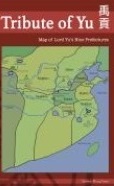
Tribute of Yu

Heavenly Questions
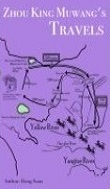
Zhou King Muwang's Travels
The Legends of Mountains & Seas
The Bamboo Annals - Book 1
The Scourge-of-God-Tetralogy:
From the Khitans to the Jurchens & Mongols: A History of Barbarians in Triangle Wars and Quartet Conflicts
(available at iUniverse;
Google;
Amazon;
B&N)
|
|
 This website's contents are the result of 20 years' writings --that could be compared to the "archaeological deposits" in a literary sense.
The freelance-style writings on the website were not proof-read.
Portion of the writings, i.e., related to Pre-History, Xia, Shang, Zhou, Qin, and Han dynasties, was extracted, polished, reconciled, and synthesized into
The Sinitic Civilization - Book I which is
available now on
Barnes & Noble,
Amazon,
Google Play|Books
and
Nook.
Book II is
available now on
Amazon
and Barnes & Noble.
Check out this webmaster's 2nd edition --that realigned Han dynasty's reign years strictly observing the Zhuanxu-li calendar of October of a prior lunar year to September of the following lunar year
and
cleared this webmaster's blind spot on the authenticity of the Qinghua University's Xi Nian bamboo slips as far as Zhou King Xiewang's 21 years of co-existence with Zhou King Pingwang was concerned.
To give the readers a heads-up, this webmaster had thoroughly turned the bricks concerning the Sinitic cosmological, astronomical, astrological, historical, divinatory, and geographical records, with the indisputable discovery
of the fingerprint or footprint of the forger for the 3rd century A.D. book Shang-shu (remotely ancient history),
and
close to 50 fingerprints or footprints of the forger of the contemporary version of The Bamboo Annals --a book that was twice modified and forged after excavation.
All ancient Chinese calendars had been examined, with each and every date as to the ancient thearchs being examined from the perspective how they were forged or made up.
Using the watershed line of Qin Emperor Shihuangdi's book burning to rectify what was the original before the book burning,
this webmaster filtered out what was forged after the book burning of 213 B.C.
This webmaster furthermore filtered out the sophistry and fables that were rampant just prior to the book burning, and validated the history against the oracle bones, bronzeware and bamboo slips.
There are dedicated chapters devoted to interpreting Qu Yuan's poem Asking Heaven, the mythical mountain and sea book Shan Hai Jing, geography book Yu Gong (Lord Yu's Tributes), and Zhou King Muwang's travelogue Mu-tian-zi Zhuan, as well as a comprehensive review of ancient calendars, ancient divination, and ancient geography.
One chapter is focused on the Huns, with a comprehensive overview of the relationship between the Sinitic people and the barbarians since prehistory.
The book has appendices of two calendars: the first Zhuanxu-li anterior quarter remainder calendar (247 B.C.-85 A.D.) of the Qin Empire, as well as a conversion table of the sexagenary years of the virtual Yin-li (Shang dynasty) quarter remainder calendar versus the Gregorian calendar, that covers the years 2698 B.C. to 2018 A.D.
Refer to
Introduction_to_The_Sinitic_Civilization,
Afterword,
Table of Contents - Book I (Index)
and
Table of Contents - Book II (Index)
for details.
This website's contents are the result of 20 years' writings --that could be compared to the "archaeological deposits" in a literary sense.
The freelance-style writings on the website were not proof-read.
Portion of the writings, i.e., related to Pre-History, Xia, Shang, Zhou, Qin, and Han dynasties, was extracted, polished, reconciled, and synthesized into
The Sinitic Civilization - Book I which is
available now on
Barnes & Noble,
Amazon,
Google Play|Books
and
Nook.
Book II is
available now on
Amazon
and Barnes & Noble.
Check out this webmaster's 2nd edition --that realigned Han dynasty's reign years strictly observing the Zhuanxu-li calendar of October of a prior lunar year to September of the following lunar year
and
cleared this webmaster's blind spot on the authenticity of the Qinghua University's Xi Nian bamboo slips as far as Zhou King Xiewang's 21 years of co-existence with Zhou King Pingwang was concerned.
To give the readers a heads-up, this webmaster had thoroughly turned the bricks concerning the Sinitic cosmological, astronomical, astrological, historical, divinatory, and geographical records, with the indisputable discovery
of the fingerprint or footprint of the forger for the 3rd century A.D. book Shang-shu (remotely ancient history),
and
close to 50 fingerprints or footprints of the forger of the contemporary version of The Bamboo Annals --a book that was twice modified and forged after excavation.
All ancient Chinese calendars had been examined, with each and every date as to the ancient thearchs being examined from the perspective how they were forged or made up.
Using the watershed line of Qin Emperor Shihuangdi's book burning to rectify what was the original before the book burning,
this webmaster filtered out what was forged after the book burning of 213 B.C.
This webmaster furthermore filtered out the sophistry and fables that were rampant just prior to the book burning, and validated the history against the oracle bones, bronzeware and bamboo slips.
There are dedicated chapters devoted to interpreting Qu Yuan's poem Asking Heaven, the mythical mountain and sea book Shan Hai Jing, geography book Yu Gong (Lord Yu's Tributes), and Zhou King Muwang's travelogue Mu-tian-zi Zhuan, as well as a comprehensive review of ancient calendars, ancient divination, and ancient geography.
One chapter is focused on the Huns, with a comprehensive overview of the relationship between the Sinitic people and the barbarians since prehistory.
The book has appendices of two calendars: the first Zhuanxu-li anterior quarter remainder calendar (247 B.C.-85 A.D.) of the Qin Empire, as well as a conversion table of the sexagenary years of the virtual Yin-li (Shang dynasty) quarter remainder calendar versus the Gregorian calendar, that covers the years 2698 B.C. to 2018 A.D.
Refer to
Introduction_to_The_Sinitic_Civilization,
Afterword,
Table of Contents - Book I (Index)
and
Table of Contents - Book II (Index)
for details.
|
|
Table of lineages & reign years:
Sovereigns & Thearchs;
Xia-Shang-Zhou dynasties;
Zhou dynasty's vassalage lords;
Lu Principality lords;
Han dynasty's reign years
(Sexagenary year conversion table-2698B.C.-A.D.2018; 247B.C.-A.D.85)
|
Epigraph|Preface|Introduction|T.O.C.|Afterword|Bibliography|References|Index
(available at iUniverse|Google|Amazon|B&N)
|
|
* In Commemoration of China's Fall under the Alien Conquests in A.D. 1279,
A.D. 1644 & A.D. 1949 *
 U.S.S.R./Comintern Alliance with the KMT & CCP (1923-1927)
 Korean/Chinese Communists & the 1931 Japanese Invasion of Manchuria Korean/Chinese Communists & the 1931 Japanese Invasion of Manchuria
American Involvement in China: Soviet Operation Snow, IPR Conspiracy, Dixie Mission, Stilwell
Incident, O.S.S. Scheme, Coalition Government Crap, Amerasia Case & The China White Paper
* Stay tuned for "Republican China 1911-1955: A Complete Untold History" *
|
|
Zou Rong's Revolutionary Army;
Shin Kyu Sik's
Shrine (Spirit, Kunitama) of Korea
|
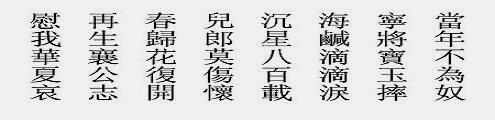
This snippet is for sons and daughters of China:
Heed the sons & ministers' agony and sorrow of our ancestors who died or lived through the Mongol, Manchu and Soviet-Chicom conquest
and
the Yongjia, Jingkang and Jiashen cataclysms !
Jeanne d'Arc of China:
Teenager girl Xun Guan breaking out of the Wancheng city to borrow the relief troops in the late Western Jinn dynasty;
Liu-Shao-shi riding into the barbarian army to rescue her husband in the late Western Jinn dynasty;
teenager girl Shen Yunying breaking into Zhang Xianzhong's rebels on the horseback to avenge on father's death in the late Ming dynasty.
China's Solitary and Lone Heroes:
Nan Jiyun breaking out of the Suiyang siege and charging back into the city in the Tang dynasty;
Zhang Gui & Zhang Shun Brothers breaking through the Mongol siege of Xiangyang in the Southern Soong dynasty;
Liu Tiejun breaking through three communist field armies' siege of Kaifeng in the Republican China time period;
Zhang Jian's lone confrontation against the communist army during the June 3rd & 4th Massacre of 1989.
|
|
|
THE JAPANESE
This episode on Japan and the Japanese people is to explore into their origin and paste a picture as true to the real facts as possible. To read into Japan's past, one will have to rely on the written records from the Chinese and the Koreans. The earliest Japanese history chronicles would be Kojiki and Nihon shoki, all written in Chinese in the 8th century.
There was no written form of the Korean language till A.D. 612 when the Koreans devised a writing system embedding Chinese characters or employing Chinese characters in total. It would take the Koreans another 800 years to invent the Hangul characters. For the Japanese, the 'kana' would not appear till much later.
The early Japanese history was invariably linked to that of China and Korea. The Korean link would be best shown by a Japanese 'surname book' in the 8th century, on which names of the continental origin had occupied a large proportion. Japanese Emperor Akihito recently acknowledged that their ancestor of the 8th century, Emperor Kammu, reign 736-836, had origin in the Paekche Kingdom of the 6th century.
The Chinese link, interestingly, would extend as far as the 2-3rd century B.C. at minimum.
Shan Hai Jing (The Legends of Mountains & Seas), namely, the Book or Classics of Mountains and Seas, which was compiled into 18 chapters from the original records of 32 chapters by Liu Xiang and Lin Xin at the end of the Western Han Dynasty under the Han imperial order, already recorded the existence of Wo [Wa] Japan as known in prehistoric China.
Shan Hai Jing, in Section 12, i.e., the northern records of the [inner-]seas, claimed that Wo (Wa in Japanese) was subject to the Yan statelet of the Zhou Dynasty for the possibility that the ancient Wo Japanese travelled through the peninsula to submit tributes to Yan in today's Peking area.
Following the Liu father and son, we have Wang Chong, a philosophically-materialist proponent of Han Dynasty, recording on several occasions in his book Lun Heng the prehistoric exchange between Wo and Zhou China, claiming that the Wo Japanese had submitted tributes (i.e., Chang-cao or tulip stems and leaves, a kind of material used for making tulip liquor which was said to have the superstitious function of eradicating ailments and pestilence in ancient China) to Zhou King Chengwang (Ji Song, reign approx 1,115-1,078 B.C.).
--Also see the Korean section for the 4th century B.C.E. descriptions of Ji-zi Chao-xian (Korea) in Shan Hai Jing:
Chaoxian (Korea) as Recorded in the Book or Classics of Mountains and Seas.
Note that Shan Hai Jing, which could be edited [or written] by annotator Shi-zi
(i.e., teacher of Qin reformer Shang Yang), had a corroborated history of at least the 4th century B.C.E.
There were three major components to Shan Hai Jing (The Legends of Mountains & Seas), namely,
"The Book on the Mountains", "The Book on the [Inner-]Seas & [Over-]Seas" and "The Book on the [Overseas] Wilderness", with the mountain section covering the viscera
of Mother Earth as known in the Central Kingdom of China in the 4th century B.C.E., the section on the [Inner-]Seas, [Over-]Seas and the [Overseas] Wilderness to have credible geography on the Korea peninsula while the rest being
difficult to pinpoint in an exact match.
(Note that the "seas" component of Shan Hai Jing could be relatively new in comparison with the "mountain" part of Shan Hai Jing. Hence, the writings on Chaoxian (Korea) in Shan Hai Jing were after-the-matter-of-known-facts.)
Notwithstanding the reference to 'Wo' in the above-mentioned books, Confucius' The Analects (Lun Yu) constantly mentioned that part of the nine 'Yi' people of the ancient time, who lived in eastern China since before the time of overlord Yao, Yu and Shun,
might have moved away to the place where Confucius and some of his disciples wished to dwell by crossing the seas to the east, without specifying whether it was the Yellow Sea to Korea/Japan or the Bohai Sea to today's Manchuria.
That is to say that in Confucius' times, the ancient Chinese already began to feel fuzzy about the whereabouts of the ancient Nine Yi people.
Frequently, Confucius and his disciples
referred to a mythical land beyond the seas to be the land of the Nine Yi people without defining the actual locality.
Later, in the geography section of Han Shu, it was inferred that Confucius meant the land of the nine 'Yi' people to be the place of the Wo people who dwelled in the waters off the Lelang Commandary of today's Korea.
Further, Sui Shu further corroborated Han Shu in the section on the Dong-yi (i.e., eastern Yi people) that the Wo people was where the nine 'Yi' people lived.
The later interpretation, however, could be wrong as this webmaster repeatedly used the word misnomer Eastern Yi in the Korean section to emphasize the point that
the original Koreans might not be Tungunsic at all, but Sinitic.
More to follow next.
More about Shan Hai Jing (The Legends of Mountains & Seas) is available at http://www.imperialchina.org/ImperialChina/?p=331; the "Eastern Yi People" at http://www.imperialchina.org/ImperialChina/?p=311
|
|
|
|
|
|
|
Sovereigns & Thearchs;
Xia-Shang-Zhou dynasties;
Zhou dynasty's vassalage lords;
Lu Principality lords;
Han dynasty's reign years
(Sexagenary year conversion table-2698B.C.-A.D.2018; 247B.C.-A.D.85)
|
|
The Sinitic Civilization - Book I is
available now at
iUniverse,
Barnes & Noble,
Amazon,
Google Play|Books
and
Nook.
The Sinitic Civilization - Book II is available at
iUniverse,
Amazon and Barnes & Noble.
Check out the 2nd edition preface that had an overview of the epact adjustment of the quarter remainder calendars of the Qin and Han dynasties, and the 3rd edition introductory that had an overview of Sinitic China's divinatory history of 8000 years.
The 2nd edition, which realigned the Han dynasty's reign years strictly observing the Zhuanxu-li calendar of October of a prior lunar year to September of the following lunar year, also cleared this webmaster's blind spot on the authenticity of the Qinghua University's Xi Nian bamboo slips as far as Zhou King Xiewang's 21 years of co-existence with Zhou King Pingwang was concerned, a handicap due to sticking to Wang Guowei's Gu Ben Bamboo Annals and ignoring the records in Kong Yingda's Zheng Yi.
Stayed tuned for Book III that is to cover the years of A.D. 86-1279, i.e., the Mongol conquest of China, that caused a loss of 80% of China's population and broke the Sinitic nation's spine.
Preview of annalistic histories of the Sui and Tang dynasties, the
Five Dynasties, and the two Soong dynasties
could be seen in
From the Khitans to the Jurchens & Mongols: A History of Barbarians in Triangle Wars and Quartet Conflicts
(The Barbarians' Tetralogy - Book III: available at iUniverse;
Google;
Amazon;
B&N).
(A final update of the civilization series, that is scheduled for October 2022, would put back the table of the Lu Principality ruling lords' reign years, that was inadvertently dropped from Book I during the 2nd update.)
|
|
Book II - Table of Contents:
Chapter XXXI: The Han Dynasty's Chronological History p.367
Invasion into the Korean Peninsula p.391
Chapter XXXVI: The Western Expedition, The Kunlun Mountain & Shan Hai Jing p.489
Han Emperor Wudi Seeking Elixir from the Immortals on the Kunlun Mountain p.491
Credible Geography Book on the Mountains Possibly Expanded to Include the Legendary Kunlun Mountain p.493
Unearthly Things in the Mountains' Component of The Legends of Mountains & Seas p.501
The Divination Nature and Age of the Seas' Component of The Legends of Mountains & Seas p.506
Chapter XXXVII: The Legends of Mountains & Seas (Shan Hai Jing) & The Ancient Divination p.520
The Divination Nature and Age of the Seas' Component in The Legends of Mountains & Seas - Debunking the Theory of "Asiatic Fathers of America"
Shan Hai Jing, in the "within-seas" and "great [overseas] wilderness sections, contained three interesting matters, namely, an alternative history of the thearchs that differed from the five thearchs' lineage in Shi-ji and Da-dai Li-ji; the wind gods that had the trace from the oracle bones of the Shang dynasty time period; and the divination topics such as Xia King Qi3's bestriding the flying dragons to rise to the heaven.
It could be speculated that the mythic writings in the seas' components of Shan Hai Jing were the result of the emperor's seeking the panacea or elixir. Note that dozens of diplomatic missions were sent to the west, with an apparent side order for ascertaining the locality of the legendary Kunlun Mountain where the immortals lived. If the mountain sections of Shan Hai Jing was written before Zhang Qian's trip to the west, the writer(s) of the sea sections, possibly following the "mountains" component of Shan Hai Jing (i.e., The Legends of the Mountains and Seas), expanded the writings on Kunlun, the Queen Mother (old woman), and the origin of the Yellow River, etc., into the chapters known as "The Book on the Within-Seas", "The Book on the Inner Seas", "The Book on the Outer Seas", and "The Book on the [Overseas] Wilderness" --a highly speculative book that talked about the panacea, the immortals, the various gods, as well as the ancestral human gods like Tai-hao the Senior (i.e., wind or phoenix-surnamed ancestor), Huang-di the Yellow Thearch, Yan-di the Fiery Thearch, Shao-hao the Junior (i.e., Ji3-surnamed ancestor), Overlord Zhuanxu, Overlord Di-ku, Overlord Yao, Overlord Shun, the founder-kings of the Xia, Shang and Zhou dynasties, as well as mythical figures like Lord Di-jun, et al. (Depending on the coverage of the overlords in different sections of the sea components of Shan Hai Jing, there were unfounded claims among the modern historians that those particular sections of the book were from some particular past dynasties like Xia or Shang.)
The mountain part of Shan Hai Jing, while having its geographical layout built on top of Yu Gong (Lord Yu's Tributes), was not written as a geography book but with possibly two purposes, namely, a proclivity for expounding sacrifice and primitive prophecy conducted on the mountains and hills, and a description of the treasures and wealth of the mountains. The second purpose was similar to the forgery Han dynasty political economy book Guan Zi --which, like the "Salt & Iron Debate" of the Han dynasty, contained chapters on the mountains such as 'Shan-guo Gui' (mountain nations' track, i.e., finance management), Shan Quan Shu (mountain's whimsical mathematical strategy), and Shan Zhi Shu (mountain's utmost mathematical strategy), containing similar description of the treasures and wealth of the mountains. The writings sharing the common geographical data or similar raw materials with the mountain part of Shan Hai Jing included Qu Yuan's poems like Tian Wen (asking heaven); Mu-tian-zi Zhuan (Zhou King Muwang's travelogue); and Lv-shi Chun-qiu.
(The four eastern mountain ranges were mistakenly appropriated to North America by Henriette Mertz in the 1958 book Pale Ink, which was the author's overzealous pursuit of the topic of Asiatic fathers of the Amerindians. Henriette Mertz also had the wild imagination about the deep gully beyond the east sea, stating that it was the Grand Canyon of Arizona. Henriette Mertz, who had erroneously appropriated the mountains and valleys in Shan Hai Jing to North America, had some validity as to the link of monk Hui-shen to Quetzalcoatl.)
In contrast, the seas or overseas' components of Shan Hai Jing transcribed the unearthly animals, human-faced animal gods and strange-looking people in the mountain part of Shan Hai Jing into the names of countries or tribes as seen in Lv-shi Chun-qiu and Han dynasty book Huai Nan Zi, exhibiting the seas or overseas' components to be later than the mountain part. The seas or overseas' components could be further separated into two groups, namely, the "inner seas" and the "outer seas" sections that were compiled by Liu Xin of the Han dynasty and the "within-seas" and the "overseas wilderness" sections that were collected by Guo Pu of the Jinn dynasty, with the former two sections possibly synchronizing with the Han empire's military expansion, and the latter two sections sharing similar contents seen in the divinatory books Lian-shan Yi and Gui-cang Yi, including the Wangjiatai excavated divination texts of the 3rd century B.C. and possible materials from the Ji-zhong tomb excavation materials that were possibly a few decades earlier than the Wangjiatai texts.
Gui-cang Yi, like what the seas' component of Shan Hai Jing did in extensively copycatting Qu Yuan's and the other Chu Principality poems, had taken some of the poems' concepts as part of the divination texts, such as the "Feng-xue" (wind cave) in poem Bei Hui-feng [feeling sad about the percolating wind], and the "Yun-zhong[-jun]" (god in the cloud) and "Dong-jun" (eastern god) deities in poem Jiu Ge (nine songs), for example. While the divination in the seas or overseas' components of Shan Hai Jing could be relatively old, like the age of the Ji-zhong tomb and Wangjiatai excavation texts, the materials had apparently undergone revision through the Zhou, Qin, Han and Jinn dynasties, for about half millennium's time, as seen in Guo Pu's citation of eight polars in Qi3-shi1 of Gui-cang Yi to describe Xi-he2's reign in the empty mulberry land under the 'cang-cang' blue sky, as well as in the erroneous interpretation of Xia King Qi3's rising to the sky to be a high lord's guest as some theft of heavenly music, not an award from the high lord.
Simply speaking, the seas or overseas' components of Shan Hai Jing, though carrying the names of countries like in today's Korea, Chinese Turkestan and India, etc., were not about geography at all but divination. The divination materials, similar to those in Shi1 Fa, Gui-cang Yi, the Wangjiatai divination script, and the divination in Mu-tian-zi Zhuan, served the same augury purpose of the late Warring States time period, albeit possessing their separate freelance or freewheeling traits.
For example,
The one eyed son of Lord Shaohao in the "great northern wilderness" (Da Huang Bei Jing) section of Shan Hai Jing, like the one-hand and one-eye 'shen-mu-guo' (the deep eye socket) state in the "Northern Outer Seas" section, which was speculated to be the legendary one-eyed state Arimaspi that was described by Herodotus in Histories as located north of Scythia and east of Issedones and linked to the three-eye stone statutes of the Okunev Culture in Minusinsk, could have its source in some one-eye bird in the northern mountain range of Shan Hai Jing, and the one-eye and three-tail 'huan' foxlike animal on Mt. Yiwang-zhi-shan in the western mountain range.
Some conclusive statement could be made about the alternative divination methods other than Zhou Yi (i.e., Yi-jing). No matter Gui-cang Yi, Shi1 Fa, the Wangjiatai divination script, Mu-tian-zi Zhuan, or the mountain part and seas' part of Shan Hai Jing, they served the same augury purpose of the late Warring States time period, that possessed their separate freelance or freewheeling traits in the land of the Wei Principality in the case of the Ji-zhong tomb's type of Gui-cang Yi divination or in the land of the Chu Principality in the case of Shi1 Fa and Wangjiatai divination bamboo slips. The line augury objects in Shi1 Fa under the stalk numbers "eight", "five" and "four", with similarity to the augury topics in Zhou Yi and Gui-cang Yi's four trigram images or diagrams, could be said to be like what was seen as the primitive prophecy in the mountain part of Shan Hai Jing. Roughly, Shi1 Fa matched the primitive prophecy in the mountain part of Shan Hai Jing, while Gui-cang Yi, namely, the Wangjiatai scripts or the Ji-zhong tomb's type of Gui-cang Yi divination, matched the seas' part of Shan Hai Jing as far as divination was concerned.
For details, refer to
THE SINITIC CIVILATION Book II, available on Amazon,
B&N.
Epigraph|Preface|Introduction|T.O.C.|Afterword|Bibliography|References|Index
(available at iUniverse|Google|Amazon|B&N)
|
|
The Linkage Between China And Japan
In Chinese TV dramas, two incidents were constantly mentioned to link the origin of the Japanese to the mainland Chinese: namely, i) the story of Xu Fu (Jo Fuku)'s sailing to Japan to find panacea on behalf of first Qin Emperor Shihuangdi (Shi Huang Di or Shi Huangdi), and ii) the story of hairy-faced knight's abandoning China's central plains to Tang Dynasty founders in search of an eastern land for creation of his own kingdom. There is no definite proof that Xu Fu, together with 3000 virgin boys and girls, had actually landed in Japan 2200 years ago though a tombstone bearing his name was erected in Japan. Some people speculated that Xu Ju was the legendary Jimmu Tenno, and it seems Xu Fu's pronunciation is close to Jimmu. The always-on lamps inside of Shihuangdi's tomb, lit by oil refined from mermaid fish from the East China Sea, corroborated the fact that Chinese fishing vessels were very active in the East Sea 2200 years ago. Shihuangdi personally oversaw two seafaring trips by Xu Fu. During his second trip, Xu Fu was said to have conspired in bringing virgin boys and girls to 'Yingzhou' in East China Sea for colonization. Alternative speculation would point America as the land of Xu Fu's destination.
The legend of the knight ('Qiu-ran-ke' or 'Qiu-xu-ke'), i.e., La Biographie du chevalier à la barbe frisée, happened in late years of Sui Dynasty (AD 581-618). (During Sui Dynasty, Japan dispatched four delegations to China, by the way, including the A.D. 607 visit by Ono no Imoko [xiaoye meizi], known as Su-yin-gao in Chinese records.) The knight and his female companion disbursed all their assets and properties to Li Jing (who later became a famous Tang general), saying that he would not compete with Li Shiming (Tang's 2nd emperor, i.e., King of Qin and Emperor Tang Taizong) for the land of China and that should Li Jing hear that someone had obtained a kingdom in the southeast it would be him:
Chinese tea-house stories also claimed that 'Ranxu-ke' operated a chain of stores in the mainland and that the country that 'Ranxu-ke' had usurped could be Korea, not Japan. Omitted by official history chronicle "Tang Zhi" [i.e., Tang Dynasty History] would be Du Guangting's writing on 'Qiu-ran-ke' in which he adopted 'Fuyu' [i.e., the ancient royal clan name for the Korean kingdom of Paekche] for the territory that he had conquered after leading an expedition with thousand ships.
The most detailed account of China's embassy to Wa Japan would be in Sui Dynasty's history annals.
In A.D. 607, Wa Japanese King Duo-li-si-bi-gu [with royal clan surname A-mei (speculated to be today's Japanese pronunciation for heaven), given name Duo-li-si-bi-gu and acclaimed name A-bei-ji-mi (i.e., Abekimi, speculated to be today's Japanese pronunciation for the son of heaven or "tian er" in the Chinese language), soundex Ame Dolisubiku] sent an emissary, Ono no Imoko ([xiaoye meizi], known as Su-yin-gao in Chinese records), to Sui China.
The king was known today as Regent Shotoku under curtain empress Suiko, an aunt, with a purported reign of A.D. 554-628.
The letter stated that they had heard that the new 'buddha' emperor to the west of the sea had revived Buddhism and they would like to have a dozen monks study Buddhism in China. (Duo-li-si-bi-gu was known as Yongming [Yomei] Tenno in New History of the Tang Dynasty which carried literally the fabricated Japanese historical accounts from the 7th-8th centuries.) Sui Emperor Yangdi at first refused to hear about the Wa State (Japan) because the Japanese king [in fact, regent] wrote the sentence: "The Son of Heaven from the sunrise wish good health for the Son of Heaven at the sunset...." However, Emperor Yangdi sent an emissary, Pei Shiqing [Pei Qing], to the Wa State the second year (i.e., A.D. 608). [In here, the Chinese records of the year of visit conflicted with the fabricated Japanese accounts by at least 20 years. The records beyond this known contact between ancient Japan and China was to become more and more ambiguous, till about eight imaginary emperors were fabricated to push the legendary Kimmu Tenno to the 6-7th century B.C.E.]
Pei Shiqing crossed the sea to Paekche, arrived at Zhu-dao (bamboo island) Island which could be today's disputed island in-between Korea and Japan or another island, watched the Dan-luo-guo statelet to the south [an island recorded to be off Silla's southern coast, that was initially subject to Paekche and subsequently to Silla, an island with King by the name of Ru-li-du-luo who sent an emissary to China in A.D. 661, and an island with an interesting group of pig-leather people like an island of Xianbei-like hair-cut people off the western Korean coast --which was the Jeju Island in this webmaster's opinion], passed through the Du-si-ma-guo statelet, crossed sea again [? from Kyushu to Honshu - as Japan had already moved eastward to the Yamato Plains from Kyushu about 200 years before, at approx. 400-410 A.D.] to the Yi-zhi-guo statelet, arrived at the Zhu-si-guo statelet, went eastward to the Qin-wang-guo statelet (Qin King Country which was commented to be similar to the Chinese: Qin-han of South Korea? --Could be Qin-Han migrants to Japan from Korea but was said to be from the lineage of Xu-wo or the Xu-fu Wo statelet [which could also mean that Xu Fu had actually travelled to southern Korea, not Japan, in the beginning, and then his descendants migrated to Japan hundreds of years later), travelled through another dozen countries to reach the coast of Wa Japan. Pei Shiqing recorded that the domain east of Zhu-si-guo belonged to the vassalage of Wa Japan. Wa King welcomed Pei Shiqing with over one hundred people, displaying ceremonial courtesy and beating the drums and horns. Within the next ten days, Wa King dispatched 200 cavalry to fetch Pei Shiqing at the outskirts of the capital. After arriving at the capital, Pei Shiqing and Wa King exchanged gifts and tributes. The Japanese asked another emissary to accompany Pei Qing [Pei Shiqing] back to China. It was from the mouth of this Japanese emissary that Sui Emperor Yangdi confirmed the identity of Ryukyu, an island to the southwest of Japan.
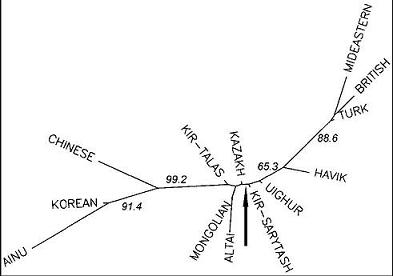
In the phylogenetic tree Ryukyuans and Ainu were neighbors, but the genetic distance between them was larger than the distances between Ryukyuans and Hondo Japanese and between Ryukyuans and Korean populations. The geographic cline of the predominant haplotype in Ryukyuans, A*24-B*54-DRB1*0405, suggests that an ancestral population possessing A*24-B*54-DRB1*0405 moved into the Okinawa Islands after the divergence of Ryukyuans from the Ainu. Such a recent gene flow, probably from South China to the Okinawa Islands, is considered the major cause of difference in genetic characteristics between Ryukyuans and the Ainu.
The Torai-Jin ("guihua-ren" [immigrant] clans) of Japan
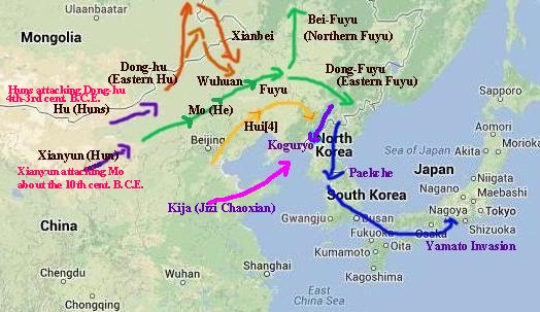
Certainly, the mainland people had arrived in Japan much earlier than the 6th century A.D. It seems the earliest reference to mainland people's landing in Japan would be during the aftermath of Wei Man's usurping the Choson Kingdom of Ji Zhun around the 190s B.C.E. As we had detailed in the Korean section, Ji Zhun fled to southern Korea to be king of Haan [Han(2)]. Some of Ji Zhun's palace people were driven into the sea by Wei Man's Chinese army according to Chen Shou. There was speculation that those people sailed to southern Korea and/or Japan. In then southern Korea, the Chenhan (i.e., Qin-Han) and Bianhan people, who nominally obeyed to Mahan, had retained more ancient Qin Chinese characteristics than the Wei Man Chinese in northern Korea. The Chenhan people claimed that their ancestors came from China's Qin Dynasty (221-206 B.C.), they called their country by 'bang' [i.e., nation], and they worked as iron miners for the Koreans and the Wa Japanese.
Out of the three-Haan land in southern Korea arose Paekche, Kaya and Silla, where the Torai-Jin ("guihua-ren" [immigrant] clans), i.e., ancient Chinese refugees from the Chinese continent, had dwelled before a further move to Japan.
Han Emperor Wudi, after zoning Korea into the commanderies of Zhenfan, Xuantu, Lelang and Lindun, came into contact with the Wo Japanese on the western shore of Kyushu, who possibly shared the same iron-smith background as the Chinese dwellers at the southern Korean tip.
The geography section of Han Shu definitely stated that the Wo people dwelled in the waters off the Lelang Commandary of Korea.
Thereafter, in the section on the Eastern Yi people in Hou Han Shu, it was recorded that during the 2nd year of Jianwu-zhongyuan, A.D. 57, the Wo-nu-guo statelet in Japan, which was situated at the southernmost tip of Kyushu, dispatched an emissary, who called himself by da fu, to seeing Han Emperor Wudi, on which occasion a seal was conferred. The seal was excavated at the Hakata Bay [i.e., the opposite side of Kyushu] during the Edo era, around A.D. 1784, with the Chinese characters of Han-wei[wo]-nu-guo-wang[king] inscribed.
Now, in Chen Shou's San Guo Zhi (The History of Three Kingdoms), it was recorded that thirty statelets in ancient Wo Japan had diplomatic relations with China, including the Wei[wo]-nu-guo statelet which appeared to enjoy the highest esteem in that it had a gold seal on a similar footing as the Dian-yue statelet in southwestern China.
Some kind of fiduciary and vassal relationship was established between the Wa State and China.
The competing entity on the Japan islands, i.e., Himiko's statelet, sought help with countering the neighboring Wo statelet.
http://www.os.xaxon.ne.j p/~sinkodai/efuruta/esss.html said that "Chiu-T'ang-shu or old T'ang History contains the Records on Japan and Wa-state, and one passage in it radically contradicts the existing dogmatic interpretations advanced by historians of ancient Japan. According to this passage, Wa-state was granted a gold seal by Kuang-wu of Later Han dynasty" in apparently the first years of the first century A.D. In the 3rd century, the Wa people requested for pilgrimage to Chinese capital with Governor -General Liu Xia of the Daifang Commandary in Korea. Diplomatic emissaries were frequently exchanged, and seals were conferred upon the Wa Queen by Wei China. Later, when the Wa State in Japan had internal turmoil, Queen Himiko requested with the new Governor-General of the Daifang Commandary, Wang Qi, for assistance. An official called Zhang Zheng (Chang Cheng) was dispatched to the Wa State in the 8th year of Cheng-shih or A.D. 247.
When the Chinese emissary, Zhang Zheng, who apparently took a Chinese army to the Japan islands for creating detente among the rivalry Wo Japanese, returned to China with two dozen Wa people in A.D. 266, China was already ruled by Sima Shi's Jinn Dynasty [AD 265-317].
As a result of the ensuing disintegration of northern China as well as the turmoil in Korea, i.e., the Tungunsic [and mixed or misnomer Tungusic] invasion towards the south, the composition of the Chinese-lineage ironsmiths in southern Korea and western Japan were apparently overtaken by the invaders. (By the word misnomer, this webmaster is making the point that the Fuyu invaders from Korea were not actually C-haplogroup Tungus from the northern Xing'an Ridge and the Amur River but the mixed O2-haplogroup people from today's Inner Mongolia territory.)
The massive Chinese-Korean emigration to Japan, termed "guihua-ren" [i.e., the naturalized people to Japan], however, would not come till northern China disintegrated into chaos during the "Five Nomadic Groups Ravaging China" in late Western Jinn Dynasty [AD 265-317].
On basis of Kojiki and Nihon shoki, "guihua-ren" [i.e., the naturalized people to Japan] included clans such as Yutsuki-kimi [Gong-yue-jun; bow moon gentleman or chieftain], Higashikan-atai [Dong-han-zhi; Eastern Han descendant chieftain], Nishibun-abido [Xi-wen-shou; Western culture head] and etc. [The suffix like '-jun', '-zhi' or '-shou' meant for the hereditary titles of heads of the immigrant clans.]
The Yutsuki-kimi clan, claiming the Qin Dynasty surname or the Hata clan in Japanese, was responsible for developing the silkworm industry and civil engineering in Japan;
the Higashikan-atai clan, led by Achi-no-Omi who claimed descent from Emperor Lingdi of Eastern Han Dynasty, developed the handicraft industry and metallurgy; and the Nishibun-abodi clan took charge of bookkeeping and protocol inside of the Japanese government.
Claiming a direct descendant of Qin Emperor Shihuangdi, Yutsuki-kimi (i.e., King Yusuo), according to Nohonshoki, brought 120 counties of people to Japan from Korea, and later in the 7th century, Japan, for the Hata clan's contribution, purportedly built the Koryu-ji Temple as a memorial for Hata no Kawakatsu (Hada no Kokatsu).
(Though, contrary to shoki's account that the Yutsuki clan came to Japan in 285 A.D., the Qin-haan people of southern Korea, located in original Qin Haan and later Kaya (Imna), might have come to Japan at the turn of the 4th-5th centuries, when the Korean peninsula was embroiled in the three-kingdom warfare and Wa Japan was counted as an outsider force to lend aid to one of the warring parties.)
Achi-no-Omi, whose Chinese name was Liu Ahzhi (Achi in Japanese pronunciation), who claimed a 4th (?) generation grandson of Han Emperor Lingdi of Eastern Han Dynasty, brought 2,040 clansmen to Japan. On basis of the Japanese shoki and Kojiki accounts, Liu Ahzhi contemplated about leaving China in A.D. 289, i.e., the 10th year of the Taikang Era of Western Jinn Dynasty, and arrived in Japan during the Ojin 29th year or A.D. 299.
What was conflicting was the mismatch of the Ojin era and the subsequent timeline, when Liu Ahzhi, under the order of Yuryaku (Xionglüe, r. 456-479), at one time travelled with the Koguryeo embassy to the Eastern Jinn court in the Yangtze River area and recruited textile craftsmen and craftswomen for employment in Japan. (According to the Chinese historical account, the Koguryeo embassy received the Jinn conferral in A.D. 413, which was one year after the death of Koguryeo King Gao Tande who obstructed the Wa Japanese' passage to and relations with the continent.)
Wang Ren (Wani in shoki or Wani-kishi in Kojiki), a Korean-Chinese migrant from Paekche on the Korea peninsula, who claimed descent from Han Dynasty Emperor Gaozu, came to Japan at the recommendation of Achiki [who purportedly first brought Chinese characters to Japan in A.D. 284] and at the invitation of the Japanese emperor with 10 volumes of Confucius' Analects and one volume of Qian ZiWen (the thousand characters' book). Wang Ren was to be head of the Nishibun-shu clan. Wang Ren, according to the purported Japanese historical account, came to Japan at A.D. 285, i.e., the so-called 16th year reign of emperor Yingshen [Ojin Tenno], which seemed to match with the Chinese records as to Pimiko's contact with Wei China in A.D. 247 and the Chinese emissary's return to China in A.D. 266.
What was likely was that Wang Ren fled to Paekche from Lelang [i.e., Pyongyang] after Lelang's demise in A.D. 313 and subsequently came to Japan in the early 4th-5th centuries -- which was about the difference of three sexagenary cycles. In China, the thousand character book was to be written by Zhou Xingsi [?-521 A.D.] in the early 5th century, namely, about 200 years after the purported Ojin year of 285 A.D. -- which was about the difference of three sexagenary cycles. (Also see an interesting writeup on the Japanese myth related to Okinaga tarashihime no mikoto.)
To make the above-mentioned years coherent, the Yamato Japanese had to push the start of Ojin's reign to A.D. 270, and to make the Ojin reign last for a purported 41 years at a life of 111 years. That purportedly was meant to corroborate the fabricated account stating that Ojin was born on the Korean peninsula around A.D. 200s while his mother Jingu Kogo [Pimiko or Iyo?, legendary Okinaga tarashihime no mikoto] was purportedly campaigning against Silla.
What was even more weird and incredible would be the successor to Ojin [reign A.D. 270-310], tenno Nintoku, to have a reign of A.D. 313-399, or 86 years.
Wontack Hong, in year 2005, corroborated the 120-year (two sexagenary cycles) difference between the records of Nihongi and those of Samguk-sagi, which was a citation by Wontack Hong built on top of Aston's research (see Aston 1889, pp. 51-65).
By adding the omitted 120 years to Nihonshoki and Kojiki, the Japanese records could be reconciled with the Korean records in Samguk-sagi.
This meant that tenno Ojin's reign started in A.D. 390, not 270; that Paekche sent crown prince Cheon-ji to the Yamato court in the eighth year of Oujin’s reign, i.e., A.D. 397, not 277; and that Wang Ren (Wani-kishi), Achi-no-Omi (Liu Ahzhi) and Yutsuki-kimi et al., i.e., the Torai-Jin ("guihua-ren" [immigrant] clans), could have only come to Japan in the early 5th century, about the time the Ojin Japanese crossed the sea to found Yamato.
(Note that
the 60-year cycle sexagenary years of China could not have existed before the Qin Empire's first state sanctioned
anterior quarter remainder calendar, namely, Zhuanxu-li (247-104 B.C./247 B.C.-85 A.D.), that
was inherited by the Han dynasty.
Japan's chronicling differential might be inadvertent, not necessarily malicious as seen to be the case of a forgery on the surface.
In China, by the Sui dynasty, the recompiled book
The Bamboo Annals contained 60-year cycle sexagenary years, that were mapped on top of the virtual Yin-li calendar that started in A.D. 85, a calendar reform that was justified by the sentence "the Dipper Handle calendar
changing every 300 years" in the argot or apocrypha book Bao-qian Tu (map of safeguarding 'Qian' the first and
heaven hexagram) of the Chun-qiu Wei forgery series.
By the Southern Soong dynasty, in the forgery contemporary version of The Bamboo Annals, similar to the Japanese efforts, Luo Mi likely re-aligned the dynastic reign years by two to three sexagenary cycles, subtracting 120 years from the Shang dynasty to yield 508 years (1558-1051 B.C.) and 60 years from the Zhou dynasty to yield 795 years (1050-256 B.C.) in comparison with Liu Xin's 629 summary years for the Shang dynasty and 867 summary years for the Zhou dynasty.)
--The above-mentioned Japanese clan naming for the continental immigrants was interesting in that it exhibited a hereditary caste system, with titles suffixed by Kimi (local elderly), Omi (minister), Muraji (local chieftain with administrative power), Obido (head), Adai (straight), Fubito (historian), Suguji (village chief), agatanushi (county chief), suguri (village head), and etc., which were replaced later in the 7th-8th centuries by the eight "Ason" [court minister] rankings, i.e., yakusa no kabane as recorded in Nihonshoki.
Other than claiming descent from Qin and Han royal families, the immigrants had purported origins from Wu, Wei dynasties of the Three kingdom time period, and the Gongsun Yuan family from Manchuria.
Per Zhang Guoren & Yuan Changyao's "A Simple History of Japan" [kaiming shudian, hk, july 1993], surnames of "guihua-ren" clans [Torai-Jin in Japanese], numbering 324 names, had taken about 30% of all Japanese surnames by the early 9th century A.D. in court-sanctioned "Records of Newly Edited Surnames" [i.e., Shinsen-Joujouroku see http://homepage1.nifty.com/k-kitagawa/data/shoji.html ].
Reader Steve Gladstone mentioned that Japanese records had linked "ninjutsu" or "ninja" to Chinese martial arts monks or masters who had fled to the Japan Island from China. (See angelfire.com/ma/imaf/ninja.html , geocities.com/remipulw er/Budo/TogakureRyu.html, ninjutsu.org.uk/nineryu.htm, and http://www.daytonbujinkan.com/gyokk oryu.html.)
Old Japanese texts carried a sentence to this effect: "In the era of Koryo & Song, about the 1st year of Huangyou Era, General Yi-gou [Yi-jun?] from Si-jiang [four rivers] fought the Khitans, the Tanguts andSoong Emperor Renzong's armies and lost. He then fled to Ise in Japan." What this webmaster saw here in Chinese classics is nothing other than Khitan's messages to theSoong court in regards to their campaign against the Tanguts: The Khitans attacked the Tanguts in the
first year of Huangyou Era, i.e., A.D. 1049, and reported that they had succeeded in defeating the Tanguts in A.D. 1054.
The Dao-yi (Island Alien) Designation
At the very beginning, Yu Gong (Lord Yu's Tributes) made a distinction between the 'dao-yi' [island] aliens and the 'niao-yi' [bird] aliens --though the very early lexicon for 'yi could be merely a designation for people rather aliens or barbarians.
In the later times, the Yi designation would be associated with a word 'dao' for islands, pointing to the barbarian people in the East China Seas.
Both the character 'niao' and 'dao' looked quite close and might have corrupted consecutively during the course of history.
Later, Yi became more an inclusive word to mean all kinds of aliens. The big Korean school of thought, touched on in the prehistory section, claimed that the Koreans were true descendants of the [Dong-]yi people, which could be partially right.
Yu Gong (Lord Yu's Tributes) might have corroborated Huai Nan Zi in pinpointing the easternmost Sinitic world to be today's Liaodong Peninsula --when Yu Gong (Lord Yu's Tributes) implied that the ancient Dao-yi people came from possibly today's Liaodong Peninsula by sea, using the Jie-shi mountain around today's Mountain and Sea Pass as the beacon tower equivalent, and sailed into the ancient Yellow River for surrendering tributes. Yu Gong (Lord Yu's Tributes) was more precise in making the distinction among the Yi people, listing the Dao-yi (island Yi) in the ancient Ji-zhou prefecture, the Yu-yi [sea corner Yi] and Lai-yi [the Laizhou prefecture Yi] in the ancient Qing-zhou prefecture, the Huai-yi [the Huai-shui River Yi] in the ancient Xu-zhou prefecture, the Niao-yi -bird totem Yi] in the ancient Yang-zhou prefecture, plus the He-yi in the ancient Liang-zhou prefecture. (Note that the ancient book Yu Gong (Lord Yu's Tributes) made a difference between the Dao-yi and Niao-yi while the two characters later corrupted into each other to mean the wrong Yi group, i.e., the island Yi in today's southeastern Manchuria being swapped to be the bird totem Yi in the Yangtze River area.)
Sima Qian's Shi-ji stopped at Han Dynasty Emperor Wudi's overthrow of Wei Man Choson. In descriptions of Xu Fu's elixir-seeking journey, Sima Qian did repeat ancient Chinese legends about the islands of Peng-Lai, Fang-Zhang and Ying-Zhou (land in the sea).
Chen Shou's San Guo Zhi covered the island of Japan and grouped the early Japanese in the section on Dongyi (Eastern Yi). Later history records referred to the Japanese as Dao-yi (Island Aliens).
The ancient Chinese had different terms for the barbarians in four directions. Dongyi or Yi-of-the-East will include people in Manchuria, Korea and Japan. However, the misnomer Dong-yi was a recent event. In the 3rd millennium B.C., the Yi people, who had no directional denotation, were categorically called the Nine Yi people in comparison with the possibly non-agricultural Yellow Overlord-centric forces -which defeated Chi-you (who could be the same as the Fiery Overlord Yandi)'s agricultural dwellers.
In early times, the Yi was associated with the word 'niao' for bird, and there were eight to nine different 'niao-yi' people in the east. The Shang Dynasty people, considered a group of the Yi people, were recorded to have treated 'Xuan Niao' (i.e., Black bird, possibly sparrow) as their totem. The Manchu legends as to the birth of their founder had something to do with swallowing the red fruit dropped by a bird.
Toba Wei Dynasty, in return for being called the nickname of 'suo lu' (pigtailed enemies), would call the southern Chinese by the derogatory name of 'niao yi' (i.e., bird-like aliens) for possibly the southern Chinese's pitched accents or a generic-kind of name for the southeastern Chinese and islanders. (Toba, being a part of Western Xianbei, carried the mark of shaving hair off the head, for which ancient historians linked them to the convicts who were ordered to construct the Great Wall by Qin Emperor Shihuangdi. The later Manchus, who carried pigtails, might have picked up the practice that was only known among the Xianbei people who lived along today's Xing'an Ridge in western Manchuria.)
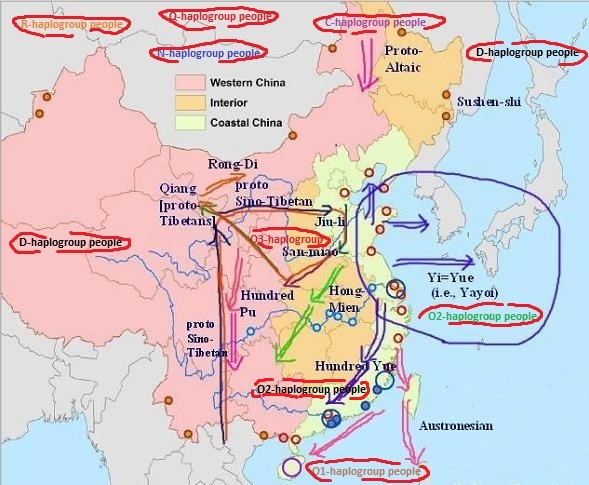
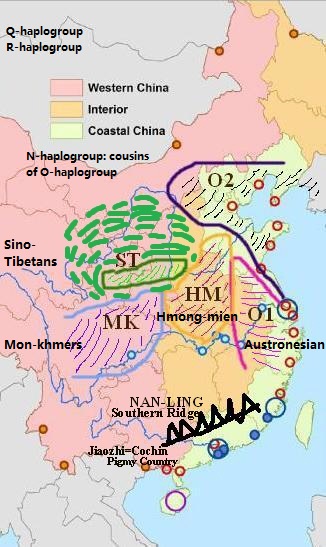
What could be inferred was that the original Nine Yi people, being not homogeneous, could have lived in the interface ground among the main Mongoloid groups
of the Sino-Tibetan, the Hmong-Mien and the Tungunsic, plus people of the Hundred Yue nature [as ancient Chinese records juxataposed 'yi' with both 'di' and 'yue' to become 'yi-di' and 'yi-yue'] -
who were pushed to the southeastern Chinese coast where they evicted the Austronesian-speaking people to Taiwan and Southeast Asia].
We could further deduce that as a result of the mixing-up of the Nine Yi people, the Hmong-Mien people and the Tungunsic people in today's Hebei Province and on the Shandong Peninsula, we then have the phenomenon of the later people in Manchuria, Korea and Japan sharing the same archaic squatting traditions as recorded among the ancient Nine Yi people of the 3rd millennium B.C.E., but lacking the hallmark "phoenix" adoration as still exists among today's minority Hmong-Mien people in Southwestern China.
The archaic traditions would include the historical practice of "dun ju" (squatting, which mutated into the Manchu practice of one leg kneeling on the ground while another leg bending at the knee, a Manchus protocol for seeing the superiors; or interpreted alternatively as spreading the two feet), slate coffins, and bearing down the newborn's head with stone, etc.
The Island Statelets Beyond Japan:
Chen Shou's San Guo Zhi recorded dozens of statelets on the islands, including Queen Beimihu (Himiko)'s Wa Statelet, the Gounu-guo statelet under a king to the south of Beimihu's Wa Statelet, and a pigmy statelet to the south of Wa (about 4,000 li distance) as well. (Also recorded would be two statelets to the southeast of Japan, i.e., the Luo-guo (naked body) statelet and the Heichi-guo (black teeth) statelet, which could be reached by travelling for one year on boat. Some Japanese historians speculated that the two statelets to the southeast of Japan must have been located in Central or South Americas. Yao Silian's Liang Shu (The History of Southern Liang Dynasty) further mentioned that the two statelets of Luo-guo and Heichi-guo were 4,000 Chinese li distance to the southeast of Japan or 1-year sea journey by boat. "Liang Shu" also recorded an island 10,000 li to the southwest of Japan where people, of black body and white eyes, were said to have delicious meat on their body; it said that travelers would shoot to kill those islanders for eating them. (The measure by distance being inaccurate, the timing for travel should be reliable.)
To the northeast of Japan, Liang Shu recorded a Wen-shen-guo (tattoo) statelet that was located 7,000 Chinese li distance; 5000 li to the east of Wen-shen-guo [tattoo body] would be the Da-han-guo [great Han] statelet. (Notes: 4,000 Chinese li distance between the pigmy statelet and Wa or the 7,000-li distance between Mao-ren-guo [i.e., the Ainu] and tattoo statelet, in comparison with the distance of 7000 li between South Korea and Japan, could mean all those statelets were all located on the Japan archipelago. In my opinion, Wen-shen-guo (the tattoo statelet) would be somewhere near Hokkaido, while the Da-han-guo statelet would be likely in the Aleutian Islands & Alaska. Liang Shu was noted for its record of the Fu-Sang (Fusang) Statelet, saying that it was located 20,000 Chinese li distance to the east of Da-han-guo. Here, we could see an apparent linkage from China, to Korea, to Japan, to the Wen-shen "tattoo body" country, to Fu-sang, and to the "black teeth" country.)
Bei Shi (The History of Northern Dynasties) recorded a big island statelet called Dan-mou-luo-guo statelet to the south of Paekche. It said that the island, having a span of over thousand li distance south-north and several hundred li east-west, could be reached by boat after three months, that it had lots of deer, and that it was a vassal of Paekche. The Liuqiu (Ryukyu) island was recorded to be reachable after 5 days of boat travelling. This points Dan-mou-luo-guo more towards Southeast Asian countries, Micronesian or Polynesian islands or Hawaii. However, alternative historic accounts might have corrected the mistake about "three months" to reach Dan-mou-luo-guo to pinpoint this island to be an island not too fa away from the southern tip of the Korean peninsula.
The Fusang (Puso) State:
Liang Shu (history of the Liang dynasty) recorded that there existed a state called Fusang to the east. The word 'fusang' would later be used by the Chinese for designating Japan in poems. (Shogunate Ashikaga, in reply to Ming Dynasty Emperor Hongwu's emissary Zhao Zhi, claimed that Japan, though an alien people dwelling in Fu-sang, had reverence for China's culture.) Wei Chu-Hsien validated a separate identity of Fusang from Japan by citing ancient records in regards to the usage of iron in Japan but not in Fusang. The more exact mapping would be to measure distance between statelets in between: a Wen-shen-guo (tattoo) statelet (near Hokkaido?) was located 7,000 Chinese li distance to the northeast of Japan; 5000 li to the east of Wen-shen-guo would be Da-han-guo statelet (near the Aleutian Islands & Alaska?). The Fu-Sang (Fusang) Statelet was located 20,000 Chinese li distance to the east of Da-han-guo, at least somewhere near British Columbia or Oregon.
                                                            "Great Han" ------------ -- Fu-sang
                                                            / country
                                                           /
                                           /"tattoo body"
                                          /   country
                                         /
                                        /
        China   ----  Korea  ---- Japan
                                        \
                                          \
                                            \
                                              \-------------------------> Luo-guo (naked body country)
                                                                          Hei-chi-guo (black teeth country)
Both Chinese language websites and English language websites
had mentioned the story of Monk Huishen and the Kingdom of Fu-Sang (Fusang). The popular belief is that Fusang was located in today's Mexico. Liang Shu stated that during the first year of the Yongyuan Era of Southern Qi Dynasty, i.e., A.D. 499, a monk by the name of Hui-shen (Huishen or Hui Shen) arrived at Jingzhou prefecture from the Fu-Sang (Fusang) Statelet. Hui-shen claimed that Fu-Sang was to the east of China; that it was located 20,000 li distance from the Da-han-guo statelet; that it was a land full of Fu-Sang wood (speculated to be North American corn by the Chinese or cactus-like agave by the Americans -- Senior Scholar Prof Wei Chu-Hsien analyzed early writings on Fusang and claimed that the earliest Fusang description meant for the coastal Redwood Trees with arched hollowness in the middle as a result of American Indians' farming the wood plates); that the Fu-Sang (Fusang) leaf was similar to the Tong-tree leaf; that Fu-Sang looked similar to bamboo shoots at early stage; that the Fu-Sang people ate it for food; that Fu-Sang appeared to be of red color and tasted like pear; that the Fu-Sang's surface could be used for cloth or cotton. Hui-shen further stated that the Fu-Sang people had log cabins but no cities; that Fu-Sang had a written language and used the Fu-Sang skin for paper; that Fu-Sang had no army or weapons; that Fusang did not treasure gold or silver; that Fu-Sang had two prisons, with minor offence going to the north while serious offence going to the south prison; that amnesty went to the north prison, only; that the king possessed drums and wore different color clothes for different seasons; that the Fu-Sang people used buffalo horns for holding stuff; that Fu-Sang possessed horse carts (?), buffalo carts and deer carts; that the Fu-Sang people used deer milk for making cheese; that Fu-Sang was abundant with walnuts; that Fu-Sang had copper but no iron; that Fu-Sang previously had no Buddhism but a five-member monk team, headed by Monk Biqiu, arrived at Fu-Sang from the Libin-guo statelet (said to be today's Afghanistan) during the 2nd year reign of the Daming Era of LiuSoong Dynasty, i.e., A.D. 458, and propagated Buddhism there. (The book Pale Ink carried place naming designation with the Hui-sheng soundex across southwestern United States and the Central America countries.)
Note that most of secondary records had errors in regards to the five-monk team. Hui-shen or Hoei-shin did not take part in the A.D. 458 journey to Fusang, and he merely returned to China in A.D. 499. My speculation is that the trips from China to ancient America was frequent enough for Hui-shen to return to China on a different ship. Should Monk Fa-Shien had returned to China from India by ship at the timeframe, why would it not be possible that Monk Hui-shen and et al., could have travelled to ancient America?
I picked up Prof Wei's book again and found out that Prof had listed abundant written texts, from ancient Chinese chronicles, about the existence of i) the 'Deep Sea Valley' beyond Japan, ii) the 'Feather Mountain' island in possibly the Pacific Northeast, iii) 'Brown Bear' stories, and iv) the Redwood Trees. Prof Wei had citations of dozens of entries about the Redwood Tree, which was known to the Chinese as 'Fu-sang' in Chinese texts prior to B.C.E. eras. Apparently, ancient Chinese in A.D. eras, i.e., Monk Hui-shen of the 5th century, had mutated the ancient term 'Fu-sang' to mean something different from the Redwood tree.
Prof Wei Juxian validated that though America had no iron, ancient Peruvians had imported iron from ancient China for cutting the stones for the palace construction. Also, Prof Wei Juxian validated ancient Chinese texts [prior to B.C. eras] as to the abundance of silver and gold in ancient America that the American natives did not treasure the metals as recorded in Liang Shu
After the rampage of the 4th century, Tuoba Wei Dynasty & Southern Chinese Dynasty, respectively, renewed historical contacts with the rest of the world, i.e., Japan to the east, ancient Burma/Indochina/India/Ceylon to the south, Central Asia to the west, and Arab/Persia/Roman further away.
Nevertheless, Japan's history in Fourth Century became forever "mysterious" as a result of Northern China's disintegration.
With Tuoba Wei China developing the northern Silk Road, Liang Dynasty of southern China underwent a prosperous sea route exchange with the rest of the world. Monk Fa -Shien's return trip from India had been widely analyzed to infer a possible blow-away to Mexico coastline before going the opposite direction to China.
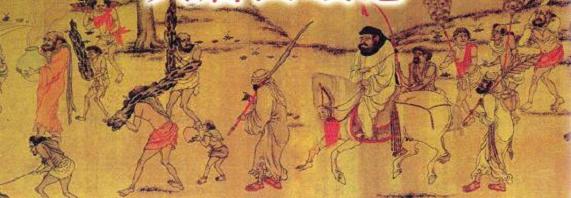 Often researched upon by scholars would be a drawing by Liang Dynasty's Emperor Yuandi, entitled "zhi [duty or post] gong [tribute] tu [picture]" [Liang chih-kung-t'u]. Liang chih-kung-t'u, whose original drawing possibly destroyed together with 140,000 volumes of books at the time of Emperor Yuandi's death, was supposed to be a recollection works of the emissaries who had visited Jingzhou the garrison city where Yuandi had stationed throughout dozens of years. The point to make here is that Liang Dynasty had apparently received delegations from 2-3 dozen statelets covering the countries mentioned earlier. The drawing's minute details about the ancient countries in today's Afghanistan and Iran and their emissaries absolutely corroborated the facts that China's linkage with Central Asia was live and frequent, yielding substantial validity to the person of Monk Hui-shen and his story of the trip to the American continent.
|
|
Hui-shen also stated that over 1000 li distance to the east of Fusang would be a country called Nü-guo (the women statelet). Nü-guo was speculated by Minhua Zhang to be the Amazon statelet in South America. Hui-shen women were said to have lighter skin, hairy body and long hair that dangled to the floor. "Liang Shu" further cited a personal account stating that a Jin'an area traveler was blown to an island of women during the 6th year of Tianjian Era (i.e., A.D. 507).
Layers Of Composition of the Japanese People
The composition of today's Japanese, like many other people, is quite complicated. Though today's Japanese would usually divide themselves into two groups, northerners and southerners, the actual ingredients are much more diversified than that. We could probably list at least the following subgroups:
- The Melanesian - a group of early hunters in Japan during the so-called middle Jomon period, about 10,000 years ago. Those people had remained stone-aged people throughout.
The name Jomon comes from the archaeological artifacts from this period, mysterious clay figurines that appear to be female and clay pots used for cooking and storing food. Jomon, namely, "cord pattern", will be used for those excavations.
Beginning around c. 2,500 B.C. and continuing for nearly a millennium, the Jomon culture spread
from the Kanto Plain near modern Tokyo to the surrounding mountains.
- The Rice Culture People living on the western coast of Japan who might had migrated here from the Yangtze River Delta of China. This group of people would include Queen Himiko of Wa State referred to in Chinese history around the 2-3rd centuries. The Wa people were recorded to have tattoos over their body, in a similar fashion to the Zhejiang people in Yangtze delta where the descendants of King Shaokang of Xia Dynasty (21-16th c. BC) had lived. Chen Shou's San Guo Zhi also recorded that the early Japanese of the 3rd century A.D., calling themselves by the title of 'Da Fu', claimed to be descendants of 'Tai Bo' [the brother of early Zhou Dynasty ruler]. The ancient Japanese, however, did not claim heritage from Xia King Shaokang, two dynasties ahead of the Zhou royal house - while the Xia people had been living in the Yangtze area to found the Ancient Yue (Gu-yue) Statelet much earlier than the later Tai-bo Zhou people.
The Japanese, whom history chronicles repeatedly likened to the tattoo natives of the Yangtze Delta, had an interesting name for one of their four islands, i.e., Kyushu, a name that literally means the "nine prefectures", which coincides with Xia Dynasty Overlord Yu's nine cauldrons. This name, however, was taken in the 19th century around when the shogunate system was revamped.
(One more interesting thing would be the Japanese citation of Liang Dynasty monk Bao-zhi in saying that the country in the East Sea (i.e., Wa Japan) was a Ji-shi country, namely, the Ji-surnamed derivative country of Zhou Dynasty.)
Recent DNA tests of the charcoal remains of rice from 2200 years ago proved that the early rice shared the same origin as that in China's Yangtze Delta, while today's Japanese rice is mainly transplanted from Korea.
DNA studies conducted on human remains excavated in Shandong Peninsula ( http://www.journals.uchicago.edu/AJHG/journal/issues/v64n1/980634/980634.html )
suggested southern and northern points of origin for Jomon and Yayoi Japanese. On basis of various historical records and modern technology analysis, this webmaster would speculate i) that early Japanese, like early Korean, were very much connected with eastern China as a result of the nascent human migration from south to north and ii) that the Tungunsic [and mixed or misnomer Tungusic] invasion from Manchuria gradually overtook the early Continental traits in both Korea and Japan.
(My speculation is that ancient Wa Japanese with Tai Bo lineage had been wiped out or assimilated into the later immigrants from Korea. An Zhimin, at carleton.ca/~bgordon/ Rice/papers/zhimin84.htm, wrote about "EFFECT OF PREHISTORIC CULTURES OF THE LOWER YANGTZE RIVER ON ANCIENT JAPAN", with speculation about pre-Han-Dynasty contacts between Japan and China.)
- The Yayoi - said to be of the Korean origins but more likely the eastern Chinese natives [who were called by the Nine Yi people]. They had a long history of migration into Japan and recorded incidents of their voyages would last from 2-3 century B.C. to 2-3 century AD. The migrations have to do with the chain reactions on the continent, namely, the demise of the Chinese Qin Dynasty and the establishment of Han Dynasty around 206 BC. In the korean section, we mentioned Wei Man's usurpation of Old Choson and consequent relocation of Choson King to southern Korea. Some of the Koreans had been pushed off the peninsula in between, and the island of Kyushu and islands in the Tsushima Strait were already the back waters of the fishermen on two sides from very old times on.
Tombs dating to 200-300 A.D. contained bronze utensils which were mainly brought over from Korea. There was a report saying that a tomb which was opened through a lightening in A.D. 1872 showed the dead king or emperor (Nintoku) wearing Korean clothes and the bronze utensils dated around 4th century. This wave of migration, beginning around c. 200 B.C. and continuing for the next hundreds of years, gradually spread eastward to the Kanto Plain. Based on the fact that remnants of settlements were first discovered in the Yayoi District in Tokyo, these immigrants are referred to as the Yayoi people. They brought along advanced culture that bore the marks of China's Qin/Han culture. The three major symbols of the Japanese, i.e., bronze mirror, sword, and royal seal, are exactly the same as symbols used by the Qin Dynasty.
- The Paekche Colonialists & Refugees -
http://www.koreanhistoryproject.com cited a Korean [i.e., Wontack Hong] saying that Prince Homuda, a Paekche prince, led a expeditionary force to Japan. He landed on the northern shore of Kyushu at the Hakata Bay, on the westernmost of Japan's Kyushu, and pushed his way to the agricultural plain formed by the Yodo and Yamato Rivers at the head of Osaka Bay where the Yamato Kingdom was founded.
The Korean revisionist account could not be correct in that in A.D. 369, Koguryeo sent an expidition force, including 20,000 cavalry, against Paekche, which forced the Paekche king into seeking alliance with the Wa Japanese against Silla, i.e., Koguryeo's ally -- an event that the Korean records on Silla had mistaken to have had happened in year 364.
After defeating Koguryeo, the Paekche (Baekje) king purportedly ordered a sword to be made as a gift for Japan, namely, nana tsusaya no tachi (Seven-Pronged Sword).
This would mean an inverse direction from Japan to Korea.
(Wontack Hong may have modified the Homuda invasion year of A.D. 369 to infer to a later year, i.e., after Paekche struck northward into the Pyongyang area, killing King Kogug-won of Koguryeo in A.D. 371, and then invaded Japan at the hieght of its military might on the Korean peninsula, before the resuscitated Koguryeo under King Kwang-gae-to the Great [391-412] was to defeat Paekche again.)
The Japan-Korea link is most evident in the history of Korea's three kingdoms' warfare and China's participation. Tang General Su Dingfang, who had just defeated the Western Turkic Khanate in Central Asia in A.D. 662-666, crossed the see from Chengshan to campaign in Korea. At the request of the Silla king, China came to Korea and aided Shilla in defeating both Paekche & the Japanese (whose 400 warships were burnt by General Liu Rengui). The Japanese link showed the historical links between Paekche and Japan. It was the Paekche who went to Japan to pick up one of their princes and put him on the throne for sake of continuing the war efforts against Silla/Tang. After Paekche was exterminated, some remnants of the Paekche kingdom fled to Japan, and the newly arrived Koreans were said to be responsible for compiling Japan's history books.
- The Micronesian - the Southeast Asian people, like the proto-Malays, who had spread across the Pacific islands, Taiwan, Ryukyu and Japan. Chinese history recorded a name 'pygmy state' or 'dwarf state' south of Queen Himiko's Wa State in the 3rd century AD. (Also possible would that the original low-height Japanese could have something to do with the pigmy people from Africa, and on the Chinese continent, the pigmy people were caught by Wu Dynasty of the Three Kingdoms era around the Huai-shui River.)
- The Ainu (Ezo) - Said to be a group of the aborigines of Japan.
 They had a religion of a bear cult which is about sacrificing a bear at an annual winter feast. Owning to migrations of people from the continent, they had been retreating to the northern islands of Japan, Sakhalin and the Kuril Islands. Today, they reside mainly on Hokkaido. Except for possibly body hair, intermarriage has led to no particular difference between them and ordinary Japanese. According to China's historical accounts, the Japanese claimed that on their island there were a group of people called 'Mao Ren', namely, hairy people (related to the Ainus?). In A.D. 478, Wa King sent an emissary to LiuSoong Emperor Shundi, claiming that they had campaigned against 55 eastern statelets of hairy people, corroborating the fact that Yamato Japanese had just started colonizing the whole Japan islands around that timeframe and pushing against the poor hairy people.
On basis of DNA analysis, as shown at http://www.pitt.edu/~ annj/courses/notes/jomon_genes.html
&
http://hgm2002.hgu.mrc.ac.uk/Abstracts/Publish/WorkshopPosters/WorkshopPoster11/hgm05 84.htm, Jomon could be ancestors of the Ainu people, and Jomon could be related to the Tibetans.
http://www.boondocksnet .com/expos/wfe_1904_book26.html (by Marshall Everett ) stated that an Ainu chieftain had attended the
Anthropology Exhibits at the 1904 World's Fair in St Louise, with such close examinations as follow:
"They [Ainu} are dark-skinned, and slow-witted, and their old men, with their long beards, look like patriarchs. They are almost the same height as the Japanese, but are heavier, and they haven't the almond eye...
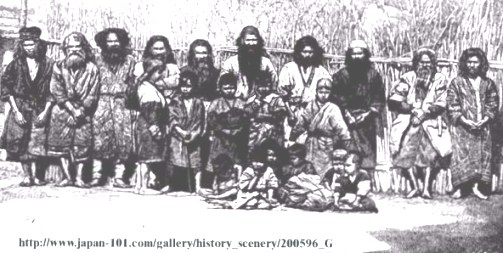 The Ainu have wavy hair, often curly. Black is the predominant color. The hair of the children is lighter, and often auburn. All Ainu hair is coarse and strong...
They are light reddish-brown in color, and have none of the sallow yellowness of the Mongolian. They have expressive eyes, and almost every Ainu's eyes are light brown in color. Black eyes are rare among them...
Their foreheads are narrow, and slope gently backward. Their noses are slightly hooked, flat and broad, with wide nostrils. They have large mouths and firm, thick lips. They have exceptionally long ear lobes."
(A facial profile is available at http://www.kahaku.go.jp/special/past/japanese/ipix/5/5-01.html.)
The Ainu have wavy hair, often curly. Black is the predominant color. The hair of the children is lighter, and often auburn. All Ainu hair is coarse and strong...
They are light reddish-brown in color, and have none of the sallow yellowness of the Mongolian. They have expressive eyes, and almost every Ainu's eyes are light brown in color. Black eyes are rare among them...
Their foreheads are narrow, and slope gently backward. Their noses are slightly hooked, flat and broad, with wide nostrils. They have large mouths and firm, thick lips. They have exceptionally long ear lobes."
(A facial profile is available at http://www.kahaku.go.jp/special/past/japanese/ipix/5/5-01.html.)
Wa - Yamato - Nippon
There are very important questions here. Is the Wa State mentioned in China's records in the early 1st century A.D. the same as that which existed during China's Sui Dynasty (AD 581-618)? Is the Wa State the same as the Yamato? And, is the Yamato Kingdom the same as Nippon (i.e., Chinese Ri Ben or English Japan) of the late 7th century AD?
Wa:
The Wa people in then Japan had close relationship with the Chenhan and Bianhan people in the southern tip of the Korean Peninsula. The Daifang Commandary of Wei China (AD 220-265), located near the present capital city of Seoul, was in charge of affairs of the Wa State.
http://plaza14.mbn.or.jp/ ~sinkodai/efuruta/esss.html said that "Chiu-T'ang-shu or old T'ang History (*5) contains the Records on Japan and Wa-state, and one passage in it radically contradicts the existing dogmatic interpretations advanced by historians of ancient Japan. According to this passage, Wa-state was granted a gold seal by Kuang-wu of Later Han dynasty (AD 25-220)."
(The seal, bearing the characters of "Han Wei [assign] Nu [Wo-nu-guo statelet] Guo [state] Wang [king]", was excavated in Japan around A.D. 1784.)
"Hou Han Shu", written in the 5th century, stated on basis of "San Guo Zhi" that the King of Wa resides in the country of Yematai [Yamadai] (disputed to be Yamaichi as a result of the error by the author of "Hou Han Shu). In the second year of the Jianwu Zhongyuan era, namely, A.D. 57, the Wa Nu Country sent an envoy with tribute to Loyang, and he called himself by the ancient Chinese title of "Dafu" ["distinguished court minister"]. Latter Han Emperor Guangwudi bestowed on him a seal. In the first year of the Yongchu era (A.D. 107), during the reign of Han Emperor Andi, the King of Wa presented one hundred sixty slaves. During the reigns of Huandi (147-168) and Lingdi (168-189), the country of Wa was in wars; and the conflicts were raging on all sides, and there was no ruler till a woman named Beimihu [Pimiko] was selected as a ruler. Beimihu (Pimiko) was said to have no husband but a 1000-female entourage; she was capable of witchcrafts and used a brother for governing the country; and her funeral was accompanied by live burial of hundreds of slaves in a tomb that spanned hundred human steps in diameter.
From San Guo Zhi, it could be discerned that Beimihu's Wa [Wo] Statelet, as a result of prestige of conferral from the Chinese court, had absorbed or nominally ruled over neighboring statelets and tribes (?? about 30 small statelets as recorded in the Chinese history) throughout the years.
After Gongsun Yuan, whose family controlled the Liaodong peninsula and the northern Korean peninsula for three generations, was exterminated from the Korea peninsula in A.D. 239 (?), the Wa people requested for pilgrimage to the Chinese capital with Governor-General Liu Xia of the Daifang Commandary. Diplomatic emissaries were frequently exchanged, and seals were conferred upon the Wa Queen as "King Qin-wei-wang" (king befriending Wei China) by Wei China, i.e., successor to Han China as one of the three kingdoms on the Chinese continent.
During the ten year time period of A.D. 238 onward, Japan sent five delegations to China while China paid 2 return visits to Japan.
In Jan of A.D. 238, the Queen of Wa sent an emissary ("da fu" Nan-sheng-mi) to the Daifang Commandary, requesting pilgrimage for seeing Chinese emperor.
In Dec, Wei Emperor Mingdi (Cao Rui) acknowledged receipt of 4 Wa males and 6 Wa females, and conferred the title of Qin-wei-wo-wang (king befriending Cao Wei) onto Wa Queen plus hundred bronze mirrors, pearls, silk and other precious gifts.
In the first year of Zhengshi, i.e., A.D. 240, Governor Gong Zun sent Ti Zhun to Wa and proxy Wa king replied with thanks.
In A.D. 243, the Wa king dispatched a Wa court "da fu" to China. In A.D. 245, Wei China conferred Nan-sheng-mi a title. In A.D. 245, Governor Gong Zun and Governor Liu Mao defeated Marquis Bunai-hou in today's southern Manchuria. In A.D. 247, Marquis Bunai-hou sent tribute to Cao Wei and was conferred the king of Bunai-Mo.
Later, around A.D. 247, when the Wa State in Japan had internal turmoil because Himiko was at odds with the King of Kunu [i.e., the Gounu-guo statelet to the south of Wa] (Bei-mi-gong-hu-su), Queen Himiko (Pimiko) requested with the new Governor-General of the Daifang Commandary, Wang Qi, for assistance. An official called Zhang Zheng was dispatched to the Wa State in the 8th year of Cheng-shih or A.D. 247.
After Queen Pimiko died, internal turmoil erupted after erecting a male as king.
The Pimiko death led to a turmoil with thousand deaths. The Pimiko live burial included hundred slaves and servants.
Iyo, a girl of thirteen from the Pimiko family, was made queen.
When Zhang Zheng returned to China with two dozen Wa people, it was already dozens of years later and China was ruled by Sima family's Western Jinn Dynasty which had usurped Cao Family's Wei Dynasty in A.D. 265.
http://plaza14.m bn.or.jp/~sinkodai/efuruta/jimmue/jimmue.html had a good account of this episode of history. Between his (Zhang Zheng)'s "arrival to Wa and the final return to Lo-yang, many events are chronicled, such as the death of Queen Himiko, the political turmoil ensuing after her death, and the assumption of young queen, Ichiyo(or Toyo) as the ruler of Wa-state. For the enthronement of Ichiyo, Chang Cheng seems to have exercised his political influence. Consequently there is little doubt that Chang's stay in Wa-state lasted over a considerable period of time. In addition, according to the Record of Wa-state in Western Chin History(*3), this particular Wa mission was received by the newly established Western Chin court during the early years of Tai-shih (AD 265~274). According to Western Chin's chronicler's own additional writing of the record, this was the second year of Tai-shih (AD 266)(*4). Therefore, it can be calculated that Chang Cheng's stationing in Wa-state was 20 years -between the 8th year of Cheng-shih (AD 247) and the second year of Tai-Shih (AD 266)."
Yamatai, Izumo and Yamato
Venerable Master Dongchu (1908-1977), in his book on "The Exchange of Buddhism Between China and Japan",
proposed the school of thought about Three Ancient Japanese States.
Dongchu pointed out that ancient non-Ainu Japan, by the turn of the 3rd to 4th centuries, possessed three major competing statelets of Yamatai (Northern Kyushu, i.e., Kita-kyushu), Izumo (Shimane Prefecture), and Yamato (Nara). This would be a consolidation of over 100 statelets and tribes as recorded by the geography section and the Eastern Yi section in Hou Han Shu (The History of the Latter Han Dynasty). As correctly postulated by Dongchu, 30 plus Japanese statelets and tribes out of over 100, at the time of Han Emperor Wudi's invasion of the Korean peninsula, began to send emissaries to China, which was confirmed by Chen Shou's San Guo Zhi (The History of the Three Kingdoms), a book written earlier than Hou Han Shu.
By the late 3rd century A.D., however, three spheres of influence had formed, with Three Ancient Japanese States of Yamatai, Izumo and Yamato in charge, respectively.
Dongchu's conclusion was built on top of Chen Shuifeng's research, which was based on excavations of bronze daggers and bronze bells (dotaku) that pointed to the Kita-kyushu area as belonging to the culture of bronze bells and bronze daggers, the Izumo area belonging to the culture of bronze bells, and the Nara (Yamato) area belonging to the Yayoi culture. Of course, the archaeological findings already concluded that the Kyushu area contained a far more advanced 'iron' culture than the Izumo (Shimane Prefecture) and Yamato (Nara) areas.
Chen Shuifeng claimed that Japan was populated by the Ainus, by the Tungus coming south to Dewa no kuni from the Strait of Tartary (Mamiya) [-which this webmaster doubt since it was unlikely that the Tungus could have penetrated the Ainu land to go south from Hokkaido],
by the Tungus crossing the Japan Sea to Izumo, by the Tungus crossing the Tsishima Straight to Hyuga on the southeastern Kyushu coast, and by the latest Tungus migration that came to be adored by today's Japanese as the "Tenson-zoku" in the legends of origin.
What Chen Shuifeng speculated on top of the Japanese legends was that the "Tenson-zoku" migrants ultimately dominated Kyushu, crossed the Seto-neikai inner sea to take over the Yamato (Nara) area, defeated the Ainus to the eastern direction, and then turned around towards the west to defeat the early Tungus statelets in Izumo and Dewa areas.
Chen Shuifeng's opinions did not pay special attention to the historical records as to the ancient Japanese claim of heritage from Count Tai-bo, i.e., Zhou King Wenwang's elder brother, nor the recent excavations exhibiting the origin of the Japanese rice as being from the Yangtze River area of China.
Venerable Master Dongchu, however, stated that the Yamato (Nara) had conquered Yamatai of Kyushu and Izumo of southwestern Honshu to unite Japan without specifying the cause and effect, and its context.
While the Japanese legends seemingly corroborated the descent of the "Tenson-zoku" migrants onto the Kinki (Nara) area of Honshu by crossing the Seto-neikai Sea from Kyushu, it did not explain the reason why the gold seal, Han-wei[wo]-nu-guo-wang[king], was discovered in the Hakata Bay of northern Kyushu around A.D. 1784.
Note that the gold seal was conferred upon the Wo-nu-guo statelet in Japan in A.D. 57, which was situated at the southernmost tip of Kyushu.
Himiko's Wa State, which was said in the later YAMATO Japanese legends to have resided in some Hyuga palace in Tsukushi on the southeastern Kyushu coast [but more likely in the center of Kyushu according to the section on the Eastern Yi in Wei Shu of San Guo Zhi, somewhere around volcanic Mt. Aso], was about 212 years after the conferral of the gold seal onto the Wo-nu-guo statelet - which was said to be at the southernmost Kyushu.
Scholar Xue Jun of Ming Dynasty, in Ri Ben Guo Kao Lüe, stated that the Japanese, after crossing the Seto-neikai Sea to Honshu to found the YAMATO dynasty, still retained the generic name "Wa".
Did Himiko's Wa State [actually the Queen Country at Yamatai per Chinese records] lose Han Emperor Guangwudi's gold seal already in A.D. 269, or they had to change the seal because the Chinese dynasty had changed name in mainland China? Her statelet was of course offered a new seal bearing the title of the "Wa King who befriended Wei China".
Or, as this webmaster believes, Himiko's Wa statelet, which was known as the Queen Country in Chinese records, was a totally different entity from the southernmost Wo-nu-guo statelet of the 1st century A.D.
The likely event was that the southernmost Wo-nu-guo statelet of the 1st century A.D. had at one time extended its rule over the entire Kyushu area, carrying its gold seal northward to the Hakata Bay. By the 3rd century, the original Wo-nu-guo statelet might have already suffered demise, with Himiko's Queen Country in Yamatai and a rivalry statelet (Bei-mi-gong-hu's Gounu-guo) [to the south of the Queen Country] dominating the entire area. --The ideal place to cross the Seto Sea is not Hyuga (i.e., today's Miyazaki) at the southeastern tip but today's Kitsuki, or the Saganoseki Peninsula [i.e., the stepping stone to Sadamisaki Peninsula on the Shikoku Island], or Usuki or Saiki in the mid-coast of the eastern and/or northeastern Kyushu coastline.
Complicating the matter would be Himiko's rivalry statelet, i.e., Gounu-guo (Kuna-koku as pronounced in today's Japanese language) as we discussed above. Did Himiko's Wa destroy Bei-mi-gong-hu's Gounu-guo, which was situated to the south of Himiko's Wa in Wei Shu of San Guo Zhi, a statement conflicting with Hou Han Shu in that the Wo-nu-guo was said to be situated at the southernmost boundary [of Kyushu] in Hou Han Shu? This conflict could be resolved should both the Queen Country and the Gou-nu-guo statelet were both located in central Kyushu.
Did the Gounu-guo statelet destroy Himiko's Wa? Was the Gounu-guo statelet of the 3rd century A.D. the same one as the southernmost Wo-nu-guo statelet of the 1st century A.D.? Not likely.
In light of the Japanese YAMATO records in Nihonshoki and Kojiki, we could rule out the possibility of the Gounu-guo statelet's sharing any commonality with the Yamato Japanese from today's Nara area. The candidate qualified for leading the eastern expedition against Honshu might be Himiko's Queen Country and their descendants.
(Japanese Naito Konan thought that the Gounu-guo statelet of the 3rd century A.D. was a country of Kyushu natives called the Kumaso people in Nihonshoki. They carried similar titles, Isao, e.g., for their chieftains, a same title as those recorded in the Chinese history for the Ryukyu people. Japanese scholar Mizuno Yu had a book on the three statelets of the Wo-nuo-guo, the Queen Country and the Gou-nu-guo. Other than the three names here, there were numerous "nu" prefixed or suffixed statelets in Kyushu.)
Incidentally, a correct reading of the Chinese records would show that there still existed a dozen statelets to the east and south of Himiko's Queen Country, including a county called Qin-wang-guo, i.e., the country ruled by a king of the Qin people. In Sui Dynasty's history writing covering the events of the 7th century, we could see that to reach Yamato, Chinese emissary Pei Shiqing passed through the Qin-wang-guo statelet.
(Xue Jun of Ming Dynasty, in Ri Ben Guo Kao Lüe, claimed that the Qin-wang-guo statelet was founded by elixir-seeking Xu Fu without elaboration. Today's Chinese people, including the Japanese, took the Wakayama area, southern tip of Honshu and to the southwest of Nara, as the place where Xu Fu might have landed. However, the Wakayama heritage could be a latter-day add-on.
Interestingly, Xue Jun had recorded the name of Xu-wo in Japan, namely, the Wa Japan statelet under Xu Fu's rule, stating that Xu-wo was subject to Da-wo, i.e., the Greater Wa State. This could mean that Xu Fu, with 3000 boys and girls [or 3000 boys and 3000 girls], did not have enough adult men to defeat the aboriginals upon landing in Japan. It was said that Qin Emperor Shihuangdi sent Xu Fu on the sea trip in search of An Qisheng, a legendary figure with whom Qin Emperor Shihuangdi had conversations about the elixirs in the seas and who later left a note with the emperor saying that he had departed for the overseas.)
The Mysterious Fourth Century:
About one hundred years of history, from Queen Himiko's era of A.D. 269 to the so-called Korean-revisionist Homuda Invasion, was in a kind of black box. While there might have existed a ruler by the name of Ojin after Queen Iyo (or Ichiyo), there was no chance that someone called Nintoku could have reigned from A.D. 313 to A.D. 399 or 86 years.
There is no way to find out what happened to Himiko's Wa State or her rival state of Kunu. Some speculations exist: Himiko Wa of Kyushu absorbed Kunu and expanded into the Yamato plains in Honshu, Kunu absorbed Wa and expanded into Yamato, or an invasion force from Korea landed in Kyushu and then expanded into Yamato in Honshu; or an invasion force from Korea, without the connection with the Wa Statelet on Kyushu, landed direct at Honshu and pushed to the Yamato plains.
To find out what might have happened, we would have to examine the traces of history from later times. My deduction below was that Yamato Japan, which could consist of the Tungunsic [and mixed or misnomer Tungusic] invaders from Korea, had inherited the lineage of Wa Japan, and it was the consequence of the similar fate of the barbarian invasion against northern China and southern Korea. The united Japan, for its historical contact with the Paekche kingdom during the 7th century war against Tang China, could mean that Yamato Japan might have elements in the Tungunsic invaders from the Korean peninsula.
And, the Tungunsic elements might have usurped the Wa Japan lineage of the Five Wa Japan Kings.
(Someone studied the ancient Koguryo monument to find the "nan" notation to mean seven, which could be linked to the Japanese pronunciation of "nana" for seven. This could mean that the Japanese of the 4-5th centuries might have origin from the Fuyu people of southern Manchuria, who in turn were related to the ancient "Mo [He]" people.)
Liu Yu'sSoong Dynasty (AD 420-479), according to Liang Dynasty (AD 502-557)'s historian, Shen Yue, had conferred the Wa ruler the (blank) title of 'King of Six States' of Wa, Silla, Qinhan and Bianhan etc.
Throughout the short history of Eastern Jinn & LiuSoong dynasties, the Wa Japanese had sent numerous missions, and one Korean mission, with Japanese emissary on board, was recorded to have cried aloud when they saw the dilapidated Jinn Chinese capital which just went through a war as a result of internal rebellion. The contacts between Japanese and southern Chinese were understandable in that northern China was in the hands of the barbarians and the traditional Korean land route was already cut off at the time.
LiuSoong Dynasty's designation of 'King of Six States' could be a good proof that the Wa State (Wa-koku) did exert influences over peninsula Korea [or southern Korean peninsula] in some way as a result of collaboration with or colonization by the Koreans. The two successive dynasties of Qi (AD 479-502) and Liang (AD 502-557) continued to receive Japanese emissaries. Liang reaffirmed the title of 'King of Six States' onto the Wa State.
During LiuSoong Dynasty, five Japanese kings dispatched 12 delegations to China in about 80 years, culminating in Japan's "fei [flying] niao [bird]" Buddhist cultural prosperity by the late 6th century.
[Liu-]Soong Shu recorded that in A.D. 421, Wa King Zan sent over tributes and Liu Soong Emperor Gaozu decreed that the Wa Statelet could be exempted from the tribute requirement due to sea perils. It further stated that in A.D. 425, the Wa King dispatched a 'sima' (i.e., an ancient Chinese official designation meaning counsellor or magistrate) called Cao Da to the LiuSoong Dynasty court. When Wa King Tsan [Zan, San in modern Japanese pronunciation] died, his brother, Zhen, came to the throne. He sent an envoy to the LiuSoong Court with tribute in A.D. 438 in the name of "King of Wa, Paekche, Silla, Imna, Chinhan, and Mahan (Mok-han) and Generalissimo Andong Da Jiangjun (i.e., the general who pacifies the east)." In A.D. 443, Wa King Ji (Sai) was also confirmed the same title as King of the 6 states. In A.D. 451, the order and title of the 6 states was changed a bit, to the Six States of Wa, Silla, Imna, Kara, Chin-han, and Mok-han. "Paekche" was replaced by Kala (Kara). In A.D. 462, the son of Wa King Ji (Sai), i.e., Xing (Ko), was confirmed the same title. King Bu (Yuryaku), Ko's brother, was last granted the title in A.D. 478. "Nan-Qi Shu" (The History of Southern Qi Dynasty) recorded that Wa King Wu (Bu) was promoted to "Zhendong Da Jiangjun" (i.e., the general who quells the east), King of Wa, and 'du-du' or governor of the Seven States in A.D. 479, and "Liang Shu" recorded that King Wa was further promoted to "Zhengdong Da Jiangjun" (i.e., the general who campaigns in the east) in A.D. 502. [Liu-]Soong Shu ("The History of LiuSoong Dynasty") did not expound the relationship between Wa and Korea of the time, unfortunately. In A.D. 478, the Wa King sent an emissary to Liu Soong Emperor Shundi, claiming that their ancestor, Mi (Dei in modern Japanese pronunciation, i.e., Yingshen [Ojin Tenno]), had campaigned against 55 eastern statelets of hairy people (Ainu ?), 66 statelets in the east, and 95 statelets in the north. The Wa King also complained that Korguryo had raided his emissaries of tributes and gifts destined for the LiuSoong court. In ancient times, Japan took the cross-strait trip to Korea and then travelled to the Chinese capital via the Manchuria corridor, in lieu of the perilous sea trip to the eastern Chinese coast.
(Per fabricated Nihonshoki, the eastern expedition was undertaken by someone called Prince Yamatotakeru who had campaigned eastward under an emperor called Keiko at about A.D. 130.)
Wontack Hong, at http://gias.snu.ac.kr/wthong/, had a very good account of the intricacy involved in here. He pointed that many scholars ( including Hirano, 1977) believed that the "rulers of Yamato Wa were placed below the kings of Koguryeo and Paekche because when King was given the title of Andong Jiangjun in A.D. 462, ... , the king of Koguryeo bore the title of Zhengdong Jangjun and the king of Paekche Zhendong Da Jiangjun. ... The king of Paekche must have been in the position of an overlord ..." Hong further stated that "Wa Kings could not have included the names of non-existent states (Chin-han, and Mok-han). One may then conclude that the remnants of Chin-han or Ma-han existed as other members of the Kaya Federation by ... fifth century. .. Town states constituting Ma-han and Chin-han were by themselves no longer independent political entities [having mostly been conquered by Paekche and Silla, except those remaining as the member states of the Kaya Federation]". Silla's position was apparently less than that of Paekche. "According to 'Samguk-sagi', Silla established the first contact with the Southern Chinese Dynasties in A. D. 521 by sending an envoy to the Court of Liang along with the Paekche envoy." Later, at one time, when Yamato Wa requested that their monks be sent to China under the umbrella of Silla embassy, the Silla flatly refused it.
The Invasion Theory:
The Japanese could not agree upon any specific date as to their prehistory. Uncorroborated conventional world history books cited the event that happened in the year of AD 391 as something ascertained by three parties, China, Japan and Korea. The Chinese record is to be searched yet for this claim. The Koreans flatly denied that it was an invasion into Korea by Wa Japan at all.
But in this year, according to http://home. earthlink.net/~dlturk/japanhistory/yamatohistory.html, the "Japanese forces cross to Korea, defeat Paekche and Silla armies and establish a small colony (called Mimana) on the southern tip of the peninsula. To thank the Japanese for helping save his territory from the Silla, the king of Paekche sends scholars to Japan. With them they bring the Chinese writing system."
http://home. earthlink.net/~dlturk/japanhistory/yamatohistory.html made a rough time table for the Yamato Period to be A.D. 300-550. By adopting A.D. 300-550, the Jimmu Tenno Invasion would have happened in the 4th century A.D., instead of something like in the first millennium BC. This certainly is close to the purported Korean claim that Paekche's Prince Homuda led a expeditionary force to Japan and colonized the country as Yamato. (See the earlier writing on the nana tsusaya no tachi or the Seven-Pronged Sword. Wontack Hong, an economist-turned Korean historian, claimed that Homuda (namely, Homuda no Sumeramikoto, tenno Ojin, or Homuda-wake-no-mikoto, a.k.a. the god of Hachimanshin/Yahata-no-kami) was a Korean in the first place.)
What happened then in the fourth century after all?
Wontack Hong, at http://gias.snu.ac.kr/wthong/, firmly believed that the so-called invasion of Mimana in southern Korea was not an action on the part of the Wa Japan, but an en-route campaign by Paekche armies. The Paekche armies, in order to cross the sea to Japan, would have no choice but to go through the territories of Mimana. Hong borrowed some research from a Japanese scholar called Egami (1964) who claimed that "Mimaki-iri-biko from Mimana" ( a Chinhan ruler with connection to Puyo people) was "the leader of the horse riding invasion force". In contrast with Egame, Hong claimed that it would be the Paekche who invaded Wa Japan and set up the Yamato State. Hong believed that Egame could not divest himself from the imperialist Japanese viewpoint that Japanese could never be subjugated by an inferior race like the Koreans. In an academic article, Egami (1964) expounded the 'Horserider Invasion' theory which was to say that "the alien people called the gods of heaven were a North East Asian people related to the people of Fu-yu [Puyeo] and Kao-chu-li [Koguryeo]... immediately prior to their invasion of Japan, they [the horseriding invaders] were based on the Mimana area in south Korea."
Egame's theories, however, were built on undisputable artifacts excavated from the tombs of intermediate and late Kofun periods. The tombs had shown striking similarities to those in Korea, which made the Japanese into an awkward position should they deny the sudden continental influx in the 4th century.
The biggest excavated Kofun tomb was purportedly that of Wa King Tsan [Zan] , i.e., the first of legendary Five-succession Wa Kings of Zan-Zhen-Ji-Xing-Wu of the 5th century A.D. [which conflicts with the fabricated Japanese Yamato equivalent lineage of tenno Ninkotu (rende, r. 313-399); tenno Hanzei (fanzheng r. 406-410 or rende); tenno Ingyo (yungong, r. 412-453); tenno Anko (ankang, r. 453-456); and tenno Yuryaku (xionglüe, r. 456-479) as recorded in Kojiki (compiled by O no Yasumaro) and Nihon shoki (compiled by Toneri shinno)].
Though, archaeological findings, though, pointed to Kyushu as the land of advanced metallurgy, i.e., iron weapons and utensils, which were more the product of the Chinese from the Yangtze River area or the Chinese-lineage Qin-han people from the southern Korean peninsula.
The comparison of iron versus bronze from the Kofun excavations is important in that as of the cut-off time of the mid-5th century, the southern-ring of both Korea and Japan remained the people who were associated with the iron-smith Chinese with origin from the continent, i.e., Wa, Silla, Qinhan and Bianhan.
My take is that you don't have to make the Japanese ruling history a continuous line, and you don't have to use the soundex to make the later Yamato inherit the Yamadui or Yamatai place naming of the Wa Japan of the 3rd century A.D.
In my view, the Yamato Japanese, before reaching the Yamato Plains in Honshu, still carried on the same name Wa as was known from the 1st century AD. However, the composition of the Wa Japanese in the 4th-6th centuries, or the 1st versus the 3rd centuries, had changed.
While the input of immigration from the Yangtze and iron-smith quasi-Chinese from the southern Korean tip had dwindled to nil, the new blood from the Tungunsic [and mixed or misnomer Tungusic] invaders from the mid-peninsula and the northern Korean peninsula kept arriving at Wa Japan.
During the continuous migration to Wa Japan, some of the new emigrants from the Korean peninsula could have bypassed Kyushu to land at the waist of the Japanese Honshu island for establishing colonies.
To find out what might have happened, we would have to examine the traces of history from later times. My deduction below was that
initially, the Wa Japanese, for their host's role, might still command the respect among the new immigrants.
Yamato Japan, which could consist of the invaders from Korea from later time periods, had inherited the legacy of Wa Japan, as a consequence of the similar fate of the barbarian invasion against northern China and southern Korea.
The Chinese dynasties in southern China apparently were not interested in investigating the lineage of the new generation of Japanese rulers.
The Koreans claimed that it would be the Paekche people who had set up the State of Yamato. This school of thought had claimed that the Paekches, out of hatred for the Sillas who conquered their country, had embarked on a mission to hide or destroy their Korean identities. They basically wrote the "Kojiki" and "Nihon shoki" in the early 8th century to make the 'invasion' occur hundreds of years earlier than it actually occurred. http://www.koreanhistoryproject.org - which was apparently adopting Wontack Hong's "invasion" theory - stated that "in the winter of 369 AD, Prince Homuda's expeditionary force landed on the northern shore of Kyushu at Hakata Bay on the westernmost of Japan's large islands... Prince Homuda's army pushed eastward for six years, encountering fierce resistance from many of the clans in its path... finally halted on the rich agricultural plain formed by the Yodo and Yamato Rivers at the head of Osaka Bay... Prince Homuda proclaimed the creation of his new kingdom, taking its name from the surrounding region and giving the country its first official 'name' - Yamato. (Note previously we stated that "in A.D. 478, the Wa King sent an emissary to LiuSoong Emperor Shundi, claiming that their ancestor, Mi (Dei in modern Japanese pronunciation, Yingshen [Ojin Tenno]), had campaigned at about the turn of the 4th to 5th centuries against 55 eastern statelets of hairy people (Ainu ?), 66 statelets in the east, and 95 statelets in the north." This means that the Japanese was still in the process of stabilizing the Honshu territory, and were far from the possibility of establishing a so-called Yamato [Da He Zhou] statelet in the Kinki area, or today's Kyoto-Tokyo area, at the time of A.D. 369.)
--Refer to the earlier discussion of the 120-year (two sexagenary cycles) difference between the records of Nihongi and those of Samguk-sagi in this period, which was cited by Wontack Hong (see Aston 1889, pp. 51-65).
Now, the question will be whether this 'Wa' State was the same as 'Yamato'.
Yamato:
http://plaza 14.mbn.or.jp/~sinkodai/efuruta/ikazuchi/ikazuchi.html provided a theory of two dynasties existing in Japan in the 7th century, simultaneously, namely, the Kinki Dynasty (Yamato Dynasty) versus Kyushu Dynasty (Wa-state). It stated that "after the defeat of Battle of Hakuson-Kou, Kinki Imperial Families as Great King Tenchi make a public statement of being separate from Kyushu Dynasty (Wa-state) through the backing of Tang. Tang gave Kinki Imperial Families a push that 'Now that you have us behind you, you may absolutely rest assured that all'll go well, and if you get it started, it's half a battle.' ...And as soon as Kyushu Dynasty defeated, they announced an new augmentation and revision of the caps denoting themselves official rank."
As far as the last sentence is concerned, this webmaster has not found any Chinese literature ascertaining it yet. It would be calling the Chinese emissaries all fools to say that they, during their missions to the Wa State in A.D. 664, 665, 669, 670 & 671, did not know whom they had fought against in Hakuson-Kou.
http://plaza14.mbn.or.jp/ ~sinkodai/efuruta/esss.html claimed on basis of his interpretation of Chinese records that "since Wa attempted to conduct its diplomatic relations with ... as an equal state, it had to fight a great war against the Sui (should be Tang) dynasty at Hakusonko (in A.D. 663) in the Korean Peninsula where it was completely defeated. All through these events over the centuries, only one Wa-state was involved, and it was located on the island of Kyushu." Hakusonko is called Jinjiang-kou or Jinjiang River Mouth.
I would question only one word here, namely, 'Kyushu'. Why? Because the Japanese would contradict themselves by claiming different dynasties in Japan, Kinki Yamato versus Kyushu Wa dynasties. According to http://www.wsu.edu:8080/~dee/A NCJAPAN/TAIKA.HTM, "the two most important political innovations in ancient Japan were the Seventeen Article Constitution of Prince Shotoku (604 A.D.) and the Taika Reform Edicts of Emperor Kotoku. The regency of Shotoku was followed by a coup against the ruling Soga clan, from which Shotoku was derived. The new emperor, Prince Karu, together with the Imperial Prince Naka no Ohoye, issued a series of reform measures that culminated in the Taika Reform Edicts in 645 AD. These edicts were written and sponsored by Confucian scholars in the Yamato court and in essence founded the Japanese imperial system and government. The ruler, according to these edicts, was no longer a clan leader, but Emperor (in Japanese, Tenno) that ruled by the Decree of Heaven and exercised absolute authority. After the edicts, Japan would no longer be composed of separate states, but provinces of the Emperor that would be ruled by a centralized bureaucracy." Should Japan be a unified country under one emperor, there could not have existed two authorities.
http://home. earthlink.net/~dlturk/japanhistory/yamatohistory.html claimed that in A.D. 646, "The Imperial capital is set up in Naniwa. A new era name (Taika) is announced... During this period, the capital is moved from Yamato to Naniwa, then to Kyushu, then back to Yamato, and finally settled in Omi..." This sounds like a good reconciliation, but needs the third party corroboration. As far as Yamato itself is concerned, this webmaster would probably claim that the name 'Yamato' was more a terminology for the regime which was first set up in the Yamato area. Before the Yamato Invasion of A.D. 369 as depicted in the controversial theories, Japan was apparently in a state of loosely independent units. Chen Shou's San Guo Zhi mentioned about 100 states existing in Japan prior to the 3rd century.
The following will be an approximate description of the locality of the Wa State: Chen Shou said there were, in the 3rd century, 30 plus states in Japan which maintained relations with China.
Starting from Korea, about 7000 li by sea, you arrived at the state of 'Yichi' (Izu State). Another 1000 li by sea would be the state of 'Weilu' (Matsuro?). Travelling by land for 500 li to the southeast would be 'Yidu' (Izu). Another 100 li by land in the same direction would get to 'Nu'. Another 100 li to the east would be 'Bumi'. 20 days sailing to the south would get to 'Touma'. Another 10 days by water and 30 days by land to the south would get to a place called 'chimatai' (Qimatai) or 'yemaye (Yamaichi)' where the Wa King or Queen dwelled. To the south of Yamaichi was the country of Kunu [Gounu-guo] where a King ruled, and this country was not subject to the Queen. (Professor T. Furuta said the "li" used by Chen Shou was not 435 meters as used during the Qin or Han dynasties, but rather the unit adopted by the Wei and Western Jinn dynasties, which is that one "li" is approximately 77 meters. Looking at Japan's map, people will say this conclusion was quite sound.)
In "Wei Zhii", the name of the place was 'Yematai' (disputed by the Japanese to have copied from an error in "Hou Han Shu", and in "Bei Shi" (history of the Northern Dynasties), it was called 'Yemuodui'. What is to be noted here is that none of the mutations imply the Chinese characters 'Da He Zhou' which would denote Yamato in "New History of the Tang Dynasty". The sounding of the pronunciation, however, is almost the same as the later 'Yamato'. Wontack Hong, at http://gias.snu.ac.kr/wthong/, claimed that Chen Shou used the two words 'tai' and 'ichi' more than dozens of times in his book, and in none of those appearances did Chen Shou ever confuse the word of 'ichi' for 'tai' or vice versa.
You may ask why the Japanese made a big deal out of this? This is because the later Japanese state of Yamato posed a lingering historical dispute till today. In the Chinese history, the records in regards to 'Ri Ben' or Nippon are often marked with the word 'suspicion'. Before the word 'Ri Ben' or Nippon appeared in Tang records, the Chinese used the Chinese character of 'Wa' indiscriminately for designating Japan. The Japanese, however, pronounced the same character differently, as 'Wa' and 'Yamato' at the turn of the 7th-8th centuries A.D., till 'Nippon' was adopted by Yamato Dynasty as the official name in the early 8th century A.D. Today's Japanese claimed that Nippon or Nihon was corrupted from the word Hinomoto, namely, Chinese 'Ri Ben', the origin of sun, and they further claimed that the Hinomoto was a state that existed at the time of legendary emperor Jimmu. The Chinese TV drama depicted Tang Empress Wu Zetian as making up the name of 'Ri Ben' for the Japanese emissary. (I found an entry in history book supporting the Empress Wu Zetian claim.)
Adding further to the complexity will be the fact that the Chinese character used for Yamato would be switched from 'wo' to 'he'. The character 'he' meant peaceful or 'mixing-up' in Chinese.
In Fang Zhiping's opinion, 'he' or yamato originally
meant for the mix-up of Ainu natives and Japanese colonizers.
In the opinion of this webmaster, the Japanese corrupted the original word "Wo" (Wa in the Japanese pronunciation) to the character "he",
with the same 'crop' part. (The 'wo' character, which was misused today by the Chinese to mean people of lower height, could originally just mean a peaceful and obedient people, with
compositions of 'human', 'crop' and 'women' parts, while the character 'he' had the parts of 'crop' and 'mouth' (meaning people).
As to why the new Japanese generation from the 6-7th century A.D. called the Japanese 'newfoundland' by Da-he, it could be merely an imitation
of the Chinese way of calling the country by adding the 'grand' prefix.
"New History of the Tang Dynasty" recorded quite some claims by the Japanese such as the migration to the place called 'Da He Zhou', namely, Da (Great) He (Yamato) Zhou (Prefecture). The ancient Japanese then called the Ainu land to the east by the name of "Hitagami no kuni", meaning the country where the sun was seen rising above the highland.
This migration could not be any earlier than what was recorded in the 'Five Japanese Wa Kings' era.
In another word, this webmaster believed that what the ancient Japanese tried to forge was to call their country by Da-he (grand 'he' - which was pronounced Yamato) instead of
Da-wo (where wo was purportedly called by Yamato as well).
DaHe would also be the name used by the Japanese for designating their race today.
Similarly, as Venerable Master Dongchu (1908-1977) pointed out what Wei Tingsheng had discovered, the Japanese 'tenno' (emperor) was a copycat of the Tang Chinese invention as well. In A.D. 674, Tang Emperor Gaozong first coined the words "tian [heavenly] huang [emperor]" for himself, and the Japanese hastily copied over the title to name their emperor by a similar name, pronounced tenno.
In another sense, there was no chance that the Japanese invented the title tenno in A.D. 645 and the Chinese emperor copied the Japanese, and it had to be a new invention sometime around A.D. 720 when the Nihonshoki was written.
In Tang China, in 674, the emperor and the empress (Wu Zetian) were decreed to be called 'tian huang' [i.e., the heavenly emperor, which was appropriated by the Japanese to be tenno] and 'tian hou' [i.e., the heavenly empress].
The Five Japanese King Era of the 5th Century A.D.
[Liu-]Soong Shu and Liang Shu had no differentiation of the Yamato Japan from the Wa Japan.
Liang Shu stated that after the death of Queen Iyo or Toyo (Yiyu in Wei Zhii or Taiyu in Liang Shu and Bei Shi), male kings were erected again and they were conferred titles by China. Thereafter, during the reign of Eastern Jinn Emperor Andi (Sima Dezong, reign 397-418), a male king by the name of Zan was erected. (Eastern Jinn was usurped by LiuSoong Dynasty in A.D. 420.)
[Liu-]Soong Shu recorded that in A.D. 421, Wa King Zan (San in modern Japanese) sent over tributes; in A.D. 425, Wa King dispatched a 'sima' called Cao Da to LiuSoong court. After Tsan [Zan, San in modern Japanese] would be brother Zhen [Chin in modern Japanese]); after Zhen would be son Ji (Sai in modern Japanese); after Ji would be son Xing (Ko in modern Japanese); after Xing would be brother Wu (Bu in modern Japanese or Yuryaku).
Wa King Wu (Bu) continued the renewal of titles till A.D. 502. Available records did impress me that Japan's Wa ruling house was continuous at least during the fifth century A.D.
The Japanese attempted to match the Five Kings of Zan-Zhen-Ji-Xing-Wu to
i) San, Ninkotu (rende or lüzhong, with a fabricated reign of A.D. 313-399); ii) Chin, Hanzei (fanzheng [with a fabricated reign of A.D. 406-410] or rende); iii) Sai (Sei), Ingyo (yungong, with a fabricated reign of A.D. 412-453); Ko, Anko (ankang, with a fabricated reign of A.D. 453-456); and Bu, Yuryaku (xionglüe, with a fabricated reign of A.D. 456-479).
What remained dubious was after that.
Because the future Japanese emissaries, who no longer carried the accounts about the Five-Succession Wa Kings as recorded by China's southern dynasties, fabricated the myth of the Jimmu Tenno dating to the 1st millennium B.C.E. and his migration to the Yamato (Da-he-zhou) Plains.
--For the approximate date of the migration to the Yamato Plains, this webmaster will take the report of
the Wa King in A.D. 478, to LiuSoong Emperor Shundi, as the approximate time of the eastern expedition, i.e., the early 5th century.
In the report to the Chinese emperor, Wa King claimed that their ancestor, Mi (Dei in modern Japanese pronunciation, Yingshen [Ojin Tenno]), had campaigned against 55 eastern statelets of hairy people (Ainu ?), 66 statelets in the east, and 95 statelets in the north.
Mi (pronounced Dei in modern Japanese) was the father of
Tsan [Zan, San in modern Japanese] and Zhen [Chin in modern Japanese]).
This historical entry is also significant in that up to A.D. 478, the Wa Japanese had respect for China in contrast with later evasion, fabrication and disrespect.
Remember in A.D. 631, Tang Dynasty emperor Taizong ordered to have Xin-zhou 'ci shi' Gao Renbiao return a visit to Japan; however, the Japanese king (i.e., tenno) argued with the Chinese emissary about the 'minister' or vassal protocol. Hence Gao Renbiao returned to China without relaying emperor Taizong's decrees.
Why the later evasion, fabrication and disrespect? It could mean the Five Wa King lineage and the Yamato Japanese lineage could be totally different. Especially so when the reign years of the Five Wa King do not match with
Ninkotu (rende, r. 313-399); Hanzei (fanzheng r. 406-410 or rende); Ingyo (yungong, r. 412-453); Anko (ankang, r. 453-456); and Yuryaku (xionglüe, r. 456-479) - as recorded in Kojiki (compiled by O no Yasumaro) and Nihon shoki (compiled by Toneri shinno)].
What was missing from China's history was the elapse during the later years of Liang Dynasty (AD 502-557), Chen Dynasty [A.D. 557-589] and the early years of Sui Dynasty. Ouyang Xiu said the Wa Japanese did not establish contacts with Sui China till close to A.D. 600, after last record of pilgrimage to China's Liang Dynasty (AD 502-557).
Liang Shu recorded that King Wa was further promoted to Zhengdong Da Jiangjun (i.e., the general who campaigns in the east) in A.D. 502.
From the Korean records, we could tell that Silla established the first contact with the Southern Chinese Dynasty of Liang in A.D. 521 by sending an envoy in the same embassy as the Paekche envoy, but after that, Silla had declined the Wa Japan's attempt to piggyback their envoy to China in the same mission as the Silla's.
It was right in the second half of the 7th century, when Japan was in the process of promoting Buddhism or banishing Buddhism - which was simultaneously going in on the Chinese continent -- that we saw the conflicts emerging in Japan's history, with a difference of about 20 years for the reign of Kimmei (Qinmin) Tenno. The New History of Tang Dynasty recorded that Yomei (Yongming) Tenno [i.e., Du-li-si-bi-gu or Mu-du-li-si-bi-gu in New History of the Tang Dynasty] sent an emissary to Sui China at the end of the Kaihuang era of Sui Dynasty, i.e., about A.D. 600, while the Japanese claimed that this tenno [Yommei (Yongming) Tenno] had a reign of A.D. 585-587, at least 13 years earlier, while Shotoku's aunt, empress (tenno) Suiko was said to have a reign of A.D. 554-628.
(Did the Chinese mix up tenno [Yommei (Yongming) Tenno, reign A.D. 585-587] with Regent Shotoku who purportedly served under aunt-empress [tenno] Suiko [reign of A.D. 554-628]?)
Dozens of years later, when the Japanese came to Tang China, they had a totally different tenno lineage,
inserting eight imaginary emperors' reign to push the legendary Kimmu Tenno to the 6-7th century B.C.E.
Sui Emissary's Visit To Japan in A.D. 608:
Ryukyu was first mentioned in Bei Shi (History of Northern Dynasties) as an island country in the East China Sea, which could be reached by sailing by boat for five days. Bei Shi stated that Ryukyu was full of caves; that it had three circles of defence-purpose fences, with water flowing by the fences; that its king was named Huan-si-shi, with a first name of Ke-ci-dou and 16 palace rooms decorated with inscriptions of animals; that their people were in constant fighting with each other; that various villages were ruled by a chief called Niao-lian-shuai; that it had 4-5 marshals in charge of various caves; and that they were cannibals eating dead bodies of enemies and family members.
Bei Shi (Northern Dynasties' History) and Sui Shu (The History of Sui Dynasty [AD 581-618]) recorded that the coastal Chinese people often noticed smoke or mist rising in the East China Sea during spring and autumn time periods and that Sui Emperor Yangdi confirmed the identity of Ryukyu via the Japanese emissary. In A.D. 607, Wa Japanese King Duo-li-si-bi-gu sent an emissary to Sui China, stating that they had heard that the new 'buddha' emperor to the west of the sea had revived Buddhism and they would like to have a dozen monks study Buddhism in China. Emperor Yangdi at first refused to hear about the Wa State (Japan) because the Japanese king wrote the sentence "The Son of Heaven from the sunrise wish good health for the Son of Heaven at the sunset...." However, Emperor Yangdi sent an emissary, Pei Shiqing, to the Wa State the second year, i.e., A.D. 608. Pei Shiqing crossed the sea to Paekche, arrived at Zhu-dao (bamboo island) Island, watched Dan-luo-guo statelet to the south, passed through Du-si-ma-guo statelet, crossed sea again to Yi-zhi-guo statelet, arrived at Zhu-si-guo statelet, went eastward to Qin-wang-guo (Qin King Country which was commented to be similar to Chinese) statelet [which could still be in Kyushu], travelled through another dozen countries to reach the coast of Wa Japan [then in today's Nara]. Pei Shiqing recorded that the domain east of Zhu-si-guo belonged to the vassalage of Wa Japan. Wa King welcomed Pei Shiqing with over one hundred people, displaying ceremonial courtesy and beating the drums and horns. Within the next ten days, Wa King dispatched 200 cavalry to fetch Pei Shiqing at the outskirts of the capital. After arriving at the capital, Pei Shiqing and Wa King exchanged gifts and tributes. The Japanese asked another emissary to accompany Fei Qing back to China. It was from the mouth of this Japanese emissary that Emperor Yangdi confirmed the existence of Ryukyu, an island to the southwest of Japan.
(During Sui Dynasty, Japan dispatched four delegations to China. This was like after an elapse of over 50 years, counting the last Japanese visit to southern China.)
Nippon (Nihon):
"Old History of the Tang Dynasty", claimed that 'Ri Ben' or Nippon could be an alternative race of the Wa State, and it cited two points: 1) The Japanese did not like the ugly name of 'Wa'; 2) Nippon was probably a small statelet that was swallowed by the Wa State and the Wa State just borrowed their name. It also claimed that the numerous Japanese students who went to Tang Dynasty had also been recorded to have been ambiguous about their origin. It said that those 'overseas students' (namely, lyu'ngakusei, the same exact term used by Japanese to designate the Chinese who obtained student visas to study in Japan today) often saved the money given by Chinese emperors and then bought huge amounts of Chinese classics for shipping back to Japan. It also said numerous times that those Japanese students often exaggerated description about 'Nippon' and their words were very doubtful. Further, "Old History of the Tang Dynasty" said the first Japanese emissary who used the name 'Ri Ben' came in A.D. 703 (the third year of Chang'an under Tang Empress Wu Zetian). Subsequent visit would be A.D. 713 when Tang Emperor Xuanzong was in rein.
Ouyang Xiu of the Soong Dynasty, in his book Xin Tang Shu (new history of the Tang dynasty), said that Tang Emperor Gaozong had ordered in A.D. 650 that the Wa King Xiaode send armies to aid Silla in the wars against Koguryo and Paekche. Wa King Xiaode, earlier, sent in opal and precious stone to the Tang court. After the death of Xiaode, son Tian-feng-cai was erected. After Tian-feng-cai will be son Tian-zhi. The next year, a Wa [Wo] emissary came to China with "Xia [shrimp] Yi [barbarian] Ren [people]" (i.e., the Ainu people with long whisker or beard or mustache) who, with hair dangling as long as 4 Chinese feet, were good marksmen who could shoot arrows accurately. After Wa King Tian-zhi would be son Tian-wu. After Tian-wu would be son Zong-chi. After the Tang success in Korea, the Wa State sent emissary to congratulate Tang in A.D. 670 on the victory in Korea. Ouyang said that after A.D. 670, their emissary used the name of 'Ri Ben' or 'Nippon' (namely, Chinese 'Ri Ben', the origin of the sun), saying they derived the name from the fact that they lived close to sunrise. Possible causes cited by Ouyang would be the same as what "Old History of the Tang Dynasty" said: 1) They did not like the ugly name of 'Wa'; 2) Nippon was probably a small statelet that was swallowed by the Wa State and the Wa State just borrowed their name. Ouyang further said that the Japanese emissary did not want to give the details as to the two names, and hence the question mark lingered on.
(Note that Ouyang Xiu's "New History" should be discounted while the "Old History of the Tang Dynasty" should be judged more authentic.)
"New History of the Tang Dynasty", better than "Old History Of the Tang Dynasty", recorded quite some claims by the Japanese emissaries, such as their first claim of 'Heaven Emperor' for their lord and the migration to a place called 'Da He Zhou', namely, Da (Great) He (Yamato) Zhou (Prefecture). Please note that the Japanese had switched Chinese characters here, and the old way of using the same character for Wa and Yamato would be discarded. The Wa character (pronounced 'wo' in Mandarin) will be for Wa, while the Chinese character 'He' (meaning peaceful or mixed-up) would be used for Yamato.
Ouyang Xiu said the Wa Japanese did not establish contacts with Sui China till close to A.D. 600, after last record of pilgrimage to China's Liang Dynasty (AD 502-557).
This was due to the nomadic groups ravaging northern China, which caused a disruption of trade and communications between China and the rest of the world.
Reading through the sections on Japan in both books, my conclusion would be that the name change to "Ri Ben' or Nippon (Nihon) occurred well after A.D. 670. It won't be too much erroneous to use the year A.D. 703 as the official date for the name of Nippon to be known to the Chinese. This certainly contradicts the Japanese theory of the existence of Kinki Yamato Dynasty in addition to the Kyushu Wa Dynasty around the time when the Wa State was defeated by the Silla/Tang armies in A.D. 663. Professor T. Furuta said "Hinomoto lately corrupted to Nihon, and from 700A.D. Yamato Dynasty adopted it for the official name of their nation."
The Japanese versus Korean Claims:
The Japanese side claimed that their Yamato Dynasty had lineage from the legendary emperor of Jimmu Tenno who, according to Kojiki and Nihon shoki (all written by Koreans in the Chinese language), had the "trek of Kamu-yamato-ihare-biko no Mikoto from south Kyusyu to the Yamato plain accompanied by hand-chosen clan (uji) heads." That was the so-called "Eastern Invasion" around the fabricated 6-7th centuries B.C.E. The validity of the claim is usually a dispute because Japan did not possess the metallurgy for producing the kind of bronze or iron swords that Emperor Jimmu had used in the 1st millennium B.C.E. See http://www.os.xaxon.ne.j p/~sinkodai/efuruta/esss.html for details about Jimmu Tenno Legends.
Professor T. Furuta, in http://plaza14.mbn.or.jp/ ~sinkodai/efuruta/esss.html did propose a non-conventional assertion, namely, " 'Kojiki and Nihonshoki take a moral position that the Kinki Imperial House was in control of Japan from the beginning to the present time. He authenticated the existence of the Wa State via Jinn China's emissary Chang Cheng, Tang China's emissary Kuo Wu-yuan, and Nakamaro the Japanese student who was dispatched to China in the 8th century.
The Koreans claimed otherwise, saying that it would be the Paekche people who had set up the State of Yamato. This school of thought had even claimed that the Paekches, out of hatred of the Sillas who conquered their country, had embarked on a mission to hide or destroy their Korean identity. They basically wrote the Kojiki and Nihon shoki to make the 'invasion' occur 900 years earlier than it actually occurred. http://www.koreanhistoryproject.org stated that "in the winter of 369 A.D., Prince Homuda's expeditionary force landed on the northern shore of Kyushu at Hakata Bay on the westernmost of Japan's large islands... Prince Homuda's army pushed eastward for six years, encountering fierce resistance from many of the clans in its path... finally halted on the rich agricultural plain formed by the Yodo and Yamato Rivers at the head of Osaka Bay... Prince Homuda proclaimed the creation of his new kingdom, taking its name from the surrounding region and giving the country its first official 'name' - Yamato" --This was a made-up in the opinion of this webmaster as we just discussed the origin of the word 'Yamato' as a switchover of the original character 'Wa [or 'Wo' in Mandarin pronunciation], a word used in China's prehistory for designating the ancient Japanese as courteous and obedient or docile, but mutated today into a meaning for the lower-height people.
(Note previously we stated that "in A.D. 478, the Wa King sent an emissary to LiuSoong Emperor Shundi, claiming that their ancestor had campaigned [possibly in the early 5th century] against 55 eastern statelets of hairy people (Ainu ?), 66 statelets in the east, and 95 statelets in the north." This means that the Japanese was still in the process of stabilizing the Honshu territory, and were far from the possibility of establishing a so-called Yamato [Da He Zhou] statelet in the Kinki area.)
Both the Japanese and Korean accounts did not solve the questions we raised here. The Japanese legend is certainly no history. The Tang Chinese of the 7th century could not determine the origin of 'Nippon'. How could today's people authenticate it? The Paekche Koreans did not account for the original 'Wa' state in their colonial action of the 4th century. The closest picture we could get about the Korean-Japan link would be the fact that the Paekche Koreans and the Japanese were more than allies and more likely kinsmen as claimed by the Korean school.
One Paekche prince was in Japan when their country was defeated by the Tang Chinese. In mid-600 AD, the Korean peninsula was undergoing increasing turmoil as Silla had just requested China's Tang court for assistance in the wars against Paekche to the west and Koguryo to the north. The Tang Chinese came to Korea at the invitation of Silla. The Paekche prince, Fuyu Feng (please note the family name of Fuyu, a bearing of their ancestral Fuyu or Puyo statelet in Manchuria), was picked up in A.D. 661 from Japan by two Paekche generals. Wars were waged between Paekche and Tang/Silla armies for the next 2 years. General Liu was re-enforced by 7000 soldiers who were dispatched from today's Shandong Province, and Prince Fuyu Feng requested relief with Wa. http://plaza 14.mbn.or.jp/~sinkodai/efuruta/ikazuchi/ikazuchi.html claimed that in A.D. 663, "this year, in order to assist Paekche, arms were out put in order, ships fitted out,... Generals of the Rear Division, were sent in command of 27,000 men to invade Silla."
In this war, the 400 Japanese ships were burnt by Tang General Liu Ren'gui and his Paekche ally Fuyu Rong, during
the Battle of Bailongjiang (White River [Baijiang-kou or Baekgang in Korean]), known as
Hakusuki-no-e no Tatakai or Hakusonko no Tatakai in Japanese.
(Fuyu Rong was a Paekche royal family member who was loyal to China)
As to the Fuyu lineage, the Chinese history said the Tang Chinese captured the Fuyu family and brought them to China. Liu made Fuyu Rong, a royal family member who was loyal to China, swear with the Silla king that they would not war against each other, and further buried the sworn testaments underneath their royal palaces, respectively. Liu designated Fuyu Rong as governor-general of Paekche and then sailed home. Shortly thereafter, Fuyu Rong fled to mainland China out of fear for Silla. The Tang court later ordered the Fuyu prince to go back to Korea in A.D. 677, but Fuyu Rong was still afraid of going home. Tang China continued on to conquer Koguryo. This Fuyu prince was afraid of going back to Korea because the Silla armies were in full control of his old land, and he was conferred some Chinese titles as an official in the Tang court. Fuyu Rong was ordered to go to Korea again, but he stopped short of the Korean peninsula and stayed in the old territory of Koguryo and he died there.
This would mutate into a history riddle for many historians in the fallacious belief that two Fuyu (Paekche) kingdoms had existed, one to the south of Goguryeo, and the other to the north of Goguryeo. (The Paekche remnants certainly fled to Japan as well. http://plaza14.mbn.or.jp/~sinkodai/efuruta/ikazuchi/ikazuchi.html claimed that "Prince Syon-kwang of Pekche and his people were given a residence at Naniha" of Japan in A.D. 664.)
In A.D. 664, 665, 669, 670 & 671, the Tang court sent to Japan numerous missions, some in hundreds and some numbering 2000. Those missions were either sent by General Liu Renyuan who were in charge of the Paekche affairs or sent direct by the Tang court, and some of the mission included former Paekche generals. It would be a real puzzle should the Chinese records fail to tell whether there had existed a different dynasty, namely, the Kinki [the capital district] Yamato against the Wa State.
The Taika Reform, Kojiki and Nihon Shoki
Taika Reform Edicts in 645 A.D., as detailed at
http://www.wsu.edu:8080/~dee/A NCJAPAN/TAIKA.HTM, purportedly had laid the foundation for Japan to develop into a Confucian-style imperial society mapping that of China. This is an important piece of work in the Japanese history. We could not doubt it simply because the Chinese history chronicles had no record of it.
History, however, is usually compiled by someone of a later time period. Inconsistency, perjury, modification and revision often occurs, and it would be up to some later historians to authenticate it by double checking alternative sources. In China, concurrent history accounts had been important source for the later historians. In Spring & Autumn time period, there were three brothers who worked as royal chronicler for Qi Principality. The elder brother wrote that prime minister, Cui Zhu, killed the king and hence got killed by the usurper, the second brother continued his brother's version and got killed, and the third brother did it again, which made Cui Zhu frustrated at it and hence left the record unchanged. During China's South-North Dynasties, usurpation and killing had been the norm. Often, the emperors would summon the historians and asked them to give them some favor in their description about usurpation.
In case of Japan, we would cast doubts on the authenticity of events described by Kojiki and Nihon shoki. Possible explanations for the ambiguity of the Japanese emissaries would be to hide something. The original act of hiding the truth may not have to do with later glorification. The Japanese ambiguity about the origin and history of Yamato and Nihon could have much to do with their internal usurpation and killings.
Similar examples could be found in Ming China's relationship with Koryo. Koryo regularly sent in tributaries to Ming emperors. When the tributary was not regular or interrupted for some time, the Chinese emperor would conduct an inquiry into the Koryo kings. At one time, when one Koryo king passed away, Ming Emperor had worn mourning clothing for days when the Koryo emissary was in the Chinese capital. When Ming Emperor was having doubts about the cause of the death of the Koryo king, Ming Emperor would threaten to attack Koryo to punish the usurper should that be the case. This webmaster would raise my suspicion here as to the hidden secrets in the Japanese court in the 7th century.
http://home. earthlink.net/~dlturk/japanhistory/yamatohistory.html mentioned the following usurpations: In A.D. 644, there was the Taika Coup in which Naka no Ôe (son of Empress Kôgyoku and future Emperor Tenchi [Tianzhi 626-672]) arranged for the assassination of the Soga clan leaders [Soga no Iruka, i.e., Suwo-shi clan in Chinese]. Kôtoku (Empress Kôgyoku's brother) became Emperor Xiaode [645-654] in A.D. 645 after Naka [Prince Zhongda-xiong] killed Soga [Suwo] Rulu [Iruka].
On lunar calendar Jan 1st of A.D. 646, Emperor Xiaode [Kotoku] decreed the economic and political reform with the help of returnee students and monks from the Continent and Korea.
In A.D. 647, eight provinces were stipulated by mapping Tang China's system at the proposal of returnees Gaoxiang Xuanl; 100 officialdom system was implemented, with 8 ministries, one censorship [inspector] department and five garrisons; nationwide, capital, seven 'dao' [circuit], guo [state], jun [commandary] and li [shire] were established; and taxation, land allocation, and a military draft system was adopted.
Emperor Xiaode and crown prince Naka [Prince Zhongda-xiong], during the reign, participated in the war against Silla-Tang, but got defeated at the Battle of Baijiang-kou
(White River [Baijiang-kou or Baekgang in Korean]) in August of A.D. 663, known as
Hakusuki-no-e no Tatakai or Hakusonko no Tatakai in Japanese.
In March of A.D. 662, Goguryeo requested with the Japanese for engaging with the Tang army. Against the withdrawal order from Tang Emperor Gaozong to pull out of Korea, Liu Ren'gui petitioned for more reinforcement, and further proactively attacked to link up with the Silla army. After the China-Silla joint army sacked the Zhenyan Fort, the Tang army was able to get the grain supply from Silla.
In August of A.D. 663, the Japanese reinforcement arrived at the White River [Baijiang-kou or Baekgang in Korean] rivermouth, the estuary of a tributary of the Jinjiang (Geum) River. With the 7000-men reinforcement headed by Sun Renshi, the Tang army launched a two-prong attack at the Paekche (Baekje) remnants at the Zhouliu fort. While Liu Renyuan, Sun Renshi and the Silla army attacked via land, Liu Rengui's navy force and the Silla navy moved along the river to attack Zhouliu.
En route, Liu Ren'gui encountered the Japanese Navy near a place called Baisha (white sand) where about 170 Japanese ships were anchored, with the Paekche cavalry guarding the riverbank. The Japanese ships, upon seeing the Tang-Silla navy, charged out of the anchor area. During the subsequent navy battle, the Chinese-Silla joint fleet completely routed the Japanese fleet via a strategy of inducing the enemy into the center of the battle scene for an encirclement. According to Xin Tang Shu, the Tang navy, after four engagements, burnt 400 Japanese ships. This came to be known as the Battle of Baijiang-kou (the white river rivermouth), or the Battle of the White River Village Estuary (Hakusuki-no-e no Tatakai or Hakusonko no Tatakai) in Japan. (It was deduced from miscellaneous records of history that the Japanese sent in their king, or tenno, to Tang China as hostage after the defeat. This Japanese delegation, not the later Japanese overseas students to China, which was responsible for the subsequent Japanese reforms.)
In A.D. 671, Emperor Tenchi died. A succession dispute between his son and his younger brother broke out. His son temporarily succeeded him as Emperor Kôbun, but was later killed in battle. In A.D. 672, Temmu (Tianwu [631-686], Tenchi's younger brother) became an emperor. In A.D. 673, Temmu ordered the compilation of the Kojiki and the Nihongi (Nihonshoki) to justify his accession.
By A.D. 701, Japan completed the compilation of its first law, i.e., "Da Bao Luu Ling".
In A.D. 710, under Empeoress Gemmei (Yuanming), the capital city was moved to Pingcheng-jing [Nara] from Asuka [feiniao, i.e., flying bird, Asuka, 538-710], and would not move under Emperor Kammu (Hengwu or Huanwu) to Ping'an-jing [Kyoto] till A.D. 794.
From A.D. 702 to 894, Japan renewed its policy of dispatching delegations to Tang China, a policy first started in A.D. 630-660 but revised during the A.D. 663 conflict with Silla/China.
Delegations amounted to close 500 personnel and four ships.
The Scourges-of-God Tetralogy
would be divided into four volumes covering
Hsiung-nu (Huns), Hsien-pi (Xianbei), Tavghach
(Tuoba), Juan-juan (Ruruans), Avars, Tu-chueh (Turks), Uygurs (Huihe), Khitans, Kirghiz, Tibetans, Tanguts, Jurchens, Mongols and Manchus and
southern barbarians.
Book I of the tetralogy would extract the contents on the Huns from
The Sinitic Civilization-Book II,
which rectified the Han dynasty founder-emperor's war with the Huns on mount Baideng-shan to A.D. 201 in observance of the Qin-Han dynasties' Zhuanxu-li calendar.
Book II of the Tetralogy would cover the Turks and Uygurs.
And
Book IV would be about the Manchu conquest of China.
From the Khitans to the Jurchens & Mongols: A History of Barbarians in Triangle Wars and Quartet Conflicts
, i.e., Book III of
the Scourge-of-God-Tetralogy,
focused on the Khitans, Jurchens and Mongols, as well as provided the annalistic history on the Sui and Tang dynasties, the
Five Dynasties & Ten Kingdoms, and the two Soong dynasties.
Similar to this webmaster' trailblazing work in rectifying the Han dynasty founder-emperor's war with the Huns to 201 B.C. in The Sinitic Civilization - Book II,
this Book III of the Scourge-of-God-Tetralogy
collated
the missing one-year history of the Mongols' Central Asia campaigns and restituted the
unheard-of Mongol campaign in North Africa.
|
The Scourges of God: A Debunked History of the Barbarians" - available at iUniverse|Google|Amazon|B&N
From the Khitans to the Jurchens & Mongols: A History of Barbarians in Triangle Wars and Quartet Conflicts
(The Barbarians' Tetralogy - Book III)
Epigraph,
Preface,
Introduction,
Table of Contents,
Afterword,
Bibliography,
References,
Index
|
|
Table of Contents
(From the Khitans to the Jurchens & Mongols: A History of Barbarians in Triangle Wars and Quartet Conflicts)
Chapter XXXVIII: The Mongol Invasion of Koryo, Japan, Vietnam, South &
Southeast Asia & Island States .................669
The Invasion of Koryo & Japan ............................................................................................669
The Invasion of Burma, Champa & Annam ............................................................................675
|
|
The Mongol Invasion of Japan
The Japanese Piracy, Shogunate Tallies, Korea & the Taiwan Island
The Japanese Invasion of Ryukyu
The 1894 Sino-Japanese War
The Infamous Luushun Massacre
The First World War & China - Japan's Twenty-one Demands
Russia, Britain & Japan - Tibet, Xinjiang, Mongolia & Manchuria
The Ji'nan Incident & the National Humiliation Memorial Day
KOREAN COMMUNISTS & THE JAPANESE INVASION OF MANCHURIA - 1930-1931
[Modified : Saturday, 31-Mar-2012 04:14:16 EDT]
The Japanese Invasion of Manchuria
[Modified : Saturday, 31-Mar-2012 19:29:38 EDT]
The Air Battle over Shanghai-Suzhou-Hangzhou & Western Power Intervention - 1932
[Modified : Tuesday, 27-Dec-2011 22:27:06 EST]
The Japanese Invasion Of China (1937-1945)
Resistance War Against the Japanese Invasion
The Defence Battle at Nanking
The Rape Of Nanking
|
|
|
|
|
|
|
Sovereigns & Thearchs;
Xia-Shang-Zhou dynasties;
Zhou dynasty's vassalage lords;
Lu Principality lords;
Han dynasty's reign years
(Sexagenary year conversion table-2698B.C.-A.D.2018; 247B.C.-A.D.85)
|
|
The Sinitic Civilization - Book I is
available now on
iUniverse,
Barnes & Noble,
Amazon,
Google Play|Books
and
Nook.
The Sinitic Civilization - Book II is
available at
iUniverse,
Amazon and Barnes & Noble.
Check out the 2nd edition preface that realigned the Han dynasty's reign years strictly observing the Zhuanxu-li calendar of October of a prior lunar year to September of the following lunar year, and the 3rd edition introduction that had an overview of Sinitic China's divinatory history of 8000 years.
The 2nd edition preface had an overview of the epact adjustment of the quarter remainder calendars of the Qin and Han dynasties, and the 3rd edition introduction had an overview of Sinitic China's divinatory history of 8000 years.
The 2nd edition realigned the Han dynasty's reign years strictly observing the Zhuanxu-li calendar of October of a prior lunar year to September of the following lunar year.
Stayed tuned for Book III that is to cover the years of A.D. 86-1279, i.e., the Mongol conquest of China, that caused a loss of 80% of China's population and broke the Sinitic nation's spine.
Preview of annalistic histories of the Sui and Tang dynasties, the
Five Dynasties, and the two Soong dynasties
could be seen in
From the Khitans to the Jurchens & Mongols: A History of Barbarians in Triangle Wars and Quartet Conflicts
(The Barbarians' Tetralogy - Book III: available at iUniverse;
Google Play|Books;
Amazon;
B&N).
(A final update of the civilization series is scheduled for October of 2022, that would put back the table of the Lu Principality ruling lords' reign years, that was inadvertently dropped from Book I during the 2nd update.)
|
|
Now, the Scourge-of-God-Tetralogy.
Book III of
The Barbarian Tetralogy, i.e., this webmaster's barbarism series, is released in October of 2022 by iUniverse. This barbarism series would be divided into four volumes covering the Huns, the Xianbei, the Turks, the Uygurs, the Khitans, the Tanguts, the Jurchens, the Mongols and the Manchus.
Book I of the tetralogy would extract the contents on the Huns from
The Sinitic Civilization-Book II,
which rectified the Han dynasty founder-emperor's war with the Huns on mount Baideng-shan to A.D. 201 in observance of the Qin-Han dynasties' Zhuanxu-li calendar.
Book II of the Tetralogy would cover the Turks and Uygurs.
And
Book IV would be about the Manchu conquest of China.
From the Khitans to the Jurchens & Mongols: A History of Barbarians in Triangle Wars and Quartet Conflicts
, i.e., Book III of
the Scourge-of-God-Tetralogy,
focused on the Khitans, Jurchens and Mongols, with the missing one-year history of the Mongols' Central Asia campaigns rectified.
This webmaster, other than the contribution to the Sinology studies in rectifying the Huns' war to 201 B.C., and realigned the missing one-year history of the Mongol Central Asia war, had one more important accomplishment, i.e., the correction of one year error in the Zhou dynasty's interregnum (841-828 B.C. per Shi-ji/840-827 per Zhang Wenyu) in
The Sinitic Civilization-Book I, a cornerstone of China's dynastic history.
|
The Scourges of God: A Debunked History of the Barbarians (available at iUniverse|Google Play|Google Books|Amazon|B&N)
From the Khitans to the Jurchens & Mongols: A History of Barbarians in Triangle Wars and Quartet Conflicts
(The Barbarians' Tetralogy - Book III)
Epigraph,
Preface,
Introduction,
Table of Contents,
Afterword,
Bibliography,
References,
Index
|
|
written by Ah Xiang
|
|
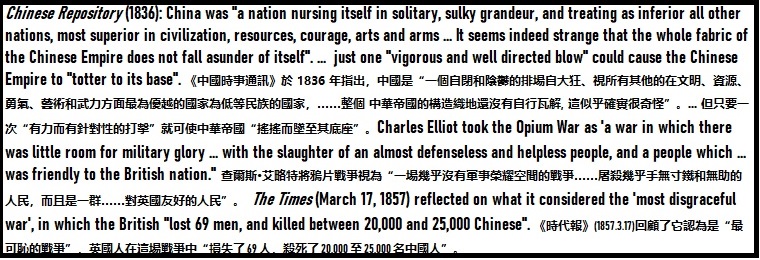

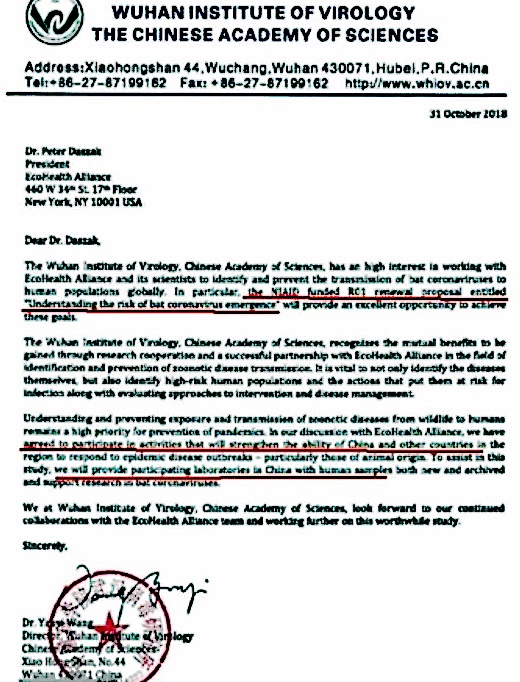
 ***
***


![Though, Anna Wang [Anneliese Martens], in her memoirs, expressed jealousy over Gong Peng by stating that the Anglo-American reporters had flattered the Chinese communists and the communist movement as a result of being entranced with the goldfish-eye'ed personal assistant of Zhou Enlai](GongPeng.jpg)