Sinitic Civilization-Book 1
Sinitic Civilization-Book 2
Tribute of Yu

Heavenly Questions
Zhou King Muwang's Travels

The Legends of Mountains & Seas
The Bamboo Annals - Book 1

The Scourge-of-God-Tetralogy:
From the Khitans to the Jurchens & Mongols: A History of Barbarians in Triangle Wars and Quartet Conflicts
(available at iUniverse;
Google;
Amazon;
B&N)
|
|
THE VIETNAMESE & THE SOUTHERNERS
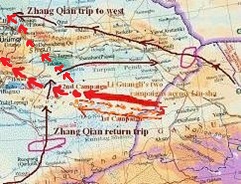 For details on when the east met with the west, see this webmaster's discussion on the Huns, the Yuezhi, the Tarim Mummies, the Yuezhi-Yushi misnomer,
the Mongoloid-Caucasoid admixture at 2000 B.C.E.,
the fallacy of the Aryan bearing of the Chinese civilization,
the fallacy of the Yuezhi jade trade,
the Yuezhi migration timeline,
as well as
the location of the Kunlun Mountain,
Queen Mother of the West,
the legendary book of mountains and seas at the Imperial China blog,
and the Qiang's possible routes of passage into Chinese Turkestan
at
http://www.imperialchina.org/Barbarians.htm which was embedded within the
Huns.html and
Turks_Uygurs.html pages.
(Note that Western Queen Mother had the prototype in an "earth mother" deity, not related to Queen Sheba of Charles Hucker.
The Mt. Kunshan jade was more likely the Mt. Huoshan jade in the Han dynasty book Huai Nan Zi, or the Mt. Yiwulü jade or the Kunlun jade that were juxtaposed together in the same book Huai Nan Zi, not related to Queen Mother of the West.
http://www.sino-platonic.org/complete/spp115_chinese_proto_indo_european.pdf provides another perspective of looking at things of the past from the perspective of language cognates. Rather believing that the Indo-Europeans ever invaded China and gave the Sinitic people the language, we could actually deduce that "Old Chinese", for its 43% correlation with the Proto-North-Caucasian, rather 23% with the Proto-Indo-European, was the source for both the cognates of the Proto-North-Caucasian and the Proto-Indo-European -- with the Proto-North-Caucasian falling under the umbrella of the Dene-Caucasian (Sino-Caucasian) Language Family that encompassed the [Proto-North-]Caucasian, Yeniseian and Sino-Tibetan languages. This is because our cousins, i.e., the N haplogroup people, relocated to North Asia and then to Latvia, Estonia, Finland and Scandinavia, bringing along the Sinitic language to the Proto-North-Caucasian who in turn gave it to the Proto-Indo-European. Note the Sinitic language cognates' 74% correlation with the Proto-Tibeto-Burman who split from the Sinitic people merely 5000-6000 years ago.)
For details on when the east met with the west, see this webmaster's discussion on the Huns, the Yuezhi, the Tarim Mummies, the Yuezhi-Yushi misnomer,
the Mongoloid-Caucasoid admixture at 2000 B.C.E.,
the fallacy of the Aryan bearing of the Chinese civilization,
the fallacy of the Yuezhi jade trade,
the Yuezhi migration timeline,
as well as
the location of the Kunlun Mountain,
Queen Mother of the West,
the legendary book of mountains and seas at the Imperial China blog,
and the Qiang's possible routes of passage into Chinese Turkestan
at
http://www.imperialchina.org/Barbarians.htm which was embedded within the
Huns.html and
Turks_Uygurs.html pages.
(Note that Western Queen Mother had the prototype in an "earth mother" deity, not related to Queen Sheba of Charles Hucker.
The Mt. Kunshan jade was more likely the Mt. Huoshan jade in the Han dynasty book Huai Nan Zi, or the Mt. Yiwulü jade or the Kunlun jade that were juxtaposed together in the same book Huai Nan Zi, not related to Queen Mother of the West.
http://www.sino-platonic.org/complete/spp115_chinese_proto_indo_european.pdf provides another perspective of looking at things of the past from the perspective of language cognates. Rather believing that the Indo-Europeans ever invaded China and gave the Sinitic people the language, we could actually deduce that "Old Chinese", for its 43% correlation with the Proto-North-Caucasian, rather 23% with the Proto-Indo-European, was the source for both the cognates of the Proto-North-Caucasian and the Proto-Indo-European -- with the Proto-North-Caucasian falling under the umbrella of the Dene-Caucasian (Sino-Caucasian) Language Family that encompassed the [Proto-North-]Caucasian, Yeniseian and Sino-Tibetan languages. This is because our cousins, i.e., the N haplogroup people, relocated to North Asia and then to Latvia, Estonia, Finland and Scandinavia, bringing along the Sinitic language to the Proto-North-Caucasian who in turn gave it to the Proto-Indo-European. Note the Sinitic language cognates' 74% correlation with the Proto-Tibeto-Burman who split from the Sinitic people merely 5000-6000 years ago.)
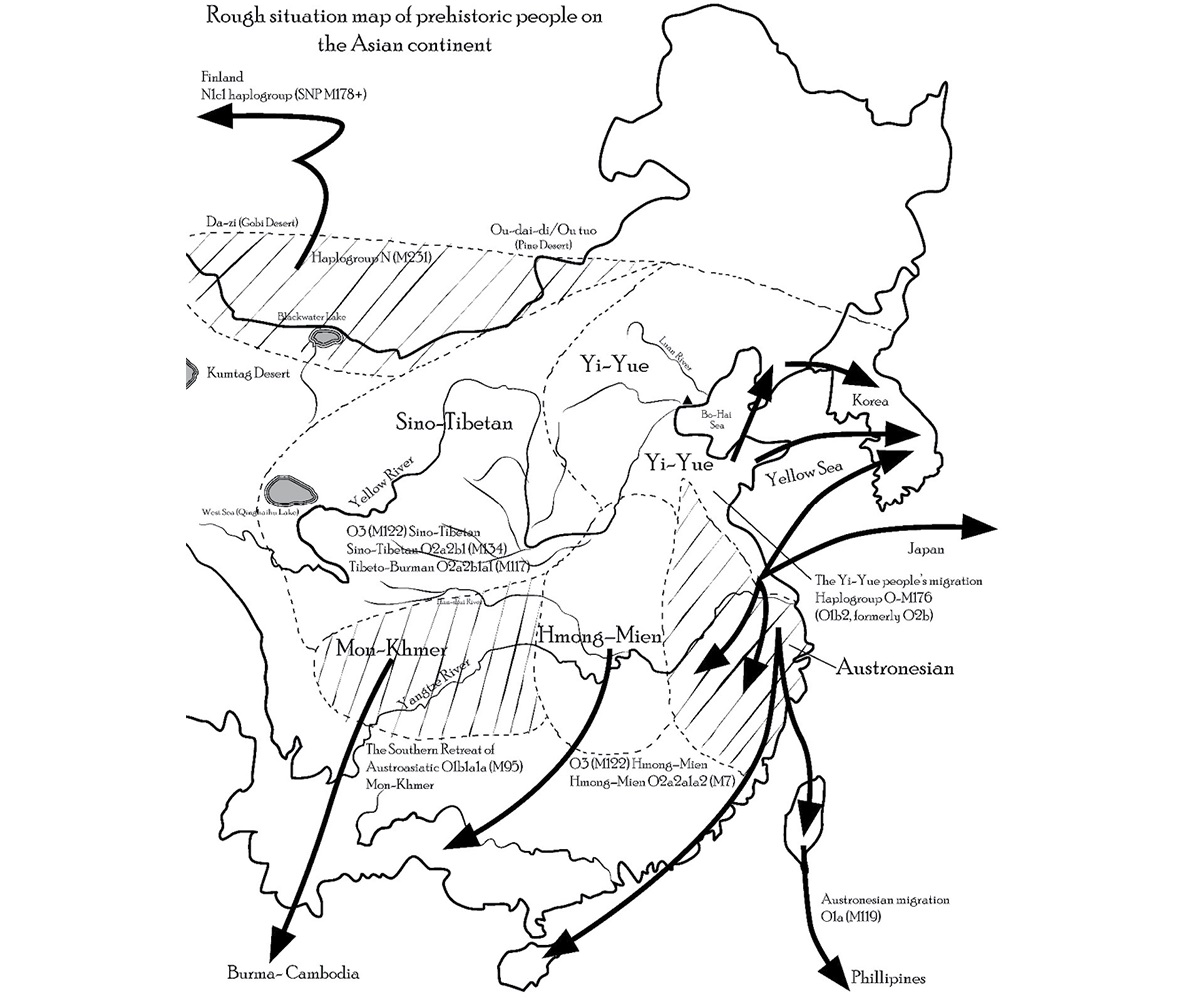
Li Hui of Fudan University of China analyzed the Asian DNAs to have derived a conclusion that ancestors of the [East] Asians possessed a distinctive Mark M89 by the time they arrived in Southeast Asia.
About 30,000 years ago, from the launching pad of Southeast Asia, the early Asians went through a genetic mutation to marker M122.
Li Hui claimed that the early migrants to the Chinese continent took three routes via two entries of today's Yunnan and Guangxi-Guangdong provinces.
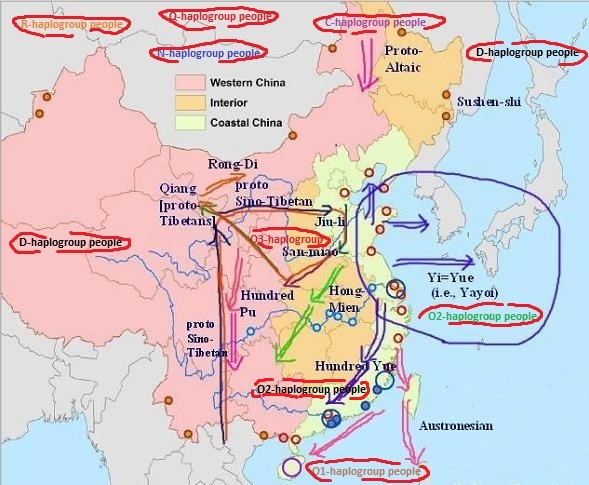
More studies done after Li Hui had ascertained the dates of the O1, O2 and O3 haplogroup people, with the (O1, O2) entrants along the Southeast Chinese coast dated to have split away from the O3-haplogroup people like 20,000 years ago, much earlier than the continental peers, i.e., the Sino-Tibetans (O3a3c1-M117), Hmong-Mien (Miao-Yao, O3a3b-M7) and Mon-khmers.
According to
https://www.ncbi.nlm.nih.gov/pmc/articles/PMC5255561/
"Y chromosome suggested Tibeto-Burman populations are an admixture of the northward migrations of East Asian initial settlers with haplogroup D-M175 in the Late Paleolithic age, and the southward Di-Qiang people with dominant haplogroup O3a2c1*-M134 and O3a2c1a-M117 in the Neolithic Age. Haplogroup O3a2c1*-M134 and O3a2c1a-M117 are also characteristic lineages of Han Chinese, comprising 11.4% and 16.3%, respectively. However, another dominant paternal lineage of Han Chinese, haplogroup O3a1c-002611, is found at very low frequencies in Tibeto-Burman populations, suggesting this lineage might not have participated in the formation of Tibeto-Burman populations."
Namely, the haplogroup O3a1c-002611 Sinitic people, not the O3a2c1*-M134 and O3a2c1a-M117 barbarians, were responsible for engendering the Yangshao and Longshan civilization, and partially with the N-haplogroup people, engendering the Hongshan civilization.
The Zhou people were archaeologically speculated to have origin from today's Shanxi for the link to the Guangshe Culture –- which was in turn a derivative of the You'ao-type Laohushan Culture of the mixed N-haplogroup and O-haplogroup people.
(Since the O3a1c-002611 people were separated from the Northwestern cousins and Tibeto-Burmese at an early age, for it to have a part in the history of Northwestern China, the explanation would be to treat the Haplogroup O3a2c1*-M134 and O3a2c1a-M117 people as the historical Qiang and Hu barbarians, with the latter's paleo-Northwestern genes replacing the paleo-North-China and paleo-Central Plains genes of O3a1c-002611 Sinitic people by the Soong dynasty (A.D. 960-1279), that was likely triggered by the multiplication of the Tang dynasty's imperial house that had its origin from the Western Corridor.
The Soong dynasty royals took Tianshui of western China as the ancestral homeland, which was similar to the Tang dynasty royals' origin from the Western Corridor in western China, i.e., the Qin and Zhao states' common ancestral place.
The Soong royal house, however, could be of the Shatuo Turks' Q-haplogroup gene.
Also see this webmaster's discussion on
the ethnic nature of the ancient Huns belonging to part of the epic Jiang-rong human migration
of the Jiang-surnamed San-miao people and Yun-surnamed Xianyun people.)
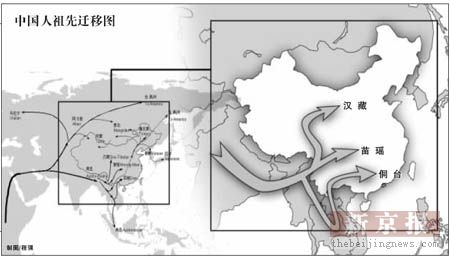 Li Hui commented that one branch of the early Asians, over 10,000 years ago, entered China's southeastern coastline with genetic marker M119. Li Hui, claiming the same ancestry as the Dai-zu and Shui-zu minorities of Southwestern China, firmly believed that his ancestors had dwelled in the Hangzhou Bay and the Yangtze Delta for 7-8 thousand years.
The people with the M119 marker would be the historical "Hundred Yue People".
The interesting theory adopted by Li Hui would be the migration of one branch of people who continued to travel non-stop along the Chinese coastline to reach the Liao-he River area of today's Manchuria.
Li Hui's speculation on basis of the DNA technology was an evolving process.
This would be likely the O2-haplogroup people, rather than the C-haplogroup or North Asia people whose historical presence in Asia could be dated 50,000 years ago, just after the earlier D-haplogroup people who were now mostly restricted in the area of Hokkaido, Japan, and known as the Ainu.
The C-haplogroup people developed into what this webmaster called by the Altaic-speaking people,
i.e., ancestors of the Mongols and Manchus.
What likely happened was that the O2-haplogroup people first travelled along the coast to reach Manchuria, and then traced back towards the south to reach the Yangtze area about 7-8000 years ago, where they evicted the O1-haplogroup people to the Southeast Asian islands.
At about the same time, the O3-haplogroup people, moving through the continent, reached today's western Liaoning at least 5000 years ago, or like 11,000 years ago on basis of the evidence of the pottery aging.
See the genetical analysis conducted by Li Hongjie of Jirin University on the remains of prehistoric people extracted from the archaeological sites.
Li Hui commented that one branch of the early Asians, over 10,000 years ago, entered China's southeastern coastline with genetic marker M119. Li Hui, claiming the same ancestry as the Dai-zu and Shui-zu minorities of Southwestern China, firmly believed that his ancestors had dwelled in the Hangzhou Bay and the Yangtze Delta for 7-8 thousand years.
The people with the M119 marker would be the historical "Hundred Yue People".
The interesting theory adopted by Li Hui would be the migration of one branch of people who continued to travel non-stop along the Chinese coastline to reach the Liao-he River area of today's Manchuria.
Li Hui's speculation on basis of the DNA technology was an evolving process.
This would be likely the O2-haplogroup people, rather than the C-haplogroup or North Asia people whose historical presence in Asia could be dated 50,000 years ago, just after the earlier D-haplogroup people who were now mostly restricted in the area of Hokkaido, Japan, and known as the Ainu.
The C-haplogroup people developed into what this webmaster called by the Altaic-speaking people,
i.e., ancestors of the Mongols and Manchus.
What likely happened was that the O2-haplogroup people first travelled along the coast to reach Manchuria, and then traced back towards the south to reach the Yangtze area about 7-8000 years ago, where they evicted the O1-haplogroup people to the Southeast Asian islands.
At about the same time, the O3-haplogroup people, moving through the continent, reached today's western Liaoning at least 5000 years ago, or like 11,000 years ago on basis of the evidence of the pottery aging.
See the genetical analysis conducted by Li Hongjie of Jirin University on the remains of prehistoric people extracted from the archaeological sites.
  Northeast (southeastern Inner Mongolia)
    Niuheliang, Lingyuan, the Hongshan Culture, 5000 YBP,
    4 N, 1 C*, 1 O

  North
   Yuxian County (the Sanguan site), Hebei,
   the Lower Xiajiadian Culture, 3400-3800 YBP, all O3
Combining Li Hui's study with the pottery excavation, we could see a clear path going north extending from around 15,000 years ago to 10,000 years ago.
Refer to Yaroslav V. Kuzmin's discourse on potteries
to see the path of migration of
proto-Mongoloids
from southwestern China (approx. 15,120+/-500 BP) to
Northeast Asia (Manchuria [13,000 BP, or c. 14,000 - 13,600 cal BC] and
Japan [c. 11,800-10,500 cal BC (c. 13,800 - 12,500 cal BP)]) to
Siberia (11,000 BP, or 11,200 - 10,900 cal BC).
In the timeframe of about 10,000 years, developing a genetic mutation to the marker M134, one branch of people who went direct north, per Li Hui, would penetrate the snowy Hengduan Mountains of the Tibetan-Qinghai Plateau to arrive at the area next to the Yellow River bends.
Owning to the cold weather environment, some physique, such as big noses, heavy lips and longer faces, developed among this group of people, i.e., ancestors of the Sino-Tibetans.
Splitting out of the northbound migrants would be those who went to the east with a new genetic marker M117, i.e., ancestors of the modern Han [a misnomer as the proper term should be Sino-Tibetan, nor the later Sinitic] Chinese.
We could say that our Sino-Tibetan ancestors forgot that they had penetrated northward the Hengduan Mountains from the Indo-China "CORRIDOR" in today's Burma-Vietnam.
"Walking down Mt Kunlun", i.e., the "collective memory of the ethnic Han Chinese" throughout China and the Southeast Asian Chinese communities, that was echoed in Guo Xiaochuan's philharmonic-agitated epic, would become the starting point of the eastward migration which our Chinese ancestors remembered.
(Li Hui grouped the 3000-year-old Chu and Qi people in the same category as the Han Chinese, albeit meeting the ancient classics' records as to the Qi statelet's lineage from the Qiangic-Tibetan Fiery Lord.
According to
https://onlinelibrary.wiley.com/doi/full/10.1111/j.1759-6831.2012.00244.x
"the frequencies of the three main subhaplogroups of O3-M122: O3a1c-002611, O3a2c1*-M134, and O3a2c1a-M117 in Han Chinese are 16.9%, 11.4%, and 16.3%, respectively (Yan et al., 2011).
The northward migration of haplogroup O3a1c-002611 started about 13 thousand years ago (KYA). The expansions of subclades F11 and F238 in ancient Han Chinese began about 5 and 7 KYA immediately after the separation between the ancestors of the Han Chinese and Tibeto-Burman.
Haplogroup O3a1c-002611 and O3a1c1-F11 started their northward migration about 12 KYA from Southeast Asia, along with other O3-M122 lineages, and reached the upper and middle Yellow River basin. About 7 KYA, haplogroup O3a1c2-F238 originated in the ancestors of modern Sino-Tibetan populations. About 6 KYA, the Han Chinese split from the Proto-Sino-Tibetan, and started their migration to the east and south (Su et al., 2000b). About 5 KYA, haplogroup O3a1c1-F11 experienced rapid expansion, probably in the Eastern Han Chinese, with recent gene flow with surrounding populations and eventually became prevalent in different ethnic groups in East Asia.)
Li Hui then pointed out that the ancient Wu people, with M7 genetic marker, came to the lower Yangtze area about 3000 years ago.
While Li Hui claimed that the M7 Wu people had split away from the northbound M134 Sino-Tibetan people, the historical Chinese classics pointed out that the Wu Statelet was established by two uncles of Zhou Dynasty King Wenwang, i.e., migrants from the Yellow River area.
The general layout by Lu Hui seems to have corroborated with Scholar Luo Xianglin's claim that early Sino-Tibetan people originated from the Mt Minshan and upper-stream River Min-jiang areas of today's Sichuan-Gansu provincial borderline and then split into two groups, with one going north to reach the Wei-shui River and upperstream Han-shui River of Shenxi Province and then eastward to Shanxi Province by crossing the Yellow River.
--Though, this webmaster's analysis of China's prehistory shows that the Sino-Tibetan people who moved to the eastern coast was one group, with the future Tibetans being actually the exiles to Northwest China from eastern and central China during the era of Lord Shun. Namely, the split of the Sinitic and proto-Tibetan people occurred prior and during the exile in the late 3rd millennium B.C.E.
(George Driem proposed that the Sino-Tibetans had splitoffs like the Western Tibeto-Burmans and the Eastern Tibeto-Burmans, with the Eastern Tibeto-Burmans forming two groups of northern and southern, who in turn split into the Northwestern Tibeto-Burmans, the Northeastern Tibeto-Burmans, the Southwestern Tibeto-Burmans, and the Southeastern Tibeto-Burmans, with a claim that the western offshoots went all the way to the Kashmir before returning east along the northern slope of the Himalayas to have a reunion with their cousins and that the Northeastern Tibeto-Burmans were the Sinitic people.)
What Li Hui did not touch on in his earliest studies were the cousin tribes of the Sino-Tibetans, namely, the Hmong-miens and Mon-khmers.
As noted at http://www.ncbi.nlm.nih.gov/pmc/articles/PMC3164178/, "A clear hierarchical structure (annual ring shape) emerged in the network of O3a3b-M7 (Fig. 2B), in which MK (Mon-Khmers) haplotypes lay at the center of the network (immediately next to the origin), HM (Hmong-Mien) haplotypes were distributed at the periphery to the MK haplotypes, and the ST (here the subfamily Tibeto-Burman) haplotypes were only found further away from the origin."
|
|
* In Commemoration of China's Fall under the Alien Conquests in A.D. 1279,
A.D. 1644 & A.D. 1949 *
 U.S.S.R./Comintern Alliance with the KMT & CCP (1923-1927)
 Korean/Chinese Communists & the 1931 Japanese Invasion of Manchuria Korean/Chinese Communists & the 1931 Japanese Invasion of Manchuria
American Involvement in China: Soviet Operation Snow, IPR Conspiracy, Dixie Mission, Stilwell
Incident, O.S.S. Scheme, Coalition Government Crap, Amerasia Case & The China White Paper
* Stay tuned for "Republican China 1911-1955: A Complete Untold History" *
|
|
Zou Rong's Revolutionary Army;
Shin Kyu Sik's
Shrine (Spirit, Kunitama) of Korea
|
This snippet is for sons and daughters of China:
Heed the sons & ministers' agony and sorrow of our ancestors who died or lived through the Mongol, Manchu and Soviet-Chicom conquest
and
the Yongjia, Jingkang and Jiashen cataclysms !
Jeanne d'Arc of China:
Teenager girl Xun Guan breaking out of the Wancheng city to borrow the relief troops in the late Western Jinn dynasty;
Liu-Shao-shi riding into the barbarian army to rescue her husband in the late Western Jinn dynasty;
teenager girl Shen Yunying breaking into Zhang Xianzhong's rebels on the horseback to avenge on father's death in the late Ming dynasty.
China's Solitary and Lone Heroes:
Nan Jiyun breaking out of the Suiyang siege and charging back into the city in the Tang dynasty;
Zhang Gui & Zhang Shun Brothers breaking through the Mongol siege of Xiangyang in the Southern Soong dynasty;
Liu Tiejun breaking through three communist field armies' siege of Kaifeng in the Republican China time period;
Zhang Jian's lone confrontation against the communist army during the June 3rd & 4th Massacre of 1989.
|
|
|
In this section on Vietnam, for simplicity's sake, I will lump together various people living to the south of ancient Chinese in lieu of separating them into the Sanmiao (Three Miao) people, the Dian-Yue (Yunnan Yue) People, the Dong-Yue (Eastern Yue) People, the Nan-Yue (Southern Yue) People, the Min-Yue (Fujian Yue) People, the natives living in the mountains of southwestern China, the Nan-Zhao people, the Burmese (Myanmar), the Thai people, the Taiwan natives, and the Vietnamese.
Southwest China, part of the plateau leading to the Himalaya, was validated to be a spot full of traces of ancient homo erectus and homo sapiens.
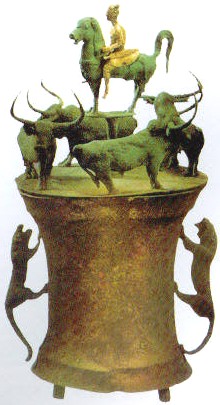 In this very spot, archaeologists had proven that the ancient Yunnan Prov people could be the sole supplier of tin for the bronze of Shang Dynasty and succeeding Chinese dynasties.
Hair styles of men and women on bronze utensils excavated from the ancient Dian-yue Statelet in Yunnan Prov had proved a continuity of customs among today's Yi-zu minority people. In between today's Southwestern China and the ancient Shang China domain would be today's Sichuan Prov where the Sanxingdui Excavations yielded tremendous number of bronze articles. Do note that Wei Chu-hsien, who attempted to validate an opposite movement of the Yangtze River Chinese towards the north and northwest by deciphering the literal meaning of the town of Wuxi [literally meaning "no tin"], had claimed that the tin of the Shang Dynasty Chinese came from a hill near Wuxi in the Yangtze River mouth [where tin mine was purportedly exhausted in the 3rd century B.C.], not from Southwestern China. Wei, who had contributions to the excavation of the Liangzhu Culture ruins in the early 1930s, did not get to know the Sanxingdui bronze culture in Sichuan Prov which apparently served as a venue for the tin of Southwest China to reach the Yellow River area.
In Prehistory, we mentioned that some advocates for the southern aboriginals claimed that Chiyou (Chi-u) belonged to the southern Chinese who descended from the Liangzhu Culture of the Yangtze River delta and that the southerners had expanded into today's Hebei areas of northern China, instead. Conventional wisdom claimed that the SanMiao was derived from Chiyou's Jiu-li or "Nine Li[2] Tribes".
Per Historian Fan Wenlan, Chiyou possessed 9 tribes, with nine sub-tribes each, totaling 81 tribes, and that is how the 81 Chiyou brothers came to be known in Sima Qian's "Shi Ji".
Someone by the name of Qin Yanzhou speculated that Chiyou's Jiuli was an alliance of the ox-totem [?] southern proto-Nan-Man people and the bird-totem eastern proto-Dong-Yi people.
This speculation was based on the deficient ancient records as to the fighting between the Yellow Overlord, the Fiery Overlord and Chi-you in the weird absence of the powerful Dong-yi [i.e., Eastern Yi] tribal group.
The Yi people, i.e., descendants of Tai-hao-shi & Shao-hao-shi that possessed a history earlier than the Yellow Overlord & Fiery Overlord, did not identify themselves in ancient records during the fighting between Huangdi and Chiyou. Hence, it is possible that Chiyou's 9 tribal groups or 81 tribes had included the 'Yi' people.
Nevertheless, Chi-you, in this webmaster's opinion, was actually a divinatory figure, not a historical figure.
Compounding the perplexity further, Wei Juxian had followed through with a literal interpretation of character 'li' in wildly speculating that the Liangzhu Culture people of the Yangtze River delta, who had manufactured the black-colored potteries as well as adored the black fish [i.e., snake-headed fish] as totem, might belong to the Negroid people.
After the loss of war, Chiyou was said to have been decapitated by the Yellow Overlord.
The succeeding southerners recorded in Chinese history would be called San-miao.
At the times of Lords Yao-Shun-Yu, the 'Sanmiao' (Three Miao) people had been living in the middle Yangtze River, taking Lake Dongting as their very homeland.
The middle Yangtze River would remain marshlands and lakes till the time of the Chu State of the Warring States period (403-221 B.C.). The State of Chu, 1500 years after Xia Dynasty was first established, would still belong to an alien ethnical group, and they were the first group of people to reject the overlordship of Zhou Dynasty by declaring themselves as a king of equal footing.
Historic annals repeatedly claimed the SanMiao people were mostly exiled by Lord Shun to San-Wei-Shan Mountain in Gansu Province's Dunhuang to counter the Xirong or Western Rong people.
Today's Miao-zu minority, numbering 5 million per 1982 census, are said to be descendants of ancient Lord Chiyou who headed the Nine Li[2] tribes, i.e., ancestors of the SanMiao people.
Miao-zu's epic talked about a "westward migration", which pointed to the fact that they had probably dwelled more to the center and east of China in the ancient times.
Mainly in today's Guangdong and Hunan provinces would exist Zhuang-zu and Yao-zu minorities, and mainly in today's Guizhou and Guangxi provinces would exist Miao-zu, Zhuang-zu, and Yao-zu minorities. Miao-zu, Zhuang-zu, and Yao-zu, living more closer to central China, should have closer affiliations with ancient San-Miao people, with the same character 'miao' embedded.
However, should we buy Lü Simian's research, then San-miao people would have shared the same origin as the ancient Chinese.
In accordance with Lü Simian's dissertation, San-Miao, with 'miao' meaning descendants, could point to three ancient clans and tribes of Dihong-shi, Jinyun-shi, Shaohao-shi as their ancestors.
After San-miao, history recorded extensively the people that would come to be known as 'Man[2]' or 'Nan [southern] Man2 [barbarian]'.
Scholar Luo Xianglin stated that the five tribal groups of Xia, Qiang, Di[1], Yi, and Man[2] shared the same origin.
(Chi-you widely taken today as the ancestors of the Yi (i.e., misnomer Dong-yi [eastern barbarians]),
not a cultivator of the original Chinese civilization,
could be actually a fable figure or a divinatory figure to every history enthusiast's disappointment. In the Han dynasty astrology, Chi-you was a flag-shaped cluster of asterisms. Chi-you appeared to be a non-Hua and non-Xia deity. Guo Yu used the term Jiu-li, not Chi-you, for some group of rebels who caused disturbance [in the area of making no distinction between the mundane people and the gods/ghosts] during the late Shao-hao-shi's reign but were put under control by Lord Zhuan-xu, with the Jiu-li's descendants being the [Jiang-surnamed] San-miao people during Lord Yao's reign. Chi-you was seen in Shi-ji, Lü-shi Chun-qiu, Yi Zhou Shu, Guan Zi, Shan Hai Jing (The Legends of Mountains & Seas), and Yue Jue Shu, etc. Sima Qian could have expanded on Chi-you on basis of the record in Lü-xing of Shang-shu. Yi Zhou Shu made a sensational story about Chi-you attacking west, Yan-di failing to stop Chi-you, and Huang-di appearing on the stage to defeat both. In a later book such as The Salt & Iron Debate of the Han Dynasty, you had the statement that Huangdi killed both Chi-you and two Hao-suffixed lords, which could mean the descendants of Tai-hao-shi and Shao-hao-shi. (The books listed here, that carried the fable or divinatory figure Chi-you, were actually very late works from the time of the Han dynasty, or pure forgeries, including Yi Zhou Shu.)
Origin of the Yue [Viet] People
The Hua-xia-centric historical accounts then recorded two important events about the ancient
migrations from China's central plains to the Yangtze River mouth during the first and third Chinese dynasties of Xia and Zhou,, i.e., the grandson of Lord Yu being assigned to the Kuaiji land to guard the tomb of Lord Yu, and Zhou royal member Tai-bo's launching own statelet in the Yangtze River mouth instead of competing for power against the father of Zhou King Wenwang.
The corroborating fact would be Lord Yu's tomb on Mount Kuaijishan in Shaoxing, Zhejiang. One of the grandsons of Lord Yu was permanently assigned to the Kuaiji land to guard the tomb.
The later Yue Principality was said to have descended from this lineage.
The Japanese, whom history chronicles repeatedly likened to the tattoo natives of the Yangtze Delta, had an interesting name for one of their four islands, i.e., Kyushu, a name that literally means the "nine prefectures" mapping the nine cauldrons that were supposedly devised by Lord Yu.
The ancient books also recorded that Wa Japan must be situated to the east of Kuaiji Commandery. Chen Shou's San Guo Zhi recorded that the rice culture people living on the western coast of Japan around the 2-3rd centuries A.D. were recorded to have tattoos over their body, in a similar fashion to the Zhejiang people in the Yangtze Delta where the descendants of King Shaokang of Xia Dynasty (21-16th c. B.C.) had lived. (My speculation is that the ancient Wa Japanese with Tai Bo's lineage had been wiped out or assimilated into the later immigrants or invaders from Korea, i.e., the Yamato invasion.)
Another sentence in the early Chinese history would be the record that people from ancient Wa Japan claimed that they were the descendants of 'Tai Bo' [not the grandson of Lord Yu] and called themselves by the ancient title of 'Da Fu'.
Tai Bo wanted to yield the succession to his brother because the ancient mandate said that the son of Tai Bo's brother (Ji Li) would be the future lord of the Zhou people. Ji Li's son would be Ji Chang, i.e., Zhou King Wenwang posthumously.
While ancient records repeatedly claimed that the Wa Japanese were the descendants of Tai-bo, the Yue people [who derived from the grandson of Lord Yu's Xia people] would spread across southeastern and southern Chinese coasts as the Yue people.
Sima Qian, in "Shi Ji", stated that the people of Nan-yue [Southern Yue] and Min-Yue [Fujian Prov Yue], i.e., descendants of the Gu-yue [Ancient Yue statelet], must have retained the spirits of Lord Yu [the father of Xia Dynasty founder].
In the eyes of Sima Qian and the ancient historians, the Bai-yue [Hundred] Yue people would be traced to the same origin, i.e., the grandson of Lord Yu.
[Note that scholar Luo Xianglin linked the ancient Yue people to the Xia people on basis of the common lexicon 'yue' which meant for excavated ancient "stone axe".]
The Southern Minority People
The natives living in the mountains of southwestern China number the most variety in today's China. Especially noteworthy would be Yunnan Prov, i.e., the original habitation of the ancient Nan-zhao & Da-li statelets.
Among 56 ascertained ethnic groups, Yunnan Prov was in possession of 26 groups, comprising of one third of the provincial population. Specific to Yunnan Prov would be about 16 groups, while the other 10 lived across multiple provinces and borders.
Dwelling in Yunnan would be the following ethnic groups: Lahu-zu, Pumi-zu, Nu-zu (nu meaning angry, and a river was named Nu-jiang, too), Dulong-zu (i.e., lonely dragon), and Jinuo-zu. Other ethnic groups in Yunnan that span across provinces would be Zang-zu (Tibetan), Hui-zu (Muslim), Miao-zu (the same 'miao' character as SanMiao), Zhuang-zu, and Yao-zu.
Separately, the provinces of Guizhou, Guangxi, Guangdong, Hunan and Sichuan harbored numerous other ethnic groups.
In Guizhou Prov could be found Shui-zu (water), Gelao-zu, and Buyi-zu, in addition to cross-provincial-border groups like Miao-zu, Yi-zu, Dong-zu, Zhuang-zu, and Yao-zu.
In Guangxi Prov could be found Mulao-zu, Maonan-zu, Jing-zu, in addition to cross-border groups like Miao-zu, Dong-zu, Zhuang-zu, and Yao-zu. (Jing-zu is the majority ethnic group in today's Vietnam.)
Zhuang-zu and Yao-zu also dwelled in Guangdong and Hunan provinces.
In the south and southeast, the Hainan-dao Island possesses the Li-zu minority. Fujian & Zhejiang provinces possess the She-zu minority.
Gaoshan-zu (high mountain ethnic group) would be in Fujian Prov & the Taiwan Island.
Per Scholar Zhan Quanyou ("The Culture of Nan-zhao & Da-li Statelets", 2002 edition, Sichuan People's Press, Chengdu, Sichuan),
Yi-zu's ancestor would be Wu-man (i.e., the black[-teeth?] barbarians);
Bai-zu's ancestor would be Bai-man (i.e., the white[-teeth?] barbarian);
Dai-zu's or the Thai ancestor would be Jin-chi-man (i.e., the gold teeth barbarian), Yin-chi-man (i.e., the silver teeth barbarian), Hei-chi-man (i.e., the black teeth barbarian) and Mang-man;
Bulang-zu and De'ang-zu belonged to Pu-zi-man;
Wa-zu belonged to Wang-man;
A'chang-zu belonged to Xunchuan-man;
Jingbo-zu belonged to Luo-xing-man (i.e., the nude body barbarian);
Naxi-zu belonged to Mo-xie-man;
Lisu-zu belonged to Shi-man and Shun-man; and
Hani-zu belonged to He-man.
(Here, Bai or Wu has nothing to do with the color of the skin, and both groups belonged to the Sino-Tibetan Di[1]-Qiang[1] people.)
Zhan Quanyou further grouped Dai-zu under the Bai-yue or Hundred Yue Family; Bulang-zu, De'ang-zu and Wa-zu under the Bai-pu or Hundred Pu[2] Family; A'chang-zu, Jingbo-zu, Naxi-zu, Lisu-zu, Bai-zu, Yi-zu and Hani-zu under the Di[1]-Qiang[1] Family.
Dominance Of Tibeto-Burman Language
Brief Introduction To the Southern Minorities
|
|
|
|
|
|
|
Sovereigns & Thearchs;
Xia-Shang-Zhou dynasties;
Zhou dynasty's vassalage lords;
Lu Principality lords;
Han dynasty's reign years
(Sexagenary year conversion table-2698B.C.-A.D.2018; 247B.C.-A.D.85)
|
|
The Sinitic Civilization - Book I is
available now at
iUniverse,
Barnes & Noble,
Amazon,
Google Play|Books
and
Nook.
The Sinitic Civilization - Book II is available at
iUniverse,
Amazon and Barnes & Noble.
Check out the 2nd edition preface that had an overview of the epact adjustment of the quarter remainder calendars of the Qin and Han dynasties, and the 3rd edition introductory that had an overview of Sinitic China's divinatory history of 8000 years.
The 2nd edition, which realigned the Han dynasty's reign years strictly observing the Zhuanxu-li calendar of October of a prior lunar year to September of the following lunar year, also cleared this webmaster's blind spot on the authenticity of the Qinghua University's Xi Nian bamboo slips as far as Zhou King Xiewang's 21 years of co-existence with Zhou King Pingwang was concerned, a handicap due to sticking to Wang Guowei's Gu Ben Bamboo Annals and ignoring the records in Kong Yingda's Zheng Yi.
Stayed tuned for Book III that is to cover the years of A.D. 86-1279, i.e., the Mongol conquest of China, that caused a loss of 80% of China's population and broke the Sinitic nation's spine.
Preview of annalistic histories of the Sui and Tang dynasties, the
Five Dynasties, and the two Soong dynasties
could be seen in
From the Khitans to the Jurchens & Mongols: A History of Barbarians in Triangle Wars and Quartet Conflicts
(The Barbarians' Tetralogy - Book III: available at iUniverse;
Google;
Amazon;
B&N).
(A final update of the civilization series, that is scheduled for October 2022, would put back the table of the Lu Principality ruling lords' reign years, that was inadvertently dropped from Book I during the 2nd update.)
|
|
Book II - Table of Contents:
Chapter XXVIII: The Qin Empire & The Unification of China p.323
Campaigns to the South p.331
Chapter XXXI: The Han Dynasty’s Chronological History p.367
Relationship with the Southern Statelets p.397
Chapter XXXVI: The Western Expedition, The Kunlun Mountain & Shan Hai Jing p.489
Unearthly Things in the Mountains’ Component of The Legends of Mountains & Seas p.501
The Divination Nature and Age of the Seas’ Component of The Legends of Mountains & Seas p.506
Chapter XXXVII: The Legends of Mountains & Seas (Shan Hai Jing) & The Ancient Divination p.520
|
|
The Early Southern Statelets
Sima Qian's "Shi Ji" & Ban Gu's "Han Shu" said that among the southern barbarians, the Yelang Statelet, located in the southwestern mountains of today's Guizhou Province, was the biggest of all. Further to the west will be a statelet called Dian-Yue [or Dian], located in today's Yunnan Province. (The early Yunnan Prov civilization, located around the Erhai Lake, was validated to have possessed the bronze technology dating from the 12th century B.C., and this bronze technology spread eastward to reach the peak around the Dianchi Lake by the 1st century AD.) North of Dian would be a statelet called Qiongdu bordering today's Sichuan. In eastern Yunnan and southern Sichuan would be a country called 'Bo'. Half a dozen small statelets existed to the southwest of Sichuan Province at that time. Sima Qian, on basis of the position of today's Sichuan Prov, classified the southwestern barbarians into two groups of Nan-yi (i.e., the southern barbarians) and Xi-yi (i.e., the western barbarians).
Nan-yi would be the equivalent Pu-Yue people, while Xi-yi would be the Di[1]-Qiang[1] people.
While the Yue people had migrated to the westward, the Pu people as well as the Di[1]-Qiang[1] people had migrated southward.
Ancestors of the Pu people, at the time of Shang-Zhou transition, i.e., 1122 B.C., lived to the south of the Han-shui River, somewhere between today's Sichuan and Hubei provinces.
"Shi Ji" recorded that Zhou King Wuwang, calling his troops by the name of the 'people from the west', had included eight barbarian statelets as allies, including the Qiangs from today's Gansu, the Shu-Sou-Mao-Wei statelets in today's Sichuan Province, Lu and Peng from the northwest, and Yong and Pu from south of the Han-shui River.
Per Sima Qian's Shi Ji, King Weiwang (reign 339-329 B.C.) of the Chu Principality, during the Warring States period, ordered his General Zhuang Jue (Zhuang Jiao) on a campaign along the Yangtze River. The Chu army conquered Ba (namely, today's Chongqing city or the area around the Dabashan Mountains of today's Sichuan Province), and the middle of Qian (namely, today's Guizhou Province). Zhuang Jiao arrived at Dianchi, a lake in Kunming of today's Yunnan Province.
Hou Han Shu, using the name Zhuang Hao, claimed that the Chu army sailed to Qiulan via ships and then fought an infantry battle against the southwestern barbarians.
Hou Han Shu put the campaign under Chu King Qingxiangwang's reign, with the context being a campaign against the Yelang statelet (Tongzi, Zunyi, Guizhou) in 281 B.C.
General Zhuang was said to have pacified dozens of the Mimo clans. But General Zhuang was cut off the return path by the Qin army which invaded today's Sichuan and Guizhou provinces and took over Zhuang Jiao's return path. Hence, General Zhuang returned to the Dianchi Lake and declared himself King of the Dian Statelet in approx 263 B.C., and for one hundred years, the Dian Statelet was disconnected with Qin China and Han China.
Sima Qian, in Shi Ji, claimed that Zhuang Jue, a descendant of Chu King Zhuangwang, entered southwestern China at an earlier time and under Chu King Weiwang's order --which was disputed by Tang historian Du You --while Xun Zi, Shang-jun Shu, Haan Fei Zi, plus Han Dynasty scholar Jia Yi, juxtaposed Zhuang Jue with bandit Dao-zhi (Liuxia Zhi/Zhan Zhi, said to be a brother of Liuxia Hui).
Per Xun Zi, Shang-jun Shu and Haan Fei Zi, in the aftermath of the demise of the Chu army at the 301 B.C. Battle of Chuisha and the death of Chu General Tang Mei, Zhuang Jue rebelled against Chu, which led to turmoil in the Chu state and a division of Chu into four spheres or a different count of three and five spheres.
Zhuang Jue was said to be Tang Mei's follower, which posed some historical riddles as to the real identity of this person --who was accredited with being the person called Zhuang Jiao or Zhuang Hao pioneering the Chu excursion into today's southwestern China and establishment of the Dian-guo or Dian-yue State.
Qin extended its influence southward, crossed the Jinshajiang River (gold sand river), and reached north and northwest of today's Yunnan Province.
After Qin Shihuangdi's succession of the throne in 246 B.C., Li Bing, the "tai shou" [i.e., governor for today's Sichuan] who built the Dujiangyan Fork Dam, began to build roads leading towards Daobo (today's Yibing of Sichuan) bordering today's Yunnan Province. After the Qin's unification of China in 221 B.C., "tai shou" Chang E extended the road to Yunnan Prov's Shaotong and Qujing on basis of Li Bing's pavement. This is the so-called "Five Chinese Feet Road" [i.e., wu chi dao] that was paved with the raw stone slates, with trace of over thousand meter long recognizable today still.
Archaeological Discoveries & Origin of the People In the Southwest:
Scholar Zhan Quanyou pointed out i) that Yunnan Prov possessed a variety of mono-color potteries dating from the Neolithic Age; ii) that southeastern region of Yunnan province exhibited similar pattern on the stone hatchets as excavations of Southeast China; and iii) that the middle, western and northwestern regions of Yunnan province exhibited similar potteries, stone weapons, burial customs and building patterns as excavations from the Yellow River area.
Zhan Quanyou cited museum chief Li Kunsheng in stating i) that west of Guizhou and east/northeast of Yunnan belonged to the domain of the ancient Lao-ren [Liao-ren] people, ii) that Guangxi, Vietnam and southeast of Yunnan belonged to the domain of the ancient Luo-yue people, iii) that central Yunnan like the Dianchi Lake and Lancangjiang River (i.e., the Mekong River in the upper stream) areas belonged to the domain of the ancient Di[1]-Qiang[1] people and the ancient Pu-yue people; and that iv) western Yunnan Prov like the Baoshan city belonged to the domain of the ancient Dian-yue people.
Zhan Quanyou further stated that the ancient Di[1]-Qiang[1] people had apparently arrived at the Erhai Lake of today's Yunnan Province via the Jinshajiang River in northwestern Yunnan Province.
In Yunnan Prov, 3000-year-old stone carvings had been discovered, with totem-like pictures like snakes and lizards (i.e., dragon totem), birds (i.e., phoenix totem) and gourd (i.e., a plant similar to the shape of a woman's body that was often cited as the source of human creation by the minority people like Wa-zu). Cangyuan area of Yunnan Prov was called Hulu-guo or the Gourd Country in the ancient times.
Zhan Quanyou's conclusion is that Yunnan Prov was a localized culture mixed up with the two groups of the Hundred Yue people from southeast and the Di[1]-Qiang[1] people from the northwest, respectively, and that the Dali-Nanzhao statelets were the result of exchanges between the two cultures of Erhai Lake to the west and Dianchi lake to the east.
Per Scholar Zhang Zengqi, the 3800-year-old Erhai Lake culture, on basis of carbon data, exhibited a typical rice planting culture that could be seen to the south of the Yangtze River, with agri-tools and rice traces etc., whereas the potteries, half-cave buildings and burial sites of this area shared similarities with the Majiayao Culture of today's Qinghai Province and Banpo Culture (i.e., Yangshao Culture) in Xi'an of today's Shaanxi Province.
Alternatively speaking, Scholar Zhang Zengqi stated that in the ancient times, there existed two groups of people with husbandry and agriculture modes of life in the Erhai Lake area; that Kunming-man around the Lanchangjiang River Valley, not the same as the Di-Qiang nomadic people, were the native husbandry people who entered the Erhai Lake area in the 12th century B.C. and later merged with Ailao-yi after Kunming-man were defeated by the Nanzhao Statelet during the Tang Dynasty time period; that part of Kunming-man would become the later Wa-zu (Wabeng-zu) minority; that Siyu-man (aka Yeyu-man) were the native agriculture people in the Erhai Lake area who later were relocated to the Dianchi Lake by the Nanzhao Statelet during the Tang Dynasty time period; that Baopu-man, a group belonging to the Khmers (i.e., Gao[high]Mian[cotton]) of the Austroasiatic Language Family, entered the Erhai area about the 8th-6th century B.C.; that the Bo-ren, who originally dwelled in eastern Yunnan Prov, would enter the Erhai area about the 1st-8th century A.D. and become later Bai-man (i.e., today's Bai-zu minority); and that Ailao-yi, ancestors of today's Yi-zu minority who originally dwelled in Yongchang and Ailao-shan Mountain area, would establish the Nan-zhao Statelet under the support of Tang Dynasty and Bai-man.
The Khmers & Mon People:
The ancient Khmers, said to be of the Austroasiatic Language Family, for sure had migrated towards the land of today's Thailand in the south. What remained unsure would be whether it was related to the southwestern expansion by the Qin/Han Chinese.
http://www.khmerclub.com/History.htm claimed that the ancestors of the Khmers "moved southward before 200 B.C. into the fertile Mekong delta from the Khorat Plateau of what is now Thailand". Thereafter, they were Indianized by successive waves of Indian influence [Funan's legend of creation by marriage of an Indian Brahmin Kaundinya to an indigenous "naga" princess] and ... were exposed to Indo-Malayan influences [Java's conquest of Chenla]...More Indian influence [ANGKOR period A.D. 889-1434] ... followed by migrations of Tai [Siam] people from the 10th to the 15th century [Dali King, Duan Zixing, surrendered to the Mongols in A.D. 1253], by a Vietnamese [Champa] migration beginning in the 17th century, and by Chinese migrations in the 18th and 19th centuries.
Khmers' move into the Mekong Delta before the 2nd century B.C., however, might have cut off the contacts between Dravidians stranded in Champa of Vietnam and those who remained in the Indian Subcontinent, in my opinion.
In the Mekong Delta already existed a statelet called Funan as recorded in the Chinese Chronicles in the 2nd century A.D., a maritime state with same commercial importance as Champa in acting as a stopover for the Arabs/Romans and Chinese.
The Funan statelet was purportedly established by an Indian monk who married with a local queen in the 1st century B.C.E.
In the Han Dynasty time period, the Funan statelet submitted tributes to China in the form of sugar canes (a Cambodian specialty) and bajiao bananas.
Funan was later conquered by its vassal, i.e., Chenla ("Kambuja" by the Khmer), which was said to be a "more direct ancestor of the Khmer Empire" per http://spirit.dos.uci.edu/cambo/knowledge/history.html in the 7th century AD.
According to some Chinese legends,
Chenla ("Kambuja" by the Khmer) was launched by the remnants of the Qin royal family members who founded
"Sambor Prei", the pre-Angkorian civilization.
Chenla (Chanla) was said to mean the Qin migrants in the Cambodian language, with Chen meaning Qin.
In A.D. 617, the unified Chenla established diplomatic relations with China.
In the 7th cent., Chenla split into two parts, the continental Chenla and the watercourse Chenla.
Defeated by Java, Prince Jayavarman II of Chenla served hostage at the Java court and returned to become king of a later Angkor Empire in 790 AD.
In 806 A.D., the Angkorian city was built.
In A.D. 1112, the Angkorian-Ku [Kuk] was built.
Chenla campaigned against Zhan-po and was called Zhanla by the Song Dynasty time period.
Zhenla or Chang-la, spelled Zhenla in Mandarin, was recorded in Chinese chronicles to be a country where the male population were small in size but dark in skin, some females were said to have lighter skin, and the Chang-la people all had curly hair.
There is a good possibility that ancient Mon people were related to the ancient Khmers. The Mons were said to have occupied the central plain (the Menam Delta) and northern highland of modern Thailand and Burma, while the Khmers in Cambodia and Laos. Both the Mon and Khmer were grouped under the same language branch. From the 6th century A.D. onward, the Mon had developed a culture with a lot of import from Buddhism and Sanskrit and were said to have diffused the Indian culture to the Khmers.
Sandwiched between the Khmer Kingdom of Angkor Wat and the Thai from Southern China, the Mon territory shrank into Southern Burma. When the Burmese rose to power in Pagan in the 11th century, the Mon suffered further oppression from the Burmese.
In the 13th cent., the Vientiane (10,000 elephants) people arose under the pressure of the invasion by Mongol Yuan Dynasty.
Yuan Dynasty dispatched emissary Zhou Guanda to southeast Asia. Zhou Guanda made records on the Zhanla customs as well as noted the human smuggling going on near Saigon [an ancient human smuggle port since the 3rd cent. A.D.], where an island called Kunlun-dao was said to have mutated from or mutated into the ancient Chinese designation of dark-skinned and curly hair southeast Asian natives as 'Kun-nu' or Kunlun-nu slaves.
In A.D. 1351, the ancient Thailand attacked Zhanla and took over its ancient capital.
In A.D. 1431, Zhanla was defeated by the Thais again.
About the 17th cen. around, Mo Jingjiu, a Hainan Islander from China, took his clansmen to ancient Cambodia to develop agriculture.
By the 18th century, Burmese Ruler U Aungzeya destroyed the last remaining Mon stronghold and massacred innumerable Mon people.
The Nan-Yue Statelet:
Early Han Dynasty was a restoration of Zhou Dynasty's feudal system. Numerous independent statelets were in existence.
Han[4] Emperor Liu Bang had conferred kingship to numerous generals who contributed to the overthrow of Qin Empire and the later campaigns against General Xiang Yu.
For example, King Lu Wan of the Yan Principality, was one of the non-Liu kings. Among the non-Liu kings, Marquis of Huaiying, Han Xin, was demoted to marquis from kingship.
King of Han[2] Principality defected to the Huns for fear of his failure in resisting the Huns. After King of Han[2] Principality defected to the Huns, the prime minister of Dai Principality, Chen Xi (a friend of Marquis of Huaiying, Han Xin), rebelled against Han[4] Emperor. Chen Xi himself defected to the Huns after losing battles to Han Emperor, while Han Xin (who had earlier encouraged Chen Xi to plot the rebellion out of anger at Han Emperor for demoting him to marquis from king) was executed together with his wife and mother's lineages, so-called 3 lineage extinction, by Han Empress Lü Hou (i.e., Gaohou). King Peng Yue of Liang Principality did not answer the call to quell the Chen Qi rebellion. He was arrested by Emperor Liu Bang and put to death by Empress Lü Hou. King Ying Bu of Huainan Principality was accused by his minister of plotting to rebel against Han[4] Emperor, and during the battle, he wounded Emperor Liu Bang with an arrow. Ying Bu was killed by his relative, King Wu Chen of Changsha Principality when he fled to Changsha for asylum.
Later, the non-Liu kings were reduced to King of Changsha Principality, only. Emperor Liu Bang had conferred 8 king titles to his own kinsmen (6 being Liu Bang's own sons and 2 the sons of his two brothers). The 8 kings would be for Qi, Chu, Dai, Wu, Zhao, Liang, Huaiyang and Huainan.
Among the non-Chinese statelets would be the Nan-Yue or Southern Yue Statelet led by Zhao Tuo, an ex-Qin general with the title of 'wei' [captain] for Nanhai (i.e., southern sea) Commandery. Zhao Tuo united the commanderies of Guilin, Nanhai, and Xiang-jun. Here, the prefix 'Nan' means southern.
In 207 B.C., Zhao Tuo campaigned against the Guilin and Xiang-jun commanderies, united the three commanderies, and declared the statehood of Nan-yue. The cause was the rebellion of native Luo-yue chieftains, lords and kings, as well as the invasion of Shu-pan, a prince of the last Shu-guo king, who launched the Ouluo-guo state in today's Hanoi and declared himself King Anyang-wang. Zhao Tuo, after defeating the rebellion, separated the Xiang-jun commandery into Jiaozhi and Jiuzhen.
Back in 215 B.C., the Qin army, consisted of five routes of the imperial army, with 'wei' (i.e., lieutenant general) Tu Sui in charge, invaded south.
According to Huai Nan Zi, the four other armies stationed at Saichan-cheng (Jingzhou, Hunan), Jiuyi (Ningyuan, Hunan), Nanye (Nankang, Jiangxi), and Yugan (Yugan, Jiangxi), which meant the southern territories of today's Hunan and Jiangxi, which were to the north of the Nan-ling Ridge, were not fully conquered.
The Qin army moved eastwards from today's Jiangxi Province, crossed the Wuyishan Mountains, and went southwards to today's Guangdong Province.
Tu Sui, who led the penetration force to Panyu (today's Canton), was killed by the natives in a night attack per Huai Nan Zi.
In southern China, when the uprisings occurred against Qin throughout China, Ren Xiao, who was 'wei' for the Ling-nan (south of the Nanling ridge) territory, was at death bed because of illness.
Not answering the Qin emperor's order, 'wei [captain] {or brigadier general}' was recorded by SHI-JI to have petitioned with the emperor to forward 30,000 single women of northern China to the south.
Sima Qian, who mistyped the name of the 'wei' brigadier general and put it under Qin Emperor Shihuangdi, claimed that 15,000 women were sent to southern China.
After hearing about the Chen Sheng and Wu Guang uprisings against the Qin Empire, Ren Xiao instructed that Zhao Tuo (Zhao Ta) take over the 'wei [captain] {or brigadier general}' post. Zhao Tuo was hence called by 'Wei [captain] Ta' or 'Wei [captain] Tuo'.
Zhao Tuo seized and blocked the passes through the Nan Ling (southern ridges), such as Hengpu-guan (Nanxiong, Guangdong), Yangshan-guan (Yangshan, Guangdong) and Huangxi-guan (Yingde, Guangdong), killed the Qin imperial designatories, and declared himself an emperor.
In 207 B.C., Zhao Tuo campaigned against the Guilin and Xiang-jun commanderies, united the three commanderies, and declared the statehood of Nan-yue.
The cause was the rebellion of native Luo-yue chieftains, lords and kings, as well as the invasion of Shu-pan, a prince of the last Shu-guo king, who launched the Ouluo-guo state in today's Hanoi and declared himself King Anyang-wang.
Zhao Tuo, after defeating the rebellion, separated the Xiang-jun commandery into Jiaozhi and Jiuzhen.
Later in 203 B.C. Zhao Tuo declared himself King Nanyue-wu-wang.
Other than Nan-yue, Min-Yue Statelet would be in existence in today's Fujian Province, while Dong-Yue Statelet would be near today's Wenzhou, Zhejiang Province. Across southern China and within the boundary of southeastern and southern costal arch line would be more tribal statelets like Dong-di, Yang-yue, Dong-ou, Xi-ou, Luo-yue, and Dian-yue which invariably shared similar customs and traits like bronze drums, boat building, adoring snakes or dragons, hair-cutting and tattoo.
Between 222 B.C.E. and 214 BC, the Qin expedition, to the southeastern direction, conquered two small states of the Yue people, in present-day Wenzhou and Fuzhou, and set up the Commandery of Minzhong.
In 222 B.C., Qin established the Minzhong-jun commandery in Dongzhi (Jianou, Fujian).
Central China and the region of the lower Yangtze was well connected since the time of Lord Yu. Lord Yu's son, Shaokang, assigned one of his sons to Shaoxing for guarding Lord Yu's tomb. Zhou King Wenwang's uncles came to the delta to launch their own statelet later. The Wu State was founded by two uncles of King Zhou Wenwang: the two uncles decided to go to the Yangtze Delta to launch a state because they did not want to contend with their brother Ji-li (i.e., later Zhou King Wenwang). The Zhou court later conferred the descendants of the two brothers the title of Count. Later, during the time of the Zhou dynasty, Yue and Wu were set up in the region of Hangzhou Bay. At the beginning of the fifth century B.C., Yue defeated the rival state of Wu on the Taihu Lake and in present-day Suzhou. But Yue was conquered by Chu in 334 B.C. When Chu was conquered by Qin General Wang Jian in 223 B.C., the former territory of Yue was made into the commandery of Kuaiji in 222 B.C.
Altogether 36 commanderies were zoned in 221 B.C.
Under Qin empire, 'Zhi-Dao', i.e., straight highways, were built across the nation, all originating from the capital. In the north, after the rebuilding of the Great Wall, General Meng Tian was ordered to pave a road across the mountains to reach Inner Mongolia. To the south, a highway would continue up the valley of the Xiangjiang River, along the present-day railway line, southeastward into Lingling.
South of the county of Lingling, by the present-day town of Xingan, Shihuangdi had a canal cut across the watershed to link the Xiangjiang River with the Lijiang River. This is the Ling Qu ("Magic Trench") built for sake of conquest of the south.
In 218 B.C., 500,000 Qin army, headed by captain Tu Sui, moved southwards and eastwards from today's Jiangxi Province in five columns, crossed Wuyishan Mountains, and went southwards to Guangdong. For three years, Yue people resisted Qin army using guerilla tactics. To support the war efforts, 34 kilometer long Ling-qu Canal was dug to link up Xiang-jiang River to Li-jiang river under the supervision of Jian Lu.
Li Zongren memoirs pointed out that Qin Dynasty's Shi Lu [Jian Lu?], at the link point, had constructed the two banks and waterbed of Li-shui & Xiang-jiang river with cubic stones that could weigh several tons and still exist without erosion today.
Special human-shaped dams were constructed for controlling water levels and controlling ships. Qin expeditions conquered two small statelets of the Yue people, in present-day Wenzhou and Fuzhou, and set up the commandery of Minzhong. Qin conquered and annexed territories covering present-day Guangdong, Guangxi and northern Vietnam, and part of Fujian. Qin killed a tribal chieftain of Xi-ou by the name of Yi-yu-song, and took over Luliang [Luo-yue?] land in 214 B.C. Qin Emperor Shihuangdi, after conquering the south, set up the commanderies of Guilin, Nanhai, and Xiangjun etc.
Guerilla warfare of the Yue people killed Tu Sui.
Qin Shihuangdi then conferred "captain [wei] of Nanhai" onto Ren Xiao and "magistrate [ling] of Longchuan" onto Zhao Tuo, to be in charge of 500,000 secondary class citizens like merchants, convicts and men who married to wives' homes.
Additionally, 150,000 women were dispatched to southern China for supporting the men.
When uprisings occurred against Qin throughout China, Ren Xiao, at death bed, instructed that Zhao Tuo take over the 'captain' post.
Zhao Tuo seized and blocked the passes through the Nan Ling (southern ridges), killed imperial designatories, and declared himself an emperor when he heard about the uprisings against the Qin Empire.
In 207 B.C., Zhao Tuo campaigned against Guilin and Xiang-jun commanderies, united the three commanderies, and declared the statehood of Nan-yue.
In 193 [196?] B.C., Han Emperor Liu Bang sent Lu Jia and a seal to Nan-Yue Statelet. Zhao Tuo downgraded his title to that of a king.
Han Dynasty then rescinded the previous conferral of southern territories from King Wu Rui of Changsha. Several conflicts broke out between Nan-yue and the King of Changsha in the ensuing dozen years.
At the time of Empress Lü-hou, Zhao Tuo again upgraded his title to that of an emperor. This was because Empress Lü-hou, in the spring of 183 B.C., decreed that ironworks and female cattle, sheep and horses be forbidden from export to Nan-yue.
Zhao Tuo's emissary was retained in Chang'an the capital; Zhao Tuo's ancestral tombs were dug up; and Zhao Tuo's kinsmen were persecuted and executed. To counter King Changsha, Zhao Tuo allied with the chieftains of Min-yue, Xi-ou and Luo-yue.
Zhao Tuo mounted an unsuccessful campaign against Changsha.
In Sept of 181 B.C., Lü-hou rescinded the seal of the King of Nan-yue and dispatched troops [under Rong Lühou] against the south. One year later, the Han army failed to advance while Empress Lü-hou passed away. Zhao Tuo sought for peace again. Emperor Wendi agreed to it.
Zhao did not downgrade his title till he was visited by emissary Lu Jia of the new emperor, Han Emperor Wendi (reign B.C. 179-157). Wendi won back Zhao Tuo by repairing Zhao's ancestral graves in Zhending [i.e., Dingzhou of Hebei Province] of northern China.
The Min-Yue Statelet:
King of Min-Yue or Min Yue Statelet, Wuzhu, and King Yao of Dong-Yue, were all descendants of the old Yue Principality from the Warring States period. Their family name was 'Zou'. Both Wuzhu and Yao were downgraded into chieftains after Qin defeated them and reunited China.
With the fall of Qin, Min-Yue (Fuzhou, Fujian) and Dong-Ou/Dong-Yue (Wenzhou, Fujian) re-asserted themselves.
Previously, Min-Yue and Dong-Ou joined the governor of Fanyang, Wu Rui, namely, the King of the later Changsha Principality, in the uprisings against Qin Empire.
General Xiang Yu did not confer them kingship after defeating the Qin Empire.
Hence, they allied with Liu Bang in defeating Xiang Yu. They were recognized by both General Xiang Yu and later Han Emperor Liu Bang.
In 202 B.C., Wuzhu was conferred the title as King of Min-Yue by Han Emperor Gaodi (Liu Bang).
The Dong-Yue Statelet:
Sima Qian, in comments about the length of the Min-Yue & Dong-Yue Statelets, said that the 'Yue' People must have inherited Lord Yu's spirits. One claim would put all the Yue people, i.e., Bai Yue or the Hundred Yue People, in the same lineage as Lord Yu's descendants. Min-Yue & Dong-Yue were related to so-called 'Gu-yue' or the Ancient Yue Statelet located in today's Hangzhou, Zhejiang Province. (After Han Emperor Wudi defeated Min-Yue and Dong-Ou or Eastern Ou [Dong-Yue], there existed a remnant statelet called Xi-Ou [Western Ou].)
In 192 B.C., Yao was conferred the title as King of Donghai (East Sea) by Han Emperor Huidi. The capital city was in Dong'ou and hence he was referred to as King of Dong'ou.
Here, the prefix 'Dong' means eastern. The Dong-Yue Statelet had been upheld by Han Dynasty for its contribution in the uprising against the Qin Empire.
In 135 B.C., namely, the Jianyuan 6th year of Han Emperor Wudi, however, Min-Yue attacked Dong-Ou, and besieged the Dong-Ou capital. Dong-Ou asked for help from the Han court. The Han court relocated the Dong-Ou (Dong-Yue) people northward, to the area between the Yangtze River and the Huai River. Min-Yue took over the vacant land of Dong-Ou (Dong-Yue).
In Aug of 135 B.C., King Zou Ying of Min-yue attacked Nan-yue. King Zhao Hu reported to Han Emperor Wudi. Han dispatched an army against Min-yue. Brother Yu-shan killed King Zou Ying with short spear and surrendered Zou Ying's head to Han Emperor Wudi.
A grandson of Min-yue founder king Wu-zhu, i.e., Yao-jun [Prince Yao], by the name of Chou, was made into the new king. Since Yu-shan had attempted at kingship, the Han court relocated Yu-shan to Dong-ou to be King of Dong-yue.
Another generation later, after the conquest of Nan-Yue by Han Emperor Wudi, Min-Yue, now also known as Dong-Yue, would be attacked by the Han armies under the pretext that they tried to take advantage of the Han's war with Nan-Yue. A combined force of armies from Yuzhang and ships from the Hangzhou Bay destroyed the state. The Min-Yue people were relocated northward to the areas of the Huai and the Yangtze rivers.
For the next three hundred years, the area of today's Fujian and east of the Wuyishan Mountains would be quiet. It would be until the time of Han Emperor Shundi of the Latter Han Dynasty, in A.D. 138, that the former territory of Dong-Ou would become the county of Yongning-xian.
Hidden Trade Routes of The South:
In 135 B.C., a Han emissary, Tang Meng, was dispatched to the Yelang Statelet. Tang Meng noted that Nan-Yue or the Southern Yue was using soy sauce from today's Sichuan Province. The Yelang Statelet, with 100,000 strong army, was targeted by Han as an ally in the war on the Southern Yue. The Han emissary said that the Zangke River (a place in today's Sichuan Province), by which the Yelang Statelet dwelled, flew into Panyü of today's Guangdong Province. Looking at the map, we could assume the ancient Zangke River must have flowed down today's Guizhou Province to converge with the West River of Guangdong Province.
Around 122 B.C., Zhang Qian saw cloth of today's Sichuan in Bactria (i.e., Afghanistan) and reported that he saw the Zangke bamboo products and Sichuan clothing which the Bactrian merchants said were shipped over from India. Emperor Wudi then ordered 4 search teams to the southwest in search of a route to India.
Earlier, from the mouth of a defector Hun, Wudi learnt about a country called the Yüeh-chih Major to the west of the Huns. Hence, he sent an emissary called Zhang Qian, a Hun guide called Tangyifu and 100 people on a trek across the west. Zhang et al. were arrested by the Huns soon, and he was forced to live among the Huns for dozens of years, married and born two children. Zhang, however, did not forget about Wudi's order. He fled with his Hun guide to the west and reached the state of Da'yuan (Fergana. With the assistance from the Da'yuan king, he was escorted to Kangju where the Kangju king assisted him further on his trip to Bactria, the new home where the Yüeh-chih Major people settled down.
The trade route through the southwest was named 'Shu Yuan Du Dao', i.e., the Sichuan-Indu RoA.D., that could penetrate Piao (i.e., Burma) to arrive in India. From Sichuan to Yunnan, two paths, Zhuti-dao and Lingguan-dao, existed before they converged into Chuxiong. The segment from Chuxiong to Burma was named Bonan-dao, named after the Bonan Mountain in today's Dali-zhou Autonomous Prefecture of Yunnan Province. Han Emperor Wudi, in 105 B.C., established, along the Bonan-dao Path, four counties of Yunnan-xian (Xiangyun), Xianlong-xian (Weishan), Yeyu-xian (Dali), and Bisu-xian (Yunlong), and two more counties of Buwei-xian and Suitang-xian to the south of Bonan Mountain. In 69 B.C., Bonan-xian County was set up in today's Yongping of Yunnan Province.
Han's Conquest Of the Southern Statelets
In 137 B.C., Zhao Tuo passed away at the age of over 100. Grandson Zhao Hu succeeded him. In Aug of 135 B.C., King Zou Ying attached Nan-yue. Zhao Hu reported to Han Emperor Wudi, and Han dispatched army against Min-yue. Brother Yu-shan killed King Zou Ying by short spear and surrendered the head to Han Emperor Wudi.
Zhao Hu then dispatched Prince Ying-qi to Chang'an the Han capital.
Ying-qi did not return till 122 B.C. when Zho Hu fell ill.
Ying-qi assumed the kingship till he passed away in 112 B.C. Zhao Xing, a son born during the stay in Chang'an, succeeded Ying-qi.
Nan-Yue rebelled as a result of its prime minister killing the young king, Zhao Xing, the great grandson of Zhao Tuo. This had to do with the adultery of the Han emissary with the mother of the Nan-Yue king. Zhao Xing's father was a hostage in the Han court and he married a kind of 'singer' woman; however, this woman was an old mistress of the Han emissary who visited Nan-Yue later. Nan-Yue Prime Minister, with the backing of Zhao Guang (King of Cangwu of Nan-Yue, a place in today's Guangxi Province bordering Guangdong), rebelled against Han.
Hen Emperor Wudi intended to call Zhao Xing to the capital. Wudi dispatched Anguo Shaoji [i.e., a lover of Zhao Xing's mother] to Nan-yu as well as stationed Luo Bode's troops at Guiyang to serve as military detente.
Prime minister Lü Jia barely escaped from the assassination attempt by Zhao Xing's mother.
Wudi then dispatched Haan Qianqiu and 2000 soldiers to the relief of Zhao Xing's mother.
Lü Jia and his brother then took initiatives, laid siege of the palace, and killed Zhao Xing, the dowager queen, and Han emissary.
Lü Jia erected Zhao Jiande, a son born by Ying-qi with a southern Yue woman, as the new king.
Han Qianqiu and 2000 soldiers were destroyed about 20 kilometers away from Fanyu [i.e., Canton].
Han Emperor Wudi sent Lu Bode and several columns of armies, about 100,000 strong, to campaign in southern China. A naval fleet arrived at Panyu, namely, today's Canton, at the mouth of Zhujiang Delta, to attack Nan-Yue from the sea. When the Nan-yue remnants fled to the sea, the fleet pursued them to the Gulf of Tongking in Vietnam.
Lu Bode's army sacked Canton in the winter of 111 B.C., and killed Lü Jia and Zhao Jiande.
The Nan-yue land, including central and northern parts of today's Vietnam, were made into the commanderies of Nanhai, Cangwu, Yulin [Guilin], Jiaozhi, Jiuzhen, Rinan, Zhuya and Dan'er.
The kingdom of Nan-Yue, starting from 207 B.C. and lasting five generations, continued under Zhao Tuo and his successors for almost a hundred years until it was reconquered by the armies of Emperor Wudi in 111 B.C.
The southern barbarians in today's Guizhou and Sichuan provinces were called upon as auxiliaries in the campaign against Nan Yue. But they killed a Han emissary. The Han armies killed a chief of the southern barbarians and made the territory into the Zangke Commandery, namely, today's Guizhou Province, in 111 B.C.
Four more commanderies were set up southwest of today's Sichuan, including the Yuexi Commandery (today's southwestern Sichuan and northern Yunnan), Shenli Commandery (today's Daduhe River area in Sichuan Province), Wenshan Commandery (today's Wenchuan and Songpan of western Sichuan Province) and Wudu Commandery (today's southern Gansu and southern Shenxi Province).
The Yizhou-jun Commandery, with the
governor office at today's Jinning of Yunnan, was set up to control the domain after Guo Chang
and Wei Guang quelled the area with the Ba and Shu army. Later in 105 B.C., Guo Chang, after
an assignment as 'ba-Hu [eradicating the Huns] jiang-jun' against the Huns to the north, quelled the
Yizhou and Kunming rebellion. Four more commanderies were set up southwest of today's Sichuan,
including Yuexi (today's southwestern Sichuan and northern Yunnan), Shenli (today's Dadu-he River area
in Sichuan Province), Wenshan (today's Wenchuan and Songpan of western Sichuan Province) and Wudu
(today's southern Gansu and southern Shenxi Province). In western Yunnan, Buwei County, i.e., today's
Baoshan, was setup, and in the south, Laiwei County (today's Laizhou Province of Vietnam) was set up.
During the Heping Era (28-25 B.C.) of Han Emperor Chengdi’s reign (r. 32-7 B.C.),
the Yelang Statelet was pacified and conferred kingship. Dian, aka Shoumi-guo, which Scholar Zhan Quanyou stated was built upon a Shoumi tribal statelet, was the next target.
Two years later, the Han Emperor mobilized the armies of Ba and Shu (i.e., Sichuan) for a southern campaign, exterminated the tribal statelets of Laojin (i.e., today's Malong) and Mimo (today's Qujing) in today's eastern Yunnan Prov, and amassed the army forces onto the Dian Kingdom and forced it into submission. In 109 B.C., the Dian Kingdom was conferred the title as king, with a gold seal.
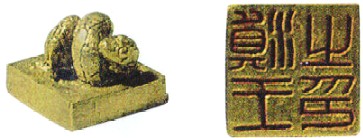 (In November 1956, excavation of the Shizhaishan Mountains tombs in Jinning produced a royal gold seal bearing the Han Dynasty's conferred title of 'Seal Of King Dian' in addition to bronze musical instruments and swords with gold sheath.) The Yizhou Commandery, with governor office at today's Jinning of Yunnan, was set up to control the domain. In western Yunnan, Buwei County, i.e., today's Baoshan, was setup, and in the south, Laiwei County (today's Laizhou Prov of Vietnam) was set up.
In southwestern China, the local resistance to Sinicization was occasionally successful. In the Latter Han Dynasty, Han would have to re-assert its influence that was lost due to the intermittent dynastic substitution by the Xin Dynasty.
In 36 A.D., one group of the Li-ren barbarians, who were said to be affiliated with the Lao-ren barbarian, sought suzerainty with the Chinese court. However, in A.D. 40, some Yue (Vietnamese) women, i.e., the Zheng (or Trung) sisters, rebelled with support from the Li-ren barbarians from Jiuzhen, Rinan and Hepu.
Ma Yuan, a former general under Kui Xiao, undertook the Jiaozhi (cross toes, namely, Cochinchina) campaign in today's central and northern Vietnam, where he quelled the rebellion of the Trung sisters in A.D. 43.
The non-Chinese people of the Wuling commandery, especially the people in Wuqi ["Five Gorges"], on the upper reaches of the Yuan River, by the present-day Hunan-Guizhou border, defeated the local Han army in 48 A.D.
General Ma Yuan would mount a full campaign in the south. General Ma Yuan erected the bronze monuments in eulogy of his victories. He erected a kind of gate on the West River. Ma Yuan went further southward and set up some bronze monuments in Champa, in today's central to southern Vietnam. "New History of the Tang Dynasty" recorded that there were ten households in the name of Ma dwelling in the Champa area.
Those people refused to return to China with General Ma. 500 years later, by Sui Dynasty, the ten families had multiplied into 300 households.
The Wuling commandery had a major rebellion in the early 160s A.D. In A.D. 178, the Wuhu [Wuqi?] barbarians in Jiaozhi [northern Vietnam] and Hepu [along the Guangdong-Guangxi border], i.e., the land of Xi-ou and Luo-yue, rebelled. The Wuhu [Wuqi] barbarians, with a recorded cannibalism habit of eating the first-born sons, continued rebellion during the Three Kingdoms period. During the Three Kingdoms time period, Zhuge Liang, prime minister of Shu State, had once campaigned against the southern barbarians led by someone called Meng Huo. Legends said that Zhuge Liang captured Meng Huo seven times and set him free for sake of captivating the hearts of the southern barbarians.
The 'Maan' Barbarians
In the Prehistory section, we mentioned the terminology of 'Nan Man', namely, southern barbarians. The 'Man' designation is categorical. Chinese classics said the 'Man' barbarians were the descendants of Pan Hu. The Quanrong or Doggy Rong in northwestern China, i.e., ancestors of later Huns, were said to be descendants of Pan-hu, too.
The 'Man' people were not a group of passive people as they seemed. They had rebelled against the Chinese numerous times. They also expanded into Chinese territories frequently. In the valley of the Xiangjiang River, there was a major rebellion in A.D. 157, and rebellion was seen in the northern part of Changsha, Hunan Province. Disturbances were seen in Xiangjiang River basin and extended across the Nan Ling Mountains to the south. Rebellions were quelled in A.D. 164.
By the time of the Three Kingdoms, the 'Man' had migrated out of southwestern China and the Three Gorges areas. According to "History of The North Dynasties", the 'Man' people were scattered between the Yangtze River and the Huai River. They were seen as east as Shouchun of Anhui Province, as west as Sichuan Province, and as north as Henan Province. They were not a threat during Ts'ao Ts'ao Wei Dynasty of the Three Kingdoms time period. But they began to multiply by the end of Jinn Dynasty. As a result of devastation dealt by Hunnic Han & Zhao Dynasties, the central areas of China became vacant. Hence, the 'Man' people began to migrate northward.
In A.D. 386, Tuoba set up Wei Dynasty and controlled the areas around the Yellow River. In A.D. 423, a 'Man' king called Mei An led a column of a thousand people on a pilgrimage to Tuoba Wei's capital. They requested for their prince to be a hostage with Tuoba Wei. This 'Man' prince, Mei Bao, was later conferred the title of governor of Jiangzhou Prefecture and the Duke of Shunyang. Another 'Man' king, Wenwulong, surrendered to the Tuobas and was conferred the title of governor of Southern Yongzhou Prefecture and Marquis of Luyang. One more 'Man' king, called 'Taiyang Man' or the sun 'Man', by the name of Huan Dan, surrendered his 80,000 households to the Tuoba, and they were located in the ancient Mian-Shui River areas (in today's Shaanxi-Hubei Provinces). Huan Dan was conferred the title of governor of Eastern Jingzhou Prefecture and King of Xiangyang. Huan Dan, however, was the son of ex-Jin general Huan Xuan (who had at one time deposed the Eastern Jinn emperor in an abortive rebellion). Huan Dan, still a boy, fled to the barbarians for asylum after Huan Xuan's failure in rebellion against the Eastern Jinn Dynasty.
The 'Maan' people were kind of sandwiched between Tuoba Wei and the southern dynasties of the Chinese. They rebelled against Tuoba Wei, and some fled to southern dynasties for protection. One group was relocated to Yangzhou Prefecture under Southern Liang Dynasty (A.D. 502-557).
Li-ren barbarians, who supported Trung sisters in 1st century, were recorded to be active in Cangwu-Yulin-Hepu-Ningpu-Gaoliang, and have rebelled against Yulin [Guilin] and killed Xun Xiang the magistrate of Southern Liang Dynasty in A.D. 502.
When Tuoba Wei underwent Hunnic rebellions in the north, the 'Man' people around the Three Gorges and today's Hubei Province rebelled as well. In A.D. 566, Northern Zhou (A.D. 551-587) armies, under Lu Teng and Sima Yi, dealt the Three Gorges 'Man' a devastating defeat, and tens of thousands of skulls were piled up as a warning to the 'Man' people. "History of The North Dynasties" said that in A.D. 572, the 'Man' people stopped rebellion.
The 'Lao-ren' Barbarians
The 'Lao-ren' Barbarians would be alternative race of 'Nan Man', i.e., southern barbarians. They scattered in various parts of Sichuan Province as well as Hanzhong region. When Li Shi's Di[1] people took over Sichuan and overthrew Jinn Dynasty's ruling, the 'Lao-ren' people began to migrate out of their traditional Sichuan Prov lands of Baxi, Guanghan, Quchuan, Yang'an and Zizhong. Li Shi's Cheng Han Dynasty was commented to have perished as a result of external attacks and internal attacks, with the internal being from the 'Lao-ren' barbarians. The external attacks would be from Eastern Jinn Dynasty General Huan Wen. "History of Northern Dynasties" said that Huan Wen, after taking over Sichuan from Cheng Han Dynasty, failed to control the 'Lao-ren' people. Once the Sichuan people relocated eastward, the 'Lao-ren' people took over the vacated lands of Sichuan. Some of the 'Lao-ren' people co-habitated with the so-called 'Xia' people or Chinese. By the time of Southern Liang Dynasty, the 'Lao-ren' people would become sandwiched between Tuoba Wei Dynasty and Southern Liang Dynasty. The 'Lao-ren' people rebelled against Northern Zhou Dynasty frequently. Later, Tang Dynasty records continued to show that 'Lao-ren' people constantly staged rebellions against the Chinese.
The 'Lao-ren' people, together with 'Li-ren', 'Lang-ren', 'Yan-ren' and 'Wei-ren', had been categorically called Bai-yue People or Hundred Yue People.
Scholar Wang Zhonghan stated that Lao-ren could mean the same as Luo character in ancient Luo-yue people, and would be equivalent to Lao character in Gelao-zu minority.
Lao-ren originated from the land of ancient Ye-lang statelet [i.e., Zangke Commandery] and the intersection land of Xinggu-jun Commandery (i.e., between Zangke and Yizhou [Sichuan]), with a territory covering Yunnan-Guizhou provinces and joint areas of Hubei-Sichuan provinces.
Over a dozen prefixed Lao-ren terms had appeared in ancient classics, with some in combination with Wuhu [Wuwu] barbarian, Li-ren barbarian, Dong barbarian, and Tu barbarian etc.
Lao-ren barbarians were recorded to have copper metallurgy but still adopted sacrificial ritual in striping human face skin to make 'ghosts'. Moreover, Lao-ren barbarians had a tradition of selling live persons in exchange for cattle and dogs.
Possibly mixed up with the 'Man' barbarians in section above, Lao-ren barbarians had a similar migration story: They began to dominate Sichuan Prov after General Huan Wen [i.e., son-in-law of Eastern Jinn Emperor Mingdi] sacked today's Sichuan Province. By A.D. 514, living under newly established Bazhou prefecture set up by Tuoba Wei Dynasty would be 200,000 households of "cooked Lao-ren households", not to mention the raw Lao-ren.
In A.D. 556, Mulong-lao barbarian in Lingzhou [Renshou county of Sichuan] rebelled, and Western Tuoba Wei General Lu Teng killed and captured 150,000 of the rebels.
(In A.D. 566, Northern Zhou (A.D. 551-587) armies, under Lu Teng and Sima Yi, dealt the Three Gorges 'Man' a devastating defeat, and tens of thousands of skulls were piled up as a warning to the 'Man' people.)
In A.D. 562, Lu Teng defeated Tieshan-lao barbarian, killed and captured 4,000, and pacified 30000 households.
The 'Pu-ren' Barbarians
Ancestors of Pu people, at the time of Shang-Zhou transition, i.e., 1122 B.C., lived to the south of Han-shui River, somewhere between Sichuan and Hubei provinces.
"Shi Ji" recorded that Zhou King Wuwang, calling his troops by the name of 'people from the west', had included eight barbarian statelets as allies, including the Qiangs from today's Gansu, the Shu-Sou-Mao-Wei statelets in today's Sichuan Province, Lu and Peng from the northwest, and Yong and Pu south of the Han-shui River.
Cai Ah-dong stated that Benglong-zu (De'ang-zu), Bulang-zu and Wa-zu all belonged to ancient Pu people, and they are close to Khmer in language.
Cuan Family Influence For 400 Years
Scholar Zhang Zengqi stated that in the ancient times, there existed two groups of people with husbandry and agriculture modes of life in Erhai area; that Kunming-man around Lanchangjiang River Valley were native husbandry people who entered Erhai in 12th century B.C. and later merged with Ailao-yi after Nanzhao Statelet defeated them during Tang Dynasty time period; that part of Kunming-man would become later Wa-zu (Wabeng-zu); that Siyu-man (aka Yeyu-man) were the native agriculture people in Erhai Lake area who later were relocated to Dianchi Lake by Nanzhao Statelet during Tang Dynasty time period; that Baopu-man, a group belonging to Khmers, entered Erhai area about 8-6th centuries B.C.; that Bo-ren, who originally dwelled in eastern Yunnan Prov, would enter Erhai area about the 1st-8th centuries A.D. and become later Bai-man (i.e., today's Bai-zu minority); and that Ailao-yi, ancestors of today's Yi-zu minority who originally dwelled in Yongchang and Ailao-shan Mountain area, would establish the Nan-zhao Statelet under the support of the Tang Dynasty and Bai-man.
Han Chinese heavily immigrated into southwest China at the time when Han Emperor Wudi first established Yizhou-jun Commandery in 109 B.C. Death row convicts as well as manipulative merchants were dispatched to the southwest. Out of the Han Chinese who stationed in Yunnan Prov would emerge several big families, including the 'Cuan' family which claimed to have ancestry from ancient lord Zhuanxu. Cuan-shi, like other big families of Chinese ancestry, gradually inter-married with the natives and took over the tribal chieftain titles like 'yi-shuai' (i.e., alien or barbarian marshal).
Scholar Zhan Quanyou stated that the Western Han's colonization was centered around the Dianchi Lake while the Eastern Han pushed westward to the Erhai Lake area. In 51 A.D., Ailao-yi submitted to Han China. In 69 A.D., the Han Dynasty established the Yongchang-jun Commandery by merging Ailao (today's Tengchong, Longling and Dehong counties), Bonan (today's Yongping county) and Yizhou Commandery, with a census data of 200,000 households or 1,890,000 heads.
By 220 A.D., Southwest China, called Nanzhong at the time, fell under the influence of Shu-Han Dynasty of the Three Kingdom time period. Shu-Han Prime Minister Zhuge Liang campaigned against rebellious chieftains in A.D. 225. Rebellious chieftains included Meng Huo and Yong Kai of Yizhou-jun and Gao Ding (aka Gao Dingyuan) of Yuexi-jun, and submissive chieftain would be Lü Kai of Yongchang-jun. Zhuge Liang, after pacifying Gao Dingyuan and Meng Huo, rezoned Yizhou-jun (with capital at today's Qujing of Yunnan Province) into Jianning-jun Commandery, and carved several counties of Yizhou-jun into Yunnan-jun (today's Xiangyun and Dali), Xinggu-jun commanderies. Shu-Han Dynasty possessed 7 commanderies in Southwest China: Jianning-Yongchang-Yunnan-Xinggu in Yunnan, Zangke in Guizhou/Yunnan, Yuexi in Sichuan, and Zhuti (established in Yunnan in 205 A.D.). Cuan Xi, from the Cuan family, who served under Yong Kai, was transferred to Chengdu under the order of Zhuge Liang. After going through turmoil of Western Jinn and Eastern Jinn time periods, the Cuan family expanded westward towards the middle and west of today's Yunnan Province.
In A.D. 271, Western Jinn established Ningzhou Prefecture on basis of Jianning-Yunnan-Yongchang-Xinggu. In A.D. 279, after unification of China, Western Jinn rezoned the country into 19 prefectures (zhou) and made Ningzhou into one of the 19. Later, Western Jinn changed Ningzhou's rank into so-called 'xiaowei' or colonel for pacifying southern barbarians instead of 'cishi' or circuit inspector, leading to the rebellions by Di[1] people under the leadership of Li Te and Li Xiong in A.D. 301. Western Jinn re-established Ningzhou in A.D. 302. The Di[1] people established the first state of Cheng Han among the Sixteen Nations, and Li Xiong proclaimed himself an emperor in Chengdu in A.D. 306. Western Jinn's circuit inspector Li Yi was killed by the rebels at Qujing in A.D. 307. A new circuit inspector by the name of Wang Xun failed to quell the Di[1] rebellion. In A.D. 322, Eastern Jinn court dispatched Yi Feng to Ningzhou as circuit inspector. Yi Feng, who was guarding the remaining Zhuti and Jianning areas, had to surrender to Di[1] General Li Shou in A.D. 333. Among Eastern Jinn generals who surrendered to Di[1] would be Cuan Shen who was retained by the Di[1] people as an official for Ningzhou (renamed Jiaozhou of Jianning-guo Statelet by Li Xiong's Cheng Han Dynasty). The Cuan Family continued its influence in Southwest China till A.D. 747, for about 400 years.
Ancient China's Island Policies
Two islands, Taiwan and Hainan, were not far away from China's coastline. Their fate was different. Hainan was colonized several times by Han China, but Taiwan was skipped in the early efforts. China was not interested in colonizing the island of malaria, Taiwan. Early China did possess navy to mount major campaigns, as evidenced by the naval operations along the coast of present-day Fujian during the third and second centuries B.C.E. Former Han, in its wars on Nan-Yue in 111 B.C., dispatched a fleet to Panyu, namely, today's Canton, at the mouth of the Zhujiang (Pearl River) Delta.
Sima Qian commented on Panyu as
a trading polis in Shi-ji, with products of pearls, rhinoceros horns, tortoise (hawksbill sea turtle)
shell bracelet/head plugs/rings, fruits and cloth.
When the Nan-yue remnants fled to the sea, the Han army pursued them to the Gulf of
Tonkin.
The fleet pursued the Nan-yue remnants to the Gulf of Tongking in Vietnam.
At the end of the second century B.C., after the conquest of Nan-Yue, Emperor Wudi set up two commanderies on the island, i.e., Dan'er ("drooping ears") and Zhuyai ("shore of pearls").
Emperor Wudi ordered to carve out the coastal land of Nanhai and Xiang-jun commanderies,
at today’s Leizhou peninsula, into the Hepu commandery.
At the Hepu port, close to one thousand Han dynasty tombs were excavated with gem stones
and glass products of the alien origin. It was apparent that the sea route trade carried the silk products to
Central Asia and ancient Europe, not the land route.
The next year, 110 B.C., Lu Bode took
over today’s Hainan Island that was made into the Zhuya and Dan’er commanderies. The Nan-yue
land, including central and northern parts of today’s Vietnam, was made into the commanderies of
Nanhai, Cangwu, Yu4lin [Guilin], Jiaozhi, Jiuzhen, Rinan, Zhuya and Dan’er, with Jiaozhi, Jiuzhen
and Rinan located inside of today’s Vietnam. The Linyi (Champa) state would be where the Xianglin
County of the Rinan Commandery was. Later, General Ma Yuan erected two bronze pillars here as
a demarcation line of Han China’s boundary. History recorded that the people living to the south of
Vietnam, in both Linyi (Champa) and Funan, possessed the curly hair, a Negroid characteristic that
had more to do with the Dravidians of India.
(At the end of Latter Han Dynasty, Sun Ce (brother of Sun Quan, the founder of Wu Dynasty of the Three Kingdoms) mounted an expedition, by sea from the Hangzhou Bay, to the mouth of the Min River in 196 A.D. Lü Dai of Wu Dynasty attacked the Shi family in Jiaozhi (today's Vietnam) by both land and sea in A.D. 226.)
Under Han China, Hepu commandery was in charge of the shoreline between Guangzhou and Hanoi, including the Hainan strait and the Leizhou peninsula. Pearl fisheries were the incentive for Han to exercise control. The West River of today's Guangdong Province was utilized for trading and transportation. Hepu county had access by land to the West River in Yulin. As noted by http://www.anu.edu.au/asianstudies/south_china.html, "Hepu was the base for long-distance sea traffic, ... that officials of the emperor's private apartments were sent on missions as far as India to exchange the gold and silks of China for precious stones, curios and trinkets, while the pearls they brought back were as large as two inches diameter, far more valuable than those collected locally. The goods were assessed and traded in the market at Hepu, and then joined the local production of pearls for portage to the West River and then by the
rivers and canals to the north."
Frequent rebellion by locals caused Dan'er to be abolished in 82 B.C., and Zhuyai in 46 B.C. At the beginning of Later Han Dynasty, a county named Zhuyai was re-established. Han Emperor Mingdi was said to have received tribute from Dan'er.
In the spring of 46 B.C., rebellion in the Shannan county of Zhuya (pearl cliff, i.e., Hainan Island) led
to the abandonment of the commandery, with the administrative agency incorporated into Hepujun
(Xuwen, i.e., today’s Zhanjiang, Guangdong). Earlier, in 82 B.C., the Dan’er commandery was
incorporated into Zhuya. This was a decision taken after the emperor listened to Jia Juanzhi, a great
grandson of Jia Yi. Jia Juanzhi claimed that the sage kings ruled the remote land with ‘sheng-jiao’
(i.e., the voice and creeds); the Shang-Zhou dynasties did not extend their influence beyond ‘Mann-Jing’
to the south [and 'Jiang-Huang' {the Jiang-guo and Huang-guo states} to the east]; the Great Wall’s song
was still being sung [about the skeletons of dead people building the wall for Qin Emperor Shihuangdi];
Han Emperor Wendi declined and returned the remote land people’s surrender of the stallions, and
the campaign against the Qiangs [in 61 B.C.] cost all the royal savings at the Da-si-nong ministry,
etc. Jia Juanzhi suggested abandoning the land of people with no caps and ribbons (i.e., ‘guan-dai’) for
retreating to the domain touched on in Yu Gong (Lord Yu's Tributes) and Chun-qiu.
During the 170s and 180s A.D., Han Emperor Lingdi of Later Han Dynasty sought for the establishment of Gaoliang commandery over east Leizhou peninsula. Attempts were made to establish posts on Hainan Island.
http://www.anu.edu.au/asianstudies/south_china.html noted that "during the Han period, ... coastline of present-day Fujian... An outpost of the empire was maintained by the counties of Dongye and Houguan, at the mouth of the Min River by present-day Fuzhou... Something was known of Taiwan, then called simply Yizhou ... "Barbarian Island", but there was no official interest in the place. Further to the north, from the time of Han Emperor Shundi, the county of Yongning occupied the mouth of the Ou River by present-day Wenzhou in southern Zhejiang. None of the coastal settlements, however, appear to have exercised more than nominal control over their hinterland, and there was no drive to do so. The greater part of the mountain country of southeastern China, including all of Fujian, and great areas of eastern Guangdong,
southeastern Jiangxi and southern Zhejiang, was unoccupied land outside the
frontiers of the empire ..."
(During the early Han
dynasty, the Nan-yue (Southern Yue) state, which was the land conquered by a Qin expedition army
of 500,000, was belittled by Han emissary Lu Jia to be merely possessing a few hundred thousand
troops. The Eastern Yue state possessed even less people who were at one time forcefully resettled in
the Huai-shui River area. By the time of the Sui dynasty (A.D. 581-618), the former Min-yue and Dongyue
land possessed merely 12,420 households, with the demographics changing in the Tang dynasty
to reach 93,535 households at the time of Tang Emperor Xuanzong. From the genetic perspectives, the
Sino-Tibetans, carrying the O2a2b1 (M134) gene, were not related to the Yi-Yue people of Haplogroup
O-M176 (O1b2, formerly O2b) as they split like 20,000 years ago. Though the two groups of people
apparently had the longest interaction among all groups of the Asian people, to the extent that the Yi-
Yue people’s original spoken language could now only be discerned from among the modern Koreans
and the Thai people.)
http://www.anu.edu.au/asianstudies/south_china.html has a good account of early Vietnam:
"During Later Han, there was major development of Chinese colonization in
the whole region of Jiao province. In the eastern part of the territory,
Nanhai commandery extended up the Beijiang River (North River) to the border with Guiyang
commandery in Jing province, and up the system of the Dongjiang River (East River)
and along the coast as far as present-day Shantou. Cangwu, with its capital
by present-day Wuzhou, controlled the lower reaches of the present-day Xijiang River (West River), known at that time as the Yu River, and notably its northern tributary the Gui River, then known as the Li, which joined the Ling Qu Canal.
...
Upstream of Cangwu, Yulin commandery controlled the main stream of the West
River and its tributary the Liu River. The capital of the commandery was at the
river junction by present-day Guiping in Guangxi. ..
... Vietnam ... The major administrative units were
the commanderies of Jiaozhi, on the Red River delta, with its capital at
Longbian by present-day Hanoi, Jiuzhen, with its capital at Xupu, near
Thanh Hoa in northern Vietnam, and Rinan, which was based upon Xiquan, near
present-day Quang Tri. ..
At the beginning of Later Han imperial authority was confirmed by the
campaigns of Ma Yuan against the rebellion led by the Zheng (or Trung)
sisters in the region of the Red River between 40 and 43 AD. ..
For a hundred years after Ma Yuan put down the rebellion of the Trung
sisters, the imperial authority remained largely intact, despite endemic
small-scale rebellion ... In 136, however, there was a
great uprising, chiefly by the Cham people from the south, which
overwhelmed the greater part of Rinan Commandery, and made heavy inroads
into Jiuzhen. Moreover, when troops were raised in Jiaozhi to oppose the
rebels, these men in turn broke out in mutiny, and the whole imperial
position in the region was threatened...
There were, however,
continued disturbances in the region of Vietnam during 144, 157 and 160,
and troubles with the mountain people of the north, in present-day Guangxi
and Guizhou. At the extremity of the empire, Rinan Commandery below the
16th parallel appears to have been lost, and the non-Chinese kingdom of
Linyi was established in the region of Hue, extending south beyond
present-day Da Nang. Further around the coast, on the Mekong Delta, the
kingdom of Funan, which traded regularly with the Han empire, and which was
developing political authority along the eastern coast of the Malay
peninsula and a dominance of the regional trade, was powerful enough and
sufficiently distant to avoid any military confrontation.
http://www.anu.edu.au/asianstudies/south_china.html further said that
the population of Jiaozhi commandery, in 2 A.D., before the rebellion and partial withdrawal of the late 130s, had reached three quarters of a million people, Jiuzhen commandery increased by about a quarter, from 166,013 to 209,894 at the same time, and Rinan gained more than 40 per cent from just under 70,000 to just over 100,000.
Jiaozhi commandery provided a prosperous hinterland for trade and influence by land and sea, northeast across the modern frontier into the upper reaches of the West River, northwest into present-day Kunming in Yunnan (administered by Yizhou Commandery) where Later Han claimed
suzerainty over the Ailao people and the new commandery of Yongchang about the Dali Lake."
The Scourge-of-God-Tetralogy.
Book III of
The Barbarian Tetralogy, i.e., this webmaster's barbarism series, is finally released in September of 2022 by iUniverse. This barbarism series would be divided into four volumes covering the Huns, the Xianbei, the Turks, the Uygurs, the Khitans, the Tanguts, the Jurchens, the Mongols and the Manchus.
Book I of the tetralogy would extract the contents on the Huns from
The Sinitic Civilization-Book II,
which rectified the Han dynasty founder-emperor's war with the Huns on mount Baideng-shan to A.D. 201 in observance of the Qin-Han dynasties' Zhuanxu-li calendar.
Book II of the Tetralogy would cover the Turks and Uygurs.
And
Book IV would be about the Manchu conquest of China.
From the Khitans to the Jurchens & Mongols: A History of Barbarians in Triangle Wars and Quartet Conflicts
, i.e., Book III of
the Scourge-of-God-Tetralogy,
focused on the Khitans, Jurchens and Mongols, with the missing one-year history of the Mongols' Central Asia campaigns rectified.
This webmaster, other than the contribution to the Sinology studies in rectifying the Huns' war to 201 B.C., and realigned the missing one-year history of the Mongol Central Asia war, had one more important accomplishment, i.e., the correction of one year error in the Zhou dynasty's interregnum (841-828 B.C. per Shi-ji/840-827 per Zhang Wenyu) in
The Sinitic Civilization-Book I, a cornerstone of China's dynastic history.
|
The Scourges of God: A Debunked History of the Barbarians
From the Khitans to the Jurchens & Mongols: A History of Barbarians in Triangle Wars and Quartet Conflicts
(The Barbarians' Tetralogy - Book III)
Epigraph,
Preface,
Introduction,
Table of Contents,
Afterword,
Bibliography,
References,
Index
|
Chapter XXIX: Mengke Khan (r. A.D. 1251-1259) ......................................................509
Chapter XXX: The Mongol Conquest of the Mywa (Dali) State ....................................513
|
|
Nan-Zhao & Da-li Statelets
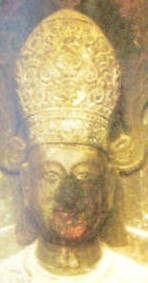 Nan-Zhao & Da-li Statelets remained independent for hundreds of years till it was destroyed by the Mongols. In Nan-Zhao dialect, the word 'zhao' meant king. There are six 'zhao' according to "New History of Tang Dynasty", and Nan-Zhao was the southern-most king of the six. It had a domain connecting to Vietnam to the southeast and Tibet to the northwest. During Three Kingdoms time period, Zhuge Liang, prime minister of Shu State, had once campaigned against this group of people.
During the Tang Dynasty, the Nanzhao arose. Tang Dynasty's demise was commented to have been induced by the failures in its wars with Nan-zhao, not the Huang Chao Rebellion. Nanzhao, Tibet and Tang China had been engaged in triangular warfare for hundred years.
Nanzhao was succeeded by the statelet of Dali (A.D. 937-1253). The Mongols advanced into present-day Yunnan and destroyed Dali in A.D. 1253. The Mongols set up Yunnan Province.
In 1252 and 1253, Khubilai would order Subetei's son to attack Dali (i.e., Nanzhao) in today's southern Chinese province of Yunnan, with three columns. Dali King, Duan Zixing, surrendered. Moslems from northwestern China and Khitans/Dawo'er (Dagur) relocated to the area under Mongol orders.
Tibetans vs Nan-Zhao
Wars with the Tibetans continued till Tang Emperor Dezong struck a Qingshui Hui-meng peace accord in A.D. 783, with the border running through Jingzhou, Long2-zhou, Feng4zhou to reach Xishan (west hill) and Dadu-shui of Jiannan to the south, the Tibetans taking control of Lan2, Wei4, Yuan2 and Hui4, inclusive of the land west of Lintao and east of Chengzhou and reaching Mo-xie[? Mo-sa like Luo-xie for Lhasa]-Zhu-maan barbarian tribes to the west of Jiannan and southwest of the Dadu-shui River, the northern borderline extending through Xinquan-jun (new spring garrison) to the Da-qi (Gobi) Desert to the north and the Tuota-ling Ridge of the Helanshan Mountain to the south. However, the Tibetans attacked Jingzhou, Long2-zhou, Binzhou and Ningzhou again in A.D. 786 over the Tang refusal to yield the Anxi and Beiting governor-general offices in today’s Chinese Turkestan. Tang General Li Cheng defeated the Tibetans at Qiancheng and destroyed the Tibetan Cuishabu (sand breaking) fort. The Tibetans continued to sack Yanzhou, Xiazhou, Yinzhou and Linzhou. In A.D. 787, Tibetan ‘da-xiang’ prime minister Shang-jiezan, after failure to sow dissension to have the Tang emperor get rid of capable Tang generals such as Li Cheng, Ma Sui and Hun Jian, set up a trap to induce the Tang officials to have another peace summit at Pingliang, on which occasion the Tibetans arrested ‘Honglu qing’ Cui Hanheng and eunuch Ju Wenzhen but failed to chase to catch Hun Jian. Li Mi (Li Bi, A.D. 722-789) suggested to Emperor Dezong to strike alliance with Huihe, Nanzhao, Dashi (Arabs) and Tianzhu (Indians) to pincer-attack the Tibetans. The emperor reached a Zhenyuan-zhi-meng alliance with Huihe Khan Wuyi-chenggong. The Tibetans, after killing and mutilating the elderly and weak, abducted over 10,000 young men for the west.
The Tibetans got weakened under attacks by ‘Sichuan jiedu-shi’ Wei Gao to the south and the Huihe to the north, as well as through the Tang’s instigation of Nanzhao for defection. In A.D. 785, Wei Gao replaced Zhang Tingshang as the new Jiannan-Xichuan jiedu-shi. Nanzhao King Yi-mou-xun relayed a message of goodwill to Wei Gao through the tribal chieftains. Wei Gao petitioned with Emperor Dezong to win back the southern barbarians in Yunnan and the ‘Ba-guo sheng-Qiang’ (raw Qiangs of eight states) of Xi-shan (west hills). In A.D. 787, Li Mi (Li Bi) suggested to pacify Nanzhao so as to cut off the Tibetans’ right flank army after the Huihe (Uygurs) were already harmonized to the left side, and blamed Nanzhao’s rebellion on former Tang prime minister Yang Guozhong. In A.D. 788, Nanzhao King Yi-mou-xun relayed a message to the Tang court through Dong-maan (eastern Maan barbarians) ‘Gui-zhu’ (ghostly tribal king) Biao-pang, with ‘Biao’ a moon-signific soundex to the horse-signific Pye tribe in Burma, who was given a reception at the Linde-dian palace and conferred the title of a king with seal. When the Tibetans mobilized an army of 100,000 to attack Xichuan and called on Nanzhao to supply troops, the Nanzhao king dared not disobey and aligned an army at Lu-bei. Wei Gao sowed a dissension in having the Dong-maan tribe relay a letter to the Tibetans but with attention to the Nanzhao king, which made the Tibetans suspect Nanzhao’s loyalty and sent an army of 20,000 to Huichuan, a linkage between Yaozhou and Chengdu, to guard against Nanzhao, which in turn enraged the Nanzhao king who withdrew the auxiliary army. The Tibetans attacked Dong-maan and Lianglin (two forests), with 30,000 men against Dong-maan, 7000 against Qingxiguan (clear creek pass, Hanyuan of Sichuan), and 5000 against Tongshan (copper hill). Wei Gao sent prefect Wei Jinn to helping Dong-maan in repelling the Tibetan attack at Qingxiguan, and defeated a renewed Tibetan attack of Dong-maan. In February of A.D. 789, Wei Gao wrote to Nanzhao to come to tang ahead of the Huihe (Uygur) khan, and after dispatching Wang Youdao to assisting Dong-maan and Lianglin in defeating two Tibetan satraps of Qinghai and Lacheng at Taideng-gu of [Yue-]Xizhou in October, wrote another letter to Nanzhao. In A.D. 793, Yi-mou-xun sent three batches of messengers with letter, raw gold (strong will) and red cinnabar (red heart/loyalty) to Wei Gao. In a letter for the Tang emperor, the Nanzhao king blamed rebellion against Tang on Zhang Qiantuo and Xianyu Zhongtong, as well as accused the Tibetans of harming King Tuihun-wang (Tuyuhun), queen Xi-shan (a Tangpang-shi queen in charge of eight states of west hills, a Tang surnamed Eastern Women Qiang state with the Indian script per Xi-nan-maan section of Jiu Tang Shu), the Tuoba leader (? La-meng), and Huihe Pugu Zhizhong (possibly someone related to Pugu Huai’en). In January of A.D. 794, Wei gao sent xun-guan Cui Zuo to delivering the Tang emperor’s decree, with Cui Zuo refusing to change to the Zangke-maan barbarians’ clothes and further demanding that the Nanzhao king ordered all Tibetan delegation’s emissaries killed. At the time, Yi-mou-xun was asked by the Tibetans to provide an army of 10,000 troops for the Beiting siege in today’s Turkestan. Yi-mou-xun, after sending 5000 troops to the Tibetans, followed behind with an army and raided the Tibetan Shenchuan dudu-fu office, took over sixteen forts including Tieqiao (iron bridge), captured five Tibetan kings and over 100,000 troops.
THE VIETNAMESE
Vietnam was historically restricted to today's northern Vietnam and parts of China's Guangxi-Yunnan Provinces. The word 'viet' means the same as 'Yue', while 'nam' means southern. It was called Jiaozhi in Chinese history. It fell under Chinese influence beginning from Qin Empire. Zhao Tuo's Nan-Yue Statelet took Jiaozhi as a prefecture.
Today's Vietnamese belonged to the same group as Jing-zu minority in China's Guangxi Province.
Vietnamese, the equivalent of Jing-zu minority in China's Guangxi Prov, certainly have their ancestry in southern China that we had explored above. Vietnamese, from the perspective of geography, should belong to the ancient Hundred Yue family.
During the early conquest, Qin mobilized an army of 100 to 200 thousand people, mostly consisting of the so-called outcasts of then China, i.e., the men who lived in wives' homes after the marriage and the merchants whose occupation was deemed the lowest in then society. History recorded that altogether 500,000 people, again consisting of the disgraced men and the merchants, were relocated to southern China by Qin Shihuangdi. This explains the fact that today's Guangdong Province still possesses the most variety of ancient Chinese dialects.
The people of Vietnam were an interesting group. They differ from Burmese and Thai people who were descendants of the Nan-Zhao refugees. They have a good mixture of Chinese and Austro heritage. The reason I said Vietnam was restricted to the northern part of today's Vietnam is that there existed many statelets in today's southern and central Vietnam, Laos and Cambodia. Chinese history recorded that the people living to the south of Vietnamese, in both Linyi (Champa) and Funan, possessed curly hair, a Negroid characteristic that has more to do with Dravidians of India. "History of Northern Dynasties" mentioned that the people of Linyi possessed relatively deep-socket eyes and higher nose bridge, which further supported the previous claim that the ancient people of southern Vietnam were Indians. "History of Sui Dynasty" stated further that the people of Linyi (Champa) possessed dark skin and curly hair, and that after first Sui Emperor Yangdi conquered Southern Chen Dynasty in A.D. 589, Linyi sent in tributes. Linyi stopped tributes till Sui armies, led by General Liu Fang, attacked them in A.D. 604. (Sui Emperor, in addition to attacking Linyi, had invaded Ryukyu.) According to "History of Sui Dynasty", further to the southwest of Linyi (Champa) would be a statelet called Zhenla (Chang-la or Chenla), a vassal of Funan. Zhenla (Chang-la) male population were recorded to be small in size but dark in skin, but some females were said to have lighter skin. Chang-la people all had curly hair. To the west of Zhenla (Chang-la) would be a statelet called Zhu-jiang, and to the south Che-qu. Numerous statelets existed further, with rulers carrying Indian names. It is no strange to see this phenomenon when we examined the history of southeast Asia as a whole to find that Indian influence had spread across the whole area much before the Chinese poked their nose in the same area.
In the 110s B.C., General Lu Bode (carrying the same title of 'Quelling Sea Waves' as the later General Ma Yuan) was ordered by Han Emperor Wudi to campaign in the south, and he first set up Rinan Commandery. The Linyi (Champa) Statelet would be where the Xianglin County of Rinan Commandery was.
At the beginning of Later Han, Ma Yuan campaigned against the rebellion led by the Zheng (or Trung)
sisters in the region of the Red River between 40 and 43 AD. General Ma Yuan erected two bronze pillars here as a demarcation line of Han China's boundary.
"History Of Liang Dynasty" said that in the demise years of Han Dynasty, a county clerk, by the name of Qu Da, killed the county sheriff of Xianglin and declared himself a king. After several generations, the throne passed on to a nephew called Fan Xiong. By A.D. 337, someone called Nuwen usurped the Linyi Kingdom throne. Nuwen was originally a servant under Fan Zhi the county sheriff of Xijuan County of Rinan Commandery. Governor-general of Jiaozhi Prefecture was in charge of Rinan Commanderies. But Nuwen and his son and grandson kept attacking Rinan Commandery for generations. Nuwen killed Xiahou Lan (the chief of Rinan Commandery) in A.D. 347 and stayed put in the capital of Rinan Commandery for 3 years.
Vietnam hence began as two states, a northern statelet called Annam (Nam Viet or Dai Viet) under Chinese influence and a southern one called Champa that displayed strong Indian influences. The southern Vietnamese kings are similar to Cambodian kings, like in the names of Rudravarman etc.
Annam:
Chinese records did not give any claim to native dynasties in Northern Vietnam. One alternative Vietnamese account treated Zhao Tuo, the king of Nan-yue statelet of Guangzhou (Canton), as the first emperor of Vietnam. As we mentioned earlier, the first record of dynastic nature in Vietnam would be attributed to Fan Xiong of Champa, in Central and Southern Vietnam, around 270 AD.
In Northern Vietnam, there was the claim of Thuc Dynasty set up by An Duong during 257-207 B.C. Zhao Tuo's Nan-Yue expanded into Northern Vietnam by this time. Zhao Tuo is also spelled as Chao Tuo or Trieu Da. Thereafter, there was the claim of Nan Viet's Chieu Dynasty, with rulers of following reign years:
Vo Vuong (207-137 B.C.),
Van Vuong (137-125 B.C.),
Minh Vuong (125-113 B.C.),
Ap Vuong (113-111 B.C.),
Duong Vuong (111 B.C.).
General Lu Bode of Han China would campaign against Southern and Central Vietnam after Han's conquest of Nan-Yue in 111 B.C. Rinan Commandery was set up.
General Ma Yuan quelled the rebellion led by the Zheng (or Trung) sisters between 40 and 43 AD.
In the demise years of Han Dynasty, a county clerk, by the name of Qu Da, killed the county sheriff of Xianglin and declared himself a king. After several generations, the throne passed on to a nephew called Fan Xiong. By A.D. 337, someone called Nuwen usurped the throne of Linyi Kingdom (Champa). Nuwen killed Xiahou Lan (the chief of Rinan Commandery) in A.D. 347.
Then, there was the Vietnamese claim of Li (Ly) Dynasty (111 B.C. - 544 A.D.), and thereafter Vietnamese produced names of kings like
Bon (544-548 A.D.),
Kuang Phuc (548-571 A.D.),
Thien Bao (549-555 A.D.),
Phat Tu (571-603 A.D.). Chinese records showed that Sui and Tang had re-asserted control over Annam.
By A.D. 603, Sui China re-conquered Northern Vietnam and attacked Champa in Central Vietnam. Another Vietnamese dynasty, Ngo Dynasty, would emerge at 939 AD. Tang Dynasty continued Sui policies, and it set up 'Du-hu Fu', i.e., the Protector-General Office of Annam. Tang China divided Ling-nam into two 'dao' units, and Annam was a part. China controlled Northern Vietnam for a short time period of 965-968. Song Dynasty conferred the title of King Jiaozhi-jun onto a person called Ding Buling of Dinh Dynasty (968-981). Ding Lian, the son of Ding Buling, assumed the same title of King of Jiaozhi Commandery. After another three generations, someone called Li Gongyun usurped the kingdom and was validated by Song China. Li family (i.e., Le Dynasty 981-1009) ruled for eight generations till it was usurped by someone. The son-in-law of this usurper would be King Tran Nhon-ton (Chen Ri-xuan). Rough timelines for the dynasties will be like:
Ngo Dynasty 939-965,
Dinh Dynasty 968-981,
Le Dynasty 981-1009,
Later Li 1010-1072,
Latter Le 1072-1225,
Tran Dynasty 1225-1400,
Ho Dynasty 1400-1407.
Champa: Champa would be the statelet Chinese records claimed Fan Hiong (Xiong) set up around 270 AD. Vietnamese records showed an Indian king by the name of Sri Mara ruling a so-called first dynasty from 192 A.D. onward. The Indian king, by the name of Bhadravarman I, would return to the reign around 377 AD. This would be after one hundred years of ruling by the Fan family: Fan Hiong c. 270, Fan Yi c. 284-336, Fan Wen 336-349, and Fan Fo 349-?.
http://www.seacrc.org/media/pdfiles/ChamBook.pdf
had a good article exploring into the Champa people. It mentioned that "in 1905 A. Cabaton, in an article published in the Journal Asiatique (Dix Dialectes Indochinois recueillis par Prosper Oden’ hal), introduced a classification of the Indochinese languages based on lexical similarities. He grouped them in three families: Mon-Khmer, Tai and Burman-Tibetan, and Malayo-Polynesian. He classified Cham and related languages under the latter category.
The Scourges-of-God Tetralogy
would be divided into four volumes covering
Hsiung-nu (Huns), Hsien-pi (Xianbei), Tavghach
(Tuoba), Juan-juan (Ruruans), Avars, Tu-chueh (Turks), Uygurs (Huihe), Khitans, Kirghiz, Tibetans, Tanguts, Jurchens, Mongols and Manchus and
southern barbarians.
Book I of the tetralogy would extract the contents on the Huns from
The Sinitic Civilization-Book II,
which rectified the Han dynasty founder-emperor's war with the Huns on mount Baideng-shan to A.D. 201 in observance of the Qin-Han dynasties' Zhuanxu-li calendar.
Book II of the Tetralogy would cover the Turks and Uygurs.
And
Book IV would be about the Manchu conquest of China.
From the Khitans to the Jurchens & Mongols: A History of Barbarians in Triangle Wars and Quartet Conflicts
, i.e., Book III of
the Scourge-of-God-Tetralogy,
focused on the Khitans, Jurchens and Mongols, as well as provided the annalistic history on the Sui and Tang dynasties, the
Five Dynasties & Ten Kingdoms, and the two Soong dynasties.
Similar to this webmaster' trailblazing work in rectifying the Han dynasty founder-emperor's war with the Huns to 201 B.C. in The Sinitic Civilization - Book II,
this Book III of the Scourge-of-God-Tetralogy
collated
the missing one-year history of the Mongols' Central Asia campaigns and restituted the
unheard-of Mongol campaign in North Africa.
|
The Scourges of God: A Debunked History of the Barbarians" - available at iUniverse|Google|Amazon|B&N
From the Khitans to the Jurchens & Mongols: A History of Barbarians in Triangle Wars and Quartet Conflicts
(The Barbarians' Tetralogy - Book III)
Epigraph,
Preface,
Introduction,
Table of Contents,
Afterword,
Bibliography,
References,
Index
|
|
Table of Contents
(From the Khitans to the Jurchens & Mongols: A History of Barbarians in Triangle Wars and Quartet Conflicts)
Chapter XXXVIII: The Mongol Invasion of Koryo, Japan, Vietnam, South &
Southeast Asia & Island States .................669
The Invasion of Koryo & Japan ............................................................................................669
The Invasion of Burma, Champa & Annam ............................................................................675
The Invasion of Java, Declaring Amnesty, and Khubilai's Death ..............................................686
|
|
MONGOLS' WAR WITH CHAMPA & ANNAM (VIETNAM)
In between, the Mongol army, after conquering Dali in Yunnan, Shanshan statelet in Chinese Turkistan and Tibetan Plateau, would briefly invade Vietnam. Subetei's son was ordered to march to the southwest and he conquered various southwestern statelets and tribes such as Baiman, Wuman, Guiman, Luoluosi, A'bo and A'lu etc. Tonkin or Annam (northern Vietnam) was invaded. In 1257, Vietnamese king, by the name of Chen, fled to an island and Hanoi was sacked. Vietnamese king surrendered and Mongols left after a stay of nine days. In the A.D. 1280s, Khubilai Khan, for sake of his wars with Champa, had few wars with Annam when Annam king refused to lend the path to the Mongols. After losing wars to Champa and Annam, the Mongols later mounted futile overseas campaigns against Java.
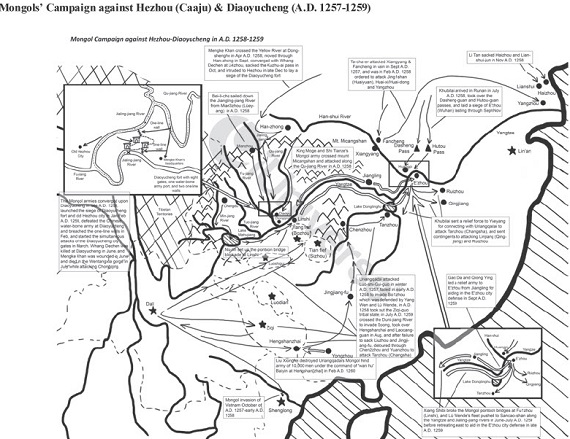
Mongol Campaign against the Jurchens (Battle of Yehuling, July of A.D. 1211)
Mongol Campaigns against Semiryechye & Central Asia (A.D. 1216-1219, 1219-1224)
Mongol Campaign against Kiev Rus (A.D. 1223)
Mongol Campaign against the Jurchens (A.D. 1231-1232)
Mongol Campaigns against the Volga Bulgars, Kipchaks, Alans, Rus Principalities, Crimea, Caucasus & Kiev Rus (A.D. 1237-1240)
Mongol Campaigns against Poland, Bohemia, Moravia, Hungary, Austria & Dalmatia (A.D. 1240-1242)
Mongol Campaign against Arsacia (Mulahida) from A.D. 1253 to A.D. 1256
Mongol Three-prong Campaign against Hezhou (Caaju) from late A.D. 1255 to early A.D. 1256
Mongol Continuous Campaigns in the Sichuan Basin (A.D.1257-1259)
Mongol Campaign against Hezhou (Caaju) & Diaoyucheng (A.D. 1257-1259)
Mongol Campaigns against the Abbasid Caliphate, Mecca, Misr (Egypt) Outposts, North Africa, and the Ayyubid & Mamluk Sultanates (A.D. 1257-1260)
|
|
To the south of China, the Mongols attacked the tribal states in southwestern China, Vietnam and Burma.
Jiaozhi, i.e., Vietnam, was attacked by the Mongols in A.D. 1256 and 1257.
After defeating the Jiaozhi water-borne army and infantry, Jiaozhi Emperor Chen Rijiong fled to the seas. The Mongols slaughtered the Jiaozhi capital city for the death of one of two Mongol messengers detained and departed over the heat after a stay of nine days.
Successor Jiaozhi Emperor Chen Guangbing accepted the Mongol pacification in A.D. 1258.
However, the Vietnamese often antagonized the Mongols in refusing to adopt the submissive stance in accepting decrees, in finding pretext to put off the Mongol demand for the tribute of elephants, and in desisting from surrender of the Huihu (Weiwuer/Uygur or Central Asian) merchants who came to Vietnam via the sea trip.
In A.D. 1277, Chen Guangbing died.
The new Jiaozhi (Vietnam) emperor requested for vassalage with the Mongols.
The new successor Jiaozhi emperor, i.e., Chen Rixuan, being rebuked by the Mongols for his late father-king's non-fulfullment of six demands, still put off the Mongol demand for paying a pilgrimage visit to the Mongols at Dadu (i.e., Peking).
Chen Rixuan claimed that he was a spoiled child who could die en route. The Mongols claimed that Soong Emperor Gongdi (Duke Yingguo-gong), also a child, did not die while being sent to North China after the demise of Soong China.
The Mongols pardoned the Vietnamese emperor with extraction of more monetary tributes.
Later in A.D. 1281, the Mongols established the 'Annan xuanwei-si' office to manage the territory and further demanded that an uncle, i.e., Chen Yi'ai, replace Chen Rixuan as acting king.
In A.D. 1283, Chen Rixuan put off the Mongol demand to attack Zhancheng (Champa), claiming that it was Jiaozhi's vassal and that for thirty years, the Jiaozhi country had not fought a war.
In A.D. 1285, Mongol King Zhennan-wang (quell south), by the name of Tuohuan, forcefully attacked Zhancheng (Champa), which led to the breakup of Jiaozhi (Vietnam)'s vassalage relationship with the Mongols.
The Vietnamese emperors, who were versed in the Confucian classics, adopted uncommon and abstruse Chinese characters for their given names.
With the Soong Chinese refugees fleeing to Vietnam, the Vietnamese organized a mercenary army which was to play a role in defeating the Mongols during the Mongol-Annam War.
Champa, located to the south of Annam, refused to acknowledge being a vassal of the Mongols. Mongols, under Suodu, departed Canton with over thousand ships. Champa boasted an army of 200,000. After being defeated by the Mongols, Champa prince fled to the mountains and sent a minister to the Mongol camp for surrender. Unguarded, Suodu was later defeated by a Champa ambush. Suodu requested for relief army. Khubilai ordered that his ninth son, Duohuan, i.e., King of Zhennan (i.e., quelling the south), lead an army southward via Annam. Annam King agreed to supply grains, but refused to lend the path to the Mongols. The brother of Annam King, Chen Jun, took charge in fighting the Mongols. Annam King sent over one thousand ships to aid his brother. After several rounds of fighting, Annam King requested again that Mongols leave Annam per the treaty signed with Mengke Khan before. Mongols attacked the Annam camp and took over the capital. Annam King fled, and one brother by the name of Chen Yiji surrendered. Mongols met with shortage of grain and pestilence in Annam capital and hence called off the campaign. When fleeing northward, Annam army attacked them with poisonous arrows at a river crossing. Duohuan barely escaped alive. Suodu, not knowing the retreat of Tuohuan, was ambushed at another river crossing, and Suodu committed suicide by jumping into the river. Having incurred heavy losses, Khubilai was advised not to attack Annam for now. In A.D. 1284, Khubilai conferred Annam kingship onto Chen Yiji and ordered King of Zhennan Tuohuan to lead a campaign against Annam. Mongols took over Annam capital again, and Annam king fled to the island. By the spring of A.D. 1288, pestilence erupted again. When Mongols retreated, Annam King assembled a land/sea army of 300,000 and circumvented to the hind of the Mongols. Tuohuan barely escaped alive, and he was reprimanded by Khubilai with a prohibition to return to Peking. Annam king, however, sent over a gold statute and requested for amnesty. Khubilai hence sufficed with the status of Annam. Burma, however, was invaded by another Mongol king and Burma acknowledged vassalage.
Champa, located to the south of Annam, refused to acknowledge being a vassal of the Mongols. The Mongols, under Suodu, departed Canton with over thousand ships. Champa boasted an army of 200,000.
Jing-shi Da Dian claimed that Champa King had over 20,000 army at mount Yahoushan but requested for relief with Jiaozhi (Vietnam), Zhenla (Cambodia) and Dupo (Sumatra).
On February 16th of A.D. 1283, Mongol 'wan hu' Zhang Yong intruded to Champa.
The Mongols encountered heavy resistance near Mucheng (log city).
on the 19th, Zhang Yong defeated over 2000 Champa army to reach Mucheng but had to retreat after the Champa army cut off the hind of the Mongol army.
Suodu, who enjoyed the title of 'xing sheng', reorganized an attack to sack the fort. After leaving 'zong-guan3' Liu Jin, 'qian hu' Liu Juan and 'qian hu' at Mucheng, Suodu returned in March.
After being defeated by the Mongols, the Champa prince fled to the mountains and sent a minister to the Mongol camp for surrender. Unguarded, Suodu was later defeated by a Champa ambush. Suodu requested for a relief army. Khubilai ordered that his ninth son, Duohuan, i.e., King of Zhennan (i.e., quelling the south), lead an army southward via Annam. The Annam king (emperor) agreed to supply grains, but refused to lend the path to the Mongols.
In December of A.D. 1284, Mongol King Zhennan-wang (quell south), by the name of Tuohuan, invaded the northern Annam territory via two prongs.
In northwestern Vietnam, the Mongols attacked Xuanhua which was the defense zone of Vietnamese King Zhao-wen-wang (Chen Riyu, a son of the Vietnamese emperor).
The Mongols' eastern prong, from the north, attacked south.
A brother of the Annam king (emperor), Chen Jun, took charge of fighting the Mongols. The Annam king (emperor) sent over one thousand ships to aid his brother. After several rounds of fighting, the Annam king (emperor) requested again that Mongols leave Annam per the treaty signed with Mengke Khan before. The Mongols attacked the Annam camp and sacked the capital city Shenglong-cheng (rising dragon), which caused Vietnamese King (Emperor) Renzong and paramount emperor Shengzong to flee to the Tianchang-fu prefecture.
The two Vietnamese emperors carried the same posthumous titles as the two Northern Soong emperors who were abducted by the Jurchens in the A.D. 1120s.
The Mongols met with shortage of grain and pestilence in the Annam capital and hence called off the campaign. When fleeing northward, the Annam army attacked them with poisonous arrows at a river crossing. Tuohuan barely escaped alive.
Chen Riyu, hearing of the danger of the capital city, abandoned Xuanhua for the south, and en route, debarked ship after figuring out that the Mongols on the two riverbanks deliberately chased slow behind because the Mongols were setting up a trap at the lower stream.
Before leaving Xuanhua, Chen Yiru, with Soong refugee-Taoist Xu Daozong presiding the ceremony, made a divination and swear at the Baiheci (white crane) monastery that boasted of a three-clear[-rivers] deity as to the confluence of three rivers.
Yelü Manggudai, who followed Mongol King A-tai in campaigning against Jiaozhi (Vietnam), fought against Vietnamese King Zhao-wen-wang (Chen Riyu, a son of the Vietnamese emperor), and wrestled over 87 ships at the Baihe-jiang River (white crane), which appeared to be ships abandoned by Chen Riyu.
The combined Vietnamese forces, which contained a Soong Chinese mercenary army under Chen Riyu, concentrated on fighting the Mongols on the southern front.
In January of A.D. 1285, from the south, the Mongols, after forcefully attacking Zhancheng (Champa) - which led to the breakup of Jiaozhi (Vietnam)'s vassalage relationship with the Mongols, attacked southern Annam via sea.
The Mongol army, upon seeing the Soong mercenary army, exclaimed in fear and got defeated.
In A.D. 1286, Khubilai conferred the Annam kingship (i.e., Vietnamese emperor) onto Chen Yiji and ordered King of Zhennan Tuohuan to lead a campaign against Annam with 500,000 troops, i.e., the third invasion of Vietnam.
Tuohuan led the Mongol land army while Wuma'er the navy.
In May, Manggutai's Mongol troops joined the Mongol 'E'zhou xing-sheng' in invading Vietnam.
The Annam king (emperor) abandoned the capital city.
The Mongols defeated Chen Qingyu's Vietnamese army; however, the Vietnamese destroyed the Mongol grain ships commanded by Zhang Wenhu.
After the Mongol 'Hunan xuanwei-si' complained about the loss of populace in mobilizing millions of people for war against Japan and Champa and 'Hu-Guang xing-sheng' also petitioned to end war with citation of merely possessing no more than 200 people in the seventy plus garrisons under his command, Khubilai agreed to put a stop, with the Vietnamese defector king relocating to E'zhou.
However, in A.D. 1287, Khubilai again mobilized a huge army against Annam (Vietnam), with the main army coming from the three provinces of Jiang-huai, Jiang-xi and Hu-Guang, plus a grain supply fleet.
The war started in December.
In A.D. 1288, the Mongols took over the Annam capital again. The Annam king (emperor) fled to the island.
By the spring, pestilence erupted again.
The Mongols burnt down the capital city and retreated via land and sea in March.
When the Mongol land army retreated, the Annam king (emperor) assembled a land/sea army of 300,000 and circumvented to the hind of the Mongols.
Tuohuan barely escaped alive. Tuohuan was reprimanded by Khubilai with a prohibition to return to Peking.
The Mongol navy was ambushed by the Vietnamese who planted the stumps in the middle of the Baiteng-jiang (white vine/ratten) River.
On March 3rd of A.D. 1287, the Mongol navy was defeated by Vietnamese General Chen Guojun at the Battle of Baiteng-jiang according to Da-yue Shi-ji Quan-shu (complete books of historic records on the Grand Yue dynasty).
Wuma'er was caught by the Vietnamese.
This was a repeat of the water-borne battle of A.D. 938 between Liu Yan of the Southern Han dynasty and Wu Quan of the Posterior Liang dynasty.
Nevertheless three consecutive military victories over the Mongols, the Annam king, Tran Nhon-ton (Chen Ri-xuan), however, sent over a gold statute and requested for pardon. Khubilai hence sufficed with the status of Annam.
Khubilai intended to invade Japan and Annam again. One minister, Lu Shirong, who raised money via over-circulation of the paper currency, was executed.
However, before Khubilai died, there was another mobilization in A.D. 1293 before new Mongol Yuan Emperor Chengzong aborted it in May of A.D. 1294.
Emperor Chengzong was the third son of Mongol Crown Prince Zhenjin who passed away in A.D. 1286.
Ming China controlled Northern Vietnam for a short time period of 1407-1428. Then came:
Latter Le 1428-1527,
Mac Dynasty 1527-1533,
Nguyen Dynasty 1533-1802-1883.
The 1884-1885 Franco-Chinese War Over Vietnam
France, whose priests were killed in the struggle with Tibetan lamaists in Tibet from 1845 to 1861, mounted invasion against Vietnam and the Guangxi-Yunnan provinces of southwestern China since the 1860s-70s. From 1858 to 1862, France obtained the control of southern Vietnam from the Nguyen dynasty. In A.D. 1873, the French expeditionary force attacked Hanoi of Vietnam. The Vietnamese king (emperor) requested for relief with "hei qi jun" [i.e., "seven star black flag" army] led by a Chinese rebel called Liu Yongfu. The "black flag army" originated from the Wu Lingyun & Wu Yazhong Zhuang-zu minority rebellion in the Xinning prefecture of Guangxi Province, consisting of people from Shangsi, Ningming, Chongzuo, Jingxi, Mubian and Qinzhou. It was part of uprisings conducted by the "Tian [heaven] Di [earth] Hui [society]" to echo the Taiping Heavenly Kingdom Rebellion. While seeking asylum inside of Vietnam, Liu Yongfu got the opportunity to fight for Vietnam and China. In Dec of 1873, the "black flag army", about 1000 strong, after trekking through the mountains, suddenly descended upon the outskirts of Hanoi, defeated the French to the west of Hanoi, and expelled them out of the Red River Delta. The French lost about 200 soldiers, including commander by the name of Francis Garnier [An-ye]. The Vietnamese king conferred the title of 'deputy general" onto Liu Yongfu.
The Vietnamese king was coerced into a so-called 1874 Franco-Annamese Philastre Treaty.
The French claimed that Liu Yongfu [Liu Yung-fu, spelled Lü Vinh Phuc in Vietnamese], i.e., Vietnamese King's "deputy general" was to blame for the Sino-French War because
Liu Yung-fu obstructed the "French trade in Vietnam".
In 1875, the "black flag army" continued to engage the French around Hanoi, Nanding and Zhiqiao area.
In A.D. 1882, France attacked Hanoi and northern Vietnam again. The French took over Hanoi and Nanding. The Vietnamese king called for help with the "black flag army" again. In Tianjin, Li Hongzhang held a talk with French minister-envoy Bao-hai and agreed to withdraw Chinese forces from Sino-Vietnamese border. France then asked its minister-envoy to Japan, Te-li-gu, to have a meeting with Li Hongzhang in Shanghai for another revision of agreements in regards to Vietnam. The next year, 1883, French launched a campaign against the area to the north of Hanoi. At the request of Vietnamese King, Liu Yongfu led his "black flag army" down the Red River. On May 19th 1883, at the western outskirts of Hanoi, "black flag army" defeated the French again, inflicting a casualty of 30 French officers and 200 soldiers. A French colonel by the name of Li-wei-ye was killed. French retreated back to Hanoi. In late 1883, France conferred the commander post onto Courbet, Amede'e Anatole Prospor [Gu-ba] . About 6000 French attacked Manchu Qing Army and "black flag army". "black flag army" resisted the French for five days and exited Shan-xi area of Vietnam. The "black flag army", with soldiers from Yao-zu, Zhuang-zu and Han-ethnic people, would fight against the French in Huaide & Danfeng area of northern Vietnam.
At the request of the Vietnamese King, Liu Yongfu led his "black flag army" down the Red River.
On May 19th, 1883, at the western outskirts of Hanoi, the "black flag army" defeated the French again, inflicting a casualty of 30 French officers and 200 soldiers.
A French colonel by the name of Henri Riviere [Li-wei-ye] was killed.
In May of 1884, Li Hongzhang reached an agreement with French Fu-lu-nuo in Tianjin, which basically yielded China's suzerainty over Vietnam to France. However, French government raised a new demand in having China reimburse 250,000,000 francs [equivalent to 38 million taels of silver] to France via a threat of naval attacks at China's coastline. In Vietnam, French launched a two prong attack at Manchu Qing Army and "black flag army in May of 1884.
On the sea, France launched a sudden attack at Jilong [Keelung] of Taiwan, and occupied the battery at one time.
On August 5, 1884, Admiral Courbet's fleet bombarded Keelung [Jilong] and occupied the port.
Governor Liu Mingchuan resisted the French invasion.
Lin Chaodong, a southern Taiwan gentry, led a few thousands of natives to Keelung to render relief to Liu Mingchuan.
The fight against the French lasted through the next year.
The French army suffered casualties of more than few thousands, with over 400 French buried in one cemetery alone.
Courbet himself died In April 1885.
For the victory over the French, the Manchu court granted the Lin family monopolization rights over the camphor trade.
(The French, who were still interested in the rubber and camphor resources of Taiwan, later in the early 20th century explored with the Japanese as to purchase of the Taiwan island.
The Americans, back in the 1850s, had a plan to purchase Taiwan as well.)
In mid-July of 1884, 12 French warships and 9 auxiliary ships sailed into Mawei-gang Port in Fuzhou of Fujian Province. Though being equipped with seven batteries, Manchu government allowed the French to moor side by side for 40 days without taking any action other than providing luxury reception to the invaders. Zhang Peilun, i.e., son-in-law of Li Hongzhang, had received instruction that China should not fire the first shot. In the morning of Aug 23rd, French consul at Fuzhou suddenly notified Manchu China of a war declaration. Meantime, French warships, within one hour, sank 11 Manchu warships and 19 merchant ships, in addition to the shipyard of Fuzhou Ship Administration Bureau. This is what I called here as a "Pearl Harbor" style attack at Fujian Province Fleet by the French. Manchu China hence officially declared war on France. (Before any Chinese talk about the Sino-French friendship, pause for a few seconds to reflect what had happened to China here.)
In Vietnam, the western prong of the French Army was hindered by the "black flag army", while the eastern prong pushed the Manchu Qing Army towards the Chinese border. In late 1884, at the western prong, the "black flag army", in cooperation with Manchu Qing Army, surrounded about 1000 French in the Xuanhua city. Additionally, the "black flag army" ambushed about 500 French relief army from Hanoi via buried powder.
By Dec of 1884 [solar calendar?], eastern French prong took over Mt Liangshan and approached Zhennanguan Pass, at the Sino-Vietnamese border, and sacked the pass on Dec 23rd. In Feb of 1885, Manchu Governor for Guangxi Province fled to Longzhou. To counter French attacks, Manchu government dispatched General Feng Zicai to Longzhou & Zhennanguan Pass. Per Wang Zhonghan, minority people, numbering 100 battalions or 50000, joined the anti-French armies. At about 5 kilometer inside of Zhennanguan Pass, Feng Zicai constructed a 1.5 kilometer wall at Guanqianai as well as five batteries on the two ridges overlooking the entry of the mountain ranges. On the early morning of March 23rd 1885, French launched two prong attacks at the eastern ridge and one prong attack at the Guanqianai Wall. French overlook three batteries on the ridge and blasted at the Guanqianai Wall. General Feng Zicai mounted a counter-attack at Zhennanguan Pass. By late afternoon, two batteries were recovered from the eastern ridge. The next day, French mounted another three prong attacks, with 2000 and hundreds of cannons on each front. When the French climbed up the Guanqianai Wall, Feng Zicai and his two sons led the soldiers out of the gate for a wrestling fight with the French. On March 25th, after two days and two nights fighting, Feng Zicai ordered a general attack. French left about 1500 corpses behind. Chinese took over the Zhennanguan Pass, chased the French, and thereafter took over Mt Liangshan. Manchu army killed a dozen French officers and over 2000 soldiers. While General Feng Zicai re-took the pass and chased the French to the east, "black flag army" defeated the French at Lintao to the west. After victory in Lin-tao, the "black flag army" recovered over 10 counties and prefectures. With French Army defeated, French in Paris mounted an anti-war protest. Ru-fei-li Cabinet collapsed. Taking advantage of two victories on east and west sides, Li Hongzhang, on April 7th, issued an order of ceasefire. In June of 1885, Li Hongzhang, in Tianjin, signed a peace treaty with the French minister-envoy, i.e., Sino-French Vietnam Treaty of 1885, and ordered that all soldiers and troops return inside of China.
Japanese Aggression Against Vietnam & Southeast Asia
In June 1940, France stopped China from using the Vietnamese-Chinese highway and railway;
in July, Britain forbade China from using HK and Burma as the transport routes.
In Haifang [Haiphong] of Vietnam, 6000 overseas Chinese organized a donation committee for sending money to China. The French authorities ordered that only the merchandise purchased by China before July 13th, 1937, i.e., mostly the German military equipment, could pass through Haiphong. In Nov 1938, the French colonialists prohibited the pass-through of 1000 trucks that China purchased. The Vietnamese circumvented the restriction to allow 100 trucks drive through the border every night as an alternative. Elsewhere in Vietnam, young ethnic Chinese launched the truck driving schools for service inside of China. About 3033 drivers and technicians returned to China for serving on the Sino-Vietnamese Highway and the Sino-Burmese Highway.
(After the victory of war over Japan, hundreds of truck drivers continued the service for the motherland, carrying the goods through the Ledo Highway to China from India, passing the high mountains of northern Sichuan, crossing the Yellow River in the Ordos area, and trekking along the Gobi Desert to arrive at Kalgan in today's Mongolia, a remarkable long distance trip that was praised by priest Raymond de Jaegher; further joined General Fu Zuoyi's Suiyuan Army as a mobile force, with a division of Fu Zuoyi's infantry army carried into Manchuria by the trucks at one time for repelling a communist army attack; and stood steadfast with 35th Corps commander Guo Jingyun during the Defense Battle of Xinbao'an, till Geng Biao's communist army sacked the city in December 1948, on which occasion General Guo Jingyun committed suicide as a martyr and 400 trucks and the truck drivers fell into the communist hands.)
The Japanese, early in the year of 1939, on Feb 10th, attacked Haikou of the Hainan Island and took over Qiongshan, Wenchang and Anding counties. The French authorities in Vietnam, fearing the Japanese, procrastinated the pavement of the Vietnam portion of the Nan-Zhen [Nanning-Zhennanguan Pass] Segment of the Xiang-Gui Railway. The Japanese further planned to attack Vietnam for cutting off supplies to China.
From May 11th to 21st, 1939, Japan reorganized the 4th fleet for a possible war against the Dutch East Indies. On June 11th, Japan devised a campaign against Kunming of Yunnan Province for cutting off the Vietnam-Yunnan Highway. On June 29th, the British authorities in HK declared an emergency and evacuated women and children, while a Japanese delegation arrived in Hanoi for talks with the French. On July 26th, the U.S. announced the annulment of the commerce act with Japan in 6 months, which was partly triggered by the Japanese encirclement of Tianjin's settlement and insulting the British & American citizens. On Aug 18th, the Japanese heavy artillery landed in the Kowloon area, while Britain promised to secede all transportation from HK to China as well as to shut down the Burma-China Highway for three months.
The British closed the Burma-China Highway in July 1940 and did not reopen it till Oct.
The Burma-China Highway trespassed across the Hengduan Mountain Range, crossing the three rivers of Nujiang (upper Salween), Lancangjiang (upper Mekong) & Yangbi-jiang, with three bridges bombing constantly by the Japanese planes.
On June 28th, Japan declined the U.S.'s request to maintain the status quo of the trustee islands in the Pacific that belonged to the warring European nations. On July 2nd, the U.S. required permits for the oil and scrap metal exports to Japan. On Aug 7th, the U.S. warned Japan of its ambition against Vietnam.
All the American maneuvers were to do with the changing situation in Europe, namely, the German attack at 'Mother Russia', which made an imperative for the Soviet spies in the U.S. government to find a way for the U.S. to join the war through a backdoor.
On Sept 6th, the National Government declared Chungking the "interim capital". On Sept 13th, the newly re-organized Chinese airforce, with 34 planes, took off to fight against 66 Japanese planes, and suffered the most serious loss of 24 planes.
The Soviet planes no longer had the edge against the newly-developed Japanese 'zero' fighter planes.
In June 1940, France stopped China from using the Vietnamese-Chinese highway and railway; in July, Britain forbade China from using HK and Burma as the transport routes.
On Sept 23rd, 1940, Japan intruded into northern Vietnam for cutting off the supply route to China. The Chinese transferred oil to two American companies [Texaco & Standard], and then the Americans delivered the same goods to the Chinese at Rangoon. (Later, the Chinese retrieved most of the goods on the German ships that stranded in the Dutch East Indies after the eruption of the European War.
The German goods, however, were hindered from further transportation in Vietnam, and later most of the German goods were surrendered by the French to the Japanese. Germany, using technicality, had let go the goods that were ordered by the Chinese prior to a certain deadline.
The ROC also set up offices in Manila and Singapore for transporting the military supplies to Rangoon.)
The U.S. announced that it did not recognize Japan's interest in Vietnam. The U.S. protested against Japan's action, and on the 26th, issued a ban of steel and scrap metal to Japan.
On Sept 27th, 1940, Hirohito announced "joining the gang" of the Axis nations with Germany & Italy on top of the Nov 1936 Anti-Communism Treaty.
The Soviet Union, by then, was in the last stage of talks to join the Germany-Italy-Japan axis power.
In Yenan, communist leader Mao Tse-tung touted the possible Germany-Italy-Japan-U.S.S.R. axis powers, and hinted that China should not join the imperialist warmonger nations, i.e., the Anglo-American-Franco bloc.
On Oct 8th, Britain, in light of the continuous Japanese aggression in Vietnam, announced a re-opening of the Burma-China Highway. On Oct 9th, Japan dispatched a minister to Vietnam for talks over supplying Japan with rubber, rice and tin, but met with resistance from the De Gaulle faction of the French colonialists in Vietnam. Japan's emissary to the Dutch East Indies also met frustration. On June 12th, Thailand agreed to a "friendship treaty" with Japan; however, the British exerted some influence on Thailand for stopping the advance of the Japanese interest.
(Historian Tang Degang, in the context of the Tibetan independence movement, commented on the Thai royal family's collusion with the Japanese for expanding the Thai influence throughout southeast Asia and southwestern China during WWII.)
In November, there ensued a conflict at the Thai-Vietnamese border. Japan pressured the French into allowing it to intervene in the Thai-Vietnamese conflict for sake of gaining a foot in the future war against the Dutch East Indies to the south.
In Southeast Asia, the Japanese already took over northern Vietnam, further dealing China a blow in the continental blockade. Worldwide, the Axis powers, i.e., Germany & Japan, had a contradictory agenda as to their wars against the U.S.S.R. and America. On April 13th, 1941, Japan signed a neutrality pact with the U.S.S.R. for sake of concentrating its efforts to the south. While Japan orchestrated the military exercises in Manchuria, Comintern agent [Richard Sorge, i.e., Zuo-e-ge], close to Japan's prime minister [Hotsumi Ozaki & Kimkazu Saionji], had already disclosed Japan's true intent to the U.S.S.R. This Comintern agent was said to have later prewarned the Russians of Germany's blitz attack.
On June 25th, Japan made a final decision to attack south. On July 2nd, the Japanese emperor instructed that Japan must control Vietnam for sake of subjugating China even at the price of going to war with Britain and America.
On July 5th, 1941, departing the Sanya Harbor of the Hainan Island, Japan organized the 25th Corps for Vietnam as well as a southern fleet for controlling the Vietnamese coast. On July 21st, the French accepted Japan's ultimatum.
By the 28th, Japan took control of the whole Vietnam.
Vietnamese War
In 1954, communists took over Northern Vietnam.
The Vietnam War should be traced to the Chinese communists
as well. During the Korean truce talks in 1952 and 1953,
the Americans repeatedly told the Chinese counterparts
that China should not reshuffle the troops to the border
with Vietnam once the Korean War was to stop. What
happened was exactly what the Americans had feared the
most: The Chinese communists redirected the troops and
military supplies to Vietnam, helping the Vietnamese
communists (i.e., Viet Minh) in the counter-attack against
the French in Dien Bien Phu in March-May 1954, which
effectively led to a thorough defeat of the French army
and the subsequent signing of the Geneva peace accord that
divided Vietnam into the two parts of North Vietnam and
South Vietnam, and allowed the North Vietnamese communists
to have a secured staging ground to continue the invasion
against South Vietnam.
(The Chinese communists, who signed the 1953 Korean
Armistice Agreement, additionally launched a massive
bombardment of the Quemoy Island on September 3rd, 1954
--thanks to Harry Truman's sending in the American 7th
Fleet to the Taiwan Straits, after the eruption of the
1950 Korean War, to prevent Taiwan from launching a Second
Battlefield against mainland China, as well as a Third
Battlefield in the Golden Triangle area of northern
Burma.)
The Vietnamese communists, who had a wide-range
cooperation with American OSS [infiltrated by the
Comintern agents] during the WWII, were commented by the
U.S. State Department to have the least trace of
contacts with Moscow among all Southeast Asian communists.
Superficially, the American policy towards Vietnam was to
prevent the French from re-asserting the colonial rule
over Vietnam. Fundamentally, the undercover Russian agents
inside of the U.S. State Department hijacked the American
foreign policy to lend support to the Communist movement
in Vietnam.
The Chinese nationalist government, being anti-British and
anti-French, always took into own hands the role of acting
as the beacon tower for the liberation and independence of
all colonized and semi-colonized countries of Asia. Hence,
the Chinese army, which took over the surrender of Japan
in North Vietnam, hindered the return of the French troops
and indirectly lent support to the small contingent of few
thousand men led by the Vietnamese communist leader, Ho
Chi Minh. The Chinese army, before pulling out from
Vietnam in May of 1946, had supplied Ho's force with the
firearms. Ho, like the Chinese communists who
intentionally hid their identity and pretended to be a
so-called "democratic allied army" upon entry into
Manchuria, called themselves by Viet Minh, i.e., the
Vietnamese [national] [democratic] alliance.
Ho purportedly established some regime right after the
Japanese surrender in Aug 1945. However, open
confrontation against the French did not start till
November of 1946.
Similar to the Korean War, ethnic-Chinese generals had
fought the war against the Vietnamese communists.
The fallacious read of the Vietnam War was the mistaken
belief of the Vietnamese Communists' true abilities at the
end of WWII.
For five years, from 1945 to 1950, the Vietnamese
Communists could not fight the ethnic Chinese militia or
the civilian corps in the Chinese-ethnic towns, villages
and settlements of North Vietnam.
The ethnic Chinese living in North Vietnam, at the time
the R.O.C. troops pulled out of Vietnam at the turn of
1945-1946, were given some token numbers of guns for
self-defence in the major residential points. Ho
controlled merely a tiny area near the Tonkin [eastern
capital] Bay.
It would be after the Chinese nationalist government lost
the civil war that Ho Chi Minh got in direct contact with
the Chinese communists for military supplies.
After the fall of China to the Chinese Communists, the
Chinese army remnants acted as buffer in the Golden
Triangle area at the Burmese-Chinese border and the
Thai-Chinese border.
In Vietnam, the buffer that could have existed was
destroyed by the French themselves.
The French, being shortsighted as they were, hoodwinked
and disarmed the Chinese Nationalist Army remnants, who
retreated into Vietnam under General Huang Jie, the war
hero from the 1933 Battle of the Great Wall. Among Huang
Jie's remnant troops would be about 400 Henan Province
middle school students, i.e., remnants of about 3000-4000
exile students, who tenaciously travelled across the
country and walked through the high Shiwan [One Hundred
Thousand] Mountains of Southwestern China.
In 1950, Vo Nguyen Giap, a general under Ho, claimed to
have 4 divisions of troops. In 1950, France dispatched
General Jean de Lattre de Tassigny to Vietnam for leading
the French expedition army for the First Indochina War.
From 1950 to September 1951, Tassigny commanded the French
troops to win three major victories at Vinh Yen, Mao khe
(near the port of Haiphong) and Yen Cu Ha (in the Red
River Delta), in January 1951, March 1951, and late May
1951.
The Chinese Communists, who had wrapped up the war in
Korea in 1953, shifted their weaponry and army southward
towards the Vietnam to take the fight against the French,
ending in the French debacle at the Battle of Dien Bien
Phu.
The Chinese dispatched Wei Guoqing, a Zhuang-ethnic
general, to Ho's camp as the chairman of the Chinese
military delegation, for directing the war against the
French.
Tassigny's successors, Raoul Salan and Henri Navarre, did
not fare well. In late 1953, the French conducted a
campaign against Dien Bien Phu, a town close to the Laos
border. The French sacked the town.
The Vietnamese communists, under the support of the
Chinese communists, counter-attacked the French. In
March-May 1954, after some month-long campaign, the
Vietnamese communists thoroughly defeated the French army.
The French in July signed the Geneva peace accord that
divided Vietnam into the two parts of North Vietnam and
South Vietnam, and effectively pulled out of Vietnam. The
North Vietnamese communists, who had demanded with the
Chinese communists to continue to take the battle to the
south, beyond the 16th Parallel, hence blamed the Chinese
communists for the betrayal.
The North Vietnamese communists, with control of North
Vietnam, secured a base to continue the invasion against
South Vietnam.
Across Southeast Asia, the torrents of communism, which
won the Vietnam War with the support of the Soviets and
the Chinese Communists, swept their way all over the area.
The American sell-out of the Catholic Vietnamese
President
With the French defeat, the power was yielded to the last
remaining ruler of the Nguyen dynasty, i.e., Bao-dai.
To counter North Vietnam which launched a government,
Bao-dai organized his regime in southern Vietnam.
Ngo Dinh Diem (Wu Tingyan), at the invitation of the
Vietnamese emperor Bao-dai, returned to Vietnam to be
prime minister in 1954.
In October of 1955, the Vietnamese Republic was launched
after Ngo Dinh Diem deposed Emperor Bao-dai to become
president.
Ngo Dinh Diem, while suppressing the buddhists, was an
adamant anti-communist, something with do with Ho Chi
Minh's killing his elder brother and father.
In 1959, the communist spy returned to the north to
suggest to Ho Chi Minh to initiate attack at South
Vietnam, with a claim that any further delay could mean
the loss of chance of re-uniting Vietnam as Ngo Dinh Diem
had developed the economy and society so well that
communism would not find favor in South Vietnam.
Ngo Dinh Diem allowed the communist fake defectors to work
in the South Vietnamese government, including spy Fan
Yucao who later worked in the Vietnamese embassy to the
United States and spy Fan Chun'an who worked for the TIMES
magazine.
In 1963, the Americans sold out Ngo Dinh Diem in allowing
the younger officers to stage a coup.
The pretext was to do with Ngo Dinh Diem's anti-buddhism
stance, with the burning buddhists' self-immolation shot
into the documentary videos.
To be continued !
|
|
|
|
|
|
|
Sovereigns & Thearchs;
Xia-Shang-Zhou dynasties;
Zhou dynasty's vassalage lords;
Lu Principality lords;
Han dynasty's reign years
(Sexagenary year conversion table-2698B.C.-A.D.2018; 247B.C.-A.D.85)
|
|
The Sinitic Civilization - Book I is
available now on
iUniverse,
Barnes & Noble,
Amazon,
Google Play|Books
and
Nook.
The Sinitic Civilization - Book II is
available at
iUniverse,
Amazon and Barnes & Noble.
Check out the 2nd edition preface that realigned the Han dynasty's reign years strictly observing the Zhuanxu-li calendar of October of a prior lunar year to September of the following lunar year, and the 3rd edition introduction that had an overview of Sinitic China's divinatory history of 8000 years.
The 2nd edition preface had an overview of the epact adjustment of the quarter remainder calendars of the Qin and Han dynasties, and the 3rd edition introduction had an overview of Sinitic China's divinatory history of 8000 years.
The 2nd edition realigned the Han dynasty's reign years strictly observing the Zhuanxu-li calendar of October of a prior lunar year to September of the following lunar year.
Stayed tuned for Book III that is to cover the years of A.D. 86-1279, i.e., the Mongol conquest of China, that caused a loss of 80% of China's population and broke the Sinitic nation's spine.
Preview of annalistic histories of the Sui and Tang dynasties, the
Five Dynasties, and the two Soong dynasties
could be seen in
From the Khitans to the Jurchens & Mongols: A History of Barbarians in Triangle Wars and Quartet Conflicts
(The Barbarians' Tetralogy - Book III: available at iUniverse;
Google Play|Books;
Amazon;
B&N).
(A final update of the civilization series is scheduled for October of 2022, that would put back the table of the Lu Principality ruling lords' reign years, that was inadvertently dropped from Book I during the 2nd update.)
|
|
Now, the Scourge-of-God-Tetralogy.
Book III of
The Barbarian Tetralogy, i.e., this webmaster's barbarism series, is released in October of 2022 by iUniverse. This barbarism series would be divided into four volumes covering the Huns, the Xianbei, the Turks, the Uygurs, the Khitans, the Tanguts, the Jurchens, the Mongols and the Manchus.
Book I of the tetralogy would extract the contents on the Huns from
The Sinitic Civilization-Book II,
which rectified the Han dynasty founder-emperor's war with the Huns on mount Baideng-shan to A.D. 201 in observance of the Qin-Han dynasties' Zhuanxu-li calendar.
Book II of the Tetralogy would cover the Turks and Uygurs.
And
Book IV would be about the Manchu conquest of China.
From the Khitans to the Jurchens & Mongols: A History of Barbarians in Triangle Wars and Quartet Conflicts
, i.e., Book III of
the Scourge-of-God-Tetralogy,
focused on the Khitans, Jurchens and Mongols, with the missing one-year history of the Mongols' Central Asia campaigns rectified.
This webmaster, other than the contribution to the Sinology studies in rectifying the Huns' war to 201 B.C., and realigned the missing one-year history of the Mongol Central Asia war, had one more important accomplishment, i.e., the correction of one year error in the Zhou dynasty's interregnum (841-828 B.C. per Shi-ji/840-827 per Zhang Wenyu) in
The Sinitic Civilization-Book I, a cornerstone of China's dynastic history.
|
The Scourges of God: A Debunked History of the Barbarians (available at iUniverse|Google Play|Google Books|Amazon|B&N)
From the Khitans to the Jurchens & Mongols: A History of Barbarians in Triangle Wars and Quartet Conflicts
(The Barbarians' Tetralogy - Book III)
Epigraph,
Preface,
Introduction,
Table of Contents,
Afterword,
Bibliography,
References,
Index
|
|
written by Ah Xiang
|
|





 ***
***


![Though, Anna Wang [Anneliese Martens], in her memoirs, expressed jealousy over Gong Peng by stating that the Anglo-American reporters had flattered the Chinese communists and the communist movement as a result of being entranced with the goldfish-eye'ed personal assistant of Zhou Enlai](GongPeng.jpg)