Sinitic Civilization-Book 1
Sinitic Civilization-Book 2

Tribute of Yu

Heavenly Questions
Zhou King Muwang's Travels

The Legends of Mountains & Seas
The Bamboo Annals - Book 1

The Scourge-of-God-Tetralogy:
From the Khitans to the Jurchens & Mongols: A History of Barbarians in Triangle Wars and Quartet Conflicts
(available at iUniverse;
Google;
Amazon;
B&N)
|
|
 This website's contents are the result of 20 years' writings --that could be compared to the "archaeological deposits" in a literary sense.
The freelance-style writings on the website were not proof-read.
Portion of the writings, i.e., related to Pre-History, Xia, Shang, Zhou, Qin, and Han dynasties, was extracted, polished, reconciled, and synthesized into
The Sinitic Civilization - Book I which is
available now on
Barnes & Noble,
Amazon,
Google Play|Books
and
Nook.
Book II is
available now on
Amazon
and Barnes & Noble.
Check out this webmaster's 2nd edition --that realigned Han dynasty's reign years strictly observing the Zhuanxu-li calendar of October of a prior lunar year to September of the following lunar year
and
cleared this webmaster's blind spot on the authenticity of the Qinghua University's Xi Nian bamboo slips as far as Zhou King Xiewang's 21 years of co-existence with Zhou King Pingwang was concerned.
To give the readers a heads-up, this webmaster had thoroughly turned the bricks concerning the Sinitic cosmological, astronomical, astrological, historical, divinatory, and geographical records, with the indisputable discovery
of the fingerprint or footprint of the forger for the 3rd century A.D. book Shang-shu (remotely ancient history),
and
close to 50 fingerprints or footprints of the forger of the contemporary version of The Bamboo Annals --a book that was twice modified and forged after excavation.
All ancient Chinese calendars had been examined, with each and every date as to the ancient thearchs being examined from the perspective how they were forged or made up.
Using the watershed line of Qin Emperor Shihuangdi's book burning to rectify what was the original before the book burning,
this webmaster filtered out what was forged after the book burning of 213 B.C.
This webmaster furthermore filtered out the sophistry and fables that were rampant just prior to the book burning, and validated the history against the oracle bones, bronzeware and bamboo slips.
There are dedicated chapters devoted to interpreting Qu Yuan's poem Asking Heaven, the mythical mountain and sea book Shan Hai Jing, geography book Yu Gong (Lord Yu's Tributes), and Zhou King Muwang's travelogue Mu-tian-zi Zhuan, as well as a comprehensive review of ancient calendars, ancient divination, and ancient geography.
One chapter is focused on the Huns, with a comprehensive overview of the relationship between the Sinitic people and the barbarians since prehistory.
The book has appendices of two calendars: the first Zhuanxu-li anterior quarter remainder calendar (247 B.C.-85 A.D.) of the Qin Empire, as well as a conversion table of the sexagenary years of the virtual Yin-li (Shang dynasty) quarter remainder calendar versus the Gregorian calendar, that covers the years 2698 B.C. to 2018 A.D.
Refer to
Introduction_to_The_Sinitic_Civilization,
Afterword,
Table of Contents - Book I (Index)
and
Table of Contents - Book II (Index)
for details.
This website's contents are the result of 20 years' writings --that could be compared to the "archaeological deposits" in a literary sense.
The freelance-style writings on the website were not proof-read.
Portion of the writings, i.e., related to Pre-History, Xia, Shang, Zhou, Qin, and Han dynasties, was extracted, polished, reconciled, and synthesized into
The Sinitic Civilization - Book I which is
available now on
Barnes & Noble,
Amazon,
Google Play|Books
and
Nook.
Book II is
available now on
Amazon
and Barnes & Noble.
Check out this webmaster's 2nd edition --that realigned Han dynasty's reign years strictly observing the Zhuanxu-li calendar of October of a prior lunar year to September of the following lunar year
and
cleared this webmaster's blind spot on the authenticity of the Qinghua University's Xi Nian bamboo slips as far as Zhou King Xiewang's 21 years of co-existence with Zhou King Pingwang was concerned.
To give the readers a heads-up, this webmaster had thoroughly turned the bricks concerning the Sinitic cosmological, astronomical, astrological, historical, divinatory, and geographical records, with the indisputable discovery
of the fingerprint or footprint of the forger for the 3rd century A.D. book Shang-shu (remotely ancient history),
and
close to 50 fingerprints or footprints of the forger of the contemporary version of The Bamboo Annals --a book that was twice modified and forged after excavation.
All ancient Chinese calendars had been examined, with each and every date as to the ancient thearchs being examined from the perspective how they were forged or made up.
Using the watershed line of Qin Emperor Shihuangdi's book burning to rectify what was the original before the book burning,
this webmaster filtered out what was forged after the book burning of 213 B.C.
This webmaster furthermore filtered out the sophistry and fables that were rampant just prior to the book burning, and validated the history against the oracle bones, bronzeware and bamboo slips.
There are dedicated chapters devoted to interpreting Qu Yuan's poem Asking Heaven, the mythical mountain and sea book Shan Hai Jing, geography book Yu Gong (Lord Yu's Tributes), and Zhou King Muwang's travelogue Mu-tian-zi Zhuan, as well as a comprehensive review of ancient calendars, ancient divination, and ancient geography.
One chapter is focused on the Huns, with a comprehensive overview of the relationship between the Sinitic people and the barbarians since prehistory.
The book has appendices of two calendars: the first Zhuanxu-li anterior quarter remainder calendar (247 B.C.-85 A.D.) of the Qin Empire, as well as a conversion table of the sexagenary years of the virtual Yin-li (Shang dynasty) quarter remainder calendar versus the Gregorian calendar, that covers the years 2698 B.C. to 2018 A.D.
Refer to
Introduction_to_The_Sinitic_Civilization,
Afterword,
Table of Contents - Book I (Index)
and
Table of Contents - Book II (Index)
for details.
|
|
Table of lineages & reign years:
Sovereigns & Thearchs;
Xia-Shang-Zhou dynasties;
Zhou dynasty's vassalage lords;
Lu Principality lords;
Han dynasty's reign years
(Sexagenary year conversion table-2698B.C.-A.D.2018; 247B.C.-A.D.85)
|
Epigraph|Preface|Introduction|T.O.C.|Afterword|Bibliography|References|Index
(available at iUniverse|Google|Amazon|B&N)
|
|
* In Commemoration of China's Fall under the Alien Conquests in A.D. 1279,
A.D. 1644 & A.D. 1949 *
 U.S.S.R./Comintern Alliance with the KMT & CCP (1923-1927)
 Korean/Chinese Communists & the 1931 Japanese Invasion of Manchuria Korean/Chinese Communists & the 1931 Japanese Invasion of Manchuria
American Involvement in China: Soviet Operation Snow, IPR Conspiracy, Dixie Mission, Stilwell
Incident, O.S.S. Scheme, Coalition Government Crap, Amerasia Case & The China White Paper
* Stay tuned for "Republican China 1911-1955: A Complete Untold History" *
|
|
Zou Rong's Revolutionary Army;
Shin Kyu Sik's
Shrine (Spirit, Kunitama) of Korea
|
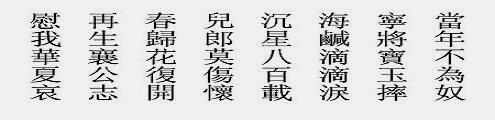
This snippet is for sons and daughters of China:
Heed the sons & ministers' agony and sorrow of our ancestors who died or lived through the Mongol, Manchu and Soviet-Chicom conquest
and
the Yongjia, Jingkang and Jiashen cataclysms !
Jeanne d'Arc of China:
Teenager girl Xun Guan breaking out of the Wancheng city to borrow the relief troops in the late Western Jinn dynasty;
Liu-Shao-shi riding into the barbarian army to rescue her husband in the late Western Jinn dynasty;
teenager girl Shen Yunying breaking into Zhang Xianzhong's rebels on the horseback to avenge on father's death in the late Ming dynasty.
China's Solitary and Lone Heroes:
Nan Jiyun breaking out of the Suiyang siege and charging back into the city in the Tang dynasty;
Zhang Gui & Zhang Shun Brothers breaking through the Mongol siege of Xiangyang in the Southern Soong dynasty;
Liu Tiejun breaking through three communist field armies' siege of Kaifeng in the Republican China time period;
Zhang Jian's lone confrontation against the communist army during the June 3rd & 4th Massacre of 1989.
|
|
|
THE SOONG DYNASTY
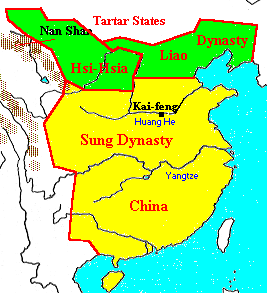
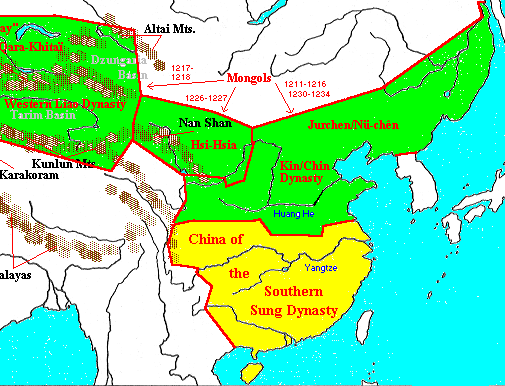
For hundreds of years, the Soong Dynasty, built on top of Northern Zhou (A.D. A.D. 951-960) of the Chai(1) family, would be engaged in the games of 'three kingdom' kind of warfare. Northern Soong (A.D. A.D. 960-1127) faced off with the Western Xia (A.D. 1032-1227) and the Khitan Liao in a triangular war. After a defeat in the hands of the Khitans, Soong Dynasty never tried to retake the northern territories, including Youzhou (Beijing), again. Posterior Tang general Shi Jingtang, a Shatuo, in order to fight Posterior Tang, had ceded the 16 Yan-Yun [Youzhou, Yunzhong, etc.] zhou or prefectures to the Khitans, including Youzhou (Beijing). It would be Ming Dynasty that would overthrow the Mongol Yuan Dynasty and retake Youzhou (Beijing). Soong Dynasty played the card of allying with the Jurchens in destroying the Khitan Liao. With Northern Soong defeated by the Jurchens thereafter, Southern Soong (A.D. 1127-1279) was engaged in another triangle game, with the other players being the Western Xia and the Jurchen Jin. Southern Soong then played the card of allying with the Mongols in destroying the Jurchen Jin, and it even sent tens of thousands of carts of grain to the Mongol army in the besieging of the last Jurchen stronghold.
Soon after that, the Southern Soong generals broke the agreement with the Mongols and took over the three ancient capitals of Kaifeng, Luoyang and Shangqiu. But they could not hold on to any of the three because what they had occupied had been empty cities after years of wars between the Jurchens and the Mongols.
Similar to the times of the Western Jinn (A.D. 265-316) and Eastern Jinn (A.D. 317-420), the northern Chinese would have fled to the south during these conflicts. While Eastern Jinn re-established their capital in Nanking, the Southern Soong, after being driven away from Nanking by the Jurchens, chose Lin'an (today's Hangzhou) as the new capital.
Historians had a good conclusion for the Soong dynasty: Soong Dynasty, per Mongol General Bayan, had obtained the throne from a kid and would lose it in the hands of a kid. Soong obtained its kingdom from a child emperor of Northern Zhou, and officially ended when Prime Minister Lu Xiufu jumped into the sea after the debacle of the mount Yashan Sea battle, with a child emperor on his back.
Soong Dynasty enjoyed the start of the prosperous 'Silk Road' on the seas. Historians cited some European historian's claim that the southern Chinese developed the overseas commerce as compensation for the loss of the land route after losing northern China to the Jurchens, with ships built in coastal Canton & Quanzhou carrying as many as 1000 people. Across the Southeast Asian islands, wreckage of numerous Soong Chinese merchant ships had been discovered, with typical Chinese products like potteries as well as Chinese coins.
The adoption of compass in A.D. 1119, an invention first mentioned in the 1st year of the Xuanhe Era of Northern Soong Emperor Huizong, would make the seafaring trips less precarious than before.
Yan Qinghuang also mentioned that the imperial sanction of a sea goddess, i.e., "Ma [mother] Zu [ancestress]", in A.D. 1156, 1158 & 1190, pinpointed a sign that the sea commerce had prospered under Soong emperors. In lieu of the Tang system of using eunuchs, Soong designated the court officials to the four coastal ports for dealing with foreign merchants.
The "overseas trip permit" system, first adopted in A.D. 989, was enforced.
Zhao Rushi's "Zhu [various] Fan [foreign countries] Zhi [records]" mentioned that some murderer of a Chinese merchant at Zhancheng [southern Vietnam?] was caught and that King of San-fo-qi wrote to China in the Chinese language.
Yan Qinghuang cited "Soong Shi" [History of Soong Dynasty] in pointing out that the overseas Chinese had become leaders in the alien lands, including Java [Mao Xu] and Japan [Zhu Rencong, Zhou Wende, Zhou Wenyi, Chen Wenyou, Sun Zhong & Li Chong].
Along the southeast coast of China would be settlement or ghettos of ethnic Arab, Muslim and Christian residents.
Yan Qinghuang mentioned an A.D. 1225 book by port magistrate ("shi [trade] po [moor] si [magistrate]") Zhao Rushi of Quanzhou as a good example of the governmental management over foreigners. (Also see Mongol Yuan's extension of the shi-po-si system to some three additional cities.)
Do note that foreigners had visited and dwelled in Guangzhou and Quanzhou much earlier than the Soong dynasty. History recorded
i) that some Indian envoys arrived at the Han Court in A.D. 159/161 and Roman emissary in the Han Dynasty year of A.D. 166 and during the Wu Dynasty time period of the Three Kingdoms via a stop at Rinan (i.e., Champa);
ii) that a Lijian or Roman emissary, per "History of the [two] Jinn Dynasties" by Tang Dynasty's Fang Xuanling, came to the Western Jinn court during the Taikang Era, A.D. 280-289, of Jinn Emperor Wudi (reign A.D 265-290);
iii) that Indian and Arab merchant ships carried monk Fa Shien back to China during A.D. 399-414;
iv) that Indian Buddhists had come to Canton (Guangzhou) during the Liang dynasty of the South-North time period;
v) that famous Tang Dynasty monk Xuan-zang had returned to China overland in lieu of a sea trip as suggested by the Indians for only one reason: Xuan-zang promised to Gaochang [Turpan] King Ju Wentai that he would pass through Turpan for a gathering on his return trip; and vi) that at the end of Tang Dynasty, rebel leader Huang Chao had sacked Canton and killed numerous foreigners.
Soong China possessed the most numerous and brilliant neo-Confucians. Those Confucians were pillars and safeguards of the system, an elite class who obtained their officialdom via the civil services exam (open to almost all classes of people, though not altogether).
This system of emperor's men had its heyday in the Soong Dynasty when the first emperor of Soong, in July of A.D. 961, forced all his generals ["jie du shi"], including Shi Shouxin et al., into retirement and conferred even the military posts onto civil-service officials. (Cai Dongfan commented that Soong Dynasty's weakness lied in its disparagement of the military since Soong never had to experience the power corruption of empresses, eunuchs, in-law families, governors and royal families as seen in the previous dynasties.) Soong Dynasty produced such righteous ministers as Fan Zhongyan who was famous for a motto that "one should worry before the populace do so and seek happiness only after the populace become happy".
Various Soong ministers would devise their family mottos. This is best illustrated by the familial motto guides such as The Zhu Family Mottos. (Zhu Xi was the neo-Confucian of Soong Dynasty.)
The Soong time period also saw a 'political correctness' in applying Confucianism.
Soong Dynasty also produced numerous 'Si [die for] Yi [righteousness]' intellectuals, i.e., those Confucians who sacrificed their families and lives for the country. When chased by the Mongol army, Prime Minister Lu Xiufu, with the young emperor on his back, fled to the southern tip of Mt Yashan. After driving his family into the sea, Lu jumped into the sea with emperor on his back. Wen Tianxiang, on the date of being executed, wrote a poem, stating that "Confucius proposed that one should die for compassion (Ren) and Mencius suggested that one should die for righteousness (Yi). Only when righteousness is fully exerted will the compassion be derived. What should I endeavour after educating myself with so many books of the ancient saints? However, I am sure that I feel no guilty about myself from this death moment on." (Confucius wording for 'Ren' should mean a broader sense of human perfection, similar to nirvana in Buddhism. 'Ren' also meant nucleus in the Chinese language, as used for the nucleus of various fruits like apple.)
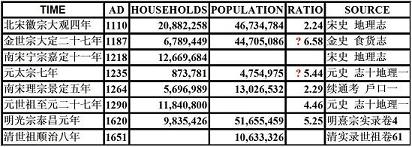 In A.D. 1110, i.e., the 4th year of Soong Emperor Huizong's Daguan Era, Whole China boasted of a population of 20.88 million households or 46.73 million people, but in A.D. 1264, i.e., the 5th year of Soong Emperor Lizong's Jingding Era, Southern China only had 13.03 million people. The conclusion is that China's brave men had fallen martyrdom in the resistance to invasion, something we should take pride in.
(Similarly, China endured another round of some dramatic population drop during the Manchu invasion. In A.D. 1620, i.e., the 1st year of Ming Emperor Guangzong's Taichang Era, China boasted of a population of 51.66 million people, but in A.D. 1651, i.e., the 8th year of Qing Emperor Shizu's Shunzhi Era, China only had 10.63 million people. For details of calculation - please see below.)
In A.D. 1110, i.e., the 4th year of Soong Emperor Huizong's Daguan Era, Whole China boasted of a population of 20.88 million households or 46.73 million people, but in A.D. 1264, i.e., the 5th year of Soong Emperor Lizong's Jingding Era, Southern China only had 13.03 million people. The conclusion is that China's brave men had fallen martyrdom in the resistance to invasion, something we should take pride in.
(Similarly, China endured another round of some dramatic population drop during the Manchu invasion. In A.D. 1620, i.e., the 1st year of Ming Emperor Guangzong's Taichang Era, China boasted of a population of 51.66 million people, but in A.D. 1651, i.e., the 8th year of Qing Emperor Shizu's Shunzhi Era, China only had 10.63 million people. For details of calculation - please see below.)
Northern Soong Dynasty
|
The demise of the Tang dynasty brought about the Five Dynasties & Ten Kingdoms, i.e., Five Dynasties (A.D. 907-960) in northern China, and nine kingdoms in southern China and Northern Han (A.D. 951-979) in today's Shanxi. As recorded in history, the three dynasties in between Posterior Liang and Posterior Zhou were of alien nature, founded by generals who belonged to a group of barbarians called the Shatuo (Sha'to, a Turkic tribe) Turks. While Posterior Liang (A.D. 907-923) was set up by Zhu Wen (who first betrayed rebel leader Huang Chao and then usurped the Tang dynasty), the leader of later Posterior Tang (A.D. 923-936) and Posterior Jinn (A.D. 936-946) all came from nomadic Shatuo (Sha'to).
The Shatuo Turks, who acted as the Tang dynasty's mercenary army since the mid-8th century, set up the Posterior Tang dynasty that overthrew Posterior Liang.
This time period also marks the penetration and influence of the Khitans on northern China.
The Shatuo Turks' dynasties changed hands a few months as a result of the intervention of the Khitans.
Liu Zhiyuan, who was also said to be a Shatuo, expelled the Khitans from north China and launched the Posterior Han dynasty
which was defeated by a subordinate Chinese general Guo Wei.
Guo Wei's Posterior Zhou passed on to his foster son, Cai Rong, to be eventually usurped by General Zhao Kuangyin who founded the Northern Soong dynasty (A.D. 960-1127).
|
|
Around A.D. 907, the Khitans invaded the northern Chinese post of Yunzhong. To combat Posterior Liang, Li Keyong struck an agreement with the Khitans. However, the Khitans, under Yelü A'baoji (Yeh-lu A-pao-chi A.D. 872-926), colluded with Posterior Liang. Yelü A'baoji sought suzerainty with Zhu Wen for sake of some title conferring as well as marriage with Zhu Wen's daughter.
Posterior Jinn (A.D. 936-946), led by Shi Jingtang [a former general of Posterior Tang], ceded 16 zhou to the Khitans in order to fight Posterior Tang.
Yelü A'baoji's son, Yelü Deguang, assisted Posterior Jinn in destroying Posterior Tang.
However, rifts between the Khitan Liao and Posterior Jinn ensued. The Khitans destroyed Posterior Jinn in A.D. 946. The Khitans renamed their dynasty to Liao Dynasty in A.D. 947 in the attempt of ruling northern China.
When weather got hot and the Chinese under Liu Zhiyuan rebelled against them, Yelü Deguang retreated to the north and died en route at a place called the Fox-killing Ridge.
A Posterior Jinn general of Shatuo tribe origin, Liu Zhiyuan, would be responsible for rallying an army and pressured the Khitans into retreat, and hence Liu founded the Posterior Han dynasty (A.D. 947-950).
Guo Wei, a general of Posterior Han Dynasty, who was responsible for defeating Posterior Jinn, rebelled after his family were slaughtered in the capital. Guo staged a change of dynasty by having his soldiers propose that he be the emperor of Posterior Zhou (A.D. 951-960). The uncle of Posterior Han's emperor then declared Northern Han (A.D. 951-979) in today's Shanxi and allied with the Khitans.
Guo Wei's Posterior Zhou will pass on to his foster son, Chai Rong, to be eventually usurped by a general called Zhao Kuangyin who founded the [Northern] Soong dynasty (A.D. 960-1127).
Soong Emperor Taizu (Zhao Kuangyin, reign A.D. 960-976)
Soong Emperor Taizu, i.e., Zhao Kuangyin, had a few legendary chivalry stories, including 'Escorting Miss Jingniang Home For Over Thousand Miles'. Emperor Taizu's grandfather was a Tang Dynasty 'ci shi' (circuit inspector) of Zhuozhou Prefecture, and further up the lineage there would be numerous ancestors serving under the Tang Dynasty emperors. Emperor Taizu's father was Zhao Hongyin who had served Posterior Zhou as 'si tu', 'shang-jiangjun' (highest general), and 'tai wei' (grand captain) posthumously. Before Posterior Zhou, Zhao Hongyin at one time rescued Posterior Tang Emperor Zhuangzong, for which he was conferred the post of 'dian jian', i.e., monitoring general in charge of the imperial bodyguard column (i.e., the garrison troops). During the Posterior Han time period, Zhao Hongyin had defeated a Shu army (i.e., today's Sichuan area) at Chencang; and during the Posterior Zhou time period, in A.D. 953, Zhao Hongyin defeated a Wu army from the Yangtze Delta and took over Yangzhou of today's Jiangsu and Shouchun of today's Anhui.
Zhao Kuangyin was born in Luoyang in A.D. 927, i.e., the 2nd year of Posterior Tang's Tiancheng Era. Zhao Kuangyin was called a 'fragrant baby' at birth, and his body carried a golden glittering color. Zhao Kuangyin had two childhood friends, Han Lingkun and Murong Yanzhao. Zhao Kuangyin had high ambition at a young age and left home for the frontline by himself, without notifying his father. In A.D. 948, Zhao Kuangyin joined the army led by Guo Wei, qumi fu shi and zhaowei anfu shi of Posterior Han. Guo Wei was ordered to fight the Li Shouzhen rebellion at the time. Guo Wei quelled the rebellion of Hezhong, Yongxing and Fengxiang, and brought Zhao Kuangyin to Yecheng. When Guo Wei usurped the Posterior Han dynasty and set up Posterior Zhou in A.D. 951, Zhao Kuangyin was assigned the post of deputy head for the Huazhou prefecture and ma zhi jun shi of the Kaifeng-fu governor office. When Posterior Zhou Emperor Shizong (Chai Rong) enthroned in A.D. 954, Zhao Kuangyin and his father (Zhao Hongyin) were both in charge of the Posterior Zhou Emperor Shizong's imperial bodyguard column. Chai Rong was the son of Guo Wei's brother-in-law, Chai Shouli.
While the Zhao family was speculated to have similar traits as the Q-haplogroup Shatuo Turks, the Zhao royals took Tianshui, i.e., western China, as the ancestral homeland.
Emperor Huizong, who was abducted by the Jurchens during the Jingkang Cataclysm of A.D. 1127, was in A.D. 1141 upgraded by the Jurchens to King Tianshui-jun-wang for the Zhao clan's claim of origin from Tianshui, i.e., the Qin and Zhao states' common ancestral place.
This actually corroborated the physical anthropology studies that the paleo-northwestern genes, i.e., the Sui and Tang dynasties' royal families, replaced the paleo-central-plains genes by the Soong dynasty, i.e., reaching the level of two times the paleo-central-plains Chinese.
* In Commemoration of China's Fall under the Alien Conquests in A.D. 1279,
A.D. 1644 & A.D. 1949 *
U.S.S.R./Comintern Alliance with the KMT & CCP (1923-1927)
Korean/Chinese Communists & the 1931 Japanese Invasion of Manchuria
American Involvement in China: Soviet Operation Snow, IPR Conspiracy, Dixie Mission, Stilwell
Incident, O.S.S. Scheme, Coalition Government Crap, Amerasia Case & The China White Paper
* Stay tuned for "Republican China 1911-1955: A Complete Untold History" *
|
|
Zou Rong's Revolutionary Army;
Shin Kyu Sik's
Shrine (Spirit, Kunitama) of Korea
|
This snippet is for sons and daughters of China:
Heed the sons & ministers' agony and sorrow of our ancestors who died or lived through the Mongol, Manchu and Soviet-Chicom conquest
and
the Yongjia, Jingkang and Jiashen cataclysms !
Jeanne d'Arc of China:
Teenager girl Xun Guan breaking out of the Wancheng city to borrow the relief troops in the late Western Jinn dynasty;
Liu-Shao-shi riding into the barbarian army to rescue her husband in the late Western Jinn dynasty;
teenager girl Shen Yunying breaking into Zhang Xianzhong's rebels on the horseback to avenge on father's death in the late Ming dynasty.
China's Solitary and Lone Heroes:
Nan Jiyun breaking out of the Suiyang siege and charging back into the city in the Tang dynasty;
Zhang Gui & Zhang Shun Brothers breaking through the Mongol siege of Xiangyang in the Southern Soong dynasty;
Liu Tiejun breaking through three communist field armies' siege of Kaifeng in the Republican China time period;
Zhang Jian's lone confrontation against the communist army during the June 3rd & 4th Massacre of 1989.
|
|
|
When Northern Han (Liu Chong) and the Khitan Liao attacked Posterior Zhou by taking advantage of the death of Guo Wei, Chai Rong led the imperial bodyguard troops to Gaoping to counter Northern Han and the Khitans.
The Zhou emperor led a campaign against the Northern Han army.
A general, zhi hui Fan Aineng fled the scene. Seeing that Chai Rong was targeted by the enemy archers, Zhao Kuangyin led a dozen brave soldiers on a charge against the enemies and rescued Chai Rong. The Posterior Zhou army chased Liu Chong to the He-dong city, and Zhao Kuangyin personally led a fire attack at the city. Chai Rong retreated after Zhao suffered an arrow wound in the left arm. After the Posterior Zhou troops retreated to Biandu (Kaifeng) the capital, Zhao Kuangyin was conferred Marquis Duyu-hou and ci shi [i.e., circuit inspector] of the Yanzhou prefecture.
Haan Chongyun, a sworn brother of Zhao Kuangyin, was promoted to be the imperial garrison cavalry director for the contribution at the Battle of Gaoping.
During the third year reign of Emperor Zhou Shizong, i.e., A.D. 956, Posterior Zhou campaigned against the Huainan (south of the Huai River) territories of Southern Tang Dynasty. Both Zhao Kuangyin and Zhao Hongyin joined the campaign.
Posterior Zhou defeated a Southern Tang army of over 10000 men at Guo-kou (Wo-kou, the Guo-shui/Wo-shui river mouth], and killed "bingma (soldier & horse) du-jian (monitoring general)" Heh Yanxi. The Southern Tang army, claiming a headcount of 150000, led by "jiedu-shi" (satrap or governor) Huangfu Hui and Yao Feng, overflowed the Qingliu-guan Pass. When Zhao Kuangyin chased the Southern Tang army to the city, Huangfu Hui requested for stationing his troops outside of the citywall for a duel. Huangfu Hui was personally decapitated by Zhao, and Yao Feng was captured. After Zhao Kuangyin entered the city, he ordered that the city gates be closed at night. Zhao Kuangyin's father, Zhao Hongyin, was dissuaded from entering the city at night as show of disciplne without regard for the kinsmanship.
The northern army, led by Wang Shenqi, separately took over Shuzhou (Qianshan of Anhui).
When Haan Lingkun took over Yangzhou, a Southern Tang army came to the relief. Haan Lingkun proposed a retreat; however, Posterior Zhou Emperor Shizong ordered that Zhao Kuangyin lead 2000 relief soldiers to Luhe to counter the Southern Tang relief army. Zhao Kuangyin issued an order stating that should Haan Lingkun's soldiers retreat to Luhe, they would be cut off the feet. Haan Lingkun hence solidified his defence at Yangzhou. Thereafter, Zhao Kuangyin defeated King Qi Jingda of Southern Tang to the east of Luhe. Zhao Kuangyin killed over 10000 enemies. Upon return to the capital, Zhao Kuangyin was conferred the post of "dianqian (front of the imperial throne) du-zhihui-shi (directing general)" and "jiedu-shi" (satrap or commissioner general) for the Dingguo-jun Garrison.
During the fourth year reign of Posterior Zhou Emperor Shizong, i.e., A.D. 957, Zhao Kuangyin participated in the campaign against Shouchun of today's Anhui Province. Posterior Zhou took over the Zhu-zhai Garrison and the Shouzhou city.
In March, at the Battle of Zijinshan-zhai (Fengtai), Wang Shenqi defeated the southern army.
Later, upon return, Zhao Kuangyin was conferred the post of "jianxiao (censoring and inspecting) taibao (gestapo)" and "jiedu (commissioner general)" for the Yicheng-jun Garrison.] In the winter, Posterior Zhou campaigned against the Hao-Si prefecture areas of today's Anhui Province.
Wang Shenqi led the northern army against Southern Tang at the Battle of Haozhou (Fengtai) and the Battle of Chuzhou (Huai'an of Jiangsu).
Southern Tang stationed its army on the beach of Shibali-tan (eighteen Chinese mile beach). Zhou Emperor Shizong intended to cross the river on camels, but Zhao Kuangyin simply jumped into the river to lead the way, setting up an example for his soldiers. Zhao defeated the Southern Tang army on the opposite bank, and then flowed down the river to take over the Sizhou city.
The Tang army then stationed at the Dunqing-kou river mouth for defence. Zhao followed Zhou Emperor Shizong in marching along the east side of the Huai River and chased the enemy to Shanyang. Zhao captured Southern Tang "jiedu-shi" (satrap or governor) Chen Chengzhao and took over the Chuzhou city. Zhao went on to defeat the Tang army at another river mouth, burnt the Tang camps south of the river, and defeated the Tang army at Guabu. After the northern army's quelling the Huainan (south of Huai River) areas, Southern Tang tried to sow a dissension between Zhao Kuangyin and Zhou Emperor Shizong by sending 3000 Chinese ounces of 'baijin' (white gold) as bribe. Zhao submitted the gold to the imperial coffer. The next year, Zhao was conferred the post of "jiedu-shi" (satrap or commissioning general) for the Zhongwu-jun Garrison.
In March of A.D. 958, Southern Tang ceded land to sue peace with Northern Zhou.
In March of A.D. 959, Zhou Emperor Shizong led a northern campaign against the Khitans at Chanzhou. Zhao Kuangyin was conferred the post of sui-lu du bushu ('land-water governing general in charge'). Haan Tong and Shi Shouxin were assigned the commander and deputy posts for the land army.
Zhou Shizong personally went to the Qianning-jun Garrison to lead the attack at Ningzhou. Ningzhou ci shi (circuit inspector or governor) Wang Hong surrendered. Then, Haan Tong was assigned the post in charge of a land army while Zhao in charge of boats. The Posterior Zhou army attacked the Yijin-guan Pass. Wang Hong called upon the guarding general Zhong Tinghui for surrender. Zhong Tinghui agreed. Zhong Tinghui was retained as a general at the pass.
When reaching the Mozhou area, Zhao Kuangyin deserted boats for the riverbank, and attacked the Waqiao-guan [tile bridge] Pass. Zhao defeated guarding general Yao Neibing at the Waqiao-guan Pass. When the Posterior Zhou armies, led by du zhihui-shi Li Chongjin, by Haan Tong (who pacified Mozhou and Yingzhou) and by the emperor himself, converged under the Waqiao-guan Pass, defender Yao Neibing surrendered. Yao was assigned the post of ci shi for Nuzhou. Posterior Zhou quelled the area south of the pass.
Zhou Emperor Shizong then ordered a campaign against the Khitans in Youzhou and Yizhou. Li Chongjin was ordered to attack northward. Li took over the Gu'an city. North of the city was the An'yang-shui River. The Khitans dismantled the bridge and hid away the boats. Emperor Zhou Shizong, seeing that the river was wide, ordered the building of a bridge and then left for the Waqiao-guan Pass. Emperor Zhou Shizong later fell ill. Meantime, Sun Xingyou was ordered to attack Yizhou and he took over the city and captured ci shi Li Zaiqin. Li Zaiqin refused to surrender and was ordered to be executed by emperor Zhou Shizong. When Zhou Shizong's illness got worse, Zhao Kuangyin persuaded him into returning to the capital. Waqiao-guan was renamed Xiongzhou and Chen Sirang was to guard it; the Yijin-guan pass was renamed Bazhou, and Haan Lingkun was to guard it.
Zhou Shizong accidentally read about a 3-foot wood document stating that 'dian jian' would be the new emperor'.
Upon return to the capital, Zhou Shizong deprived "dian jian" Zhang De (Zhang Yongde) of his post and re-assigned it onto Zhao Kuangyin. Emperor Zhou Shizong also assigned Zhao Kuangyin the title of "jianxiao taifu". Emperor Zhou Shizong died shortly, in June. When Posterior Zhou Emperor Gongdi [Chai Zongxun], a child emperor, was enthroned, Zhao Kuangyin was conferred the post of "jiedu" for the Gui'de-jun Garrison [with office set at Songzhou, i.e., today's Shangqiu, a name that would yield to the founding of the Soong dynasty] and "jianxiao tai-wei" (grand captain).
The next year, A.D. 960, in January, when some rumor went that the Northern Han army and the Khitans colluded in invading the Zhou territories of Zhenzhou (today's Zhengding) and Dingzhou (Dingxian), Zhao led an army to counter the attack. It was recorded that Zhao managed to have deputy prime minister Wang Fu instigate prime minister Fan Zhi into issuing the army mobilization order, and Zhao sent Guo Tingyun back to the capital for liaison with Shi Shouxin to stage the mutiny. While stopping at the Chenqiao-yi imperial postal station, Zhao's follower, Miao Xun et al., pointed to the sky for another officer to see a second sun under the sun. Chenqiao-yi was between Chenqiao and Fengqiu, to the northeast of today's Kaifeng. At deep night, Zhao's generals had an assembly and proposed that Zhao Kuangyin be the new emperor. The generals under Gao Huaide forcefully put a yellow gown or robe onto Zhao Kuangyin. The next day, Zhao Kuangyin led his troops back to the capital and usurped the Posterior Zhou dynasty. The mutineers had to go around the Chenqiao for a roundabout trip through Fengqiu, for which Zhao later ordered the Chenqiao commander to be executed for dereliction of duty. At the capital, Shi Shouxin and Wang Shenqi, all Zhao's cronies, opened the gates. General Wang Yansheng killed a deputy garrison commander, Haan Tong, and his family, for which Zhao demoted him. Prime minister Fan Zhi was pressured into supporting the new regime. The young emperor, Chai Zongxun, was made into King Zheng-wang, and a royal family baby was given to Pan Mei for adoption.
Zhao inscribed three mottos on a stone inside of the palace, stating that the Chai family would be forever preserved; the intellectual-background ministers should never be killed; and the agricultural taxes should not be increased.
Only two regional heads opposed the mutiny, i.e., Li Yun of the Zhaoyi-jun Garrison in Luzhou and, Huai-nan "jiedu shi" Li Chongjin in Yangzhou. Both were consecutively defeated within half year. Shi Shouxin and Gao Huaide were sent north against Li Yun, while Murong Yanzhao and Wang Quanbin were sent against Li Yun from the east. Shi Shouxin defeated Li Yun's army at Changping (Changzi of Shanxi) and Zezhou (Jincheng). Li Yun, who fought against Zhao in April, was quelled in June of A.D. 960, and committed suicide by setting himself on fire in Zezhou. Li Jixun, a sworn brother of Zhao Kuangyin, was assigned the job as the Zhaoyi-jun Garrison "jiedushi" to control the Luzhou area. In the Yangtze area, Li Chongjin fought against Zhao in September. Shi Youxin and Wang Shenqi were assigned the jobs of quelling the Li Chongxin rebellion. Shi Youxin took over Yangzhou in November. Li committed suicide by setting himself on fire.
Zhao was able to take over power as a result of making 10 sworn brothers ("yi-she shi xiongdi"), with many of them playing the important role of executing the rebellion inside and outside of the capital. This usurpation was contrived as premeditated.
After the consolidation of power, Zhao continued the Posterior Zhou campaigns to reunite China. The first target would be the southern regimes.
In A.D. 963, Zhao quelled the Nan-ping (Gao Jichong's Jing-nan) and Wuping (today's Hunan) regimes. In this area, 11-year-old Zhou Baoquan, son of Zhou Xingfeng, had requested aid with the Soong court for quelling the rebellion of Zhang Wenbiao. Soong emperor Taizu sent Murong Yanzhao to the south. On March 26, the Soong army took over Sanjiang-kou [three rivers' confluence area] and consecutively took over Yueyang and Langzhou (Changde of Hunan Province). The Soong army, in the name of borrowing a path, took over the Nanping-guo regime in passing through Jiangling.
The Nanping-guo regime was originally assigned to Gao Jiping [a follower of Zhu Wen's adopted son] by the Posterior Tang dynasty back in A.D. 924.
In 965, Zhao quelled the Posterior Shu regime.
* In Commemoration of China's Fall under the Alien Conquests in A.D. 1279,
A.D. 1644 & A.D. 1949 *
U.S.S.R./Comintern Alliance with the KMT & CCP (1923-1927)
Korean/Chinese Communists & the 1931 Japanese Invasion of Manchuria
American Involvement in China: Soviet Operation Snow, IPR Conspiracy, Dixie Mission, Stilwell
Incident, O.S.S. Scheme, Coalition Government Crap, Amerasia Case & The China White Paper
* Stay tuned for "Republican China 1911-1955: A Complete Untold History" *
|
|
Zou Rong's Revolutionary Army;
Shin Kyu Sik's
Shrine (Spirit, Kunitama) of Korea
|
This snippet is for sons and daughters of China:
Heed the sons & ministers' agony and sorrow of our ancestors who died or lived through the Mongol, Manchu and Soviet-Chicom conquest
and
the Yongjia, Jingkang and Jiashen cataclysms !
Jeanne d'Arc of China:
Teenager girl Xun Guan breaking out of the Wancheng city to borrow the relief troops in the late Western Jinn dynasty;
Liu-Shao-shi riding into the barbarian army to rescue her husband in the late Western Jinn dynasty;
teenager girl Shen Yunying breaking into Zhang Xianzhong's rebels on the horseback to avenge on father's death in the late Ming dynasty.
China's Solitary and Lone Heroes:
Nan Jiyun breaking out of the Suiyang siege and charging back into the city in the Tang dynasty;
Zhang Gui & Zhang Shun Brothers breaking through the Mongol siege of Xiangyang in the Southern Soong dynasty;
Liu Tiejun breaking through three communist field armies' siege of Kaifeng in the Republican China time period;
Zhang Jian's lone confrontation against the communist army during the June 3rd & 4th Massacre of 1989.
|
|
|
To the north, the Soong army launched two unsuccessful campaigns against Northern Han.
After Zhao Kuangyin died in October of A.D. 976, brother Zhao Kuangyi, i.e., Emperor Taizong, continued the reunification wars.
In August of A.D. 968 [i.e., the first year of the Kaibao Era], Li Jixun, as "du bu shi" or director of the frontal army of the He-dong xing-ying (camp), commanded a Soong army in invading the Northern Han territories. Northern Han dispatched Liu Jiye (Yang Ye), i.e., Marquis Duyu-hou, to defending Tuanbaigu [Taigu of Shanxi], while the Khitan emperor Liao-muzong sent a relief army to aiding Northern Han. The Soong army defeated the Northern Han army, taking over the Fen-he River bridge and pressing against the capital city of Taiyuan. When the Khitan army, led by Yelü Talie (Nie-lu-gun), reached the Yanmen [swan gate] Pass, the Soong army pulled off for the south. Yelü Talie, a Khitan southside king equivalent, previously led a relief army to defeating the Northern Zhou's cavalry at Xinkou and rescued the Northern Han regime.
In February of A.D. 969, the Soong emperor personally led an unsuccessful campaign against Northern Han. The Soong army defeated the northern army at Tuanbaigu again, and pressed on to lay siege of Taiyuan, where a Khitan emissary [who came to congratulate Liu Jiyuan on enthronement] assisted in the defense and requested with the Khitan homebase for relief. In April, the Khitans came south via two routes, the western route which came south through the Shiling-guan Pass [Xinzhou], and the eastern route which came west from Dongzhou. The Soong army impeded both Khitan relief armies. In May, the Soong army flooded Taiyuan with the Fen-he River water. In summer, more Khitan relief armies came. The Soong army withdrew the siege and stationed the army troops at Shangdang to weaken the agricultural base of the Northern Han regime.
In A.D. 971, Zhao quelled the Southern Han regime.
In A.D. 975, the Soong army sailed down the river to surround Jiangning-fu (Nanking) for close to one year, forcing the Southern Tang emperor Li Yu to surrender in November of the 8th year of the Kaibao Era, A.D. 975.
Soong Emperor Taizong (Zhao Jiong/Guangyi/Kuangyi, reign A.D. 976-997)
Zhao Kuangyi's succession of his brother's emperor seat was shrouded in mysteries as a result of the easiness in the act, as well as some unnecessary revision of the historical context. The rumor was carried in a book called "Xu [continuum] Zizhi [reference] Tongjian [comprehensive check] Chang-bian [long editing]" by Li Tao of the Soong Dynasty, where there was a claim of "spotting a jade hatchet stick's sound in the limelight of candles' light". The story went that when Zhao Kuangyin suddenly fell ill, he called over brother Kuangyi, and the two closed doors; but then people outside heard about the throwing of a jade "hatchet" [stick] onto the floor, seen through the shadows on the window paper, that were reflected by the candle lights. Li Tao continued to state that Zhao Kuangyin threw the stick hatchet (i.e., jade hatchet-shape stick) onto the floor and then uttered the words to his younger brother to the effect that he was desperately asking the younger brother to do whatever good deeds as he could. Some speculation in "Xiangshan ye lu" [wild stories of Mt. Xiangshan], by monk Wen-ying of the Jinluan-si Monastery of Jingzhou, went further to state that Zhao Kuangyin, during the hours of drinking with brother, repeatedly hit the piled-up snowy palace floor with the jade stick before getting drunken and going to sleep, to be found dead later, and that what followed next was that the younger brother called in the imperial family members and the ministers to the scene; however, the emperor was already dying. Xu Dachao, a Soong-Yuan survivor from today's Suzhou, in "Jin yu lu" [records from the ember of the Mongol fire], a book that recorded the barbaric mongol Droit du seigneur against the ethnic Chinese brides, carried a rumor to the effect that emperor Kuangyin hit brother Kuangyi with the jade stick when he found out that the younger brother was teasing with concubine Huarui-furen (madam flower pistil).
Sima Guang, the great Soong dynasty historian, in "Su-shui jiwen" [recording what was heard about as a man from the Su-shui River], stated that brother Kuangyi was not present when the emperor died; that eunuch Wang Ji'en, against Empress Soong-huang-hou's order to call in crown prince Zhao Defang, went straight to Kuangyi's Kaifeng-fu governor office, and asked Kuangyi to hastily go to the palace; that the three entourage, including Kuangyi, and "zuo-wei-ya" [leftside office guard] Cheng Dexuan, walked the snowy road to the palace; and that at the palace, the empress, upon seeing the arrival of Kuangyi, not prince Defang as expected, suddenly sensed what was to happen, and told Kuangyi that her life and her child's life were all with Kuangyi. Separately, Wang Yu, in "Jianlong yishi", pointed out that at one time when the emperor was ill, prime minister Zhao Pu had proposed to have a will made to make the crown price a successor, for which Kuangyi, who heard about it, had discord with Zhao Pu. This means that Kuangyi's assumption of the emperor's seat was not unanimously supported by all ministers. Though, no purge among the ministers was conducted, that was to point to the succession as the result of some bloody coup.
With the support of ministers, Zhao Kuangyi (King Jinn-wang, 'fuyi' of Kaifeng-fu) was enthroned. With this commonly-accepted background, there was no evidence that the younger brother was responsible for the emperor's death.
Though, Zhao Kuangyi, in a hurry, changed the imperial era to his Taiping-xingkuo 1st year two months ahead of the end of his brother's Kaibao Era, and further personally intervened in the editing of Emperor Taizu's chronicles ['Taizu shilu'] five years after the succession, in which an old story about the late mother-empress [Du-shi]'s A.D. 921 advice against passing the reign to the young siblings was inserted, giving the foture historians doubt as to the legality of the imperial succession. What was carried in the official history was the unfortunate demotion and exile of Kuangyi's brother [Zhao Tingmei] and Kuangyin's sons, i.e., candidates who might succeed the throne using mother-empress Du-shi's established convention, i.e., a nomadic and barbarian tradition as well as an ancient Chinese dynastic tradition of Shang Dynasty China; and furthermore, history chronicle Soong Shi, in chapter 244, carried a sentence from prime minister Zhao Pu to the effect that Emperor Taizong was dissuaded from passing the reign to a brother-equivalent, saying the reign succession blunder by Emperor Taizu (Kuangyin) should not be repeated.
Exerting the political pressure, Zhao Kuangyi, i.e., Emperor Taizong, pacified Qian Liu of the Wu-yue regime and Chen Hongjing of the Zhangzhou-Quanzhou regime. In early A.D. 979, Taizong personally led an army against Northen Han. Having sent General Pan Mei to encircling the capital city of Taiyuan of Northen Han, Taizong induced the Khitans to invade south and defeated them. With the Khitans gone, Liu Jiyuan surrendered the Taiyuan city to Soong, ending the 200-year historical turmoil of China, that started with the An Lushan-Shi Siming Rebellion of the Tang Dynasty.
The Soong army completely destroyed the Taiyuan city for sake of preventing the city from being used again in a future war.
150 years later, when the Jurchens invaded Soong China, Taiyuan defenders mounted a nine-to-ten month defense against the Jurchens even though the Soong emperor already agreed to cede Taiyuan and most of the land north of the Yellow River to the Jurchens.
The Soong Chinese died to the last person in the lane-to-lane battles.
(Liu Jiye (Yang Ye), a Northern Han general, hence began to serve the Soong regime.
Yang Ye's father was named Yang Xin, a local strongman in Linzhou [giraffe prefecture] who self-proclaimed himself a 'ci shi' [satrap].
Yang Ye later married a Zhe (also pronounced as 'She2') family woman, daughter of 'jiedu shi' of the Yong'an-jun Garrison District of the Fu-zhou prefecture.
Madam She2 would be the heroine, Grandma She2-tai-jun, in romance novel "The Yang Family's Female Generals".)
Relationship with the Khitans
Khitan Emperor Muzong (Yelü Jing r 951-969) was assassinated in A.D. 969. Wuyue's son, Yelü Xian, was enthroned as Khitan Emperor Jingzong (r. A.D. 969-982).
Yelü Xian appointed Xiao Shouxing as 'shangshu-ling' and take over Xiao's daughter as his empress.
Empress Yanyan (or Yeye), after the death of Yelü Xian in A.D. 979, would assume the Khitan regency as Xiao-niangniang or Xiaotaihou. Empress Xiaotaihou changed the dynastic name back to Khitan. i.e., Da Qi Dan or the Great Khitan. Yelü Longxu was enthroned in A.D. 982 and continued till A.D. 1031, but Xiaotaihou held the actual power. Xiaotaihou appointed a Chinese, Han Derang (son of Han Kuangsi or Han Guosi) as 'shumi-shi' in charge of secretariat, Yelü Boguzhe in charge of areas west of Youzhou (Beijing), Yelü Xiuge in charge of areas south of Youzhou (Beijing), and accepted the surrender of a Soong Chinese general (Li Jiqian).
During Soong Dynasty, Tangut's Toba Sigong descendant sought suzerainty with the Soong Chinese and changed their last name to the Soong royal family name of 'Zhao' from the Tang family name of 'Li'. However, Xixia sought suzerainty with the Khitans at the same time.
Li Guangrui, in A.D. 975, declined Northern Han Emperor Liu Jiyuan's demand for a concerted attack at the Soong Dynasty.
In May 975, Northern Han dispatched an army of 10,000 for crossing the Yellow River to attack the Tanguts' Yinzhou city.
In August, Soong Emperor Taizu launched a five prong attack at Northern Han, and the Tanguts assisted Soong in attacking Northern Han from the west.
In A.D. 976, Soong Emperor Taizu passed away, and his brother Zhao Guangyi succeeded as Soong Emperor Taizong (r. A.D. 976-997).
Li Guangrui changed his name to Li Kerui for conflict with the first character of the given name of Zhao Guangyi.
Son Li Jiyun [Li Jijun] succeeded the post of Li Kerui in A.D. 978.
Soong Dynasty's second emperor, Soong Taizong (r. A.D. 976-997), tried to attack Youzhou [Beijing] after quelling the remnants of Posterior Han. The Khitans dealt Soong Chinese a thorough defeat.
When Soong Dynasty's second emperor, Soong Taizong (r. A.D. 976-997), tried to attack Youzhou (Beijing) (after quelling the remnant Posterior Han), the Khitans dealt Soong Chinese a thorough defeat.
In January of the 4th year of the Taiping-xingguo Era, i.e., A.D. 979, Emperor Taizong dispatched General Pai Mei and et al., on a multi-route invasion against Northern Han. In March, General Guo Jin, 'guan cha shi" [observer] for Yunzhou, took over Xilongmen-zhai [west dragon gate fort]. The Soong army defeated the Khitan relief at Shiling-guan-fu. The Khitans, under the command of Yelü Sha, were half-crossing a creek at Baimajian [white horse creek] when the Soong army launched the attack of Bamaling. The Soong army took over Mengxian, Longzhou and Luanzhou. At Taiyuan, the Soong army fired at the city wall with stone throwers. In May, the Soong army took over Yangmacheng [sheep and horse fort], to the southwest of Taiyuan. Liu Jiyuan, after running out of supply, surrendered to the Soong army.
Emperor Taizong, who personally led the attack at the south wall of Taiyuan at one time, ordered the old city to be burnt for its steadfast defence, and relocated the wealthy residents, monks and bhuddists to Xin-bingzhou (Yuci) and renamed Taiyuan to Ping-jin [quelling Shanxi] County.
In June, the Khitan 'ci shi' for Dong-Yizhou [Qigou-guan], Liu Yu, surrendered his city. At Shahe [sandy river], Soong generals Fuqian and Kong Shouzheng defeated Yelü Xida [i.e., the Khitan northside king]. Khitan "pan guan" [judge] for Zhuozhou, Liu Yuande, surrendered to Soong.
The Soong emperor, after taking the Yi[zhou] and Zhou[zhou] prefectures, then ordered a campaign against the Khitan southern capital, Youdu-fu [i.e., Peking]. Shi Shouxin was assigned the job as a frontline supervisory general.
The emperor intended to retake the 16 prefectures that were ceded to the Khitans by the Shatuo dynasty.
Among the 16 prefectures would be seven prefectures located to the southeast of the Taihang-shan Mountain range, and nine to the northwest of the mountain range.
The seven prefectures to the southeast were called 'shan-qian' or the front-of-the-mountain prefectures, including the prefectures of You[zhou], Ji[zhou], Ying[zhou], Mo[zhou], Zhuo[zhou], Tan[zhou], and Shun[zhou].
The other nine hind-of-the-mountain prefectures were situated on the outer side of the Inner Great Wall that extended southwestward to Shuozhou from today's Juyong-guan Pass.
Soong planned to take back the lost territories at the front of the Taihang mountain for safeguarding the Yellow River line.
On June 23 of A.D. 979, the Soong army reached south of Youzhou. Emperor Taizong entered the Baoguang-shi [treasured light] Monastery for rest.
At Deshengkou [victory achieving mouth], the Khitans lured the Soong army with Yelü Xida's flag while dispatching Yelü Xiezhen on a stealthy attack from the side.
After defeating the Soong army, Yelü Xiezhen stationed his army on the north bank of the Qingsha-he [green sand] River to lend support to the besieged Youzhou city, i.e., the Khitan's 'nan-jing' [southern capital, after the Khitans renamed their original southern capital of today's Liaoyang as the eastern capital, as part of the three juxtaposed capital cities with the original land named the highest capital].
At Youzhou, Haan Derang was in charge of the city defense.
Khitan south capital cavalry-field army director Yelü Xuegu led an army to aiding Youzhou, and dug a canal to enter the Youzhou city.
Khitan emperor Jingzong dispatched Yelü Sha and Yelü Xiuge to the relief of Youzhou.
In July, at the Battle of Gaoliang-he [sorghum river, i.e., the Xizhi-men Gate of today's Peking], the Soong army, with Emperor Taizong supervising the attack, was defeated by the Khitans in a night attack.
The Khitans, led by Yelü Xiuge, Yelü Xiezhen, and Yelü Xuegu, attacked the Soong army on three sides.
The Khitans, after defeating the Soong army, continued the counterattack and chased to Zhuozhou. The Khitan emperor ordered a southern campaign in September, two months later. Khitan King Yan-wang, Haan Kuangsi, and Khitan generals Yelü Xiuge and Yelü Sha, passed Yizhou and pushed to Mancheng and Suicheng, with target set at the Soong northern fort of Zhenzhou [i.e., Hengzhou, or today's Zhengding]. Separately, the Khitans dispatched a diversionary force towards the Hedong-lu [east of the Yellow River circuit].
In October, the two sides fought over the control of bridges on the Xu-he River, with the Soong army taking control of the bridges and crossing over to the north.
Soong generals Zhao Tingjin and Li Jilong changed the emperor's order to amass the troops for a decisive battle against the superior Khitan cavalry army while sending in an emissary to fake surrender with Haan Kuangsi.
At the Battle of Mancheng, the Soong army thoroughly defeated the Khitans.
While the Khitans were retreating, Soong general Cui Yanjin, who hid his troops along the Great Wall line, came out to intercept the enemy, and chased the Khitans to Suicheng. The Soong army also defeated the Khitan diversionary Hedong-lu force.
The Soong army later defeated the Khitans at the Battle of Yangcheng [sheep fort] and at the A.D. 980 Battle of Yanmen [swan gate], laying the foundation for striking a lasting peace agreement with the Khitans.
After Khitan Emperor Jingzong (Yelü Xian, r A.D. 969-982) died, Yelü Longxu, at age 20, was enthroned as Khitan Emperor Shengzong (r. A.D. 982-1031).
Empress Yanyan (or Yeye), after the death of Yelü Xian, assumed the Khitan regency as Xiao-niangniang or Xiaotaihou. Empress Xiaotaihou changed the dynastic name back to Khitan. i.e., Da Qi Dan or the Great Khitan. Xiaotaihou held the actual power. Xiaotaihou appointed a Chinese, Haan Derang (son of Haan Kuangsi or Haan Guosi) as 'shumi-shi' in charge of the secretariat, Yelü Boguzhe in charge of the areas west of Youzhou (Beijing), Yelü Xiuge in charge of the areas south of Youzhou (Beijing), and accepted the surrender of a Soong Chinese general (Li Ji-qian).
Xiaotaihou later took in Han Derang as her lover and conferred onto him the post of prime minister and the title of King Jinn; Xiaotaihou gave Han Derang the Khitan name of Yelü Rongyun. When Xiaotaihou and Han Derang passed away, Yelü Longxu ordered that Han Derang be buried next to the tomb of Xiaotaihou. Yelü Longxu campaigned against Koryo for the killing of the Koryo king by a minister.
Thinking that the Khitans were weak, Emperor Taizong launched a new invasion against the Khitans in A.D. 986, i.e., the Yongxi Northern Campaign. The Soong army attacked with three prongs, but retreated after the eastern prong was impeded by the Khitans.
Meantime, in the Sichuan basin, rebellion led by Wang Xiaobo and Li Shun erupted against the Soong rule in A.D. 993, and Tangut ruler Li Jiqian allied with the Khitans to attack Soong.
Hence, from A.D. 991 onward, the Soong emperor adopted the defensive posture against the Khitans, and ordered to build the watercourse and lake defense line against the Khitans, that extended from the Chenyun-po Lake (Baoding) to the seacoast near today's Tanggu, Tientsin.
The Khitans, after repulsing the second Soong invasion, raided deep into the Soong territory.
The Khitans destroyed a Soong army in the Yingzhou area, sacked Shenzhou (Shenxian, Hebei), Qizhou (An'guo, Hebei), and Yizhou (Yixian).
* In Commemoration of China's Fall under the Alien Conquests in A.D. 1279,
A.D. 1644 & A.D. 1949 *
U.S.S.R./Comintern Alliance with the KMT & CCP (1923-1927)
Korean/Chinese Communists & the 1931 Japanese Invasion of Manchuria
American Involvement in China: Soviet Operation Snow, IPR Conspiracy, Dixie Mission, Stilwell
Incident, O.S.S. Scheme, Coalition Government Crap, Amerasia Case & The China White Paper
* Stay tuned for "Republican China 1911-1955: A Complete Untold History" *
|
|
Zou Rong's Revolutionary Army;
Shin Kyu Sik's
Shrine (Spirit, Kunitama) of Korea
|
This snippet is for sons and daughters of China:
Heed the sons & ministers' agony and sorrow of our ancestors who died or lived through the Mongol, Manchu and Soviet-Chicom conquest
and
the Yongjia, Jingkang and Jiashen cataclysms !
Jeanne d'Arc of China:
Teenager girl Xun Guan breaking out of the Wancheng city to borrow the relief troops in the late Western Jinn dynasty;
Liu-Shao-shi riding into the barbarian army to rescue her husband in the late Western Jinn dynasty;
teenager girl Shen Yunying breaking into Zhang Xianzhong's rebels on the horseback to avenge on father's death in the late Ming dynasty.
China's Solitary and Lone Heroes:
Nan Jiyun breaking out of the Suiyang siege and charging back into the city in the Tang dynasty;
Zhang Gui & Zhang Shun Brothers breaking through the Mongol siege of Xiangyang in the Southern Soong dynasty;
Liu Tiejun breaking through three communist field armies' siege of Kaifeng in the Republican China time period;
Zhang Jian's lone confrontation against the communist army during the June 3rd & 4th Massacre of 1989.
|
|
|
Soong Emperor Zhenzong (Zhao Heng, reign A.D. 998-1022)
In A.D. 999, the Khitan Liao army laid siege of Fu Qian's Soong army at Dingzhou (Zhengding, Hebei).
In A.D. 1000, the Khitan Liao army defeated the Soong army at Yingzhou and captured Soong General Kang Baoyi.
This was the Suicheng-Yangshan campaign.
In April of A.D. 1003, the Khitan Liao army, led by Liao empress Xiao-tai-hou and Liao emperor Shengzong (Yelü Longxu), invaded the Soong territory for sake of recovering the Waqiao-guan (tile bridge) Pass, namely, today's southern quarter of Xiongxian County, Hebei.
Liao general Xiao Talin sacked Suicheng and captured Soong general Wang Xianzhi. The Liao army went further to attack Dingzhou.
Khitan cavalry under Yelü Nugua, i.e., prime minister of the 'nan fu' (southern) office, attacked towards Wangdu.
The Khitan Liao army invaded Wangdu of Dingzhou.
Wang Chao and Wang Jizhong, 'dubu shu' of the Dingzhou 'xing ying' (headquarters), lent relief to the north, and ordered the Zhenzhou and Gaoyang-guan troops to come to the aid of Dingzhou.
Only Sang Zan of Gaoyang-guan answered the call.
When Wang Jizhong encountered the Khitans south of Wangdu, Wang Chao and Sang Zan fled.
The Khitan Liao army captured Soong General Wang Jizhong after two days' battles, a Soong 'guancha shi' [imperial observer] for Yunzhou (cloud prefecture).
The Khitans withdrew after seeing the Soong relief army's arrival.
In August of A.D. 1004, the Khitans mounted another attack against the Soong dynasty.
In leap September, the Khitans under emperor Liao-sheng-zong and empress Xiao-tai-hou sacked the Tangxing-zhai fort.
Outside of Suicheng, Khitan General Xiaotalan captured Soong general Wang Xianzhi.
The Khitans then attacked Gaoyang-guan.
Shi Pu from Mozhou repelled the Khitans.
The Khitans then turned around to attack Beiping to the northwest, but were repelled by Soong general Tian Min.
Tian Min raided the Khitans' camp on one night.
The Khitans then combine troops to attack Dingzhou.
With Wang Chao's Soong army lining up along the Tang-he River, the Khitans withdrew the siege.
The Khitans, through Wang Jizhong, sent peace overtures.
Soong Emperor Zhenzong sent emissary Zhang Hao to the Khitans to answer the goodwill.
Peace talks broke down over the Khitan demand for the Guan-nan land, namely, Waqiao-guan (Xiongxian), Yijin-guan (Bazhou), Yukou-guan (Bazhou), Yingzhou (Hejian) and Mozhou (Ren'an), namely, the land recovered from the Khitans by Posterior Zhou emperor Chai Rong in A.D. 959.
The Khitans in October renewed attacks to the south.
Going around Dingzhou, the Liao army went straight for Yingzhou along the Shanhe and Hutuohe Rivers to the east of Dingzhou.
In November, the Liao army was defeated by the Soong army at Shuozhou.
The Liao Kelan-jun column withdrew after running out of supply.
The Liao army failed to sack Yingzhou (Hejian, Hebei), which was defended by Soong general Ji Yanwo.
At the cost of 30,000 deaths, the Khitans failed to sack Yingzhou.
The Khitans sacked Qizhou.
Liao general Xiao Dalin sacked Qizhou (Anguo, Hebei).
To the north, the Soong army from Baozhou and Beiping-zhai raided into the Khitan territory and attacked Yizhou (Yixian).
Liao empress Xiao-tai-hou laid siege of Jizhou and Beizhou (Qinghe, Hebei).
However, the Liao army, ignoring the Soong army's excursion into the Khitan territory, went south for Chanzhou and the Yellow River bank.
The Liao army took over Deqing (Qingfeng, Henan) and on November 24th surrounded Chanzhou from three sides.
With Soong general Wang Chao's army staying put at Zhenzhou,
Soong emperor Zhenzong intended to relocate the capital by adopting Wang Qinruo and Chen Yaosou's opinions.
At the urging of Kou Zhun and Bi Shian, the emperor went to the Chanzhou (Puyang, Henan) front to direct the war, a city with two parts on both sides of the Yellow River.
Khitan general Xiao Talan was shot to death by the Soong arrows called 'san-gong [three bows] chuang [machine bed] nu [bows]', which hurt the Khitan army's morale.
At Chanzhou, the Soong army, using the 'chuang-zi-nu' Katyusha-arrows, shot dead Liao general Xiao Dalin, i.e., the Khitan 'Nan-jing [southern capital, i.e., today's Peking] tongjun-shi [commanding general]'.
This was a mechanic triple-bows machine that actually shot the spear-size arrows that could pierce the city wall and allow the soldiers to step on the spears to climb up the city wall, a device that the Mongols were to deploy against and terrorize the Muslim countries later.
On November 26th, Emperor Zhenzong arrived at Chanzhou (still water pond prefecture).
North of the Yellow River, Li Jilong, who was idled by the emperor and just recently recalled for commanding the army, fought the Khitan army with daring raids outside of the citywall.
The Soong emperor, at the urge of Kou Zhun, crossed the Yellow River to stand steadfast with the defenders, with the defenders shouting aloud "long live ten thousand years" repeatedly.
(Kou Zhun was demoted later after minister Wang Qingruo accused Kou Zhun of encouraging the emperor on the trip to Tanzhou for striking the truce in humiliation.
Kou Zhun was sent to today's Shanxi as 'zhi [zhou]' [magistrate] of Shaanzhou.)
Knowing that the Soong emperor was on the north city gate and the Soong army continuously shouting "Long Live the Emperor for Ten Thousand Years!" above the defence wall, the Khitan empress was forced to seek for truce after twenty-five years of wars against Soong China.
In December, the Chan-yuan (deep pond of Chanzhou) Truce was signed, with the Soong and Khitan emperors calling each other by younger and elder brothers, and calling the Khitan empress by aunt.
The territory demarcation was unchanged along the Baigou-he (white ditch) River, namely, the Juma-he River.
The price for Soong was a tribute of 100,000 ounces of silver per year and 200,000 rolls of cloth.
Peace ensued for the next 120 years plus.
Emissaries exchanged visits by over 380 times.
The cost to the Soong dynasty was the degrading of the Hebei-jun [north of the Yellow River] army and the imperial garrison army at the capital city.
Wars with the Tanguts
The strongest Soong army would be the Shenxi-jun that faced with the Tanguts to the west.
During the Soong Dynasty, a Tuoba Sigong descendant sought suzerainty with the Soong Chinese and changed their last name to the Soong royal family name of 'Zhao' from the Tang family name of 'Li'. However, Xixia sought suzerainty with the Khitans at the same time.
When Soong Emperor Zhenzong (Zhao Heng, reign A.D. 998-1022) was enthroned, a Xixia ruler, Li Jiqian, sent congratulation. Soong Emperor Zhenzong conferred the post of ding nan jie-du-shi (governor-general quelling rebellion) and the territories of Xia-Sui-Yin-You-Jing onto Li Jiqian. Zhenzong released a Xixia official by the name of Zhang Pu. Li Jiqian sent his brother to the Soong court, and Soong granted the name of Zhao Baoji to him.
Emperor Zhenzong dispatched a minister (Zhang Qixian) to the Jing-Yuan areas as jinglüe shi. Zhang proposed that the city of Lingwu on the west Yellow River Bend be abandoned. Heh Liang, a Soong official in charge of the Yongxing Jun Garrison proposed to defend Lingwu so that Xixia and the Western Territories could be segregated from each other. Heh Liang adamantly proposed that Soong build two castles of Fule and Yaode for sake of supplying the Lingwu fort with grains. Heh Liang stated that the supply of good horses would be cut off should Lingwu be lost to the Tanguts. Emperor Soong Zhenzong then ordered Wang Chao to lead a 60,000 relief army to Lingzhou (Lingwu).
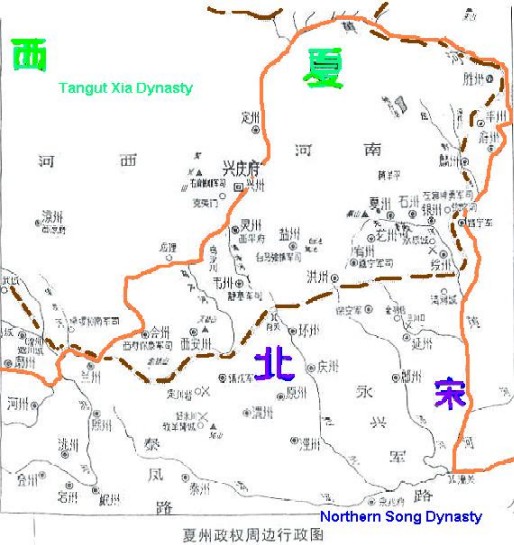
Li Jiqian attacked Soong's Qingyuan Jun Garrison [military district]. Soong defender Duan Yi surrendered to the Tanguts. Li Jiqian then attacked Dingzhou and Huaiyuan; Soong official Cao Can assembled the barbarians and defeated Li Jiqian. In A.D. 1002, Li Jiqian attacked Lingzhou. Soong zhi zhou shi Fei Ji defended the city for over one month, cut his finger and wrote a letter for requesting relief with the Soong court, and later died in the street fighting. Wang Chao made an excuse for not going to Lingzhou on time. Li Jiqian renamed Lingzhou to Xiping-fu and made it the capital of Xixia (the Western Xia Dynasty).
One year later, Soong zhi zhenrong jun Li Jihe wrote to the Soong court that a chieftain (Tibetan?) from Liugu (six valleys), by the name of Balaji (Panluozhi), intended to attack the Tanguts on behalf of Soong. Zhang Qixian proposed that Soong conferred the title of King of Liugu and the post of zhao tao shi onto Balaji. Soong decided to offer Balaji the title of Shuofang jie-du-shi. Balaji claimed that he had assembled a 60,000 strong army.
Balaji (Panluozhi), back in 1003, declined the Tanguts' offer of alliance.
Li Jiqian attacked Linzhou but was defeated by Soong zhi zhou Wei Jubao. Li Jiqian re-routed towards Xiliang (today's Gansu Province) and killed a Soong official called Ding Weiqing.
The Tanguts, after sacking Liangzhou, returned to Xipingfu in November.
Hearing that Balaji (Panluozhi) had accepted the Soong post of Shuofang jie-du-shi, Li Jiqian returned west to attack the Tibetans.
Balaji, previously a vassal under the jurisdiction of the Xiliang [western Liang] territory, pretended to surrender to the Tanguts.
Li Jiqian hence cancelled the campaign against the Tibetans.
When Balaji led his Liugu Tibetan army to Xiliang for Li Jiqian to inspect on, Balaji suddenly launched an attack at the Tanguts.
The Tibetans then launched a sudden attack at the Tanguts near Xiping.Balaji shot an arrow at the eye of Li Jiqian. After Li Jiqian fled back to Lingzhou, he died of the wound in January of A.D. 1004.
Li Jiqian's son, Li Deming, was enthroned next. The Tanguts notified the Khitans of the succession. The Khitans conferred the title of King Xiping-wang onto Li Deming. Soong Emperor Zhenzong sent a messenger to Li Deming for sake of pacifying him, and Li Deming dispatched general Wang Shen to Soong for seeking suzerainty. Soong "zhi zhenrong jun [garrison]" Cao Wei proposed that Soong exterminated Xixia by taking advantage of Li Jiqian's death. Soong Emperor Zhenzong stated that Soong could not attack Tanguts while the Tanguts were in a mourning period. Soong conferred the post of "dingnan jun [garrison] jie-du-shi" onto Li Deming and then added the title King Xiping-wang by copying the Khitan approach.
Balaji was killed by some alien tribe, and the Liugu tribes selected Balaji's brother, Sibangduo (Siduodu), as the new chieftain. The Soong court continued the conferral of Shuofang jie-du-shi onto Sibangduo. Sibangduo failed to rein in his people, and Sibangduo's people defected to the Tibetans. A Tibetan chieftain proposed to the Soong court that they launch an allied attack at Li Deming. Soong Emperor Zhenzong declined it. The Tibetans, however, invaded Soong's Qinzhou territories. Soong official at Qinzhou, Cao Wei, defeated the Tibetans. Soong conferred the title of ningyuan da jiangjun and tuan lian shi of Aizhou onto the Tibetan chieftain.
Soong Emperor Renzong (Zhao Zhen, reign A.D. 1023-1063)
The Khitans sent emissary to congratulate Soong Emperor Renzong's enthronement. The second year, the Khitans propagated the news that they would go for hunting at Youzhou. A Soong minister by the name of Zhang Zhibai advised against amassing the troops for guarding a possible Khitan invasion, and the Khitans failed to find any excuse to invade Soong. The Khitans quelled a rebellion in the Liaodong areas.
In A.D. 1031, Khitan Emperor Shengzong (Yelü Longxu) passed away, and son Yelü Zongzhen was enthroned as Emperor Xingzong (r. A.D. 1031-1055). Yelü Longxu gave two wills to Yelü Zongzhen, i.e., i) treat the Khitan empress as his own mother; ii) befriend Soong as long as Soong keep peace. Yelü Zongzhen sent an emissary to Soong to notify of his father's death, and Soong sent zhong cheng (central prime minister) Kong Daofu to express condolences. In A.D. 1032, Yelü Zongzhen's birth mother took advantage of Yelü Zongzhen's hunting and ordered that Yelü Longxu's dowager empress to commit suicide. Yelü Zongzhen's birth mother later tried to instigate an usurpation to have a junior son replace Yelü Zongzhen. The junior son (Yelü Chongyuan) notified his brother emperor. Yelü Zongzhen relocated his mother out of the capital and officially took over the regency.
Soong Emperor Renzong preferred two concubines over his empress. Empress Guohou accidentally injured Renzong with two finger scratches in the neck while arguing with Concubine Shang. Renzong, against the objection of several ministers, deposed the empress. Among the admonition ministers, Fan Zhongyan and Kong Daofu were exiled to the prefectures as magistrates, and Sun Zude was deprived half a year worth of salary. The ministers argued that the emperor was like a father and the empress was like a mother and that ministers should help to reconcile the differences of father and mother instead of encouraging a divorce.
When Soong Emperor Renzong's health deteriorated as a result of indulging in sex with two concubines, Dowager Empress Yang Taihou forcefully ordered that the two concubines be driven out of the palace. Yang Taihou selected the daughter of late qu mi shi Cao Bin as Empress Caohou. Because Renzong was weak physically and failed to bear offspring, Yang Taihou selected late Emperor Taizong's 4-year-old grandson as the adopted son, and this person would be the later Emperor Yingzong. When Renzong became reminiscent of deposed Empress Guohou, Yan Wenying, a minister who pushed for deposing of Guohou, poisoned Guohou. At this time, Fan Zhongyan (989-1052) was recalled to the Kaifeng-fu, i.e., capital city office. Fan Zhongyan impeached Yan Wenying; Yan was ordered to be exiled to the Xiangzhou prefecture; and Yan died en route.
Continuing Conflicts with the Tanguts
Tangut ruler Li Deming, a.k.a. Zhao Deming, had a son by the name of Li Yuanhao. Li Yuanhao, who was good at both the Tibetan and Chinese languages, often proposed to Li Deming that the Tanguts defeat the Huihe (Uygur) and Tibetans first. Li Yuanhao led a surprise attack at Ganzhou and took over the city from Huihe. Li Deming made Li Yuanhao a crown prince. Li Yuanhao often instigated his father in rebelling against Soong. After the death of Li Deming, Li Yuanhao got enthroned. Soong dispatched gongbu langzhong Yang Ji to the Tanguts and continued the previous conferral onto Li Yuanhao. The Khitans conferred Li Yuanhao the title of King of Xia.
In A.D. 1034, Li Yuanhao attacked the Huan'qing territories, i.e., Rouyuanzhai of Qingzhou. Soong General Wei Tong attacked the hind of the Tanguts. The Tanguts then invaded the Soong territories again. Li Yuanhao captured Qi Zongju who led the relief soldiers from Huanqing and defeated Wang Wen who led the relief soldiers from Ningzhou. Then, Li Yuanhao released Qi Zongju for sake of striking peace with Soong. After that, Li Yuanhao dispatched an army of 25,000 against the Tibetans. The Tanguts were defeated and Tangut general Sunuer was taken prisoner. Li Yuanhao personally led a retaliatory expedition against the Tibetans, attacked the Maoniucheng city, Zongge and Daixingling; while attacking Linhuang and crossing the river half way, the Tibetan cavalry charged out, and Li Yuanhao was completely defeated by the Tibetans. Soong conferred the Tibetan chieftain the title of "bao shun jun [garrison] liu-hou".
Li Yuanhao then changed target and attacked the Huihe (Uygur) people. Li Yuanhao took over the Huihe territories of Guazhou, Shazhou and Suzhou (Wuwei, Zhangye, Jiuquan and Dunhuang of Gansu).
In A.D. 1036, Li Yuanhao took over the Huihe territories of Guazhou (Gansu-xian and Anxi-xian of Gansu), Shazhou (Tunhuang-xian of Gansu) and Suzhou (Jiuquan of Gansu Province), and hence the Tanguts controlled the He-xi Corridor for 191 years.
(Along the Western Corridor, the Tubo (Tibetan) state which was dissolved in A.D. 842 after its king ('zan pu') Lang-da-ma was killed by the monks over the Buddhism suppression movement. Along the Western Corridor, Zhang Yichao, A.D. 799-872, a civilian-turned Tang Dynasty general who was famous for re-asserting the Tang China's rule over the western territories, i.e., Today's Turkestan, in the aftermath of the Tang China's turmoil, had defeated the Tibetans in the Guazhou and Shazhou territories in A.D. 848, recovered the Xizhou (Turpan) territory in A.D. 850, recovered the Guazhou and Shazhou territories from the Tibetans in A.D. 851, and recovered the Liangzhou territory from the Tibetans in A.D. 861.
The Tang Chinese army called themselves by the Guiyi-jun [returning the loyalty] Army.
The Tang Chinese rule continued among Zhang Chaoyi's generals and their descendants till A.D. 1028, when Tangut Emperor Li Yuanhao led a surprise attack at Ganzhou [Zhangye of Gansu Province], took over the city from Huigu (i.e., Huihe), took over Shuzhou, and pacified General Cao Jushun, i.e., the Tang China's Guiyi-jun [returning the loyalty] Army commander at Guazhou.)
At this moment, two Chinese intellectuals from the Huazhou area went to Lingzhou to see Li Yuanhao. Li Yuanhao (Zhao Yuanhao) adopted the advice of the two guys in building a Xi-xia kingdom, renamed Lingzhou to Xingzhou (where 'xing' means prospering) and Xiping-fu into Xingqing-fu, declared a dynastic title of "Da Xia" (Grand Xia), established 16 departments and ministries, instituted a system of 12 army supervisors (i.e., "jian jun si"), recruited an army of 500,000, and devised the Tangut characters.
In A.D. 1038, Li Yuanhao sent a messenger to Soong to notify his imperial entitlement. In his letter, Li Yuanhao claimed a Tuoba heritage from the Tuoba Wei dynasty.
Tangut Emperor Xia-jing-zong launched numerous wars against the Soong territory in the attempt at breaking the northeast-to-southwest Mt. Hengshan blockade line. In A.D. 1040, Tangut Emperor Jingzong launched the Battle of Sanchuankou to lay a siege of Yanzhou. At Sanchuankou, the Tangut army defeated the Soong relief army led by Liu Ping and Shi Yuansun. Soong dispatched Xia Song, Haan Qi and Fan Zhongyan to the northwestern territory. After the Sanchuankou defeat, the Soong emperor adopted a defensive strategy, and ordered Haan Qi to be in charge of the Jingyuan-lu Route and Fan Zhongyan in charge of the Fuyan-lu (Fushi-Yenan) Route. In 1041, the Tanguts attacked the Weichuan and Huaiyuan area. Xia Song sent Ren Fu to the relief of Huaiyuan. The Soong relief army, plus the Jingyuan-lu garrison troops, departed Yanglongcheng (Guyuan, Ningxia) for the Tangut territory. The Tanguts, who were defeated at Zhangyibu, pulled back to induce the Soong army into a chase, and ambushed the Soong army at Haoshuichuan (Longde, Ningxia). For the loss of over 10,000 Soong army troops at Haoshuikou, the Soong emperor could not bear to eat. Teng Zijing, a friend of Fan Zhongyan at Jingzhou, made a sacrifice to the dead, over which he was censured for wasting the government funds and banished to the Baling-jun prefecture.
After the Haochuankou debacle, the Soong army shrank the defense to the Fuyan-lu (Fushi-Yenan) Route, the Huanqing-lu Route, the Jingyuan-lu Route and the Qingfeng-lu Route. In A.D. 1042, the Tangut emperor adopted the advice of Zhang Yuan to circumvent the defense lines to attack the Soong Jingzhao-fu prefecture, namely, attacking east against Weizhou from Pengyangcheng (Guyuan, Ningxia). The Tangut army tried to breach the Jingyuan-lu defense line. Wang Yan, 'jinglüe shi' for the Jingyuan-lu Route (i.e., circuit), sent deputy Ge Huaimin against the Tanguts. Ge Huaimin and about ten thousand troops were destroyed by the Tanguts at the Dingchuanzhai Campaign. The Tanguts intruded to Weizhou (Zhenyuan, Gansu) but had to withdraw after learning that the other Tangut prong was defeated at Yuanzhou (Zhenyuan, Gansu) by Soong 'zhi zhou' (prefect magistrate) Jing Tai. In A.D. 1044, i.e., Soong Emperor Renzong's 4th year of the Qingli Era, the Tanguts and the Soong Chinese reached the Qingli Peace Accord.
The Tanguts, back in A.D. 1043, were attacked by the Khitans over a dispute related to the Tanguts' defecting to the Western Xia territory from the southwestern Khitan territory. In A.D. 1044, Khitan Emperor Xingzong attacked the Tanguts again. The Khitan-Tangut wars continued till A.D. 1049.
Fan Zhongyan, in A.D. 1044, while on assignment as 'xuanfu shi' for the 'Hedong-lu' (east of the Yellow River) circuit in today's Shenxi against the Tanguts, hired Yang Wen'guang as a general under his command.
Yang Wen'guang served as 'fangyu-shi [defense]' for Xingzhou (Lüeyang, Shenxi) and deputy 'du-zong-guan' for the Qin-feng (Tianshui, Gansu; Fengxian, Shenxi) prefectures.
Yang Wen'guang was a son of Yang Yanzhao, while Yang Yanzhao was a son of Yang Ye.
Because of Li Yuanhao's arrogance in the letter, Soong Emperor Renzong, against the advice of admonition official Wu Yue, decreed that Li Yuanhao's previous conferral be rescinded and that the Soong Chinese be forbidden from trading with the Tanguts. The Soong court further gave out a reward for the head of Li Yuanhao, i.e., rewarding as governor-general of ding nan jie-du-shi. The Soong court conferred the post of anhu shi onto Xia Song for the territories of Jing-Yuan-Qin-Feng, and the post of anhu shi onto Fan Yong for the territories of Fu-Yan-Huan-Qing.
Li Yuanhao invaded Soong and attacked Soong's bao-an jun Garrison [military district]. At Anyuan-zhai, Li Yuanhao encountered a defeat in the hands of several Soong Chinese armies led by Di Qing. Di Qing, who was originally from west of the Yellow River Bend, with the title of xunjian zhi-hui-shi (commander), was recorded to have long dangling hair. During the fighting, Di Qing often wore a bronze mask and impressed the enemy with a golden face. Li Yuanhao, with tens of thousands of army, retreated in face of Di Qing's ferociousness. Li Yuanhao then re-routed towards the Yanzhou area.
The Khitans sent several messages to the Soong court in
regards to their campaign against the Tanguts. The Khitans attacked the Tanguts in the first year of the Huangyou Era, i.e., A.D. 1049, and reported that they had succeeded in subjugating the Tanguts in A.D. 1054, i.e., the first year of the Zhihe Era.
After Soong Emperor Renzong passed away, the Khitan emperor took the Soong emissary's hands into his hands, and shed tears, saying that the Khitans and the Soong Chinese had no war for 42 years.
In A.D. 1048, the Tangut emperor was killed by his crown prince Ning-ling-ge. Previously, Emperor Xia-jing-zong revoked the titles of his empress Ye-li-shi, and the crown prince. The revocation of dowager-empress Ye-li-shi's title led to the resentment from the empress's two brothers, i.e., Ye-li Wang-rong and Ye-li Yu-qi --who were both killed by the Tangut emperor in A.D. 1043 as a result of Soong General Zhong Shiheng's sowing dissension. Ye-li Yu-qi was a Tangut general stationed at Mt. Tiandu-shan (the heavenly capital), i.e., Mt. Hengshan, that separated the Tangut territory from Soong. Further, the Tangut emperor took over the crown prince's wife as Empress Mo-yi-shi back in A.D. 1047. At the instigation of minister Mo-zang E-pang whose sister Mo-zang-shi was Xia-jing-zong's another empress, the crown prince and a Ye-li clansman intruded into the palace to assassinate the emperor. After the death of Tangut Emperor Xia-jing-zong, the in-law family took over the power. Mo-zang E-pang killed the crown prince and his mother, dowager-empress Ye-li-shi. Mo-zang E-pang made his sister's one-year-old son, Li Liangzuo, into an emperor, i.e., Tangut Emperor Yizong.
In A.D. 1067, Haan Qi tacked on the post as 'jinglüe [managing] anhu shi' for the western Shenxi circuit, i.e., 'Shanxi-Xi-lu'.
General Yang Wen'guang, under Haan Qi's order, defeated the Tanguts in a battle near today's Gan'gu (Tianshui), a place known as the gourd valley in the novel "The Yang Family's Female Generals', in A.D. 1068.
In A.D. 1120, the Jurchens and the Soong Chinese reached a Hai-shang (above the Bo-hai Sea) Alliance agreement to pincer-attack the Khitans.
However, uprising erupted in southern China.
The Soong army, which was experienced in fighting the Tanguts, was called over to southern China instead of the scheduled attack at Khitan Liao.
In A.D. 1120, Soong general Zhang Jun led the frontier army across the Yangtze.
Among the officers participating in war against rebel Fang La would be a northwestern China native called Wu Jie from Deshun-jun (Jingning, Gansu).
The Soong army subsequently quelled another uprising in North China.
Khitan Emperor Tianzuo-di in early A.D. 1222 fled Zhong-jing (Chifeng) for the Jia-shan mountain of Mongolia under the attacks of the Jurchens. At today's Peking, Yelü Dashi (Prester John) supported a Khitan king by the name of Yelü Chun as a new emperor, i.e., Liao Emperor Xuanzong (r. A.D. 1122) or Emperor Tianxi-di.
At the time the Jurchens attacked Khitan Liao, Khitan general Guo Yaoshi surrendered to Soong with the Zhuozhou and Yizhou prefectures. With 6000 Soong army troops, Guo Yaoshi attacked Yan-jing (Peking) but was repelled by the Khitan army led by Yelü Dashi and Khitan Empress Xiao-fei who was wife of late Khitan Liao Emperor Xuanzong. It would be the combined efforts of the Jurchens and Soong Chinese that the Khitans were defeated.
The Jurchens, before handing over Yan-jing, extracted more money from the Soong Chinese.
When the Soong Chinese took over some land west of 'shan-xi' (i.e., land to the west of the Huashan Mountain) that was seceded to the Tanguts, Tangut Emperor (Li Qianshun) wrote to the Jurchens asking for intervention. The Jurchens, as appreciation of the alliance with the Soong Chinese against the Khitans, had earlier ceded nine prefectures of 'shan-xi' ex-Khitan territories to Soong, including today's Shenxi Prov and the 'he-nan' land (south of the Yellow River). The Jurchens, who had an earlier agreement to allow Soong to retake today's Peking, would help Soong in the siege of Peking when the Soong army failed to take over Peking from the remnant Khitans. Hence, the Jurchens, in exchange for surrendering Peking to Soong per the alliance agreement, received the tax revenues of Peking as compensation. (Later, the Jurchens retook the territories of 'he-nan' / 'shan-xi' and Peking after defeating the Soong Chinese and capturing two Soong emperors, Soong Huizong & Soong Qinzong.)
In A.D. 1125, the Jurchens instigated the Tanguts to attack Shuozhou and Wuzhou at the Northeastern Yellow River Bend.
The Jurchens accused eunuch Tan Zhen of failure to send money and grains to the Jurchens.
Soong Emperor Huizong dismissed Tan Zhen in preference for Tong Guan who sent a messenger to request with the Jurchens for handing over the remaining prefectures according to the A.D. 1120 alliance agreement.
In the autumn of A.D. 1125, the Jurchens, on the pretext that Zhang Jue2, a former Khitan Liao general who surrendered to Jurchen General Wanyan Zonghan in A.D. 1223 and received the Jurchen appointment as 'Nan-jing (southern capital) liu-shou' for Pingzhou (Linyu/Lulong, Hebei) and 'Linhai-jun jiedu-shi', defected to Soong in June of A.D. 1223 as a result of Soong's instigation, mounted an attack at Soong.
The Jurchens split into two flanks for attacking Soong, with Wanyan Zongwang attacking Yan-jing and Wanyan Zonghan attacking Taiyuan.
Soong Emperor Huizong abdicated to son Zhao Heng, i.e., Emperor Qinzong, after listening to the 'self-blame decree' advice from Yuwen Xuzhong.
The Jurchen eastern prong led by Wanyan Zongwang attacked Southern Soong capital city Bian-jing after sacking Ruizhou on the north riverbank and Huazhou on the south riverbank.
In January of A.D. 1126, upon hearing that the Jurchens had crossed the Yellow River, Emperor Huizong fled south.
At the petition of academy student Chen Dong, et al., who lodged treason accusation against six ministers including Cai Jing, Wang Fu3, Tong Guan, Liang Shicheng, Li Yan and Zhu Mian, Emperor Qinzong issued a decree to banish or execute the culprits and ordered to fetch Huizong from Sizhou.
Soong prime ministers Bai Shizhong and Li Bangyan, who wanted the emperor to abandon the city, offloaded the duty to Li Gang for the city defense.
Soong 'Tai-chang shao-qing' Li Gang, as 'shou-yu shi', strengthened the emperor's resolve and beat back the siege.
Li Gang arranged to have 12,000 troops defend each of four sides of the city walls in addition to organization of five armies of 8000 each as backup.
The Jurchens, unable to sack the city, demanded ransom of 5 million ounces of gold, 50 million ounces of silver, 10,000 ox and horses, ceding the three garrison cities of Zhongshan, Hejian and Taiyuan, and sending in a royal king and a prime minister as hostage.
The Jurchens sent Xiao Zhonggong to Soong for a visit. Emperor Qinzong passed on a wax-ball letter to Yelü Yudu for instigating the Khitan against the Jurchens.
Xiao Zhonggong sent the letter to Wanyan Zongwang instead. Hence the Jurchens decided to invade Soong again in August under this pretext.
The Jurchens renewed the two-prong attack in August of A.D. 1126.''
The western prong, departing Datong, defeated Soong General Zhang Hao at Wenshui, subsequently defeated Zhong Shizhong and Yao Gu's relief army, and sacked the city of Taiyuan which persisted for over 250 days.
The eastern prong laid the siege of Bian-jin in leap month November.
At the turn of A.D. 1126-1127, the Jurchens breached the city of Bian-jing.
Coming to the aid of the Soong capital city would be 'Nan-dao (southern route) zongguan' Zhang Shuye, his sons Zhang Bofen and Zhang Zhongxiong, and 30,000 troops.
With the Jurchen army doubling the number deployed during the first siege while the Soong relief army failing to come to aid, the capital city defense was doomed.
Soong Emperor Qinzong was forced to travel to the Jurchen camp to talk peace in person.
The Jurchens sent minister Xiao Qing to the Soong court as a supervisor. Under the pressure to surrender gold and silver, the Soong army ransacked the whole city of Kaifeng for the precious metals.
Li Tianmin's Nan-zheng lu-hui (assembled records of southern campaign) claimed that the Jurchens allowed the Soong court to make up the deficient amount of 1 million bars of gold and 5 million silver with the surrender within ten days of
concubines at 1000 bars per person,
royal 'zong' (clan) kings and dukes' concubines at 500 bars per person, related 'zu' {familial clans)' concubines at 200 bars per person,
royal 'zong' (clan) women and girls at 500 bars per person, related 'zu' {familial clans)' women at 200 bars per person, and
wealthy royal family women and girls at 100 bars person.
Out of 5000 women and girls, 3000 virgins were selected, with the Jurchen prime minister Wanyan Zonghan enjoying the first right of selection.
The Jurchens, conducting dissolute and lewd wine parties, cruelly killed those women and girls who disobeyed or showed non-cooperation.
When Emperor Qinzong was asked to go to the Jurchen camp again in January of A.D. 1127, he was detained on the pretext that King Kangwang was at large and should come back to be under the Jurchen control.
In March, the Jurchens erected Zhang Bangchang as puppet Da-chu Dynasty emperor.
At the turn of March-April, the Jurchens returned to Manchuria and placed the Soong prisoners at Wuguocheng (five states' fort, Yilan, Heilongjiang).
According to Jingkang bai-shi jian-zheng (jotted-down notes of unofficial history of the Jingkang cataclysm), the Jurchens demanded the surrender of palace jade, chariot and decorations, 600 virgin girls, hundreds of musicians and artisans, plus young women from the court and former prominent ministers, raped women, abducted women, and robbed, ravaged and burnt the city, with Wanyan Zongwang abducting over seventy women and girls one account.
Kaifeng-fu Zhuang (status of Kaifeng) of Que An's Tong Fen Lu (book of shared agony) claimed that the Jurchens altogether abducted 11,635 women and girls, alone, on basis of tender for gold and silver's deficiency.
The Jurchens, in A.D. 1127, abducted the Soong emperors, palace people, ministers and 100,000 civilians for the north.
As to the destruction to China's books and classics, Ming Dynasty scholar Hu Yinglin enumerated ten incidents including the post-South-North-dynasties incidents.
Wu Weiye, a person from the Ming-Qing dynasties' transitionary time period, mentioned the destruction of China's classics and culture during the Jiashen (A.D. 1644) Cataclysm, stating that China's classics in the imperial Zhishen-ku vault, which were the Northern Soong dynasty's rebuilt collection after what Sui Dynasty minister Niu Hong called by the five incidents of book burning and/or destruction, were all lost.
Wu Weiye did not specify whether it was Li Zicheng's rebels or the Manchus who were responsible for the dissipation of the millions of volumes of books --which still carried the seals and inks of the Jurchens when they sacked the northern Soong capital city of Bianliang (Kaifeng, Henan) in A.D. 1127, and marked the imperial books for shipping to today's Peking, to be repossessed by the Mongols who never bothered to open the seals to check on the books after the Mongols defeated the Jurchens, and to be re-possessed by the Ming Chinese after Ming Dynasty General Xu Da (Xu Zhongshan) expelled the Mongols from Dadu (Peking, Hebei).
The Scourges-of-God Tetralogy
would be divided into four volumes covering
Hsiung-nu (Huns), Hsien-pi (Xianbei), Tavghach
(Tuoba), Juan-juan (Ruruans), Avars, Tu-chueh (Turks), Uygurs (Huihe), Khitans, Kirghiz, Tibetans, Tanguts, Jurchens, Mongols and Manchus and
southern barbarians.
Book I of the tetralogy would extract the contents on the Huns from
The Sinitic Civilization-Book II,
which rectified the Han dynasty founder-emperor's war with the Huns on mount Baideng-shan to A.D. 201 in observance of the Qin-Han dynasties' Zhuanxu-li calendar.
Book II of the Tetralogy would cover the Turks and Uygurs.
And
Book IV would be about the Manchu conquest of China.
From the Khitans to the Jurchens & Mongols: A History of Barbarians in Triangle Wars and Quartet Conflicts
, i.e., Book III of
the Scourge-of-God-Tetralogy,
focused on the Khitans, Jurchens and Mongols, as well as provided the annalistic history on the Sui and Tang dynasties, the
Five Dynasties & Ten Kingdoms, and the two Soong dynasties.
Similar to this webmaster' trailblazing work in rectifying the Han dynasty founder-emperor's war with the Huns to 201 B.C. in The Sinitic Civilization - Book II,
this Book III of the Scourge-of-God-Tetralogy
collated
the missing one-year history of the Mongols' Central Asia campaigns and restituted the
unheard-of Mongol campaign in North Africa.
|
The Scourges of God: A Debunked History of the Barbarians" - available at iUniverse|Google|Amazon|B&N
From the Khitans to the Jurchens & Mongols: A History of Barbarians in Triangle Wars and Quartet Conflicts
(The Barbarians' Tetralogy - Book III)
Epigraph,
Preface,
Introduction,
Table of Contents,
Afterword,
Bibliography,
References,
Index
|
|
Table of Contents
(From the Khitans to the Jurchens & Mongols: A History of Barbarians in Triangle Wars and Quartet Conflicts)
Section Four: The Northern Soong Dynasty's Triangle & Quartet Wars
Chapter XIII: The Northern Soong Dynasty (A.D. 960-1127) ................................... 217
Soong Emperor Taizu (Zhao Kuangyin, r. A.D. 960-976) .......................................... 219
The Soong Dynasty vs. the Khitans & Tanguts ...........................................................226
Soong Emperor Taizong (Zhao Jiong/Guangyi/Kuangyi, r. A.D. 976-997)....................228
Soong Emperor Taizong's Wars with the Khitans.........................................................230
Soong Emperor Zhenzong (Zhao Heng, r. A.D. 998-1022) & the Chanyuan Peace
Accord with the Khitans ......233
Soong Emperor Renzong (Zhao Zhen, r. A.D. 1023-1063) ........................................ 236
Northern Soong's Continuing Conflicts with the Tanguts ..............................................239
Soong Emperor Yingzong (Zhao Shu, r. A.D. 1063-1067) ..........................................242
Soong Emperor Shenzong (Zhao Xu1, r. A.D. 1067-1085) ........................................242
Soong Emperor Zhezong (Zhao Xu4, r. A.D. 1085-1100) ..........................................244
Soong Emperor Huizong (Zhao Ji, r. A.D. 1100-1126) ..............................................246
Soong Emperor Qinzong (Zhao Heng, r. A.D. 1126-1127) ........................................248
Chapter XIV: The Khitan Liao Dynasty (A.D. 907-947 [Qidan], 947-983 [Liao],
983-1066 [Qidan], 1066-1125 [Liao], 1124-1218 [Western Liao]) ....253
The Chanyuan Peace Accord of A.D. 1004 ................................................................ 253
Chapter XV: The Tangut Xia Dynasty (A.D. 1038-1227) ............................................258
The Tanguts vs. the Soong Dynasty .............................................................................263
The Soong Debacle at the Battles of Sanchuankou (in A.D. 1040) , Haoshuichuan
(in A.D. 1041) and Dingchuanzhai (in A.D. 1042) ....271
The Triangle & Quartet Wars Among the Khitans, Jurchens, Tibetans,
Tanguts and Soong ...273
The Triangle & Quartet Wars Among the Tanguts, Jurchens, Mongols and Soong .........280
Chapter XIX: The Jurchen Jin's Triangle & Quartet Wars .............................................337
The Jurchens Launching a Third Battlefront against Southern Soong ..............................345
Southern Soong's Taking the Shan-dong & He-bei Territory from the Mongols &
Jurchens ........347
Southern Soong's Northern Campaign against the Mongols & Jurchens ........................357
The Mongols' Attacking the Jurchen & Soong's Western Territories after
Elimination of the Tangut Xia Dynasty ....360
Chapter XXXII: Mengke Khan's Death in the Siege of the Hook-Line Fishing Castle ....524
Section Six: The Southern Soong Dynasty (A.D. 1127-1279)
Chapter XXXIII: The Southern Soong Dynasty vs. the Jurchens ....................................529
Soong Emperor Gaozong (Zhao Gou, r. A.D. 1127-1162) ............................................529
The Jurchens' Attacking Southern Soong to the South of the Yangtze
(A.D. 1129-1130) .....533
Wu Jie's Defeating the Jurchens at the Battle of Heshangyuan (A.D. 1231) & at the
Xianren-guan Pass (A.D. 1134) .....535
Yue Fei's Northern Campaigns against the Liu-Qi Dynasty Puppets & Jurchens
(May of A.D. 1134, July & November of 1136, June of 1140) ....537
The Tianjuan Peace Agreement (A.D. 1139) & the Shaoxing Peace Treaty
(A.D. 1141) ....539
Wei Sheng (A.D. 1120-1164) 's Wars with the Jurchens along the Eastern Coastline
(A.D. 1161-1164) .....543
Soong Emperor Xiaozong (Zhao Shen, r. A.D. 1162-1189) & the Longxing
Northern Expedition ..546
Soong Emperor Guangzong (Zhao Dun, r. A.D. 1189-1194) ...........................................549
Soong Emperor Ningzong (Zhao Kuo, r. A.D. 1194-1224) & the Kaixi Northern
Expedition ....549
Southern Soong's Triangle & Quartet Wars with the Tanguts, Jurchens and
the Mongols ....553
Soong Emperor Lizong (Zhao Yun, r. A.D. 1224-1264) ...................................................560
Chapter XXXIV: Southern Soong vs. the Mongols ...........................................................571
The Duanping Northern Expedition against the Mongols (A.D. 1234) ................................571
Ogedei Khan's Campaign against Southern Soong ............................................................572
Cao Youwen Defeating the Mongols at Qingyeyuan and Defending the
Yangpingguan-Jiguan'ai Passes (A.D. 1236) ... 577
The Mongols Ravaging the Sichuan Basin from A.D. 1236 to 1279 ...................................582
The Mongols' War against Southern Soong during Toregene, Guyuk &
Oghul-qaimish's Reigns ....585
The Mongols' Recurring Attacks against the Sichuan Mountain Forts &
the Han-shui River Bend Forts through the A.D. 1250s ....589
The Third Mongol Campaign against Hezhou (Caaju) & Diaoyucheng
(A.D. 1257-1259) ...596
Chapter XXXV: Khubilai's War Against Southern Soong .................................................603
Khubilai Khan's Sinicization & Southern Soong's Northern Expedition to Echo Li
Tan3's Rebellion ....608
Khubilai Khan Launching the Yuan Dynasty (A.D. 1271) ..................................................612
The Mongols' Continuous Campaigns in the Sichuan Basin for Two Decades ....................613
Soong Emperor Duzong (Zhao Qi, r. A.D. 1264-July 1274)..............................................616
The Mongol Siege of Xiangyang & Fancheng Twin Cities (A.D. 1267-1273) ....................617
The Mongols' Campaign against the Triangular Vertices of Ying3zhou, Jiangling
and Yueyang (A.D. 1274-1275) ....623
Soong Emperor Gongdi (Zhao Xian, r. A.D. 1275-1276) .................................................626
Soong Dowager-Empress Surrendered the Capital City Lin'an to the Mongols
(February of A.D. 1276) .....631
Continuous Resistance in the Sichuan Basin and Southwestern China .................................635
Soong Emperor Duanzong (Zhao Shi, r. A.D. 1276-1278) & Emperor Shaodi
(Zhao Bing, r. A.D. 1278-1279) ....640
Demise of the Southern Soong Dynasty (A.D. 1127-1279) ...............................................644
The Mongols' Weapon Prohibition Order against the Chinese ............................................648
Chapter XXXVI: The Death Toll from the Mongol Conquest .............................................650
|
|
Southern Soong Dynasty
The Jurchen-Soong War
General Yue Fei (Yue Pengju, A.D. 1101-1142) was a national hero during the times of the Jurchen invasion. Born in Xiangzhou (today's Tangyin, Henan), General Yue Fei was a filial son according to the Confucian standards. At the time of his birth, the Yellow River breaching destroyed his hometown. Yue Fei's mother put him in a clay cauldron and survived the flooding. When he grew up, his mother taught him the Confucian principles, such as 'being loyal to the overlord and showing requital by serving the country'. When the Jurchens invaded China, Yue Fei's mother encouraged him to get recruited in the royal army. Yue Fei's mother inscribed four characters on Yue Fei's back, i.e., 'jing zhong bao guo' (exerting full loyalty in serving the country).
In A.D. 1122, Yue Fei joined the Soong army, and after paying filiality to late father, rejoined the army in A.D. 1124.
Yue Fei returned to hometown in A.D. 1125 after the Soong army was defeated by the Jurchens.
In A.D. 1126, Yue Fei rejoined the army but was dismissed in A.D. 1127 over admonishment.
In A.D. 1127, Yue Fei joined the army headed by Zhang Suo, i.e., 'He-bei [north of the Yellow River] Xi-lu [western circuit] zhaohu shi [pacifying commissioner]'.
In September, Yue Fei followed Wang Yan's 7000 troops in crossing the Yellow River to fight the Jurchens.
In A.D. 1128, Yue Fei joined Zong Ze's army.
After Zong Ze, i.e., 'Kaifeng yin' (capital city magistrate), died,
Yue Fei served under Du Chong, i.e., 'Dong-jing [kaifeng] liushou' (garrison commander)'.
At Sishui-guan (Si-shui River pass), in August, Yue Fei defeated the Jurchens.
In June of A.D. 1129, Du Chong abandoned Kaifeng for south of the Yangtze.
Wanyan Zongbi, who was commonly known as Jin-wuzhu in romance novels, commanded a Jurchen army to invade Jiankang.
Du Chong and his three thousand troops surrendered to the Jurchens.
Yue Fei withdrew to the Zijinshan mountain to the northeast of Jiankang.
Yue Fei fought four battles to recover Changzhou.
However, Soong Emperor Gaozong fled along the Yangtze for the East China Sea.
The Jurchen navy chased behind in vain and then pillaged the Jiankang area.
In March of A.D. 1130, Soong Emperor Gaozong returned north to station at Yuezhou (Shaoxing, Zhejiang).
Zhang Jun, who was appointed the post of 'zhizhi shi' for the Zhe-xi-Lu (western Zhejiang) and Jiang-dong-Lu (east of the Yangtze) circuits, ordered Yue Fei to recover Jiankang.
In April, Yue Fei defeated the Jurchens at Qingshuiting (clear water pavilion).
In May, Yue Fei intruded to mount Niutoushan (ox head mountain), defeated Wanyan Zongbi to the northwest of Jiankang, and recovered Jiankang.
At the recommendation of Zhang Jun, Yue Fei was promoted to 'wugong [martial feats] dafu', 'fangyu shi' for Changzhou, and 'zhenhu shi' for Tongzhou and Taizhou.
When Wanyan Zongbi and Wanyan Chang attacked Chuzhou, Zhang Jun ordered Yue Fei and Liu Shiguang to the relief.
Before arriving at Chuzhou, the city fell.
Yue Fei returned south.
In June, the emperor realigned the front-of-palace-imperial-seat ('yu qian') army into the Shenwu-jun (divine) army, with Haan Shizhong commanding the left army, Zhang Jun the right army, Xin Yongzong the middle army, Wang Xie the frontal army, and Chen Sigong the hind army.
The imperial garrison ('yu ying si') army was organized into five auxiliary divine army.
Yue Fei tacked on the 'tong zhi' post for the rightside auxiliary divine army, and later in the year, took over the auxiliary army commander's post from Xin Qizong in the role of 'dutong zhi'.
In January of A.D. 1132, Yue Fei was sent to Tanzhou (Changsha, Hunan).
Yue Fei, who was subordinate to Jing-hu-Lu and Guang-nan-Lu 'xuanfu shi' Li Gang, pacified the armed bands in today's Hunan and Jiangxi area, and spared a Samson-like person called by Yang Zaixing.
With the troops expanding to 23000 plus, Yue Fei's army reached the levels comparable to Haan Shizhong, Liu Guangshi and Zhang Jun's armies.
In A.D. 1133, the emperor, other than appointing Yue Fei the post of 'zhizhi shi' for the Jiang-nan Xi-lu (western south-of-the Yangtze) circuit, granted Yue Fei the extra responsibility for taking charge of prefectures in the Huai-nan Xi-lu (western south-of-the-Huai-River) circuit.
Yue Fei's auxiliary army was upgraded to the hind divine army, with the rank downgraded to 'tong zhi' from 'dutong zhi'.
In the Xiangyang-fu area, puppet Liu-Qi dynasty generals defected to Soong in batches, including Niu Gao and Dong Xian, et al.
The Soong army recovered Ruzhou, Yingchang-fu and Xinyang-jun, as well as the Jurchen 'Xi-jing He-nan-Fu' (south-of-the-Yellow River of the western capital). In March of A.D. 1133, the Jurchen relief army, with the 'Guaizi [limp feet] Ma [horse]' armoured cavalry forces (that were usually aligned on the two flanks of the battle formation to surround and protect the three-horses-chained 'Tie [iron] fotu [Buddha]' heavy armoured cavalry phalanx), defeated the Soong army at Moushigang, northwest of Kaifeng.
By October, the Jurchens pressed the Soong army back to the Yangtze bank.
The puppets of the Liu-Qi dynasty schemed with Yang Yao and Huang Cheng's bandits south of the Yangtze to pincer-attack Soong.
From May to July, A.D. 1134, Yue Fei conducted the first northern campaign, defeated the puppet Liu-Qi dynasty army of the Jurchens in the Xiangyang-fu area, and recovered Tangzhou and Xinyang-jun.
In May, Yue Fei took over Ying3zhou (Zhongxiang, Hubei).
Then, Yue Fei attacked puppet Li Cheng at Xiangyang-fu, while Zhang Xian and Xu Qing attacked Suizhou.
In June, Yue Fei defeated the puppet reinforcements by ordering Wang Gui to attack the enemies' cavalry aligned along the river while sending Niu Gao's cavalry to attack the enemies' infantry troops on the flat land.
The Jurchens, who suffered a defeat in the hands of Wu Jie at the Battle of the Xianren-guan Pass and the Battle of Jinping in the Sichuan basin, failed to render aid to the puppet Liu-Qi emperor.
In July, Yue Yun, i.e., Yue Fei's son, first intruded into Dengzhou.
The Soong army took over Tangzhou and Xinyang-jun, consecutively.
Yue Fei assigned his subordinates to garrisoning various cities of six Xiang-Han prefectures, that were formerly subject to the Jing-xi Nan-lu and Jing-xi Bei-lu circuits, namely, the southern and northern west-of-Kaifeng circuits.
At the advice of prime minister Zhao Ding, Emperor Gaozong confirmed Yue Fei's post as 'zhizhi shi', with headquarters set at Ezhou for taking charge of the Xiangyang-fu-Lu circuit, i.e., formerly the Jing-xi Nan-lu and Jing-xi Bei-lu circuits.
Yue Fei ordered the military farming in the Jing-xiang area.
In late A.D. 1134, the Jurchens under Wanyan Zongfu, Wanyan Chang and Wanyan Zongbi, and the puppet Liu-Qi army under Liu Lin (who was son of puppet Qi emperor Liu Yu) launched a campaign against Southern Soong.
The Jurchens crossed the Huai-he River, pressing Soong General Liu Shiguang into retreat to south of the Yangtze.
Zhang Jun refused to cross the Yangtze to fight the Jurchens.
Only Chou Yu, i.e., 'zhi zhou' for Luzhou (Hefei, Anhui) and 'anhu shi' for the Huai-nan Xi-lu (western south-of-the-Huai-River) circuit defended the city with 2000 militia.
Yue Fei rendered relief to Luzhou.
The Jurchens withdrew after Jin Emperor Taizong became seriously ill.
In A.D. 1136, Southern Soong launched a second northern campaign after a meeting of four Soong generals, Zhang Jun, Haan Shizhong, Liu Guangshi, and Yue Fei.
Haan Shizhong was assigned the post of 'xuanfu chuzhi shi' for Jing-dong and Huai-dong-Lu circuits,
and Yue Fei the post of 'xuanfu fu shi' for Jing-hu-Bei-Lu and Jing-xi-Nan-Lu circuits.
Haan Shizhong, departing Chengzhou (Gaoyou, Jiangsu) and Chuzhou (Huai'an, Jiangsu), was to attack Huaiyang-jun (Pizhou, Shandong), while Yue Fei was to launch a campaign from Xiangyang-fu.
In February, Haan Shizhong failed to sack Huaiyang-jun.
In July-August, Yue Fei sent troops on the second Northern Expedition with Li Tong, former puppet magistrate of Luanchuan County as a guide. The vanguard leftside army led by Niu Gao captured Ruzhou (Lushan, Henan).
Niu Gao continued to attack Yingchang-fu and the vicinity of Caizhou. Yue Fei led the main force to attack towards the northwest. In early August, Wang Gui, Dong Xian, and Hao Zhu captured Lushi of Guozhou Prefecture and seized 150,000 'shi' of grains. The Yue-jia-jun army then captured Guolüe (Lingbao, Henan), Zhuyang (now Zhuyang Town, southwest of Lingbao) and Luanchuan. Wang Gui continued westward to conquer Shangzhou, including Shangluo, Luonan, Fengyang (Shanyang, Shaanxi) and Shangjin County (now northwest of Yunxi, Hubei).
During this campaign, to the east, Yue Fei's army, i.e., Yue-jia-Jun (Yue surnamed army), took over Yi1yang (Luoyang) and Luoyang before returning to Ezhou.
In August, Yue Fei's army took over Changshui, Yongning and Fuchang.
Yue Fei called on Wu Jie to send subordinate Shao Long to taking over the administration of Shangzhou and Guozhou, i.e., territories subject to the Shen-xi-Lu circuit.
The territories of Shangzhou, Guozhou, Dengzhou and Tangzhou were later yielded back to the Jurchens via the Shaoxing Peace Treaty of A.D. 1141, which led to peace between Southern Soong and Jurchen Jun for close to 100 years.
In September of A.D. 1136, the puppet Liu-Qi dynasty troops, under Liu Yu, counterattacked Soong and invaded Liu Guangshi's Huai-nan-Xi-lu circuit.
After a defeat, Liu Yu attacked Yue Fei's army, with skirmishes going on in the territories of Shangzhou, Guozhou, Dengzhou and Tangzhou.
In November, Wang Gui, with 10,000 troops, defeated puppet Liu Fu's 100,000 army near Tangzhou.
In Dengzhou, Zhang Xian defeated the puppet Liu-Qi army.
At Tangzhou, Niu Gao and Wang Gang defeated the puppet Liu-Qi army, and chased to Caizhou.
En route of pulling back from Caizhou, Yue Fei's army defeated puppet Li Cheng's army.
In November of A.D. 1137, Wanyan Chang and Wanyan Zongbi deposed puppet emperor Liu Yu and downgraded him to King Shu-wang, while proclaiming to retrieve Northern Soong prisoner-emperor Soong-qin-zong to Kaifeng as a Soong emperor.
Southern Soong Emperor Gaozong sent emissary Wang Lun to seeing Wanyan Chang with a request for returning the He-nan and Shenxi land.
In A.D. 1138, Wanyan Chang proposed to the Jurchen emperor as to ceding the land for peace.
The First Shaoxing Peace Accord was signed.
In A.D. 1139, the Jurchen dove faction, like Wanyan Chang, lost a power struggle.
Wanyan Chang, fleeing 'zhong-jing' (middle capital), was captured and killed.
In April of A.D. 1140, Wanyan Zongbi, i.e., Jin-wu-zhu, tearing apart the truce agreement, invaded Soong with four prongs.
Wanyan Zongbi personally led the main force to attacking Kaifeng, while 'yuanshuai you jian-jun' (right marshal's supervisor) Wanyan Salihe attacked today's Shaanxi, Jurchen Jin He-nan 'zhi fu' (prefect magistrate) Li Cheng attacked Xi-jing-He-nan-fu (Luoyang), and Nie-li-bei-jing attacked the Jing-dong-Lu circuit.
In Shenxi, i.e., part of formerly xuanfu-chuzhi-shi Zhang Jun's domain that included the Chuan-shen-Lu, Jing-xi-Lu and Hu-bei-Lu circuits, Wu Shijiang (i.e., 'anhu zhizhi shi' for Sichuan) resisted the Jurchens.
On the Jing-dong-Lu circuit's battleground, Haan Shizhong (i.e., 'xuanfu chuzhi shi') took over Haizhou (Lianyun'gang, Jiangsu) and faced off with the Jurchens at Huaiyang-jun.
In the middle battlegrounds, in May, Liu Qi's Ba-zi-jun (eight-characters inscribed on faces, i.e., the words of oath for serving the country like inscribed on Yue Fei's back) army, en route to Kaifeng, defeated the Jurchens at Shunchang-fu (Huyang, Anhui).
Liu Qi first defeated the Jurchen army led by Wanyan Xiu (King Ge-wang) and Wanyan Tuhesu (King Longhu-Da-wang), and then defeated Wanyang Zongbi's main force,
breaking the Jurchen 'Guaizi [limp feet] Ma [horse]' armoured cavalry forces (that were usually aligned on the two flanks of the battle formation to surround and protect the three-horses-chained 'Tie [iron] fotu [Buddha]' heavy armoured cavalry phalanx) and the three-horses-chained 'Tie [iron] fotu [Buddha]' heavy armoured cavalry phalanx.
The Jurchens, after suffering a defeat of 5,000 deaths and 10,000 wounded, fled back to Kaifeng, while assigning Haan Chang to Yingchang-fu and General Di-jiang-jun to Huaining-fu.
Beyond Caizhou, Sun Xian further defeated the Jurchens.
In June, Zhang Xian defeated Jurchen 'wan-fu-zhang' (10,000-men general) Haan Chang and took over Yingchangfu.
The Soong army further took over Huaining-fu.
Wang Gui's Soong army, after taking over Zhengzhou, attacked the Jurchens at Zhongmou.
In June, Zhang Xian and Yao Zheng took over Caizhou, while Niu Gao took over Lushan and threatened Ruzhou.
In July, Hao Zheng defeated Jurchen general Li Cheng and took over Xi-jing-He-nan-Fu (Luoyang).
In early July, Wanyan Zongbi, with reinforcements, launched an excursion campaign to attack Yue Fei's command center at Yancheng.
With intelligence that 15000 Jurchen cavalrymen were closing in, Yue Fei ordered son Yue Yun and 8000 Bei-wei-Jun (wine and jar-shouldering, i.e., bodyguards {kono'e in Japanese}) cavalry to exit Yancheng to fight against the Jurchens.
Yang Zaixing, i.e., a Titan-like general under Yue Yun, rode into the Jurchen camp in the attempt to catch Wanyan Zongbi.
Yue Fei personally went to battles at the front and ordered the infantry to use long handle knives to cut the horse legs of the Jurchen three-horses-chained 'Tie [iron] fotu [Buddha]' heavy armoured cavalry phalanx.
Yue Fei defeated the Jurchens at the Battle of Yancheng.
The Soong army pressed to Zhuxianzhen which was 45-li away from Bianliang (Kaifeng), by which time the Soong emperor called for halting the campaign in order to strike peace with the Jurchens.
Yue Fei advocated for continuing the war, pointing out that the demoralized Jurchen army had abandoned equipment and supplies in a rush to flee across the Yellow River.
Qin Hui, who already ordered Zhang Jun and Yang Yizhong's armies to return south, claimed that Yue Fei's lonely army should not stay behind by itself.
As recorded in Soong Shi (history of the Soong dynasty), Yue Fei lamented the loss of opportunity with an exclaim of "shi-nian [ten years] zhi [whereof] li [efforts], fei [destroyed] yu [on] yi-dan [one morning]".
In A.D. 1140, Yue Fei defeated the Jurchens at today's Yancheng, Henan Province, and reached Zhuxianzhen. Soong Emperor (Zhao Gou), fearing that Yue Fei might defeat the Jurchens and retrieve Emperors Huizong and Qinzong, issued 12 decrees to have Yue Fei recalled. After returning to Lin'an, Yue Fei was arrested together with his son (Yue Yun) and General Zhang Xian. Both royal family members and civilians petitioned with the Soong emperor for releasing Yue Fei, but Zhao Gou and Prime Minister Qin Hui instructed Moqi to collect various non-existing crimes for executing Yue Fei. Yue Fei died at the age of 39 in A.D. 1142. Yue Fei was restored fame only after Soong Emperor Xiaozong was enthroned. Yue Fei's body was secretly buried by a prison guard called Kui Shun.
In A.D. 1161, Wanyan Liang (King Hailing-wang, A.D. 1149-1161), who usurped Jurchen Jin Emperor Xizong (Wanyan Dan3, r. A.D. 1135-1149) in December of A.D. 1149 as a result of Xizong's cruelty, launched an invasion against Soong in the attempt at reuniting China. Wanyan Liang, who killed royal family members to grab the women to staff the forbidden palaces, wrote Jinn-Tang-Soong style poems and proses about taking three former Wu states' capital city and throwing down the horse whip into the Yangtze as oath of war, etc.
The Soong armies across the front were commanded by three marshals including Wu Gong, 'Zhenjiang-fu yu-qian zhu-jun dutong-zhi' and 'Huai-dong zhizhi shi' Cheng Min, and
'Jiankang-fu yu-qian zhu-jun dutong-zhi' and 'Huai-xi zhizhi shi' Li Xianzhong.
Liu Qi, who was in A.D. 1141 demoted over discord with Zhang Jun, was appointed the frontline post of 'Huai-nan, Jiang-nan & Zhe-xi zhizhi shi' in June of A.D. 1161.
At Anfeng-jun (Shouxian, Anhui), Wei Yongshou and 200 cavalrymen, who were sent by Li Xianzhong as relief, repelled a Jurchen army attack.
When more Jurchen troops came, Li Xianzhong personally commanded an army to Anfeng-jun.
In August, Liu Qi stationed at Yangzhou.
Liu Qi sent Wang Gang to stationing at Baoying and Wu Chao to stationing at Xuyi-jun.
At the Qinghe-kou estuary, Liu Qi destroyed the Jurchen Jin army's grain ships by sending in divers to sabotage the ships' hull.
While Wanyan Liang was attacking Soong's Lu2zhou city, Jurchen 'Dong-jing (Liaoyang-fu) liu-shou' Wanyan Yong, i.e., Duke Cao-guo-gong, killed deputy Gao Cunfu in October and declared himself an emperor, i.e., Jurchen Jin Emperor Shizong (Wanyan Wulu/Wanyan Yong, A.D. 1161-1189).
In November, the Jurchen Jin army attacked Guazhou.
Liu Si, i.e., Liu Qi's nephew, repelled the Jurchen attack with the 'ke-di gong' (defeat enemy) bows.
Ye Yiwen forced the Soong army to cross the Yangtze, to which Liu Si raised objection.
With Liu Si retreating, the Jurchen Jin army defeated Soong General Le Heng at Guazhou.
The Soong court sent Yang Yizhong (Yang Cunzhong) to Jingkou for the Yangtze defense.
At the Battle of Caishi (quarry, Ma'an'shan, Anhui), in November, Wanyan Liang was ambushed by the Southern Soong ships with about 18,000 men commanded by 'Jiang-Huai can-jun' Yu Yunwen in place of marshal Li Xianzhong.
At the Guazhou-du crossing, i.e., the confluence area of the Canal and the Yangtze, subordinate Wanyan Yuanyi assassinated Wanyan Liang with a flurry of arrow shots in late November. In early December, the eastern route Jurchen army fled north.
Yu Yunwen and Yang Yizhong (Yang Cunzhong) crossed the Yangtze.
Yang Yizhong ordered Li Xianzhong to cross the Yangtze River for the Huai-xi territory.
At Hengshan-jian (Hengshan creek) of Huai-xi, Li Xianzhong defeated the Jurchen She-diao-jun (shooting eagle) army.
In North China, rebels like Zhongyi-jun army generals Geng Jing and Wang Shilong in the Taihang-shan mountain area petitioned with the Southern Soong emperor for taking control of the mountain territory.
Serving under Geng Jing would be 'zhang shuji' (secretary) Xin Qiji who joined Geng Jing and Kai Zhao's A.D. 1261 rebellion in Shan-dong and was sent to southern Soong as part of the eleven-person mission.
Emperor Gaozong appointed Geng Jing the post of 'Tianping-jun jiedu-shi'.
However, Geng Jing was killed by a traitor subordinate by the name of Zhang An'guo.
In leap February of A.D. 1262, Xin Qiji, commanding 50 cavalrymen, rode into Geng Jing and Zhang An'guo's army camp of 50,000 troops, caught Zhang An'guo and took the traitor back to southern China.
For the later Jurchen-Soong peace, Xin Qiji was never offered important posts at the Soong court, other than provincial 'anfu-shi' jobs, over which Xin Qiji vented the sons and ministers' agony and sorrow in numerous poems and proses.
Before Haan Tuozhou launched the A.D. 1206 Kaixi northern expedition, Xin Qiji was at one time appointed the post of 'Zhenjiang zhi[-fu]', on which job he trained an army of 10000 troops and wrote the famous poem Jinkou Beiguting huai gu (recalling the ancient past at the Beigu-ting pavilion of Jingkou [Zhenjiang]), in which he eulogized Liu Yu (363-422)'s A.D. 409 & A.D. 417 northern expeditions and criticized successor Liu Yilong's aborted Yuanjia 8th Year (A.D. 431) northern expedition, which inferred to Zhang Jun's defeat at Fuli in A.D. 1163 and turned out to be the same case as Haan Tuozhou's.
Xin Qiji (1140-1207) was raised by grandfather Xin Zan, a Jurchen county magistrate at Qiao2xian but a patriot who indoctrinated his grandson with the feuds against the enemy who could not share the same heaven.
In December of A.D. 1164, after a time period of interruption which saw Zhang Jun forced to resign and Tang Situi's manipulation to get the Jurchen Jin army cross the Huai River to pose threat to Soong, Soong and Jurchen Jin signed the Longxing Peace Accord, with Soong ceding four re-occupied prefectures to Jin --which returned the status quo of the boundary stipulated by the Shaoxing Peace Accord. The relationship was changed to uncle and nephew, not emperor and minister; the tribute was changed to annual money; and silver and cloth were reduced by 50,000 ounces and 50,000 folds, respectively.
Peace lasted through half a century.
Soong Emperor Ningzong
During Soong Emperor Ningzong's reign, there was an abortive campaign against the Jurchens in A.D. 1206 under Soong prime minister Haan Tuozhou, termed by the Kaixi Northern Expedition.
In A.D. 1205, Soong Emperor Ningzong adopted Haan Tuozhou's advice, revoked Qin Kuai's posthumous titles, conferred Yue Fei the posthumous title of King E'wang, and issued the northern campaign decree.
Haan Tuozhou had an article proclaimed about the campaign, heeding the anger and sorrow of ancestors in the shoes as sons and ministers, a 'chen [ministers] zi [sons] hen [sorrow]' theme of avenging the humiliation of the A.D. 1127 Jingkang Cataclysm as expressed by Yue Fei's lyrical poem 'Man jiang hong' (A river of blossoms).
Haan Tuozhou was a grandson of Northern Soong prime minister Haan Qi.
The Soong army, with three routes, crossed the Huai-shui River to attack Suzhou (Suxian, Anhui), Shouzhou (Fengtai, Anhui), Tangzhou (Tanghe, Henan) and Caizhou (Runan, Henan).
The Soong army at one time took over Xixian and Sizhou. The middle prong general Huangfu Bin was defeated by the Jurchens at Tanghe and Runan.
In the Sichuan basin to the west, Soong general Wu Xi attacked Yanzhou but was repelled by Wanyan Wangshan, a Jurchen defender at Gongzhou.
In July of A.D. 1206, Wu Xi attacked Qinzhou, with the Jurchens defeating two Soong prongs, respectively.
Qing-yi-ke, a Qiang chieftain, defected to Jurchen General Wanyang Gang with dozens of Tibetan and Qiangic tribes.
Soong General Cheng Song attacked Heshangyuan (monk plateau), Xishanzhai (west hill fort) and Longmen (dragon gate).
The Jurchens defeated the Soong army and recovered the lost territories,
Wu Xi's Soong army invaded Chigu (red valley).
In October, Wanyang Gang, dispatching the Tibetan-Han infantry and cavalry against Soong via Lintan, counterattacked the Soong army with four routes exiting Chencang (consisting of the Guan-zhong army), Chenji (consisting of the Qi[shan]-Longshan army), Yanchuan (consisting of the Long-you cavalry), and Laiyuan.
Soong general Wu Xi, a descendant of Wu Jie and Wu Lin whose family secured and defended the Sichuan basin for three generations, surrendered to the Jurchens after the Jurchens sowed dissension between Wu Xi and Haan Tuozhou.
Wanyan Gang cited the precedent of Soong General Yue Fei's death, with elimination of three lineages, to warn Wu Xi.
The Jurchens delivered a gold seal to Wu Xi as King Shu-wang.
Wu Xi, sending Guo Cheng ('tuan-lian shi' [militia trainer] for Guozhou) and Ren Xin ('shi' for the Xianren-guan Pass) to the Jurchens, surrendered four Sichuan prefectures to the Jurchens after Cheng Song's army was defeated by the Jurchens.
To lend support to Wu Xi, the Jurchen emperor ordered Wanyan Kuang ('you fu yuanshuai') to attacking Xiangyang.
To the east, Soong general Deng Wenlong was dismissed by the emperor over defeats by the Jurchens.
The Jurchens counterattacked the Soong in crossing the Huai-he River, took over Zhenzhou (Yizheng, Jiangsu), and laid a siege of Yangzhou.
Only Bi Zaiyu managed to score some victories over the Jurchens.
In October of A.D. 1206, Jurchen General Hu Shahu sacked Huaiyin and laid siege of Chuzhou.
Meanwhile, the Jurchens sacked Xiangyang.
In the area southwest of the Qin-ling Ridge, the Jurchens attacked Heshang-yuan (monk plateau) and the Dasan-guan Pass, and defeated Soong general Wang Xi.
Jurchen General Zhuhu Gaoqi in A.D. 1206 repelled the Soong invasion force from the Lulu-ling (windlass) Ridge of Gongzhou.
Soong general Wu Xi accepted the Jurchen conferral of King Shu-wang from Zhuhu Gaoqi.
Zhuhu Gaoqi received the title of General 'Ping-nan Hu jiang-jun' (south quelling tiger) from Jurchen Emperor Zhangzong.
The Jurchens, in A.D. 1207, sent Zhuhu Gaoqi to conferring the Jurchen title onto Wu Xi.
In the Sichuan basin, An Bing killed Wu Xi for the treachery. The Jurchen emperor rebuked Wanyan Gang as to the reason why the Jurchen army was not sent to the Xianren-guan (fairy) Pass for controlling the Sichuan domain.
An Bing's Soong army re-sacked Jiezhou and Xi-hezhou.
Wanyan Gang ordered to pull out of the five prefectures and brought along the people for the retreat.
The Soong army at one time took over the [Da]San'guan Pass.
Soong General An Bing dispatched Li Xiaoyi against Qinzhou.
The Jurchens under Zhuhu Gaoqi repelled the attack.
When Soong General Li Xiaoyi attacked towards Jiaochi (i.e., former Qin dragon lake),
the Jurchens defeated the Soong army.
The Soong peace negotiator, Fang Xinru, brought back five Jurchen conditions including the demand for head of Haan Tuozhou.
After Jurchen General Pu Sankui died of illness In A.D. 1207, the Soong court intended to strike peace again.
At the Soong court, Shi Miyuan colluded with dowager-empress Yang-huang-hou (Yang Guizhi) in assassinating Haan Tuozhou who was responsible for the abortive 1206-1207 northern campaign.
In A.D. 1208, Soong struck a humiliating Jiading Truce with the Jurchens, with an increase of 50,000 money and cloth annually, 3 million taels of silver as condolence, plus upgrade of the nephew-junior uncle relationship to nephew-elder uncle relationship.
In A.D. 1208, the Soong dynasty surrendered the heads of Haan Tuozhou and Su Shidan and struck peace with the Jurchens.
For the victories over the Soong army, Zhuhu Gaoqi was promoted to 'ci shi' for Qinzhou and given the command of the Jurchen Zhan3-jun (quiver) army in A.D. 1211.
In A.D. 1224, Shi Miyuan tacked on the prime minister's post and later orchestrated the scheme to have a royal nephew by the name of Zhao Guicheng (King Yih-wang) to become Emperor Soong-lizong succeeding Soong Emperor Ningzong's throne.
In A.D. 1233, Shi Miyuan died.
In A.D. 1234, the Jurchens were destroyed.
After the joint Soong-Mongol campaign that eliminated the Jurchens, there was an abortive Ru-Luo (entering Luoyang) Campaign to retrieve the three old capitals, which resulted in the feud between the Soong Chinese and the Mongols.
The Mongols and the Soong Chinese demarcated the territories along Dengzhou and Tanghe at the Nanyang basin and along the Huai-he River.
Soong China's Game Of Triangular Warfare with the Mongols and Jurchens
After the Jurchens lost the war to the Mongols,
new Jurchen Emperor, Jin Xuanzong, made a strategic mistake by relocating his capital to Bianliang (today's Kaifeng), which essentially enraged Genghis Khan as well as cut himself from the Jurchen base in Manchuria. The successor Jin emperor would be defeated again.
In A.D. 1213, Genghis Khan resumed warfare against the Jurchens. With three armies into the heart of the Jin territory, in A.D. 1214, the Mongol siege of Zhongdu (Beijing) began. Meantime, the Mongols devastated northern China, sacking numerous cities in today's Hebei/Shandong provinces, reducing them into all ruins. By A.D. 1215, Bei-jing (known as Yanjing) fell, and history recorded the horrors of massacre and suicides.
Some western traveler recorded that the human oil from burning those dead bodies had been so thick that it did not disappear for a long time. In A.D. 1216, Genghis went back to Mongolia.
In October of A.D. 1216, the Mongols attacked and sacked the Tongguan Pass in the west, and intruded to the Song[shan] mountain and Ru (i.e., Henan) area.
Jurchen minister 'shi [attaché] quetai-yuan [rostrum palace] ling [minister in charge]' Gao Yi submitted a petition to the Jurchen emperor in regards to sending Zhuhu Gaoqi to proactively fighting the Mongols.
However, Zhuhu Gaoqi objected to it, and further had the Jurchen emperor spend resources to build an inner palace fort, instead.
The Mongols were defeated by the Jurchen army called 'Hua-Mao-jun [flowery hat army] Garrison'. The Mongols retreated after reaching Bian-jing (Kaifeng).
The Jurchen emperor, however, adopted Zhuhu Gaoqi's policy of making gain on the south side to compensate for the loss on the north side.
The Southern Soong Chinese, taking advantage of the Jurchen-Mongol army, renegaded on the surrender of tributes, hence initiating the seven-year 'Sui-bi' (annual monetary tributes) War in A.D. 1217.
In April, Zhuhu Gaoqi sent Dugulun Qingshou ('yuanshuai zuo dujian' [supervisor under the leftside marshal) and Wanyan Sai ('qian shumi-yuan shi' [privy council's assistant minister]) against the Soong, hence terminating the diplomatic relations with Southern Soong.
Zhuhu Gaoqi asked the Jurchen emperor to ignore advice from two ministers. In December, Zhuhu Gaoqi obstructed one more minister's advice to abort the southern campaign.
Zhuhu Gaoqi deliberately sent dissenting ministers to north of the Yellow River to borrow the Mongol knife in getting them killed.
In face of the Mongol cavalry raiding prefectures and counties west of the capital city, Zhuhu Gaoqi refused to send the Jurchen army to the assistance of the besieged cities.
In A.D. 1217, the Jurchens attacked Xiangyang and stationed an army at Tuanshan.
Zhang Fang, i.e., 'Jing-hu zhizhi shi', ordered Meng Zongzheng to fight the Jurchens.
The Soong Chinese, under the command of Meng Zongzheng and Meng Gong, defended the Jing-hu territories, and using Meng Gong's advice, ambushed the Jurchens who were crossing a river to attack Fancheng.
Meng Gong, in the Zaoyang Battle, rescued his father Meng Zongzheng.
In A.D. 1219, the Soong army defeated Wanyan Eke's 200,000 Jurchens in the defense of Zaoyang, and after raiding 18 Jurchen camps, the Soong army pressed the Jurchens into retreat.
Meng Zongzheng was to take in 20,000 people from the Tang-Deng-Cai prefectures, i.e., the Jurchen territory, and organized them into the Zhongshun-jun (loyal and obedient) army.
In December of A.D. 1219, the Jurchen emperor, who was fed up with two-front wars with the Mongols and the Soong Chinese, managed to find a pretext to get Zhuhu Gaoqi killed.
In A.D. 1228, Meng Gong built dams in the area to the west of Zaoyang and ordered to launch the Zhongshun-jun (loyal and obedient) army into military farming, which culminated in irrigating 100,000 hectares of land.
Meng Gong, who inherited father Meng Zongzheng's Zhongshun-jun army, tacked on various posts, and scored several victories at the Battles of Xiangyang and Zaoyang, with the most significant battle success being the defeat and destroying of the Jurchen 'Wu Xian jun' army.
Wu Xian, who fled the A.D. 1232 Mongol elimination campaign at the Sanfengshan (three peaks) Mountain, regrouped himself in the Nanyang area.
Rather than following Jurchen Emperor Aizong's order to protect the emperor who consecutively relocated to Guide-fu (Shangqiu, Henan) In A.D. 1233 and Caizhou (Runan, Henan), Wu Xian, with 100,000 troops, intended to invade the Soong's Sichuan basin territory, with an objective to tear through a path through the Soong territories of Xiangyang and Fancheng.
Wu Tianxi, with 200,000 troops, attacked the Soong Guanghua-jun circuit (Laohekou-Xiangyang, Hubei).
Wu Tianxi was killed.
Then, at Lüyan (northeast of Xiangyang), the Soong army defeated Wu Xian's Jurchen army.
Wu Xian fled towards Dengzhou.
Liu Yi, a general under Wu Xian, surrendered to Meng Gong.
The Soong army defeated Wu Xian at Madengshan (stirrup), on which the Jurchen armies set up nine mountain palisades, and captured 70,000 Jurchen troops.
Wu Xian, fleeing into the Mongol territories with 5-6 followers, was killed by the Mongols.
Genghis Khan died in A.D. 1227 during a campaign against the Tanguts. Since Western Xia had refused to provide troops in the war against the Khwarizm, and moreover, signed another alliance treaty with Jurchen Jin, Genghis Khan readied a force of 180,000 troops for the new campaign against the Tanguts. Late in A.D. 1226, when the rivers were frozen, the Mongols struck southward. On the banks of the frozen Yellow River, the Mongols defeated a Xixia army of more than 300,000.
Leaving one-third of his army to attack the Tanguts, Chinggis sent Ogedei eastward, across the great bend of the Yellow River, to attack the Jurchen Jin. This was the Mongol detour path to attack the Jurchens by borrowing a path from the Southern Soong territory.
On his death In A.D. 1227, he outlined to his youngest son, Tolui (Tuolei), the plans that later would be used by his successors to complete the destruction of the Jin empire.
In A.D. 1229, Ogodei got enthroned according to Genghis Khan's wish. Yelü Chucai would persuade Ogedei into erecting rituals for officialdom and hiring civil officials for governance. Ogedei further ordered to promulgate the tax laws and persuaded the Mongols into less killing for sake of more tax revenue collection from the people conquered.
Ogedei declined Jurchen Jin's tributes meant for condoling Genghis Khan's death and declined again Jurchen Jin's tributes for congratulating Ogedei on his enthronement.
In the spring of A.D. 1230, Ogedei (i.e., Yuan Emperor Taizong posthumously) ordered a campaign against Jurchen Jin. The Mongols crossed the Yellow River into today's Shanxi Province and took over more than 60 towns and castles, and attacked the city of Fengxiang (which Muhuali failed to take earlier).
Jurchen Jin General Wanyan Hada, fearing the Mongol army, did not go to the relief of Fengxiang which fell after a siege of 2-3 months. Wanyan Dada sought safe haven in the Tongguan Pass. Tolui then went on to attack Tongguan Pass but failed to conquer it. In A.D. 1231, Ogedei sent an expedition to defeat the remnant Khitans who invaded Korea.
A Jurchen defector general called Li Guochang proposed that the Mongols march southeastward by circumventing the city of today's Baoji, Gansu Province, and flow down the Han-shui River to attack the Jurchens from the southwestern direction.
When the Mongol emissary arrived at Feizhou to borrow a path from Soong governor Zhang Xuan, Zhang Xuan killed the emissary. Ogedei then ordered Tolui to march out of Baoji to take over the Da'san-guan Pass. Tolui took over the Fengzhou Prefecture and slaughtered the Yang-zhou Prefecture. Tolui further sent a column into today's Sichuan Province by paving a road out of Guibieshan (turtle & tortoise) Mountain and crossing the Jialingjiang River. To avoid further confrontation with the Soong Chinese, the Mongols withdrew from the Soong territories and went to the Han-shui River to attack the Jurchens.
The Mongols, passing Hanzhong, the area bordering with both Soong and Jurchen Jin in eastern Sichuan Province, were to defeat the Jurchens in the Hanzhong areas, and in the Tang-Deng areas (today's Yuxian County, Henan Province).
Wayan Hada was recalled from Tongguan to defend the He-nan [south of the Yellow River] land, and Jurchen General Wu Xian came to the reinforcement, too. A Jurchen general by the name of Fengdula advised against attacking the Mongols when the Mongols crossed Han-shui River halfway. The Mongols under Tolui, though numbering 30,000, managed to trick the Jurchen armies into thinking that they had retreated.
With 40,000 cavalry, Tuolei (Tolui) forcefully entered Southern Soong's Qin-ling Ridge territory for borrowing a path, passed through the Han-zong territory, and invaded the Nanyang basin.
The first Mongol column, i.e., the middle route under Ogedei, crossed the Yellow River at the Baipo Town, Heqing County, and attacked the city of Zhengzhou. Subetei was ordered to attack Biancheng (i.e., today's Kaifeng) which was the Jurchens' capital city. The Jurchens had about 40,000 men around the capital, with the city wall being 20 Chinese li in perimeter.
Wanyan Hada and Fengdula were ordered to return north to guard the capital. Tolui chased the Jurchens with 3000 cavalry while Subetei also sent armies to attack the Jurchen relief column.
In the winter of A.D. 1231, 50,000 Mongol cavalry had a duel with 120,000 Jurchen cavalry and infantry.
At the Sanfengshan Mountain, the two Mongol columns encircled the Jurchens and defeated them by intentionally tricking them with fleeing and then ambushing the Jurchens via a trap.
When the Jurchens were driven out of Bianliang or Kaifeng in A.D. 1233, they retreated southward to a city close to the Soong border called Caizhou (today's Runan, Henan Province). The Jurchens sent a messenger to the Soong Chinese requesting for help in fighting the Mongols. Soong Emperor Lizong flatly denied it, and moreover, Soong struck a deal with the Mongols in attacking the Jurchens together. Soong played the card of allying with the Mongols in destroying Jurchen Jin, with General Meng Gong's 'Jin-hu zhizhi si' army ordered to lay siege of the last Jurchen fort.
What happened was that Ta-cha-er, i.e., a Mongol 'du yuanshuai, after a defeat by the Jurchens in September, sent emissary Wang Ji to seeking help with Soong. Wang Ji was a Jurchen general spared by Genghis Khan for his bravery in resisting the Mongols for three days and daring the execution, and played an important role in dissuading the Mongols from massacre and pillage in northern China.
In October, the Soong court approved the joint action.
The 'Jin-hu zhizhi si' command ordered Jiang Hai, Jiang Wanzai and Meng Gong to render the relief to the Mongols.
Commanding an army of 20,000 to the north with 300,000 'shi' grains, Meng Gong defeated a Jurchen cavalry of 20,000.
The Soong army reached Caizhou in November, and sent tens of thousands of carts of grain to the Mongol army for the besieging of the last Jurchen stronghold.
Meng Gong and Ta-cha-er made a swear as brothers.
Meng Gong was a son of Meng Zongzheng who fought the Jurchens, and Meng Gong's gandfather and great grandfather fought against the Jurchens under Yue Fei.
The unit 'shi' (stone) was originally pronounced as 'shi2'
before changing to 'dan' in the recent times and speculated to be a soundex related to the talanton unit and
talent in the Bible.
In December, the Soong army drained the Chaitan lake to close in to the city wall, while the Mongols breached the Lianjiang River to close in as well.
Meng Gong at one time rescued Mongol 'wan hu' Zhang Rou under Mongol general Ta-cha-er during a Jurchen commandos' nightly raid.
Zhang Rou was father of later Mongol generals Zhang Honglüe and Zhang Hongfan.
With the Mongols attacking the north gate and the Soong Chinese attacking the south gate, the Jurchens were completely defeated.
On January 10th, 1234, the Soong army first breached the west city gate and launched the lane-to-lane battles against the Jurchens.
After cutting into two halves the charcoaled body of the Jurchen emperor, the Mongol army withdrew.
The last emperor, Jin Aizong, committed suicide in A.D. 1234.
The Jurchens made Wanyan Chenglin into an emperor.
The new Jurchen emperor was killed by the Soong-Mongol allied army when the city was breached.
The remaining Jurchen generals and royal family members jumped to the river to commit suicides. (There is a saying that the Jurchens who survived the Mongols had later retreated towards Manchuria. However, the truth of fact is that Manchuria was already in the Mongol hands; besides, the Jurchens in northern China were already very much Sinicized to be differentiated from the local Chinese.)
Meng Gong reorganized the people from the formerly Jurchen territories into the Zhenbei-jun (quell north) Army.
Later, before the Mongol army was redeployed to the cities to the south of the Yellow River line, Meng Gong personally accompanied the imperial emissaries on a fast-riding trip to Luoyang to make sacrifice to the Soong emperors' mausoleums.
For hundreds of years, the Soong Dynasty, built on top of Northern Zhou (A.D. 951-960) of the Chai(1) family, would be engaged in the games of 'three kingdom' kind of warfare. Northern Soong (A.D. 960-1127) would face off with the Western Xia (A.D. 1032-1227) and Khitan Liao in a triangle, and then played the card of allying with the Jurchens in destroying the Khitan Liao. With Northern Soong defeated by the Jurchens thereafter, Southern Soong (A.D. 1127-1279) would be engaged in another triangle game, with the other players being Western Xia and the Jurchen Jin. Southern Soong would then play the card of allying with the Mongols in destroying Jurchen Jin, and it even sent tens of thousands of carts of grain to the Mongol army in the besieging of the last Jurchen stronghold. Soon after that, the Southern Soong generals broke the agreement with the Mongols and they shortly took over the three old capitals of Kaifeng, Luoyang and Shangqiu. But they could not hold on to any of the three because what they had occupied had been empty cities after years of warfare between the Jurchens and Mongols.
Soong Emperor Lizong
Soong minister Zhao Fan proposed to wrestle back the three ancient capitals and used the Yellow River and Tongguan pass as the defense against the Mongols.
In June of A.D. 1234, Southern Soong launched the Ru-Luo (entering Luoyang) Campaign. Departing Hefei, the Soong army under Quan Zicai crossed the Huai-he River to attack the Mongols in a northern campaign to retake the three ancient capitals of Kaifeng, Luoyang and Shangqiu.
The Mongols, before retreating north, broke the Yellow River dike near Kaifeng to inundate the interface area between the Mongols and the Southern Soong Chinese.
At Kaifeng, Li Boyuan killed Cui Li and surrendered to the Soong Chinese.
The Soong army continued west to attack Zhengzhou.
Ogodei, hearing of the Soong attack, decided to counterattack in July with the Mongol armies in today's Shenxi and Hebei area.
To the east, along the coast, Soong generals Liu Hu and Zhao Kai captured Haizhou.
Soong General Zhao Kui further commanded a 50,000 army to reinforce Quan Zicai's northern expedition army.
Ding Tong, a civilian brigand leader who held out in the Mongol-controlled territories, dispersed his 10,000 militia after ascertaining that the Soong generals were not up to par for the campaign.
Quan Zicai and Zhao Kui, who were unable to reconcile over the leadership, refused to lead the Luoyang campaign.
Xu Minzi and Yang Yi, i.e., second-tier commanders, were ordered to recover Luoyang.
Near Luoyang, the Mongol army under Liu Ting'an, from Lin'ru, raided Yang Yi's army from the north, causing Yang Yi to flee east.
The Mongols from Tongguan came east to join the siege of Luoyang.
Xu Minzi, running out of the grain supply, killed horses for food, and then ordered to abandon Luoyang.
En route, Xu Minzi lost majority of his troops after being intercepted by Liu Ting'an as well as being chased by the Mongols from the west.
Hearing that Xu Minzi fled to Huai-xi, Quan Zicai and Zhao Kui abandoned Kaifeng for Shangqiu.
Liu Hu, after repelling three Mongol sieges, abandoned Shangqiu.
The Mongols counter-attacked Pizhou, Xuzhou and Haizhou to the east.
In A.D. 1234, the Mongols sacked Xuzhou.
Defender Guo Yong'an committed suicide.
Soong Emperor Lizong offered to talk peace with the Mongols.
In A.D. 1235, Ogodei decided to launch two-front wars, with elder sons Badu (Batu, i.e., Jochi's son), Baidaer (Baidar, i.e., Chahatai/Chagatai's son), Guiyou (Guyuk, i.e., Ogodei/Ogedei's son) and Mengge (Mengke/Moengke, i.e., Tuolei/Tolui's son) leading the western campaign against Europe, and Ogodei's junior and third sons Kuoduan (Godan) and Kuochu attacking the Sichuan basin and Jingzhou-Xiangyang area, respectively.
The western campaign with 150,000 troops, alternatively called the elder son's campaign, was commanded by Batu and deputy Subetei.
In Long-xi, former Jurchen general Whang Xianshi surrendered to Kuoduan.
In December A.D. 1235, with Whang Shixian as forerunner general, the Mongols attacked Lüeyang along the Chencang-dao mountain road.
The Mongols took over Mianzhou.
Soong general Zhao Yanna retreated to Da'an to the southeast of Lüeyang.
At Lüeyang, Gao Jia died defending the city.
Zhao Yanna, however, circumvented to the Xianren-guan (fairy) Pass, at the hind of the Chencang-dao road and north of Lüeyang, to attack the Mongols.
The Soong army was encircled by the Mongols.
This was known as the Battle of Qingyeyuan (green wilderness plains), on which occasion the Yang family army from Bozhou, from south of the Sichuan basin and in today's Zunyi of Guizhou Province, came to aid the Soong army.
Cao Youwen of the Li4zhou (Guangyuan) garrison, departing Shimen (stony gate), came west to help Zhao Yanna.
The joint army from the Yang family and Cao Youwen defeated the Mongols.
The Yang army was commanded by Yang Jie who came north with 5000 clan troops of Bozhou which was located to the south of the Sichuan basin and in today's Zunyi of Guizhou Province.
Yang Jie originally stationed 5000 troops at Shu-kou.
Yang Jie was a 14th generation grandson of a Tang dynasty general who volunteered to take his whole clan to southwestern China to fight the Nanzhao kingdom and enjoyed the hereditary conferral of the Bozhou land for three hundred years.
At the Xinpuzhen town, north of Zunyi, there was excavated the Yang family burials, with Yang Jie's tombstone recording the event of the Qingyeyuan Battle.
Tang dynasty general Yang Duan answered Tang Emperor Xizong's call to take his clan and associated clans with eight surnames to southwestern China from Taiyuan of Shanxi for fighting the Nanzhao kingdom, for which the Yang family enjoyed the hereditary fief of the Bozhou land for three hundred years after defeating and expelling the Nanzhao army from Bozhou.
In A.D. 1108, the Yang family received the conferral of 'anhu shi' for Bozhou from Soong Emperor Huizong.
The Mongols, after reorganization, attacked south again.
Cao Youwen deployed the Soong army at Jiguan-ai (rooster crown pass), Wufu-guan (five samson-like men's pass) and Yangping-guan (sunny flat pass).
Then Yang Jie took charge of defending Yangping-guan.
When the Mongols came south to Yangping-guan along the Jialing-jiang River, the Soong army ambushed and defeated the Mongols.
At Jiguan-ai, Chen Geng's Soong relief army defeated a Mongol contingent.
Wang Zi's troops came out of the pass to pincer-attack the Mongols.
The Mongol cavalry under Whang Shixian was defeated after one month abortive siege of Yangping-guan, and retreated across the board after the debacle of the Mianzhou (i.e., Han-zhong) Campaign.
For the victory of Yangping-guan, Soong Emperor Lizong conferred onto Yang Jie the title of
'Wugong [martial feats] da-fu',
Sichuan 'zhizhi shi',
and decreed the honorary name of 'Yu-qian [in front of the throne's palace floor] Xiongwei-jun [heroic awe army]' onto Yang Jie's Bozhou-jun army.
Later, when Yang Jie died, the emperor decreed the honorary burial ceremony of 'kaifu-yi-tong-sansi' (authorized prefectural office with the same treatment as three grand dukes equivalent), and the posthumous title of Marquis 'Weining-yinglie hou' (awe and peace, and bravery and sacrifice).
In July 1236, Kuoduan and Tahai, leading a 500,000 army of miscellaneous mercenaries including the Jurchens, Huihui (i.e., Muslims), and Tobo (Tibetans), attacked Qin-ling via the Chencang-dao road.
The Mongols split into two routes for attacking Han-zhong.
The Mongol right prong was impeded by Cao Youwen at Xianren-guan, a midpoint between Liangdang and Lüeyang.
The Mongol left prong, led by Kuoduan, defeated Soong General Li Xianzhong at Wuxiu-guan (war termination pass), a strategic point to the north of Shimen and Mianxian.
The Mongols then moved along the Bao-Xie mountain road to sack Shimen (stony gate), i.e., gateway to the Han-zhong basin.
The Mongols then attacked towards Yangping-guan.
Cao Youwen suggested to defend Xianren-guan; however, Zhao Yanna ordered Cao Youwen to pull back to defend Yangping-guan.
In Sept, Cao Youwen abandoned Xianren-guan for defending Leigu-tai (drum beating terrace) next to Yangping-guan, and subsequently deployed two brothers and the troops on the precarious Jiguan-ai (rooster crown pass mountain.
Cao Youwen himself, departing Yangpingguan, moved upstream along the Jialing-jiang River to set up ambush at Liuxi (flowing creeks) and Heishui (black water).
The Mongols, moving along the Jinniu-dao (gold ox) road, attacked Yangping-guan.
Brother Cao Youwan was wounded in defending the pass.
After seeing Cao Youwan's smoke from the beacon tower, from Heishui, Cao Youwen dispatched three contingents to attacking the Mongols who were spread out along the Gold Ox Road, from Yangping-guan to the Fenshui-ling (watershed ridge) Village to Da'an.
Cao Youwen's army, plus more Soong army columns, converged on Jiguan-ai to encircle and attack the Mongols.
The Battle of Yangping-guan and Jiguan-shan lasted for close to two weeks, with over twenty-li distance laden with corpses and blood.
At this time, the Mongol reinforcements, including Whang Shixian's iron-clad cavalry, came south to surround Cao Youwen's army.
Cao Youwen, with his horse littered with arrows, dismounted to fight as infantry, and was killed in battle.
The Mongols, after destroying Cao Youwen's troops, moved on to lay siege of Cao Youwan's remnant 500 Soong army at Jiguan-ai.
Zhao Yanna, instead of sending relief, abandoned Shu-kou (Sichuan mouth) for the Jianmen-guan (swan gate) Pass, which was to the north of Guangyuan and the last pass in front of the Chengdu Plains.
On September 29, Cao Youwan, Cao Youliang, and Liu Xiaoquan broke out of the siege and when being chased by the Mongols, all died at Longmen (dragon gate), to the southwest of Yangping-guan.
This was a heroic battle fought by the Cao brothers with an army force of 30,000.
The Soong Chinese, lacking horses, could not raise a cavalry by thousands, and after the Jurchens like Whang Shixian defected to the Mongols, the Soong Chinese were cut off the path to purchase horses from the Qiangic and Tibetan pastures.
The Mongols, under Kuoduan, then penetrated all the way to the Sichaun basin, reaching Chaotian-guan on October 1, sacking Guangyuan and capturing Liu-tai-wei on October 7, pressing Zhao Yanna to retreat to Jiangyou and Chengdu, respectively.
At Jianmen-guan, Wang Lian was defeated by the Mongols.
The Mongols then split into two prongs for pillaging the Chengdu Plains.
The left Mongol prong, moving along the Jialing-jiang River, sacked Liangzhong on October 10 and Nanchong on October 13.
The left prong then detoured through Anyue and Shehong to sack Tongchuan on October 16.
Zhao Yanna, with 30,000 troops, escaped from Chengdu for Kuizhou.
The Mongols converged on Chengdu on October 19th.
Ding Pu, 'zhi fu' for Chengdu, died in defending the city.
Over 100,000 Mongol troops attacked and breached Chengdu on October 24th.
On the 26th, Chengdu fell and 'zhi[zhi] si' counsellor Wang Yu committed suicide.
1.4 million residents of Chengdu were massacred.
The Mongols, forming four routes, pillaged and massacred the territories to the four directions of Chengdu, reducing the Chengdu Plains' population by millions.
Within one month, all 54 Sichuan prefectures were pillaged, other than Zhao Yanna's Kuizhou.
After the ensuing 30 years' war with the Mongols, 10 out of 12 million population of Sichuan were killed.
After massacre and pillage, the Mongols withdrew from the Sichuan basin, leaving several armies guarding the northern mountain passes, and important points,
including Shu-kou (Sichuan mouth),
Shi-men (stony gate),
Han-zhong to the east,
and
Long-nan and Liangshui to the west, which were to the north of Motianling and Pingwu.
Ta-hai was assigned the job of guarding Shu-kou (Sichuan mouth).
(In the winter of A.D. 1236, Ogedei sent an army of 150,000 against Qin-cha (Kipchak) and Russia, with Batu, Subetei, Moengke, et al., in charge.)
To the east, the Mongols under Kuochu attacked the Jing-Xiang and Huai-he River areas.
In August of A.D. 1235, the Mongols attacked Tanghe. Quan Zicai fled the city.
In Oct, Kuochu sacked Dengzhou and Xiangyang, devasting the Jing-Xiang area.
The Mongols consecutively sacked Xiangyang, Suizhou, Ying3zhou (Zhongxiang, Hubei), Jingmen-jun, Zaoyang-jun and De'an-fu.
The Soong people organized resistance on their own accord in the Jing-Xiang area.
In November, the Mongol eastern route attacked Huai-xi.
Soong generals at Qichun, Qianshan and Huangchuan abandoned the cities.
In the Jing-hu area, Meng Gong, who was appointed command of the armies of Huangzhou and Qizhou (Qichun), organized defense at Huangzhou in A.D. 1236.
Subsequently, Meng Gong was put in charge of armies of Huangzhou, Qizhou (Qichun), Guangzhou and Xinyang-jun.
In October A.D. 1236, the middle route Mongol army under Cha-ha-er attacked Qizhou.
Meng Gong was ordered to render relief to Qizhou from Huangzhou. Cha-ha-er withdrew the siege of Qizhou to attack Jiangling (Jingzhou, Hubei) at the Yangtze riverbank.
The Mongols built ships and rafts at Zhijiang and Jianli.
Meng Gong ordered a blockade of the Yangtze, raided 24 Mongol camps, wrestled back over 20,000 people, and burnt the Mongol ships and rafts.
In autumn of A.D. 1237, Cha-han under Mongol general Wenkoubuhua attacked Zhenzhou (Yizheng, Jiangsu), while Wenkoubuhua attacked Anfeng.
At Zhenzhou, Qiu Yue repelled the Mongols.
At Anfeng, Du Gao, after the city walls and rostrums were destroyed, built the mobile wood storeys with logs above the city walls to continue resisting the Mongols.
The Mongols filled in the moats to build 27 pontoon bridges above the moats.
Du Gao managed to send the commandos to destroying the bridgeheads.
When the Mongol commandos wore the ten-fold ox skin gear to attack the city, Du Gao ordered soldiers to shoot at the Mongols' eyes with small arrows.
From Chizhou, 'du tong' lü Wende came to Anfeng with the relief army.
lü Wende and his commandos broke through the Mongol siege to enter Anfeng to have junction with Du Gao.
lü Wende, in the dozens of years with the Mongols, scored numerous feats of breaking into the Mongol sieges to have junction with the defenders.
Yu Jie and two more Soong relief armies also came to Anfeng.
The Mongols, under pincer-attacks from inside and outside of Anfeng, ended the three-month siege and fled Anfeng after incurring a casualty of 17000.
In the spring of A.D. 1237, the Mongols raided the Sichuan basin again.
Whang Shixian raided Suining, Anyue and Zizhong before returning to Han-zhong.
In June, the Mongols raided Ankang and crossed mount Dabashan to attack Kuizhou in November through Dazhou and Kaizhou.
Yang Fuxing, 'tong zhi', was killed.
The Mongols continued on to attack Wushan (sorceress mountain).
In the middle battleground, Mongol King Kouwenbuhua and Mongol General Zhang Rou launched a campaign against Huangzhou (Huanggang, Hubei).
In October A.D. 1237, the Mongols took over Guangzhou (Huangchuan, Henan), while Shi Tianze's Mongols attacked Fuzhou (Tianmen, Hubei) and then attacked the Soong Anfeng-jun military circuit (Shouxian, Anhui).
Mongol 'tai si' Ta-si attacked Dashushan (Shangcheng, Henan) while Kouwenbuhua and Zhang Rou attacked Huangzhou.
At one time, Zhang Rou defeated a Soong army half-crossing the Yangtze.
Under Shi Songzhi's order, Meng Gong, then 'du tong zhi' for the Ezhou armies, commanded a navy of 'mengchong' (ox skin-wrapped narrow body boats) from Ezhou to sail upstream and defeated a Mongol navy which was planning to cross the Yangtze, entered the Huangzhou city, where the populace exclaimed in treating Meng Gong as a father, and further wrestled over the Tongti beachhead, i.e., the link between the city and the navy.
Kouwenbuhua sent the Hui-hui (Muslim) and He-xi (western corridor of the Yellow River) reinforcements to the Yangtze riverbank.
At Dongti (eastern dyke), Meng Gong sent a seven-prong army to raiding into the Mongol army camps, with six routes dealing a defeat onto the Mongols.
After repelling the Mongols with constant city wall repair, Meng Gong further dug a ten-thousand-men pit and construct another inner citywall with the mud from the pit to defeat a Mongol tunneling invasion in the spring of A.D. 1238, with innumerable Mongol troops falling into the pit in waves and getting killed by the Soong army's stones thrown down the inner wall.
By the spring of A.D. 1238, the Mongols withdrew the siege of Huangzhou.
For the Huangzhou victory, Meng Gong received the conferral of 'cheng-yi shi' for the Ningyuan-jun (quell the remote) Army, with command over the armies in Jiangling and Ezhou, i.e., the middle battleground.
In September A.D. 1238, Cha-han, boasting of an army of 800,000, attacked Huai-xi to avenge the Anfeng debacle, with the objective of taking Hefei and the Chao-hu Lake.
Du Gao, continuing the log wood storey tactic, additionally deployed various catapults, plus various three-bows cannons, goose egg cannons, fire thrower canons and iron-fire cannons along the inside space between the storey buildings and the city walls.
The catapults that could project the powder iron balls were called the iron-fire cannons, while the three-bows mechanical bow, i.e., an invention that the Mongols were to adopt in the conquest of the Muslim world dozens of years later, could shoot the distance of 1500 meters.
The two sides traded the cannon balls.
Unable to take Hefei, the Mongols went on to attack Chuzhou. With one Mongol general killed, Cha-han withdrew from the two Huai-shui River areas.
Meng Gong, under the imperial order to recover the lost territories and bearing the new title of 'anhu zhizhi shi' for the Jing-xi-Lu and Hu-bei-Lu circuits, departed Yueyang in October A.D. 1238, recovered Jingmen, in December A.D. 1238 recovered Ying3zhou (Zhongxiang, Hubei), reached Xiangyang by December, in January 1239 recovered Xinyang, in April recovered Xiangyang, and continued north to recover Xixian and Runan.
During the Jing-Xiang Campaign, Zhang Jun4 was responsible for taking Ying3zhou (Zhongxiang, Hubei), Heh Shun responsible taking Jingmen-jun, Liu Quan responsible for defeating the Mongols at Fancheng, and Cao Wenyong taking Xinyang-jun.
And it was Jiang Hai, departing the Jingmen-guan Pass, recovered Fancheng in collaboration with defector Liu Tingmei, and further in April 1239 recovered Xiangyang.
Liu Quan sent Tan Shen to recovering Guanghua-jun (Laohekou, Hubei).
Xizhou and Caizhou surrendered to Soong, with the defector troops organized into the Zhongwei-jun (loyal guards) army.
The defectors of Xiangyang and Ying3zhou were organized into the Xianfeng-jun (vanguards) army.
Meng Gong was conferred the cabinet post of 'shumi [privy] du cheng-zhi [listening to imperial decrees]' as award for the Jing-Xiang battle success.
Meng Gong ordered the military farming and built several new armies, including a mercenary army consisting of defector Huihu.
Back in the Sichuan basin, the Mongols pillaged the plains every year since A.D. 1235, with the Chengdu city slaughtered twice.
In the autumn of A.D. 1239, the Mongol western route army, with 800,000 troops under 'du yuanshuai' (marshal) Dahai-ganbo and Tuxue, sacked Chengdu in August, and pillaged Hanzhou (Guanghan), Qiongzhou (Qionglai), Jianzhou (Jianyang) and Meizhou (Meishan).
Mongol marshal Anzhuer sailed down the Jialing-jiang and the Yangtze to attack Chongqing, while Whang Shixian, as Qiong-chang 'bianyi [convenience] zongshuai' marshal, crossed the Qu-jiang River and attacked Wanzhou (Chongqing) via Dazhou and Kaizhou (Chongqing).
Whang Shixian's Mongol army further sailed down the Yangtze to attack Kuizhou (Fengjie), captured the Soong ships by thousands at the Qutangxia gorge, and reached Wushan (sorceress mountain), while the Mongol army, which crossed the Yangtze at Wanzhou, marched along the southern riverbank to sack Shizhou (Enshi, Hubei).
Soong general Meng Gong, i.e., 'anhu da [grand] shi' for the Jing-hu area and 'ceying [coordinated action] shi' for the 'Kui-Gu lu' military circuit, to thwart the Mongol attempt to attack the two lakes' areas via Shizhou and Qianzhou (Pengshui), deployed an army of 2000 at Xiazhou (Yichang, Hubei), reinforced 1000 troops to Wanhugu of Guizhou (Zigui, Hubei), and sent brother Meng Huang and 5000 troops to Songci (Songci, Hubei), as well as brother Meng Xingzhang (Hangzhang) and 3000 troops to Li3zhou (Li3xian, Hunan).
Meng Jing, i.e., Meng Gong's elder brother, repelled Whang Shixian's Mongol army at the Dayazhai fort, while Liu Yi also repelled a Mongol contingent at Badong.
Whang Shixian withdrew west. Meng Gong ordered a chase and recovered Kuizhou.
In February 1240, Anzhuer, after failing to sack Chongqing (Chungking), sailed down to attack Wanzhou.
After defeating a Soong navy, the Mongols pushed to Kuimen (Kuizhou gorge gate) before pulling back.
In early 1240, Meng Gong ordered subordinates to disrupting Zhang Rou's military farming and the Mongol shipbuilding in the Dengzhou and Shunyang (Xichuan, Henan) area.
Zhang Ying departed Suizhou; Ren Yi departed Xinyang-jun; and Jiao Jin departed Xiangyang to harass the Mongols.
Wang Jian raided Shunyang and burnt the Mongol shipyard, while Zhang De and Liu Zheng intruded into Caizhou to get the Mongol logistics burnt.
Meng Gong received the conferral of 'jiedu shi' for the Ningyuan-jun (quell the remote) Army, 'xuanfu shi' for Sichuan, and 'zhi [zhou]' for Kuizhou.
In addition to the Ningwu-jun army, Meng Gong pacified a Huigu (i.e., Huihe) person by the name of Ailibaduluo, renamed him to Ai Zhongxiao, and designated the Huigu mercenary army by the title of Huigu-jun.
Under the command of Meng Gong would be reorganized armies of Xianfeng-jun (vanguards), Zhongyi-jun (loyal and righteous), and Huyi-jun (tiger's wings), etc.
Later in A.D. 1241, Meng Gong received the post of 'Jing-hu anhu zhizhi da [grand] shi', concurrent '[zhi]zhi da [grand] shi' for the Kuizhou-Lu circuit, and conferral as Marquis Han-dong-jun-Hou, 'jian-xiao shao-bao' imperial tutor, and Duke Han-dong-jun-Gong.
Wang Jian was sent to the Sichuan basin and for the A.D. 1250 northern expedition, was promoted to 'Xing-yuan du tong' commander and 'zhi [zhou]' magistrate for Hezhou.
The reason to appoint Meng Gong the command over the Kuizhou-Lu circuit, by carving the southeastern Sichuan defense out of the four Sichuan circuits of Li4zhou, Tongchuan-fu, Chengdu-fu and Kuizhou-lu [which were previously subject to the Sichuan 'xuanfu shi'], was to implement Meng Gong's three defense lines' strategy for southwestern China, namely, guarding against the possible Mongol invasion from Tibet, Dali and Vietnam direction by building defenses along the Fuzhou-Wanzhou line in today's eastern Sichuan, the Ding3zhou-Li3zhou line in today's southwestern Hunan, and the Chenzhou-Jingzhou-Guizhou line in today's Hunan-Guangxi border area.
In A.D. 1242, Soong Emperor Lizong sent Yu Jie to the Sichuan basin as
Sichuan 'zhizhi shi' [in charge of Li4zhou, Tongchuan-fu, and Chengdu-fu] as well as 'zhi fu' for Chongqing (Chungking).
When passing Meng Gong's garrison in the Xiang-fan area, Meng Gong offered 100,000 'shi' (i.e., 'dan' or talanton equivalent) of grains and ordered Jinn De and 6000 troops to aid Yu Jie.
Out of Meng Gong's subordinates, Wang Jian was to take charge of the foture Diaoyu-cheng defense of A.D. 1259, on which occasion Mengke Khan was killed, and Liu Zheng was to take charge of the Tongchuan-fu-Lu defense before he defected to the Mongols to cause major damages to the Soong dynasty.
Yang Wen, i.e., Yang Jie's son who succeeded the post of 'dutong zhi' of Bozhou,
recommended three strategies to Yu Jie as to defense of Sichuan, namely, defending the cities, constructing and defending the mountain forts, and defending the Yangtze, and recommended Ran Jin and Ran Pu brothers who advocated for building the mountain forts in Hechuan (Hezhou rivers).
Adopting the two Ran brothers' advice, Yu Jie built the mountain forts of Yunding-cheng (cloud top) at the Tuo-jiang River to the far west, to Qingju-cheng (green residence), Dahuo-cheng (great capture), and Diaoyu-cheng (fishing) in the Hechuan area.
In Sichuan, Yu Jie, to fend off the Mongol cavalry, orchestrated the mountain forts' strategy and constructed several defense lines consisting of mountains forts.
The last defense line, which was centered at the Chongqing city, was actually the Yangtze River river course.
Altogether, Yu Jie built three west-to-east lines of mountain forts' defense in the central and southern Sichuan basin, that extended from
the pass of Kuzhu-ai (bitter bamboo pass, Jian'ge), southeastward along the Jialing-jiang River to Cangxi, and then east to the mountain fort of Dahuo-cheng (great capture, Cangxi) and the mountain fort of Pingliang-cheng (Bazhong), then southeastward to the mountain fort of Xiaoning-cheng (Pingchang) at the Qu-jiang River, then northward to Tongjiang and the mountain fort of Dehan-cheng (Tongjiang);
the mountain fort of Yunding-cheng (cloud top, Jintang/Guanghan) at the Tuo-jiang River to the far west, to Shehong at the Fu-jiang River, eastward to the mountain fort of Pengxi-cheng, to the mountain fort of Qingju-cheng (green residence, Nanchong), northeastward to the mountain fort of Yunshan-cheng (cloudy mountain, Peng'an) at the Jialing-jiang River, then southeastward to the mountain fort of Da-xiao-liang-cheng (north of Guang'an) at the Qu-jiang River, and eastward to the mountain fort of Chiniu-cheng (red ox, Liangshan/Liangping of Chongqing);
the mountain fort of Jiading-cheng (Leshan, south of Meishan/Qinshen) at the Min-jiang River, southeastward to the mountain fort of Ziyun-cheng (violet clouds, Jianwei), eastward to the mountain fort of Shenbi-cheng (divine arm, Luzhou), northeastward to the mountain fort of Diaoyu-cheng (fishing, Hechuan [confluence of three rivers of Tuo-jiang, Jialing-jiang and Qu-jiang]), northeastward to Fuling, Zhongxian, the mountain fort of Tiansheng-cheng (heaven born, Wanzhou), Yunyang, Kuizhou, and the mountain fort of Baidi-cheng (white god, Fengjie) on the Yangtze.
In A.D. 1244, as 'zhi [zhou]' for Jiangling-fu, Meng Gong organized raids into the Mongol He-nan [south-of-the-Yellow-River] territories by taking advantage of the Mongols' internal strife over succession.
In A.D. 1245, Meng Gong, appreciating Jia Sidao's accomplishments in building forts in the Huai-xi territory, petitioned the emperor with transfer of the post of 'Jing-hu anhu zhizhi da [grand] shi' to Jia Sidao --who turned out to be a culprit causing the later collapse of the Soong dynasty.
Meng Gong recommended Li Tingzhi, a learned youth, to Jia Sidao.
In A.D. 1246, when the emperor declined the surrender of Fan Yongji, a Mongol 'He-nan xing sheng' (governor) who was formerly a Soong general in the Zhen-bei-Jun [quell north] army, Meng Gong was depressed to death after reflecting on the unfulfilled swear of thirty years to recover the lost land.
Namely, the lament recorded in Soong Shi (history of the Soong dynasty) that "san-shi-nian [30 years] shoushi [fighting to handle and recover] zhongyuan [central plains] ren [person], jin [today] zhi [aspiration and ambition] bu-ke [could not be] shen [realized] yi [modal]".
Cai Dongfan, i.e., history romance novels' writer, commented that Meng Gong was China's 'Gong-Hou [duke-marquis] gancheng [fort/nation defender]' for his setting the foundation of the Xiangyang defense.
At about the same time Yu Jie built the Sichuan mountain forts,
Yang Wen contemplated to build a similar mountain defense works in the Bozhou hometown after reflecting on the possibility that the Mongols could detour through the deserts of today's Chinese Turkestan and through the Tibetan plateau to attack the Dali state and then raid Soong China from the southwestern direction.
Yu Jie launched a proactive attack by mounting a northern expedition in A.D. 1250.
Wang Jian, i.e., a follower of Meng Gong, commanded the expedition army.
Yu Jie's Soong army moved along the Jinniu-dao mountain road to attack the Hanzhong territory, scored three battle victories, took over western Hanzhong, and furthermore launched an excursion along the Chencang-dao to attack towards the Dasan-guan Pass and burnt the cliff road before retreating from Dasan-guan and withdrawing from Hanzhong.
Later in July of A.D. 1253, Yu Jie was depressed to death after a Soong minister by the name of Xie Fangshu submitted a censure petition to the emperor for recalling Yu Jie.
In A.D. 1252, the Mongols launched a campaign to attack the Dali kingdom so as to circumvent Yu Jie's Sichuan mountain forts to attack Southern Soong from the Dali and Vietnam direction.
Zong-wang-Chao-he and Ye-zhi-lie's eastern prong intruded into western Sichuan basin via today's Maoxian and Wenchuan.
Whang Dechen's Mongol cavalry sacked Chengdu and then attacked Jiading. Yu Jie repelled the Mongols at Jiading and forced Whang Dechen into a retreat.
Zong-wang-Chao-he, unable to move through Jiading, crossed the Dadu-he River for Huili to the south.
In October of A.D. 1253, Khubilai's Mongol army consecutively crossed the Dadu-he River at Luding to attack the Dali kingdom, and in November, crossed the Jinsha-jiang River to reach Lijiang.
The Mongols' western prong also arrived via a path between the Hengduan Mountain and the Snowy Mountain to attack Dali.
Dali King Duan Xingzhi fled to Kunming to the east after the Dali capital city was breached by the Mongols' Tiehuo-pao (iron and fire) cannons and Muslim catapults that were lined up on mount Diancang-shan.
In the autumn of A.D. 1254, Wulianghetai laid a siege of Kunming. Duan Zhixing was captured after seven days' siege and surrendered to the Mongols.
As
seen on Yang Wen's tombstone Shendao-bei (divine way statute) excavated in 1972, the Yang family, throughout the wars in the Sichuan basin, participated in various campaigns.
Yang Wen in A.D. 1248 took 3000 cavalry in following Yu Xing in a western expedition against the Mongols along the Dadu-he River, on which occasion the Yang family army defeated the Mongols at mount Ma'an-shan (saddle) three times, for which Yang Wen was conferred the post of 'zuo-wei da-jiangjun' (leftside imperial grand general);
in A.D. 1255, brother Yang Dasheng with 5000 infantry and cavalry aided xuanhua, defeated the Mongols nine times, and campaigned against the Jinsha-jiang River, for which Yang Wen was conferred the post of 'zhongliang [central brightness] da-fu' and Hezhou 'fangyu shi' (defense commissioner);
and In A.D. 1258 the Yang family army rendered relief to Diaoyu-cheng which endured Mengke Khan's siege for more than half a year in A.D. 1259.
When In A.D. 1256 the Mongols first reached the Bozhou perimeter, Yang Wen took action to write to the Soong court for help. Pu Zezhi, i.e., Sichuan 'zhizhi shi', submitted Yang Wen's proposal to build a fort in Bozhou to the emperor. Emperor Lizong sent 'jiedu shi' lü Wende, plus 100,000 ounces of imperial funds, to assisting Yang Wen with building the mountain defense works under a project called Hailongtun (sea dragon garrison) on mount Longyan (dragon rock) in today's Gaopingzhen of Guizhou, with dozens of satellite fortresses. The project took five years to complete, lasting A.D. 1257-1262
The Mongols, however, skipped Bozhou in the subsequent dozens of years' wars against Soong China, leaving Bozhou the only free land that was not conquered by the Mongols.
In the winter of A.D. 1257, the Mongols under the command of Wulianghetai attacked the Luo-shi-Gui-guo (Luo-surnamed ghost country) State from the Dali direction.
Yang Wen and lü Wende were sent south to counter the Mongols who then retreated to attack Annan/Annam (Vietnam) to the south.
Being not accustomed to the hot weather at Shenglong-cheng (rising dragon), the Mongols withdrew.
(Later, Khubilai, seeing that the Mongols failed to sack Bozhou, offered peace. In A.D. 1277, Yang Bangxian, i.e., Yang Wen's son and Yang Duan's 16th generation grandson, accepted Khubilai's pacification and surrendered the land of Bozhou, Zhen[1]zhou and Nanping-jun (Nanping [quell south] military circuit), as well as the title of Duke Boguo-gong (Bozhou state duke).)
* In Commemoration of China's Fall under the Alien Conquests in A.D. 1279,
A.D. 1644 & A.D. 1949 *
U.S.S.R./Comintern Alliance with the KMT & CCP (1923-1927)
Korean/Chinese Communists & the 1931 Japanese Invasion of Manchuria
American Involvement in China: Soviet Operation Snow, IPR Conspiracy, Dixie Mission, Stilwell
Incident, O.S.S. Scheme, Coalition Government Crap, Amerasia Case & The China White Paper
* Stay tuned for "Republican China 1911-1955: A Complete Untold History" *
|
|
Zou Rong's Revolutionary Army;
Shin Kyu Sik's
Shrine (Spirit, Kunitama) of Korea
|
This snippet is for sons and daughters of China:
Heed the sons & ministers' agony and sorrow of our ancestors who died or lived through the Mongol, Manchu and Soviet-Chicom conquest
and
the Yongjia, Jingkang and Jiashen cataclysms !
Jeanne d'Arc of China:
Teenager girl Xun Guan breaking out of the Wancheng city to borrow the relief troops in the late Western Jinn dynasty;
Liu-Shao-shi riding into the barbarian army to rescue her husband in the late Western Jinn dynasty;
teenager girl Shen Yunying breaking into Zhang Xianzhong's rebels on the horseback to avenge on father's death in the late Ming dynasty.
China's Solitary and Lone Heroes:
Nan Jiyun breaking out of the Suiyang siege and charging back into the city in the Tang dynasty;
Zhang Gui & Zhang Shun Brothers breaking through the Mongol siege of Xiangyang in the Southern Soong dynasty;
Liu Tiejun breaking through three communist field armies' siege of Kaifeng in the Republican China time period;
Zhang Jian's lone confrontation against the communist army during the June 3rd & 4th Massacre of 1989.
|
|
|
Khubilai Khan's Conquest Of Southern China
In September of A.D. 1257, the Mongols, with 40,000 cavalry, departed today's Mongolia for attacking the Sichuan-Shenxi areas again.
Kubilai's eastern route army departed Kaiping in November of A.D. 1258.
Ta-cha-er, owning to rainy weather, withdrew from the siege of Fancheng and returned north.
By December A.D. 1258, the Mongols under Mengke sacked Chinese forts in today's central and northern Sichuan and contemplated upon attacking the Diaoyu-cheng fort.
From the south, Wulianghetai, after pacifying Annam (i.e., northern Vietnam), at one time attacked today's Guangxi Province from Dali to lend support to Annam which was campaigned against by Southern Soong. En route, Wulianghetai took out the Ziqi-guo state which was a tribal state to the south of the Luo-shi-Gui-guo state and the Bozhou prefectural kingdom.
Not seeing the Vietnamese coming for conversion, Wulianghetai withdrew back to Dali.
The Soong army, however, continued to relocate southwestward to counter the possible Mongol attacks.
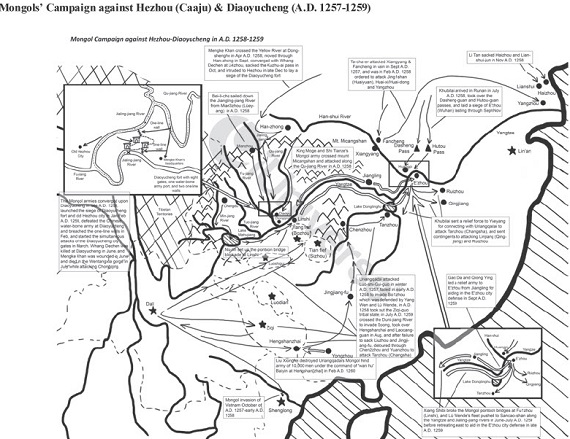
Mongol Campaign against the Jurchens (Battle of Yehuling, July of A.D. 1211)
Mongol Campaigns against Semiryechye & Central Asia (A.D. 1216-1219, 1219-1224)
Mongol Campaign against Kiev Rus (A.D. 1223)
Mongol Campaign against the Jurchens (A.D. 1231-1232)
Mongol Campaigns against the Volga Bulgars, Kipchaks, Alans, Rus Principalities, Crimea, Caucasus & Kiev Rus (A.D. 1237-1240)
Mongol Campaigns against Poland, Bohemia, Moravia, Hungary, Austria & Dalmatia (A.D. 1240-1242)
Mongol Campaign against Arsacia (Mulahida) from A.D. 1253 to A.D. 1256
Mongol Three-prong Campaign against Hezhou (Caaju) from late A.D. 1255 to early A.D. 1256
Mongol Continuous Campaigns in the Sichuan Basin (A.D.1257-1259)
Mongol Campaign against Hezhou (Caaju) & Diaoyucheng (A.D. 1257-1259)
Mongol Campaigns against the Abbasid Caliphate, Mecca, Misr (Egypt) Outposts, North Africa, and the Ayyubid & Mamluk Sultanates (A.D. 1257-1260)
|
|
From the north side, after crossing the Jialingjiang River, the Mongols sacked Jianmen and Chengdu.
In January 1259, Mengke sent defector Jinn Guobao to pacifying the Soong Chinese.
From the east, the Mongols crossed the Qu-jiang River at Jizhua-tan (chicken claw) beach to attack Diaoyu-cheng that was defended by Wang Jian and deputy Zhang Jue.
In February, the Mongols began the Diaoyu-cheng siege, with Shi Tianze and Whang Dechen attacking the Chinese water-borne army from the west and south.
In February, Whang Dechen's Mongols breached the southern one-line wall, attacked Zhenxi-men (quell west) gate that had a height of 19 meters, took over the outer wall.
The Mongols destroyed or captured hundreds of Soong ships at the docks.
Wang Jian, i.e., a Chinese general in charge of Diaoyushan, previously carved out a perpendicular mountaintop fort with eight gates, erecting two one-line walls extending to the northside river bund and southside river bund, plus secret cave exits for launching stealthy attacks at the enemy from behind.
Diaoyu-shan, meaning the fishing mountain, was surrounded by the Jialing-jiang River from north, northwest, west, southwest and south, Qu-jiang River from northeast.
For months, the Mongols launched the barbaric human wave attacks, breaching the citywall defenses with high ladders and tunneling work occasionally; however, the Mongols were unable to hold gain due to the heights of the forts, that could range 19 to 41 meters high.
In March, the Mongols attacked Diaoyu-cheng at multiple fort gates.
In late March, Dong Wenwei, a Mongol 'qian hu' commanded the turncoat army from the Dengzhou area of today's Henan and attacked the Dongxin-men (new eastern) gate of Diaoyu-cheng in vain, with the turncoat Chinese troops becoming the Mongols' fodder of war and piling up below the cliff.
In April, after twenty days' rains, Whang Dechen's Mongol army was repelled in attacking the Huguo-men (nation protection) gate after fifty commandoes exited the secret Feiyan-dong (flying eaves) cave via dropdown by ropes to attack the Mongols from behind.
The Mongols then launched a nightly raid on the Qisheng-men (surprise victory) gate, climbed up the outer city wall but was kicked off the wall after a melee battle.
In mid-May, Wang Jian, commanding a commando column, exited through the secret Huangdong (imperial) cave exit, raided Mengke's tents on one night, and went straight for the khan's command center, with hundreds of Soong commandos fighting the Mongol khan's bodyguards to death.
Mengke had to relocate to a safe camp after the night raid. However, Mengke refused to take Zhushuhuli's advice to skip Diaoyu-cheng to sail down the Yangtze for combining troops with Khuibilai to attack the Soong capital city downstream.
On the night of June 5th, the Mongols, digging a tunnel, at one time breached the Ma'anzhai (horse saddle) palisade, with the whole fort's defenders fighting to the last person at the outer wall.
Wang Jian, and consecutively deputy Zhang Jue after Wang Jian's injury, led the Soong relief army in repelling the Mongols at the Ma'anzhai inner city wall.
Whang Dechen, riding up to the inner city wall, attempted to persuade the defenders into surrender but was blasted to death.
At mount Ma'an-shan (saddle hill), Mengke ordered to set up high storey observation posts.
lü Wende, commanding a Southern Soong navy, sailed upperstream to today's Chungking along the Yangtze and then sailed upstream along the Jialing-jiang River to render relief to Diaoyu-cheng but was repelled by Shi Tianze at Heishixia (black stone gorge) in July.
In July 1259, Mengke Khan personally directed the Mongol army at Mount Ma'an-shan (saddle hill).
Wang Jian, after observing the Mongols' activities on the high storey observation posts, ordered the cannons to blast the Mongols.
Mengke, who was near the observation post, was injured during the blast.
Wang Jian ordered to throw down fresh live fish and cooked pancakes with a letter to the effect that the Soong Chinese had grain supply for ten years.
In late July, Mengke, who was angered by Wang Jian's letter, personally sailed down the Yangtze to attack Chungking to the southeast while leaving a portion of his army to continue the siege of Diaoyu-cheng.
On August 11th, at Wentangxia (lukewarm spring gorge), Mengke died of the wound suffered at Diaoyushan of Hezhou Prefecture (today's Chungking, Sichuan Province).
With death of the khan, the Mongols hence called off the campaign.
Mengke Khan purportedly left a wish to slaughter the city owning to death from a wound incurred in attacking the fort; however, Khubilai dozens of years later spared the city defenders in exchange for the surrender of the fort.
Diaoyu-cheng would not surrender to the Mongols till A.D.1279 when Wang Li took the persuasion of Mongol official Li Dehui, to surrender the fort after the news came that last Soong emperor and 100,000 Soong troops and civilians all died in the Yashan Sea Battle off today's Macao.
Meanwhile, not knowing of Mengke's death, Khubilai just crossed the Huai River in September, then crossed Dabieshan Mountain, and arrived at Huangpo [Huangpi] in today's Hubei Province.
Prior to the E'zhou Campaign, Lian Xixian, a Weiwuer who adopted father Buluhaiya's 'Yan-nan [south of Yan-jing] Zhu-lu [various circuits] lian [anti-corruption] fang [inspection] shi [commissioner]' title as surname and nicknamed Lian-Mencius, petitioned with Khuibilai to allow all to-be-caught Confucians to be set free.
Jia Sidao was ordered to sail along the Yangtze to lend relief to E'zhou.
Meanwhile, lü Wende's navy sailed downstream to aid E'zhou.
After defeating Badu'er, lü Wendao entered the E'zhou city (i.e., Wuchang of today's Hubei Province).
Two Chinese brothers under Khubilai, Dong Wenbing and Dong Wenyong, crossed the Yangtze River to lay siege on E'cheng of today's Hubei Province.
Hearing of Mengke Khan's death, Khubilai continued to attack E'zhou while sending a diversionary force to sack Yueyang.
Khubilai wrote to Subetei's son, i.e., Wulianghetai, in the hope of attacking Soong from two directions.
The Soong Chinese at Han'yang, under Prime Minister Jia Sidao, secretly negotiated for peace with the Mongols by promising 200,000 units of silver and silk, each.
Lian Xixian proposed to Khibilai to return north to compete for the throne.
Khubilai then returned north.
Khubilai, ending the seven year war with the Soong Chinese, was to be engaged in four years' wars with Arik-Buka (Ariq-boeke).
Subetei's son Wulianghetai, coming to the east in June 1259, attacked today's Hunan Province.
In November, Wulianghetai, after slaughtering the tribal state of Ziqi-guo in southwestern China, arrived at Tanzhou (Changsha of today's Hunan Province).
Hearing of the peace deal, Subetei's son went north, too.
Wulianghetai, after one month siege of Tanzhou, withdrew to north of the Yangtze.
In December, Jia Sidao's Soong army ambushed the Mongol hind army which was subordinate to Subetei's son, four times.
The Mongol hind army, about 10,000 men under the command of a 'wan hu' (ten thousand households) general by the name of Baiyin (white silver), failed to pass through the territory.
By February of A.D. 1260, the stranded Mongols were all killed in Hengshan, next to the Ziqi-guo territory whose people previously died to the last person resisting the Mongols.
Jia Sidao claimed to Soong Emperor Lizong that he had defeated the Mongols, for which Jia Sidao was conferred the title of Duke Weiguo-gong.
Before the Mongols' returning to Helin, Arik-Buka (Ariq-boeke), a junior brother of Khubilai, held an assembly in Helin and declared himself 'khan'. Khubilai stopped at Jinlianchuan (Kaiping, i.e., Duolun, Cha'haer, Inner Mongolia), where he declared himself Khan without an assembly. Yao Shu and Lian Xixian were ordered to make an announcement of Khubilai's enthronement in the Chinese language. A Chinese era was declared, and the year would be First Year of Zhongtong Era, A.D. 1259.
Lian Xixian, who was sent to the Guan-zhong area, defeated Hun-du-hai, a follower of Arik-Buka's, for which Lian Xixian was promoted to 'pingzhang zhengshi' for the Guan [central Shenxi], Long [Gansu] and Shu [Sichuan] area, i.e., today's Gansu and Shenxi.
In A.D. 1268, the 'yushi [censor] tai' department was established, with provincial 'ti-xing [criminal justice] ancha [inspector] si' subbureaus set up at the various 'dao' [subcircuit] level.
Liu Bingzhong and Xu Heng revised on Genghis Khan's governmental structure of 'Duanshi-guan' (criminal prosecutor), 'Wan-hu' (10,000 head military chief), and Jurchen-style titles of 'yuan-shuai' (marshal) and 'xuan-hu' (pacifier) for provinces. New structure will be i) 'zhongshu sheng' (state affairs), ii) 'shumi yuan' (military affairs), and iii) 'yushi tai' (promotion and demotion of officials). Lower levels will include shi, jian, yuan, si, wei, and fu. Provincial affairs would be handled by 'xing-sheng', 'xing-tai', 'xuan-hu', 'lian-fang' and 'muming zhangguan', and levels included 'Lu' (comprising of several provinces), 'Fu' (province or prefecture), 'Zhou' (smaller prefectures) and 'Xian' (county).
But discrimination against the Chinese was rampant. The Mongols would assume the primary posts while the Han Chinese the deputy posts. Tax administration could only be laid in the hands of Muslims - allies of the Mongols.
A caste society was established, and four levels were differentiated: 1) Mongols, 2) Se Mu Ren or Semuren, 3) Han-Ren (i.e., northern Chinese, Khitans etc.), and 4) Nan-zi (southern Chinese-barbarians).
* In Commemoration of China's Fall under the Alien Conquests in A.D. 1279,
A.D. 1644 & A.D. 1949 *
U.S.S.R./Comintern Alliance with the KMT & CCP (1923-1927)
Korean/Chinese Communists & the 1931 Japanese Invasion of Manchuria
American Involvement in China: Soviet Operation Snow, IPR Conspiracy, Dixie Mission, Stilwell
Incident, O.S.S. Scheme, Coalition Government Crap, Amerasia Case & The China White Paper
* Stay tuned for "Republican China 1911-1955: A Complete Untold History" *
|
|
Zou Rong's Revolutionary Army;
Shin Kyu Sik's
Shrine (Spirit, Kunitama) of Korea
|
This snippet is for sons and daughters of China:
Heed the sons & ministers' agony and sorrow of our ancestors who died or lived through the Mongol, Manchu and Soviet-Chicom conquest
and
the Yongjia, Jingkang and Jiashen cataclysms !
Jeanne d'Arc of China:
Teenager girl Xun Guan breaking out of the Wancheng city to borrow the relief troops in the late Western Jinn dynasty;
Liu-Shao-shi riding into the barbarian army to rescue her husband in the late Western Jinn dynasty;
teenager girl Shen Yunying breaking into Zhang Xianzhong's rebels on the horseback to avenge on father's death in the late Ming dynasty.
China's Solitary and Lone Heroes:
Nan Jiyun breaking out of the Suiyang siege and charging back into the city in the Tang dynasty;
Zhang Gui & Zhang Shun Brothers breaking through the Mongol siege of Xiangyang in the Southern Soong dynasty;
Liu Tiejun breaking through three communist field armies' siege of Kaifeng in the Republican China time period;
Zhang Jian's lone confrontation against the communist army during the June 3rd & 4th Massacre of 1989.
|
|
|
Arik-Buka (Ariq-boeke), a junior brother of Khubilai, held an assembly in Helin and declared himself 'khan'. Lian Xixian, on his own initiative, frustrated the attempts of Arik-Buka emissaries (Liu Taiping and Huo Luhuai) at Peking and defeated a general who answered Arik-Buka's order. Khubilai then attacked Arik-Buka and drove him off in A.D. 1261. At the advice of Liu Bingzhong, Khubilai Khan moved his capital to Peking in A.D. 1260, i.e., winter capital Dadu ("great capital") or Khanbalik in Marco Polo's Cambaluc. This is in addition to summer palace at Shangdu (the Xanadu of Coleridge). After being in reign for five years, Khubilai Khan declared the new era of Zhiyuan in A.D. 1263. (In A.D. 1271, the Mongols adopted the dynastic name Yuan.)
Khubilai Khan sent an embassy, comprising of scholar officials Hao Jing, He Yuan and Liu Renjie, to Southern Soong. Southern Soong Prime Minister, in order to hide his previous treachery acts from Emperor Lizong (Zhao Yun, reign A.D. 1224-1264), would imprison the Mongol emissaries. Khubilai Khan sent another emissary to Soong border general Li Tingzhi. Li Tingzhi's report to Emperor Lizong was covered up by Jia Sidao. Khubilai Khan issued the war decree in the second year of Zhongtong Era (A.D. 1260). Mongol governor-general in charge of the Huai River and Yangtze areas, Li Tan, defected to Soong in the spring of third year of Zhongtong Era, i.e., A.D. 1262, rebelled at Lianshui, intruded into Yi-zhou, and sacked Ji'nan. This was after Li Tan's son fled the Mongol camp where he served as a hostage.
Hearing of that, Khubilai Khan ordered that Shi Tianze and Ha-bi-chi to attack the defector general at Jinan, Shandong.
The Soong court launched a campaign against Xincai and Tengzhou by crossing the Huai-he River to lend support to Li Tan.
In March, Xia Gui, i.e., deputy 'anhu shi' for Huai-dong, attacked Fuli from Sizhou.
From Huai'an, the Soong army took over Pizhou and Xuzhou.
In May, Xia Gui took over Qi-xian.
From Qingyang, Meng Yan's Soong army took over Lijin.
Mongol general An-tuo counterattacked Pizhou and Xuzhou, repelling the Soong army.
Meng Yan's army continued to penetrate north to reach Cangzhou in today's Hebei Province.
However, Meng Yan disobeyed the emperor's order to render relief to Li Dan and detoured to return south.
After a few months siege, in July, the Mongols took over Ji'nan and killed Li Zhan, who failed to commit suicide at Daminghu Lake, via a cruel penalty of splitting the body.
Zhang Honglüe, i.e., Mongol 'wan hu' at Bozhou, counterattacked Xia Gui's Soong army at the Wo-he (Guo-he) confluence, and pressed the Soong army back to Qi-xian which was abandoned after one month defense.
The Siege Of Xiangyang
Around A.D. 1264, during the fifth year of the Zhongtong Era, Khubilai Khan changed his era to the Zhiyuan Era. Arik-Buka was spared and came to surrender. At this time, a Soong officer at Tongchuan, called Liu Zheng, being resented by Jia Sidao, would surrender his 15 prefectures to the Mongols.
Liu Zheng was conferred the posts of 'xing(2)sheng(3)' (governor) and 'anhu shi' of today's Sichuan areas. Liu Zheng proposed to have the Soong Chinese's grain supply cut off at Xiangyang. Soong Chinese General in Sichuan, Luu Wende, did not pay attention to Liu Zheng's building up the castles and cutting off Xiangyang and Fancheng, i.e., the twin forts, from today's Sichuan.
Luu Wende said that Xiangyang had ten years of grain supply. General Luu Wenhuan at Xiangyang wrote to Lu Wende, but he was ignored.
Luu Wende, back in A.D. 1260, recommended Yu Xing to take over the 'zhi-zhi shi' (governor-general) post for the Sichuan basin from Pu Zhezhi, while Liu Zheng tacked on the 'zhi fu' (magistrate) post for Luzhou and deputy 'anhu shi' (pacification) for the Tong-chuan-Lu Circuit.
Liu Zheng, a former Jurchen military officer who defected to the Soong Chinese, was disliked by lü Wende, for which Liu Zheng surrendered to Liu Heima and the Mongols at Chengdu in A.D. 1261.
A lot of Soong generals either resigned or were persecuted to death by Jia Sidao and lü Wende.
Yu Xing was forced to resign.
lü Wende failed to defeat Liu Zheng at Shenbicheng (divine arm fort) several times.
The Mongols attacked Dazhou, and the Soong Chinese counterattacked the Mongols by sailing upstream along the Jialing-jiang to Qingju-cheng.
In January 1262, Liu Zheng and the Mongols abandoned Shenbi-cheng (divide arm fort) near today's Chungking.
Zigzag wars continued in the Sichuan basin till Khubilai defeated the rivals and consolidated power In A.D. 1264.
Xia Gui was dispatched to the Sichuan basin as the Soong governor-general in A.D. 1265.
Xia Gui defeated Liu Zheng at Tongchuan along the Fu-jiang River in a northern campaign.
Then Xia Gui sailed upstream along the Tuo-jiang River to attack the Mongols at Yundingcheng; however, Xia Gui was defeated by Liu Zheng, with loss of two generals.
In A.D. 1267, Liu Zheng proposed to Khubilai to attack Xiangyang.
The new Soong Emperor Duzong (Zhao Qi, reign A.D. 1264-1274) again conferred Jia Sidao important posts and added an extra title called 'Tai Shi', i.e., imperial tutor. Jia Sidao was extolled as comparable to Archduke Zhou of Western Zhou Dynasty. Jia Sidao pretended to resign several times, but Emperor Duzong would not let him go. Jia Sizong continued to shield the Xiangyang siege from the emperor. When a concubine told Duzong that Xiangyang had been under siege for 3 years, Jia Sidao would order that the woman be killed. The notoriety of Jia Sidao was best illustrated by another story: When one concubine of Jia Sidao saw a young man on the bank of Xihu Lake (West Lake) and exclaimed about the beauty of the young man, Jia Sidao would order that the young man be killed in front of the concubine.
This snippet is for sons and daughters of China:
Heed the sons & ministers' agony and sorrow of our ancestors who died or lived through the Mongol, Manchu and Soviet-Chicom conquest
and
the Yongjia, Jingkang and Jiashen cataclysms !
Jeanne d'Arc of China:
Xun Guan breaking out of the Wancheng city to borrow a relief army in the late Western Jinn dynasty;
Liu-Shao-shi riding into the barbarian army to rescue her husband in the late Western Jinn dynasty;
Shen Yunying breaking into Zhang Xianzhong's rebels on the horseback to avenge on father's death in the late Ming dynasty;
China's Solitary and Lone Heroes:
Nan Jiyun breaking out of the Suiyang siege and charging back into the city in the Tang dynasty;
Zhang Gui & Zhang Shun Brothers breaking through the Mongol siege of Xiangyang in the Southern Soong dynasty;
Liu Tiejun breaking through three communist field armies' siege of Kaifeng in the Republican China time period
;
Zhang Jian's lone confrontation against the communist army during the June 3rd & 4th Massacre of 1989.
|
|
In August 1267, the Mongols began to attack Xiangyang.
A-zhu, with 50,000 Mongol troops, reached Xiangyang, and then detoured to go south to pillage the Jinghu area.
A-zhu, who left a contingent to defeat the Soong chasers, was himself encircled by the Soong army north of the Han-shui River and barely escaped south with the help of the Mongols on the northern riverbank.
lü Wenhuan was sent to Xiangyang for defense against the Mongols' attempt at Xiangyang.
In Sichuan, lü Wende recovered Kaizhou from the Mongols.
Back at Xiangyang, Liu Zheng induced lü Wenhuan with permission to build a trading post (i.e., 'que chang') at Baihe-kou (white river estuary) east of Xiangyang-Fancheng, which was a river flowing east to west to enter the Han-shui River's U-shaped winding area at the Xiangyang-Fancheng twin cities, and successfully established a Mongol beachhead fort.
South of Baihe-kou, the Mongols built another fort at mount Lumen-shan (deer gate) that overlooked the Han-shui River to the west.
In January of A.D. 1268, the Mongols built one more fort across the Bai-he River, which was to the east of the Fancheng city while building a new fort ('xin cheng') on the west riverbank of the Han-sui River to blockade the river course with the pincer action from mount
Lumen-shan.
Liu Zheng, from September of A.D. 1268, commanded a 50,000 Mongol cavalry in raiding the Soong territories along the Han-shui River, causing the Soong cities in the Jing-Xiang area to close city walls in isolated defense.
Liu Zheng and A-zu led the Mongols to Xiangyang and encircled it for four-five years.
Serving under Liu Zheng was an officer called Sui Shichang who proposed to build the one-character (one line) wall to encircle the Xiangyang city.
Sui Shichang also proposed to build the artillery terrace outside of the Fancheng city for blasting at the twin-city defenders.
At Mt. Lumen-shan (deer gate), Sui Shichang defeated the Soong army, and at the Han-jiang-kou rivermouth, i.e., the Han-shui rivermouth, Sui Shichang defeated and burnt hundreds of Soong Chinese ships.
In January of A.D. 1269, on the southern Han-shui River riverbank and to the west of Xiangyang and the L-shaped inflexion, the Mongols built the Wanshan fort to cut off traffic at the upperstream Han-shui River, and further built two one-line great walls extending to the Han-shui River riverbanks to the east and towards the Xincheng fort to the southeast.
North of the Han-shui River and the Fancheng city, the Mongols also built a one-line great wall, plus another one on the eastern Han-shui River riverbank.
In the spring of A.D. 1269, with the rising water tides, the Soong navy sailed upstream along the Han-shui River to render aid to Xiangyang.
From Huangzhou, Xia Gui commanded a fleet to sail upstream, and after delivering supplies to Xiangyang, Xia Gui returned.
In March, Zhang Shijie led a fleet to aiding Xiangyang but was repelled by the Mongols at Chitanpu (red beach garden).
In June, A-zhu's Mongols pillaged south to reach Jingshan.
In July, with heavy rains and rising tides, Xia Gui, with 3000 ships and 50,000 troops, sailed upstream again, and fought against the Mongols at mount Lumen-shan for seven days.
With A-zhu returning to the riverside fort from Xinye, Xia Gui's Soong army was repelled at the Longweizhou (dragon tail island) midstream island had to abort the mission.
Jia Sidao ordered Li Tingzhi and Fan Wenhu to aid Xiangyang.
In the same month, Fan Wenhu sailed upstream to render aid.
Fan Wenhu and his 100,000 troops were defeated at Guanzi-tan.
The Soong army troops under lü Wende's Jing-hu zhi-zhi si suffered heavy casualties in the zigzag wars with Mongols.
lü Wende died in December of A.D. 1269, with Li Tingzhi succeeding the zhi-zhi si post.
In Sichuan, after Luu Wende died, his brother-in-law, Fan Wenhu, took over the post; but Fan, like his predecessor, refused to send the relief army to Xiangyang.
In March 1270, Liu Zheng proposed to Khubilai to build a Mongol navy for attacking Xiangyang.
In March 1272, the Mongols began to attacked and took over the Soong Guchengbao (ancient castle fort) outpost north of Fancheng and at the Bai-he and Han-shui Rivers' confluence.
In May, Li Tingzhi deployed all troops at Ying3zhou (Zhongxiang) south of Xiangyang and Junzhou (Danjiangkou) west of Fancheng.
With Fan Wenhu not providing troops, Li Tingzhi recruited 3000 militia from Xishan (west hill) of Xiangying, headed by Zhang Shun and Zhang Gui.
Taking advantage of rising tides of the Han-shui River,
two generals under Li Tingzhi, Zhang Shun and Zhang Gui, on May 24th sailed downstream along the Han-shui River from Junzhou; Zhang Gui broke through the Mongol midstream siege lines, and Zhang Shun died on the Han-shui River. Zhang Gui barely entered Xiangyang alive on May 25th.
This breakthrough with extra manpower and materials, May or August, greatly enhanced the defenders' morale.
After finding out that Xiangyang was in great urgency, Zhang Shun was to implement Li Tingzhi's plan to sail downstream for sake of appealing for aid with Fan Wenhu.
After finding out that Xiangyang was in great urgency, Zhang Gui was to implement Li Tingzhi's plan to sail downstream for sake of appealing for aid with Fan Wenhu.
In September, hiring two brave men and with 2000 troops, Zhang Gui departed Xiangyang
to seek conjunction with the Soong army at Ying3zhou (Zhongxiang, Hubei). But soon after Zhang Gui broke through the Mongol siege lines, he encountered the Mongol ships.
Xia Gui, sailing upstream, failed to connect with Zhang Gui when being impeded by the Mongols at Longweizhou (dragon tail island).
Zhang Gui, who ordered the boats to return upstream,
was caught at Guimen-guan (ghost gate pass) by the Mongols who chased behind, and Zhang died in the Mongols' hands.
Zhang Gui's body was displayed to the Xiangyang defenders so as to degrade the Soong Chinese morale.
In November of A.D. 1272, the Mongols launched a final assault on Xiangyang-Fangcheng.
Shi Tianze was made into the general commanding general for the siege.
The Mongol navy broke the pontoon bridge linking Xiangyang and Fancheng, and captured over 30 Soong ships.
The sister city of Fancheng was taken over by the Mongols after a five direction siege attack that lasted two months, with the assistance of the Muslim catapults that were built by artisans loaned from Bagdad.
Two generals, Fan Tianshun and Niu Fu, plus 7000 defenders, died in citywall and lane-to-lane battles. Several thousands of stranded civilians were all massacred by the Mongols.
The Mongols hung the corpses of the dead Fancheng defenders and civilians on the southern city wall to create detente to the Xiangyang defenders.
The Mongols then deployed catapults (made by the Persian engineers) against the outer wall of Xiangyang, blasted at the citywall from the southeastern corner of Fancheng, and destroyed it. Every
time Luu Wenhuan climbed up the citywall, he would have tears while facing the south. A Mongol general by the name of A-li-hai-ya, after sending away Liu Zheng to Huai-xi, called on Luu Wenhuan to surrender, saying that Luu Wenhuan had done his job by guarding Xiangyang for five years. After they broke the arrows to swear forgiveness and sincerity, Luu Wenhuan on February 24th, A.D. 1273, surrendered, ending the 5-6 year long Mongol siege wars, and was conferred the post of 'da-dudu' or governor-general for Xiangyang and the Han-shui River areas.
Demise Of the Soong Dynasty
After Emperor Duzong died, his four year old son, Emperor Gongdi (Zhao Xian, A.D. 1271-1323; reign 1275-1276), was made emperor in A.D. 1275. The Mongols sent Shi Tianze and Boyan (Bayan, grandson of Subetei) on a full campaign against Soong. Shi Tianze died en route. Bayan ordered that A-zu head the first column and depart for the Yangtze from Xiangyang, with Luu Wenhuan as the fore-runner general; the 2nd column was to be headed by Mang-wu departing from Yangzhou, with Liu Zheng as forerunner general. Bayan took over numerous cities on the way, slaughtered one town, and killed and captured numerous Soong generals. Soong Dowager Empress Xie-shi had no choice but to rely on Jia Sidao for fighting the Mongols. More Soong generals surrendered, including Fan Wenhu in today's Sichuan, Chen Yi in Huangzhou (the Huanggang area, Hubei).
In A.D. 1275, Lian Xixian was sent to south of the Yangtze as 'Jing-nan xing sheng' to pacify the Jing-nan territories. For his pro-Confucian fame and the Tian family of Sizhou, Yang family of Bozhou of southwestern China, as well as Soong's 'Chongqing zhizhi' Zhao Dingying expressed wish to be pacified by the Mongols.
Hearing that Liu Zheng had passed away, Jia Sidao had a short ecstasy and led an army of about 130,000 against the Mongols, but he was defeated on the Yangtze River.
Jia Sidao was defeated at Lugang on the Yangtze River in February of A.D. 1275.
For the battle, Jia Sidao ordered Sun Huchen to counter the Mongol fleet at Chizhou.
Jiang Cai, with 70,000 infantry troops, stationed at Dingjiazhou as a forerunner general.
However, Xia Gui, with 2500 ships, fled the scene rather than fighting the turncoat Mongol army led by lü Wenhuan, and moreover bumped Jia Sidao's ships.
The infantry troops, seeing that Sun Hucheng changed ship to his concubine's ship, shouted that the commanding-general had fled, which caused the whole Soong army to collapse. Jiang Cai retreated to Yangzhou, with the Mongols chasing behind.
Jia Sidao also fled to Yangzhou.
Fleeing to Lu2zhou, Xia Gui refused to answer the Soong court's recall and secretly contacted Bo-yan for surrender.
Jiang Cai, who retreated to Yangzhou, resisted the Mongol army at Sanligou (three league ditch) and Yangziqiao (Yangtze bridge).
The Mongols, unable to sack Yangzhou, constructed a long wall to encircle the riverside city, extending from Yangziqiao to Guazhou.
Several ministers at the Soong court requested that Jia Sidao be deprived of his posts. Soong released the former Mongol emissaries like Hao Jing as a good-will gesture.
Jia Sidao was expelled from the capital and was killed by the escort official en route of banishment.
In today's Jiangsu areas, around the Yangtze, including Zhenjiang and Jiangyin, generals deserted in face of the Mongol attacks. Jia Sidao sent an emissary to Bayan for peace, but met with declination. Jia Sidao requested with the dowager empress for relocation of the Soong capital, but Empress Xie-shi refused to move.
In early July, Zhang Shijie's navy was defeated on the Yangtze by the Mongol fire attack.
Zhang Shijie and Liu Shiyong chained ten ships and anchored in the middle of the Yangtze, which became a target of Mongol General A-zhu's fire arrow attack.
Over ten thousand Soong troops were drowned.
Zhang Shijie, who fled to Chuishan (barn mountain) near Zhenjiang, was to chain 1000 ships at the last Mongol-Soong Battle of Yanshan three and half years later.
In the second half of A.D. 1275, the Mongols failed to pacify one single city in southern China.
Yao Shu later explained to Khubilai that the Mongol army, which had taken thirty cities in the first half of the year, failed to do so in the second half for the Mongol army's pillage and massacre, with citation that people at Yangzhou, Jiaoshan and Huai'an fought persistently to death.
At this moment, Zhang Shijie of Er'zhou (Hubei Province), Wen Tianxiang of Jiangxi and Li Fei of Hunan came to the east to help the Soong court. The Jiankang (i.e., Nanking) city was deserted by a Soong general. Changzhou and Wuxi were next taken by the Mongols.
The Soong court in July decreed to have Wen Tianxiang come in to Lin'an.
This was because Zhang Shijie's navy suffered a defeat at the Battle of Jiaoshan, near Zhenjiang, on July 2nd.
In August, Wen Tianxiang's army arrived in the West Lake of Lin'an.
Wen Tianxiang arrived in Lin'an (Hangzhou) the capital, but Empress Dowager did not take his advice.
The court ministers, fearing that Wen Tianxiang could be another Yue Fei, arranged to offer a cabinet post as 'quan (acting) Gongbu (engineering department) shang-shu' before adding a quasi-military post as 'jian (concurrent) dudu-fu can-zan jun-shi4'.
Wen Tianxiang, for reporting to two prime ministers Chen Yizhong and Liu Mengyan on the military affairs, put off the restraint of military rights with threat of resignation.
Khubilai Khan then sent Lian Xixian2 and Yan Zhongfan to Soong for talking about a ceasefire. Lian Xixian2 requested with Bayan for bodyguards, but Bayan advised that the more bodyguards Lian was to take with him, the more likely the Soong Chinese might harm him. Lian obtained 500 soldiers, but once Lian arrived at the Dusong-guan [lone pinetree] Pass, Soong General Zhang Ru killed Yan Zhongfan and captured Lian Xixian2.
Lian Xixian, a cousin, was recalled to the Mongol capital 'Shangdu' from the Jiangling area in A.D. 1277, was promoted to 'zhongshu shi' in A.D. 1279 and passed away in A.D. 1280, enjoying the posthumous title of Duke Wei-guo-gong from Yuan Emperor Chengzong.
Bayan reprimanded the Soong's acts, and sent another emissary, Zhang Xu, to the Soong court together with a Soong emissary. Again, Zhang Xu was killed by a Soong border general. Then, the Mongols stopped the peace talks and attacked Yangzhou on the north bank of the Yangtze (Changjiang River). The Mongols attacked Yangzhou and defeated two generals under Li Tingzhi. The Jiading city surrendered next.
Zhang Shijie's navy was defeated on the Yangtze by the Mongol fire attack. Wen Tianxiang arrived in Lin'an (Hangzhou) the capital, but Empress Dowager did not take his advice. Jia Sidao was expelled from the capital and he was killed by the escort official en route. Taizhou of today's Jiangsu was lost to the Mongols, and the Changzhou city was slaughtered. In Hunan, Li Fei died, and both Hunan and Jiangxi Provinces were lost. After taking over the Dusong-guan Pass, the Mongols were closing in onto the Soong capital. A Soong minister called Liu Yue was sent to the Mongol camp for peace, but Bayan declined it, saying the Soong Emperor obtained the throne from a kid and would lose it in the hands of a kid. Lu Xiufu was sent to the Mongols for expressing a wish to be a Mongol nephew, but the Mongols declined it. Soong's new prime minister, Chen Yizhong, sent Liu Yue to the Mongols in the attempt of expressing acknowledgement as a Mongol vassal, but Liu Yue was killed by a Soong Chinese civilian en route, at Gaoyou of today's Jiangsu Province. The Mongols then sacked Jiaxing and An'jie of today's Zhejiang Province.
In September, Chen Yizhong dispatched Wen Tianxiang to Pingjiang-fu (Suzhou, Jiangsu) for guarding the Wu-men (Suzhou gate) pass.
Meanwhile, Chen Yizhong recalled lü Shimeng, i.e., defector lü Wenhuan's nephew, as the army minister in the attempt of seeking truce with the Mongols through the lü family.
Citing 'zhongyuan [central plains] lu-chen [continental cave-in]', Wen Tianxiang, from Pingjiang-fu, sent in a petition to request for execution of lü Shimeng and requested for relaunching the governors-general' system to counter the Mongols, which was against the early Soong dynasty's policy of centralized military control in the context of quelling the turmoil of five dynasties.
Wen Tianxiang proposed the establishment of four domains of Changsha, Longxing, Fanyang and Yangzhou.
Wen Tianxiang and Zhang Shijie advised that the Soong court relocated to the islands in the seas, but Prime Minister Chen Yizhong decided to send the imperial seal to the Mongols for surrender. Bayan requested that Chen personally came to the Mongols. Chen fled to Wenzhou, a southern Zhejiang coastal city. Zhang Shijie led his people into the sea. Wen Tianxiang was made into the rightside prime minister and was ordered to go to the Mongols for peace. Wen was arrested by Bayan after he accused Bayan of invasion.
On February 21st of A.D. 1276, Bayan took over Lin'an and forced the dowager empress to issue the surrender order. The Soong royal family, including the dowager empress and Emperor Gongdi, was sent to Peking.
Soong ministers Wu Jian, Jia Yuqing, Jia Xuanweng, Liu Jie and Wen Tianxiang were named the escort officials for the trip.
The baby emperor, i.e., Soong Emperor Shaodi, downgraded to Duke Yinghai-gong, was later allowed to study Buddhism in Tibet, and became the chief monk in several lamaseries. Owning to a poem about sighing about the rounds of plum blossom and missing the hometown, he was ordered to be killed by the successor Mongol Yuan emperor. (Soong Emperor Shaodi was the speculative topic of giving her woman to the Mongol emperor, with an unborn child being the future Mongol Yuan Emperor Shundi.)
* In Commemoration of China's Fall under the Alien Conquests in A.D. 1279,
A.D. 1644 & A.D. 1949 *
U.S.S.R./Comintern Alliance with the KMT & CCP (1923-1927)
Korean/Chinese Communists & the 1931 Japanese Invasion of Manchuria
American Involvement in China: Soviet Operation Snow, IPR Conspiracy, Dixie Mission, Stilwell
Incident, O.S.S. Scheme, Coalition Government Crap, Amerasia Case & The China White Paper
* Stay tuned for "Republican China 1911-1955: A Complete Untold History" *
|
|
Zou Rong's Revolutionary Army;
Shin Kyu Sik's
Shrine (Spirit, Kunitama) of Korea
|
This snippet is for sons and daughters of China:
Heed the sons & ministers' agony and sorrow of our ancestors who died or lived through the Mongol, Manchu and Soviet-Chicom conquest
and
the Yongjia, Jingkang and Jiashen cataclysms !
Jeanne d'Arc of China:
Teenager girl Xun Guan breaking out of the Wancheng city to borrow the relief troops in the late Western Jinn dynasty;
Liu-Shao-shi riding into the barbarian army to rescue her husband in the late Western Jinn dynasty;
teenager girl Shen Yunying breaking into Zhang Xianzhong's rebels on the horseback to avenge on father's death in the late Ming dynasty.
China's Solitary and Lone Heroes:
Nan Jiyun breaking out of the Suiyang siege and charging back into the city in the Tang dynasty;
Zhang Gui & Zhang Shun Brothers breaking through the Mongol siege of Xiangyang in the Southern Soong dynasty;
Liu Tiejun breaking through three communist field armies' siege of Kaifeng in the Republican China time period;
Zhang Jian's lone confrontation against the communist army during the June 3rd & 4th Massacre of 1989.
|
|
|
On the northern Yangtze riverbank, near the Canal intersection, Wen Tianxiang and a few captives fled the Mongols' camp while in the process of being sent to the north via the Canal.
The gang escaped onto a ship at the time the Mongol chasers followed them to the Yangtze riverbank.
Late Emperor Duzong had two more sons, 11 and 6 year old, respectively. They fled to Wenzhou before Lin'an was taken by the Mongols. Chen Yizhong sailed them to Fuzhou of Fujian Province where a new Soong court was set up. On June 14th, eleven year old Zhao Shi (King Yi-wang) was made Emperor Ruizong (reign A.D. 1275-1278). Zhang Shijie, Su Liuyi, and Lu Xiufu consecutively arrived in Fuzhou. Chen Yizhong was retained as leftside prime minister, while Wen Tianxiang, after fleeing from the Mongols, also arrived in Fuzhou and acted as rightside prime minister. The Soong court would last another three years before the final demise. The Mongols continued to push south.
Canton (Guangzhou) of Guangdong Province was taken, and Soong General Huang Jun died. Yangzhou on the Yangtze Bank were taken, and General Li Tingzhi was captured and killed. The Mongols then invaded Fujian Province.
The Mongol army, under the guidance of Wang Shiqiang, continued to push south.
The Mongols, crossing the Qiantang-jiang River, attacked Zhe-dong, i.e., eastern Zhejiang.
Wen Tianxiang, at Nanjianzhou, rallied an army by sending orders of mobilization the territories under the Soong control.
In October of A.D. 1276, Wen moved to Tingzhou.
While Wen Tianxiang was fighting the Mongols, Zhang Shijie, who possessed an army of 170,000 plus 300,000 militia and 10,000 Huai-shui River troops, abandoned the interim capital city of Fu'an for the seas. This was after Zhang Shijie defeated the Mongol army at the Battle of Shaowu.
Zhang Shijie, who was praised by Wen Tianxiang to have quelled the Fujian province, was able to rally the She-zu minority people headed by Chen Diaoyan (hanging eyes Chen) and Madam Xu-fu-ren.
The Muslims at Quanzhou, in collusion with the Mongols, rebelled against Soong.
However, in the attack against Pu Shougeng, i.e., a Muslim magistrate of Quanzhou with Central Asian ancestry, the allied army failed to sack the city after Suo-du's Mongols came to the aid of Pu Shougeng in October.
Zhang Shijie detained Sun Anfu who was sent by Suo-du for surrender lobbying.
Mongol 'zhaotao' general Liu Shen defeated Zhang Shijie at Qianwan (shallow bay), which forced Zhang Shijie into relocating the new Soong emperor to Jingao (Zhuhai) where he repelled Liu Shen's attack.
Zhang Shijie then relocated the emperor to the Naozhou Island (Zhanjiang).
In January of A.D. 1277, Wen Tianxiang's army retreated south to Zhangzhou.
In February, the Mongols took over most of the Soong prefectures in Guangdong. Canton (Guangzhou) of Guangdong Province was taken, where Soong General Huang Jun died
In March, Wen Tianxiang recovered Meizhou.
In April, the Soong army recovered Canton.
In August, Mongol General Li Heng attacked Wen Tianxiang at Xingguo.
Wen Tianxiang's army was defeated at Kongkeng (empty pit).
In November, the Mongols retook Canton.
In January of A.D. 1278, the Mongol army under Wang Yong was defeated in the Battle of Leizhou, which secured today's Hai'nandao Island as a Southern Soong base.
In April of A.D. 1278, the new Soong Emperor died of illness within two years of enthronement. The then eight-year-old brother, Zhao Bing (King Wei4-wang, r. 1278-1279), was made into the new emperor Di-bing on June 28th of A.D. 1278. Note Di-bing had no posthumous imperial title at all.
In May, the Xiangxing (propitious revival) Era was declared.
Chen Yizhong died. Lu Xiufu was made into the leftside prime minister. When the Mongols under 'Qiongzhou anhu' Zhang Yingke attacked Leizhou again in vain, three times in May and with Zhang Yingke's death under the citywall of Leizhou in June, the Soong Court in June abandoned Nanzhou and fled to Yashan (Xinhui, Guangdong), somewhere in the Pearl River and near Macao.
In August, Zhang Shijie was conferred the title of Duke Yue-guo-gong.
The Soong Court was frequently on the run, from one island to another, along the coast, and on May 8th of A.D. 1278, the new Soong Emperor died of illness within two years of enthronement. The now eight-year-old brother, Zhao Bing (King Wei-wang), was made into the new emperor Di-bing on June 28th of A.D. 1278. Note Di-bing had no posthumous imperial title at all. Chen Yizhong died; Lu Xiufu was made into the leftside prime minister.
From A.D. 1276 onward, Zhang Shijie constantly hopped along the sea coast to the extent that he adopted a suicidal tactic of chaining ships at the January A.D. 1279 Battle of Yashan with citation that his army troops could no longer stick together should they go ashore after the prolonged drifting over the seas.
When the Mongols attacked again, the Soong Court fled to Yashan, somewhere in the Pearl River and near Macao. Mongol General Zhang Hongfan led a surprise attack at Chaoyang (Chaoshan areas, Guangdong Province) and captured Wen Tianxiang who later wrote the famous poem entitled 'Ling Ding Yang' ('Lingding Sea'). At the Yashan Island, Zhang Shijie nailed together his fleet, trying to defend the straits. Zhang Shijie declined Zhang Hongfan's invitation for surrender. After a defeat, Zhang Shijie broke through the siege with 16 ships. When chased by the Mongols, Lu Xiufu, with young emperor on his back, jumped into the sea with emperor on his back after driving his family into the sea. On February 26th of A.D. 1279, after driving his family into the sea, Lu jumped into the sea with emperor on his back.
In February, the Mongol fleet surrounded the Soong fleet at Yashan from both the inner river side and the sea side.
Both the water supply and firewood were cut off, with the Soong army troops lacking drinking water on the ships for over one dozen days but continuing the battles against Mongol General Su Liuyi and Fang Xing daily.
Zhang Shijie three times declined Zhang Hongfan's surrender request that was relayed by a Haan-surnamed nephew.
After a defeat and with the Mongol navy closing in, Zhang Shijie ordered to cut loose the cords chaining the ships, and broke through the siege with over ten ships.
When chased by the Mongols, Lu Xiufu, with young emperor on his back, jumped into the sea with emperor on his back after driving his family into the sea. On February 26th of A.D. 1279, a 'gui-wei' day, after driving his family into the sea, Lu Xiufu jumped into the sea with emperor on his back.
Zhang Shijie then returned to Yashan for collecting the defeated army but was repelled by the Mongols, with Fang Yulong, Ye Xiurong and Zhang Wenxiu, et al., pacified by Mongol General Liu Zili.
Zhang Shijie, still attempting to locate another Soong royal as an emperor, lost his hope after the dowager-concubine Yang-tai-fei committed suicide upon knowing death of Emperor Zhao Bing.
Zhang Shijie met with a hurricane near the Hailingshan Mountain, preyed that his ship sink should the Heaven intend to capsize the Soong Dynasty, and died when his ship was sunken. The Soong Dynasty officially ended in A.D. 1279, after a total of 320 years, including 152 (153?) years in southern China. The Soong royal tombs would be dug up by a Central Asian monk for treasures.
Khubilai Khan declared the dynasty of Yuan ("first" or "beginning") in this year.
In the Sichuan basin, the Mongols in A.D. 1275 appointed Li Dehui, who was prime minister for Mongol King Anxi-wang (quell west) Mang-ge-la in Guan-zhong, as a pacifier and a grain logistics official.
The Mongols established Dong-chuan and Xi-chuan 'shu-mi yuan' privy houses in eastern and western Sichuan.
The Mongols, after taking over Luzhou, reinforced the siege of Chongqing.
Li Dehui objected to a land water-borne military solution with a claim that the Chongqing defenders refused to surrender because the Mongols were fond of pillaging and massacre, and accused the Mongol generals of failure to pass on the Mongol emperor's amnesty decrees prior to battles.
When the Luzhou city rebelled, the Mongols withdrew the siege of Chongqing to retake Luzhou.
The Mongols took over Luzhou in A.D. 1277.
The next year, the Mongols launched a siege of Chongqing again and sacked it after one month.
The Mongols consecutively sacked Shaoqing (Youyang, Chongqing), Nanping (Nanchuan, Chongqing), Kuizhou (Fengjie, Chongqing), Shizhou (Enshi, Hubei), Sizhou (Wuzhou, Guizhou), and Bozhou (Zunyi, Guizhou).
In Sichuan alone, the Mongol conquests caused a loss of population by over 10 million people.
In the Chengdu-fu-lu circuit, there were 2.59 million households or 7.24 million persons (adults) in the 2nd year of the Chunxi Era, i.e., A.D. 1275.
In the whole area of Sichuan, there were 12.9 million persons (adults) in A.D. 1275.
But, in A.D. 1290 (i.e., the 27th year of the Mongol Yuan's Zhiyuan Era), there were left 165,000 households or 825,000 persons (adults) in the while area of Sichuan.
To pacify the Diaoyu-cheng fort, Mongol official Li Dehui released the Soong prisoners of war for persuading Zhang Jue into surrender, with a claim that the full house of the Southern Soong royal house, including dowager empress, already surrendered to the Mongols in A.D. 1276, and then lived a peaceful life in the Mongol capital city of Yanjing (Peking).
Li Dehui suggested Zhang Jue to follow the examples of Soong generals Xia Gui and lü Wenhuan.
Li Dehui further released Wang Li's twelve spies, i.e., Li Xing and Zhang He2, et al., back to Hezhou (i.e., Diaoyu-cheng).
Li Dehui dissuaded the Mongol eastern Sichuan privy house official from meddling in the pacification, with a claim that though a lower-level official than Zhang Jue, Wang Li, fearing feuds with the eastern Mongol office, probed his Chengdu office for surrender, and that he had no intention to score points in competition.
With just hundreds of troops, Li Dehui arrived at Diaoyu-cheng and successfully pacified the defenders.
Later in A.D. 1280, Li Dehui stopped three Mongol armies from campaigning against the Luo-shi-gui-guo state, and then sent Zhang Xiaosi to pacifying chieftain Acha.
Acha personally visited Li Dehui at Bozhou to express submission, with today's middle Guizhou territory zoned as the Shunyuan-lu (obeying Yuan) Circuit.
Beginning of the Yuan Dynasty
Khubilai Khan obtained his throne without a proper assembly, and hence he had lost the kind of mandate over ruling other Mongol khanates. By moving the capital to Peking from Karakorum (rebuilt by Ogedei in A.D. 1235), he had changed the old Mongol yasaq. In the very beginning, Jochi's son, Batu, ruled the region to the north and west of Lake Balkash (extending from Hungary to Kirghiz Plains, and from lower Danube to Caucasus); Chagadai was given the southwestern region to the east of River Amu-darya and to the southeast of River Syr-Darya, including Afghanistan, Turkestan, the former Naiman territories around the Altai, and central Siberia; Ogedei was awarded China and East Asia; Tolui (Tuolei), the youngest of the four sons, was to have central Mongolia. Later, Tolui (Tuolei) sons exterminated the ruling of Ogedei descendants and diminished the domain of Ogedei descendants, and Chagadai domain was curtailed; Hulegu was given the territories beyond the Oxus River and the Hindu Kush. Nominally, Khubilai Khan was in charge of all khanates: 'Amu-darya Xingsheng' was in charge of Ilkhanate and Kipchak Khanate; 'Lingbei (north ridge) Xingsheng' was in charge of Ogedei Khanate; and two 'yuan shuai (marshal)' offices were in charge of Chagadai Khanate. A separate 'Liaoyang Xingsheng' was in charge of Manchuria. After declaring his dynasty of Yuan (A.D. 1261-1368), Khubilai Khan could only be considered a ruler of China and Mongolia.
Before subjugating Southern Soong, Kubilai sent a fleet of 150 boats against Japan in A.D. 1274. Marco Polo supposedly had travelled to and stayed in China during the period of A.D. 1275 - 1292. Two years after the 1279 conquest of Southern Soong, Kubilai's empress, an Onggirat woman, passed away. Mongol khans had a custom of marrying Onggirat women, a convention passed down from Genghis Khan. A niece of the empress would become the new empress. But Khubilai, though getting older, chose to go to the capital of Shang-du (i.e., Kaiping) for sake of indulging himself in concubines there (i.e., concubines from past emperors). Kubilai hired a Muslim as his finance minister, and this person, A-he-ma, had done his best to exploit the people in iron and salt trades. A-he-ma nepotism would include over 500 officials across the country. A-he-ma would later be killed by a 'qian hu' who issued an order in the name of crown prince. Khubilai then renovated politics a bit by ordering Guo Shoujing to recompile calendar, promoting overseas trading, and inviting Confucian descendant as academy official. Rebellions broke out in coastal China of Fujian and Guangdong. Owing to rumors about Soong revival, Khubilai relocated late Soong Emperor Gongdi (now Duke Yingguo-gong) to Shang-du and ordered ex-Soong prime minister Wen Tianxiang be executed should he refuse to surrender. Wen Tianxiang was executed at the age of 47 in A.D. 1283. Wen was previously No. 1 scorer, i.e., zhuang yuan, during Soong Emperor Lizong's imperial exam.
Wen Tianxiang, together with Lu Xiufu and Xie Fangde, were the top imperial exam scorers from the 4th year of the Baoyou Era.
Wen Tianxiang wrote a poem, stating that
"Confucius proposed that one should die for compassion (Ren) and Mencius suggested that one should die for righteousness (Yi). Only when righteousness is fully exhausted will the compassion be derived. What should I endeavour after educating myself with so many books of the ancient saints? However, I am sure that I feel no guilty about myself from this death moment on."
(Confucius wording for 'Ren' should mean a broader sense of human perfection, similar to nirvana in Buddhism. 'Ren' also meant nucleus in Chinese, as used for the nucleus of various fruits like apple.) Khubilai, impressed by this poem, would confer a title of Duke Lulingjun-gong on Wen Tianxiang posthumously.
The Death Toll in the Hands of the Mongols
Forums where this webmaster had extensive discussions on the Mongol/Manchu massacres
http://www.chinahistoryforum.com/index.php?/topic/35697-chinas-outrageous-mortality-statistics/page__p__5005092#entry5005092
http://www.chinahistoryforum.com/index.php?/topic/19969-why-qing-survived-for-so-long/page__st__15
http://www.chinahistoryforum.com/index.php?/topic/13884-population-of-southern-song/
About the Soong population. It is
about time for me to go against the history books, and use my judgment to make
a case as to how many people had been killed and how the household ratios
changed during the said time period.
First, we want to say that the household numbers and the
headcounts were both valid, though not exact. The Soong Chinese families had a stable composition as to the children
born, and with the onset of the barbarian conquests by the Jurchens and the Mongols consecutively, the household ratio numbers changed in the Jurchen domain or the Mongol domain. The explanations could be: i) Possibly the conquerors and the surviving inhabitants took in the extra women, and ii) possibly the conquerors adopted the same policy as was practiced
by the Kim family in North Korea and by Mao in China, namely, encouraging the massive births,
was adopted, which should explain the extremely high ratio like 6.58 in
North China under the Jurchen rule (in A.D. 1187, with
6.789 million households but extraordinarily high headcounts of 44.7 million
people), the ratio of 5.44 in North China under the Mongol rule (in A.D. 1235,
with 0.873 million households but in contrast a higher headcount of 4.75
million people), and 4.46 in whole China under the Mongol rule (in A.D. 1290, with
11.8 million households but a higher headcount of 58.83 million people).
Now, let me explain the numbers by analyzing the households and headcounts.
Before the Jurchen conquest of North China in AD
1126, we had 20+ million households or 46.7+ million people. Namely,
AD 1100 ......... 19,960,812 households;
AD 1110 ......... 20,882,258 households or 46,734,784 people.
After the Jurchen conquest of North China, in AD
1218, about 92 years later, Southern Soong China had 12.669+ million households, south of the Huai-he River and the Qinling
Ridge, and inclusive of South China. (The rest fell under the Jurchen rule.)
Namely,
AD 1218 ......... 12,669,684 households (under the Southern Soong rule)
NOTE: ALTERNATIVE CLAIM POINTS TO THE APEX OF THE CHINESE POPULATION, prior to
the Mongol conquest, to be at 90+ MILLION
in A.D. 1222.
How do we reconcile the numbers? The household ratios had changed over the past
century. The number that was cited but was disputed to be inaccurate would
be the from-to numbers.
1195-1223年(金章宗明昌六年---南宋嘉定十六年)
7681万人
Namely, from A.D. 1195 to A.D. 1223, there were 76 million
people, not itemized either to the Jurchen territory
or the Southern Soong territory.
Validation:
Assuming that Southern Soong China continued the old practice, and using the AD
1110 ratio of 2.24, then we had at minimum [approx.] 28.4 million people under
the Southern Soong rule in A.D. 1218, while the population under the Jurchen rule would have FAR multiplied over the base of AD
1187 number of 44.7 million.
In sequential order, the numbers for the population under Northern Soong [AD 960-1127] were steadily increasing prior to the Jurchen invasion:
AD 1063, 12,462,531 households;
AD 1066, 14,181,486 households;
AD 1077, 14,245,270 households;
AD 1086, 17,957,092 households;
AD 1094, 19,120,921 households;
AD 1100, 19,960,812 households;
AD 1110, 20,882,258 households.
After the Jurchen invasion, the population under Southern Soong [AD 1127-1279] gradually recovered.
AD 1218 12,669,684 households;
AD 1223 19,202,500 households.
For the population under the Jurchens, there is a number from Jurchen Emperor Zhangzong's A.D. 1207 census, namely, 7.68 million households
or 45.81 million headcounts.
金章宗太和七年(1207) 户七百六八万,4581万
In sequential order, the numbers for the population under the Jurchen rule look to be in conformity with some constant
growth rate at peace times:
AD 1187 44.7 million head;
AD 1207 45.81 million heads.
Combining the Southern Soong population in A.D. 1223 with the Jurchen Jin population in A.D. 1207, we have
19,202,500 households * 2.26 + 45.81 million heads = 89.21 million heads.
So, the estimated from-to number of 76 million [from A.D. 1195 to A.D. 1223] for both Jurchen Jin [AD 1115-1234] and Southern Soong in A.D. 1223 is very
conservative, and the popular claim that the whole China possessed 90+ Million
people prior to the Mongol conquest is valid.
For the popular claim of a total of 93.47 million
in A.D. 1122-, see
http://www.google.co...iw=1157&bih=559
THE MONGOL CONQUEST
The brutal Mongol quest of the Jurchens decimated the
North China population, to a meager number of
873,781, namely 0.873 million households or 4.755
million headcounts in A.D. 1235 in North China. (This number must
have included the Mongol invasion forces from the steppe.)
Using the Mongol Yuan Dynasty records, the incremental population gain in North
China from A.D. 1235 to A.D. 1290 was another meager number of 0.4816 million
households.
Namely,
NORTH+SOUTH=13,196,206 households in A.D. 1290;
NORTH CHINA = 13,196,206 [South+North] - 11,840,800
[South China] = 1,355,406 households {North China] in A.D. 1290;
NORTHERN CHINA GAIN = 1,355,406 - 873,781 = 481,625 households from A.D. 1235 to
AD 1290. That was about 50% gain in about half a century.
In the ensuing half-century, there occurred Mongols' attrition wars against
Southern Soong, till the demise of the Southern Soong Dynasty in 1279.
There was an imperial
Southern Soong census number in A.D. 1264 of 5,696,989 households or 13,026,532
headcounts, maintaining the century old household ratio of about 2.29.
On the surface, for the Southern Soong dynasty, there was a halving of the
household numbers to 5.696 million in A.D. 1264 from 12.669 million in A.D. 1218.
What happened? At http://www.chinahist...ost__p__4848739 we discussed the attrition
warfare. Back in the first part of the century, in A.D. 1227, the Mongols began
to raid into Hanzhong and Sichuan, after conquest of
the Tanguts. From A.D. 1227 to A.D. 1290, the
population in the Sichuan area, which used to be 19.4% of Southern Soong China's
population in A.D. 1223 or 2.59 million households, was wiped out by the Mongols.
By A.D. 1290, there were only 100,000+ people left in the whole Sichuan basin,
from approximately the base of [approx.] 6 million people in A.D. 1223.
This 67-year attrition loss in Sichuan alone, from A.D. 1223 to A.D. 1290, was a
good mirror when comparing the nationwide drop of the household numbers to
5.696 million in A.D. 1264 from 12.669 million in A.D. 1218, which was a span of 56
years.
There were
several massive scale zigzag territorial changes: around A.D. 1261, a Southern Soong general for Tongchuan Circuit,
which used to be the name for the area around the Yellow River inflection point, called Liu Zheng,
for being resented by prime minister Jia
Sidao, surrendered his 15 prefectures to the Mongols.
Note 成都府路、潼川府路,
namely, the Chengdu (Sichuan) Circuit and the Tongchuan
Circuit, together with four circuits of the Southeastern China at the coast,
had the 72-73% of the total population of the Southern Soong Dynasty.
Alternatively speaking, the halving drop of the household numbers was very well
supported by the historical facts related to the two circuits.
In contrast with Liu Zheng's defection to the
Mongols, there was a general on the Mongol side, who defected to Southern Soong
with the land and people around the Huai-shui River.
The Number of 5.696 Million Households or 13
Million People in A.D. 1264
Please note that the above major event led to a
further drop in the population
when the rebellion quelling war was waged by the Soong court.
After one
year around civil war between Liu Zheng and the Soong
troops, Southern Soong managed to recover 3-4 prefectures.
The Mongols obtained part of the territory of Chengdu Circuit and the whole
Tongchuan circuit. See http://blog.sina.com...1f0100fr04.html for discussions on the loss of land and people in the western China.
The Number of 11,746,000 Households in A.D. 1276
versus Shang Yue's number of 9.3 Million Households
There was a dispute concerning the census data of
"11,746,000 households" in A.D. 1276, namely, the year the Southern
Soong dowager empress surrendered to the Mongols at the capital Hangzhou in
today's Zhejiang coastline. This number came from a book 《紫山大全集》 卷一一《效忠堂记》.
My point was that the
Mongols boasted of the conquest by claiming that the Southern Soong
court submitted the census books to the Mongols, but there was never ever a
census conducted in that year. The number of "11,746,000 households" of A.D. 1276 was either a rough census
that was taken by the Southern Soong court probably years before A.D. 1276, or most likely a number that Hu CHiyu (Hu Zhiyu), the said Mongol Han Chinese official who began to serve under the Mongols since A.D. 1260, derived independently of the household ministry.
Historian Shang Yue, 尚铖,
who was Kim Il-sun's teacher, had edited the book An
Outline of the Chinese History 《中国历史纲要》, in
which he pointed out that 元灭宋,得户九百三十万,
namely, after the Mongols destroyed Southern Soong, they obtained 9.3 million
more households. -So there is a discrepancy here between the number
of 9.3 million households from Shang Yue versus the paper number
"11,746,000 households" of A.D. 1276 from the editor of the book 《紫山大全集》 卷一一《效忠堂记》.
Note: Even if we use "11,746,000 households" of A.D. 1276 as a
reference, by A.D. 1290, there was virtually no change under the Mongol rule,
i.e., 11,840,800 households. This census of 11,840,800 households should have
included all domains of South China, including those taken by the Mongols
before the Yangtze Crossing of A.D. 1276, including the Southwestern China that was taken by the Mongols after the campaigns against Tibet and Vietnam but before the conquest against Southern Soong, and
the areas between the Huai River and Yangtze River,
where the Xiangyang city used to be the only LONELY
holdout during the period of 1267-1272.
AD 1276-AD 1290
In the interval of 24 years, from A.D. 1276 to A.D. 1290, South China had almost
no change in the total household numbers. What does that tell
you? It merely means that the prevalent growth rate among the Southern Chinese
had merely restored the population to 11,840,800 households in A.D. 1290, after
this many years. Remember that in North China, there
was an increase of 481,625 households from A.D. 1235 to A.D. 1290 or about 50% gain
in about half a century. You have to use an inverse growth rate to calculate
how the decimated Southern Soong households grew back to 11,840,800 households
in A.D. 1290.
While I acknowledge that Southeastern China did not incur the same wrath as
Sichuan's calamity of almost 99% population loss, the guess would be that 25% of the former
Southern Soong households were exterminated during the Mongol conquest.
Whatever on paper in A.D. 1276, namely, out of "11,746,000 households",
possibly one quarter was eliminated, or approximately 3 million households, and
after a quarter of a century, the households grew to 11,840,800 from the
decimated base, and using the hypothetical growth rate
of 25% for the quarter century time-frame, you very much fit in to the records.
Now, one more caveat, after a quarter of a century control by the Mongols, the
southern Chinese no longer observed the demography convention as before, and
hence you would have the household ratio of 4.46 in
AD 1290, no longer 2.24 or 2.26 under the former Soong rule.
THE FINAL DEATH-TOLL TALLY
Alternatively speaking, the population loss, using the households in
lieu of the headcounts, were far more severe. While the total
population South and North China combined in A.D. 1290 was 58 million, it did not
account for the household ratio change in both North China and South China. While
the North China ghost town was not disputed, the actual carnage for the South
China case has to be observed by examining the loss of households in South
China, not the headcounts.
A more precise approach would be to filter out
the "fake" or the extra population that was generated under the
Mongol hormone-policy, and then compare the new baseline
[removing the extra heads under the 4.46 ratio for calculation's sake] in AD
1290 with the figures prior to the Mongol quest. With this in mind, it is
reasonable to conclude that the Mongols had destroyed 80% of the original
Chinese population in both North China and South China.
In another word, for the total population South and North China combined in A.D.
1290, i.e., 58 million, you could only use half of it as the more accurate
numbers under the Soong ratio, and then compare against the 76 or 89.21 or 93.47 million heads - as discussed earlier. That means,
the Mongols destroyed 76 million - (58 million/2) = 47 million original
Chinese;
If using the original number of 90+ million, then
the Mongols destroyed 93.47 million - (58 million/2) = 64.47 million original
Chinese. <= Still not the full number, in my opinion.
* In the above, I divided the 58 million number by two, which was to normalize
the extra population growth by adopting the old 2.24-2.29 household ratio
versus the new 4.46 ratio
If Using the A.D. 1276 Cut-off Time for Southern
Soong & the A.D. 1235 for Jurchen Jin:
If using the A.D. 1235 cut-off number for Jurchen Jin, there
were 873,781, namely 0.873 million households or 4.755 million headcounts.
If using the A.D. 1276 cut-off time for Southern Soong, then there were 9.3
Million Households, and using the traditional Soong ratio of 2.29, there would
be 9.3*2.29 = approx. 21.3 million heads.
Then the Mongols would have eliminated
93.47 million - ( approx. 21.3 million Southern Soong +
[[approx 4.755 million in the former Jurchen
territory ]] ) = 67.42 million people.
Wu [no] Wang [forgetting] Zai [at] Ju [the Ju fort]
In Commemoration of China's Fall under the Alien Conquests in AD 1279,
AD 1644 & AD 1949
China was time and again invaded and raped by the "aliens" - whom this webmaster considered to be
i) the Mongols,
ii) the Manchus, and
iii) the Soviet proxies, consecutively.
For the future sons of China to read the following poem, see whether someone of you would revive the spirits of China,
and some day do some thing to reverse the fate of China, i.e., one billion coolies and slaves toiling to death for the multinational corporations and banksters under the supervision of the 'housekeeper' - the Chinese Communists or the former Soviet proxies.
(The Japanese invasion [AD 1931-1945], similar to the Jurchen invasion prior to the Mongol conquest, did not doom China as a whole as the Mongol conquest and the Soviet-ChiCom conquest subsequently did.)
The communists had conquered China owning to the key battle success in Manchuria, which was the result of treacheries on the part of Wei Lihuang, i.e., the government troops' commander-in-chief in Manchuria, a treachery that was comparable to Soong Dynasty prime minister Jia Sidao's abandoning to the Mongol the Xiangyang city [which was under siege for 4-5 years] and Ming Dynasty general Wu Sangui's betrayal of the Mountain and Sea Pass to the Manchus.
Wei Lihuang, with the communist mole by his side from the days of the resistance war, overrode General Wang Tiehan's proposal and made the government army into the sitting ducks in the isolated pockets and cities of Manchuria, for the communist army to attack.
Namely, Wei Lihuang allowed the communist army to take the transcendental secret manoeuvre to ship thousands of artillery to the foot of the Jinzhou city wall under the assistance of the Soviet railway army corps.
General Wang Tiehan suggested that the Changchun garrison troops could break out towards Mukden to the south as intelligence had shown that the communist army had disappeared along the trunk line of Changchun-Jirin-Mukden.
Only the 52nd Corps, that was hoodwinked by Wei Lihuang into attacking towards Shenyang [i.e., Mukden] as the relief troops but impeded by the communist army halfway for lack of coordination between Wei Lihuang and the communist army, managed to return to wrestle back the Yingkou port to escape the Manchurian battleground via sea.
A part of the Youth Army division, which broke out of the Mukden siege, fought its way along the Liao-xi Corridor to arrive at the Mountain and Sea Pass.
We don't need to remind the readers that the communist army was a motley group of mercenaries including about 250,000 ethnic-Korean Japanese Kwantung Army diehards per Kim Il-sun plus the Japanese 8th Route Army (i.e., the Japanese medical staff, airforce staff, officer corps, and tank and artillery operators), the ethnic-Taiwan Japanese Kwantung Army, the Outer Mongolian cavalry army, not counting the Soviet railway army corps.
According to the Soviets, the 'railway' tag was a guise for intervening in the Chinese civil wars, namely, the cloak of secrecy under which the Soviets orchestrated the historical Soviet conquest of China to fulfill Stalin's mantle that pro-Soviet regimes must be established in all territories that the Soviet Red Army ever stepped on, no matter Europe or Asia.
That is, Soviet military staff, not merely Soviet military advisers, fought the Chinese civil wars in Manchuria as the railway staff.
Ivan V. Kovalev, as Stalin and All-Union Communist Party (Bolsheviks)'s plenipotentiary to the Chinese Communist Party (CCP), was sent to China for directing the civil war as a railway czar.

George Kennan's Fallacious Disclaim of Soviet Instigation and Bankrupt 'Long' Containment View:
George Kennan
naively discounted
the Chinese communist revolution as "part of the Soviet system" and asserted its victory to be an
exception to the Soviet "military intimidation or invasion" and not a result that could be ascribed
"primarily to Soviet propaganda or instigation" (American Diplomacy, p. 119. The U of Chi Press 1951,
expanded edition).
George Kennan's bankrupt 'long' view as to communism was "a long-term, patient but firm and vigilant containment", which was to seek solutions in the "historical"
context, namely,
the "Russian or the oriental mind" of the "Russian-Asiatic world", something the communist China twin shared, that was
seemingly perceived as an innate matter that could not be overcome.
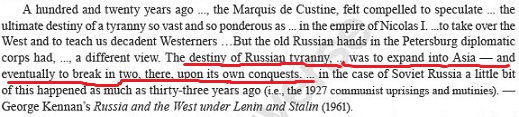
|
|
|
|
|
TEN TRAINS EQUIVALENT AMERICAN LEND-LEASE WEAPONS THAT STALIN & RUSSIANS GAVE TO MAO & CHINESE COMMUNISTS;
FORTY SHIPS EQUIVALENT QUANTITY OF TANKS & CANNONS, BOTH AMERICAN-MADE & JAPAN-MADE
3300 TONS OF PETROL FROM RUSSIANS IN 1947 ALONE; PLUS 2000 TONS OF DIESEL, 1000 TONS OF PLANE FUEL, 700 TONS OF EXPLOSIVES & 2000 TONS OF MACHINERY OIL
30000 TONS OF PETROL FROM RUSSIANS IN 1948; PLUS 1000 TONS OF PLANE FUEL, 5000 TONS OF KEROSINE, 3000 HEAVY WEIGHT TRUCKS & 150 ARTILLERY TRACTORS
DEATH OF MILLIONS OF YELLOW MEN, & POSSIBLY MORE IN THE FUTURE WAR AGAINST TAIWAN !!!!!
Reference: see the writing by James Perloff China Betrayed Into Communism on Friday, 24 July 2009 at
http://www.thenewamerican.com/index.php/history/world/1464
August Storm lend-lease weapons ended up in Mao's hands.
"At the Teheran and Yalta wartime conferences, however, Roosevelt asked Stalin if he would break his pact with Japan and enter the Far East war. Stalin agreed, but attached conditions. He demanded that America completely equip his Far Eastern Army for the expedition, with 3,000 tanks, 5,000 planes, plus all the other munitions, food, and fuel required for a 1,250,000-man army. Roosevelt accepted this demand, and 600 shiploads of Lend-Lease material were convoyed to the USSR for the venture. Stalin's Far Eastern Army swiftly received more than twice the supplies we gave Chiang Kai-shek during four years as our ally.
"General Douglas MacArthur protested after discovering that ships designated to supply his Pacific forces were being diverted to Russia. Major General Courtney Whitney wrote: 'One hundred of his transport ships were to be withdrawn immediately, to be used to carry munitions and supplies across the North Pacific to the Soviet forces in Vladivostok.... Later, of course, they were the basis of Soviet military support of North Korea and Red China.'
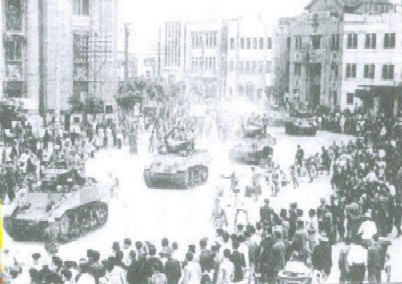
|
* In Commemoration of China's Fall under the Alien Conquests in AD 1279,
AD 1644 & AD 1949 *
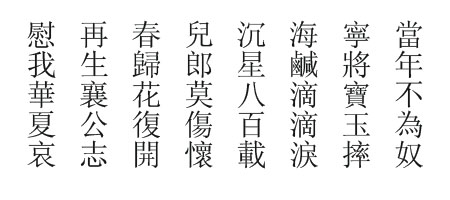
At the time [when China fell under the alien rule], refusing to be slaves,
[our ancestors] died as broken jades rather than being alive as an intact tile.
Tears, which tasted like the sea water, dripping down [the face] one by one,
For [China] the star [that fell from the sky] had been down [at the bottom of the sea] for 800 years.
Sons, please do not get saddened in the hearts,
For as the flowers did, they blossom when the spring returns.
When the [hegemony lord] Xianggong's swear is to be revived again,
The sorrow of the Flowery Xia Chinese would be soothed.
|
|
|
|
|
|
|
|
|
Sovereigns & Thearchs;
Xia-Shang-Zhou dynasties;
Zhou dynasty's vassalage lords;
Lu Principality lords;
Han dynasty's reign years
(Sexagenary year conversion table-2698B.C.-A.D.2018; 247B.C.-A.D.85)
|
|
The Sinitic Civilization - Book I is
available now on
iUniverse,
Barnes & Noble,
Amazon,
Google Play|Books
and
Nook.
The Sinitic Civilization - Book II is
available at
iUniverse,
Amazon and Barnes & Noble.
Check out the 2nd edition preface that realigned the Han dynasty's reign years strictly observing the Zhuanxu-li calendar of October of a prior lunar year to September of the following lunar year, and the 3rd edition introduction that had an overview of Sinitic China's divinatory history of 8000 years.
The 2nd edition preface had an overview of the epact adjustment of the quarter remainder calendars of the Qin and Han dynasties, and the 3rd edition introduction had an overview of Sinitic China's divinatory history of 8000 years.
The 2nd edition realigned the Han dynasty's reign years strictly observing the Zhuanxu-li calendar of October of a prior lunar year to September of the following lunar year.
Stayed tuned for Book III that is to cover the years of A.D. 86-1279, i.e., the Mongol conquest of China, that caused a loss of 80% of China's population and broke the Sinitic nation's spine.
Preview of annalistic histories of the Sui and Tang dynasties, the
Five Dynasties, and the two Soong dynasties
could be seen in
From the Khitans to the Jurchens & Mongols: A History of Barbarians in Triangle Wars and Quartet Conflicts
(The Barbarians' Tetralogy - Book III: available at iUniverse;
Google Play|Books;
Amazon;
B&N).
(A final update of the civilization series is scheduled for October of 2022, that would put back the table of the Lu Principality ruling lords' reign years, that was inadvertently dropped from Book I during the 2nd update.)
|
|
Now, the Scourge-of-God-Tetralogy.
Book III of
The Barbarian Tetralogy, i.e., this webmaster's barbarism series, is released in October of 2022 by iUniverse. This barbarism series would be divided into four volumes covering the Huns, the Xianbei, the Turks, the Uygurs, the Khitans, the Tanguts, the Jurchens, the Mongols and the Manchus.
Book I of the tetralogy would extract the contents on the Huns from
The Sinitic Civilization-Book II,
which rectified the Han dynasty founder-emperor's war with the Huns on mount Baideng-shan to A.D. 201 in observance of the Qin-Han dynasties' Zhuanxu-li calendar.
Book II of the Tetralogy would cover the Turks and Uygurs.
And
Book IV would be about the Manchu conquest of China.
From the Khitans to the Jurchens & Mongols: A History of Barbarians in Triangle Wars and Quartet Conflicts
, i.e., Book III of
the Scourge-of-God-Tetralogy,
focused on the Khitans, Jurchens and Mongols, with the missing one-year history of the Mongols' Central Asia campaigns rectified.
This webmaster, other than the contribution to the Sinology studies in rectifying the Huns' war to 201 B.C., and realigned the missing one-year history of the Mongol Central Asia war, had one more important accomplishment, i.e., the correction of one year error in the Zhou dynasty's interregnum (841-828 B.C. per Shi-ji/840-827 per Zhang Wenyu) in
The Sinitic Civilization-Book I, a cornerstone of China's dynastic history.
|
The Scourges of God: A Debunked History of the Barbarians (available at iUniverse|Google Play|Google Books|Amazon|B&N)
From the Khitans to the Jurchens & Mongols: A History of Barbarians in Triangle Wars and Quartet Conflicts
(The Barbarians' Tetralogy - Book III)
Epigraph,
Preface,
Introduction,
Table of Contents,
Afterword,
Bibliography,
References,
Index
|
|
Written by Ah Xiang
|
|


 ***
***


![Though, Anna Wang [Anneliese Martens], in her memoirs, expressed jealousy over Gong Peng by stating that the Anglo-American reporters had flattered the Chinese communists and the communist movement as a result of being entranced with the goldfish-eye'ed personal assistant of Zhou Enlai](GongPeng.jpg)