Sinitic Civilization-Book 1
Sinitic Civilization-Book 2
Tribute of Yu

Heavenly Questions
Zhou King Muwang's Travels
The Legends of Mountains & Seas
The Bamboo Annals - Book 1
The Scourge-of-God-Tetralogy:
From the Khitans to the Jurchens & Mongols: A History of Barbarians in Triangle Wars and Quartet Conflicts
(available at iUniverse;
Google;
Amazon;
B&N)
|
|
 This website's contents are the result of 20 years' writings --that could be compared to the "archaeological deposits" in a literary sense.
The freelance-style writings on the website were not proof-read.
Portion of the writings, i.e., related to Pre-History, Xia, Shang, Zhou, Qin, and Han dynasties, was extracted, polished, reconciled, and synthesized into
The Sinitic Civilization - Book I which is
available now on
Barnes & Noble,
Amazon,
Google Play|Books
and
Nook.
Book II is
available now on
Amazon
and Barnes & Noble.
Check out this webmaster's 2nd edition --that realigned Han dynasty's reign years strictly observing the Zhuanxu-li calendar of October of a prior lunar year to September of the following lunar year
and
cleared this webmaster's blind spot on the authenticity of the Qinghua University's Xi Nian bamboo slips as far as Zhou King Xiewang's 21 years of co-existence with Zhou King Pingwang was concerned.
To give the readers a heads-up, this webmaster had thoroughly turned the bricks concerning the Sinitic cosmological, astronomical, astrological, historical, divinatory, and geographical records, with the indisputable discovery
of the fingerprint or footprint of the forger for the 3rd century A.D. book Shang-shu (remotely ancient history),
and
close to 50 fingerprints or footprints of the forger of the contemporary version of The Bamboo Annals --a book that was twice modified and forged after excavation.
All ancient Chinese calendars had been examined, with each and every date as to the ancient thearchs being examined from the perspective how they were forged or made up.
Using the watershed line of Qin Emperor Shihuangdi's book burning to rectify what was the original before the book burning,
this webmaster filtered out what was forged after the book burning of 213 B.C.
This webmaster furthermore filtered out the sophistry and fables that were rampant just prior to the book burning, and validated the history against the oracle bones, bronzeware and bamboo slips.
There are dedicated chapters devoted to interpreting Qu Yuan's poem Asking Heaven, the mythical mountain and sea book Shan Hai Jing, geography book Yu Gong (Lord Yu's Tributes), and Zhou King Muwang's travelogue Mu-tian-zi Zhuan, as well as a comprehensive review of ancient calendars, ancient divination, and ancient geography.
One chapter is focused on the Huns, with a comprehensive overview of the relationship between the Sinitic people and the barbarians since prehistory.
The book has appendices of two calendars: the first Zhuanxu-li anterior quarter remainder calendar (247 B.C.-85 A.D.) of the Qin Empire, as well as a conversion table of the sexagenary years of the virtual Yin-li (Shang dynasty) quarter remainder calendar versus the Gregorian calendar, that covers the years 2698 B.C. to 2018 A.D.
Refer to
Introduction_to_The_Sinitic_Civilization,
Afterword,
Table of Contents - Book I (Index)
and
Table of Contents - Book II (Index)
for details.
This website's contents are the result of 20 years' writings --that could be compared to the "archaeological deposits" in a literary sense.
The freelance-style writings on the website were not proof-read.
Portion of the writings, i.e., related to Pre-History, Xia, Shang, Zhou, Qin, and Han dynasties, was extracted, polished, reconciled, and synthesized into
The Sinitic Civilization - Book I which is
available now on
Barnes & Noble,
Amazon,
Google Play|Books
and
Nook.
Book II is
available now on
Amazon
and Barnes & Noble.
Check out this webmaster's 2nd edition --that realigned Han dynasty's reign years strictly observing the Zhuanxu-li calendar of October of a prior lunar year to September of the following lunar year
and
cleared this webmaster's blind spot on the authenticity of the Qinghua University's Xi Nian bamboo slips as far as Zhou King Xiewang's 21 years of co-existence with Zhou King Pingwang was concerned.
To give the readers a heads-up, this webmaster had thoroughly turned the bricks concerning the Sinitic cosmological, astronomical, astrological, historical, divinatory, and geographical records, with the indisputable discovery
of the fingerprint or footprint of the forger for the 3rd century A.D. book Shang-shu (remotely ancient history),
and
close to 50 fingerprints or footprints of the forger of the contemporary version of The Bamboo Annals --a book that was twice modified and forged after excavation.
All ancient Chinese calendars had been examined, with each and every date as to the ancient thearchs being examined from the perspective how they were forged or made up.
Using the watershed line of Qin Emperor Shihuangdi's book burning to rectify what was the original before the book burning,
this webmaster filtered out what was forged after the book burning of 213 B.C.
This webmaster furthermore filtered out the sophistry and fables that were rampant just prior to the book burning, and validated the history against the oracle bones, bronzeware and bamboo slips.
There are dedicated chapters devoted to interpreting Qu Yuan's poem Asking Heaven, the mythical mountain and sea book Shan Hai Jing, geography book Yu Gong (Lord Yu's Tributes), and Zhou King Muwang's travelogue Mu-tian-zi Zhuan, as well as a comprehensive review of ancient calendars, ancient divination, and ancient geography.
One chapter is focused on the Huns, with a comprehensive overview of the relationship between the Sinitic people and the barbarians since prehistory.
The book has appendices of two calendars: the first Zhuanxu-li anterior quarter remainder calendar (247 B.C.-85 A.D.) of the Qin Empire, as well as a conversion table of the sexagenary years of the virtual Yin-li (Shang dynasty) quarter remainder calendar versus the Gregorian calendar, that covers the years 2698 B.C. to 2018 A.D.
Refer to
Introduction_to_The_Sinitic_Civilization,
Afterword,
Table of Contents - Book I (Index)
and
Table of Contents - Book II (Index)
for details.
|
|
Table of lineages & reign years:
Sovereigns & Thearchs;
Xia-Shang-Zhou dynasties;
Zhou dynasty's vassalage lords;
Lu Principality lords;
Han dynasty's reign years
(Sexagenary year conversion table-2698B.C.-A.D.2018; 247B.C.-A.D.85)
|
Epigraph|Preface|Introduction|T.O.C.|Afterword|Bibliography|References|Index
(available at iUniverse|Google|Amazon|B&N)
|
|
QING DYNASTY: PART I
Founding Of 'Da Jin' (Grand Gold Dynasty)
Eight Banner System
Twenty Five Years Of War Against China
The Battle Of Mountain & Sea Pass
Entering China Proper
Infamous Queue-Related Massacre
Solidifying Rule Over China
Qing Emperor Shunzhi (Qing Shizu, Aixinjueluo Fu-lin, r. 1644-1661):
Qing Emperor Kangxi (Qing Shengzu, Aixinjueluo Xuan-ye, r. 1662-1722):
1689 Treaty of Nerchinsk & Pereira Thomas
Recovering Taiwan:
Qing Emperor Yongzheng (Qing Shizong, Aixinjueluo Yin-zhen, r. 1723-1735):
Qing Emperor Qianlong (Qing Gaozong, Aixinjueluo Hong-li, r. 1736-1795):
Qing Emperor Jiaqing (Qing Renzong, Aixinjueluo Yong-yan, r. 1796-1820):
|
The Opium War (1839-1842)
"Wangxia Treaty" [U.S.] & Whampoa Treaty [France]
Second Opium Wars (1856–60) & Arson of Summer Palace
Taiping (Grand Peace) Heavenly Kingdom Rebellion
Foreign Enterprises Movement (Self-Strengthening)
The Manchu Military System: Brave-Camp Army & New Army
Russian Encroachments [1847-1900]
1876 Anglo-Chinese Yantai Treaty
1884-1885 Franco-Chinese War
Imperialist Encroachments On Korea
1894 Sino-Japanese War
Russo-Japanese War Over Manchuria
Rise of Yuan Shi-kai
Start Of Water-Melon Partitioning
Hundred Day Reformation
The Boxers & Invasion of Eight Allied Nations
Rise of Yuan Shi-kai (Continued)
Assassinations & Uprisings
'Retaining Railroad' Movement
Wuchang Uprising & Xin Hai Revolution
|
| [ this page: Manchu.htm ] |
[ next page: qing.htm ] |
The Manchus were both a blessing and a disaster for China. The blessing would be its early territorial expansion which somehow prepared China proper for buffering the Czarist eastward expansion that would inevitably come in the last couple hundreds of years. The disaster would be its policy of 'closing off the seashore' for segregation of the Ming Dynasty remnants in Taiwan and Southeast Asia from mainland China.
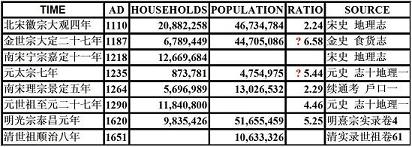 (The Manchu's territorial gain was at the expense of China's population drop from 51.66 million people in 1620 to 10.63 million people in 1651, a tragic loss from the Manchu invasion, which also exhibited the fact that China was not a country that could be easily conquered and that China's brave men were always willing to fall martyrdom in the resistance to the foreign invasion.
* In Commemoration of China's Fall under the Alien Conquests in A.D. 1279,
A.D. 1644 & A.D. 1949 *
Li Ao, a critic of the K.M.T. party on Taiwan, echoed Li Hongzhang's comments that Manchu China's confrontation with 'red-hair devils' (i.e., the British) was an extraordinary event not foreseen by China for 3000 years and that Britain, with its military might and fire-power, was an enemy China could not match during the course of past 1000 years.
Wrong ! The cousins of 'red-hair devils', i.e., the Dutch, had arrived at Java in A.D. 1595 and the Chinese coast in A.D. 1602. From A.D. 1603 to 1624, Ming China exerted hundreds of ships and thousands of soldiers to repelling the Dutch from the Chinese coasts and the Pescadores Islands. Oftentimes, numerous small Ming ships encircled the big Dutch warships for sake of winning the fight. Ming China mobilized a huge field army for landing on the Penghu Islands (i.e., Pescadores) and after a fierce fighting, forced the Dutch into withdrawal. Dozens of years later, Zheng Chenggong, i.e., son of pirate-turned Ming General Zheng Zhilong, would first adopt the approach of "defeating the aliens by means of the aliens' weapons". Zheng Chenggong, whose merchant fleets sailed to the four corners of the seas, actively purchased weapons, firearms and cannons from the Dutch. In February of A.D. 1662, Zheng Chenggong successfully expelled from the Taiwan Island the Dutch who, having colonized the island from 1624 to 1662, already latinized the aboriginals' language to the extent that the aboriginals no longer remembered their own native language. Before the Dutch, Ming China waged two wars against the Portuguese during the time periods of 1521-1522 and 1547-1549 for securing the territorial integrity.
(Ming China, after Zheng Heh's 7 Naval Expeditions and Zheng He's death, destroyed the 'bao chuan' or "treasure ships" [that were 440 feet long and possessed nine masts] and the diagrams, and closed off the seashore till Ming Emperors Rongqing [Ming Muzong] & Wanli [Ming Shenzong], and after a short time period of loosening, completely closed off the seashore beginning from Emperor Jiajing's 2nd year, i.e., A.D. 1523.
In ancient China, the 'gui' [ghost] word had no derogatory connotation as known in the modern equivalent word of 'devil' that was cited by Li Ao.)
Manchu Qing China, in the ensuing hundreds of years, had been mostly occupied with "pleasure-seeking (hedonism) and literature-decoration" (inquisitions), a 1916 comment by Japanese Prime Minister Okuma Shigenobu in regards to Yuan Shi-kai's death and its influence on the rise and fall of the Republic Of China. (The worst thing is that today's decadent Communist China is not any better
than the Manchu rulers.
Note that the "1957 Anti-Rightists Movement" had doomed China's fate for 20 years after finishing off China's half-century worth of elites and conscience,
and the June 4th, 1989 Massacre had routed China's elites & conscience once again and doomed China since 1989.
China, in addition to losing tons of gold, silver & wealth that were accumulated over the span of 5000 years, would lose almost one century worth of good souls for nothing.
Red alerts !!!)
Founding Of the 'Great Jin Dynasty' (gold dynasty)
Similar to the legends about the Jurchen founders, the ancestor of the Manchu founders, Bu-ku-li-yong-shun, had wandered into a village where he was taken in as a distinguished guest and given a woman for marriage. Bu-ku-li-yong-shun was said to have been born after his mother swallowed a red fruit dropped by a sparrow. Bu-ku-li grew up under the foot of the Changbaishan Mountain. When he asked who his father was, his mother told him the 'red fruit' story and gave him the last name of 'Ai-xin-jue-luo' which was translated into Chinese as the 'jin' or gold for Ai-xin and 'surname' for Jue-luo. Bu-ku-li-yong-shun, similar to the Jurchen founders, would somehow pacify the multi-generation fighting between this village where he took as home and two other neighboring villages. He was supported by all three villages as chieftain, called 'bei-le'. Hence the 'Ai-xin-jue-luo' tribe came into existence.
Bu-ku-li-yong-shun's descendants would relocate to a place called He-tu-a-la (i.e., later Xingjing). Jue-chang-an, the grandfather of later Manchu founder Nurhachi or Nurhachu (1559-1626), would gradually grow in strength. A Ming Dynasty general (Li Chengliang) at Liaoxi, in order to suppress the Jurchen growth, attacked the grandson-in-law of Jue-chang-an. Jue-chang-an and his son died as a result of conspiracy between the chieftain Ni-kan-wai-lan and Ming Dynasty General Li Chengliang. Nurhachi and his brother were among the Manchus captured by the Ming army. Nurhachi, for his extraordinary outlook, was set free by the wife of Li Chengliang per "Qing Shi Gao". "Qing Shi Gao" stated that Nurhachi acquired his strength after winning over the support from chieftains of the Saerhu fort, the Jiamuhu city and the Zhanhe city in A.D. 1583. Nurhachi, around the age of 25 at that time, attacked chieftain Ni-kan-wai-lan to avenge the death of his father/grandfather. Ni-kan-wai-lan fled to the Ming territories, and Nurhachi wrote a letter to the Ming court asking for handover of Ni-kan-wai-lan. The Ming court, however, only condoled with Nurhachi with 30 horses, two coffins, the post of 'dudu' (i.e., governor-general) of Jianzhou-wei, and the title of General 'long-hu' (dragon and tiger). Nurhachi hence set up four banners of armies, and trained his soldiers. The original four banners were of yellow, red, white and black, and later blue replaced the color of black. (http://www.secretchina.com/news/articles/4/7/2/67823.html pointed out that banner system was first set up in A.D. 1601.) Nurhachi attacked the Ming border castle to have Ni-kan-wai-lan captured and executed.
|
There is a need to make a distinction between the Jurchens and the Manchus.
The later Manchus might not be a kinsmen tribe of the original Jurchens, or descendants of the Jurchens who remained in the homeland throughout the Jurchen expansion in northern China during the period of 1115-1234 A.D.
The royal family of the Jurchens could be different from the Jurchens that they ruled.
The history annals pointed out that the Jurchen founders came from the Korea peninsula.
According to Meng-da Bei Lu, the Jurchens and the Dadan [i.e., the Mongols], whose C haplogroup gene was validated today, were of the same family, with the distinction made for the Dadan people due to their civilized levels.
Those near the Chinese were called by cooked, those faraway called raw, and among the raw, there were two groups of black and white, black meaning the extreme uncivilized and the white meaning somewhat civilized. Genghis Khan's Mongols, according to the book, belonged to the Black Dadan, whose barbarity was exhibited in its customs of having each horseman round up ten non-Mongol villagers as fodder to fill moats and sack forts, while the Jurchens belonged to the White Dadan. The Dadan, according to the Chinese classics, could have some ingredients from the Shatuo Turks of the Tang Dynasty period.
Now, the Jurchens, when they were overrun by the Mongols, had been decimated.
The later Manchus could have nothing to do with the Jurchens, at most hijacking the Jurchen name.
The Manchu clan names bore no resemblance to the Jurchen clan names, such as the royal Wanyan name.
The purported Manchu founder Nuerhachi's six-generation ancestor carried the Mongol name 'Mengge-timuer'.
According to Korean book Lee Dynasty's factual Records, the Jurchens disclosed to the Korean emissary that they belonged to the Mongol stock.
In A.D. 1635, Huang-tai-ji prohibited the people from calling the Manchus by the Jurchens (i.e., 'Zhu-shen').
The 'Qing' dynasty's name purportedly meant 'brave' in the Mongol language.
The fellow tribesmen that the Manchus acknowledged to be their own included Manzhou (Jianzhou), Hada, Wula, Huifa, and Yehe.
According to Lü Simian's analysis, the two characters 'Manzhou' (with the water sign to mean a midstream island or continent) for the Manchus derived from the 'Man-zhu' which was a Manchu chieftain's declension for self like what the word Malgal was for, with a conclusion that the Jurchens in Manchuria never changed their name for thousands of years since the Su-shen time of the Zhou dynasty but were given alternative names of 'Yi-lou' (cave dwelling) and 'Man-zhu' or Mohe (Malgal) for the chieftains' declension.
(The presently dominant C haplogroup people in southwestern Siberia, i.e., the Mongols, were ascertained to be of the C2b1b1-F3796 type. The Manchus, a northern C2b branch that separated from the former about 3000 years ago, carried the rare C2b1b2a-F14751 gene.
As to the C haplogroup barbarians in western Siberia 4000 years ago, they were found with a minor presence in the bronze sites and carried the C41a genes while their closest relatives, like C4a2, C4a3, were seen moving on to today's Ukraine.
Note that the majority stock of the Huns, the Xianbei, and the Khitans were ascertained by Jirin University frontier people research institute to be of the same 'North Asia' stock.
The physical anthropology studies of the Khitan tomb remains showed that the Khitans belonged to the "North Asia" or the "Siberia-Baikal" type with a low cranial forehead and a higher facial appearance, i.e., people who had no similarity to the East Asia type people.)
|
|
By the late Ming dynasty, three Jurchen tribes were known: Jianzhou or Chien-chou (Jianzhou Prefecture), Haixi or Hai-hsi (west of the sea), & Yeren or Yeh-jen (the uncivilized people).
The territories was named Haixi-wei [West-of-sea Garrison] by the Ming Dynasty, and the Ye-he tribe was the biggest of the four sub-tribes in that area.
Nurhachi united various tribes of Manchuria, pacified the neighboring Mongol tribes, and expanded their territory.
Nurhachi first defeated the Ye-he tribe. Ye-he married over a woman to Narhaci, with Huangtaiji born by this Ye-he woman. The Ye-he tribe chieftain, considered a vassal of the Ming Dynasty, was jealous of Nurhachi's expansion, and he called upon an army of 30,000, including some Mongols, for an attack on Nurhachi.
"Qing Shi Gao" stated that Ye-he assembled three tribes of Qula, Hada and Huifa, three Mongol tribes of Ke'erxin, Xibo and Gua'ercha, and three Changbai [Mt Forever White] tribes of Ne'yin and Zhusheli.
Nurhachi thoroughly defeated the Ye-he tribe. The Ye-he tribe promised to send in their daughter for inter-marriage with Nurhachi, but the Ye-he tribe then decided to marry the princess to the Mongols. The Ye-he family would later produce the Empress Dowger Cixi who induced the 1900 invasion of the eight allied powers. More Mongol tribes came to submit, including Ke'erxin and Khalka. Huangtaiji went to Mongolia to have an engagement with a Mongol princess of the Ke'erxin tribe.
By A.D. 1616, Nurhachi would proclaim the founding of 'Da Jin', namely, the Grand Gold Dynasty, at a place called Xingjing. Nurhachu declared the era of Tian Ming, i.e., the mandate of heaven. Huangtaiji, the eighth son, was conferred the title of No. 4 Beila, i.e., the fourth prince. The eldest son, Zhu-ying, was ordered to commit suicide for his intention to subjugate his brothers two years before.
Later in A.D. 1636, Huangtaiji changed their name to Manzhou (Manchu) from Jurchen, with a weird combination of characters wherein the water-signed [Manchuria] "zhou" meant for a continent in the sea or an island in the river, and declared the dynasty name of 'Qing'.
The Eight Banner System
In addition to four princes, five ministers were instituted. In August of A.D. 1616, the Manchu armies went across the Heilongjiang [Amur] River and took over 11 castles. In A.D. 1617, Prince Ming'an of the Mongol tribe Ke'erxin came to pay respect. The Manchus campaigned against islands in the sea (? Sakhalin Island in the Japan Sea) in this year.
Aside from the original four banners of yellow, red, blue and white, comprising of 7500 soldiers each banner, Nurhachi set up four extra 'embedded banners' of yellow, red, blue and white [in A.D. 1615 per http://www.secretchina.com/news/articles/4/7/2/67823.html].
The so-called 'Eight Banner' system was used for organizing the armies into eight columns at times of war but released to agricultural production at times of peace. Later, the Manchus under Huangtaiji set up eight Mongol and eight Chinese banners, respectively, on basis of the ethnic composition.
The original four banners were assigned as the left wing, and the embedded four banners were assigned as the right wing. In addition to the Manchu Eight Banners, some Mongol and Han ethnic eight banners were set up, and the total head-count reached 280,000. After the unification of China, the original four banners, about 100000 soldiers, were named 'Jin Qi' or the Forbidden Banners, which were deployed around the capital. The remaining 24 banners were assigned to some eight major provincial garrisons around the nation as the Stationed Banners. Nationwide passes, cities around the capital and Manchuria were staffed with another 25 garrisons. All banner officers and soldiers were hereditary.
The Manchu, after entering Peking, set up a Green-Camp Standard Battalion of about 500,000 comprising of the turncoat Ming armies. It was under the command of "bing bu" or the ministry of army. The Green-Camp was named after the color of its banner and it was ethnic Chinese. The Green-Camp was sub-divided into two parts, the 'Green-Camp At-The-Capital' guarding the capital and the Canal, and the 'Green-Camp At-The-Province'. By the time of eruption of the Taiping Rebellion, both the Banner and the Green Camp armies had rotten so much that they could not put up a fight.
Twenty-Five Years of War Against Ming China
Southern Manchuria, today's Liaoning Province, was historically the Ming Chinese territories.
Since the Qin Dynasty, the Chinese had fled to Manchuria for asylum. History repeatedly speculated that ancestors of the Khitans could be those coolies who fled the order of Qin Emperor Shihuangdi to build the Great Wall. Though, this speculation could be wrong in attributing the shaved heads of the barbarians to the Qin China's penalizing code of shaving the hair of the convicts - as the recent DNA analysis had proven that the barbarians of northern Manchuria belonged to the C-haplogroup people who arrived in Northeastern Asia 40 to 50 thousand years ago.
The physical anthropology studies of the Khitan tomb remains showed that the Khitans belonged to the "North Asia" or the "Siberia-Baikal" type with a low cranial forehead and a higher facial appearance, i.e., people who had no similarity to the East Asia type people.
Per Li Zhiting, the area from Shanhaiguan [the Mountain & Sea Pass] to Kaiyuan-Tieling had been fortified by a castle every 30 li distance. On the mountains, the beacon towers were built at a distance of every five Chinese li distance. Liao-dong, i.e., the area to the east of Liao-he River, was especially important for strategic defense as a result of its leveled span of land that linked to the Mongols to the west and northwest, the Jurchens to the east and northeast, and the Koreans to the east and southeast.
In A.D. 1618, Nurhachi, after making an oath of 'Seven Hatreds for the Ming Dynasty' (i.e., the Seven Grievances), would lead an army of 20,000 against the Ming border towns, including the city of Fushun.
The leftside 4 banners were to attack Dongzhou and Magengdan, while the rightside 4 banners to attack Fushun.
What happened here would be what some historians claimed to be a setup by Li Chengliang who, acting as the most powerful border general in Manchuria, deliberately abandoned the dozens of Ming forts in southern and eastern Manchuria to appease Nu'erhachi with whom Li Chengliang was said to have maintained trade relations for years.
With the Manchus taking over the territory of southern and eastern Manchuria from Li Chengliang's treacherous action, the rise of the Manchus became a fact accompli.
Before arriving in Fushun, a Chinese intellectual, by the name of Fan Wencheng, came to Nurhachi's camp to serve as a counsellor. Nurhachi asked Fan whether Song Dynasty's prime minister Fan Zhongyan was his ancestor, and Fan replied 'yes'. (What an unfilial son Fan Wencheng was! Unfortunately, China was always not lacking opportunists and traitors: When a forest is growing bigger, you would expect different variety of birds to dwell inside !) Fan Wencheng wrote a letter to Li Yongfang (a Ming "you ji" [i.e., mobile fighter] general at Fushun), and somehow persuaded him into a surrender. (Li Yongfang later became a Manchu China founding general and his family enjoyed glory and wealth for hundreds of years to come.) Nurhachi then defeated Ming relief armies for Fushun and killed three generals. The Manchus killed Zhang Chengyin, a Ming "zong bing" [sub-prefecture military magistrate] general. In July, the Manchus took over the Yahuguan Pass and killed Ming General Zou Chuxian.
When the news of defeat arrived at the Ming court, Ming Emperor Shenzong sent someone called Yang Hao to counter the Nurhachi Manchus.
The Battles Of Sa'erhu
In A.D. 1619, the Manchus attacked Ye-he and took over more than 20 castles. The Manchus retreated when they heard that Yang Hao had led the Ming army to the aid of the Ye-he tribe. Yang Hao, who had previously lost a battle to the Japanese Hideyoshi invaders in Korea, would lose the Battle of Saerhu.
Though Yang Hao mobilized an army of 200,000, including 20,000 Koreans and 20,000 Ye-he tribesmen, Nurchaci used the smart tactics and defeated the Ming armies one by one within a matter of one month. In March, the Manchus decided to attack the southern Ming contingent first. In the east, Ming General Du Song, departing Fushun, divided his forces between Sa'erhu and Jilin-ya (Jilin cliff). Under the Manchu attacks, Du Song and his deputies were all killed. In the west, the Manchus defeated the Ming army at Mt. Shaoqinshan. In the northwest, Ming General Ma Lin was defeated, and the Ye-he allies fled the scene. In the south, elder Manchu prince Daishan ordered that his soldiers, wearing Du Song's Ming army uniforms, mix up with Ming General Zhao Ting's 10,000 cavalry. The Manchus killed Zhao Ting during turmoil. Ming "jian jun" (supervisor, i.e., usually a eunuch) surrendered with his Korean allies after the flare of firearms backfired on the Ming camp. Hearing of the defeats, Yang Hao ordered that Ming's north column retreat. At Hulan, the Manchus ambushed the Ming Army's north column headed by Li Rubo. Korean General Jiang Hongli was released by the Manchus for sake of pacifying the Koreans. Yang Hao was arrested and demoted by Ming Emperor Shenzong (Zhu Yijun, reign A.D. 1573-1620), and "bingbu shilang" [supervisor of military ministry] Xiong Tingbi was conferred the post of "jing lüe" [i.e., managing governor] for Manchuria.
In April, the Manchus attacked Tieling. In May, the Korean king sent emissary to express gratitude to the Manchus for sparing the Koreans. In June, the Manchus attacked Kaiyuan and killed Ming General Ma Lin.
In July, Ming "qian zong" (i.e., general in charge of 1000 soldiers) Wang Yiping surrendered to the Manchus, and Tieling was taken. The Mongol Tribe Khalka came to the aid of Ye-he, and the Manchus defeated the Mongols and chased Khalka "beile" [prince] Lejiesai to the Liao-he River. In August, two Ye-he forts were taken over and the Ye-he tribe was exterminated by the Manchus.
In Oct, Khan Lindan of the Chaha'er Mongols sent a letter to the Manchus in a challenging tone, claiming an army of 300,000-400,000 Mongols. Five Khalka tribes sent an emissary to the Manchus for an allied attack at Ming.
In A.D. 1620, the Manchus rebuked Khan Lindan of the Chaha'er Mongols. The Chaha'er Mongols killed the Manchu emissary, and the Manchus killed the Chaha'er emissary in retaliation. In August, the Manchus attacked today's Shenyang. In Oct, the Manchus relocated the capital to Saerhu from Jiefan. Ming Emperor Shenzong died in this year.
In this year, Qin Bangping, i.e., brother of female general Qin Liangyu, came to the Liao-dong area with 3000-men Baigan-bing (white pole) army from the Shizhu County of today's Sichuan basin.
In A.D. 1621, at the Battle of the Hun-he River, two Chinese armies, consisting of Qin Bangping's Sichuan basin Qiangic or today's Yi-zu minority troops, and Dong Zhongkui and Chen Ce's Zhejiang Province army, crossed the Hun-he River to counterattack the Manchus after hearing that Shenyang (i.e., Mukden) might have fallen into the Manchu hands.
At first, the Sichuan army defeated the Manchu white banner and yellow banner army successively. The Manchus then had Li Yongfang roll in the cannons to blast at the Sichuan army.
The Manchus then fought against three thousand Zhejiang army.
The majority of the Sichuan and Zhejiang army soldiers died in the battle.
In Ming Shi, this battle was touted as the bravest act of the Chinese army which fought against a strong Manchu infantry army of several folds, that were reinforced by the cavalry.
Around ten Manchu generals were killed in this battle.
(Later, in A.D. 1630, female general Qin Liangyu (1574-1648) again answered the call of the emperor and took the Sichuan Qiangic army to the capital city of Peking, at the time when the Manchus intruded into the Desheng-men city gate.
Qin Liangyu was married with the minority Ma family, which claimed descent from Han Dynasty General Ma Yuan.)
Loss Of the Two Banks of the Liao-he River
Before Xiong Tingbi left the Shanhaiguan Pass, Shenyang was under the Manchu siege. Xiong Tingbi fortified the Liaoyang city and distributed 180,000 soldiers around various forts. Nurchaci, unable to take over Shenyang, retreated northward to conquer the Yehe tribe. The new Yehe chieftain, before being executed by the Manchus, sworn that should Yehe have one descendant left, the Yehe people would avenge themselves by capsizing the Nurchaci tribe, and it turned out to be Dowager Express Cixi (i.e., Yehe-nala-shi) who led the Manchu Qing dynasty to its final demise in 1911.
Xiong Tingbi stayed in eastern Liaoning Province for 3 years before he resigned under impeachment by an official of the new Ming Emperor Xizong (Zhu Youxiao, reign A.D. 1621-1627). Ming Emperor Guangzong, Zhu Youxiao, had a reign of only one year, A.D. 1260-1261. A civil official, Yuan Yingtai, who obtained "jin shi" (a 4th level imperial scorer in the civil services exam, after top 3 titles of 'zhuang yuan', 'bang yan' and tan hua'), was sent to Manchuria. When the Mongols suffered from a hunger disaster and came to Manchuria as refugees, Yuan Yingtai accepted all those Mongols and assigned them to the Liaoyang and Shenyang cities. In A.D. 1261, Nurchaci obtained the cooperation of the Mongol refugees as 'trojan horse', sacked the city of Shenyang, and killed "zong bing" (garrison chief) He Shixian. Yuan Yingtai lost a fight outside of Liaoyang. The Manchus released the water of the citywall ditch and sacked Liaoyang.
Yuan Yingtai committed suicide. After that, over fifty forts east of the Liao-he River all surrendered to the Manchus. Xiong Tingbi was recalled for service by Emperor Xizong. Xiong Tingbi had a dispute with "xuan hu" (pacifier minister or sub-province governor) Wang Huazhen as to defending the city of Guangning or the Liao River. Wang Huazhen circumvented Xiong Tingbi in having Emperor Xizong approve his plan to recover the territories east of the Liao River instead. Wang Huazhen then crossed the river with 140,000 soldiers.
In July, the Zhenjiang city, along today's Yalu River at the Sino-Korean border, killed a Manchu general and surrendered to Ming General Mao Wenlong. In Nov, the Manchus ordered Prince Ah'min to attack Mao Wenlong's army. A Mongol clan from the Khalka tribe surrendered to the Manchus. Xiong Tingbi was recalled as "jing lüe" by Ming Dynasty.
In 1621, Wu Xiang, i.e., father of later General Wu San'gui, passed the Ming imperial martial arts exam as "jin shi" and later married a sister of Zu Dashou.
Zu Dashou was upgraded to "you ji" (mobile fighting) general under the command of Wang Huazhen.
Wang Huazhen was "xun hu" [patrol & pacify, i.e., sub-provincial equivalent governor for the Guangning garrison of Liaoning Province].
After one year, in January of A.D. 1622, Wang Huazhen was defeated by the Manchus. Sun Degong, a "you ji" general under Wang Huazhen, surrendered the city of Guangning to the Manchus. All forts around Jinzhou were lost to the Manchus. Wang Huazhen and Xiong Tingbi burnt supplies and accompanied over 100,000 refugees back into the Shanhaiguan (Mountain and See) Pass.
From Jinzhou to the Shanhaiguan Pass, about 200 kilometer long strip between the sea and mountains was considered Hexi [west of the Liao-he River] Corridor.
Zuo Guangdou ('yu shi' [censor or inspector]), teacher of Yangzhou defender Shi Kefa, recommended Sun Chengzong ('da xue shi' [grand scholar]) for the job of fighting the Manchus. (Zuo Guangdou was later imprisoned by the eunuchs.)
Five Khalka Mongol tribes came to submit to the Manchus. Seventeen princes from the Mongol tribe of Er'lute came to submit. In A.D. 1623, the Mongol tribe of Zhalute came to submit to the Manchu, and their crown prince (who served as a hostage with the Manchus) was released. In April, the Manchus attacked the Zhalute Mongol tribe for their killing a Manchu emissary. In A.D. 1624, Khalka requested for relocation to the Manchu territories. In Feb, the Manchus decreed that the Ke'erxin Mongols not to have exchange with the Khalka tribe.
In May, Mao Wenlong invaded Huifa. In Aug, the Manchus destroyed Mao Wenlong's farming soldiers at the Yalu-dao Island. In A.D. 1625, Manchu Prince Mang-gu-er-tai defeated the Ming army at Fushun. In Feb, the Khalka Mongols sent over their daughter to Huangtaiji. In June and Aug, Mao Wenlong continued to attack the Manchus at Yaozhou and Haizhou. In Nov, Huangtaiji went to attack Chaha'er Mongol Khan Lindan. Ming Dynasty conferred Gao Di as "jing lüe".
The Battle of Ningyuan
Sun Chengzong was conferred the post of "bingbu shangshu" [i.e., secretary of military ministry]. Sun Chengzong advocated the fortification of Ningyuan as buffer for the Shanhaiguan Pass. Sun Chengzong employed Zu Dashou & Zhao Shuaijiao as his generals, built various forts around Ningyuan, trained 110,000 soldiers, and tilled 50 acres of military farmland. Four years later, Sun Chengzong was impeached by a Ming eunuch called Wei Zhongxian who had earlier managed to have Xiong Tingbi executed. Yang Di was ordered to replace Sun Chengzong. In A.D. 1625, Yang Di contracted the defense line to the city of Ningyuan which was about half way between the Shanhaiguan Pass and the Jinzhou city.
At this time, Nurhachi moved the capital to Shengjing [today's Shenyang City], and built a grand palace with front, hind, right and left accessory palaces. Hearing of Sun Chengzong's departure, Nurhachi, in January of A.D. 1626, personally led an attack at Ningyuan which was guarded by Ming General Yuan Chonghuan [a native of Dongguan of Guangdong Province]. With the help of the Jesuits, Yuan Chonghuan had built a kind of long-range cannons, named the "Red-hair Alien Cannon" [later changed by the Manchus to the 'Red-Coated Alien Cannon' for avoidance of using the "Yi" designation of barbarians by the Han Chinese]. Yuan Chonghuan employed a soldier from Fujian Province, by the name of Luo Li, who was learned in firing the cannons. Meantime, the Manchus led the Mongol soldiers on an attack of the Juehua-dao Island at the Sino-Korean border.
In April, the Manchus attacked five Khalka Mongol tribes for their betrayal. In May, Mao Wenlong attacked Anshanyi and Saerhu. The Ke'erxin Mongols sent an emissary to the Manchus to express gratitude.
In August of 1626, Nurhachi (Nuerhachi) died at age 68, after a reign of 11 years. This would be during the 11th year reign of Tianming Era.
Nurhachi was said to have died of the wounds he incurred from Yuan Chonghuan's "Red-hair Alien Cannon" at the Battle of Ningyuan (today's Xingcheng, Liaoning Province).
Yuan Chonghuan was conferred the post of "xun hu" (i.e., patrolling and protecting general or sub-provincial governor) of Liaodong, and Wang Zhichen took over the post of "jing lüe". Yuan Chonghuan renewed Sun Chengzong's policies of fortification and military farming to the west of the Liao River.
Two years later, in 1628, Zu Dashou was promoted to "zong bing" general for the A.D. 1626 victory at the Battle of Ningyuan-Jinzhou. Zu Dashou brothers, sons and nephews controlled the major forts and cities like Dalinghe [Jinxi-xian of Liaoning], Jinzhou, and Ningyuan.
The Manchus Sowing Dissension To Have Yuan Chonghuan Removed
Nurhachi's successor, Huangtaiji (1592-1643), the 8th son, would rename the Era to Tiancong from Tianming beginning from the next year. Huangtaiji was called 'Taizong Wenhuangdi' posthumously. (The name Huangtaiji was a combination of Chinese 'huang tai4 zi' and Mongol 'huang tai2 ji', both meaning a crown prince.) Huangtaiji was recorded to have red face and did not exhibit fear of coldness in the severe cold winters.
Mongol Tribe Ke'erxin also sent in condolences.
The Han Chinese were treated as slaves by the Manchus.
Huangtaiji decreed that the extra Han Chinese be separated from slaves and treated as civilians and that the Han Chinese select their own good men as leaders. Later, eight Han banners were set up, with the Manchus heading them.
In October of 1626, the Zhalute subtribe of the Khalka Mongols betrayed the Manchu alliance for the Ming dynasty. Huangtaiji ordered that elder brother Daishan campaign against them.
Yuan Chonghuan sent a lama to condoling on Nuerhachu's death. 14 Khalka "bei le" sent in emissaries for condolence. Daishan defeated the Zhalute Mongols, killed "bei le" Er'erzaitu and captured 14 more Mongol "bei le". Huangtaiji departed Shenyang for meeting Daishan at Tieling. One more Cha'haer tribe came to submit to the Manchus.
Huangtaiji instructed traitor Fan Wencheng to write a reply to Yuan Chonghuan. Yuan Chonghuan reprimanded Huangtaiji's emissary for challenging Ming China's suzerainty.
In Dec, Huangtaiji decreed that the Manchus be prohibited from trading iron weapons with the Mongols. The Heilongjiang [black dragon river] people came to pay respect to the Manchu.
In January of 1627, the first year of the Manchu Tiancong Era, Huangtaiji decided to attack the Koreans and the Mongols first. Huangtaiji dispatched Ah'min (2nd "bei le"), "bei le" Ji'erhalang, and Ah'jige etc against Korea.
Huangtaiji and Yuan Chonghuan traded more letters.
Huangtaiji intended to distract Yuan Chonghuan from the Korean expedition. At the rivermouth of Dongjiang (east river) on the border of China and Korea,
Mao Wenlong, a Ming 'zong bing' general, was attacked by the Manchus.
The Korean King requested for help with Ming Dynasty in driving the Manchus out of their country. (Korean King Li Chenggui had promised to Ming's first emperor Zhu Yuanzhang to be a Ming vassal forever.)
The Manchus invaded Korea after two Koreans, who offended the Korean king, fled to seek asylum with the Manchus and then treacherously acted as guides. Huangtaiji circumvented Mao Wenlong who stationed at the Dongjiang Island, and crossed the Yalu River to attack the Yizhou city of Korea. Huangtaiji earlier faked an attack on the bank of the Liao River for diverting Yuan Chonghuan's attention. The Manchus took over the Yizhou, Dingzhou and Anzhou prefectures of Korea. When the Manchus attacked the Korean capital, the Korean King sent over his cousin for peace talks with the Manchus.
After subduing Korea, Huangtaiji led his troops across the Liao River to attack Jinzhou. Yuan Chonghuan ordered that general Zhao Shuaijiao guard Jinzhou. Zhao Shuaijiao asked an eunuch to write letters to the Manchus for setting up a peace trap, hence delaying the Manchu attack for several days. With the relief army coming, Zhao Shuaijiao launched an attack and defeated Huangtaiji's Manchu Army. Then, Huangtaiji circumvented Jinzhou to attack the Ningyuan city. Yuan Chonghuan ambushed Huangtaiji with a column of army on the right side of the city. Huangtaiji faked to attack Jinzhou, but he actually retreated to Shenyang in an orderly manner. At this time, Yuan Chonghuan was reprimanded by the Ming court for not aiding Jinzhou.
Wang Zhichen was ordered to replace Yuan Chonghuan.
Ming Emperor Sizong (Zhu Youjian, reign A.D. 1628-1644) got enthroned and eunuch minister Wei Zhongxian was executed. Yuan Chonghuan was restored his position by Ming Emperor Sizong in April of A.D. 1628.
In A.D. 1629, Ming General Kong Youde and Geng Zhongming, i.e., the future Manchu Feudatory generals in Southwest China, defected to the Manchus with Ming China's cannons arsenal and manufacturing bureau after Yuan Chonghuan cheated Mao Wenlong into an arrest and executed Mao Wenlong for his disobedience. (Mao Wenlong was recorded to have launched numerous attacks at the Manchus and should be considered a brave man. His execution should be considered an abuse of power by Yuan Chonghuan. Yuan Chonghuan paid his price later when the Manchus adopted Kong & Geng's advice in attacking Peking from Mongolia in a roundabout way. Kong Youde and Geng Zhongming had treated Mao Wenlong as step-father.)
Kong Youde and Geng Zhongming proposed to Huangtaiji that the Manchus invade China through the Mongol territories, attack Ming's Longjingguan Pass at the Great Wall and then march on the Zunhua and Peking cities. To prevent Yuan from receiving an advance alert, Duo'ergun asked the two Ming generals to return to the Ming camp at Dengzhou on the Shandong peninsula. Duo'ergun stated that the Mongol tribe of Ka-er-xin must have guides for leading the way to the Longjingguan Pass. In October 1629, Huangtaiji, after spending days marching through the Mongol land, arrived at the Longjingguan Pass which was guarded by a few hundred Ming soldiers.
The Manchu forces totaled about 60000.
Then, Huangtaiji ordered that the four banners attack the Da'ankou Pass and another four banners attack the Hongshankou Pass. The Manchus pressed on at Zunhua-zhou.
The Ming court sent an urgent request to Shanhaiguan for relief.
Zhao Shuaijiao led the relief army to a place called Santunying where his army was destroyed by the Manchus. Zhao Shuaijiao committed suicide when Santunying refused to allow him to enter the gate at night. Santunying and Zunhua were taken by the Manchu Qing army subsequently. Within one month, numerous cities, including Jizhou, Shunyi and Tongzhou, were sacked by the Mongols. When the Manchus arrived at the citywall of Peking, Mang Gui had led another relief army to the relief of Peking from the Shanhaiguan Pass.
After Yuan Chongyuan led armies and two generals (Zu Dashou and He Kegang) to the relief of Peking, Huangtaiji was very much shaken. Yuan Chongyuan defeated the attacks by two Manchu princes.
The Manchus failed to sack the Peking city.
(Later in 1644, when Wu San'gui sent messenger to the Manchus for borrowing an army against Li Zicheng's rebel army, Duo'ergun was very much hesitant on the way to the Shanhaiguan Pass, thinking that it could be a Ming army trap: Duo'ergun asked how could Li Zicheng's rascal rebels sack the Peking city while he himself failed to do it three times.)
Huangtaiji then played a dissension to have Ming Emperor Chongzhen kill Yuan Chonghuan. Huangtaiji took the advice from Fan Wencheng to have two 'peace' letters written to the attention of Yuan Chonghuan and then have the two letters deliberately dropped near the two city gates of Peking. After capturing two Ming eunuchs sent by the Ming emperor for investigating into the two letters, Huangtaiji ordered a Chinese officer to deliberately talk about the Manchu contacts with Yuan in front of the two eunuchs and then deliberately allowed the two eunuchs to flee back into Peking. Then, Huangtaiji deliberately retreated five Chinese league distance per the fabricated agreement with Yuan Chonghuan. Soon, news came that Yuan Chongyuan was imprisoned by the 'Jinyi-wei' [colorful clothes] Imperial Eunuch Guards, and two Yuan Chongyuan generals, i.e., Zu Dashou and He Kegang, with 16000 Liao-dong crack troops, fled to exit the Shanhaiguan Pass for the hometown of Ningyuan. Yuan Chonghuan was ordered to be executed via 'slicing' or peeling off the flesh.
Emperor Chongzhen, at the admonition of court minister Sun Chengzong, immediately sent a messenger to chasing Zu Dashou and He Kegang for pacification even though the two guys had pillaged their way back to the Shanhaiguan Pass.
Huangtaiji withdrew the Peking siege to make the Ming soldiers drop their alert and then attacked Peking again after pillaging Gu'an and Liangxiang. When pressed by an eunuch gestapo, Ming General Mang Gui went outside of the city gate to have a fight with Huangtaiji's Manchu army. Huangtaiji sent some disguised soldiers into Mang Gui's camp and killed him in turmoil. Huangtaiji then withdrew his army to the Tongzhou area. At Zunhua, Huangtaiji defeated a cannon column led by Liu Zhilun. Then, Huangtaiji sacked Luanzhou.
In January of A.D. 1630, Za Dashou and Sun Chengzong were ordered to guard Santunying [Zunhua of Hebei Province] and Fenglun.
Za Dashou dispatched troops to Leting, Changli, Huning, Shimen, Taidouying and Yanheying to prevent the Manchus from retreating back across the Great Wall.
300 cavalry scouts were sent looking for the Manchu Army's trace.
After failing to take over Changli, Huangtaiji retreated to Manchuria via the old path: Huangtaiji never ever challenged the fortified Shanhaiguan Pass, i.e., the No. 1 Pass of China.
In Feb, Za Dashou was ordered to cross the Great Wall for Jianchang [Lingyuan of Liaoning Province] where he set up an ambush at the crossroad bordering the Mongol tribe of Keerxin.
On one day, Wu Xiang's scout team had a sudden encounter with the Manchu expedition force.
Wu San'gui forcefully broke out of the city to charge at the Manchu forces and rescued his father at the wound to his nosebridge in the course of killing a Manchu general. (This is in sharp contrast with his abandoning his father by defecting to the Manchus at the Battle of Shanhaiguan in 1644.)
Eunuch Gao Qiqian, i.e., the adopted father of Wu San'gui, wrote a recommendation letter to the emperor on behalf of Wu San'gui. Wu San'gui would soon become a Ming "you ji" [i.e., mobile fighter] general from the post of "zhong jun" under the leadership of Fu Zonglong.
Huangtaiji began to make similar cannons, called the 'Hong Yi Da Pao', i.e., Big Guns With Red Coat, with technology and knowhow obtained through the Shandong cannons factory that were shipped from across the Bohai sea. The Sino-Manchu warfare tilted the balance to the barbarians' favor as a result of the defectors' surrendering the cannons. Sun Chengzong was recalled for the post of guarding the Shanhaiguan Pass.
Sun Chengzong began to recover the territories of Luanzhou, Qianan, Yongping and Zunhua. Qiu Hejia was conferred the post of "xun fu" for Liao-dong.
The Surrender of Zu Dashou to the Manchus
In 1631, Wu Xiang was upgraded to the Jinzhou city's "zong bing" general under the command of Zu Dashou.
In August of A.D. 1631, Huangtaiji lay a siege of the Dalinghe city where Zu Dashoun and about 30000 civilians and soldiers were in defense. A column was led by Prince A'qige to attack Jinzhou for sake of preventing the Shanhaiguan relief army from coming to the aid of Dalinghe. Qiu Hejia ordered that Wu Xiang and Song Wei, with 40000 troops, depart Ningyuan for Jinzhou. The two parties fought a battle at Songshan. The Ming armies returned to the city of Jinzhou.
In mid-Sept, the Manchus attacked Jinzhou.
On September 24th, Wu Xiang and Song Wei were ordered to give relief to Dalinghe. The two parties used cannons and musketeers during the September 27th battle in the area between the Xiaolinghe River and the Changshan Mountain.
Huangtaiji ordered a two-prong attack at the two Ming camps.
When Wu Xiang intended to attack the Manchu camp with fire, the wind changed direction. The Ming armies were thoroughly defeated, and the remnants fled to the city of Jinzhou.
Wu Xiang was demoted by the Ming court.
At Dalinghe, Zu Dashou and He Kegang were defending the city. Zu Dashou's brother, Zu Dabi, who was renowned for his extraordinary strength, led a brave 120-men commando force on a night assault into the Manchu camp and almost killed Huangtaiji. The Manchus then bombarded the city with cannons. By winter, Zu Dashou surrendered to the Manchus, He Kegang was captured and killed, and Zu Dabi fled the city.
Among those who surrendered with Zu Dashou would be Wu Sanfeng and Pei Guozhen, i.e., brother and brother-in-law of Wu San'gui.
Zu Dashou proposed to take over Jinzhou for Huangtaiji. When Zu Dashou arrived in Jinzhou, both Qiu Hejia and Sun Chengzong had already been rebuked by the Ming court. Zu Dashou hence took over Jinzhou but asked Huangtaiji to defer attack till another time.
Emperor Chongzhen again pardoned Zu Dashou even though Qiu Hejia ["xun fu"] reported the 'fake' surrender to the Ming court.
Mutiny of Kong Youde, Li Jiucheng, Geng Zhongming & Shang Kexi
During the winter, at Dengzhou of Shandong, Kong Youde killed "zong bing" Zhang Dake and drove off "xun hu" Sun Yuanhua.
The mutiny occurred as a result of Kong Youde & Li Jiucheng being dispatched by Sun Yuanhua to Manchuria for giving relief to the Dalinghe Siege.
At Wuqiao of today's Hebei Province, the two, with 800 cavalry, pillaged villagers for food and then decided on returning to Shandong Province for rebelling against Sun Yuanhua, i.e., sub-governor for the Deng-Lai [Dengzhou-Laizhou] area.
The rebels sacked Linyi, Lingxian, Shanghe, and Qingcheng, i.e., counties to the north and east of today's Ji'nan.
In January of 1632, Kong Youde sacked Dengzhou [coastal Penglai of Shandong] and declared himself "du yuanshuai", i.e., a governor-marshal equivalent.
The Ming court sent the troops of Baoding-Tianjin-Changping to Shandong, but failed to quell the rebellion.
On June 9th, Emperor Chongzhen, at the advice of Liu Chongqing & Wang Wanxiang, ordered that eunuch Gao Qiqian relocate 10000 Liao-dong crack troops for Shandong. Za Dabi, Jin Guoqi, Wu Xiang & Wu San'gui entered the Shanhaiguan Pass.
On August 19th, the Ming armies, with 40,000 troops, which were reinforced by Wu Xiang's Liao-dong troops, attacked Kong Youde at Shahe [Yexian], and on the 30th, pushed to Baima. After a defeat, Kong retreated to Dengzhou, i.e., the coastline. On September 1st, the Ming army surrounded Dengzhou. Through Nov, Kong Youde were repeatedly beat back by the Ming army. Rebel Li Jiucheng was killed in the course of the breakout actions on November 21st & 27nd.
Kong requested for relief with Huangtaiji. Huangtaiji ordered that Kong Youde and Geng Zhongming retreat over the sea to Manchuria via the north gate of the city.
On December 3rd, the Ming army defeated Kong's breakout action at the west gate after obtaining the information from a defector.
On the night, Kong and about 10000 army and family members boarded over 100 ships for the other side of the Bay (Bohai Sea).
Luo Xianglin pointed out that Ming China's "cannons manufacturing bureau" was dismantled by Kong Youde for Manchuria as a gift to Huangtaiji, an event that would significantly strengthen the Manchu firepower.
Kong Youde, upon arriving at Shenyang, proposed that the Manchus attack Lüshun of Liao-dong. Kong and Geng hence took over Lüshun, killed "zong bing" Huang Long, and pacified a deputy general called Shang Kexi. Kong Youde was conferred the post of "yuan shuai" [marshal], and Geng and Shang the posts of "zong bing" respectively. The three guys, together with Wu San'gui, would be heads of the later "Three Feudatories".
In A.D. 1636, Huangtaiji changed their name to Manzhou (Manchu) from Jurchen, with a weird combination of characters wherein the water-signed [Manchuria] "zhou" meant for a continent in the sea or an island in the river, and declared the dynasty name of 'Qing', namely, clearness. Meanwhile, the whole northern China was in collapse as a result of marauding and pillaging by Li Zicheng and Zhang Xianzhong's rebels.
After the death of Huangtaiji, Emperor Shunzhi was enthroned. Huangtaiji's brothers, Duo'ergun (Dorgon) and Duoduo, would be responsible for pushing the war against Ming. The Manchus were said to have boasted of an army of 220,000 for the Eight Banners of the Manchu, Mongol and Han respectively. (After taking over China, they had raised an additional army of 660,000 for the Green Camp Battalions or Green Standard Battalions.)
In July 1638, Wu San'gui, at age 27, was promoted to "zong bing" [sub-prefecture military magistrate] general after Ming China had exhausted previous generations of fighters.
(Wu San'gui received three promotions within 6 years, from "you ji" to "can jiang" to "fu jiang" to "zong bing".)
Wu San'gui was in charge of the defense of Ningyuan where both Yuan Chonghuan and Sun Chengzong had dealt the devastating defeats onto the Manchus.
Surrender of Hong Chengchou
In early 1639, Hong Chengchou, so-called "san bian [trilateral border] zong du [governor-general]" of Shenxi Province, was ordered to relocate to Manchuria, away from his dozen years of entanglement wars with Li Zicheng and Zhang Xianzhong's rebellion.
Li Zicheng, originally a postal station soldier, lost his job at the Yinchuan station and
joined Gao Yingxiang's rebels, and after Gao's death, took up the rebel leader's job.
Emperor Chongzhen in A.D. 1629 took the advice of
yu-shi (censor) Mao Yujian and 'you jishi[4]-zhong' (palace steward) Liu Mao as to abuse and misuse of post stations
in the scale of 70-80% for private matters and only 20% for official business, and assigned the cost-saving matter to Liu Mao who orderd to dismantle post stations nationwide, which impacted the Yinchuan station.
Hong Chengchou instructed Wu San'gui in training the soldiers and practicing the weaponry.
On May 18th, 1640, at Xinshan [Mt Xinshan, Jinxian county of Liaoning Province], the Ming army fought against 1500 Manchu forces who stealthily circumvented Jinzhou to cover the defection of about 30 families of the Mongol Duo-luo-te tribe.
On June 15th, Huangtaiji sent 10000 reinforcements to Prince Jierhalang and Duoduo from Shenyang as replenishment of the loss from the previous skirmish.
Since March, Prince Jierhalang and Duoduo began to attack the surrounding forts of Jinzhou.
With Hong Chengchou's instruction of initiating attacks and defending cities at the same time, Wu San'gui launched an attack at the Manchu Embedded Blue Banner on July 8th.
Having called over Ma Ke from the Shanhaiguan Pass, Hong Chengchou then convened a meeting with four garrison commanders, i.e., Wu San'gui, Zuo Guangxian, Cao Bianjiao and Liu Zhaoji for a new round of attack with 40000 Ming army. On the 11th, the Ming army fought against the Manchu. Zu Dale from Jinzhou came over as well. The Manchus retreated to Yizhou.
Out of the three engagements, the Ming armies gained upper hand over the Manchus twice at Songshan [Mt Pine] & Xinshan [Mt Apricot].
Beginning from 1641, the Manchu cavalry approached the three sides of Jinzhou.
On the following two days after the Spring Festival day, Wu San'gui volunteered to load 15000 units of grain for delivery to the Jinzhou-Songshan-Xinshan cities.
On the 6th day of the lunar new year, Wu San'gui departed Ningyuan, and on the night of the following day, successfully transported the grain over to Jinzhou.
On the 9th day, 20000 Manchu cavalry tried to chase the empty carts.
In March, the Manchus dug up trenches to surround the Jinzhou city and then laid eyes on Songshan.
In May, Hong Chengchou was ordered to go to Ningyuan from Shanhaiguan.
By Dec, the Ming court sent over reinforcements consisting of troops from Datong [led by Wang Pu], Xuanfu [led by Yang Guozhu], Miyun [led by Tang Tong] and Shanhaiguan [led by Ma Ke].
With eight "zhen" [garrison] of troops, about 130000, Hong Chengchou departed for relief to Jinzhou.
Wu San'gui, counted among one of three dare-to-fight "zong bing" generals, personally headed 20000 Liao-dong troops.
By late April, the Ming armies arrived at the area between Songshan and Xinshan.
The Manchu troops stationed on Mt Rufengshan, between Songshan and Jinzhou, and the Manchu cavalry scattered to the east and west.
On April 25th, the Ming armies attacked the Manchus uphill against Mt Rufengshan.
Zu Dashou exited the south gate of Jinzhou to attack the Manchus as well.
Wu San'gui defeated the Manchu cavalry on the west side, and the Ming cannons battalion defeated the Manchu cavalry on the east side.
The Manchus presented 30 "red coated cannons" for bombarding the Ming troops. The Ming cannons battalion blasted the opposite positions reciprocally.
60000 Ming troops fought against 10000 Manchus on the mountain and 20000 cavalry on the two sides through the evening.
On July 26th of 1641, Hong Chengchou, under the pressure of the Ming court, decided on a new expedition to lift the Manchu siege of Jinzhou.
On 29th, the Ming troops arrived at Songshan.
On August 2nd, the Ming armies initiated major attacks. Yang Guozhu sacrificed his life.
On the Manchu side, on July 19th, Huangtaiji [Qing Taizong] personally led relief to Qijiabu of Songshan after a 6 day and night ride.
Again, the Manchu troops dug three circles of trenches, this time to surround Songshan within one day.
On the 19th, Hong Chengchou decided on an outbreak over the limited grain supply in Songshan. (The Ming army had three days' worth of grain for the campaign.)
On the 20th, the Ming troops failed to breach the trench.
The next day, the Ming troops failed again.
On the night of the 21st, Hong Chengchou ordered a new outbreak the next day. However, generals, such as Wang Pu, pulled ahead of the outbreak overnight in the hope of being the first to flee.
Wu San'gui adopted the advice of a Mongol in fleeing to Xinshan via the major roadpath which was less guarded by the Manchu troops. The Ming troops fell victims to trenches, and a considerable portion of the Ming army were drowned by sea.
Cao Bianjiao & Wang Tingchen returned to Songshan to be with Hong Chengchou.
Zhang Ruoling, a Ming court supervisor, fled to Xiaolinghe where he rode on a boat to Ningyuan.
The rest of generals fled to Xingshan.
On August 24th, the Manchus continued to lay siege of Xinshan and defeated a band of the Ming troops who tried to flee the city.
On 26th, Wu San'gui and Wang Pu exited Xinshan. The two fought the Manchus along the way to Ningyuan.
Remnants at Xinshan fled in separate directions. The Ming army lost 53783 soldiers.
This was the so-called Debacle of the Battle of Songshan [Mt Songshan, Jinxian county of Liaoning Province].
Wu San'gui and Wang Pu fled the battle scene.
Seeing the debacle of the Battle of Songshan-Xinshan-Tashan, Later on March 8th of 1642, Zu Dashou, after one year of encirclement by the Manchu, surrendered to the Manchus with the city of Jinzhou. Zu Dashou's family sent in a treasure mountain of precious stones to Huangtaiji as show of gratitude and submission. (A Korean prince, per Li Zhiting, had commented that Za Dashou's family was richer than the Korean king.)
Wu San'gui's Continuous Defense of Ningyuan
After the Manchus sacked Jinzhou, Hong Chengchou was caught alive after failing to commit suicide. Cao Bianjiao & Wang Tingchen were killed by the Manchu.
Huangtaiji was said to have obtained the help of his concubine in persuading Hong Chengchou into surrender.
Hong Chengchou took the advice of Fan Wencheng in writing to Ming emperor an ambiguous letter for sake of protecting his family members since Emperor Chongzhen thought that Hong Chengchou might already had died for the country.
On the side of the Ming court, Emperor Chongzhen had to execute Wang Pu as a scapegoat but retained Wu San'gui as a garrison general at Ningyuan.
By early 1642, i.e., the 15th year of emperor's reign, Wu San'gui had trained 10,000 soldiers at Ningyuan and commanded a total force of 25,000 outside of the Shanhaiguan Pass.
In March, Wu San'gui & Bai Guangen made a tentative move against the Manchus near Tashan.
Four days later, on March 8th, Zu Dashou surrendered Jinzhou to the Manchus and promised to persuade Wu San'gui into surrendering Ningyuan.
The Ningyuan soldiers refused to accept Zu Dashou's emissaries.
Qing Taizong, against the advice of several ethnic-Han officials in attacking Ningyuan, would seek for a peaceful solution to Ningyuan.
By April, Qing Taizong, at the advice of Zhang Cunren, wrote to Wu San'gui for pacification.
Friends, colleagues, relatives and family members continued to write to Wu San'gui for surrender persuasion.
Wu San'gui kept silence.
On April 12th, Fan Zhiwuan was conferred the post of governor for the Ningyuan-Jinzhou area.
By Oct, Manchu Emperor Qin-Taizong [Huangtaiji] ordered that 7th brother A-ba-tai invade China.
A-ba-tai again circumvented around the Great Wall, this time to intrude into Yanzhou of the Shandong Peninsula in the autumn.
Zu Dashou was ordered to mount both the peace and war campaigns against Wu San'gui.
Zu Dashou sent over a personal knife as 'evidence' of their relationship.
In Nov, Wu San'gui went out of Ningyuan to fight a war against the Manchu cavalry, and lost 72 horses.
In January 1643, Zu Dashou proposed to attack the satellite cities of Ningyuan.
On January 19th [lunar calendar], Wu San'gui suddenly replied to Zu Dashou by dispatching a Mongol horseman.
Scholar Li Zhiting pointed out that Wu San'gui might have some wavering by this time, but the Ming generals still possessed the kind of patriotism as exhibited by Za Dashou's persistence in defending Dalinghe & Jinzhou under the strenuous conditions of killing horses and soldiers for food.
In the spring, Wu San'gui was ordered to come into the pass for fighting A-ba-tai's Manchu expedition force.
Ma Ke of the Shanhaiguan Pass and Liu Zeqing of Shandong Province, as two other "zong bing", also participated in this campaign.
At the Huairou county, the Ming forces fought against the Manchu. The Manchus retreated towards the Lengkou Pass.
On May 12th, Emperor Chongzhen decreed a visit to the generals should they come closer to the capital.
On the 15th, the emperor received Wu San'gui, Ma Ke & Liu Zeqing at the Wuyingdian Palace, and offered an imperial sword to Wu San'gui.
Before leaving Peking, Wu San'gui, at invitation, visited Tian Hongyu whose adopted daughter was an imperial concubine. Wu San'gui sought for a singer, i.e., beauty Chen Yuanyuan, as his concubine. (Chen Yuanyuan was a singer who was grabbed at Suzhou by Tian Hongyu while leading a 1000 person trip to the south.) After leaving 1000 taels of silver with Tian Hongyu, Wu San'gui left Manchuria with a promise that he would fetch the beauty later.
By autumn, in August, Manchu emperor Qin Taizong [Huangtaiji] passed way.
Manchu Qing Emperor Shunzhi, the 9th son, at age 6, was selected as the new emperor as a result of compromise of confrontation between Duo-e-gun, the other Manchu princes [like Ji-e-ha-lang] and the dowager empresses.
Unlike the predecessor, Duo-e-gun, as regent, immediately dispatched troops against the satellite Chinese forts like Zhonghou, Qiandun and Zhongqian, beginning from September 11th, 1643.
Ming Emperor Chongzhen allocated money, manpower and grains to the defense of Ningyuan and three satellite cities.
Even when Li Zicheng's rebels approached Peking, Emperor Chongzhen was reluctant to relocate Wu San'gui's army away from Manchuria but merely called in Bai Guangen's troops.
Between Shanhaiguan and Ningyuan, only three tiny satellite forts were left.
On September 25th, Zhonghou was sacked; on October 1st, Qiandun-wei was sacked; and Zhongqian was abandoned to the Manchu. 15000 Ming soldiers were lost. Before the loss of Zhonghou, Wu Xiang, i.e., Wu Sagui's father, left for Peking.
Ningyuan, first besieged by Nu-e-ha-chi in A.D. 1626 and then attacked by Huang-tai-ji in the summer of A.D. 1627, became an island.
Back in China proper, Li Zicheng's rebels reached the Juyong-guan Pass on March 15th, 1644 (April 21 on the GRegorian calendar), where eunuch-superintendent Du Zhizhi and general ('zong bing') Tang Tong surrendered without a fight.
To the south, the rebels, under Liu Fangliang, departed Guguan for Zhending, where magistrate ('tai shou') Qiu Maohua and mobile general ('you-ji') Xie Sufu surrendered.
At Baoging, Li Jiantai surrendered to the rebels.
Li Zicheng, passing through Changping and Shahe, reached Gaobeidian and the Xizhi-men gate on the 17th and blasted at the city gates.
Overnight, one eunuch surrendered one outer-city gate. On the 18th, Li Zicheng sent eunuch Du Xun to seeing the emperor, with no terms reached.
The next day, Zhang Jinyan, who was the minister of army, surrendered the Zhengyang-men fate to rebel Liu Zongmin.
The emperor hung himself on the Meishan hill inside of the forbidden city.
The rebels, after self-restraint for a few days, began to arrest the Ming officials and wealthy people for ransom.
Tan Qian, author of Ming history book Guo Que, recorded that over 1600 people were killed.
In April, there appeared posters talking about the crown prince [of the 'eastern palace'], i.e., Zhu Cilang, becoming the new Ming emperor.
(According to Huang Zongyi's Hong-huang Shi Lu [factual records] Chao [excerpts], Li Zicheng killed the crown prince prior to the Battle of the Mountain & Sea Pass.)
The Battle of Mountain & Sea Pass
Shanhaiguan, i.e., the Mountain & Sea Pass, was first built by Duke Weiguo-gong Xu Da in 1381 to take control over the so-called Hexi [west of Liao-he River] Corridor.
From Shanhaiguan to Jinzhou, about 200 kilometer long strip linked Manchuria to northern China. In between would be another important Ming China garrison called Ningyuan. Since 1395, Emperor Hongwu had ordered the military farming in the Liao-dong [east of Liao-he River] area. Gradually, officers seized the lands cultivated by soldiers to become the hegemony landowners and utilized the garrison troops as slave labor.
Scholar Li Zhiting pointed out that various border generals, in Liaodong [east of the Liao River], had seized at least one third of the military farms by the early Wanli Era, which would be equivalent to 8390 Chinese acres and 199840 units of grains. By the end of the Wanli era, in Liaoxi [west of the Liao River], the embezzlement led to merely 170,000 units of grains versus 700k in the early Ming time period of the Hongwu-Yongxi era.
In this place would rise the five-generation Zu Dashou family. Wu San'gui's father, i.e., Wu Xiang, married a sister of Zu Dashou, paving the way for the ascension of Wu San'gui in Ming China's military apparatus.
In 1644, prior to the fall of Peking to Li Zicheng's rebels, Wu Xiang disclosed to Emperor Chongzhen that the capital could be secured by relocating the Wu family's 3000 landlord-fighters who had riches of hundred acres of land respectively. (Later in 1648, prior to the western expedition, Wu San'gui obtained the Manchu imperial permission to leave behind a brother, a general and over one hundred soldiers for taking care of 10 farms in Manchuria.)
Wu San'gui, a Ming general at Ningyuan, was on his way to Peking to rescue the Ming emperor, but he stopped at the Shanhaiguan Pass when he heard of the fall of the capital. (Historians pointed out that Wu San'gui deliberately procrastinated from Ningyuan to Shanhaiguan.) Li Zicheng sent a Ming defector general (Tang Tong) to seeing Wu San'gui. Tang Tong brought the letter from Wu Xiang together with 50,000 "liang" (tael) silver. Wu San'gui agreed to surrender to Li Zicheng and handed over the pass to Li Zicheng's forerunner general. Wu San'gui then left for Peking; on his way to a place called Luanzhou, Wu San'gui met his housekeeper who informed him that concubine Chen Yuanyuan was grabbed by the rebel leader Liu Zongmin.
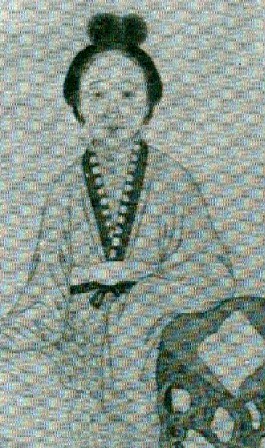 Wu San'gui then returned to Shanhaiguan and planned to surrender to Duo-er-gun [Dorgon] who had already led about 150,000-200,000 cavalry towards the South when the news came of Ming Army's abandonment of all forts in the aftermath of recall of the Ming forces to the defense of Peking. (However, Duo-er-gun did not know that Peking already fell, and did not fully trust in the rebels' sacking Peking after Wu San'gui's letter mentioned it. The Manchus treated Wu San'gui's emissaries with suspicion till Wu San'gui himself broke through Li Zicheng's siege of the Shanhaiguan Pass for a personal meeting with the Manchu regent. Historian Li Zhiting pointed out that Wu San'gui, in his first letter to Duoergun, had asked for the Manchu help in attacking the rebels by circumventing the Great Wall, not through the Shanhaiguan Pass's gates; however, Duoergun changed direction for Shanhaiguan on the road, which proved to be a right decision to meet Li Zicheng's rebels head-on.)
When they came into China in A.D. 1644, the Manchus were said to have brought in majority of the total Manchu army which numbered no more than 150k. Scholar Li Zhiting cited some Korean documents in pointing out that Duoergun's order had instructions that all Korean males from age 10 [?] to 70 must report to duty so that able men could serve in China's battlefields. The major armies fighting Li Zicheng's rebels, led by Wu San'gui, however, were still of the Chinese nature.
At the Battle of Shi-he [stony river], next to the Mountain & Sea Pass, Li Zicheng's army of about 200000-300000 fought against Wu San'gui's army of 50000 that consisted of gentry-organized forces and the Ningyuan garrison troops. Li Zicheng's troops had at one time climbed over the wall of the Shanhaiguan Pass. Suddenly, the Manchu cavalry descended upon the Li Zicheng camp under the cover of a sand storm. Li Zicheng lost 10000-20000 [? to be double checked again] troops and 15 generals at the battle. Three years later, corpses were not fully buried yet on the spot.
Dorgon, taking advice of two Confucian counsellors (defector ex-Ming general and scholar), would propose that Wu San'gui and Li Zicheng fight the battle first. While Wu & Li were entangled in a bitter fight, Dorgon led his cavalry on a charge against Li Zicheng all of a sudden. Li Zicheng retreated to Peking and decapitated the father of Wu Shangui en route of retreat, and slaughtered Wu San'gui's family prior to exiting Peking.
After the Manchus were invited by Wu San'gui the gatekeeper for the Shanhaiguan Pass, the Manchus used the slogan of 'Restoring the Ming Dynasty' to call for cooperation among the Ming Chinese remnant armies in the wars against the rebels.
Li Zhiting concluded that Wu San'gui had an agreement with Duoergun in ceding the land to the north of the Yellow River to the Manchu. However, Duoergun would prohibit Wu San'gui from entering Peking, ordered Wu San'gui on a continuous chase after Li Zicheng instead, and broke the promise of dividing China by the Yellow River.
Duo'ergun then relocated the Manchu Emperor Shunzhi to Peking.
After losing the battle, Li fled to the west. Wu San'gui pursued Li Zicheng to Xi'an. After a defeat in the Tongguan Pass, Li fled southward to the Jiugongshan Mountain, Hubei Province where Li was killed by the local Ming landlord bands. (Since Li's body was not authenticated by the Manchus or Wu San'gui's armies till months later, there was a rumor that Li had faked death and that Li went to the mountains as a monk.) The Manchu-Ming armies went on to Sichuan to kill rebel Zhang Zicheng. After defeating Li Zicheng, the Manchus re-oriented the armies to attack the Southern Ming Court and slaughtered the city of Yangzhou on the north bank of the Yangtze River. Southern Ming General Shi Kefa died during this battle. Then, crossing Yangtze River, the Manchus slaughtered the cities of Jiading and Jiangyin, both of which had rebelled against the Manchus when the queue order was re-issued. Throughout the campaigns, the turn-coat Ming armies were mobilized for fighting the Chinese. The notorious slaughtering of the Jiading City was conducted by a Manchu general of the ethnic Chinese background.
Entering China Proper
Having ascribed the division point of 1839-1842 Opium War to communist school of thoughts, Hu Qiuyuan concluded that it was Ming China's trinity of i) "eight-part essay" [i.e., stereotyped essay"], ii) sea ban and iii) "eunuch politics" that had pushed China into the down-sloping at a time when Portuguese still acknowledged China's wealth as something Europe never could match. (Scholar Li Zhiting pointed out that eunuchs participated in politics since Yongle era, entered the army as "jian jun" [monitoring emissary] in Tianqi Era, and continued to play its role even though Emperor Chongzhen eradicated Wei Zhongxian eunuch gestapo gang.)
Hu Qiuyuan also blamed Ming Dynasty's Zheng Heh seven voyages [1405-1433] for destroying ethnic-Chinese kingdoms in Southeast Asia. The arrival of Portuguese would further wipe out any remnants of such "colonialist" or "capitalist" buds that China ever possessed.
Hu Qiuyuan claimed that European powers could have converged upon China much earlier than 1839-1842 Opium War should there be absent the British-French War and Napoleonic War.
Further, Scholar Hu Qiuyuan believed that both Li Zicheng Rebellion and the Manchu Revolt were the products of Ming China's mutiny, not peasant uprising, nor minority uprising.
Zhang Xianzhong & Li Zicheng's Rebellion
In northern China, Ming Dynasty was already devastated by the rebellion led by Li Zicheng and Zhang Xianzhong.
As to the origin of the rebellion, the first significant incident would be the "garrison troops at Guyuan pillaging the prefecture vault for lack of military stipends".
That was, a mutiny.
Mire, Luo Xianglin had pointed out that Kong Youde and Geng Zhongming had rolled up Ming China's cannons manufacturing plant as a gift for the Manchu. Indeed, the Manchus fighting forces had absorbed enormous Ming Dynasty defectors.
In this sense, both Tang China and Ming China had demised as a result of their own military mutiny, not the peasant rebellion.
Historians concluded that Ming Dynasty ended in the hands of rebel Li Zicheng, not the Manchu invasion. The Manchus further gave last Ming emperor a posthumous title of Zhuangliedi as an elegy.
However, Li Zicheng's banditry did not consist of the displaced Ming army at all. The background of Li Zicheng (Li Tzu-ch'eng, 1605-1645) and Zhang Xianzhong was similar: Li Zicheng was at one time serving Ming China as a "postal garrison soldier", while Zhang Xianzong was a soldier stationed at the Yan-Sui-zhen garrison.
Ming Shi, edited by the Manchus throughout 268 years of ruling, had provided us with a possibly forged history about Li Zicheng and Zhang Xianzhong banditry.
Liu-sha-he still believed that Zhang Xianzhong slaughtered about dozen percent of Sichuan Province population, with 70% other deaths related to epidemics, starvation and wars. In the following, we will briefly cover the two rebels.
Li Zicheng was born in the [Tangut] Li-Jiqian castle of Huaiyuanbu in Mizhi county of Shenxi Province (for which Li Zicheng later proclaimed himself a descendant of the Tangut Xi-xia Dynasty Founder at the time of imperial enthronement). After working as a shepherd for a rich person and serving a postal soldier in Yinchuan, Li Zicheng fled a death penalty for law violation.
Ming Shi claimed that by the end of the Tianqi Era [1621-1627], eunuch Wei Zhongxian dispatched Qian Yingjia as governor of Shenxi [western Shenxi Province] and Zhu Tongmeng as governor of Yan-sui [northern Shenxi Province], but both guys pacified banditry by taking in briberies and ransoms only.
Li Zhiting mentioned a peasant uprising as to resisting government collection of grains in Chengcheng county of Shenxi in 1627.
In the 1st year of Emperor Chongzhen Era [1628-1644], famine erupted in western Shenxi Province while military stipends were in shortage in northern Shenxi Province. Garrison troops at Guyuan pillaged the prefecture vault.
There ensued the Wang Jiayin banditry in Fugu, and Yichuan banditry (led by Wang Zuogua, Fei-shan-hu [flying-across-mountain tiger] & Da-hong-lang [big red wolf]). Gao Yingxiang, a horse thief, rose up in Ansai border post with a pal called Wang Daliang.
Li Zicheng followed his uncle-in-law Gao Yingxiang in rebelling against Ming Dynasty in A.D. 1628.
At the time, rebel Luo Rucai was fighting under Gao Yingxiang.
After Gao Yingxiang died, Luo Rucai worked with Li Zicheng on a 40-60 split of the lootings.
Zhang Xianzhong, who was spared death by his superior officers Chen Hongfan & Wang Wei, would stage a rebellion in A.D. 1630 by rallying 18 "sai" [border villages].
The Ming court dispatched Hong Chengchou to quelling rebellion. Li Zicheng & Zhang Xianzhong gangs were occasionally destroyed and pacified, but managed to regroup again.
In the winter of A.D. 1633, the rebels, including Li Zicheng, Luo Rucai, Gao Yingxiang, and Zhang Xianzhong, broke through the Yellow River cordon at Mianchi, and intruded into western Henan.
In May-June of A.D. 1634, Chen Qiyu's government troops surrounded the rebels at Chexiang-xia (carriage) Valley in today's Ankang when the rebels passed the area after exiting the Xingan County of Shenxi.
The rebels faked a surrender.
In October of 1634, Li Zicheng ordered subordinate Gao Jie (Gao Yingwu) to fake a surrender to the government.
Zhang Xianzhong, Luo Rucai, and Lao-hui-hui (i.e., the old Muslim), about thirteen brigands, converged upon Xingyang of Henan.
However, Gao Jie took with him Li ZIcheng's woman, i.e., wife Xing-shi, and surrendered to the government troops under Heh Renlong in 1635.
By 1636, the whole northern China was in collapse as a result of banditry's mobile pillaging. (Meanwhile, Huangtaiji declared the dynasty of Qing in Manchuria, with an aim of conquering China.)
After a defeat in Shenxi, Li re-organized his rebels in Henan Province.
Meanwhile, the other rebels pillaged the country.
In A.D. 1640, the rebels, commanded by Luo Rucai and Zhang Xianzhong, were defeated by female general Qin Liangyu along the upper Yangtze gorge.
Li Zixian laid siege of Kaifeng three times.
In A.D. 1641, Li Zicheng, after twenty days' siege of Kaifeng, returned west to sack Xiangcheng, and continued west to attack and kill government official Fu Zonglong in September.
Fu Zonglong succeeded Yang Sichang's job as a general in charge of the three border areas of Shenxi and 'du du' (governor-general) for Shenxi.
Successor Wang1 Qiaonian was killed in a later battle in February of A.D. 1642.
During the 15th year of Emperor Chongzhen, i.e., A.D. 1642, Gao Mingheng, 'xun hu' for Henan Province, attempted to flood the Yellow River to destroy the rebels; however, in September, water from two separate dike break points poured into the north gate and flooded Kaifeng instead, killing over 1 million households of people, with the Ming prefecture king, his family and less than 20,000 people escaping the city alive.
In this year, Ming General Huang Degong defeated Zhang Xianzhong's rebels in Qianshan, for which he was promoted to 'zong bing' for Lu[2]zhou (Hefei, Anhui).
While in Henan Province Zicheng acquired two intellectuals, by the name of Niu Jinxing and Li Yan, and re-shaped his bandit approach. By 1644, he led an army of one million against Xi'an and sacked Xi'an and captured King Qin (Zhu Cunshu), attacked Taiyuan and killed King Jin (Zhu Qiushu). (At about this time, the Manchu, per Li Zhiting, dispatched secret emissary to Li Zicheng for a concerted fight against the Ming court, which Li Zicheng flatly declined.)
In January of 1644, Li Zicheng declared the Era of Yongchang and the dynastic name of Da-shun in Xi'an.
On January 8th, Li Zicheng's million troops departed Xi'an for the Yellow River.
Two prongs were launched, with one route against Juyingguan Pass via Taiyuan-Ningwu-Datong-Xuanhua, and another route along Xingtai, Hejian, and Baoding via Henan Province.
Emperor Chongzhen adopted the advice of Wang Yongji in recalling retiree Wu Xiang.
However, Emperor Chongzhen was hesitant about relocating the capital
to southern China.
When Emperor Chongzhen asked about relocating Wu San'gui for the capital defense, ministers tried to be ambivalent for avoiding blame as to the possible abandonment of Ningyuan.
Taiyuan of Shanxi Province was lost to the rebels on February 8th.
However, the Ming court still failed to achieve a consensus. The
Emperor produced Wang Yongji's petition for relocating Wu San'gui's army to the capital city, but ministers still tried to avoid bearing the responsibility.
After conquering the Daizhou Prefecture (today's Daixian County, Shanxi), Li Zicheng went on to attack the Ming capital city of Peking in the east. Li Zicheng sacked Peking (Beijing) on April 25th of 1644 and caused the last Ming Emperor Sizong (Chongzhen or Ch'ung-chen) to hang himself inside of the Forbidden City in Peking.
This was called by the Disaster of Jiashen, i.e., A.D. 1644.
(Some person pointed out that Ming China had been undergoing dozens of years of rat-related epidemic which might have taken half of the population in northern China at that time. Alternative account stated that in the city of Peking, the Ming government's soldiers had died in batches from this epidemic.)
Li Zicheng entered the city without a fight. Ming Shi stated that Li Zicheng's troops had caught the imperial patrol officers and spies on their way of march, hence averting the possibility of detection with a march to the Peking city gate.
Emperor Chongzhen, having sent two sons to the ministers' houses for hiding, hang himself inside of the Forbidden City. The Empress later committed suicide under the watch of Confucian-background rebel leader Li Yan. Li Zicheng caught the crown prince and the two other sons of Emperor Chongzhen.
The Ming loyalists, in Nanking, launched a new court by supporting King Fu-wang [Zhu Yousong] as an emperor, which was termed the Hongguang Regime in history.
Wu San'gui Chasing After Li Zicheng
Zhang Xianzhong's Establishing the Da-xi Regime in the Sichuan Basin
At the time Li Zicheng sacked Peking, Zhang Xianzhong, with a nickname of 'yellow tiger', marched towards today's Sichuan Province of southwestern China.
Zhang Xianzhong, back in A.D. 1635, had an agreement with Li Zicheng to separate into two bands for attacking the Ming regime, with his rampage centered in the Anhui, and Huguang (Hubei) area.
One year earlier, in A.D. 1634, Zhang Xianzhong's rebels intruded into the Sichuan basin in vain, when female warrior Qin Liangyu and son Ma Xiangling pincer-attacked and defeated the rebels at Kuizhou (Fengjie, Sichuan), along the Yangtze gorges.
Zhang Xianzhong's rebels retreated to today's Hubei Province.
The rebels then crossed the Yangtze to attack Daozhou in today's Hunan Province. After a government official 'shou bei' for Yong-dao (Yongzhou and Daozhou), called Shen Zhixu, died in battling the rebels, his seventeen-year-old girl daughter, called Shen Yunying, announced to the populace her wish to die for her father and asked the locals to die for their hometown to avoid the fate of their wives and children falling into the hands of the rebels. As recorded by Manchu-era historian Xia Zhirong, the girl, riding on a horse, charged out of the city to defeat the rebels, which was the first defeat for the Zhang Xianzhong rebels south of the Yangtze River. Shen Yunying was a brave girl comparable to Xun Guan, a Jinn Dynasty girl who broke out of the siege of her hometown city to borrow an army from the neighboring county.
This snippet is for sons and daughters of China:
Heed the sons & ministers' agony and sorrow of our ancestors who died or lived through the Mongol, Manchu and Soviet-Chicom conquest
and
the Yongjia, Jingkang and Jiashen cataclysms !
Jeanne d'Arc of China:
Xun Guan breaking out of the Wancheng city to borrow a relief army in the late Western Jinn dynasty;
Liu-Shao-shi riding into the barbarian army to rescue her husband in the late Western Jinn dynasty;
Shen Yunying breaking into Zhang Xianzhong's rebels on the horseback to avenge on father's death in the late Ming dynasty;
China's Solitary and Lone Heroes:
Nan Jiyun breaking out of the Suiyang siege and charging back into the city in the Tang dynasty;
Zhang Gui & Zhang Shun Brothers breaking through the Mongol siege of Xiangyang in the Southern Soong dynasty;
Liu Tiejun breaking through three communist field armies' siege of Kaifeng in the Republican China time period
;
Zhang Jian's lone confrontation against the communist army during the June 3rd & 4th Massacre of 1989.
|
|
In A.D. 1640, Luo Rucai's rebels attacked Sichuan.
In July, Zhang Xianzhong's rebels went to Baiyang-shan (white sheep mountain) to join Luo Rucai.
Qin Liangyu, at Wushan (the sorceress' mountain) and Kuizhou, again defeated the rebels commanded by Luo Rucai.
Luo Rucai then split from Zhang Xianzhong for joining Li Zicheng's camp, and two years later, converged with Li Zicheng for laying a siege of Kaifeng.
In January of A.D. 1644, Zhang Xianzhong intruded into Sichuan again.
Zhang Xianzhong sacked Chengdu in August of 1644.
According to the eyewitness account of two Jesuits, Zhang Xianzhong did not declare himself an emperor of the Da-xi State with the Dashun Era till the new year of A.D. 1646, which conflicted with the prevalent claim in the Chinese chronicle that sometime in November 1644, Zhang upgraded himself to be an emperor with an imperial era.
By October [lc], the Manchus renewed attacks at Li Zicheng, with Wu San'gui acting as herald general still. By January 1645 [lc], King Yu-wang Duo-duo's southern route and King Ying-wang A'jige's northern route defeated Li Zicheng at Tongguan and converged towards the Xi'an city. Li Zicheng fled towards today's Henan-Hubei provinces and stationed at the Wuchang city shortly. By Feb, A'jige pursued Li Zicheng to the south, and Duo-duo relocated to fight the Southern Ming court to the southeast. By May 1645 [lc], Li Zicheng was killed by the Ming local forces at the Jiugongshan Mountain of today's Hubei Province.
The Infamous Queue-Related Massacre
The anterior Jurchens under Jurchen Jin Emperor Taizong failed to enforce the queue ruling to have the Soong Chinese cut their hair back in the 12th century. However, the Manchus successfully tricked the turncoat Ming Chinese on the matter of haircutting.
After defeating the Ming armies at the Battle of Sa'erhu in 1619, Nurhachi first issued order to have the Han Chinese cut hair in the territories under the Manchu control. The queue order was opposed by the Han Chinese in Zhen-jiang (Dantong of Liaoning Province) area, next to the Yalu-jiang River rivermouth. After the Han Chinese killed local Manchu officials, the Manchus dispatched an army against the Zhen-jiang people. Innumerable people jumped into the Yalu River to commit suicide when the Manchu army chased them. The Han Chinese who fled to the Ming territories with queues were executed by the Ming border armies as part of the enemy headcount.
By April 22nd of 1644, Manchu Regent Duo'ergun and Turncoat General Wu San'gui defeated Li Zicheng at the Battle of the Shanhaiguan Pass. Duo'ergun, for sake of winning the heart of the Han Chinese, at one time executed three Manchu soldiers who cooked a dog robbed from a Han Chinese household. This is in sharp contrast with the lootings and killings the Manchus had conducted prior to the Shanhaiguan Battle. By May 2nd (lunar calendar), the Manchus entered the Peking city. Duo'ergun issued the queue order the next day in lieu of a previous broadcast stating that the Manchus were for restoring the Ming Dynasty throne. Manchu counsellor Fan Wencheng petitioned with Duo'ergun for a hold on the queue policy. Duo'ergun agreed to it, and ordered a three-day mourning for last Ming Emperor Chongzhen. Thereafter, the queue order began to be implemented, causing numerous Ming remnants to flee the Peking city.
After the Manchus took control of China, China's culture suffered sever setbacks after the Manchus ordered to destroy China's classics which talked about the northern barbarians for the last few thousand years, or ordered to forge the records whenever there were contents related to the northern barbarians.
Wu Weiye, who wrote a satirical poem against Wu San'gui in regards to betraying the country over woman Chen Yuanyuan, talked about the destruction to China's classics and culture during the Jiashen Cataclysm, stating that China's classics in the imperial Zhishen-ku vault, which were the Soong dynasty rebuilt collection after going through what Sui Dynasty minister Niu Hong called by the five incidents of book burning and destruction and what the later Ming Dynasty scholar Hu Yinglin added by ten including the post-South-North-dynasties incidents, were all lost.
Wu Weiye did not specify whether it was Li Zicheng's rebels or the Manchus who were responsible for the dissipation of the millions of volumes of books --which still carried the seals and inks of the Jurchens when they sacked the northern Soong capital city of Bianliang (Kaifeng, Henan), marked the imperial books for shipping to today's Peking, to be repossessed by the Mongols who never bothered to open the seal to check on the books after the Mongols defeated the Jurchens, and to be re-possessed by the Ming Chinese after Ming Dynasty General Xu Da (Xu Zhongshan) expelled the Mongols from Dadu (Peking, Hebei).
Since Li Zicheng re-established himself at Tongguan of Shaanxi Province and the southern Ming royal house established the Southern Ming court, Duo'ergun revoked the queue order on May 24th [lc]. In addition to the Southern Ming court and Li Zicheng's "da shun jun" [Great Army of 'Shun' where shun meant for smoothness], Zhang Xianzhong's "da xi jun" [Great Army of the West] still possessed quite some number of soldiers in today's Sichuan Province, mainly in the area of Chengdu and northwestern Sichuan basin.
10-day Slaughter of the Yangzhou City
The reason that the southern Ming court fell was due to its internal strife.
In Nanking, Ruan Dacheng and Ma Shiying, who belonged to the remnants of the eunuch party, supported King Fu-wang [Zhu Yousong] as Emperor Hongguang.
Among the Ming loyalist army, there were four clusters of troops at Huai, Yang, Feng and Lu, commanded by Huang Degong, Liu Liangzuo, Liu Zeqing, and Gao Jie, with Gao Jie, a former Li Zicheng rebel, serving Ma Shiying, 'zong du' or governor for Fengyang.
In early 1645, the Manchu army departed for the Henan-fu territory, to the south of the Yellow River.
Xu Dingguo, 'zong bing' at Suizhou (Suixian), already surrendered to the Manchus and sent over two sons as hostage.
Xu Dingguo set up a trap by hosting a banquet for Gao Jie, Yue Qijie, Chen Qianfu and et al.
On January 12th, Gao Jie came to visiting Xu Dingguo. The next day, Xu Dingguo decapitated Gao Jie and took the head to Manchu General Hao'ge.
Liu Liangzuo, who was another former Li ZIcheng rebel who was pacified by the Ming court during the 11th year reign of Emperor Chongzhen, surrendered to the Manchu regent, i.e., King Yuqing-wang Duo'duo.
In March, General Zuo Liangyu, with garrison at Wuchang, planned to attack Jinling (Nanking/Nanjing) to the east.
The reason was to do with a rumor that the new emperor had arrested Crown Prince Zhu Cilang, a son of the late Emperor Chongzhen, who purportedly fled to Nanking from Peking.
Minister ('shang shu') Xiong Mingyu asked Hou Fangyu to petition father Hou Xun to write a letter to Zuo Liangyu.
Ruan Dacheng accused Hou Fangyu of collusion with Zuo Liangyu, which led to the latter's arrest in January of A.D. 1645.
Ruan Dacheng had recalled most troops north of the Yangtze for quelling the rebellion of General Zuo Liangyu.
Ruan Dacheng and Ma Shiying ordered General Huang Degong to abandon the northern defense for coming south.
The Manchu army took advantage of the situation to sack Guide, Yingzhou, Taihe and Sizhou.
Zuo Liangyu died en route to Nanking, with his subordinates surrendering to the Manchu.
North of the Yangtze, only Si Kefa and about three thousand defenders stationed in Yangzhou.
[KMT General Bai Chongxi had invoked the story of Ruan Dacheng and Zuo Liangyu in dissuading Li Zongren from following Zhang Fakui's advice in a coup against Chiang Kai-shek in Canton in 1949. The KMT generals cited the vagrant life-style of the White Russians fleeing to China at the end of the 1917 Russian Revolution as historical mirror of the people who lost their country.]
On May 10th, the Manchus began to lay the siege of Yangzhou.
Liu Zeqing, not answering SHi Kefa's recall for lending the relief to Yangzhou, fled back to Huai'an.
By mid-April, after one hundred days of battles, the Manchus sacked the city of Yangzhou with the help of a Ming traitor who opened the city gate.
General Shi Kefa, riding on a horse and charging at the enemy, sacrificed his life.
Before the battle, Shi Kefa had asked Hou Fangyu (Hou Chaozong) to author a defiant reply to Duo'er'gun.
Hou Fangyu, which was depicted by Kong Shangren in a drama Tao Hua Shan (peach flower dotted folding fan), escaped the city unscathed.
The Hou family belonged to the late Ming Dynasty literary and political group called the Dong-lin-dang (east forest party) which was noted for defying eunuch Wei Zhongxian and the eunuch party, while Hou Fangyu himself, counted as one of the four distinguished young literary gentlemen of the late Ming Dynasty or one of the three early Manchu-era literary gentlemen, was a member of Zhang Fu's Fu-she Society.
The Manchus ordered a 10-day slaughter of the Yangzhou city as a demonstration of terror.
As to Liu Zeqing, the Manchu army sacked Huai'an on May 23rd.
After sailing to the seas, Liu Zeqing returned in June to surrender to the Manchu.
On May 8th [lunar calendar], the Manchu army crossed the Yangtze River at Guazhou.
Yang Wencong, 'xun hu' for Zhenjiang, fled south, while 'zong bing' Jiang Yuntai surrendered.
On the 10th, Emperor Hongguang, after decreeing to set free all court maids, left the palace through the Tongji-men gate.
At dawn, people fled the city through the Xihua-men gate upon hearing of the disappearance of Emperor Hongguang.
The civilians set free the fake crown prince from prison, and made him an emperor at the Wuying-dian Palace,
On the 12th, Emperor Hongguang arrived at the Taiping-fu governor's office, and then moved to Wufu to seek shelter with General Huang Degong.
On the 15th, the Manchu army entered Nanking.
The stranded ministers at the Southern Ming court at Nanking surrendered without putting up a fight.
Duo'duo then ordered Liu Liangzuo to chase Emperor Hongguang.
On May 22nd, Tian Xiong, a Ming 'zong bing' general, raided the imperial boat to have Emperor Hongguang abducted, and then delivered him to the Manchu.
At the Marquis Lingbi-hou-fu mansion, Duo'duo arranged a banquet, with Emperor Hongguang seated behind the fake crown prince.
Liu Guokai mentioned that the Ming Chinese at the Yangtze Delta, including Jiangyin, Nanking, Jiading and Suzhou cities, had originally mobilized the "welcome parties" for the Manchu forces in the expectation that the Manchu rulers would restore order and cut taxes.
By May [lc], Duo'ergun proposed the queue order again, thinking that Southern Ming had been pacified. In early June [lc], Duo'ergun re-issued the queue order, stating that whoever opposed the hair cutting would be punished by martial laws and whoever disobeyed would be executed as bandits and rebels.
At Jiangyin, a turncoat Chinese by the name of Fang Heng was assigned the post of magistrate by the Manchu court.
By mid-June [lc] of A.D. 1645, the Han Chinese south of the Yangtze River, hearing of the queue order, began to oppose the Manchu rule. Among the most extraordinary struggles will be the people at Jiangyin of today's Jiangsu Province.
Slaughtering Of the Jiangyin City
On June 26th, populace at Jiangyin arrested and executed Fang Heng and propagated a slogan of "retaining the hair rather than head".
Peasants numbering 100,000 converged onto Jiangyin, and rich Anhui Province merchant Cheng Bi donated 175,000 taels of silver for the uprising.
An ex-Ming official by the name of Chen Mingyu was supported as a leader. The Jiangyin people beat off a Manchu attack from Changzhou.
When the Manchu army, under the command of turncoat Liu Liangzuo, attacked Jiangyin again, Chen Mingyu, on July 9th, recommended Yan Yingyuan (i.e., an ex-Ming "dian shi" or inspector) for leading the defense.
Yan Yingyuan wrote a poem stating that "Carrying Hair For Eighty Days As A Show Of Fidelity, Populace Numbering 100,000 Are Now Willing To Die For the Confucian Righteousness With One Heart".
The Manchu army under Regent Duo'e'gun and King Duo-duo, numbering 240,000, laid siege of the city and mounted countless attacks, with a loss of three Manchu royal kings, 18 generals and 75,000 soldiers.
Yan Yingyuan replied to the Manchu surrender invitation with such words as "no surrendering inspector no matter how many other Ming generals had surrendered".
On August 21st, 1645, the Manchu army, with heavy caliber cannons from Nanking, successfully bombarded the city gate. Yan Yingyuan fought the Manchus lane by lane. Yan, having failed to commit suicide after being wounded, was killed by the Manchu soldiers. Chen Mingyu also died in street fighting, and his whole family committed suicide. Street fighting continued through to the next day when the Manchus ordered a massacre of the city. The whole city fought the Manchus to the last person by defending it for 81 days. By August 23rd, 172,000 Jiangyin people had died, and only 53 persons had survived by hiding on the top storey of a pagoda.
Duo-duo fought against Southern Ming General Huang Degong in the campaign against the Taiping-fu territory.
At the Battle of Digang, Liu Liangzuo, a turncoat Ming general, called out to Huang Degong from the riverbank, and when Huang Degong stopped to face the traitor, an arrow shot at his throat.
With Huang Degong killed, the other Southern Ming armies surrendered mostly.
Three Rounds of Slaughter at Jiading
On June 12th, 1645 [lc], the queue order reached the Jiading town. Tens of thousands of people converged on June 14th for opposing the queue order. Gentry Hou Tongzeng & Huang Chunyao were made leaders. The Jiading people defeated several attacks led by a turncoat Manchu general by the name of Li Chengdong.
By July 3rd [lc], the Manchu soldiers attacked city again with cannons' support. The Manchus first breached the east gate. When Hou Tongzeng's two sons asked about what to do next, Hou Tongzeng stated "no need for panic... nothing other than just death", and later the whole family committed suicide by jumping into the river.
The first round of slaughter by the Manchu army would cause 20,000 deaths.
Li Chengdong was recorded to have used 300 ships in shipping the lootings to Taicang of Jiangsu Province.
Remnant resistance fighters continued to attack the Manchu army outside of the city. On July 20th, the rebels defeated the Manchu soldiers at the nearby Gelongzhen Town.
By 26th, the Manchus sent over relief and slaughtered the town of Gelongzhen.
After Li Chengdong exited Jiading, resistance fighters retook Jiading. On July 27th, the Manchu soldiers invaded Jiading again and held a second round of massacre.
In August, a Southern Ming official, by the name of Wu Zhifan, organized a counter-attack at the Manchu army at Jiading. The Manch soldiers conducted a third round of massacre of Jiading as revenge.
The Manchu massacre was not restricted to the above three infamous incidents.
In the neighboring Songjiang, uprisings against the Manchus continued for years.
17-year-old prodigy-martyr Xia Wanchun, after his father died in the resistance, took on the mission to continue fighting the Manchus.
In the late 19th century and early 20th centuries, revolutionaries often invoked Xia Wanchun's Xia Jiemin [Quan-]Ji (Complete anthology of Xia Wanchun's poems and prose) for taking heart of grace in the uprisings against the Manchus.
The Manchu slaughter continued to southern China, and in Canton, up to today, to the north of Canton could be found remnants of the mass grave site of martyrs who died for Emperor Shaowu in the resistance against the Manchu.
Scholars had pointed out that in the early days, the Manchu founder Nu-e-ha-chi and Huangtaiji slaughtered the Ming Chinese in Manchuria and the Peking area; King Zhengqinwang Ji-e-ha-lang slaughtered Xiangtan of Hunan Province and Datong of Shanxi Province; and the Manchu slaughtered the people of Canton of Guangdong Province as well.
* In Commemoration of China's Fall under the Alien Conquests in A.D. 1279,
A.D. 1644 & A.D. 1949 *
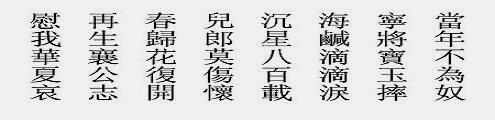 U.S.S.R./Comintern Alliance with the KMT & CCP (1923-1927)
 Korean/Chinese Communists & the 1931 Japanese Invasion of Manchuria Korean/Chinese Communists & the 1931 Japanese Invasion of Manchuria
American Involvement in China: Soviet Operation Snow, IPR Conspiracy, Dixie Mission, Stilwell
Incident, O.S.S. Scheme, Coalition Government Crap, Amerasia Case & The China White Paper
* Stay tuned for "Republican China 1911-1955: A Complete Untold History" *
|
|
Zou Rong's Revolutionary Army;
Shin Kyu Sik's
Shrine (Spirit, Kunitama) of Korea
|
This snippet is for sons and daughters of China:
Heed the sons & ministers' agony and sorrow of our ancestors who died or lived through the Mongol, Manchu and Soviet-Chicom conquest
and
the Yongjia, Jingkang and Jiashen cataclysms !
Jeanne d'Arc of China:
Teenager girl Xun Guan breaking out of the Wancheng city to borrow the relief troops in the late Western Jinn dynasty;
Liu-Shao-shi riding into the barbarian army to rescue her husband in the late Western Jinn dynasty;
teenager girl Shen Yunying breaking into Zhang Xianzhong's rebels on the horseback to avenge on father's death in the late Ming dynasty.
China's Solitary and Lone Heroes:
Nan Jiyun breaking out of the Suiyang siege and charging back into the city in the Tang dynasty;
Zhang Gui & Zhang Shun Brothers breaking through the Mongol siege of Xiangyang in the Southern Soong dynasty;
Liu Tiejun breaking through three communist field armies' siege of Kaifeng in the Republican China time period;
Zhang Jian's lone confrontation against the communist army during the June 3rd & 4th Massacre of 1989.
|
|
|
Zhang Xianzhong's Rampage in Sichuan
Zhang Xianzhong intruded into Sichuan in January of A.D. 1644, sacked Chengdu in August (i.e., September 5 [per Jesuits Ludovico Buglio and Gabriel de Magalhaes] on the Gregorian calendar)
King Shu-wang (Zhu Qishu), with his family, committed suicide in a well.
Zhang Xianzhong, sitting in the King Shu-wang (Zhu Qishu)'s mansion and called Chengdu by the Xi-jing [west) capital, set up a government with a semblance of six departments, five superintendent generals, and 1,000 officials.
Wang[1] Zhaoling, a local scholar, and Wu Jishan, a former country magistrate, were appointed as the leftside and rightside prime ministers.
Zhang Xianzhong thereafter sent the troops to pacifying the counties and prefectures but lost control of the perimeters to the remnant Ming Dynasty generals by the spring of 1645.
In southern Sichuan, there was Yang Zhan; in eastern Sichuan there was Zengying; and in the mountains there were native armed bands.
Ming Shi (i.e., History of the Ming Dynasty), edited by the Manchu Qing historians, claimed that Zhang Xianzhong slaughtered 3/4th of Sichuan's population.
When the Manchu took control of the province, and by the time of succeeding Manchu emperor Kangxi's 24th year, the survivors numbered merely 18,090 people in Sichuan.
The area was later filled up by the migrants from today's Guangdong and Hunan provinces.
Ming Shi carried pages of writings about the atrocity committed by Li Zicheng and Zhang Xianzhong: Both rebels had a long list of massacres, slaughters and butchering, like cutting off women's feet and piled them up onto a hill or piercing pregnant women's wombs etc. In this perspective, the defeats of both Li Zicheng and Zhang Xianzhong by the Manchu forces would be considered a blessing for Chinese.
Among the most egregious writing would be by a person called Mo Qiling who claimed in HOU JIAN LU (records of hind reflection) that Zhang killed over 59 million men to the east of Chengdu, 99 million men to the south, another 99 million to the west and 76 million to the north, plus similar number of women.
Ming Shi copied Mao's ridiculous passage on the massacre, which yielded a deathtoll of 600 million people in about one quarter to one third of the province which possessed over 260,000 households or over 3.1 million during the late Ming Dynasty time period (i.e., a census from the 6th year of the Wanli Era).
Some scholars pointed out that Ming Shi could have forged the real history about Li Zicheng and Zhang Xianzhong. Some had pointed out that Zhang Xianzhong's remnant armies had fought on against the Manchu rule well into the late 1650s and early 1660s, something extraordinary should we negate the Manchu Qing historian's claim to interpret Zhang Xianzhong's resistance as having garnered the support of Sichuan people.
(Bao Jie of iastate.edu had cited a bbs writing by nanxiang-zi stating that "the Manchu Qing records stated that Zhang Xianzhong was killed in 1646, and altogether over 130 'ying' or battalions of Zhang Xianzhong armies were defeated. The Manchu Qing records also contained such descriptions as the Manchu army 'slaughtering city by city, either killing all males or killing both males and females, because bandits mixed up with civilians and because jade and stone could not be distinguished from each other'.)
According to the eyewitness account from two Jesuit missionaries, Ludovico Buglio (1606–1682, a Sicilian ) and Gabriel de Magalhaes
(1610–1677, a Portuguese), Zhang Xianzhong at first appeared to be a 'pretender' at ruling the region with some institutional set-up but then became more and more paranoid, with a schizophrenia symptom of suffering from paranoia.
According to the Jesuits' description, Zhang Xianzhong could have a recurring migraine headache, which led to his loss of control over himself.
The mental derangement led to frequent outbursts of murderous impulse.
During the winter solstice festival of A.D. 1644, Zhang Xianzhong had seated the two missionaries right behind his father-in-law, exhibiting no particular wonton propensity.
Zhang Xianzhong's disregard for the human life was embodied in his poem, some jotted-down sentence that he wanted the Jesuits to pass on to the Vatican and the European countries, namely, "Heaven takes the ten thousand things to bestow upon man. Man has not one thing to bestow upon Heaven".
Ludovico Buglio and Gabriel de Magalhaes, who were close to Zhang Xianzhong, had observed the events in the immediate proximity, of course.
One incident of wonton killing was related to the torture death of Wu Jishan (Ukixen) --someone who had located the two missionaries from hiding in the mountains and recommended them to Zhang Xianzhong for service.
Without detailing the order of events, the two missionaries recorded that the first mass killing in the Chengdu city was to do with the elimination of over 2,000 Buddhists, and the extension of the Buddhism purge order to the surrounding areas.
Zhang Xianzhong claimed that God (i.e., Jesus Christ) had sent him to Sichuan to eliminate the Buddhists and other sly people who had caused trouble to the two missionaries.
The purge of Buddhists led to implication of the innocent people, which culminated in a vicious cycle of revolts by the people, and the further crackdown on the people.
* In Commemoration of China's Fall under the Alien Conquests in A.D. 1279,
A.D. 1644 & A.D. 1949 *
U.S.S.R./Comintern Alliance with the KMT & CCP (1923-1927)
Korean/Chinese Communists & the 1931 Japanese Invasion of Manchuria
American Involvement in China: Soviet Operation Snow, IPR Conspiracy, Dixie Mission, Stilwell
Incident, O.S.S. Scheme, Coalition Government Crap, Amerasia Case & The China White Paper
* Stay tuned for "Republican China 1911-1955: A Complete Untold History" *
|
|
Zou Rong's Revolutionary Army;
Shin Kyu Sik's
Shrine (Spirit, Kunitama) of Korea
|
This snippet is for sons and daughters of China:
Heed the sons & ministers' agony and sorrow of our ancestors who died or lived through the Mongol, Manchu and Soviet-Chicom conquest
and
the Yongjia, Jingkang and Jiashen cataclysms !
Jeanne d'Arc of China:
Teenager girl Xun Guan breaking out of the Wancheng city to borrow the relief troops in the late Western Jinn dynasty;
Liu-Shao-shi riding into the barbarian army to rescue her husband in the late Western Jinn dynasty;
teenager girl Shen Yunying breaking into Zhang Xianzhong's rebels on the horseback to avenge on father's death in the late Ming dynasty.
China's Solitary and Lone Heroes:
Nan Jiyun breaking out of the Suiyang siege and charging back into the city in the Tang dynasty;
Zhang Gui & Zhang Shun Brothers breaking through the Mongol siege of Xiangyang in the Southern Soong dynasty;
Liu Tiejun breaking through three communist field armies' siege of Kaifeng in the Republican China time period;
Zhang Jian's lone confrontation against the communist army during the June 3rd & 4th Massacre of 1989.
|
|
|
Ludovico Buglio and Gabriel de Magalhaes had given an impression that Zhang Xianzhong had conducted the indiscriminate massacre against the Chengdu residents at a later stage, at a time when the Manchus were rumored to be on the way of invading Sichuan and the Chengdu city, with an announcement of the pending arrival of the enemy invasion force on a date pinned at November 22, A.D. 1645 (Gregorian calendar). The two missionaries believed that this was a scheme devised by Zhang Xianzhong for mobilizing his forces as well as creating a pretext to accuse the Chengdu residents of being accomplice to the enemy.
Fearing that the Chengdu residents could be traitors bent on selling him out to the Manchu, Zhang Xianzhong ordered the rounding-up and massacre of the Chengdu residents, prior to leaving the city for the north.
Shortly after the announcement, sometime in the late A.D. 1645, Zhang Xianzhong first took his army out of the city in the name of a campaign against the invaders, then came back to seal the city gates, and then rounded up the locals for massacre outside of the south gate.
Zhang Xianzhong filled in the empty city with the natives from outside of the city.
The reasons that Zhang Xianzhong had spared the two missionaries were to do with his superstition in astrology, counting on the two foreigners for manufacturing the instruments of the celestial ball and the globe ball, to do with Zhang Xianzhong's curiosity with the peaceful demeanor of Notre Dame as shown on the Christian religious pamphlets and the legends related to Matteo Ricci (1552-1610); as well as to do with a possible experiment with converting to the Catholic religion as a result of deep resentment towards the local Chinese Buddhist and Taoist (Daoist) practice.
The two missionaries made a pair of large scale celestial and terrestrial globes in Chengdu, and later, en route of fleeing to Shenxi, near Xichong, made a smaller pair of celestial and terrestrial globes.
(Ludovico Buglio and Gabriel de Magalhaes arrived in Sichuan in late 1640 for establishing a Catholic mission and baptizing the local people.)
Zhang Xianzhong then took the army out for a campaign, did not meet with any enemy, and returned to Chengdu for the lunar new year celebration. The two priests, Ludovico Buglio and Gabriel de Magalhaes, recorded the date of festival to be in February of A.D. 1646 (on the Gregorian calendar), which was the lunar 1st month. Zhang Xianzhong declared himself an emperor of the Da-xi-chao dynasty and the imperial era of Da-shun [great smoothness].
By this time, the two priests observed that the tyrant had abnormal behavior for days, as if his head was inverted --which was the literal phrase by phrase from the two Jesuits.
Making decrees in the name of Heaven, Zhang Xianzhong asked the subordinates to look at the sky, where he said the [Christian] god was, and claimed that should the subordinates fail to see the god, it must be that only the emperor had the capability to see the god.
Zhang Xianzhong then made his four adopted sons into generals for quelling the east, south, north and west, with Sun Kewang ordered to quell Shandong, Liao-dong, Koryo and the east seas, Liu Wenxiu to quell the southern provinces, Thailand, Saigon, the southeast Asian seas and the Philippines,
Ai Nengqi to quell the northern provinces and Mongolia,
and Li Dingguo to quell Tibet, Qinghai, the Western Territories, and the Siberian territory.
Zhang Xianzhong had a book forged, which carried the name of The Heaven's Book, in which what he did and would do was prewritten, and a stone monument erected [which came to be known as the Seven Kill Monument but lacking the actual word of 'kill'].
The main thought from Zhang Zizhong was that the heaven gave everything to the people, but the people had nothing to pay back to the heaven, something the Jesuits were asked to make it into some kind of cardinal for presenting to the pope.
Zhang Xianzhong asked the two priests about the ancient Chinese metaphysical description of the universe as consisting of the square land (earth) and round heaven, taking a compromising position that he had faith in the ancient Chinese saying about China's position at the center of the square-shaped land while also having belief in the Jesuits' terrestrial globe.
At one time, Zhang Xianzhong claimed to invade Europe through the southwestern mountains as a shortcut and rule the world as was ordained by the [Christian] god --which was very much similar to the later madman rebel leader Hong Xiuquan of the Taiping Heavenly Kingdom of the mid-19th century.
Zhang Xianzhong found himself more and more isolated from the outside world.
At one time, when Zhang Xianzhong toured the Chengdu city and found it to be empty of people [as a result of his earlier order to massacre the population for fear of the locals acting as accomplices for the Manchu], he realized his blunder, drew his blade to commit suicide by slitting throat, and was stopped by the entourage.
Finally, running out of the grain supply, Zhang Xianzhong decided to abandon the Chengdu city on a trek towards the homeland Shenxi Province; and departing Chengdu, set fire on the city and forced the locals to move north with him.
Per the two Jesuits, at the time Zhang Xianzhong left Chengdu, he still had 700 out of the original 1000 officials and officers with him, but the number dwindled to only 25 when he met his demise in northern Sichuan.
En route of going north, Zhang Xianzhong was maddened by the non-cooperation of the locals, and often travelled without a guide. Going into more frequent rage, Zhang Xianzhong slaughtered his way north and resorted to killing his followers to vent his anger, with deaths by 100-200 persons daily.
The two Jesuits, fearing for their life, petitioned to ask for a leave of absence for Macao, and when the two Jesuits refused to allow the soldiers to accompany the two on the trip to Macao, Zhang Xianzhong ordered to arrest the two Jesuits.
When arguing with the two Jesuits, Zhang Xianzhong invoked a well-known story about some Japanese pirate-trading mission's attempt at blasting the Ming Chinese emperor to death with powder hidden in some giant candle, and claimed that Matteo Ricci was killed by an explosion when he attempted to manufacture cannons for Emperor Wanli in a same scheme as the Japanese pirate-trader.
Zhang Xianzhong’s ultimate death was to do with his total disconnect from reality.
Sometime in the first month of A.D. 1647 [January 3 on the Gregorian calendar per the two Jesuits --which was taken to be sometime in late November of A.D. 1646 on the lunar calendar], when the frontier sentry reported that they spotted the Manchu cavalry, Zhang Xianzhong had disbelief and then went out with a small entourage to check out the situation by himself, ending in his death after being shot in the chest by the Manchu forces in a skirmish.
According to the Manchu records, Prince Hao-ge personally shot dead Zhang Xianzhong.
(With Zhang Xianzhong dead, his followers scattered throughout the mountains. The two missionaries were spared death by the Manchu soldiers for their different outlook, was injured by some Manchu officer, and was saved by another officer.
Having failed to communicate with the Manchu soldiers using the Chinese language, the two guys were brought in front of the Manchu prince who, having determined that they were of the same 'tai-xi' [the far west] clergymen gang as Johann Adam Schall von Bell {1591-1666}, known as Tang-ruo-wang in Chinese, were sent to Peking as prisoners.
The two guys, for their extended prison stay, later filed a report with the Vatican, accusing von Bell of collusion with the Manchus.)
Solidifying the Rule Over China
Chinese history had two Manchu emperors entitled 'zu', i.e., founder. That would be Emperor Shunzhi (Qin Shizu), and Emperor Kangxi (Qin Shengzu). This was due to the fact that the Southern Ming court did not officially fall till 1662. As we had exhibited above, the Manchus got into antagonism with the southern Han Chinese as a result of enforcing the 'queue order', something designed to massacre both the Han Chinese bodies and their souls, in the physical as well as spiritual sense.
Ethnic contention between the Manchus and Han Chinese was intense. During the 268 years of the Manchu rule, numerous Chinese rebellions had occurred because of the strict rule of haircutting.
The Chinese had no choice, either hair or head to be cut.
The Manchus had a special hair style: the infamous "queue". They cut hair off the front skull of their heads and made the remaining hair into a long pigtail. The pigtail story might be related to the early Tuoba of the 4th-6th century. The Tuoba were called "suo lu", namely, pigtail styled robbers. (A better English wording for 'lu' would be enemies or savages.)
The Manchus also adopted the predatory methods of land deprivation. They set up a caste system in the attempt at avoiding the possibility of being assimilated into the Chinese.
Manchu Emperor Shunzhi had a story about marrying a woman called 'Dong Guifei'. After the death of this concubine, Emperor Shunzhi was rumored to have gone to the Wutaishan Mountain as a monk per legend. Dong Guifei could be related to some Manchu who had inter-marriage with Chinese from the Han Banner. Historians believed that Dong was a Manchu, but the populace belief was that she was a Han for carrying an ambiguous last name of 'dong' which appeared to be a soundex Manchu 'tong' surname. Recently, there was a claim that the mother of Emperor Shunzhi was from a Mongol Banner. A few examples of the Manchu-Han intermarriage would be ex-Ming General Wu San'gui who had his son married to the Manchu royal family. This shows that early the Manchus did not have a strict prohibition that the Manchus could not have inter-marriage with the ethnic Han.
Today, the Manchus had lost their ethnic identities. If anyone called himself or herself a Manchu, it would be for sake of child birth quota or college entrance quota. The Manchus may have lost their identities because they lacked a religion. The Hui Muslims could claim to be a Hui because they believed in Islam no matter how Chinese they look. The Manchus have nothing to cling to as a differentiation from the Chinese.
The Manchu legacy would be the cuisine in some restaurants, with names such as the Manchu Court Menu.
Another legacy would be the so-called Banner Clothes, 'Qi Bao', that women would wear for marriages.
Continuing Resistance in the South
After the capsizing of King Fu-wang [Zhu Yousong] in Nanking of Jiangsu Province and King Tang-wang [Zhu Weijian], in Guangdong Province, Su Guansheng [Ming "grand scholar" from Dongguan] and Liang Chaozhong [from Fanyu (Canton)] supported a brother of King Tang-wang, i.e., Zhu Yuyue, as the new ruler who declared the Era of Shaowu in A.D. 1646.
Two months later, Su Guansheng, Liang Chaozhong, Huo Ziheng and Emperor Shaowu all sacrificed their lives after the city was sacked by the Manchu army.
Up to today, to the north of Canton could be found remnants of the mass grave site for Emperor Shaowu.
Qu Shisi, Lü Daqi, Ding Kuichu & Li Yongmao went to Guangxi Prov from Zhaoqing of Guangdong in October 1646 for fetching 24-year-old Zhu Youlang as the new emperor.
After Ming Emperor Yongli was enthroned in Zhaoqing of Guangdong in October 1646, Confucian intellectuals in Guangdong Province wholeheartedly rose up in support of the new Ming court.
Among Ming loyalists would be Chen Zizhuang from Nanhai county, Chen Bangyan from Shunde, Zhang Jiayue from Dongguan, Huang Gongfu from Xinhui, Wang Xing from Enping, and Lai Qixiao from Chaozhou.
Zhang Jiayue, together with over thousand clan members and hundreds of "xiu cai" intellectuals, all sacrificed their lives at the uprising.
Moved by the brave act of Zhang Yueqiao (i.e., a concubine of Chen Zizhuang), Manchu General Li Chengdong declared that the whole Guangdong Province switch loyalty to Ming Emperor Yongli.
After the Battle of Canton in A.D. 1650, the Manchu army ordered a slaughter of the whole city.
Historian Jian Youwen estimated that 700,000 Cantonese residents were killed, with nine out of ten households emptied.
More atrocities committed against the Guangdong Province people would be: i) the Manchu order that civilians have to dwell outside of Canton city after the feudatory of Shang Kexi & Shang Zhixin were revoked during the Manchu Emperor Kangxi's reign; and ii) the Manchu order that coastal people must vacate the beach beyond five kilometers, with five such counties of Canton affected.
Continuing Resistance in the Southwest
Back in November 1645, Duoergun dispatched Heh Luohui & Li Guohan to Sichuan Province for attacking Zhang Xianzhong. In January of 1646, i.e., the 3rd year of Manchu Emperor Shunzhi (Aixinjueluo Fulin), Manchu King Hao-ge was sent to Sichuan for quelling the rebellion. A 'da-xi jun' turncoat, Liu Jingzhong, served as a guide for the Manchu army.
By August of 1646, the Manchu army quelled the counties of Zunyi, Kuizhou, Maozhou, Rongchang, Longchang, Fushun, Neijiang and Baoyang.
Ten years later, when Wu San'gui's army travelled through this territory for Chongqing, he observed only the dilapidation, with jungles, thorns and bush covering the path that local guides failed to discern.
Sometime in November of A.D. 1646, in Xichong of northern Sichuan, the Manchu army had a raid on the Daxi-jun army camp, and killed Zhang Xianzhong --who was en route of a northern expedition towards homeland province of Shenxi.
Zhang Xianzhong had earlier abandoned the Chengdu city for lack of grain supply.
In Qing Shi Gao, it was claimed that Haoge personally killed Zhang Xianzhong, and the Manchu army destroyed over 130 garrisons and forts in northern Sichuan, i.e., mainly the local populace and their resistance fighters [who had nothing to do with Zhang XIanzhong].
The Manchu rampage in northern Sichuan basin continued through the 7th year of the Shunzhi reign, i.e., A.D. 1650.
After killing Zhang Xianzhong in early 1646, the Manchu army went to eastern Sichuan against the 'yao-huang' local resistance and the southern Ming remnant loyalists.
By November 1646, Sichuan was temporarily quelled with the sacking of the Chengdu city.
Lacking grains, the Manchus retreated north to Baoning in the winter, destroying the villages and town along the way.
At Mianzhou, Manchu General Liang Yixun massacred the several thousand Chengdu abductees.
In November, the southern Ming loyalists recovered the empty Chengdu city.
Zhang Xianzhong's remnants, i.e., mainly four adopted sons of Sun Kewang, Li Dingguo, Liu Wenxiu & Ai Nengqi, fled to the Yunnan-Guizhou provinces to the south. (Wang Zhonghan claimed that Li Dingguo's "da [grand] xi [west] jun [army]" took over Yunnan Province in September 1646, and developed economy, pacified the minority people, recruited soldiers among the Yi-zu, Miao-zu, Yao-zu, Dong-zu, Gelao-zu & Dai-zu minorities, organized 50-elephant columns on basis of the Dai-zu [Thai] tradition, and controlled 16 out of 18 prefectures of Yunnan Province.)
Hao-ge went back to Peking after leaving Li Guoying as "zong bing" [chief of the military column].
Two years later, Sichuan Province was in turmoil again when the Ming royalists and Zhang Xianzhong remnants staged a rebellion. Duoergun accused Hao-ge of dereliction in Sichuan and put Hao-ge under house arrest in March 1648. With his thousand soldiers cut in half already, Li Guoying was hesitant in accepting the governor's post from the Manchu court in April 1648.
Meanwhile, Jiang Xiang rose up against the Manchus in Datong of Shanxi Province.
Duo-er-gun exerted four years, from 1648 to 1651, to quelling rebellion in the Shanxi-Shenxi provinces.
On September 8th, 1651, Wu San'gui & Li Guohan, who stationed in the Nanzheng area of Hanzhong, were dispatched to Sichuan Province for quelling the rebellion.
Southern Ming Emperor Yongli [Zhu Youlang] was the grandson of Ming Emperor Shenzong and 4th son of King Guiwang Zhu Changying. After Zhang Xianzong sacked Hengzhou in 1643, Zhu Youlang fled to Guangxi Province.
After the Southern Ming Regime lost Emperor Hongguang & Emperor Rongwu consecutively, the loyalists [such as Qu Shisi, Lü Daqi, Ding Kuichu & Li Yongmao] went to Guangxi Province from Zhaoqing of Guangdong in October 1646 for fetching 24-year-old Zhu Youlang as the new Emperor Yongli.
Emperor Yongli gained control over Sichuan Province by conferring marquis and baron titles onto numerous officials and generals.
As a result of disturbance by another Ming royal member [Zhu Rongfan], factions of the Ming regime, like Yuan Tao [Zhang Xianzhong remnant], Li Zhanchun, Yang Zhan, Li Qiande, Wang Xiang & Wu Dading et al, fought against each other in Sichuan.
Emperor Yongli dispatched Chu Yinxi & Lü Daqi to quelling Zhu Rongfan as well as frequently sent emissaries to mediating between the factions.
In September of 1650, Zhang Xianzhong's remnants, led by Sun Kewang, entered Guizhou Province from Yunnan.
After learning of the death of Yang Zhan [i.e., Ming baron Jia-ding who had opposed rebel Zhang Xianzhong earlier], Sun Kewang staged a comeback by taking advantage of the Sichuan turmoil to campaign against Yuan Tao, Li Qiande & Wu Dading in the name of Southern Ming Emperor Yongli.
Sun Kewang's Liu Wenxiu & Wang Ziqi column sacked the Zunyi city and forced Wang Xiang into suicide on the bank of the Wu-jiang River, while Lu Mingchen's column crossed the Jinshajiang River and defeated Yuan Tao, Li Qiande & Wu Dading at Jia-ding [Leshan] in coordination with Liu Wenxiu & Wang Ziqi's column. Li Qiande and his whole family jumped into the river to commit suicide.
Lu Mingchen's column then attacked Fuzhou and drove Li Zhanchun into defection to the Manchu camp.
Yu Dahai fled Zhongzhou for the Manchu camp in Hunan Province. Altogether the defector, with 800 ships, 4000 soldiers and 13000 people, sought asylum with the Manchu forces in Hunan Province.
After leaving Bai Wenxian & Liu Zhenguo in charge of Jia-ding [Leshan] & Yazhou, Liu Wenxiu returned to today's Yunnan Province.
In A.D. 1651, the 'Da-shun jun' remnants departed Guangxi for launching an enclave in western Hubei and eastern Sichuan. They came to be called the three groups of Kui-dong, namely, the area to the east of today's Chongqing city.
This base, with Kuizhou as center, was destroyed by the Manchus during the 3rd year of Emperor Kangxi, namely, A.D. 1664.
Manchu governor ('zong du') later reported that there was no survivor in eastern Sichuan.
The Sichuan basin suffered its third calamity in the hands of the Manchus when Wu San'gui, during the period of A.D. 1673-1681, rebelled against the Manchus during Emperor Kangxi's reign.
* In Commemoration of China's Fall under the Alien Conquests in A.D. 1279,
A.D. 1644 & A.D. 1949 *
U.S.S.R./Comintern Alliance with the KMT & CCP (1923-1927)
Korean/Chinese Communists & the 1931 Japanese Invasion of Manchuria
American Involvement in China: Soviet Operation Snow, IPR Conspiracy, Dixie Mission, Stilwell
Incident, O.S.S. Scheme, Coalition Government Crap, Amerasia Case & The China White Paper
* Stay tuned for "Republican China 1911-1955: A Complete Untold History" *
|
|
Zou Rong's Revolutionary Army;
Shin Kyu Sik's
Shrine (Spirit, Kunitama) of Korea
|
This snippet is for sons and daughters of China:
Heed the sons & ministers' agony and sorrow of our ancestors who died or lived through the Mongol, Manchu and Soviet-Chicom conquest
and
the Yongjia, Jingkang and Jiashen cataclysms !
Jeanne d'Arc of China:
Teenager girl Xun Guan breaking out of the Wancheng city to borrow the relief troops in the late Western Jinn dynasty;
Liu-Shao-shi riding into the barbarian army to rescue her husband in the late Western Jinn dynasty;
teenager girl Shen Yunying breaking into Zhang Xianzhong's rebels on the horseback to avenge on father's death in the late Ming dynasty.
China's Solitary and Lone Heroes:
Nan Jiyun breaking out of the Suiyang siege and charging back into the city in the Tang dynasty;
Zhang Gui & Zhang Shun Brothers breaking through the Mongol siege of Xiangyang in the Southern Soong dynasty;
Liu Tiejun breaking through three communist field armies' siege of Kaifeng in the Republican China time period;
Zhang Jian's lone confrontation against the communist army during the June 3rd & 4th Massacre of 1989.
|
|
|
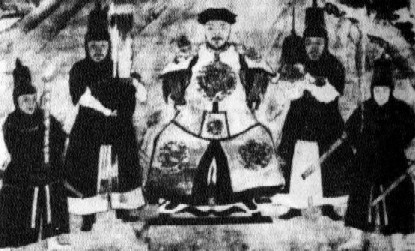 Wu San'gui would be responsible for fighting the new Ming Emperor Yongli who received support from Sun Kewang, Liu Wenxiu & Li Dingguo, namely, generals previously serving under rebel Zhang Xianzhong.
In February of 1652, Wu San'gui & Li Guohan entered Sichuan Province via the east and west routes.
After climbing the Dabashan Mountain, Wu San'gui sacked the Baoning-fu prefecture. Then, Wu San'gui sacked Jia-ding [Leshan] and killed "zong bing" Long Mingyang. Bai Wenxian & Liu Zhenguo retreated to the Xu-zhou [Yibin] city.
Wu San'gui would be responsible for fighting the new Ming Emperor Yongli who received support from Sun Kewang, Liu Wenxiu & Li Dingguo, namely, generals previously serving under rebel Zhang Xianzhong.
In February of 1652, Wu San'gui & Li Guohan entered Sichuan Province via the east and west routes.
After climbing the Dabashan Mountain, Wu San'gui sacked the Baoning-fu prefecture. Then, Wu San'gui sacked Jia-ding [Leshan] and killed "zong bing" Long Mingyang. Bai Wenxian & Liu Zhenguo retreated to the Xu-zhou [Yibin] city.
While Wu San'gui was campaigning in Sichuan Province, King Dingnan-wang Kong Youde attacked Guangxi Province, and King Pingnan-wang Shang Kexi & King Jingnan-wang Geng Zhongming attacked Guangdong Province.
Sun Kewang requested Ming Emperor Yongli for relocation to Anrong of Guizhou Province.
Emperor Yongli already conferred King Qin-wang onto Sun Kewang, King Anxi-wang onto Li Dingguo, King Gongchang-wang onto Bai Wenxian, & King Hunan-wang onto Liu Wenxiu.
Sun Kewang ordered that Li Guoding & Feng Shangli attack the Manchus in Hunan, that 80000 force attack Kong Youde in Guilin of Guangxi Province, and that Liu Wenxiu & Wa Fuchen attack Wu San'gui in Sichuan Province.
In January of 1659, Li Dingguo suffered a setback at the Battle of Mopanshan in Tengchong. Ming Emperor Yongli fled towards Burma.
Li Dingguo would be responsible for continuing the fight against The Manchu, even after Ming Emperor Yongli-di had gone to today's Burma.
Li Dingguo collected the remnants, relocated to Mengding from Nandian, and continued to resist the Manchus by rallying people among the Dai-zu [Thai] minority.
Na-song, a Thai-ethnic magistrate for the Yuanjiang prefecture, was Li Dingguo's strongest ally.
At one time, Na-song obtained the defection of Xu Mingchen & Gao Yingfeng [ex-Ming generals who surrendered to the Manchu] in fighting against the Manchu.
Wu San'gui laid a siege of the Yuanjiang city for five months.
Na-song and his whole family committed suicide.
Sichuan people had held on to the Yucheng [i.e., Chongqing] city till 1659. The Yucheng city was slaughtered after it was sacked by the Manchu Qing armies.
Ming Dynasty remnants established a regime in the Sichuan Province. Zhang Xianzhong's remnants also staged a comeback to Sichuan Province from Yunnan Province.
Li Dingguo, a general under Zhang Xianzhong, was responsible for fighting the Manchus for over a dozen years, even after remnant Ming Emperor Yongli-di was betrayed to Wu San'gui by the Burmese in A.D. 1659.
By A.D. 1661, the Manchus had subjugated most of Yunnan Province.
The minority people in southern Yunnan, Menglian & Yuanjiang areas, including the Thai-ethnic, continued to support Li Dingguo. The minority chieftains, by the name of Long Jizhao & Long Jizuo, resisted the Manchus for 70 days.
Ming Emperor Yongli, who fled to Burma earlier, refused to return to China though Li Dingguo repeatedly requested so.
Emperor Yongli was later handed over to Wu San'gui for execution by the Burmese king.
In A.D. 1662, Li Dingguo went to Mengla, and dispatched messengers to Che-li and Xian-luo [Thailand] for borrowing a relief army.
Thai king's emissary came to see Li Dingguo with support.
Hearing of the death of Emperor Yongli, Li Dingguo was saddened to death in June of 1662.
Remnants continued the resistance throughout 1663-1664: in 1663, Zhang Qi of Kunming, Zhang Tai and Mei Ah-si of Dali, Yi Shu of Tengyue, Zhang Faxiang of Wuding & Lu Jiazhu of Anning rose up in the Huicheng area against the Manchu.
In A.D. 1664, some minority people's chieftains, i.e., king Yang-zu & King Yao-zu, and Li Shifan of Mengzi assembled 110000 people against the Manchus in Lin'an & Mengzi of eastern Yunnan Province.
Na-lie, i.e., Na-song's son, mounted a counter-attack at the Yuanjiang city.
* In Commemoration of China's Fall under the Alien Conquests in A.D. 1279,
A.D. 1644 & A.D. 1949 *
U.S.S.R./Comintern Alliance with the KMT & CCP (1923-1927)
Korean/Chinese Communists & the 1931 Japanese Invasion of Manchuria
American Involvement in China: Soviet Operation Snow, IPR Conspiracy, Dixie Mission, Stilwell
Incident, O.S.S. Scheme, Coalition Government Crap, Amerasia Case & The China White Paper
* Stay tuned for "Republican China 1911-1955: A Complete Untold History" *
|
|
Zou Rong's Revolutionary Army;
Shin Kyu Sik's
Shrine (Spirit, Kunitama) of Korea
|
This snippet is for sons and daughters of China:
Heed the sons & ministers' agony and sorrow of our ancestors who died or lived through the Mongol, Manchu and Soviet-Chicom conquest
and
the Yongjia, Jingkang and Jiashen cataclysms !
Jeanne d'Arc of China:
Teenager girl Xun Guan breaking out of the Wancheng city to borrow the relief troops in the late Western Jinn dynasty;
Liu-Shao-shi riding into the barbarian army to rescue her husband in the late Western Jinn dynasty;
teenager girl Shen Yunying breaking into Zhang Xianzhong's rebels on the horseback to avenge on father's death in the late Ming dynasty.
China's Solitary and Lone Heroes:
Nan Jiyun breaking out of the Suiyang siege and charging back into the city in the Tang dynasty;
Zhang Gui & Zhang Shun Brothers breaking through the Mongol siege of Xiangyang in the Southern Soong dynasty;
Liu Tiejun breaking through three communist field armies' siege of Kaifeng in the Republican China time period;
Zhang Jian's lone confrontation against the communist army during the June 3rd & 4th Massacre of 1989.
|
|
|
After quelling southwestern China, Wu San'gui and another two Chinese-ethnic generals would control southwestern China and southern China as the so-called Three Vassals [i.e., Three Feudatories] for dozens of years.
Wu San'gui, during the period of A.D. 1673-1681, colluded with two other regional overlords for rebellion against the Manchu.
This was in objection to the Manchu attempt at downgrading the Three Feudatories, namely, three Han-ethnic vassal kings' fiefs.
Wu San'gui proactively entered the Sichuan basin to attack the Manchu rule.
The Sichuan locals, in A.D. 1674, defected to Wu San'gui's Zhou-guo State.
Wu San'gui, naming his independent state by Zhou, declared the Honghua Era.
The Manchu army countered the rebels and entered Sichuan in A.D. 1680, with an imperial decree to extract the grain supply locally.
As Qian Shaolong, a Manchu county magistrate for Fushun, reported, the whole area was buried in the thorns and bush, with no traveler seen on the roads and empty cities.
No live person answered the imperial decree to return to the cities.
Qian Shaolong recorded the atrocious acts done on the refugees, women and children included, who were hiding in the deep mountains at the border of Luzhou and Fushun.
In 1681, when the Manchu army fled to Yazhou (Ya'an) after a battle defeat, the pillaging caused the locals to flee to western Sichuan.
Hence, by A.D. 1685, i.e., the 24th year of Kangxi's reign, the census showed only 18090 people in the whole Sichuan region.
Zheng Chenggong's Resistance on the Southeastern Chinese coastline
In southern Chinese coast, General Zheng Chenggong rebelled against his father who had surrendered to the Manchus. Zheng Chenggong launched a war to recover Taiwan from the Dutch in February 1662, using Dongshan Islands of Fujian Province as a launching pad. The Zheng family would rule Taiwan till A.D. 1683. Shi Lang, an ex-general under Zheng's son, would defect to the Manchus. Shi Lang would be responsible for taking over Amoy and Quemoy in A.D. 1680 and subsequently lead the Manchus' landing onto Taiwan. Both Zheng Chenggong and Shi Lang had landed in Taiwan during the high tides.
The Manchus edited and forged the history of the former dynasty, i.e., Ming Shi (i.e., History of the Ming Dynasty). One good example would be the claim that Zhang Xianzhong, who was killed by the Manchu army back in 1646, had made a stone monument entitled the "seven killings". The number of 'seven', coinciding with the Manchu founder's so-called "Seven Hatreds For the Ming Dynasty", just rings a bell in this webmaster's ear as some cooking by the Manchu historians to cover up their slaughter of the Sichuan Province Chinese as well as to legalize the Manchu's rule over China.
To be noted would be the dramatic population drop during the Ming-Qing dynastic transition: In A.D. 1620, i.e., the 1st year of Ming Emperor Guangzong's Taichang Era, China boasted of a population of 51.66 million people, but in A.D. 1651, i.e., the 8th year of Qing Emperor Shizu's Shunzhi Era, China only had 10.63 million people. The conclusion is that China's brave men had all fallen martyrdom in the resistance to the Manchu invasion, something we should take pride in. (Other than the brave Chinese men, Confucianism had always brought about courageous Chinese women who never hesitated to take their own lives in face of assaults by the aggressors. Volumes of chronicles on the Chinese dynasties had a section entitled the 'biographies of courageous women'. There were stringent requirements that counties should only record the names of women who committed suicides before being raped or assaulted. Ironically, the Manchu emperor had decreed that those women who committed suicides after being raped or assaulted could still be eligible for their names being listed in the 'biographies of courageous women'.)
* In Commemoration of China's Fall under the Alien Conquests in A.D. 1279,
A.D. 1644 & A.D. 1949 *
U.S.S.R./Comintern Alliance with the KMT & CCP (1923-1927)
Korean/Chinese Communists & the 1931 Japanese Invasion of Manchuria
American Involvement in China: Soviet Operation Snow, IPR Conspiracy, Dixie Mission, Stilwell
Incident, O.S.S. Scheme, Coalition Government Crap, Amerasia Case & The China White Paper
* Stay tuned for "Republican China 1911-1955: A Complete Untold History" *
|
|
Zou Rong's Revolutionary Army;
Shin Kyu Sik's
Shrine (Spirit, Kunitama) of Korea
|
This snippet is for sons and daughters of China:
Heed the sons & ministers' agony and sorrow of our ancestors who died or lived through the Mongol, Manchu and Soviet-Chicom conquest
and
the Yongjia, Jingkang and Jiashen cataclysms !
Jeanne d'Arc of China:
Teenager girl Xun Guan breaking out of the Wancheng city to borrow the relief troops in the late Western Jinn dynasty;
Liu-Shao-shi riding into the barbarian army to rescue her husband in the late Western Jinn dynasty;
teenager girl Shen Yunying breaking into Zhang Xianzhong's rebels on the horseback to avenge on father's death in the late Ming dynasty.
China's Solitary and Lone Heroes:
Nan Jiyun breaking out of the Suiyang siege and charging back into the city in the Tang dynasty;
Zhang Gui & Zhang Shun Brothers breaking through the Mongol siege of Xiangyang in the Southern Soong dynasty;
Liu Tiejun breaking through three communist field armies' siege of Kaifeng in the Republican China time period;
Zhang Jian's lone confrontation against the communist army during the June 3rd & 4th Massacre of 1989.
|
|
|
The Manchu Trickery & Cunningness In Ruling
Scholar Luo Xianglin, in "History of Chinese Nationalities" (Chinese Culture Publishing Enterprise Co, Taipei, Taiwan, May 1953 edition), stated that the Manchu court ruled Chinese, Mongols, Uygurs and Tibetans in four sharply different ways for sake of maintaining the absolute control.
As to the Mongols, the Manchu rule was to forbid the Mongols from reading of, writing in and learning the Chinese language and to strengthen the Lamaism preaching among the Mongols.
Luo Xianglin listed multiple Manchu decrees to prove his points, including the Manchu Qing Emperor Daoguang's A.D. 1836 order that Mongols could only use the Manchu and Mongol languages. Three years later, Qing Emperor Daoguang further ordered that Mongols should not hire Chinese language teachers over to Mongolia.
Emperor Xianfeng, in A.D. 1853, rebuked Mongol nobles for using Chinese characters as family names and adopting Chinese language in legal paperwork.
Emperor Guangxu, in A.D. 1876, decreed that those Mongols who used Chinese language in documents should be punished.
Luo Xianglin pointed out that the Manchus intended to make Mongols less intelligent so that they could be easily employed for utilizing their "physical strength" as running dogs in wars.
As to the Tibetans, the Manchu court adopted the policy of "respecting Tibetan religion but suppressing its administration".
Luo Xianglin pointed out that the Manchus decreed that every Tibetan household must dispatch one son to monastery for studying the Buddhism, hence making Tibetan population unable to multiply. Further, the Manchus dispatched "imperial minister" to Tibet for monitoring Dalai Lama and Pancho Lama, and intentionally mixed up religion and politics so that Tibetans could not conduct any reform on administration.
Intermarriage between the Tibetans and Chinese were forbidden by the Manchu.
As to the Uygurs, the Manchus adopted the policy of disparaging on Islam and sowing dissension among the Muslims and non-Muslims.
By creating turmoil and rebellion, the Manchus easily sent in the troops for massacring the Uygurs.
As for the Han Chinese, the Manchu, in the words of Scholar Luo Xianglin, intentionally suppressed "dao qi" [i.e., Confucian righteousness, neo-Confucian rationalistic philosophy about inner saint & outer king, and applications to natural sciences] and deliberately developed "wen ci" [literature and flamboyant phrases].
The Manchus reversed the tradition of the astronomy, calendar and firearms introduced by the Muslims during the Mongol Yuan Dynasty as well as the applied sciences introduced by the Jesuits of Ming Dynasty.
AT first, the Manchus attempted to utilize the Catholics in beating off the Muslim calendar with the European calendar, and then utilized the Confucian ethics or moral principles for countering the "applied sciences" that came with the Catholics.
To further suppress the Chinese intellectuals, the Manchu emperors, like Qianlong, resorted to "literary inquisition" [i.e., "wen zi yu" (imprisonment due to writings)] for controlling the minds and thoughts of the Chinese.
The Manchus forbade the assembly of scholars or intellectuals into the societies and moreover advocated "eight-part essay" [i.e., the stereotyped essay"] as the format for imperial civil service exams.
Qing Emperor Shunzhi (Qing Shizu, Aixinjueluo Fu-lin, r. 1644-1661)
Qing Emperor Kangxi (Qing Shengzu, Aixinjueluo Xuan-ye, r. 1662-1722)
The 1689 Treaty of Nerchinsk & Pereira Thomas
At the suggestion of Nan-huai-ren (Ferdinandus Verbiest), Portuguese missionary Pereira Thomas and French missionary [Zhang Cheng], both guys who knew nothing about the Russian language, were invited in May 1688 as interpreters for negotiating the "Lingua Latina" version of the Treaty of Nerchinsk on the part of the Manchu China's panel led by Suo-e-tu.
This first trip aborted due to the Dzungarian rebellion that was instigated by the Russians.
In August 1689, Manchu China dispatched a new panel to Nerchinsk. Prior to the trip, the Russians already colluded with Thomas Pereira who intended to open up China for both the Eastern Orthodox Church and [Western] Vatican by taking advantage of the entangles between Russia and the Manchu China.
Recovering Taiwan
Qing Emperor Yongzheng (Qing Shizong, Aixinjueluo Yin-zhen, r. 1723-1735)
Qing Emperor Qianlong (Qing Gaozong, Aixinjueluo Hong-li, r. 1736-1795)
Qing Emperor Jiaqing (Qing Renzong, Aixinjueluo Yong-yan, r. 1796-1820)
Wu [no] Wang [forgetting] Zai [at] Ju [the Ju fort]
In Commemoration of China's Fall under the Alien Conquests in AD 1279,
AD 1644 & AD 1949
China was time and again invaded and raped by the "aliens" - whom this webmaster considered to be
i) the Mongols,
ii) the Manchus, and
iii) the Soviet proxies, consecutively.
For the future sons of China to read the following poem, see whether someone of you would revive the spirits of China,
and some day do some thing to reverse the fate of China, i.e., one billion coolies and slaves toiling to death for the multinational corporations and banksters under the supervision of the 'housekeeper' - the Chinese Communists or the former Soviet proxies.
(The Japanese invasion [AD 1931-1945], similar to the Jurchen invasion prior to the Mongol conquest, did not doom China as a whole as the Mongol conquest and the Soviet-ChiCom conquest subsequently did.)
The communists had conquered China owning to the key battle success in Manchuria, which was the result of treacheries on the part of Wei Lihuang, i.e., the government troops' commander-in-chief in Manchuria, a treachery that was comparable to Soong Dynasty prime minister Jia Sidao's abandoning to the Mongol the Xiangyang city [which was under siege for 4-5 years] and Ming Dynasty general Wu Sangui's betrayal of the Mountain and Sea Pass to the Manchus.
Wei Lihuang, with the communist mole by his side from the days of the resistance war, overrode General Wang Tiehan's proposal and made the government army into the sitting ducks in the isolated pockets and cities of Manchuria, for the communist army to attack.
Namely, Wei Lihuang allowed the communist army to take the transcendental secret manoeuvre to ship thousands of artillery to the foot of the Jinzhou city wall under the assistance of the Soviet railway army corps.
General Wang Tiehan suggested that the Changchun garrison troops could break out towards Mukden to the south as intelligence had shown that the communist army had disappeared along the trunk line of Changchun-Jirin-Mukden.
Only the 52nd Corps, that was hoodwinked by Wei Lihuang into attacking towards Shenyang [i.e., Mukden] as the relief troops but impeded by the communist army halfway for lack of coordination between Wei Lihuang and the communist army, managed to return to wrestle back the Yingkou port to escape the Manchurian battleground via sea.
A part of the Youth Army division, which broke out of the Mukden siege, fought its way along the Liao-xi Corridor to arrive at the Mountain and Sea Pass.
We don't need to remind the readers that the communist army was a motley group of mercenaries including about 250,000 ethnic-Korean Japanese Kwantung Army diehards per Kim Il-sun plus the Japanese 8th Route Army (i.e., the Japanese medical staff, airforce staff, officer corps, and tank and artillery operators), the ethnic-Taiwan Japanese Kwantung Army, the Outer Mongolian cavalry army, not counting the Soviet railway army corps.
According to the Soviets, the 'railway' tag was a guise for intervening in the Chinese civil wars, namely, the cloak of secrecy under which the Soviets orchestrated the historical Soviet conquest of China to fulfill Stalin's mantle that pro-Soviet regimes must be established in all territories that the Soviet Red Army ever stepped on, no matter Europe or Asia.
That is, Soviet military staff, not merely Soviet military advisers, fought the Chinese civil wars in Manchuria as the railway staff.
Ivan V. Kovalev, as Stalin and All-Union Communist Party (Bolsheviks)'s plenipotentiary to the Chinese Communist Party (CCP), was sent to China for directing the civil war as a railway czar.

George Kennan's Fallacious Disclaim of Soviet Instigation and Bankrupt 'Long' Containment View:
George Kennan
naively discounted
the Chinese communist revolution as "part of the Soviet system" and asserted its victory to be an
exception to the Soviet "military intimidation or invasion" and not a result that could be ascribed
"primarily to Soviet propaganda or instigation" (American Diplomacy, p. 119. The U of Chi Press 1951,
expanded edition).
George Kennan's bankrupt 'long' view as to communism was "a long-term, patient but firm and vigilant containment", which was to seek solutions in the "historical"
context, namely,
the "Russian or the oriental mind" of the "Russian-Asiatic world", something the communist China twin shared, that was
seemingly perceived as an innate matter that could not be overcome.
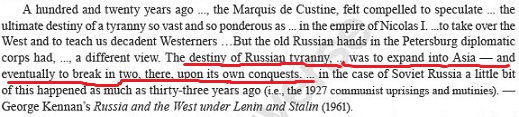
|
|
|
|
|
TEN TRAINS EQUIVALENT AMERICAN LEND-LEASE WEAPONS THAT STALIN & RUSSIANS GAVE TO MAO & CHINESE COMMUNISTS;
FORTY SHIPS EQUIVALENT QUANTITY OF TANKS & CANNONS, BOTH AMERICAN-MADE & JAPAN-MADE
3300 TONS OF PETROL FROM RUSSIANS IN 1947 ALONE; PLUS 2000 TONS OF DIESEL, 1000 TONS OF PLANE FUEL, 700 TONS OF EXPLOSIVES & 2000 TONS OF MACHINERY OIL
30000 TONS OF PETROL FROM RUSSIANS IN 1948; PLUS 1000 TONS OF PLANE FUEL, 5000 TONS OF KEROSINE, 3000 HEAVY WEIGHT TRUCKS & 150 ARTILLERY TRACTORS
DEATH OF MILLIONS OF YELLOW MEN, & POSSIBLY MORE IN THE FUTURE WAR AGAINST TAIWAN !!!!!
Reference: see the writing by James Perloff China Betrayed Into Communism on Friday, 24 July 2009 at
http://www.thenewamerican.com/index.php/history/world/1464
August Storm lend-lease weapons ended up in Mao's hands.
"At the Teheran and Yalta wartime conferences, however, Roosevelt asked Stalin if he would break his pact with Japan and enter the Far East war. Stalin agreed, but attached conditions. He demanded that America completely equip his Far Eastern Army for the expedition, with 3,000 tanks, 5,000 planes, plus all the other munitions, food, and fuel required for a 1,250,000-man army. Roosevelt accepted this demand, and 600 shiploads of Lend-Lease material were convoyed to the USSR for the venture. Stalin's Far Eastern Army swiftly received more than twice the supplies we gave Chiang Kai-shek during four years as our ally.
"General Douglas MacArthur protested after discovering that ships designated to supply his Pacific forces were being diverted to Russia. Major General Courtney Whitney wrote: 'One hundred of his transport ships were to be withdrawn immediately, to be used to carry munitions and supplies across the North Pacific to the Soviet forces in Vladivostok.... Later, of course, they were the basis of Soviet military support of North Korea and Red China.'
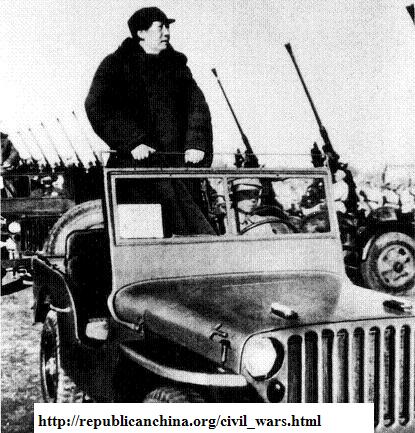
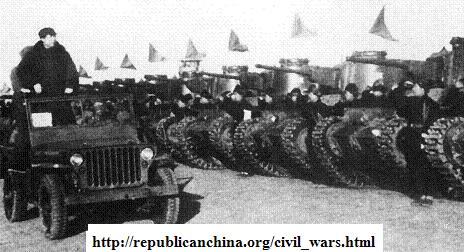
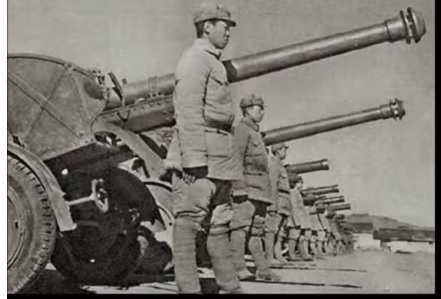
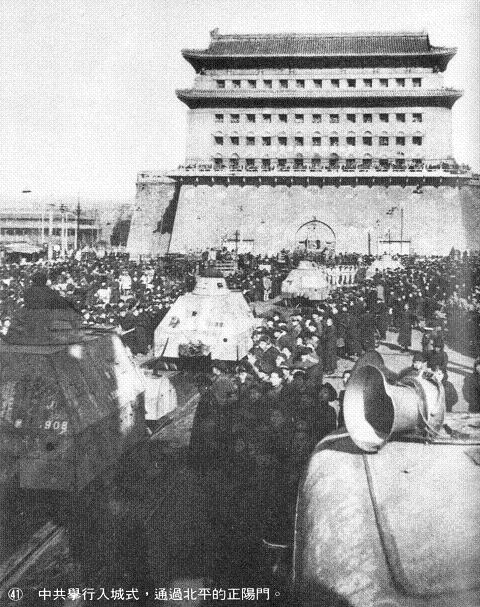
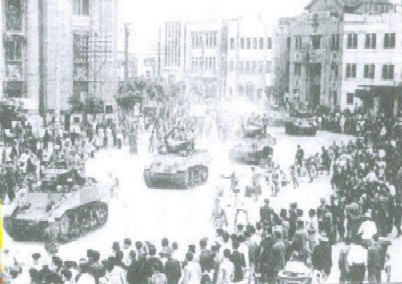
|
* In Commemoration of China's Fall under the Alien Conquests in AD 1279,
AD 1644 & AD 1949 *
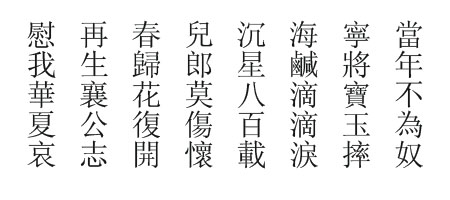
At the time [when China fell under the alien rule], refusing to be slaves,
[our ancestors] died as broken jades rather than being alive as an intact tile.
Tears, which tasted like the sea water, dripping down [the face] one by one,
For [China] the star [that fell from the sky] had been down [at the bottom of the sea] for 800 years.
Sons, please do not get saddened in the hearts,
For as the flowers did, they blossom when the spring returns.
When the [hegemony lord] Xianggong's swear is to be revived again,
The sorrow of the Flowery Xia Chinese would be soothed.
|
Founding Of 'Da Jin' (Grand Gold Dynasty)
Eight Banner System
Twenty Five Years Of War Against China
Battle Of Mountain & Sea Pass
Entering China Proper
Infamous Queue-Related Massacre
Solidifying Rule Over China
Qing Emperor Shunzhi (Qing Shizu, Aixinjueluo Fu-lin, r. 1644-1661):
Qing Emperor Kangxi (Qing Shengzu, Aixinjueluo Xuan-ye, r. 1662-1722):
1689 Treaty of Nerchinsk
Recovering Taiwan:
Qing Emperor Yongzheng (Qing Shizong, Aixinjueluo Yin-zhen, r. 1723-1735):
Qing Emperor Qianlong (Qing Gaozong, Aixinjueluo Hong-li, r. 1736-1795):
Qing Emperor Jiaqing (Qing Renzong, Aixinjueluo Yong-yan, r. 1796-1820):
|
The Opium War (1839-1842)
"Wangxia Treaty" [U.S.] & Whampoa Treaty [France]
Second Opium Wars (1856–60) & Arson of Summer Palace
Taiping (Grand Peace) Heavenly Kingdom Rebellion
Foreign Enterprises Movement (Self-Strengthening)
The Manchu Military System: Brave-Camp Army & New Army
Russian Encroachments [1847-1900]
1876 Anglo-Chinese Yantai Treaty
1884-1885 Franco-Chinese War
Imperialist Encroachments On Korea
1894 Sino-Japanese War
Russo-Japanese War Over Manchuria
Rise of Yuan Shi-kai
Start Of Water-Melon Partitioning
Hundred Day Reformation
The Boxers & Invasion of Eight Allied Nations
Rise of Yuan Shi-kai (Continued)
Assassinations & Uprisings
'Retaining Railroad' Movement
Wuchang Uprising & Xin Hai Revolution
|
| [ this page: Manchu.htm ] |
[ next page: qing.htm ] |
Written by Ah Xiang
|
|
|
|
|
|
|
Sovereigns & Thearchs;
Xia-Shang-Zhou dynasties;
Zhou dynasty's vassalage lords;
Lu Principality lords;
Han dynasty's reign years
(Sexagenary year conversion table-2698B.C.-A.D.2018; 247B.C.-A.D.85)
|
|
The Sinitic Civilization - Book I is
available now on
iUniverse,
Barnes & Noble,
Amazon,
Google Play|Books
and
Nook.
The Sinitic Civilization - Book II is
available at
iUniverse,
Amazon and Barnes & Noble.
Check out the 2nd edition preface that realigned the Han dynasty's reign years strictly observing the Zhuanxu-li calendar of October of a prior lunar year to September of the following lunar year, and the 3rd edition introduction that had an overview of Sinitic China's divinatory history of 8000 years.
The 2nd edition preface had an overview of the epact adjustment of the quarter remainder calendars of the Qin and Han dynasties, and the 3rd edition introduction had an overview of Sinitic China's divinatory history of 8000 years.
The 2nd edition realigned the Han dynasty's reign years strictly observing the Zhuanxu-li calendar of October of a prior lunar year to September of the following lunar year.
Stayed tuned for Book III that is to cover the years of A.D. 86-1279, i.e., the Mongol conquest of China, that caused a loss of 80% of China's population and broke the Sinitic nation's spine.
Preview of annalistic histories of the Sui and Tang dynasties, the
Five Dynasties, and the two Soong dynasties
could be seen in
From the Khitans to the Jurchens & Mongols: A History of Barbarians in Triangle Wars and Quartet Conflicts
(The Barbarians' Tetralogy - Book III: available at iUniverse;
Google Play|Books;
Amazon;
B&N).
(A final update of the civilization series is scheduled for October of 2022, that would put back the table of the Lu Principality ruling lords' reign years, that was inadvertently dropped from Book I during the 2nd update.)
|
|
Now, the Scourge-of-God-Tetralogy.
Book III of
The Barbarian Tetralogy, i.e., this webmaster's barbarism series, is released in October of 2022 by iUniverse. This barbarism series would be divided into four volumes covering the Huns, the Xianbei, the Turks, the Uygurs, the Khitans, the Tanguts, the Jurchens, the Mongols and the Manchus.
Book I of the tetralogy would extract the contents on the Huns from
The Sinitic Civilization-Book II,
which rectified the Han dynasty founder-emperor's war with the Huns on mount Baideng-shan to A.D. 201 in observance of the Qin-Han dynasties' Zhuanxu-li calendar.
Book II of the Tetralogy would cover the Turks and Uygurs.
And
Book IV would be about the Manchu conquest of China.
From the Khitans to the Jurchens & Mongols: A History of Barbarians in Triangle Wars and Quartet Conflicts
, i.e., Book III of
the Scourge-of-God-Tetralogy,
focused on the Khitans, Jurchens and Mongols, with the missing one-year history of the Mongols' Central Asia campaigns rectified.
This webmaster, other than the contribution to the Sinology studies in rectifying the Huns' war to 201 B.C., and realigned the missing one-year history of the Mongol Central Asia war, had one more important accomplishment, i.e., the correction of one year error in the Zhou dynasty's interregnum (841-828 B.C. per Shi-ji/840-827 per Zhang Wenyu) in
The Sinitic Civilization-Book I, a cornerstone of China's dynastic history.
|
The Scourges of God: A Debunked History of the Barbarians (available at iUniverse|Google Play|Google Books|Amazon|B&N)
From the Khitans to the Jurchens & Mongols: A History of Barbarians in Triangle Wars and Quartet Conflicts
(The Barbarians' Tetralogy - Book III)
Epigraph,
Preface,
Introduction,
Table of Contents,
Afterword,
Bibliography,
References,
Index
|
|
|
|
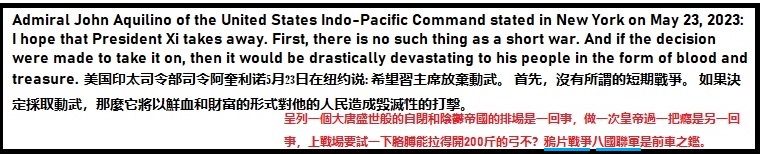
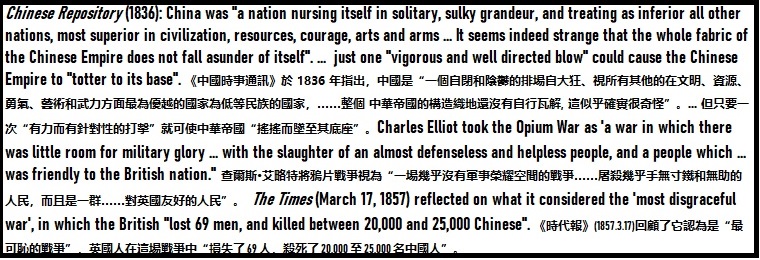

 ***
***


![Though, Anna Wang [Anneliese Martens], in her memoirs, expressed jealousy over Gong Peng by stating that the Anglo-American reporters had flattered the Chinese communists and the communist movement as a result of being entranced with the goldfish-eye'ed personal assistant of Zhou Enlai](GongPeng.jpg)