Sinitic Civilization-Book 1
Sinitic Civilization-Book 2
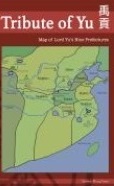
Tribute of Yu

Heavenly Questions
Zhou King Muwang's Travels
The Legends of Mountains & Seas
The Bamboo Annals - Book 1
The Scourge-of-God-Tetralogy:
From the Khitans to the Jurchens & Mongols: A History of Barbarians in Triangle Wars and Quartet Conflicts
(available at iUniverse;
Google;
Amazon;
B&N)
|
|
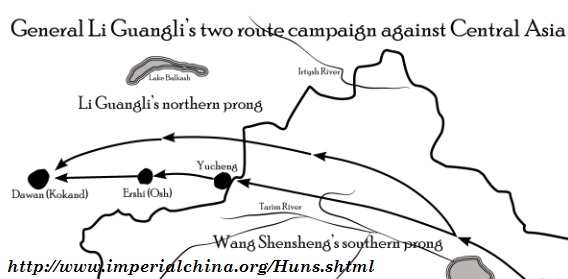
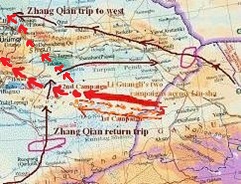 For details on when the east met with the west, see this webmaster's discussion on the Huns, the Yuezhi, the Tarim Mummies, the Yuezhi-Yushi misnomer,
the Mongoloid-Caucasoid admixture at 2000 B.C.E.,
the fallacy of the Aryan bearing of the Chinese civilization,
the fallacy of the Yuezhi jade trade,
the Yuezhi migration timeline,
as well as
the location of the Kunlun Mountain,
Queen Mother of the West,
the legendary book of mountains and seas at the Imperial China blog,
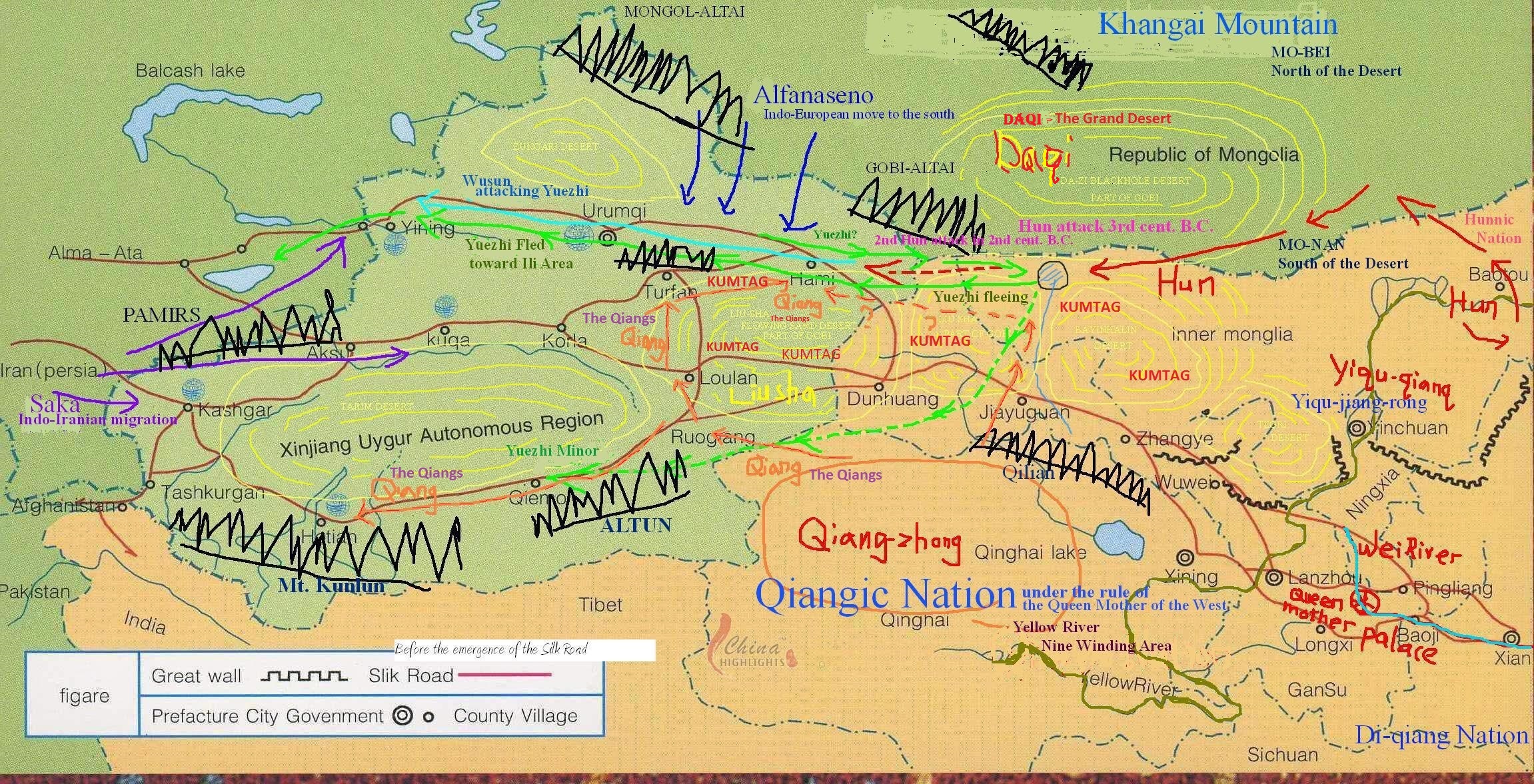
and the Qiang's possible routes of passage into Chinese Turkestan
at
http://www.imperialchina.org/Barbarians.htm which was embedded within the
Huns.html and
Turks_Uygurs.html pages.
(Note that Western Queen Mother had the prototype in an "earth mother" deity, not related to Queen Sheba of Charles Hucker.
The Mt. Kunshan jade was more likely the Mt. Huoshan jade in the Han dynasty book Huai Nan Zi, or the Mt. Yiwulü jade or the Kunlun jade that were juxtaposed together in the same book Huai Nan Zi, not related to Queen Mother of the West.
http://www.sino-platonic.org/complete/spp115_chinese_proto_indo_european.pdf provides another perspective of looking at things of the past from the perspective of language cognates. Rather believing that the Indo-Europeans ever invaded China and gave the Sinitic people the language, we could actually deduce that "Old Chinese", for its 43% correlation with the Proto-North-Caucasian, rather 23% with the Proto-Indo-European, was the source for both the cognates of the Proto-North-Caucasian and the Proto-Indo-European -- with the Proto-North-Caucasian falling under the umbrella of the Dene-Caucasian (Sino-Caucasian) Language Family that encompassed the [Proto-North-]Caucasian, Yeniseian and Sino-Tibetan languages. This is because our cousins, i.e., the N haplogroup people, relocated to North Asia and then to Latvia, Estonia, Finland and Scandinavia, bringing along the Sinitic language to the Proto-North-Caucasian who in turn gave it to the Proto-Indo-European. Note the Sinitic language cognates' 74% correlation with the Proto-Tibeto-Burman who split from the Sinitic people merely 5000-6000 years ago.)
For details on when the east met with the west, see this webmaster's discussion on the Huns, the Yuezhi, the Tarim Mummies, the Yuezhi-Yushi misnomer,
the Mongoloid-Caucasoid admixture at 2000 B.C.E.,
the fallacy of the Aryan bearing of the Chinese civilization,
the fallacy of the Yuezhi jade trade,
the Yuezhi migration timeline,
as well as
the location of the Kunlun Mountain,
Queen Mother of the West,
the legendary book of mountains and seas at the Imperial China blog,
and the Qiang's possible routes of passage into Chinese Turkestan
at
http://www.imperialchina.org/Barbarians.htm which was embedded within the
Huns.html and
Turks_Uygurs.html pages.
(Note that Western Queen Mother had the prototype in an "earth mother" deity, not related to Queen Sheba of Charles Hucker.
The Mt. Kunshan jade was more likely the Mt. Huoshan jade in the Han dynasty book Huai Nan Zi, or the Mt. Yiwulü jade or the Kunlun jade that were juxtaposed together in the same book Huai Nan Zi, not related to Queen Mother of the West.
http://www.sino-platonic.org/complete/spp115_chinese_proto_indo_european.pdf provides another perspective of looking at things of the past from the perspective of language cognates. Rather believing that the Indo-Europeans ever invaded China and gave the Sinitic people the language, we could actually deduce that "Old Chinese", for its 43% correlation with the Proto-North-Caucasian, rather 23% with the Proto-Indo-European, was the source for both the cognates of the Proto-North-Caucasian and the Proto-Indo-European -- with the Proto-North-Caucasian falling under the umbrella of the Dene-Caucasian (Sino-Caucasian) Language Family that encompassed the [Proto-North-]Caucasian, Yeniseian and Sino-Tibetan languages. This is because our cousins, i.e., the N haplogroup people, relocated to North Asia and then to Latvia, Estonia, Finland and Scandinavia, bringing along the Sinitic language to the Proto-North-Caucasian who in turn gave it to the Proto-Indo-European. Note the Sinitic language cognates' 74% correlation with the Proto-Tibeto-Burman who split from the Sinitic people merely 5000-6000 years ago.)
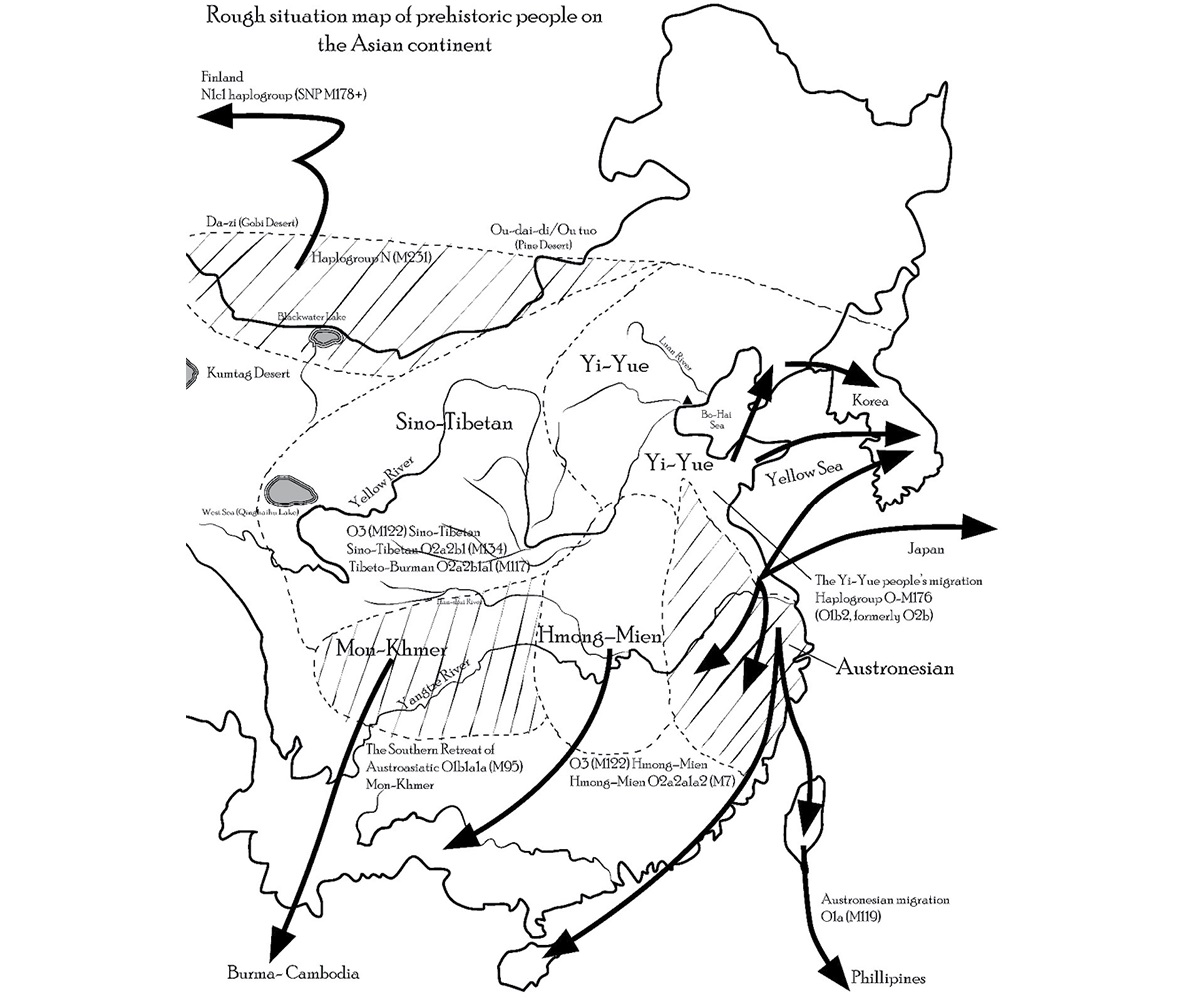
Li Hui of Fudan University of China analyzed the Asian DNAs to have derived a conclusion that ancestors of the [East] Asians possessed a distinctive Mark M89 by the time they arrived in Southeast Asia.
About 30,000 years ago, from the launching pad of Southeast Asia, the early Asians went through a genetic mutation to marker M122.
Li Hui claimed that the early migrants to the Chinese continent took three routes via two entries of today's Yunnan and Guangxi-Guangdong provinces.
More studies done after Li Hui had ascertained the dates of the O1, O2 and O3 haplogroup people, with the (O1, O2) entrants along the Southeast Chinese coast dated to have split away from the O3-haplogroup people like 20,000 years ago, much earlier than the continental peers, i.e., the Sino-Tibetans (O3a3c1-M117), Hmong-Mien (Miao-Yao, O3a3b-M7) and Mon-khmers.
According to
https://www.ncbi.nlm.nih.gov/pmc/articles/PMC5255561/
"Y chromosome suggested Tibeto-Burman populations are an admixture of the northward migrations of East Asian initial settlers with haplogroup D-M175 in the Late Paleolithic age, and the southward Di-Qiang people with dominant haplogroup O3a2c1*-M134 and O3a2c1a-M117 in the Neolithic Age. Haplogroup O3a2c1*-M134 and O3a2c1a-M117 are also characteristic lineages of Han Chinese, comprising 11.4% and 16.3%, respectively. However, another dominant paternal lineage of Han Chinese, haplogroup O3a1c-002611, is found at very low frequencies in Tibeto-Burman populations, suggesting this lineage might not have participated in the formation of Tibeto-Burman populations."
Namely, the haplogroup O3a1c-002611 Sinitic people, not the O3a2c1*-M134 and O3a2c1a-M117 barbarians, were responsible for engendering the Yangshao and Longshan civilization, and partially with the N-haplogroup people, engendering the Hongshan civilization.
The Zhou people were archaeologically speculated to have origin from today's Shanxi for the link to the Guangshe Culture –- which was in turn a derivative of the You'ao-type Laohushan Culture of the mixed N-haplogroup and O-haplogroup people.
(Since the O3a1c-002611 people were separated from the Northwestern cousins and Tibeto-Burmese at an early age, for it to have a part in the history of Northwestern China, the explanation would be to treat the Haplogroup O3a2c1*-M134 and O3a2c1a-M117 people as the historical Qiang and Hu barbarians, with the latter's paleo-Northwestern genes replacing the paleo-North-China and paleo-Central Plains genes of O3a1c-002611 Sinitic people by the Soong dynasty (A.D. 960-1279), that was likely triggered by the multiplication of the Tang dynasty's imperial house that had its origin from the Western Corridor.
The Soong dynasty royals took Tianshui of western China as the ancestral homeland, which was similar to the Tang dynasty royals' origin from the Western Corridor in western China, i.e., the Qin and Zhao states' common ancestral place.
The Soong royal house, however, could be of the Shatuo Turks' Q-haplogroup gene.
Also see this webmaster's discussion on
the ethnic nature of the ancient Huns belonging to part of the epic Jiang-rong human migration
of the Jiang-surnamed San-miao people and Yun-surnamed Xianyun people.)
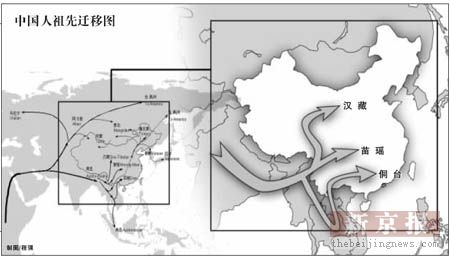 Li Hui commented that one branch of the early Asians, over 10,000 years ago, entered China's southeastern coastline with genetic marker M119. Li Hui, claiming the same ancestry as the Dai-zu and Shui-zu minorities of Southwestern China, firmly believed that his ancestors had dwelled in the Hangzhou Bay and the Yangtze Delta for 7-8 thousand years.
The people with the M119 marker would be the historical "Hundred Yue People".
The interesting theory adopted by Li Hui would be the migration of one branch of people who continued to travel non-stop along the Chinese coastline to reach the Liao-he River area of today's Manchuria.
Li Hui's speculation on basis of the DNA technology was an evolving process.
This would be likely the O2-haplogroup people, rather than the C-haplogroup or North Asia people whose historical presence in Asia could be dated 50,000 years ago, just after the earlier D-haplogroup people who were now mostly restricted in the area of Hokkaido, Japan, and known as the Ainu.
The C-haplogroup people developed into what this webmaster called by the Altaic-speaking people,
i.e., ancestors of the Mongols and Manchus.
What likely happened was that the O2-haplogroup people first travelled along the coast to reach Manchuria, and then traced back towards the south to reach the Yangtze area about 7-8000 years ago, where they evicted the O1-haplogroup people to the Southeast Asian islands.
At about the same time, the O3-haplogroup people, moving through the continent, reached today's western Liaoning at least 5000 years ago, or like 11,000 years ago on basis of the evidence of the pottery aging.
See the genetical analysis conducted by Li Hongjie of Jirin University on the remains of prehistoric people extracted from the archaeological sites.
Li Hui commented that one branch of the early Asians, over 10,000 years ago, entered China's southeastern coastline with genetic marker M119. Li Hui, claiming the same ancestry as the Dai-zu and Shui-zu minorities of Southwestern China, firmly believed that his ancestors had dwelled in the Hangzhou Bay and the Yangtze Delta for 7-8 thousand years.
The people with the M119 marker would be the historical "Hundred Yue People".
The interesting theory adopted by Li Hui would be the migration of one branch of people who continued to travel non-stop along the Chinese coastline to reach the Liao-he River area of today's Manchuria.
Li Hui's speculation on basis of the DNA technology was an evolving process.
This would be likely the O2-haplogroup people, rather than the C-haplogroup or North Asia people whose historical presence in Asia could be dated 50,000 years ago, just after the earlier D-haplogroup people who were now mostly restricted in the area of Hokkaido, Japan, and known as the Ainu.
The C-haplogroup people developed into what this webmaster called by the Altaic-speaking people,
i.e., ancestors of the Mongols and Manchus.
What likely happened was that the O2-haplogroup people first travelled along the coast to reach Manchuria, and then traced back towards the south to reach the Yangtze area about 7-8000 years ago, where they evicted the O1-haplogroup people to the Southeast Asian islands.
At about the same time, the O3-haplogroup people, moving through the continent, reached today's western Liaoning at least 5000 years ago, or like 11,000 years ago on basis of the evidence of the pottery aging.
See the genetical analysis conducted by Li Hongjie of Jirin University on the remains of prehistoric people extracted from the archaeological sites.
  Northeast (southeastern Inner Mongolia)
    Niuheliang, Lingyuan, the Hongshan Culture, 5000 YBP,
    4 N, 1 C*, 1 O

  North
   Yuxian County (the Sanguan site), Hebei,
   the Lower Xiajiadian Culture, 3400-3800 YBP, all O3
Combining Li Hui's study with the pottery excavation, we could see a clear path going north extending from around 15,000 years ago to 10,000 years ago.
Refer to Yaroslav V. Kuzmin's discourse on potteries
to see the path of migration of
proto-Mongoloids
from southwestern China (approx. 15,120+/-500 BP) to
Northeast Asia (Manchuria [13,000 BP, or c. 14,000 - 13,600 cal BC] and
Japan [c. 11,800-10,500 cal BC (c. 13,800 - 12,500 cal BP)]) to
Siberia (11,000 BP, or 11,200 - 10,900 cal BC).
In the timeframe of about 10,000 years, developing a genetic mutation to the marker M134, one branch of people who went direct north, per Li Hui, would penetrate the snowy Hengduan Mountains of the Tibetan-Qinghai Plateau to arrive at the area next to the Yellow River bends.
Owning to the cold weather environment, some physique, such as big noses, heavy lips and longer faces, developed among this group of people, i.e., ancestors of the Sino-Tibetans.
Splitting out of the northbound migrants would be those who went to the east with a new genetic marker M117, i.e., ancestors of the modern Han [a misnomer as the proper term should be Sino-Tibetan, nor the later Sinitic] Chinese.
We could say that our Sino-Tibetan ancestors forgot that they had penetrated northward the Hengduan Mountains from the Indo-China "CORRIDOR" in today's Burma-Vietnam.
"Walking down Mt Kunlun", i.e., the "collective memory of the ethnic Han Chinese" throughout China and the Southeast Asian Chinese communities, that was echoed in Guo Xiaochuan's philharmonic-agitated epic, would become the starting point of the eastward migration which our Chinese ancestors remembered.
(Li Hui grouped the 3000-year-old Chu and Qi people in the same category as the Han Chinese, albeit meeting the ancient classics' records as to the Qi statelet's lineage from the Qiangic-Tibetan Fiery Lord.
According to
https://onlinelibrary.wiley.com/doi/full/10.1111/j.1759-6831.2012.00244.x
"the frequencies of the three main subhaplogroups of O3-M122: O3a1c-002611, O3a2c1*-M134, and O3a2c1a-M117 in Han Chinese are 16.9%, 11.4%, and 16.3%, respectively (Yan et al., 2011).
The northward migration of haplogroup O3a1c-002611 started about 13 thousand years ago (KYA). The expansions of subclades F11 and F238 in ancient Han Chinese began about 5 and 7 KYA immediately after the separation between the ancestors of the Han Chinese and Tibeto-Burman.
Haplogroup O3a1c-002611 and O3a1c1-F11 started their northward migration about 12 KYA from Southeast Asia, along with other O3-M122 lineages, and reached the upper and middle Yellow River basin. About 7 KYA, haplogroup O3a1c2-F238 originated in the ancestors of modern Sino-Tibetan populations. About 6 KYA, the Han Chinese split from the Proto-Sino-Tibetan, and started their migration to the east and south (Su et al., 2000b). About 5 KYA, haplogroup O3a1c1-F11 experienced rapid expansion, probably in the Eastern Han Chinese, with recent gene flow with surrounding populations and eventually became prevalent in different ethnic groups in East Asia.)
Li Hui then pointed out that the ancient Wu people, with M7 genetic marker, came to the lower Yangtze area about 3000 years ago.
While Li Hui claimed that the M7 Wu people had split away from the northbound M134 Sino-Tibetan people, the historical Chinese classics pointed out that the Wu Statelet was established by two uncles of Zhou Dynasty King Wenwang, i.e., migrants from the Yellow River area.
The general layout by Lu Hui seems to have corroborated with Scholar Luo Xianglin's claim that early Sino-Tibetan people originated from the Mt Minshan and upper-stream River Min-jiang areas of today's Sichuan-Gansu provincial borderline and then split into two groups, with one going north to reach the Wei-shui River and upperstream Han-shui River of Shenxi Province and then eastward to Shanxi Province by crossing the Yellow River.
--Though, this webmaster's analysis of China's prehistory shows that the Sino-Tibetan people who moved to the eastern coast was one group, with the future Tibetans being actually the exiles to Northwest China from eastern and central China during the era of Lord Shun. Namely, the split of the Sinitic and proto-Tibetan people occurred prior and during the exile in the late 3rd millennium B.C.E.
(George Driem proposed that the Sino-Tibetans had splitoffs like the Western Tibeto-Burmans and the Eastern Tibeto-Burmans, with the Eastern Tibeto-Burmans forming two groups of northern and southern, who in turn split into the Northwestern Tibeto-Burmans, the Northeastern Tibeto-Burmans, the Southwestern Tibeto-Burmans, and the Southeastern Tibeto-Burmans, with a claim that the western offshoots went all the way to the Kashmir before returning east along the northern slope of the Himalayas to have a reunion with their cousins and that the Northeastern Tibeto-Burmans were the Sinitic people.)
What Li Hui did not touch on in his earliest studies were the cousin tribes of the Sino-Tibetans, namely, the Hmong-miens and Mon-khmers.
As noted at http://www.ncbi.nlm.nih.gov/pmc/articles/PMC3164178/, "A clear hierarchical structure (annual ring shape) emerged in the network of O3a3b-M7 (Fig. 2B), in which MK (Mon-Khmers) haplotypes lay at the center of the network (immediately next to the origin), HM (Hmong-Mien) haplotypes were distributed at the periphery to the MK haplotypes, and the ST (here the subfamily Tibeto-Burman) haplotypes were only found further away from the origin."
|
|
* In Commemoration of China's Fall under the Alien Conquests in A.D. 1279,
A.D. 1644 & A.D. 1949 *
 U.S.S.R./Comintern Alliance with the KMT & CCP (1923-1927)
 Korean/Chinese Communists & the 1931 Japanese Invasion of Manchuria Korean/Chinese Communists & the 1931 Japanese Invasion of Manchuria
American Involvement in China: Soviet Operation Snow, IPR Conspiracy, Dixie Mission, Stilwell
Incident, O.S.S. Scheme, Coalition Government Crap, Amerasia Case & The China White Paper
* Stay tuned for "Republican China 1911-1955: A Complete Untold History" *
|
|
Zou Rong's Revolutionary Army;
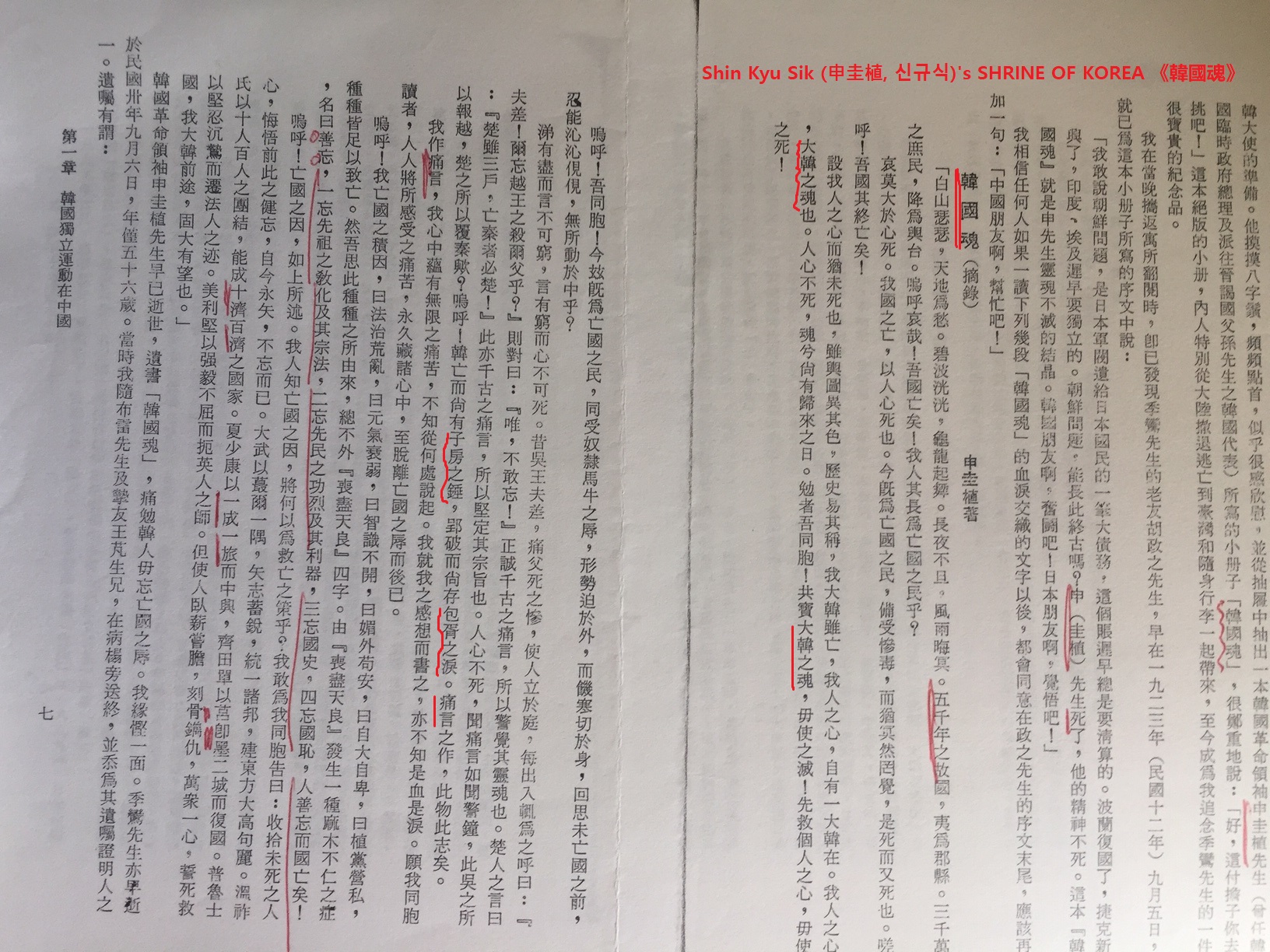
Shin Kyu Sik's
Shrine (Spirit, Kunitama) of Korea
|
This snippet is for sons and daughters of China:
Heed the sons & ministers' agony and sorrow of our ancestors who died or lived through the Mongol, Manchu and Soviet-Chicom conquest
and
the Yongjia, Jingkang and Jiashen cataclysms !
Jeanne d'Arc of China:
Teenager girl Xun Guan breaking out of the Wancheng city to borrow the relief troops in the late Western Jinn dynasty;
Liu-Shao-shi riding into the barbarian army to rescue her husband in the late Western Jinn dynasty;
teenager girl Shen Yunying breaking into Zhang Xianzhong's rebels on the horseback to avenge on father's death in the late Ming dynasty.
China's Solitary and Lone Heroes:
Nan Jiyun breaking out of the Suiyang siege and charging back into the city in the Tang dynasty;
Zhang Gui & Zhang Shun Brothers breaking through the Mongol siege of Xiangyang in the Southern Soong dynasty;
Liu Tiejun breaking through three communist field armies' siege of Kaifeng in the Republican China time period;
Zhang Jian's lone confrontation against the communist army during the June 3rd & 4th Massacre of 1989.
|
|
|
 Today, ethnicity is used mostly for gaining benefits and the special treatment, as in the case of the 'familyhood planning'. People of the Manchu descent or the Sinicized Muslims (the Hui minority/Dungans), for example, might be able to raise more than one child. Some universities had reserved quotas for enrolling the minority students, only.
Though, the Uygurs complained about the forced abortions frequently. In another sense, the corruption of the Chinese bureaucracy and apparatus had produced such phenomenon as 'second wives' or 'third wives' among the rich Chinese men, making the 'familyhood planning' a joke or an extra mechanism for the various parasite officials to milk the ransom money nationwide.
Today, ethnicity is used mostly for gaining benefits and the special treatment, as in the case of the 'familyhood planning'. People of the Manchu descent or the Sinicized Muslims (the Hui minority/Dungans), for example, might be able to raise more than one child. Some universities had reserved quotas for enrolling the minority students, only.
Though, the Uygurs complained about the forced abortions frequently. In another sense, the corruption of the Chinese bureaucracy and apparatus had produced such phenomenon as 'second wives' or 'third wives' among the rich Chinese men, making the 'familyhood planning' a joke or an extra mechanism for the various parasite officials to milk the ransom money nationwide.
Also important as to the Chinese ethnicity will be the ongoing defection of the Chinese compatriots to the West as a result of loss of the national and ethnic pride and dignity, with pursuit of the economic betterment and interests certainly the main factor.
All walks of people had chosen to flee or leave the country.
In the early 1990s, a flurry of freight ships, with illegal Chinese immigrants, sailed towards the American coasts. The 'Golden Venture' stranded on the beach of Long Island, causing numerous drowned deaths when those illegal immigrants attempted to swim to the shore, and another boat stealthily sailed under the Golden Gate Bridge to dock at the Fishermen's Wharf, resulting a manhunt across the city of San Francisco and ending in the surrender of several refugees by the 'safe haven' of a church.
The exile never ends. Most recent case would be the suffocation death of dozens of Chinese in a container truck near Dover of Britain.
To understand how desperate the Chinese peasants are, just note that seven coolies, who smuggled out of China, stranded into Iraq during the Easter weekend of year 2004, only to be caught as the "Japanese hostages".
More, on June 10th 2004, while George W. Bush was playing with Saddam's trophy pistol, terrorists killed 11 Chinese construction workers of peasant background in northern Afghanistan of Kunduz. The ten peasants from Shangrao of Jiangxi Province left behind dozens of kids and 10 widows. China Railway Shisiju [14th Bureau] Group Corporation paid those peasants merely US$10 per day !!! And, some Chinese insurance company refused to provide the indemnity to the families of the victims on the pretext that the terrorism attack was not in the insured clause.
Dignity and pride gone notwithstanding, China and the Chinese people are suffering an unprecedented crisis in belief, morality and values.
In today's China, a land void of morality and values, everything could be for sale, not restricted to women and baby girls.
Today's Chinese and China is a tragedy in sharp contrast with the Chinese 100 years ago. While there are many similarities between the time periods of the late Manchu Qing dynasty and today's degenerating Communist China, one important distinction would be the patriotism and devotion of the Chinese revolutionaries in the early 20th century and the loss of national and ethnic pride and dignity among the Chinese of the 21st century.
One century ago, especially after Manchu Qing's 1905 abolition of the imperial civil service exams, innumerable talented revolutionaries pursued the overseas studies in Japan and the West, but they had mostly returned for service under the Manchu Qing's government and in the Manchu New Army, served as a generation of revolutionaries with progressive thinking and ideals, and played the pivotal role in the 1911 soldier uprising at Wuchang, Hubei Province.
And, the overseas Chinese, called by the 'Mother of Revolution' by Dr. Sun Yat-sen, had made extraordinary contribution in both the monetary aid and personal sacrifice.
For example, about half of 72 martyrs buried on the Huanghuagang [yellow flower] Hill in Canton, i.e., participants of the March 29th, 1911 uprising against Manchu China, had been young overseas Chinese.
During WWII, in Vietnam, young ethnic Chinese launched the truck driving schools for service inside of China, and about 3,033 drivers and technicians returned to China for serving on the Sino-Burmese Highway.
And the Cantonese faction of the Chinese airforce, during the early years of resistance against Japan, by majority, had consisted of young ethnic Chinese fliers returning to the motherland from the overseas, in the aftermath of the 1931-1932 Japanese Invasion of Shanghai and Manchuria.
To re-ignite the national and ethnic confidence, there is a need to re-examine the origin of the Chinese nation and to dispel some ill-intended claims as to the non-Mongoloid origin of the Chinese civilization, apparently deviation of the "racial approach" in regards to the origin of civilization. (Arnold J. Toynbee, in the 1910s, already refuted the racial approach to the origin of civilizations. Civilization was born out of challenges, not due to the superiority of a certain racial or ethnic group, per Toynbee.)
|
|
|
|
|
|
|
Sovereigns & Thearchs;
Xia-Shang-Zhou dynasties;
Zhou dynasty's vassallage lords;
Lu Principality lords;
Han dynasty's reign years
(Sexagenary year conversion table-2698B.C.-A.D.2018; 247B.C.-A.D.85)
|
|
The Sinitic Civilization - Book I is
available now at
iUniverse,
Barnes & Noble,
Amazon,
Google Play|Books
and
Nook.
The Sinitic Civilization - Book II is
available at
iUniverse,
Amazon
and Barnes & Noble.
Check out the 2nd edition preface that had an overview of the epact adjustment of the quarter remainder calendars of the Qin and Han dynasties, and the 3rd edition introduction that had an overview of Sinitic China's divinatory history of 8000 years.
The 2nd edition, which realigned the Han dynasty's reign years strictly observing the Zhuanxu-li calendar of October of a prior lunar year to September of the following lunar year, also cleared this webmaster's blind spot on the authenticity of the Qinghua University's Xi Nian bamboo slips as far as Zhou King Xiewang's 21 years of co-existence with Zhou King Pingwang was concerned, a handicap due to sticking to Wang Guowei's Gu Ben Bamboo Annals and ignoring the records in Kong Yingda's Zheng Yi.
Stayed tuned for Book III that is to cover the years of A.D. 86-1279, i.e., the Mongol conquest of China, that caused a loss of 80% of China's population and broke the Sinitic nation's spine.
Preview of annalistic histories of the Sui and Tang dynasties, the
Five Dynasties, and the two Soong dynasties
could be seen in
From the Khitans to the Jurchens & Mongols: A History of Barbarians in Triangle Wars and Quartet Conflicts
(The Barbarians' Tetralogy - Book III: available at iUniverse;
Google;
Amazon;
B&N).
(A final update of the civilization series, that is scheduled for October 2022, would put back the table of the Lu Principality ruling lords' reign years, that was inadvertently dropped from Book I during the 2nd update.)
|
|
T.O.C.-Book-I
Maps, Tables & Illustrations xi
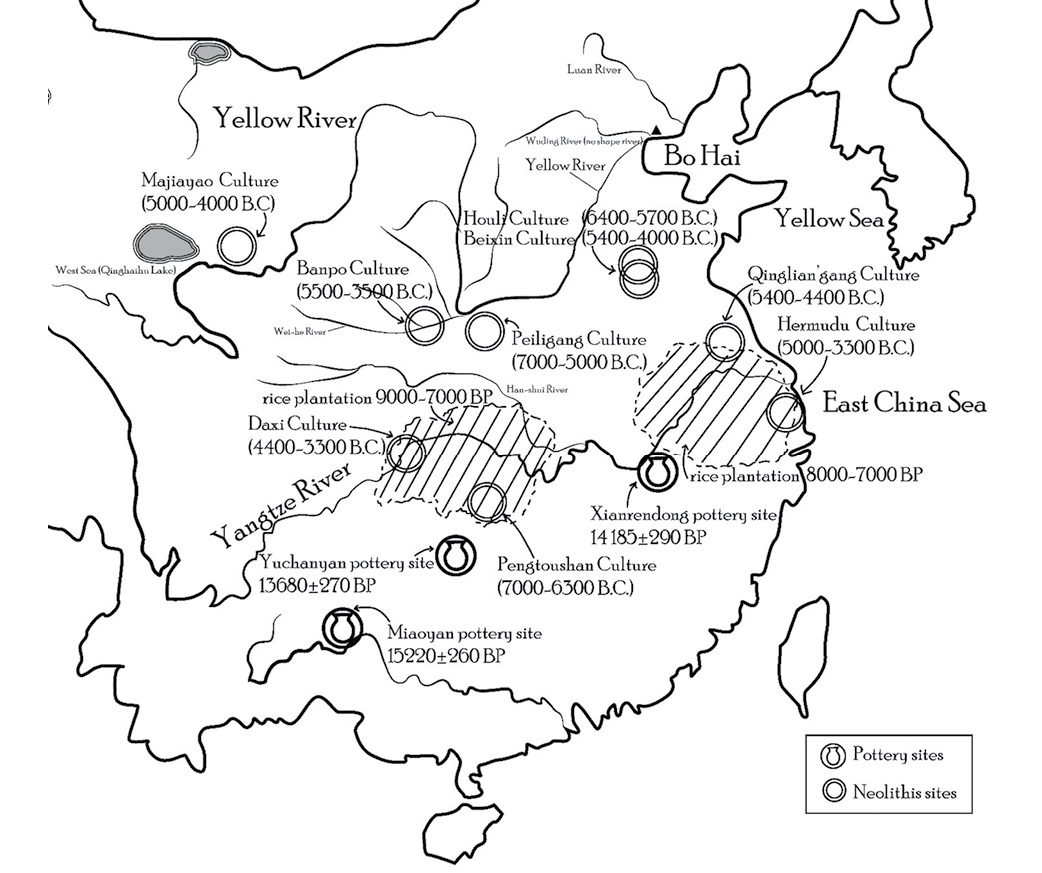
Map of the Pottery, Rice Plantation & Neolithic
Sites xi
The Human Migration Map based on Genetical Analysis
xii
Jupiter and the Iplanet Time Reckoning xv
Twenty-eight Lunar Lodges xvi
Table of Twenty-eight Lunar Lodges and Their Degrees based on the
Distance of Respective Determinative Stars xvii
Table about the Ancient Thearchs' Lineage History
xviii
Section One: The Sinitic Theological Framework
Chapter I: The Sinitic Theology Epitomized By
Epic Asking Heaven 1
Section Two: Pre-History
Chapter II: The Book Burning & Efforts at
Rebuilding the Lost Classics 31
Three Dimensional Argumentation to Validate Ancient
History 33
The Tadpole Script the Sole Sinitic Language
Characterset 37
Chapter III: A Migration History Based on the
Potteries & Genetics 39
Potteries' Trajectory From Southwestern China towards Japan,
Manchuria and Siberia 39
Extrapolation of Prehistoric People's Domains using the
Mitochondrial, Nuclear DNA, & Cranial Analysis on the Ancient
Remains Extracted from the Archaeological Sites
41
Chapter IV: Excavation of the Totem Cultures
& Archeological Phases 45
Phases of the Neolithic Culture: Yangshao, Longshan, Taosi,
Erlitou, Erligang 46
The Jade Age 52
The Sanxingdui Culture 53
Chapter V: Three Economic Zones & Six
Cultural Zones 56
The Xia People & the Dragon Totem 57
Difference between the Xia People & the Yi People
58
Luo Xianglin's Theory as to the Same Origin of the Chinese &
Diaspora of the Five Ancient Tribal Group 62
Chapter VI: Ancient Tribes, Theologicalization
& Mystification 66
Legends Of the Ancient Tribes 67
The Sinitic Heartland versus the [Eastern] Shandong
Peninsula Domain 75
The Ancient Tribes Described by the Fables and Sophistry Books
like Zhuang Zi, Lie Zi & Lv-shi Chun-qiu
76
The Non-equivalency of Fu-xi and Tai-hao 81
The Embodiment of Fu-xi 82
Post-Han Dynasty Theologicalization and Mystification
85
Chapter VII: Legends About the Three Sovereigns
& Five Thearchs 88
The Ancient Chinese' Attempt at Explaining the
Antiquity 91
The Legends about the Ancient Thearchs 95
The Dynasties, Epochs, Eons and Aeons 96
The Creation Theories 98
Chapter VIII: The Jiang-Surnamed Sino-Tibetan
People 102
The San-miao people, the Sinitic People and the
proto-Tibetans 104
Legends of the Yellow Thearch vs the Fiery Thearch
106
The Yellow Thearch's Wars with Yan-di, Chi-you, & the Xun-yu
barbarians, Respectively 111
The Book Shi Ben and Li-ji, and the Orthodox
Yellow Thearch's Lineage 114
Interpretation of the Ancient Surnames from the Prism of the
Yellow Thearch's Family 121
'Xing' (Surname), Shi (clan name) & the Moiety Marriage 123
Precession of the Equinoxes, & the Ancient Historians and
Astronomers' Efforts at Ascertaining the Reign Years of Lord
Yao 125
Lord Yao 133
Lord Shun 137
Mundane Sinitic China' Ancestor Sacrifice Framework
143
Lord Yu 145
Lack of Dates in the Ancient Lords' Chronicling and the Forgery
Contemporary Version [Jin Ben] of The Bamboo Annals
147
Fallacies of the Tribal Leadership Succession:
Yao-Sun-Yu 151
Chapter IX: A Discourse on The Bamboo Annals
154
Chronology
Chronology of the Three Dynasties (Xia, Shang and
Zhou) 587
A Timeline of Chinese Dynasties with Corroborated Reign Years
& Eras 591
References on the Calendars & the Calendar Terms:
Reference on the Calendar Terms 594
The Conversion Table for the Qin Empire's Zhuanxu-li Calendar 596
The Conversion Table for the Virtual Yin-li (Shang
Dynasty) Calendar 598
|
|
The Nativity of Origin of the Chinese Civilization vs the External Factors
There was overwhelming written evidence that the ruins or origin of majority of the ancient thearchs from the pre-Xia dynasty eras, such as the Zhu-rong Ruins (in the Zheng state), the Tai-hao Ruins (in the Chen-guo state), the Taichen {Shang Dynasty} Ruins (in the Soong state), the Zhuanxu Ruins (in the Wey state), You-shen (in the Wey state), the Kunwu Ruins (in the Wey state), the Chu-qiu Ruins (in the Wey state), and the Shao-hao Ruins (in the Lu state), were located along the middle Yellow River line.
In the Lu state, Zuo Zhuan carried a record on Dating-shi's warehouse, which was speculated by the later people to be about existence of the Dating-shi Ruins in the same location as the Shaohao Ruins.
This corroborated the O3a1c-002611 haplogroup Sinitic people's same origin in the central plains of North China. Whether Sinitic China ever had an earlier united kingdom (or dynasty) than Xia was unknown. However, archaeological excavations showed that over six thousand years ago, the Chinese continent entered a jade age from the Mesolithic age, with unison jade ritual artifacts (such as the square-shaped 'yu-cong' jade disks with a round cylindrical solid body and an inner perforated round hole, and the jade hatchets) adopted in different regions, albeit the co-existence of regionally-differentiated potteries at the non-rulers' or plebeian levels. The Sinitic civilization's contribution to the world should not be underestimated. Since remote antiquity, at least over 10,000 years ago, there was the spread of North China's microlithic stone tools towards the west. This was followed by the spread of the 6000-year-old Lingjiatan double-head or triple-head jade octagram to Central Asia, an ancient emblem built on top of the octagram star that had origin in the Sinitic pottery spin wheels with a history of 12,000-15,000 years. Additionally, there was the spread to Central Asia of the patented Sinitic gourd-shaped colored and red potteries with a beam neck.
From the physical anthropology's angle, today's northern Chinese had the traits of ancient northwestern Chinese, not the same as the ancient Sinitic people, i.e., paleo-North-China (palea-North-China) and paleo-Central-Plains (Palea-Central-Plains) people. On basis of genetic evidence, the haplogroup O3a1c-002611 Sinitic people was responsible for engendering the Yangshao and Longshan civilization, and partially with the N-haplogroup people, engendering the Hongshan civilization. Since the O3a1c-002611 people were separated from the Northwestern cousins and Tibeto-Burmese at an early age, for it to have a part in the history of Northwestern China, the explanation would be to treat the Haplogroup O3a2c1*-M134 and O3a2c1a-M117 people as the historical Qiang and Hu barbarians, with the latter's paleo-Northwestern genes replacing the paleo-North-China and paleo-Central Plains genes of O3a1c-002611 Sinitic people by the Soong dynasty (A.D. 960-1279), that was likely triggered by the multiplication of the Tang dynasty's imperial house that had its origin from the Western Corridor.
The Soong dynasty royals took Tianshui of western China as the ancestral homeland, which was similar to the Tang dynasty royals' origin from the Western Corridor in western China.
https://www.ncbi.nlm.nih.gov/pmc/articles/PMC5255561/ carried an article stating that "Y chromosome suggested Tibeto-Burman populations are an admixture of the northward migrations of East Asian initial settlers with haplogroup D-M175 in the Late Paleolithic age, and the southward Di-Qiang people with dominant haplogroup O3a2c1*-M134 and O3a2c1a-M117 in the Neolithic Age. Haplogroup O3a2c1*-M134 and O3a2c1a-M117 are also characteristic lineages of Han Chinese, comprising 11.4% and 16.3%, respectively. However, another dominant paternal lineage of Han Chinese, haplogroup O3a1c-002611, is found at very low frequencies in Tibeto-Burman populations, suggesting this lineage might not have participated in the formation of Tibeto-Burman populations." Furthermore, the O3a1c-002611 Sinitic people contained a predictable 5000-year-old admixture of about 10-20% Eurasian Q-haplotype heritage --that the northwestern O3a2c1*-M134 and O3a2c1a-M117 people lacked.
Sinitic China's prehistoric contribution includes the written language and the cognates. It would not be farfetched to make a claim that the Sinitic pictographic characters, which could have origin in the Jiahu pristine engraved pictograms with a long history of 6000-8000 years, was the common origin for both the Shang oracle bone characters and the Sumerian wedge script --that shared similar significs or radicals, such as using the 'bow' signific for armies, adopting the reeds' signific to mean writing, and treating the 'square earth' character as animal, hunting and husbandry. In addition, it could be deduced that the Sinitic language, which shares 74% cognates with the Proto-Tibeto-Burman, could be the source for both the cognates of the Proto-North-Caucasian and the Proto-Indo-European for the "Old Chinese" sharing 43% cognates with the Proto-North-Caucasian, rather 23% with the Proto-Indo-European --as a result of the N haplogroup people's relocating to North Asia and then to Estonia, Latvia, Finland and Scandinavia and bringing along the Sinitic language to the Proto-North-Caucasian who in turn gave it to the Proto-Indo-European. From the bronze technology angle, Jacques Gernet believed that the Chinese "mastery of the potters of Lungshan, the high temperatures which they seem to have been capable of obtaining, and the restricted role of hammering and forging in the technical traditions of the Far East all incline one to favor the idea of an independent discovery of bronze metallurgy".
There are several claims about the external factors in the creation of the Chinese nation and people, namely, the Chinese could be from the Nile Valley where the pictographic characters first appeared, or the ancient Chinese could be linked to the Indo-Europeans whose mummies were discovered in the Loulan areas of today's Xinjiang.
Scholar Luo Xianglin pointed out that Frenchman Terrien Lacouperie was the first to propose the fallacious claim of Babylon as the "Western Origin Of The Early Chinese Civilization" in 1894.
Very likely, renowned scholar Wang Guowei followed through with the 'Babylon' line of thought, fallaciously linking 'Hua' to the Avars and 'Xia' to the Tu-huo-luo kingdom in Central Asia.
Wei Juxian (in Hongkong) & Zhang Guangzhi (in America) further carried on the fallacy:
Wei Chu-hsien committed a fatal mistake in extrapolating on the tin decipher for the city of Wuxi ["no tin"] and polarized the Xia-Shang dynastic substitution as a fight between the Mongoloid [Negroid in Wei's apparently blown-away alternative writing] and the Caucasoid, i.e., a fallacy that scholar Luo Xianglin was opposed to.
(http://homepages.utoledo.edu/nlight/uyghhst.htm had a good exposition of the "remarkably racialized ideas" and approaches built on basis of the mummies.
Nova, in its TV series,
http://www.pbs.org/wgbh/nova/chinamum/taklamakan.html
shows the excavation of mysterious 3000-year-old mummies in China's western
desert, inside today's New Dominions Province. Note more Tang Chinese mummies were found in this area than Indo-Europeans mummies.)
Note that the 'San-Miao' people were relocated to western China to guard against the western barbarians by Lord Shun as punishment for their aiding Dan Zhu, i.e., son of Lord Yao
(reign ? 2357-2258 B.C.E. per Lu Jinggui; 2357-2286 B.C. per Shao Yong; 2145-2046 B.C. per the forgery bamboo annals; reign 2144-2048 B.C.E. with rule of 97 years and life of 118 years per Zhu Yongtang's adjustment of [the forgery contemporary version Jin Ben of] The Bamboo Annals), in rebellion. Hence, the Sino-Tibetan speaking San-Miao people had dwelled in today's Gansu much earlier than the later recorded misnomer 'Indo-European' Yuezhi people at the time of the Hunnic-Yuezhi War of the 3rd century BCE, by about 2000 years at minimum.
Should the Yuezhi be actually related to the Sinitic Chinese, then they had to be the descendants of the San-miao and Yun-surnamed Xianyun barbarians who were exiled to the west by lord Shun in the 2200s B.C.E.
Later, Zhou King Muwang resettled those barbarians at the origin of the Jingshui River, among them, Yiqu, Yuzhi, Wuzhi, Xuyan and Penglu, namely, the five Rongs as noted in history -- which could be the origin for the misnomer 'Indo-European' Yuezhi.
At
http://www.imperialchina.org/Barbarians.htm (which was embedded within the
Huns.html and
Turks_Uygurs.html
pages),
this webmaster had tentatively made speculation as to when the east met with the west on basis of new archaeological findings and historical Chinese records.
Also cited would be some unsubstantiated claims about the Indo-European links to excavations near Banpo, Xi'an, Shenxi Province.
This webmaster also saw pictures of some mound near Xi'an, something discovered by some American pilot during WWII, which people claimed to be the tombs of great overlords and saints from 4000-5000 years ago. The mounds were actually imperial hounds from the Han dynasty downward, not like the Kurgans which would be commonly taken to be a Schythian & Turkic tradition of burial. This webmaster also read about an article talking about the similarity of legends about King Arthur's sword, Excalibur, and the legend about one of the three famous Chinese pairs of swords: Gan-jiang & Mo-ye, which, like Excaliber, was pulled to some kind of spirit in a lake. That was about the female Mo-ye sword being attracted to a river where the male Gan-jiang sword was possibly located.
Some ancient Chinese classics talked about a special machinery landing on the top of Taishan Mountain 3000-4000 years, adding to the speculation of some ET and UFO linkage, i.e., mostly stuff made up in the two Jinn dynasties in the name of Lie Zi, etc. Not to mention the unfounded rumors that the human civilization had risen and fallen several cycles in the past millions of years, something not in conformity with the glaciation of the earth or the evolution of galaxies at all. Some Christian who was in charge of the Chou (Zhou) family lineage in Hawaii had even claimed that the Zhou and Shang dynasties were branches of the Jewish-Arabic family from the Middle East, which was an attempt at putting every race under Adam & Eve.
A lack of knowledge about the history of China or the classical language of China had produced numerous unfounded claims among the Western scholars or sinologists. Fallacious claims include the link of the Rouran or Ruruans to Genghis Khan's Mongols and the link of Tuoba or Topa people to the Turks.
* In Commemoration of China's Fall under the Alien Conquests in A.D. 1279,
A.D. 1644 & A.D. 1949 *
U.S.S.R./Comintern Alliance with the KMT & CCP (1923-1927)
Korean/Chinese Communists & the 1931 Japanese Invasion of Manchuria
American Involvement in China: Soviet Operation Snow, IPR Conspiracy, Dixie Mission, Stilwell
Incident, O.S.S. Scheme, Coalition Government Crap, Amerasia Case & The China White Paper
* Stay tuned for "Republican China 1911-1955: A Complete Untold History" *
|
|
Zou Rong's Revolutionary Army;
Shin Kyu Sik's
Shrine (Spirit, Kunitama) of Korea
|
This snippet is for sons and daughters of China:
Heed the sons & ministers' agony and sorrow of our ancestors who died or lived through the Mongol, Manchu and Soviet-Chicom conquest
and
the Yongjia, Jingkang and Jiashen cataclysms !
Jeanne d'Arc of China:
Teenager girl Xun Guan breaking out of the Wancheng city to borrow the relief troops in the late Western Jinn dynasty;
Liu-Shao-shi riding into the barbarian army to rescue her husband in the late Western Jinn dynasty;
teenager girl Shen Yunying breaking into Zhang Xianzhong's rebels on the horseback to avenge on father's death in the late Ming dynasty.
China's Solitary and Lone Heroes:
Nan Jiyun breaking out of the Suiyang siege and charging back into the city in the Tang dynasty;
Zhang Gui & Zhang Shun Brothers breaking through the Mongol siege of Xiangyang in the Southern Soong dynasty;
Liu Tiejun breaking through three communist field armies' siege of Kaifeng in the Republican China time period;
Zhang Jian's lone confrontation against the communist army during the June 3rd & 4th Massacre of 1989.
|
|
|
This webmaster had read about some unfounded claims that the character 'huang' for Huangdi (namely, the Yellow Thearch, Overlord or Emperor) meant for the hair by ignoring the fact that Huangdi was the embodiment of the virtue of 'earth' or 'soil' in Chinese metaphysics.
Some Hakka person made a fallacious claim by pointing that the first character 'huang' in Huangdi was made of two parts of 'white' and 'lord'.
This is a mistaken extrapolation - as in Chinese, we have two 'huangdi' of the same soundex, with the Yellow Lord carrying the coloring character of "yellow" while the emperor title carrying the character which consisted of two parts of 'white' and 'lord'.
This 'huang [emperor]' character, at the time of the First Qin Dynasty Emperor Shihuangdi
(r. 246-210 B.C.; actual May 247-July 210 B.C.; nominal October 247-Sept 210 B.C.), meant for the non-human entities and something more to do with the glory and magnificence, i.e., the Heaven 'Huang', the Earth 'Huang' and the Mt. Taishan 'Huang', a trinity in the Chinese philosophical thoughts.
Also note that some Western "racial approach" experts tried to dig up a non-Mongoloid origin for the Yi-zu minority of Southwest China. Alternatively, some Chinese scholar had compared the Yi-zu people to the Tanguts of Xi-xia [Western Xia] Dynasty, claiming that they all possessed the dark face with red decoration and the comparatively higher nose bridge.
The bamboo strips excavated at Lake Juyan [black water lake], however, threw the issue into further disputes as some records stated that some merchant named Shi-zi-gong [character 'Shi[2]' here being different from character 'Shi[3]' of the Zhaowu clans] was black-skinned, carried the long hair [whiskers?], and had obtained a pass to go through the Juyan outpost for travel between China's capital and Central Asia.
Scholar Yang Ximei, who inherited Li Ji's erroneous method of analyzing the skulls from the Shang Dynasty tombs to infer the existence of different racial groups in ancient China, speculated on this dark-skinned trader as being possibly related to the Li-rong barbarians who sacked Western Zhou Dynasty's capital Haojing and killed Zhou King Youwang, on basis of some literal interpretation of the word 'li' for blackness.
This webmaster believed that the dark skinned person could actually belong to the group of people who carried the D-haplogroup gene, who were said to have footprints in today's Tibet and southwestern China per Li Hui's article on
Inferring human history in East Asia from Y chromosomes.
Among ill-intended claims as to the non-Mongoloid origin of the Chinese civilization, apparently deviation of the "racial approach" in regards to the origin of civilization, there were claims about the Linzi DNA analysis.
As most Chinese scholars had pointed out, the findings from Linzi DNA only pointed to the phenomenon of human migration, NOT genetic mutation, NOR "looking similar to the Caucasians". At http://tech.sina.com.cn/ology/2000-08-10/33254.shtml, Dr Wang Li stated that the DNA analysis of remains from the Linzi tombs in Shandong Province had shown that the people living in Shandong 2000-2500 years ago had shared some similar gene traits to today's people in Central Asia and West Asia on the maternal side.
Note Wang Li corrected the saying to point to CENTRAL and WEST of Asia, not Europe. Besides, he said that the only similar trait is on the maternal side.
More importantly,
http://mbe.oupjournals.org/cgi/content/abstract/20/2/214
carried an article about the new research paper by the Society for Molecular Biology and Evolution, claiming that "The reanalysis of two previously published ancient mtDNA population data sets from Linzi (same province) then indicates that the ancient populations had features in common with the modern populations from south China rather than any specific affinity to the European mtDNA pool".
To better understand the origin of Mongoloid, a study of the topic as to the southern origin of Mongoloid is a must:
Y-Chromosome Evidence of Southern Origin of the East Asian-Specific Haplogroup O3-M122;
The Three O3-Haplogroup Brotherly Tribes of Mon-Khmers, Hmong-Mien and Sino-Tibetans;
Genetic Structure of Hmong-Mien Speaking Populations in East Asia as Revealed by mtDNA Lineages;
Inferring human history in East Asia from Y chromosomes.
The confusion concerning the Linzi DNA could have roots in the historical conflicts among the early Chinese people.
Before the Qin Dynasty's ancestors migrated to Northwest China, there were the exile of the San-miao people in the hands of Lord Shun (? 2257 - 2208 B.C.E. per Lu Jinggui; 2222-2173 B.C. per Seng Yixing; 2285-2225 B.C. per Shao Yong; 2042-1993 per the forgery bamboo annals; reign 2044-2006 B.C.E. with rule of 39 years and life of 100 years per Zhu Yongtang's adjustment of [the forgery contemporary version Jin Ben of] The Bamboo Annals). Though, the San-miao migration to Northwest China was the second stage of the epic migration.
There first occurred the battle between the Yellow Lord (Emperor) [Huangdi (i.e., the Yellow Thearch, ? 2697 - 2599 BC/2698-2599 per Lu Jinggui; reign 2403-2304 B.C.E. with rule of 100 years per Zhu Yongtang's adjustment of [the forgery contemporary version Jin Ben of] The Bamboo Annals)
and Chi-you,
with Chi-you widely taken today as the ancestors of the Yi (i.e., misnomer Dong-yi [eastern barbarians]), but more likely a divinatory figure who represented the ancestors of the mixed Sino-Tibetan/Hmong-mien people.
-- i.e., the ancient Jiang-surnamed Yan-di tribal group.
Note the ancient classics hinted that Yandi the fiery lord, who was Jiang-surnamed, was the same as Chi-you --which was a much later speculation from the Tang dynasty. In the prehistory section, we stated that the native prehistoric Sinitic Chinese were Jiang-surnamed from the beginning.
Extrapolation of prehistoric people using the mitochondrial and nuclear DNA analysis, as well as cranial analysis, on the ancient remains extracted from the archaeological sites
In 2012, Li Hongjie of Jirin University published a study of the ancient DNA analysis of the Y chromosomes of prehistoric people dwelling in northeastern China, northern China, and northwestern China.
  Northeast (southeastern Inner Mongolia)
    Niuheliang, Lingyuan, the Hongshan Culture, 5000 YBP, 4 N, 1 C*, 1 O
    Halahaigou, the Hongshan-Xiaoheyan Culture, 4500 YBP, all N
    Dadianzi, the Lower Xiajiadian culture, 3600 YBP, 3 N, 2 O3
    Dashanqian, the Upper Xiajiadian Culture, 3000 YBP, 1 C, 3 N1c, 1 N,
    2 O3-M117, 2 O3-M324
    Jinggouzi, 2500 YBP, all C

  Northwest (Chinese Turkestan)
   Xiaohe, Xinjiang, 3500-4000 YBP, 11 R1a1a, 1 K*
   Hami (Tianshan-Beilu), Xinjiang, 3300-4000 YBP, 5 N, 1 C
   The Balikun Basin (Heigouliang), Xinjiang, 2000 YBP, 6 Q1a*, 4 Q1b, 2 Q

  Northwest (Ningxia-Qinghai-Gansu)
   Pengyang, Ningxia, 2500 YBP, all Q1a1-M120
   Xining (Taojiazhai), Qinghai, 1500 YBP, all O3-M324

  North
   Miaozigou, central-south Inner Mongolia, the Yangshao culture, 5500 YBP, all N
   Yuxian County (the Sanguan site), Hebei, the Lower Xiajiadian Culture,
   3400-3800 YBP, all O3
   Jiangxian county (the Hengbei-cun village site), Shanxi, 2800-3000 YBP,
   a Peng-guo state, 9 Q1a1, 2 O2a-M95, 1 N, 4 O3a2-P201, 2 O3, 4 O*.
What could be extrapolated from the above data was that the Sino-Tibetan O3-haplotype people, moving along the south-to-north Yellow River east of the Taihang mountain range, had pushed northward to the western Liaoning area of today's Manchuria, about the origin of the Liao-he River, and stayed there 5000 years ago.
In the Sinitic homeland of today's southern Shanxi, there was the excavation of the Taosi Culture (2500/2400 B.C.-1800 B.C.) since 1978, with the early-stage Taosi residents genetically identified to be of the O3-M122, subhaplogroup O3-M134 type.
According to the continuing archaeological excavation and analysis, the early Taosi people, hundreds of years later, were destroyed by the mid- and late-stage people with slightly different cranial characteristics, with some pending genetical analysis to possibly infer the western move of the O2/O1 haplotype people.
The cranial analysis of the ancient dwellers as far north as the Nen-jiang River (Pingyangzhen, Tailai, Heilongjiang) shed light on the audacious northernmost penetration of the O-haplotype people to the heartland of the C-haplotype people.
Moving ahead of the O3 Sino-Tibetan people would be the N-haplotype cousin-tribe which populated the whole belt of today's Inner Mongolia front about 5500 years ago. To the east, the N-haplotype people converged with the O3-haplotype cousins in today's western Liaoning area for the next 2500 years. To the west, the N-haplogroup people reached today's northern Chinese Turkestan about 4000 years ago, replacing the C-haplogroup people and the proto-Europeans called the Andronovo type.
The N-haplotype people could be the tall Jiahu people in today's Henan Province 8000 years ago, i.e., the fabled long-leg people in ancient China.
The N haplogroup people, who relocated to North Asia and then to Latvia, Estonia, Finland and Scandinavia, could have brought along the Sinitic language to the Proto-North-Caucasian who in turn gave it to the Proto-Indo-European.
This webmaster, with clear-cut amber eyes with a greenish ring, had been found to possess about 15% ancient Euro-Asian hunters' gene, similar to the N or Q haplogroup people in the Russian Siberian province, specifically N1a (N-M96 (N-CTS7095, N-P189).
The C-haplogroup people, who arrived in Asia like 50,000 years ago but were marginalized towards Siberia, northeastern Manchuria and coastal islands, began to gradually push back to the south, taking over the western Liaoning area about 2500 years ago and coinciding with the historical events known as the Hun-Donghu [i.e., the Eastern Hu barbarians] Wars around the ancient Songmo [pine desert] area.
The Q-haplotype (Q1a1-M120) people, whose main group had moved across the Bering Straits to the American continent 10,000-15,000 years ago, saw some remnants migrating southward.
About 3000 years ago, the Q-haplotype people, with a weight of 41% among the remains analyzed, were seen to have penetrated south to have reached Jiangxian in today's southern Shanxi Province, as seen in the remains found in the possibly [patented] Kui-surnamed Peng-guo state, next to the Jinn Principality's royal tombs.
The
Q-haplotype people of the Peng-guo state were seen to have carried a character that was the patented
Red Di barbarians' Kui surname, as seen in bronzeware Bi-kui Ying-ding (dowry cauldron of Bi-kui
to the Peng-guo lord, a woman from the Bi-guo state).
From the Peng-guo's intermarriage with the Ji-surnamed Rui-guo and Bi-guo states, it could be sensed that the Peng-guo people did have something which made them prestigious, possibly the bronzeware utensils.
The purportedly same 'Peng' character found on the Shang oracle bones could mean the existence of the advanced bronze culture Peng-guo state as early as the Shang dynasty time period (1765/1765 B.C.E. - 1122 B.C. per Shao Yong; or 1559 - 1050 per the forgery contemporary version [Jin Ben] of The Bamboo Annals).
The Q1a1-M120 people, found in Pengyang, also populated today's western Yellow River Bend about 2500 years ago, coinciding with the historical events known as the Hun-Yuezhi Wars.
The Yuezhi people, who were evicted by the Huns towards the Amu Darya and Syr Darya river area, were said to have left behind a Yuezhi Minor group that relocated to the south of Mt. Qishan, where cranial analysis of the ancient remains, such as from the Mogou (grind ditch) cemetery in Lintan, Gansu, found only the continuous flow of the Sino-Tibetan population among the Siwa, Siba and Xindian culture sites.
Note that the Pengyang locality was to the further west of Qingyang which in turn was to the west of the Zhou people's south-north Binxian-Qishan habitat, with the Zhou people's southern relocation having something to do with its historical conflict with the Gui-fang people, a group of people having intermarriage with the legendary fire guardian Zhu-rong (known as Lu-zhong-shi in the Di Xi [Pian] section of Da-Dai Li-ji) and carrying the archaic Kui surname, who had extensive presence in the northern China's domain and a history as early as the start of the Sinitic civilization.
That is, the Zhou ancestors were separated from the Q1a1-M120 people by the Gui-gang/Xunyu/Rongdi barbarians.
The Q1a1-M120 people, however, could be closely situated to the J2-surnamed Mixu state in today's Lingtai of Gansu Province, i.e., a state that Zhou King Wenwang conquered in the early 11th century B.C. and Zhou King Gongwang
(Ji Yihu, reign approx 946 - 935 B.C. per Shao Yong's divinatory chronicling; 951-929 B.C. per Zhang Wenyu; 907-896 per [forgery] The Bamboo Annals)
eliminated in the late 10th century B.C.
This webmaster, having debunked the Aryan bearer theory for the bronze, chariot and wheat's arrival in China, sorted through the history records to find substantiation but could not come up with any evidence.
The non-Sinitic evidence would be the non-Asian-continent genetical mark of Q1a1-M120 which was found among the ancient Pengyang/Jiangxian tomb remains and still had a minor presence in today's Chinese population.
Alternatively speaking, the Q1a1-M120 people, like the Austronesian O1a1-P203 people,
comprised one of five super-grandfathers of today's Chinese, with the main lines being O3a2c1*-M134, O3a2c1a-M117 and O3a1c-002611.
(With the Daic people of southern China [i.e., Yi-Yue people of Haplogroup O-M176 (O1b2, formerly O2b)], and the C-haplogroup barbarians from North Asia,
China could be said to have seven super-grandfathers from the Y-chromosome perspective, or eight super-grandfathers with inclusion of the Finno-Ugric N-haplogroup.)
Li Hui, in the article "Y chromosomes of prehistoric people along the Yangtze River", concluded that the analysis of the ancient Yangtze River people showed that "at least 62.5% of the samples belonging to the O haplogroup, similar to the frequency for modern East Asian populations. A high frequency of O1 was found in Liangzhu Culture sites around the mouth of the Yangtze River, linking this culture to modern Austronesian and Daic populations. A rare haplogroup, O3d, was found at the Daxi site in the middle reaches of the Yangtze River, indicating that the Daxi people might be the ancestors of modern Hmong-Mien populations, which show only small traces of O3d today."
More recent genetical studied concluded that Y Chromosomes of 40% Chinese Descend from Three Neolithic Super-Grandfathers, with the main patrilineal expansion in China having "occurred in the Neolithic Era and might be related to the development of agriculture", corresponding with the middle Neolithic cultures such as Yangshao (6.9-4.9 kya) and Dawenkou Culture (6.2-4.6 kya) in the Yellow River Basin.
* In Commemoration of China's Fall under the Alien Conquests in A.D. 1279,
A.D. 1644 & A.D. 1949 *
U.S.S.R./Comintern Alliance with the KMT & CCP (1923-1927)
Korean/Chinese Communists & the 1931 Japanese Invasion of Manchuria
American Involvement in China: Soviet Operation Snow, IPR Conspiracy, Dixie Mission, Stilwell
Incident, O.S.S. Scheme, Coalition Government Crap, Amerasia Case & The China White Paper
* Stay tuned for "Republican China 1911-1955: A Complete Untold History" *
|
|
Zou Rong's Revolutionary Army;
Shin Kyu Sik's
Shrine (Spirit, Kunitama) of Korea
|
This snippet is for sons and daughters of China:
Heed the sons & ministers' agony and sorrow of our ancestors who died or lived through the Mongol, Manchu and Soviet-Chicom conquest
and
the Yongjia, Jingkang and Jiashen cataclysms !
Jeanne d'Arc of China:
Teenager girl Xun Guan breaking out of the Wancheng city to borrow the relief troops in the late Western Jinn dynasty;
Liu-Shao-shi riding into the barbarian army to rescue her husband in the late Western Jinn dynasty;
teenager girl Shen Yunying breaking into Zhang Xianzhong's rebels on the horseback to avenge on father's death in the late Ming dynasty.
China's Solitary and Lone Heroes:
Nan Jiyun breaking out of the Suiyang siege and charging back into the city in the Tang dynasty;
Zhang Gui & Zhang Shun Brothers breaking through the Mongol siege of Xiangyang in the Southern Soong dynasty;
Liu Tiejun breaking through three communist field armies' siege of Kaifeng in the Republican China time period;
Zhang Jian's lone confrontation against the communist army during the June 3rd & 4th Massacre of 1989.
|
|
|
The native prehistoric Sinitic Chinese,
the non-Sinitic or non-Xia rulers of antiquity,
and
the remotely ancient founding fathers of eastern or southeastern/northeastern China (Taihao)
For the native prehistoric Sinitic Chinese, the furthest trace stopped at Huangdi or the Yellow lord.
Historian Sima Qian did not trace the antiquity beyond Huangdi, the Yellow Emperor. Confucius abridged the ancient book Shang Shu [remotely ancient history], with the inception of recitals starting with Overlord Yao
(reign ? 2357-2258 B.C.E. per Lu Jinggui; 2357-2286 B.C. per Shao Yong; 2145-2046 B.C. per the forgery bamboo annals; reign 2144-2048 B.C.E. with rule of 97 years and life of 118 years per Zhu Yongtang's adjustment of [the forgery contemporary version Jin Ben of] The Bamboo Annals), a descendant of Huangdi. More, Zuo Zhuan repeatedly cited the non-Sinitic or non-Xia rulers of antiquity to be the Jiang-surnamed Yandi family, and listed the figure of Taihao as the No. 1 person, with Shaohao succeeding.
This juxtaposition of Huangdi against Yandi, or Huangdi against Taihao, was purely from the narrow perspective of the 'zhu-hua' (various Hua people) and/or 'zhu-xia' (various Xia people), without making distinction between the Yandi (the Fiery lord) and the Taihao-shi people.
Interesting records in Zuo Zhuan section on the 17th year of Lu Principality Lord Zhaogong carried a dialogue between viscount Tan-zi and the Lu lord in regards to the Shaohao-shi's practice of using the bird suffix for the titles of court ministers. Per Tan-zi, among the ancient rulers would be Taihao [dragon], Gonggong [water], Yandi [fire], Huangdi [cloud] and Shaohao [bird]. Tan-zi, who acknowledged Shaohao as his ancestor, did not explicitly state that Taihao was the first ancestor in the remote antiquity. Shaohao was commonly known as having his ruins in the An-guo land, or Qufu, Shandong.
Taihao, according to the ancient classics, possessed the 'Feng1' (wind) surname. "Zuo Zhuan" repeatedly stated that Tai-hao-shi, whose ruins ware at the later Chen-guo fief, had such family names as 'Ren4' and 'Su4' around the domain of today's Henan-Shandong provinces.
Tai-hao-shi was said to be the ancestor of the 'Feng[wind]-surnamed' tribe [which might not be the same as the O2-haplogroup Yi [misnomer Dong-Yi or Eastern Yi] people]. Shao-hao-shi was said to be a junior clan which have derived from Tai-hao-shi the senior clan.
Per Sima Qian, who recorded China's prehistory from the Yellow Thearch (emperor) onward, he heard the name of Taihao, literally meaning Hao the Great, from his forebearers, i.e., father and grandfather and so on, that Taihao was the utmost pure and generous, and was responsible for inventing the '8 Gua' trigrams, a divinity method called 'milfoil divination' as recorded in Yi Jing (Book of Changes), which Zhou King Wenwang expanded to '64 Gua' hexagrams. At about the time of Sima Qian, Huai Nan Zi, which had similar writings as Shan Hai Jing (The Legends of Mountains & Seas), made inference to the land of today's Shandong Province as the domain administered by Taihao and Goumang. Before Sima Qian, we have Zuo Zhuan making at least two claims about the existence of Taihao in Lu Lord Xigong and Lu Lord Zhaogong sections. Lu Lord Xigong's 21st year stated that the clans of 'Ren', 'Su', 'Xuqu {Xugou}' and 'Zhuanyu' [i.e., ordained to guard Mt. Mengshan] were Feng-surnamed, i.e., the wind-surnamed statelets; that they worshipped the pilgrimage of Taihao and Youji [i.e., the river god of the ancient Ji-shui River, near today's Ji'nan, Shandong Province]; and that they served the various Xia lords in a subordinate position. Lu Lord Zhaogong 17th Year stated that the land of Chen was formerly the Taihao Ruins [, in parallel with the claims of the land of Soong being the Taichen [Shang Dynasty, with 'chen' being the Shang celestial star] Ruins and the land of Zheng the Zhurong Ruins].
Among the 'Jiang3', 'Ren4' and 'Su4' surnames, some were sub-classified as the Jiang-surnamed Yandi [or the Fiery Lord] tribe versus the more remote Feng[-wind]-surnamed Taihao tribe, whereas the Ji-surnamed Huangdi or the Yellow Lord tribe was apparently newer.
Hence, before Yandi/Chi-you [who sounded like the contemporaries of Huangdi the yellow lord but more likely a fable figure or a divinatory figure], there were the remotely ancient founding fathers of eastern or southeastern/northeastern China, including Taihao, the various Shang progenitors, and Zhurong - that is, all being of the restrictive non-Xia or restrictive non-Sinitic lineages.
According to Zuo Zhuan and Guo Yu, the zhu hua (various Hua) states meant for the Ji-surnamed Zhou princeling states, and the zhu xia (various Xia) states meant for the non-Ji surnamed Zhou dynasty principalities, including the Xu2-guo state along the Huai-shui River.
On basis of this criteria, the Taihao descendant states, the various states from the Shang progenitors, and Zhu-rong descendant states such as the Chu state, should still belong to the non-restrictive Xia states.
Both Tai-hao-shi and Sha-hao-shi continued for thousand years, till the time of Xia Dynasty
(21-16th c. BC; ? 2207 B.C.E. - 1766 B.C. per Lu Jinggui's obfuscatory chronicling; 1978-1559 from lord Qi to lord Jie per raw data from the forgery contemporary version [Jin Ben] of The Bamboo Annals or 1991-1559 B.C.E. per Zhu Yongtang). Some scholar interpreted the ancient wordings to point out that Qi[3], the first overlord of the dragon-totem Xia dynasty and son of Lord Yu, later defeated the remnants of two Hao [both Tai-hao-shi and Shao-hao-shi] tribes in Henan-Shandong provinces and solidify the Xia people's rule.
The descendants of Taihao or Shaohao, such as Viscount Tan-zi's Dan-guo statelet, appeared to be rooted in eastern China for millennia, having no relations to the upheavals among the Huangdi/Yandi/Chi-you tribal groups.
The Yandi/Chi-you people [and the misnomer Yi people on the Shandong peninsula], after a defeat, were possibly uprooted, and moved towards the south [i.e., the Yangtze area] during the first stage of its epic migration, before the epic forced migration of the San-miao people towards northwestern China.
There were people who questioned the lack of evidence to show the genetical trace of the Hmong-mien people in Northwest China.
This questioning had good grounds, and it could mean that the Huangdi/Yandi/Chi-you tribal groups shared in fact the same genetical traits, i.e., the Sino-Tibetans, and only after part of the San-miao people, not those who were exiled to Northwest China, reached the southern China where they have merged with the Hmong-mien natives to allow today's Hmong-mien [Miao-Yao] people to appropriate the name 'miao' which originally meant the descendants.
While this webmaster adopted the simplistic equivalency of the bird totem to the [eastern] Yi natives living along the eastern Chinese coast, the most scientific explanation of the nature of Shao-hao could still be the theory of a Sinitic Shao-hao clique ruling the [eastern] Yi natives of ancient China. Similarly, in the Zheng Yu dialogue between Shi-bo and Zheng Lord Huan'gong, a distinction was made in identifying the Sinitic cliques ruling the [southern] barbarians from the [southern] barbarians themselves. Shi-bo, in the passage on the 'Jing' or Chu barbarians [who were counted among the southern 'Maan' group], explicitly listed the lineage of the 'Jing' or Chu ancestors, stating that Chu lord Xiong Yan had born four sons Bo-shuang, Zhong-xue, Shu-xiong and Ji-xun, with names bearing the Sinitic brotherly order, among whom the 3rd son fled to be a ruler among the southern 'Pu' [i.e., the later Hundred Pu] people and the 4th son took over the lordship in the spirits of ancient ancestors Chong-li -- also taken to be two brothers of Chong and Lih[2] -- with the Lih line tacking on the hereditary fire guardian [minister] post known as 'Zhu-rong' [i.e., virtues shining like fire]. Shi-bo's point was that in extrapolating on the achievements of descendants of Yu-mu [lord Shun's line], Xia-yu [lord Yu], Zhou-qi [Zhou ancestor Qi or Hou-ji], it was claimed that inevitably Zhu-rong's descendants, who had produced Count Kunwu[-shi] in the Xia dynasty and Count Da-peng and Count Shi-wei[2] in the Shang dynasty, should see the Mi-surnamed Chu people asserting themselves in the Zhou dynasty time period.
(Scholar Wu Limin, in rebutting Xu Xusheng, cited Lu Lord Xigong's 21st year (i.e., 639 B.C.) in Zuo Zhuan to state that when the Viscount of the Xuqu {Xugou} state [which was eliminated by the Zhu-guo state] fled to Lu, Cheng-feng [i.e., dowager of Lu Lord Zhuanggong and mother of Lu Lord Xigong, carrying the wind surname of the Xuqu {Xugou} state] petitioned with the Lu lord for help in re-establishing the ancient Xuqu state: Cheng-feng made a claim that by doing so, the pilgrimage of Taihao and Youji [i.e., the river god of the ancient Ji-shui River, near today's Ji'nan, Shandong Province] could be continuing, which was in conformity with the Zhou dynasty's rituals.
After Cheng-feng died in 618 B.C., the Qin state sent over the ritual clothes as condolence.
What Wu Limin meant was that the Taihao reverence, or Shaohao, must be related to the Sinitic family; otherwise, why would Cheng-feng make the claim about the conformity with the Zhou dynasty rituals?)
The Xia Chinese vs the Huns, and the Qiangic Tibetans vs the 'Tokharai' Yuezhi
The Zhou people, on basis of the ancient poems Shi-jing, had constant battles and fights against the Rong & Di people, namely, the Haplogroup O3a2c1*-M134 and O3a2c1a-M117 people known as the historical Qiang and Hu barbarians or what Zhou King Jing[3]wang termed by the Tao-wu northwestern barbarian exiles. Zuo Zhuan, in Lu Lord Zhaogong's 9th year, carried Zhou King Jing[3]wang (r. 544-520 B.C.)'s rebuke to the Jinn state in regards to inviting the barbarians to the Zhou capital city district area to harm the Zhou people and implied that the Zhou people, together with a batch of the same Ji-surnamed states, had received the conferral of fiefs in the western territories from the Xia king(s) for agricultural minister Hou-ji's contribution, with the list of the states including the Wei-guo state and the Rui-guo state along the Yellow River Bend.
The Zhou people, who claimed a same heritage from the various Ji-surnamed western states that received the Xia kings' conferral, could not have erred in the claim of descent. In another sense, the original Chinese 3000 years ago could not be much different from the Xi-rong & Rong-di at all. (From the physical anthropology's angle, today's northern Chinese had the traits of ancient northwestern Chinese, not the same as the ancient Sinitic people. On basis of genetic evidences, the haplogroup O3a1c-002611 Sinitic people was responsible for engendering the Yangshao and Longshan civilization, and partially with the N-haplogroup people, engendering the Hongshan civilization. Since the O3a1c-002611 people were separated from the Northwestern cousins and Tibeto-Burmese at an early age, for it to have a part in the history of Northwestern China, the explanation would be to treat the Haplogroup O3a2c1*-M134 and O3a2c1a-M117 people as the historical Qiang and Hu barbarians, with the latter's paleo-Northwestern genes replacing the paleo-North-China and paleo-Central Plains genes of O3a1c-002611 Sinitic people by the Soong dynasty. https://www.ncbi.nlm.nih.gov/pmc/articles/PMC5255561/ carried an article stating that "Y chromosome suggested Tibeto-Burman populations are an admixture of the northward migrations of East Asian initial settlers with haplogroup D-M175 in the Late Paleolithic age, and the southward Di-Qiang people with dominant haplogroup O3a2c1*-M134 and O3a2c1a-M117 in the Neolithic Age. Haplogroup O3a2c1*-M134 and O3a2c1a-M117 are also characteristic lineages of Han Chinese, comprising 11.4% and 16.3%, respectively. However, another dominant paternal lineage of Han Chinese, haplogroup O3a1c-002611, is found at very low frequencies in Tibeto-Burman populations, suggesting this lineage might not have participated in the formation of Tibeto-Burman populations.")
The most notorious forgery generation of the P.R.C. in the late 20th century tried to link the original [misnomer] Yi people on the Shandong peninsula to the Yi-zu minority in Southwest China.
Feng Shi, Bian Ren and Chen Ping et al are among the ranks of the most notorious forgery generation of the P.R.C. in the late 20th century.
Feng Shi's view was that the Sino-Tibetans' influence was initially restricted to the west of the Taihang-shan mountain till the Yi people were evicted from the eastern Chinese coast towards southwestern China. Feng Shi fully bought into the Dinggong-tao-wen pictograms excavated in Shandong, that he thought was interchangeable with the Yi-zu minority characters.
Should there be a second piece of excavation like the suspiciously mature and advanced Dinggong-tao-wen writing, Feng Shi, who was also an expert on tortoise shells' astral construct of white tiger and grey dragon pictograms that were found buried with human remains in 24 graves unearthed at Jiahu,
could be vindicated.
While the route of research in linking the excavated ancient pictographs [ ! possibly a forgery ! ] on the Shandong peninsula to Southwest China's Yi-zu minority writing was tenuous,
the extrapolation on basis of historical namings of the Yi (misnomer Dong-yi; more likely O3-haplogroup Jiang-surnamed people than the O2-haplogroup Yi) statelets and tribes as well as the historical namings of places in Anhui-Henan-Hubei tri-provincial areas are sound enough to trace the ancient tribal migration to derive some conclusions:
- that the ancient Chi-you Tribe was the [misnomer] Yi people who migrated towards today's Anhui-Henan-Hubei to
mix up with the San-miao people at the Hanshui River and the Yangtze;
- that elements of the [misnomer] Yi tribes joined the San-miao's exile towards Northwest China where they developed into
the later Xian-yun barbarians (i.e., the later Huns) as well as co-mingled with the Northwest China natives to become the ancient Jiang-rong; and
- that a branch of the San-miao/[misnomer] Yi exiles
moved south to Southwest China to become the Di-qiang barbarians and today's Yi-zu minority people.
(For details on the epic of the Yi [misnomer Dong-yi; more likely O3-haplogroup Jiang-surnamed people than O2-haplogroup Yi] migration towards the Yangtze and their subsequent exile to Northwest China, see http://www.imperialchina.org/Barbarians.htm.
Prof Wei Chu-Hsien, in China & America, separately, had research into the 'bat cave' drawings on the Taiwan Island and concluded that the ancient Taiwan aboriginals had migrated there from coastal China --which was a consequence of the chain reaction from the pressure coming from the San-miao/Hmong-mien/[misnomer] Yi migration from the north. Note that the Di[1]-Qiang[2] people had much greater influence in ancient China than people could imagine. They, as listed in the above three-stage epic migration, migrated to Yunnan Province to be ancestors of today's Yi-zu and Bai-zu minorities. More, some DNA studies pointed out that some of today's Tibetans, i.e., descendants of the ancient Di[1]-Qiang[2] people, also shared the genetical similarity with the ancient Jomon people in Japan [as they absorbed the D-haplogroup genes from the original settlers living on the Tibetan plateau].
This could be an ancient epic of migration in the Chinese history.
)
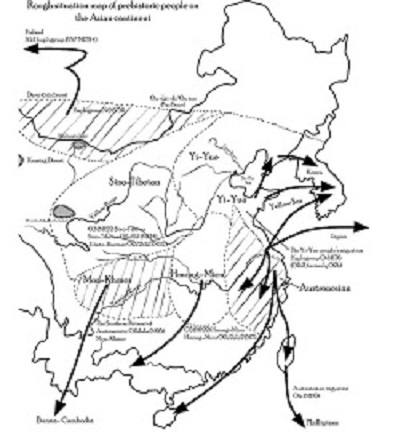 This webmaster had expounded on the ancient classics to point out that the Sino-Tibetan Qiangic people had dwelled in Gansu Province for 4000 years, earlier than the Loulan mummies. This is important because we know today's Tibetans are the real descendants of those early people.
Since prehistory, there were the legends about the Kunlun Mountain, Queen Mother of the West, and
the proto-Tibetan Qiangic jade trade with the Sinitic Chinese. Queen Mother of the West, carrying a hereditary title, whose dwelling was commonly taken to be the hillside palace at the foothill of Qilian Mountain, to the south of today's Jiuquan of Gansu Province, had sent jade artifacts to the Yellow Lord (Emperor)
(i.e., the Yellow Thearch, ? 2697 - 2599 BC; reign 2403-2304 B.C.E. with rule of 100 years per Zhu Yongtang's adjustment of [the forgery contemporary version Jin Ben of] The Bamboo Annals)
and Lord Shun
(? 2257 - 2208 B.C.E.; reign 2044-2006 B.C.E. with rule of 39 years and life of 100 years per Zhu Yongtang's adjustment of [the forgery contemporary version Jin Ben of] The Bamboo Annals).
The Qiangic people, said to be offsprings of Yandi the Fiery Lord, were the brother tribe of Huangdi (i.e., Yellow Thearch), and both Yandi and Huangdi were the sons of Shaodian Tribe. As long as the Qiangic people dwelled in between Chinese in central plains and whatever people in Turkistan, then there would be a good dividing line to start with.
The ancient Qiangic people who went west were validated to have resided in eastern Chinese Turkistan, including the Khotan area of southern Xinjiang.
Remnants of the Qiang people, who migrated on a different path to Yunnan Province in the south, would include today's Pumi-zu minority who possessed an ancient epic kailu jing (i.e., epic of opening up the road) tracing their possible path back to Gansu Province and early Xi-rong [western rong] people. Pumi-zu, who called themselves 'pei mi', were validated to be ancient 'bai[white] ren[people]' or 'bai[white] lang [wolf] guo[statelet]', a group of people who sought vassalage with Han Emperor Mingdi (r. 58-75 AD). The Qiangic groups in southern China still called the Chinese by 'Xia-ren' or the Xia people.
(George Driem proposed that the Sino-Tibetans had splitoffs like the Western Tibeto-Burmans and the Eastern Tibeto-Burmans, with the Eastern Tibeto-Burmans forming two groups of northern and southern, who in turn split into the Northwestern Tibeto-Burmans, the Northeastern Tibeto-Burmans, the Southwestern Tibeto-Burmans, and the Southeastern Tibeto-Burmans, with a claim that the western offshoots went all the way to the Kashmir before returning east along the northern slope of the Himalayas to have a reunion with their cousins and that the Northeastern Tibeto-Burmans were the Sinitic people.)
This webmaster had expounded on the ancient classics to point out that the Sino-Tibetan Qiangic people had dwelled in Gansu Province for 4000 years, earlier than the Loulan mummies. This is important because we know today's Tibetans are the real descendants of those early people.
Since prehistory, there were the legends about the Kunlun Mountain, Queen Mother of the West, and
the proto-Tibetan Qiangic jade trade with the Sinitic Chinese. Queen Mother of the West, carrying a hereditary title, whose dwelling was commonly taken to be the hillside palace at the foothill of Qilian Mountain, to the south of today's Jiuquan of Gansu Province, had sent jade artifacts to the Yellow Lord (Emperor)
(i.e., the Yellow Thearch, ? 2697 - 2599 BC; reign 2403-2304 B.C.E. with rule of 100 years per Zhu Yongtang's adjustment of [the forgery contemporary version Jin Ben of] The Bamboo Annals)
and Lord Shun
(? 2257 - 2208 B.C.E.; reign 2044-2006 B.C.E. with rule of 39 years and life of 100 years per Zhu Yongtang's adjustment of [the forgery contemporary version Jin Ben of] The Bamboo Annals).
The Qiangic people, said to be offsprings of Yandi the Fiery Lord, were the brother tribe of Huangdi (i.e., Yellow Thearch), and both Yandi and Huangdi were the sons of Shaodian Tribe. As long as the Qiangic people dwelled in between Chinese in central plains and whatever people in Turkistan, then there would be a good dividing line to start with.
The ancient Qiangic people who went west were validated to have resided in eastern Chinese Turkistan, including the Khotan area of southern Xinjiang.
Remnants of the Qiang people, who migrated on a different path to Yunnan Province in the south, would include today's Pumi-zu minority who possessed an ancient epic kailu jing (i.e., epic of opening up the road) tracing their possible path back to Gansu Province and early Xi-rong [western rong] people. Pumi-zu, who called themselves 'pei mi', were validated to be ancient 'bai[white] ren[people]' or 'bai[white] lang [wolf] guo[statelet]', a group of people who sought vassalage with Han Emperor Mingdi (r. 58-75 AD). The Qiangic groups in southern China still called the Chinese by 'Xia-ren' or the Xia people.
(George Driem proposed that the Sino-Tibetans had splitoffs like the Western Tibeto-Burmans and the Eastern Tibeto-Burmans, with the Eastern Tibeto-Burmans forming two groups of northern and southern, who in turn split into the Northwestern Tibeto-Burmans, the Northeastern Tibeto-Burmans, the Southwestern Tibeto-Burmans, and the Southeastern Tibeto-Burmans, with a claim that the western offshoots went all the way to the Kashmir before returning east along the northern slope of the Himalayas to have a reunion with their cousins and that the Northeastern Tibeto-Burmans were the Sinitic people.)
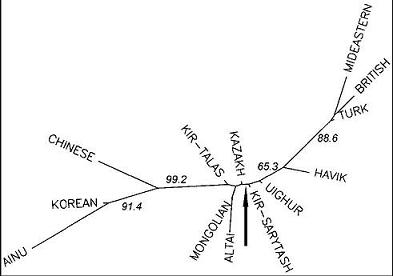 http://www.taklamakan.org/allied_comm/commonv-1-8.html carried an article by Takla titled "The Origins of Relations Between Tibet and Other Countries in Central Asia", stating that "according to the researches of Sir Aurel Stein [i.e., the arch thief of China's Dunhuang Grotto treasures] on the origins of the people of Khotan, most were the descendants of the Aryans. They also had in them Turkic and Tibetan blood, though the Tibetan blood was more pronounced. He discovered ancient documents at a place called Nye-yar in Khotan and he has stated that the script of these documents contained no Pali, Arabic (Muslim) or Turkic terminology. All were Tibetan terms and phrases."
The Tibetans, clearly the descendants of the Sino-Tibetan-speaking Qiangic San-miao people, had their influences reaching the southern Chinese Turkistan in addition to the He-xi Corridor.
P.T. Takla stated further that "according to Wu Hriu(2), the facial features of the people of Khotan were dissimilar to those of the rest of the Horpa nomads of Drugu (Uighurs belonging to the Turkic people) and similar, to an extent, to the Chinese. Khotan in the north-west was called Li-yul by the ancient Tibetans. Since Khotan was territorially contiguous with Tibet, there are reasons to believe that the inhabitants of Khotan had originated from Tibet."
http://www.taklamakan.org/allied_comm/commonv-1-8.html carried an article by Takla titled "The Origins of Relations Between Tibet and Other Countries in Central Asia", stating that "according to the researches of Sir Aurel Stein [i.e., the arch thief of China's Dunhuang Grotto treasures] on the origins of the people of Khotan, most were the descendants of the Aryans. They also had in them Turkic and Tibetan blood, though the Tibetan blood was more pronounced. He discovered ancient documents at a place called Nye-yar in Khotan and he has stated that the script of these documents contained no Pali, Arabic (Muslim) or Turkic terminology. All were Tibetan terms and phrases."
The Tibetans, clearly the descendants of the Sino-Tibetan-speaking Qiangic San-miao people, had their influences reaching the southern Chinese Turkistan in addition to the He-xi Corridor.
P.T. Takla stated further that "according to Wu Hriu(2), the facial features of the people of Khotan were dissimilar to those of the rest of the Horpa nomads of Drugu (Uighurs belonging to the Turkic people) and similar, to an extent, to the Chinese. Khotan in the north-west was called Li-yul by the ancient Tibetans. Since Khotan was territorially contiguous with Tibet, there are reasons to believe that the inhabitants of Khotan had originated from Tibet."
The Xia Chinese is an ancient term for designating the group of Chinese in southern Shanxi Province, eastern Shenxi Province and western Henan Province. They were the people who set up the Xia Dynasty.
They derived the title from Lord Yu
(r. B.C.E. 2204-2195 ?; 2207-2198 per Lu Jinggui; 1989-1982 B.C. per the forgery bamboo annals; raw reign years B.C.E. 2002-1992 with three years' mourning per Y.D. Tse's adjustment of the forgery contemporary version [Jin Ben] of The Bamboo Annals), also known as Xia-hou-shi, namely, the tribe with the title of the Xia descendants.
Lord Yu, a direct descendant of the Yellow Lord (Emperor) [Huangdi
(? B.C. 2697 - 2599; reign 2402-2303 B.C.E. with rule of 100 years per Zhu Yongtang's adjustment of [the forgery contemporary version Jin Ben of] The Bamboo Annals)] - who was speculated by the later people to have assigned two sons to today's Sichuan basin, was born in western China, hence carrying in the later records the ancient designation of Rong-yu -- which the Hunnic barbarians as well as the Tanguts often cited for substantiation of their establishment of the Hunnic Xia and Tangut Xia dynasties, respectively.
However, what the Huns and Tanguts took for granted as to Lord Yu's origin from the west was founded on the Han dynasty and Warring States fables and sophistry writings.
The concept of 'west' was relative to the You-Xia-zhi-ju land south of the Yellow River and east of the Tong-guan Pass, i.e., the central plains.
Lord Yu was said to have personally traveled to Mt Kunlun for inspecting on the western border Liu-sha (i.e., the Kumtag Desert) and met with Queen Mother of the West.
This would be after Lord Shun
(? 2257 - 2208 B.C.E.; reign 2044-2006 B.C.E. with rule of 39 years and life of 100 years per Zhu Yongtang's adjustment of [the forgery contemporary version Jin Ben of] The Bamboo Annals) had exiled the San-miao people
(with the Yi elements of eastern China per Feng Shi, Bian Ren and Chen Ping, et al.) to 'liu-sha' (the Kumtag Desert).
But, the Kumtag travelogue of ancient thearchs, like Zhou King Muwang's Travels, was more likely fiction, with Zhou Dynasty ancestor Hou-ji's meeting with the western queen mother being pure fabrication of the Jinn dynasty, for example.
Ever since the Yellow Lord defeated the people in eastern China, there was the constant rebellion of the so-called "San Miao" people and subsequently the "Nine Yi" people throughout the reigns of Lord Yao, Lord Shun and Lord Yu, as well as through the Xia Dynasty, as ascertained in The Bamboo Annals records.
Ancient historians speculated and wrote about the equivalency of two leaders of the people in the east, namely, Chi-you of the Jiu-li (Nine Li) people being the same as Yandi the Fiery Lord.
Historian Huang Wenbi believed that the ancient Yi people in eastern China, who had an opposite direction as far as wrapping the clothing and hair style were concerned, namely, "bei4? pi1?[dangling] fa1 [hair] zuo3 [left] REN4 [overlapping part of Chinese gown]", shared the same customs as the later Qiangic people in western China, who could have been exiled there from the east as this webmaster had repeatedly said.
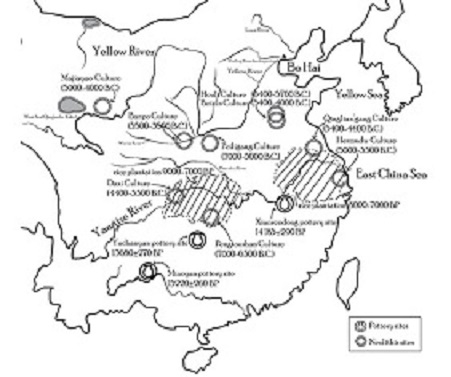 Inferring from
http://www.ncbi.nlm.nih.gov/pmc/articles/PMC3164178/, the O3-haplogroup HM (Hmong-Mien), whom the ST (Sino-Tibetans) had fought against, were in fact brotherly tribes in comparison with the O1-haplogroup people whose remains were found from the mid-Yangtze to lower-Yangtze area [with some excavation found in northern China as well], and the O2-haplogroup people found along the coast.
Inferring from
http://www.ncbi.nlm.nih.gov/pmc/articles/PMC3164178/, the O3-haplogroup HM (Hmong-Mien), whom the ST (Sino-Tibetans) had fought against, were in fact brotherly tribes in comparison with the O1-haplogroup people whose remains were found from the mid-Yangtze to lower-Yangtze area [with some excavation found in northern China as well], and the O2-haplogroup people found along the coast.
Corresponding to the ancient term of Xia, the original ancient Qiangic people, who, as this webmaster had speculated previously, did not participate in
the eastern migration of the Sino-Tibetan to the coast at the beginning, could have in fact been exiled to the northwest from the eastern coast in the late 3rd millennium B.C.E.
The Qiangs [i.e., ancestors of the Tibetans] and the Sinitic Chinese might have just split about 5000-6000 years ago.
The Qiangs then split into the Western Qiangs and Eastern Qiangs just 2500 years ago.
The Qin army's campaign in the west could also have something to do with the Qiangs who dwelled to the south of Mt. Qilianshan, which led to the split of the Western Qiangs and the ultimate migration of the ancestors of the Tibetans to the Roof of the earth where they acquired the high plateau genes of the D-haplogroup natives.
During Qin Lord Li4-gong's reign, the Qin army campaigned westward against the Qiangs around the Yellow River Nine Winding area. Wuyi [slave] Yuanjian [chieftain], who escaped from the Qin captivity, later led his clansmen in a relocation to the Xizhi-he River area, in today's Tibet-Qinghai borderline, to become the Tibetan ancestors.
Hence, in the late 3rd millennium B.C.E., there was infusion of the two groups of people from the east, i.e.,
i) the San-miao people; and ii) the [misnomer] Yi people, or specifically, i) the San-miao people and ii) the Yun-surnamed Xianyun people (i.e., the ancestors of the Huns), who relocated to Gansu Province during the late 3rd millennium B.C.E. under the order of Lord Shun.
According to Sima Qian, the 'San Miao' people, who resided in the land where the later Chu Statelet was, were mostly relocated to western China to guard against the western border, i.e., liu sha (drift sand/quick sand),
known as the Kumtag today, with the western borderline (i.e., the outer limit of ancient Chinese) covering the Blackwater Lake at today's Mongolia border
(which was erroneously disputed by Chen Ping to mean the Blackwater River to the south of Qilian and near the Bailongjiang River of Sichuan).
The result of this mixture later came to be designated by various names, which pointed to various subgroups, with identifiable names such as the Xian-yun (ancestors of the Huns)
which was part of the two groups of people exiled to Northwest China, with the ancient San-miao tribes (or more likely the [misnomer] Yi tribe) being the main components of the exile. Later, the two groups of exiled people were known as the
Jiang-surname Qiangic people, who were linked to the San-miao migrants, and the Yun-surnamed Xianyun people.
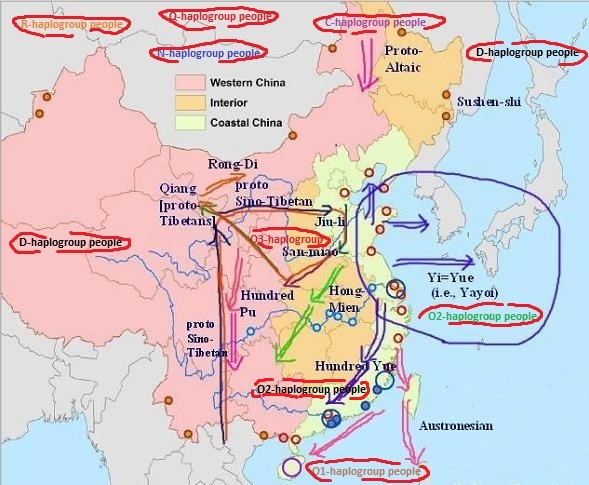
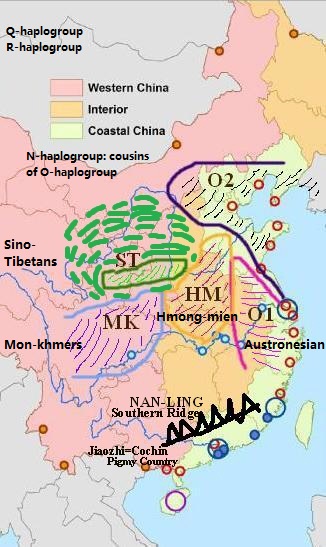 Here, historian Huang Wenbi disputed the Yun-surnamed Xianyun people to be the origin of the Huns since the Huns were known to have the similar traits as the Xia Chinese and were said to be descendants from the son of Last Xia Dynasty lord Jie. That is, the demise of Xia was like nine hundreds of years after the epic exile of the Yun-surnamed Xianyun people.
Note that both the Huns and the later Turks had in fact shared a similar hair style as the Sinitic Chinese, namely, no hair cut plus the bundling of hair, termed
"hu2 [Huns] fu2 [clothing] ZHUI1 [back of the head] jie2 [bundling the hair]".
Here, historian Huang Wenbi disputed the Yun-surnamed Xianyun people to be the origin of the Huns since the Huns were known to have the similar traits as the Xia Chinese and were said to be descendants from the son of Last Xia Dynasty lord Jie. That is, the demise of Xia was like nine hundreds of years after the epic exile of the Yun-surnamed Xianyun people.
Note that both the Huns and the later Turks had in fact shared a similar hair style as the Sinitic Chinese, namely, no hair cut plus the bundling of hair, termed
"hu2 [Huns] fu2 [clothing] ZHUI1 [back of the head] jie2 [bundling the hair]".
This, however, could be reconciled should we add one more ingredient of the Huns, i.e., the Ji-surnamed D[2] tribe.
Some elements of the Chidi (Chi-di) and the Baidi (Bai-di) appeared to be the remotely-related kinsmen of the Ji-surnamed Sinitic Chinese, to the extent of sharing the same last name 'Ji' which caused havoc to the inter-marriage between the Zhou principalities [i.e., Jinn] and those barbarians [i.e., non-agricultural and non-sedentary, to be exact] tribes.
In no circumstance did the ancient Chinese historians ever have doubts about or got confused over the origin and ethnicity of the Yun-surnamed Xianyun barbarians, one tribe of the Ji-surnamed Di[2] barbarians who were said to be offshoots of the Tang-shu lineage (i.e., the Tang-guo statelet from the Xia dynastic time), and the Jiang-surnamed San-miao exiles.
The ancient Sinitic Chinese, without the knowledge of modern DNA analysis to understand that the C barbarian groups had split from the Sino-Tibetans like 50,000 years ago and the N haplogroup cousins had split from the Sino-Tibetans like 15 to 20,000 years ago, could at best paint the above pictures about the origin of the northern barbarians. The modern DNA analysis shows that the Sinitic Chinese were mostly of the O3 haplogroup (O3a3c1-M117), the Yi[-Yue] people along the coast were of the O2 haplogroup, the Miao-Yao [Hmong Mien, (Miao-Yao, O3a3b-M7)] people were of the O3 haplogroup, while the Tungus were the C haplogroup people who might have further evicted the N haplogroup people to northwestern Siberia from western Manchuria.
This webmaster's point was that the early Huns were most likely Qiangic proto-Tibetans or a possible separate Yun-surnamed Xianyun group which was exiled to Northwest China together with the San-miao people in the late 3rd millennium B.C.E.; the later Xianbei, Khitan, Jurchen, Mongol and Manchu people, who were proto-Manchu or proto-Altaic, were the C haplogroup; and the "cooked" barbarians, i.e., those dwelling between the Sinitic Chinese and the "raw" barbarians, were the mixed O/C/N-haplogroup people.
* In Commemoration of China's Fall under the Alien Conquests in A.D. 1279,
A.D. 1644 & A.D. 1949 *
U.S.S.R./Comintern Alliance with the KMT & CCP (1923-1927)
Korean/Chinese Communists & the 1931 Japanese Invasion of Manchuria
American Involvement in China: Soviet Operation Snow, IPR Conspiracy, Dixie Mission, Stilwell
Incident, O.S.S. Scheme, Coalition Government Crap, Amerasia Case & The China White Paper
* Stay tuned for "Republican China 1911-1955: A Complete Untold History" *
|
|
Zou Rong's Revolutionary Army;
Shin Kyu Sik's
Shrine (Spirit, Kunitama) of Korea
|
This snippet is for sons and daughters of China:
Heed the sons & ministers' agony and sorrow of our ancestors who died or lived through the Mongol, Manchu and Soviet-Chicom conquest
and
the Yongjia, Jingkang and Jiashen cataclysms !
Jeanne d'Arc of China:
Teenager girl Xun Guan breaking out of the Wancheng city to borrow the relief troops in the late Western Jinn dynasty;
Liu-Shao-shi riding into the barbarian army to rescue her husband in the late Western Jinn dynasty;
teenager girl Shen Yunying breaking into Zhang Xianzhong's rebels on the horseback to avenge on father's death in the late Ming dynasty.
China's Solitary and Lone Heroes:
Nan Jiyun breaking out of the Suiyang siege and charging back into the city in the Tang dynasty;
Zhang Gui & Zhang Shun Brothers breaking through the Mongol siege of Xiangyang in the Southern Soong dynasty;
Liu Tiejun breaking through three communist field armies' siege of Kaifeng in the Republican China time period;
Zhang Jian's lone confrontation against the communist army during the June 3rd & 4th Massacre of 1989.
|
|
|
Successors to the San-miao Exiles, & the relationship to the Future Huns
Wang Zhonghan had commented that the ancient Huns belonged to the Jiang-rong group, not the Tungusic group that attacked west from Manchuria.
Wang Zhonghan could be right here about the origin of the Huns as from the west, not from the north, where the Tungus people were.
Though, the Huns, who could very well have derived from the Yun-surnamed Xianyun people, could have maintained the distinction from the Qiangs for one reason: namely, the two groups of people, though being exiled to the northwest from the eastern coast at the same time, did not belong to the same ethnicity at the beginning.
Or, the White Di and Red Di people, i.e., descendants of the Yun-surnamed Xianyun barbarians, after crossing the Yellow River, had mixed up with the Ji-surnamed tribe of Uncle Tang-shu, someone who could be related to the descendants of the Qi-surnamed fief of Lih2.
And, after this mix-up, the Huns [or their successor Turks] were later commented to carry the Sinitic customs like in the retention of full hair.
Zhou King Wuwang initially conferred the Qi-surnamed descendant of Lord Yao, i.e., Liu Lei, for example, whom the Han dynasty emperors took as their ancestor, the Ji fief [later the Jizhou prefecture, a statelet to the southwest of today's Peking as well as the abbreviation for the Hebei province of today].
King Wuwang also assigned the land of Lih2 to another Lord Yao's descendant, with a record stating that Viscount Lu4-ying'er of the Lih2 state had married Jinn lord Jinggong's sister, Bo-ji.
At about this place, there was still another state under the control of Marquis Haan-hou who received Zhou King Xuanwang's order to rebuild and expand the city of Haan-cheng (Gu'an, Hebei) for creating detente onto the northern barbarians of 'Zhui' and 'Mo'.
(As to Sima Qian's claim or jotted-down statement that the Huns were descendants of Chunwei [son of the last Xia Dynasty lord Jie], it could be some categorical speculation similar to travelogue Mu-tian-zi Zhuan's claim that the descendants of the Shang Dynasty family were marginalized to the North Yellow River Bend, namely, every dynastic change causing the original ruling clique to be marginalized to the border to be the new generation barbarians.)
As to the Qiangic influence in western China,
no matter it was the 2000 B.C. Mongoloid mummies in Chinese Turkestan ("Yanbulake Site Mummies to the north of Tianshan Mountain"
or the Qumul Mummies near Hami
or
Xiao-he Mummies near Loulan
) were linked to today's South Siberian people or Kham (Xi-kang) Tibetans, they might all be traced to the
original San-miao exile.
After the Shang people overthrew Xia during the 17-18th centuries B.C. (?), the influence of the Xia remnants was restricted to their historical land of southern Shanxi Province. Chunwei, i.e., the son of last Xia Dynasty Lord Jie, was recorded by Sima Qian to have fled to the northern plains to be ancestors of the Huns.
In this so-called Da-xia or the Great Xia land could be found Uncle Tang's fief, who was said to be Ji-surnamed, and could be wrongly postulated to be the same as the later Gui-fang-shi people carrying the 'gui' or 'kui' surname.
Gui-fang was noted for intermarriage with the legendary fire guardian Zhu-rong (known as Lu-zhong-shi) -- who was the ancestor of the Chu people.
The 'gui' (ghost) had no derogatory ghost denotation in ancient China other than meaning the deceased ancestors.
Lu-zhong married a woman
from the 'Gui-fang-shi' (i.e., soundex for {misnomer} 'ghost' or the archaic Wei[3] or Kui-surname domain
family), called by Nü-kui, and bore six sons including Kunwu, Canhu, Pengzu, Hui-ren [or Kuai-ren],
Cao-xing and Jilian, the youngest of whom would be the traceable ancestor of Chu.
The Shang Dynasty remnants, after the Zhou people overthrew them, were themselves marginalized to the North Yellow River Bend after the Zhou people overthrew the Shang rule in the 12th century B.C.E., as seen in Zhou King Muwang's travelogue.
For the next hundreds of years, the Zhou Chinese history mainly covered the entanglement with the Jiang-rong barbarians.
During Zhou King Xuanwang's 26th year, Jinn lord Muhou campaigned against Qianmu (thousand acre), which was possibly taken over by the Jiang-rong barbarians.
During the 39th year of his reign, or 789 B.C., King Xuanwang attacked the Jiang-rong barbarians (a race of the Xi Yi or western Yi barbarians, said to be descendants of ancient minister 'Si Yue' or 'four mountains' under Lord Yu), but he was defeated by Jiang-Rong and lost his Nan-ren (i.e., the southern soldiers from today's Nanyang, Henan Province).
Later, in the Battle of Xiaoshan, the Jinn state mobilized the Jiang-rong barbarians, who might have dwelled at Qianmu, to ambush the Qin army at Mt. Xiaoshan, between the Zhou capital city of Luoyi and the Zheng capital city of today's Zhengzhou.
(The part of history related to Jinn lord Muhou and Zhou King Xuanwang's wars with the Jiang-rong barbarians was mixed up by Sima Qian, with the incidents being just one Battle of Qianmu in 802 B.C. around, not 789 B.C.
And, Sima Qian also made a one-year differential mistake in the fourteen year "interregnum" (841-828 B.C. per Shi-ji; 840-827 B.C. per Zhang Wenyu), something expounded in this webmaster's book The Sinitic Civilization.
Namely, the king's 39th year should have included the fourteen year "interregnum" to be equivalent to the king's 26th year, plus or minus the one-year differential mistake in the fourteen year "interregnum".)
About this time, the Di barbarians were described to be in full motion in today's southern Shanxi, or the Jinn Principality territory, or the ancient Great Xia land.
In August of the year of the Battle of Xiao-er, the Jinn army, under Xian Zhen, also attacked the Bai-di barbarians, and defeated Bai-di at Ji-di, which could be possibly the original conferred land of Shang Dynasty Prince Ji-zi. Jinn general Xi Que captured the Di king. Xian Zhen, not wearing armour, was killed when intruding into the Di army camp.
In 579, Qin and Bai-di allied to attack Jinn. Jinn defeated Bai-di at Jiaogang.
The Di barbarians, unlike the Jiang-rong barbarians, apparently dwelled on the two sides of the Yellow River spanning today's Shenxi-Shanxi provinces.
In another word, the barbarians who lived on the east and west banks of the Yellow River had unfettered cross-river traffic for hundreds of years, with the verifiable record being the Jinn Prince Chong'er's seeking asylum with his mother's Di barbarian tribe.
Jinn Xian'gong (r. 676-651 B.C.), from the Bai-di state, obtained Hu-ji and Xiao-rong-zi, with sons Chong'er and Yi-wu born, respectively.
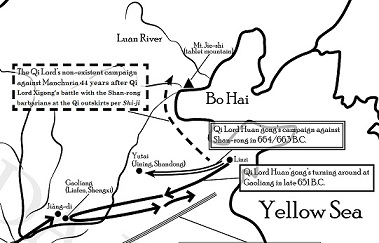 Before the Jiang-rong barbarians were recorded to be in the heartland of China since Zhou King Xuanwang's timeframe, the Rong-Di barbarians were said to have been resettled by Zhou King Muwang at the origin of the Jing-shui and Wei-shui rivers.
The Rong-Di barbarians from the west, who were bundled together, might indeed have two separate identities, with the southern group named by 'rong' south of the Wei-he River and the northern parallel-moving group, namely, the barbarians in the Yellow River sheath area and north of the Wei-he River area.
The northern group, which possibly moved across the Yellow River to today's Shanxi Province, were further divided into two groups, known at the Spring & Autumn times as Chidi (Red Di) and Baidi (White Di), plus another group called Chang Di (long leg Di).
Other than the Di, there were numerous other barbarian groups at the northern belt, including i) the future Yiqu-rong state which was situated to the north of the Qin state and ii) the Wuzhong-rong state (i.e., the so-called 'Shan-rong' or the Mountain Rongs) against which the Qi Principality Lord Huan'gong (r. 685-643 B.C.) purportedly campaigned, and against which [and the "qun-di" or the various Di allied states] Jinn General Zhongxing Wu (Xun Wu, ?-519 B.C.) battled against at Taiyuan (Dayuan, or Dalu).
Before the Jiang-rong barbarians were recorded to be in the heartland of China since Zhou King Xuanwang's timeframe, the Rong-Di barbarians were said to have been resettled by Zhou King Muwang at the origin of the Jing-shui and Wei-shui rivers.
The Rong-Di barbarians from the west, who were bundled together, might indeed have two separate identities, with the southern group named by 'rong' south of the Wei-he River and the northern parallel-moving group, namely, the barbarians in the Yellow River sheath area and north of the Wei-he River area.
The northern group, which possibly moved across the Yellow River to today's Shanxi Province, were further divided into two groups, known at the Spring & Autumn times as Chidi (Red Di) and Baidi (White Di), plus another group called Chang Di (long leg Di).
Other than the Di, there were numerous other barbarian groups at the northern belt, including i) the future Yiqu-rong state which was situated to the north of the Qin state and ii) the Wuzhong-rong state (i.e., the so-called 'Shan-rong' or the Mountain Rongs) against which the Qi Principality Lord Huan'gong (r. 685-643 B.C.) purportedly campaigned, and against which [and the "qun-di" or the various Di allied states] Jinn General Zhongxing Wu (Xun Wu, ?-519 B.C.) battled against at Taiyuan (Dayuan, or Dalu).
There appeared to be at least two different barbarian incursions into the heartland of China or the Zhou royal domain: i) the invited relocation of the Jiang-rong barbarians by the Qin-Jinn principalities to south of the Yellow River from northern Shenxi [and not likely the Western Corridor], and ii) the military expansion of the Chi-di [Red Di] barbarians from today's central/southeastern Shanxi.
The Rong-di moved to live in a place called Luhun, and they, named Lu-hun-rong, would later be forced to relocate elsewhere by the Qin-Jinn principalities, to the area around the Yi-shui and Luo-shui Rivers. What happened was that when Qin intended to get rid of the Luhun-rong & Jiang-rong around the Qin capital of Yong in 638 B.C., the Jinn Principality adopted a policy of allowing the remotely-related barbarian clan to stay closer to the land between Qin, Jinn and Zhou Dynasty capitals: Jinn Lord Huigong, for his mother's tie with the Luhun-rong clan, relocated the Luhun-rong to Yi-chuan [i.e., the Yi-shui River area] and the Jiang-rong to southern Shanxi Province, i.e., namely, the southward migration to the Mt. Songshan area of the Yun-surnamed Xianyun [Huns] clan whose Qiangic nature was validated about 80 years later by the dialogue between Fan Xuan-zi of the Jinn Principality and the descendant of Jiang-rong.
Fan Xuan-zi said that you, the Jiang-rong-shi people, were pressured by the Qin people to leave Guazhou [which was wrongly taken to be some place on the Western Corridor and in the Dunhuang-Jiuquan area but could be right inside of the Yellow River Sheath, with the character 'gua' in Guazhou being possibly a corruption from the character 'Hu' for fox]; and that when your ancestor, Wu-li, trekked across the land of thorns to seek shelter with the Jinn lord Huigong, our lord had yielded the land to you and shared food with you.
For those Rong who dwelled on the southern bank of the Yellow River, they were alternatively called the 'Yin [sun shade] Rong' or the 'Jiu-zhou [nine greater prefectures] Rong', a term which was to have applied Zou Yan's nine greater prefecture school of thought for enclosing the barbarians in a larger humanity family, who were to develop into a threat to the extent that the Chu Army campaigned against the Luhun-rong in 606 B.C.E.
(Later, in 525 B.C., Luhun-zi, i.e., Viscount Lu-hun, fled to Chu when being attacked by the Jinn principality. Lu Jia, i.e., the future Han Dynasty scholar, was said to be a descendant of the Luhun-rong barbarians.)
The invitation of the barbarians to the heartland of Zhou China caused some havoc.
The group of the barbarians, if not the same group as the Luhun-rong barbarians, penetrated southwestward to the Yellow River line and crossed the river to pose threat to the Zhou kingdom.
During the 3rd year of Zhou King Xiangwang's reign, around 649 B.C., a half brother, by the name of Shu-dai [Zi-dai], colluded with the Rong and Di barbarians in attacking Zhou King Xiangwang. (The Rong-di barbarians had come to aid Shu-dai as a conspiracy of Shu-dai's mother, ex-queen Huihou.) The Jinn Principality attacked the Rong to help the Zhou court.
The Jin (Jinn) Principality helped the Zhou King by attacking the Rongs and then escorted the king back to his throne 4 years after the king went into exile.
Shu-dai fled to the Qi Principality. The Qi Principality also helped the Zhou court by sending Guan Zhong on a campaign against the Rong people. At the Zhou court, King Xiangwang expressed gratitude to Guan Zhong, mentioning the fact that Zhou King Wuwang had married the daughter of Jiang Taigong (founder of the Qi Principality) as wife. Three years after the death of Qi Lord Huan'gong, Shu-dai returned to the Zhou court from the Qi Principality at the request of Zhou King Xiangwang.
In 639 B.C., during the 13th year reign of King Xiangwang, the Zheng Principality attacked the Hua-guo fief for its defection of loyalty to the Wey Principality.
King Xiangwang campaigned against the Zheng Principality in collaboration with the Rong-di barbarians in 637 B.C. King Xiangwang, to show his favor for the Rong-di, took in a daughter of the Rong-di ruler as his queen. But in the next year, King Xiangwang abandoned the queen of the Rong-di origin, and the Rong-di came to attack the Zhou court in revenge. In the autumn of 636 B.C., the brother of Zhou King Xiangwang, Shu-dai, hired the Di barbarians in attacking the Zhou court. King Xiangwang fled to the Zheng Principality. When the Rong-di barbarians sacked the Zhou capital, King Xiangwang fled to Zheng. Shu-dai (Uncle Dai) was made into a king. Shu-dai took over King Xiangwang's Rong-di queen as his concubine. The Rong-di barbarians hence moved to live next to the Zhou capital. The Rong-di barbarians extended their domain as eastward as the Wey Principality.
Qi Lord Huan'gong (r. 685-643 B.C.), who proclaimed himself a 'hegemony lord' in 679 B.C. and destroyed the statelets of Shan-rong and Guzhu in Manchuria [depending on how you interpret the localities of the two statelets] in 664 B.C., had campaigned against the Bai-di barbarians in the west [i.e., the area of central Shanxi] in 651 B.C. (i.e., the 9th year of Lu Lord Xigong). Qi Huan'gong was recorded to have occupied 'da xia' (i.e., the Grand Xia land) in today's southern/central Shanxi Province and might have crossed the river to subjugate 'xi yu' (i.e., the western Yu-shi clan's land) in today's Shenxi Province.
(Qi lord Qi Huan'gong was also responsible for campaigning against the Rong and Di barbarians who were invited to live at the heart of Sinitic China. Per historian Du Yu, those barbarians in the central plains were either defeated, killed and absorbed by Sinitic China or had fled to the original habitat in western China. Namely, those barbarians did not flee north to join the 'Huns' but to the west.)
The name of 'Huns' was noted in the 3rd century when Li Mu (?-229 B.C.), a Zhao Principality general who was counted as one of the four famous [together with Bai Qi, Wang Jian and Lian Po) during the Warring States time period, in mid-240s B.C. induced the Huns into invading south and thoroughly defeated about 100,000 Huns in the Yanmen area.
This was about the time the Qin people, opposite to the East Yellow River Bend, had defeated the Yiqu state: Qin Lord Xiaogong (r. B.C. 361-338) first soundly defeated the Yiqu statelet; the Qin state pacified Yiqu in 327; and Qin dowager queen Xiantaihou killed the Yiqu-rong king in 272 B.C. and merged the Yiqu land into the Qin commandaries and counties.
While the Qin state was fighting the campaign to reunite China, it was likely that the Huns, whom Li Mu of the Zhao state had initially defeated, might have crossed the East Yellow River Bend to enter the former land of the Yiqu state.
Qin Emperor Shihuangdi, after unifying China, ordered General Meng Tian to attack north to drive the Huns out of the Yellow River sheath area. The Huns did not return to the sheath area till the demise of the Qin Empire.
In the late 3rd century B.C., the Hun King Chanyu ordered that his rightside virtuous king attack the Yuezhi as a punishment for the Hunnic king's disturbing peace at the Chinese border. Majority of the Yuezhi fled to the region of Amu Darya river, and some fled across the mountains to live among Qiangic people in the south.
In 100 BC, Han Emperor Wudi sent a mission of Su Wu and over 100 people to the Huns, but the mission was detained by the Huns. Wudi later dispatched an army to punish the Huns. One contingent of 5000 archers (arrow & bow soldiers) from southern China, led by General Li Ling (grandson of Li Guang), was encircled by the Huns numbering 30000, and General Li Ling surrendered to the Huns after engaging half a dozen rounds of retreating fights and exhausting all the arrows. Li Ling was assigned by the Huns to ancient Jiankun statelet in northwest Siberia as so-called Hunnic "rightside virtuous king".
Successors of the Huns, led by Helian Bobo of Tie-fu Huns, established a Xia Dynasty lasting through A.D. 407-431. Helian Bobo's acknowledgement and tracing of ancestry in a common origin as the Chinese clearly spelled out the fact that it was the Mongoloid who had first raided to the west rather than the other way around.
* In Commemoration of China's Fall under the Alien Conquests in A.D. 1279,
A.D. 1644 & A.D. 1949 *
U.S.S.R./Comintern Alliance with the KMT & CCP (1923-1927)
Korean/Chinese Communists & the 1931 Japanese Invasion of Manchuria
American Involvement in China: Soviet Operation Snow, IPR Conspiracy, Dixie Mission, Stilwell
Incident, O.S.S. Scheme, Coalition Government Crap, Amerasia Case & The China White Paper
* Stay tuned for "Republican China 1911-1955: A Complete Untold History" *
|
|
Zou Rong's Revolutionary Army;
Shin Kyu Sik's
Shrine (Spirit, Kunitama) of Korea
|
This snippet is for sons and daughters of China:
Heed the sons & ministers' agony and sorrow of our ancestors who died or lived through the Mongol, Manchu and Soviet-Chicom conquest
and
the Yongjia, Jingkang and Jiashen cataclysms !
Jeanne d'Arc of China:
Teenager girl Xun Guan breaking out of the Wancheng city to borrow the relief troops in the late Western Jinn dynasty;
Liu-Shao-shi riding into the barbarian army to rescue her husband in the late Western Jinn dynasty;
teenager girl Shen Yunying breaking into Zhang Xianzhong's rebels on the horseback to avenge on father's death in the late Ming dynasty.
China's Solitary and Lone Heroes:
Nan Jiyun breaking out of the Suiyang siege and charging back into the city in the Tang dynasty;
Zhang Gui & Zhang Shun Brothers breaking through the Mongol siege of Xiangyang in the Southern Soong dynasty;
Liu Tiejun breaking through three communist field armies' siege of Kaifeng in the Republican China time period;
Zhang Jian's lone confrontation against the communist army during the June 3rd & 4th Massacre of 1989.
|
|
|
Concluding this episode, this webmaster's unchanged belief is still that the San-Miao people first reached the He-xi Corridor of today's Gansu Province 4000 years ago [i.e., the late 3rd millennium BCE] and onward to the Khotan area of southern Chinese Turkistan. It is never an accident that early Chinese legends were full of events about the west, including Mt Kunlun, Queen Mother of the West, the Kunlun jade [which was in fact Mt Qilian jade], and Mt Kunwu Diamond Ore etc.
Tokharai, possibly related to the Indo-Scythians, reached the area of Lake Koko Nor [and later today's Qilian Mountain area, if the myth about the original Qilian mountain was true, which this webmaster doubt] thereafter.
As to Yuezhi, history chronicles recorded the nine Zhao-wu clans. Now in the coins of the Kushan empire, there was research showing that the Yuezhi emigrants had used the word 'zhao' (or 'shao') for the meaning of a king.
The alternative interpretation for the Yuezhi hometown city of 'Zhaowu' (or 'Shaowu') would be that of a king's city.
One thousand years later, the Di-Qiang barbarians, who pushed south to Southwest China from the Western Corridor, had launched a separate Nan-zhao (Nan-shao) State, with the more definite application of the word 'zhao' (or 'shao') as the king or king's decree or the kingdom.
In this sense, the connotation of the Yuezhi king's designation could be thoroughly defined.
This passage, "the Xia Chinese vs the Huns, and the Qiangic Tibetans vs the 'Tokharai' Yuezhi", is to point out that i) it was the San-Miao people who were first exiled to Northwest China, where they developed into the Rong-di barbarians;
ii) it was the Rong-di barbarians who were resettled by Zhou King Muwang at the origin of the Jing-shui and Wei-shui Rivers, and later split into the south-parallel-moving Jiang-rong barbarians and the northern-parallel-moving Di barbarians to make incursions towards the east;
iii) it was the Qiangs who first reached Chinese Turkistan and ii) it were the Huns who first raided the Jiankun Statelet in northwest Siberia.
A clear understanding of the relationships between the Xia Chinese, the Huns, the Qiangic Tibetans and the misnomer 'Tokharai' Yuezhi is important to untangling the origin of the Chinese Nation.
Three Huang (Three Sovereigns) and Five Di (Five Thearchs), & The Hua/Xia Origin
Three Huang and Five Di
In the prehistory and Xia-Shang sections, this webmaster had discussed historical records showing the origins of 'San Huang Wu Di', namely, three 'huang' overlords and five 'di' overlords. Both Di4 and Huang2 imply the same denotation as someone who is an overlord while 'huang' could imply a semi-godly figure. In Chinese, the terminology for the empire came from an imported word, 'Teikoku', which the Japanese derived by lining up the two Chinese characters for lord and state together.
The concept of Three Sovereigns and Five Thearch was likely built on the three sage kings of the three dynasties of Xia, Shang and Zhou and five hegemony dukes, as was expounded in this webmaster's book debunking the forgery contemporary version of The Bamboo Annals.
'San Huang' would be Fuxi, Yandi (Fiery Lord) and Huangdi (Yellow Emperor).
In varying orders, 'San Huang', or the Three Sovereigns, would be Fuxi, Yandi (Fiery Lord) and Huangdi
(i.e., the Yellow Thearch, ? 2697 - 2599 BC; reign 2403-2304 B.C.E. with rule of 100 years per Zhu Yongtang's adjustment of [the forgery contemporary version Jin Ben of] The Bamboo Annals). A Western Han Dynasty story claimed that Nü-wa, Fuxi and Shennong were the three ancient lords.
Huangfu Mi mixed up the Three Sovereigns to include the 'human' overlords, i.e., Huangdi the Yellow Overlord.
What happened here was that the ancient Chinese, since the Han dynasty, had mixed up the two
personalities of Fu-xi and Tai-hao, with Fu-xi more a spirit while Tai-hao a real figure, carrying the
"Feng [wind]" surname. Per Qing dynasty historian Cui Shu, who wrote the comprehensive doubt-ancient
book called Kao-xin Lu, there was no way a later book like Yi[-zhuan] had the record on Fu-xi
while the more ancient book Chun-qiu Zuo-shi Zhuan mentioned the Yellow Thearch (Overlord), only.
Another more solid saying would be 'Heaven Huang', 'Land Huang', and 'Human Huang' or 'Taishan Mountain Huang', which was a much more ancient concept from the late Qin dynasty.
'San Huang', termed the Three Sovereigns, were more likely mythical and non-human-entity titles at the time the first emperor of Qin coined his title 'huang-di' about 2200-2300 hundreds ago, were later mixed up with fables to become Fuxi, Yandi the Fiery Lord, and Huangdi the Yellow Emperor, or varying orders. The point was that in ancient China, we did have the saying of the 'Heaven Huang', the 'Land Huang', and the 'Taishan Mountain Huang' [which was mutated to the 'Human Huang' at some later time but before the Han dynasty scholars mixed it with the Zhuang-zi and Lie-zi fables to become the 'Human Huang'].
The Three Huang denotation was embodying the ancient Chinese religious ideas and it could be compared to the trinity in Christianity. Concretely speaking, the relationship between heaven, land and humans would be the eternal topics of ancient Chinese. The impact could be seen in early dynasties like Shang which upheld polytheism and semi-human gods just like the ancient Greeks. Below, this webmaster had followed conventional history in attributing the idea of 'Mandate of Heaven' to the Zhou dynasty (instead of Shang Dynasty) because of distinction here between the polytheism reverence of the Shang people and the Heaven reverance of the Zhou people.
By the Han dynasty, The Feng-shan Shu chapter of Shi-ji
had reference to the 'jiu huang' concept in the context of Han Emperor Wudi's 'feng-shan' oblation
activities.
Huangfu Mi mixed up the Three Sovereigns to include the 'human' overlords, i.e., Huangdi the Yellow Overlord.
Ancient
Chinese progressively looked back in history to wonder about the remote antiquity, similar to what the
Babylonians told Alexander the Great's Greeks about ancient Sumerians' genesis history. In the Han
dynasty over 2000 years ago, historian Sima Qian talked about three ancient 'huang' sovereigns plus
an additional concept of 'jiu huang' or nine ancient sovereigns. In the Latter Han dynasty, forgery Ming
Li-xu (mandate's calendro-order) talked about ten aeons consisting of 9 aeons of 267,000 years each,
plus the mundane world of 70,600 years of the last and 10th aeon, totaling 2,276,000 years. A separate
forgery book Yuan-ming Bao (root of heaven's paramount mandate) of the Chun-qiu Wei esoteric series was
quoted to have the numbers of 2,760,000 or 2,266,000 years. By the Jinn dynasty, the 'aeon' concept
was modified by Huangfu Mi (A.D. 215-282) into ten aeons that were subdivided into 272 dynasties
extending for 2,760,745 years. Sima Zhen (A.D. 679-732) of the Tang dynasty further inflated the ten aeons
to 3,276,000 years.
'Wu Di' or Five Di would be Shaohao, Zhuanxu, Gaoxin, Tangyao (Lord Yao) and Yushun (Lord Shun). Historian Sima Qian had a different order, but the essence is basically the same.
In varying orders,
'Wu Di' or Five Di would be
Shaohao, Gaoyang (Lord Zhuanxu), Gaoxin (Diku), Tangyao (Lord Yao) and Yushun (Lord Shun).
Sima Qian, Qiao Zhou (Wei Dynasty of Three Kingdoms), Ying Shao, Song Jun et al. placed 'Wu Di' in the following order:
Huangdi (Yellow Thearch), Gaoyang (Lord Zhuanxu), Gaoxin (Diku), Tangyao (Lord Yao) and Yushun (Lord Shun).
Though different order, the essence is basically the same. They all belonged to the same old family and the same lineage.
Sima Zhen lamented that "the ancient books long lost; however, how could you deny that the ancient lords never existed?" Sima Zhen believed that there were ten epochs extending all the way to Huangdi's era; that all names related to the earliest Heaven 'Huang' and Earth 'Huang' were unrecoverable; that ancient saint Yiwu could identify 15 out of 72 deities inscribed on Mt. Taishan [per Sima Qian's Shi-ji which in turn cited Guan-zi which was possibly a forged or modified book by latter scholars]; and Confucius failed to figure out the inscriptions of over 10,000 deities inscribed on Mt. Taishan.
According to Sima Qian, Lord Huangdi, namely, Yellow Lord, was the son of Shaodian (disputed to be the name of a state rather than an emperor). His last name is Gongsun but renamed to Ji while growing up on the bank of Ji-sui River, and first name Xuanyuan. Lord Yandi (Fiery Lord) was in charge of China at the time, with last name of Jiang (said to evolve into the Qiangic nomads by a famous linguist), derived from the Jiangshui River. Since he could not control the tribes, Lord Huangdi organized his army and took the place of Lord Yandi. Lord Huangdi defeated Lord Yandi in a place called Banquan, and defeated another Yi tribal leader called Chiyou in Zhuolu-zhi-ye (wilderness of Zhuozhou?). Lord Huangdi had 25 sons, among whom 14 had established their own family names. One of his sons is called Changyi, and Changyi's son, named Gaoyang, is Lord Zhuanxu. Lord Yu was the grandson of Lord Zhuanxu.
Lord Yu's people would be termed the 'Xia' people who, together with Yi people, constituted the two major components of ancient Chinese.
There is a dispute here as to Lord Yu. Sima Qian thought that Lord Yu was born in today's Yuxian County, Henan Province, but other people had claimed that Lord Yu came from the Western Rong tribe as Lord Yu was also named 'Rongyu'.
The 'Xia' people, in another sense, would also imply a more restrictive meaning for the people who dwelled in the land of Xirong (the Western Rong nomads) or Xi Yi (Western Aliens). Lord Yu was said to have origin in the land of Xi Qiang (Western Qiang) & Xi Rong, and he was born in a place called 'Shiniu' (ancient Chang-mang statelet, between Sichuan, Henan and Shenxi provinces).
Scholar Liu Qihan (Liu Qihua) further tackled the issue of 'xi' or west. His validations pointed to the land of 'he qu' (i.e., the inflexion point of the Yellow River Bends) as the 'land of the west', i.e., later land between Qin and Jinn principalities. He also validated the ancient Chinese prefecture of 'ji-zhou' as equivalent to the ancient term 'zhong-guo' for China, and listed multiple ancient classics to lock down the land of original China as being the domain of southern Shanxi Province. (Liu Qihan (Liu Qihua) pointed out that original places for Taiyuan and Jinyang etc., would be in southern Shanxi Province and that they did not get appropriated to northern Shanxi Province until after Jinn Lord Daogong quelled various 'Di2' statelets in the north. Liu Qihan (Liu Qihua) further stated that after the split of Jinn into Haan-Zhao-Wei principalities, southernmost Wei statelet got the privilege to be called Jinn due to the fact that Jinn historically inherited the ancient Xia land that was termed 'ji-zhou' the Ji4 prefecture or 'zhong-guo' the central statelet.)
Lord Yu, for sake of flood control, had travelled across the country. In today's Shaoxing, Zhejiang Province, near the east coast, people could still find his monument at which site Qin Emperor Shi Huangdi had once revered 2200 years ago. Though the Xia people led by Lord Yu had originated in northwestern and central China, the Xia descendants had apparently been linked to the rice culture in the Yangtze Delta. Xia King Shaokang had designated one son as the guard of Lord Yu's tomb on Kuaijishan Mountain, Shaoxing, Zhejiang. Recent excavations had provided further support to this claim, and Lord Yu descendants are reported to have revered Lord Yu in Shaoxing for thousands of years, till today. Chen Sou's San Guo Zhi, written almost 1800 years ago, had even linked the similarity of tattoos on fishermen in Zhejiang to the rice culture people living on the western coast of Japan around the 2-3rd centuries. The Wa people of Japan were recorded to have tattoos over their body, in a similar fashion to the Zhejiang people in Yangtze (Yangzi or Changjiang) Delta where the descendants of King Shaokang of Xia Dynasty
(21-16th c. BC; ? 2207 B.C.E. - 1766 B.C. per Lu Jinggui's obfuscatory chronicling; 1978-1559 from lord Qi to lord Jie per raw data from the forgery contemporary version [Jin Ben] of The Bamboo Annals or 1991-1559 B.C.E. per Zhu Yongtang)
had lived. It was said that the later Yue Statelet was descended from this lineage of King Shaokang at ancient Kuaiji, namely, today's Shaoxing. Later Dong-yue and Min-yue, during early Han Dynasty, were of the same family as ancient Yue Statelet (Gu-yue Statelet).
The Hua/Xia Origin
As scholar Liu Qihan (Liu Qihua) pointed out, 'hua' and 'xia', pronounced the same way as [hwer] in Yangtze Delta dialects, would mean for the group of people dwelling to the north of the ancient South Yellow River Bend and to the east of the ancient West Yellow River Bend. (Ancient West Yellow River Bend is the same as today's East Yellow River Bend. Ancient Yellow River Bend did not equate to today's inverse U-shaped course with the North Bend lying inside Inner Mongolia Autonomous Region, but the U-shaped Bend with South Bend in southern Shanxi Province and then a south-to-north turn in Hebei Province for exit into the sea.) Liu Qihan (Liu Qihua)'s dissertation proposed the opposite movement of the Xia people, i.e., that the Xia people, the direct descendants of Huangdi with dragon totem, originally dwelled in southern Shanxi Province and then expanded eastward and southward, across the South Bend, to today's Henan Province.
The Xia people, under Qi (Lord Yu's son), defeated the You-hu-shi 'Yi' people,
built the cities and capital in today's Henan Province, endured power struggles with Yi (misnomer Dong-yi) people under Hou-yi and Han-zhuo,
and stayed in Henan Province for hundreds of years till Shang-tang's group of Yi people expelled them.
After Shang Dynasty
(1765/1765 B.C.E. - 1122 B.C. per Shao Yong; or 1559 - 1050 per the forgery contemporary version [Jin Ben] of The Bamboo Annals)
overthrew Xia, remnant Xia people fled northward and westward,
and majority of them returned to their ancestral home in southern Shanxi Province.
Some of those Xia people who fled northward and westward would become the Yu-shi (which was erroneously equated to the Yuezhi for the similar syllable) in the west and the Huns in the north per scholar Wang Guowei. (Note that Wang Guowei's speculation as to Yuezhi would throw the discussion into an ethnicity dispute --unless Wang Guowei was indeed correct in that the Yuezhi were related to the Sinitic Xia Chinese, being part of the five Rongs as noted in history. It is understandable that Wang Guowei might have blundered in the early 20th century since the Loulan mummies were not known at that time.
Though, Wang Guowei was actually making a soundex equation of Yu-shi [to be expounded further below] in Guan Zi to the Yuezhi people, which was different from the five Rong people of the west.)
Now, we need to point out that the Xia character had changed in its meaning. At the very beginning, there was the so-called Fuxia city that was built by Lord Shun, prior to Lord Yu's enjoying the conferral as Count Xia. In Yu Gong (Lord Yu's Tributes), we further have the land of Lei-xia turning into a lake. There, the character 'xia' apparently meant for the Xia settlements. With the establishment of Xia Dynasty, the Xia settlements multiplied in the central plains, forming into the "Zhu-xia" or various Xia entities, which continued on throughout the Xia-Shang dynasty eras. Per Shen Shanzeng, there were no real sense fiefdoms in either the Xia era or the Shang era. The country of China was a loose confederation of the "Zhu-xia" or various Xia entities and the non-Xia entities. Further, per Shen Shanzeng, the non-Xia entities, during the Xia timeframe, should be properly termed 'Yi-Di' and likely a designation for the emerging Shang power, with 'Yi2' meaning the non-Xia tribes/countries to the east and the 'Di2' element pointing to the north. This was how Shen Shanzeng interpreted the Confucius statement in regards to the demise of the Xia people's lords being worse than the lack of rulers among the barbarian 'Yi-Di' people. And, per Shen Shanzeng, the 'Xia' definition was restricted in the Zhou dynasty time period, with the Zhou court terming the Ji-surnamed statelets by "Zhu-hua" while the non-Ji-surnamed vassals termed "Zhu-xia". This was seen in a statement from Lu Lord Xianggong 4th year, to the effect that Jinn Lord Daogong, a marquis, was dissuaded by minister Wei Jiang (Wei Zhuang-zi) from attacking Baron Jiafu (Zi-jiafu) of the Wuzhong statelet with a claim that the Jinn state would lose the Zhu-hua statelets to the Chu Principality to the south while attacking the barbarian statelet to the north.
Note that at the very beginning, there was no 'east' connotation to the Yi people as the people living in the eastern Chinese coast, i.e., the offsprings from the two clans of Tai-hao-shi and Shao-hao-shi, were categorically called by 'Yi', a word that semantically meant the people carrying bows, not to do with the later denotation as the 'Eastern Barbarians".
During Zhou Dynasty, as a result of confrontation between the Zhou people who were from the west, and the remnant Shang people who were the natives dwelling in the middle China and along the eastern coast, the records began to carry passages after passages of fighting between the pretentious 'Central Kingdom' Zhou people and the so-called barbarians (i.e., rebels) in the originally Shang Dynasty land to the east.
Lineage of the Chinese Lords & Dynasties
Chinese classics, according to Sima Qian's Shi Ji, claimed that early Chinese overlords of 'Wu Di' or 'Five Overlords', i.e., Shaohao, Gaoyang (Lord Zhuanxu), Gaoxin (Diku), Tangyao (Lord Yao) and Yushun (Lord Shun), were of same heritage. They could all be traced to Huangdi the Yellow Thearch.
Huangdi-Yandi-Chiyou
Huangdi was born in eastern China, near Qufu of Shandong Province.
In this sense, Huangdi had origin in the Yi people's land of the east, in or near today's Shandong Province.
Today's Chinese, without distinction, would usually call themselves the descendants of Yan-Huang, namely, Fiery Lord and Yellow Lord, while not acknowledging that the Yi people might have comprised a much larger percentage of the original Chinese.
Yandi, Huangdi, and Lord Zhuanxu were recorded to have treated Qufu, Shandong as the capital.
Though, birthdays or birthplaces for the ancient thearchs living in the 4th-5th millennia were blatant forgeries.
The fingerprint or footprint on the forged birthplace of Shouqiu for the
Yellow Thearch could be seen in both Huangfu Mi's Di-wang Shi[4]-ji and his 58-chapter pseudepigrapha 'Kong-zhuan' Shang-shu.
Lord Zhuanxu later relocated to Shangqiu, Henan.
This was the Zhuanxu Ruins in the Wey state as known in Zuo Zhuan.
Qufu was considered to be the statelet of Da-ting-shi clan.
Shi Ji stated that Huangdi did not have a fixed palace. The domain would extend in four directions: Huangdi drove off the ancient 'Xunyu' barbarians in the north, reached Gansu Province in the west, and climbed Mount Xiongshan on the Yangtze bank in the south. The domain of his grandson, Lord Zhuanxu, reached Jiaozhi, today's Guangdong-Guangxi bordering Vietnam.
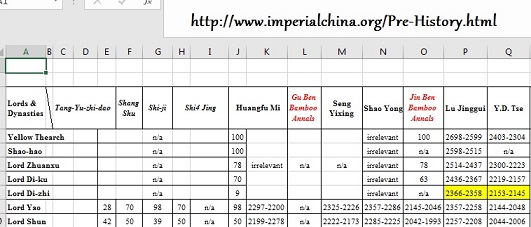 Huangdi's Wars With Chiyou & Yandi, Respectively
When Huangdi was in regency, he had 83 Chiyou brothers in his court. Since the Chiyou brothers were very cruel to people, Xuanyuan or Huangdi (the Yellow Lord) fought 73 successive battles against Chi-u (Ciyou), the leader of Jiuli tribe. Jiuli, i.e., nine 'li' people, were considered a group of Yi people.
Some advocates for southern aboriginals claimed that Chiyou (Chi-u) belonged to southern Chinese who descended from the Liangzhu Culture and that southerners had expanded into Hebei areas of northern China, instead. Qin Yanzhou speculated: that Jiuli was an alliance of ox-totem southern proto-Nan-Man people and bird-totem eastern proto-Dong-Yi [should be Yi, not misnomer Dong-yi] people; that after Jiuli's defeat, proto-Nan-Man people evolved into San-Miao people;
that proto-Yi inter-married with Lord Zhuanxu's tribe into later Chu-Qin-Zhao statelet's ancestors; and that proto-Yi inter-married with Lord Diku's tribe into later Shang people. Qin Yanzhou further divided the San-Miao into Dong-yue (Eastern Yue or She-tribe) in the southeast, Yao-tribe in the south and Wuling-man barbarians (Miao tribe) in the southwest. Qin Yanzhou classified Nan-yue (Southern Yue people) and today's Zhuang-tribe of Guangxi/Yunnan provinces as a mixture between Mongolians and Malays. Note Qin Yanzhou's speculation is not supported by either written classics or archaeology.
* In Commemoration of China's Fall under the Alien Conquests in A.D. 1279,
A.D. 1644 & A.D. 1949 *
U.S.S.R./Comintern Alliance with the KMT & CCP (1923-1927)
Korean/Chinese Communists & the 1931 Japanese Invasion of Manchuria
American Involvement in China: Soviet Operation Snow, IPR Conspiracy, Dixie Mission, Stilwell
Incident, O.S.S. Scheme, Coalition Government Crap, Amerasia Case & The China White Paper
* Stay tuned for "Republican China 1911-1955: A Complete Untold History" *
|
|
Zou Rong's Revolutionary Army;
Shin Kyu Sik's
Shrine (Spirit, Kunitama) of Korea
|
This snippet is for sons and daughters of China:
Heed the sons & ministers' agony and sorrow of our ancestors who died or lived through the Mongol, Manchu and Soviet-Chicom conquest
and
the Yongjia, Jingkang and Jiashen cataclysms !
Jeanne d'Arc of China:
Teenager girl Xun Guan breaking out of the Wancheng city to borrow the relief troops in the late Western Jinn dynasty;
Liu-Shao-shi riding into the barbarian army to rescue her husband in the late Western Jinn dynasty;
teenager girl Shen Yunying breaking into Zhang Xianzhong's rebels on the horseback to avenge on father's death in the late Ming dynasty.
China's Solitary and Lone Heroes:
Nan Jiyun breaking out of the Suiyang siege and charging back into the city in the Tang dynasty;
Zhang Gui & Zhang Shun Brothers breaking through the Mongol siege of Xiangyang in the Southern Soong dynasty;
Liu Tiejun breaking through three communist field armies' siege of Kaifeng in the Republican China time period;
Zhang Jian's lone confrontation against the communist army during the June 3rd & 4th Massacre of 1989.
|
|
|
Chi-you As a Cultivator Of the Original Chinese Civilization
http://www.hmongcenter.org/inonkinchipa.html
had a good account of Chiyou's contributions to the original Chinese civilization. It cited Historian Fan Wenlan's research in saying that "Huang-Di's tribes were living an unsteady nomadic life in Zhuolu area when Chi You realized the unification of agricultural tribes and founded the Nine-Li State" along the Yangtze River and Huai-shui River. It stated that "Chi You was the first to create weapons, penal laws and a religion, which not just played an important pole in the development of Chinese culture and technology, but ushered in a new epoch for the Chinese nation to enter a civilized era." It validated the influence of Chiyou as an overlord of then China by citing the fact (as recorded by Sima Qian's Shi Ji) that "Huang Di and the following monarchs respected Chi You as respected Chi You as Fight God after his death. ... Huang Di used Chi You's image to threaten those who wouldn't obey him. Thus Huang Di and his people took Chi You for a god to protecting themselves and had respect for him."
(Per Fan Wenlan, Chiyou possessed 9 tribes, with nine sub-tribes each, totaling 81 tribes, and that is how the 81 Chiyou brothers came to be known in Sima Qian's Shi Ji. Apparently, Chiyou, being an overlord of then China, did not serve Huangdi in the court at all. History was just revised by the victor.
Or, Chiyou or Chi-you was not a real figure but divinatory as could be validated by the excavated divination bamboo texts such as Gui-cang Yi and Lian-shan Yi.)
Chi-you, not a cultivator of the original Chinese civilization, could be actually a fable figure or a divinatory figure to every history enthusiast's disappointment.
In the Han dynasty astrology, Chi-you was a flag-shaped cluster of asterisms.
Chi-you appeared to be a non-Hua and non-Xia deity.
Guo Yu used the term Jiu-li, not Chi-you, for some group of rebels who caused disturbance [in the area of making no distinction between the mundane people and the gods/ghosts] during the late Shao-hao-shi's reign but were put under control by Lord Zhuan-xu, with the Jiu-li's descendants being the [Jiang-surnamed] San-miao people during Lord Yao's reign. Chi-you was seen in Shi-ji, Lü-shi Chun-qiu, Yi Zhou Shu, Guan Zi, Shan Hai Jing, and Yue Jue Shu, etc. Sima Qian could have expanded on Chi-you on basis of the record in Lü-xing of Shang-shu. Yi Zhou Shu made a sensational story about Chi-you attacking west, Yan-di failing to stop Chi-you, and Huang-di appearing on the stage to defeat both.
In a later book such as The Salt & Iron Debate of the Han Dynasty, you had the statement that Huangdi killed both Chi-you and two Hao-suffixed lords, which could mean the descendants of Tai-hao-shi and Shao-hao-shi.
(The books listed here, that carried the fable or divinatory figure Chi-you, were actually very late works from the time of the Han dynasty, or pure forgeries, including Yi Zhou Shu.)
The Xia Lineage
As illustrated in prehistory section, following the Five Overlords would be Lord Yu, the father of the founder of Xia Dynasty.
(Ban Gu of Latter Han Dynasty disputed the generation gap between Lord Zhuanxu and Lord Yu, claiming that Gun was the fifth generation grandson of Lord Zhuanxu and that Lord Yu would be six generations away from Lord Zhuanxu.)
Lord Yu was credited with the flood control work, a feat that was said to have united thousands of tribes across China.
As the ancient scholars had ascertained or speculated, Lord Yu, with a misnomer Rong-yu prefix, could have a birthplace a bit further west than those of Lord Yao
(reign ? 2357-2258 B.C.E. per Lu Jinggui; 2357-2286 B.C. per Shao Yong; 2145-2046 B.C. per the forgery
The Bamboo Annals; reign 2144-2048 B.C.E. with rule of 97 years and life of 118 years per Zhu Yongtang's adjustment of [the forgery contemporary version Jin Ben of] The Bamboo Annals) and Lord Shun, his two predecessors. Lord Yao's birthplace was speculated to be somewhere in today's Qingdu or ancient Wangdu, near Dingxian County, between Baoding and Shijiazhuang of today's Hebei Province. Lord Shun's birthplace was on the west side of the Taihangshan Mountain, and at the ancient Mt. Lishan [i.e., today's Zhongtiaoshan], somewhere near Yongji of Shanxi Province.
Likely, starting from Huangfu Mi of the Western Jinn dynasty, there was systematic forgery of the ancient thearchs' birthdays and birthplaces on basis of the fraudulent materials that were no other than the late Han dynasty argots and divinatory writings.
Per Shi Shuo Xin Yu, Lord Yu originated in the area of Xi-qiang, which was taken as the land of the Qiang-shui River or Qishan, Fufeng and Wugong of today's Shenxi Province. Lord Yu's tribe moved east to settle down at the land of Da-xia, which was taken by the historians to be the land near today's Fen-he River of Shanxi Province. All three overlords dwelled in the land to the east of the Eastern Yellow River Bend of today, or the land of the salt wells.
(Tian Changyue, the editor of Hua Xia Civilization anthology, compromised the issue of Lord Yu's point of origin by stating that Xia people might have two tribes, with father Gun developing in southern Shanxi Province where they were previously subordinate to Lord Yao and the son Lord Yu developing in western Henan Province by means of an alliance with Lord Zhuanxu's tribe. Lord Yu, per Tian Changyue, adopted 'xuan yu' [i.e., black fish)] as the totem and developed in today's Dengfeng-Yuxian areas of western Henan Province while his father Gun continued with the dragon totem and Lord Yu's tribe would later absorb his father's native Xia people in southern Shanxi Province.
There is no dispute as to Xia people's final demise in Henan Province. Liu Qihan (Liu Qihua) validated the demise of Xia in Henan Province by citing the ancient statement that "Xia ended when the Yi-shui and Luo-shui rivers ran dry".
Here we need to note that the Xia dynasty had demise twice, with the first occurrence being the killing of Xia King Xiang by usurper Han-zhuo, and the second occurrence being the Shang army's defeat of Xia King Jie at Mingtiao or today's Mt Zhongtiaoshan.)
The Shang Lineage
The second dynasty was founded by the Shang people. According to Sima Qian's Shi Ji, the ancestor of the Shang people was named Shang-ancestor-Xie4, a son of Lord Diku. Lord Yao conferred Shang-ancestor-Xie4 the post of 'si tu' and the last name of 'Zi'; Lord Shun conferred Shang-ancestor-Xie4 the land of Shang (later Shangluo County) for aiding Yu in flood control, and further assigned Shang-ancestor-Xie4 the post as the record keeper. The fourteen generation descendant would be Tang (Shang-Tang), founder of Shang Dynasty.
Per
The Bamboo Annals, between Shang-ancestor-Xie4 and Shang-tang, the Shang people, who enjoyed the conferral as marquis, was located somewhere in the northern part of today's Shanxi-Hebei provinces. The events recorded would be the killing of Shang ancestor Wang-hai, a son of Marquis Yin-hou, in the hands of the You-yi-shi people who could be the origin for the Yi-shui River near today's Peking. Marquis Yin-hou, to defeat the You-yi-shi, had borrowed an army from Count He-bo, i.e., the conferred count for the Yellow River - a figure who was cited in the legendary King Mu-wang's travelogue as someone who had a hereditary title of the guardian for the Yellow River at the Northern Yellow River Bend.
Scholar Zhang Guangzhi stated that the Xia-Shang-Zhou lineages should be looked at both horizontally and vertically. Horizontally speaking, the Xia-Shang-Zhou clans had co-existed together, with one of the three asserting over the others as an overlord at a specific time in history. Even after the demise of the predecessor dynasty, the remnants still survived under a different statelet name.
The Xia Dynasty remnants would survive as the Qi-guo statelet, located in today's Qi-xian county of Henan Province. The Qi-guo lineage continued through Shang and Zhou dynasties. (An ancient proverb about a Qi-guo person worrying about the fall of skies would be related to this country.)
Shang Dynasty itself was made into the principality of Soong by the succeeding Zhou Dynasty (1106-771 B.C. per Zhang Wenyu; 1044-256 B.C. per Cao Dingyun; 1122-256 B.C. per Liu Xin; 1116-256 B.C. per Huangfu Mi; 1111-256 B.C. per Seng Yixing; 1050 - 256 per the forgery contemporary version [Jin Ben] of The Bamboo Annals). Confucius at one time returned to his ancestral Soong Statelet and spent considerable time studying the Shang "Li", ritual or formality or system, which continued on in Soong long after Shang's demise. The lineage of history is cited repeatedly in China's 24 Histories.
One more example would be the demise of Qin Dynasty, after which there appeared Qin-han on the southern tip of the Korean peninsula and the Qin-hu 'barbarians' at the Western Corridor.
The Zhou Lineage
Note that the Zhou people were speculated to have origin from today's Shanxi for the link to the Guangshe Culture -- which was in turn a derivative of the You'ao-type Laohushan Culture.
According to Shi Ji, Zhou's ancestor could be traced to Houji, the Chinese god or father of agriculture. Houji, like Shang-ancestor-Xie4, was the son of ancient lord Diku. Both Lord Yao and Lord Shun used Houji as the master of agriculture; Lord Yao conferred Houji the last name of 'Ji', meaning origin. When Xia King Taikang lost his throne, Houji's son (Buzhu) left for the Rong & Di land; another two generations will be Gongliu who renewed agriculture in the Rong & Di land; Gongliu's son (Qingjie) set up a statelet in a place called 'Bin', in today's northern Shenxi Province, a place belonging to Xirong; another eight generations or three hundred years would be Zhou's founder, Gugong (aka Tanfu); Gugong, being attacked by the Rong & Di and/or Xunyu barbarians, would relocate to Qishan and built city in a plain called Zhou-yuan under the foot of Qishan Mountain; Gugong declared their statelet 'Zhou' and he is also known as 'Zhou Tai-wang' (grand king) posthumously. Gugong's elder son, 'Tai Bo', went to the Yangtze Delta (Meili Village, Wuxi County, Changzhou, Jiangsu) for sake of launching his own statelet. Tai Bo wanted to yield the succession to his brother Ji Li. Ji Li's son, born by a Zhi-ren-shi woman, would be Ji Chang, i.e., Zhou King Wenwang or Count Xibo.
The Barbarians versus the Chinese
The most important evidence this webmaster could rely on for the nativity of the origin of the Chinese civilization will be the fact that historians of every dynasty repeatedly cite the past without major conflict. The differentiation of the Chinese people from the barbarians served as a safeguard for the continuity of the Chinese though some of the barbarians could be traced to the same origin, interestingly.
The Common Origin For the Di1-Qiang1 Barbarians & the Xia Chinese
Wang Zhonghan, at http://www.meet-greatwall.org/gwmz/wen/mzs/mzs20.htm, had pointed out the historical conclusion that the ancient Qiang people [ancestors of the Tibetans] and the ancient Xia Chinese shared the same origin. The Qiang people derived from Yandi the Fiery Thearch.
The Qiangs were descendants of the Yandi (Fiery Lord or Fiery Emperor) tribal group carrying the tribal name "Jiang".
In the paragraph on Rong's Possible Link To Qiangic People, this webmaster detailed the compositions of the Rong to derive a good conclusion that some of the Rongs at the time of Zhou Dynasty shared the same blood-line with Xia Chinese but differed in 'Culture' such as cuisine, clothing, money and language.
The same origin validation could be seen in Zheng Yu of Guo Yu, wherein Shi-bo, in a dialogue with Zheng Lord Huan'gong, expounded the distinction between the Sinitic principalities [related to the Zhou royals, the brothers of the Zhou royals' mothers, and the nephews and uncles on the mothers' side] from those related to the Maan, Jing, Rong and Di barbarians, not counting the Yi barbarians who were taken to be beyond the eastern statelets of Qi, Lu, Cao, Soong, Teng, Xue, Zou, and Ju. For the barbarians, Shi-bo apparently made a case of identifying the Sinitic cliques ruling the barbarians from the barbarians themselves. Shi-bo, in the passage on the 'Jing' or Chu barbarians [who were counted among the southern 'Maan' group], explicitly listed the lineage of the 'Jing' or Chu ancestors, stating that Chu lord Xiong Yan had born four sons Bo-shuang, Zhong-xue, Shu-xiong and Ji-xun, with names bearing the Sinitic brotherly order, among whom the 3rd son fled to be a ruler among the southern 'Pu' [i.e., the later Hundred Pu] people and the 4th son took over the lordship in the spirits of ancient ancestors Chong-li -- also taken to be two brothers of Chong and Lih[2] -- with the Lih line tacking on the hereditary fire guardian [minister] post known as 'Zhu-rong' [i.e., virtues shining like fire]. Shi-bo's point was that in extrapolating on the achievements of descendants of Yu-mu [lord Shun's line], Xia-yu [lord Yu], Zhou-qi [Zhou ancestor Qi or Hou-ji], it was claimed that inevitably Zhu-rong's descendants, who had produced Count Kunwu[-shi] in the Xia dynasty and Count Da-peng and Count Shi-wei[2] in the Shang dynasty, should see the Mi-surnamed Chu people asserting themselves in the Zhou dynasty time period. Altogether, Shi-bo pointed to the Jiang-surnamed people [i.e., descendants of Bo-yi{-fu} who assisted overlord Yao as protocol minister], Ying-surnamed people [i.e., descendants of Bo-yi who assisted overlord Shun as interior minister], and Jing-Mi-surnamed Chu people as possible contestants for the Zhou dynasty's rule -- another Sinitic theme of power rotation.
Qiangic descendants included today's Tibetans. "Xin Tang Shi" (New History of the Tang Dynasty) said that the Tibetans belonged to the Xi Qiang, namely, the western Qiangic people. The book which was called 'Continuum To Hou Han Shu' stated that the Qiangs, literally meaning 'shepherds in the west', were alternative race of the Jiang surname tribes of San Miao.
According to Sima Qian, the 'San-miao' people, who originally resided in the Jiang1-shui River (wrongly postulated to be along the middle Yangtze River) area where the later Chu Statelet was, were mostly relocated to western China to guard against the western barbarians. Lord Shun, who took over the overlord post from Lord Zhi (reign 2366-2358 B.C. ? per Lu Jinggui; 2153-2145 per Y.D. Tse), son of Lord Diku, relocated them to western China as punishment for their aiding Dan Zhu (the son of Lord Yao reign 2357-2258 B.C. ?) in rebellion. (This could lead to a sound speculation that Sino-Tibetan speaking San Miao people had dwelled in Gansu much earlier than the later encounter of the Huns and the misnomer 'Indo-European' Yuezhi people, i.e., the 3rd century B.C. Hunnic-Yuezhi War, by about 2000 years at minimum --unless the Yuezhi were in fact related to the Sinitic Chinese, being part of the five Rongs as noted in history.)
http://www.meet-greatwall.org/gwmz/wen/mzs/mzs20.htm
"氐羌与炎帝、黄帝有密切的渊源关系。《国语'晋语》记述,炎、黄二帝为兄弟,是少典氏(父)与有氏(母)所生,黄帝得姓姬,炎帝得姓姜。《左传》哀公九年说:'炎帝火师,姜姓其后也。'在甲骨文字中,羌从羊从人,姜从羊从女,两字相通,表示族类与地望用羌,表示女性与姓用姜。民国初年以来,章太炎在《检论'序种姓》②中已指出:'羌者,姜也。'后来傅斯年在《姜原》③中进一步论证:'地望从人为羌字,女子从女为姜字';顾颉刚在《九州之戎与戎禹》④中更指明:'
aaaa
姜之与羌,其字出于同源,盖彼族以羊为图腾,故在姓为姜,在种为羌。"
|
|
|
|
|
|
|
Sovereigns & Thearchs;
Xia-Shang-Zhou dynasties;
Zhou dynasty's vassalage lords;
Lu Principality lords;
Han dynasty's reign years
(Sexagenary year conversion table-2698B.C.-A.D.2018; 247B.C.-A.D.85)
|
|
The Sinitic Civilization - Book I is
available now at
iUniverse,
Barnes & Noble,
Amazon,
Google Play|Books
and
Nook.
The Sinitic Civilization - Book II is available at
iUniverse,
Amazon and Barnes & Noble.
Check out the 2nd edition preface that had an overview of the epact adjustment of the quarter remainder calendars of the Qin and Han dynasties, and the 3rd edition introductory that had an overview of Sinitic China's divinatory history of 8000 years.
The 2nd edition, which realigned the Han dynasty's reign years strictly observing the Zhuanxu-li calendar of October of a prior lunar year to September of the following lunar year, also cleared this webmaster's blind spot on the authenticity of the Qinghua University's Xi Nian bamboo slips as far as Zhou King Xiewang's 21 years of co-existence with Zhou King Pingwang was concerned, a handicap due to sticking to Wang Guowei's Gu Ben Bamboo Annals and ignoring the records in Kong Yingda's Zheng Yi.
Stayed tuned for Book III that is to cover the years of A.D. 86-1279, i.e., the Mongol conquest of China, that caused a loss of 80% of China's population and broke the Sinitic nation's spine.
Preview of annalistic histories of the Sui and Tang dynasties, the
Five Dynasties, and the two Soong dynasties
could be seen in
From the Khitans to the Jurchens & Mongols: A History of Barbarians in Triangle Wars and Quartet Conflicts
(The Barbarians' Tetralogy - Book III: available at iUniverse;
Google;
Amazon;
B&N).
(A final update of the civilization series, that is scheduled for October 2022, would put back the table of the Lu Principality ruling lords' reign years, that was inadvertently dropped from Book I during the 2nd update.)
|
|
Book II - Table of Contents:
Section Seven: The Han Dynasty
Relationship with the Huns 392
Chapter XXXIII: The Hunnic Empire 409
Origin of the Huns 409
The Rong & Di Barbarians in the Context of Relation to the Fiery Thearch, the San-miao Exiles and the last Xia Dynasty King 413
The Zhou, Qin and Jinn's Zigzag Wars with the Barbarians & the Construction of the Great Walls 417
Mote's Hun Empire, the Yuezhi People, and the Early Han Dynasty 424
The Huns & the Eastern Hu Barbarians 430
The Hunnic Government Structure & the Dragon Reverence 431
Chapter XXXIV: The Han Dynasty's Wars with the Huns 435
Chapter XXXVI: The Western Expedition, The Kunlun Mountain & Shan Hai Jing 489
Han Emperor Wudi Seeking Elixir from the Immortals on the Kunlun Mountain 491
Credible Geography Book on the Mountains Possibly Expanded to Include the Legendary Kunlun Mountain 493
Unearthly Things in the Mountains' Component of The Legends of Mountains & Seas 501
The Divination Nature and Age of the Seas' Component of The Legends of Mountains & Seas 506
Chapter XXXVII: Shan Hai Jing & The Ancient Divination 520
Chapter XL: The Latter Han Dynasty's Chronological History 560
The Relation with the Southern Huns 561
|
|
The Relationship Between Shang Dynasty, Succeeding Zhou Dynasty & the Barbarians
The barbarian nomadic people, by the name of 'Shanrong' or 'Xunyu' or 'Xianyun', had been roaming on the steppe over 4000 years ago, prior to the Xia-Shang-Zhou dynasties - if we interpreted Sima Qian's statement on "beyond Tang & Yu" as being "beyond the eras of Lord Tang-yao and Lord Yu-shun", not the "domain beyond the central land of lord Tang-yao and lord Yu-shun". The demise of Xia Dynasty would see Chunwei, son of Jie [the last Xia Dynasty Lord], fleeing to the northwest to join the nomads and becoming the de facto ancestor of the later Huns. Sima Qian's section on Shang Dynasty
(1765/1765 B.C.E. - 1122 B.C. per Shao Yong; or 1559 - 1050 per the forgery contemporary version [Jin Ben] of The Bamboo Annals)
did not mention too much on the steppe people other than King Wuding's wife, Fu Hao, who had led a personal campaign against the ancient Gui-fang (ghost domain) barbarians as the famous female warrior of China. (Chinese historians also claimed that Gui-gang could be actually a statelet ruled by Marquis Gui-hou, i.e., one of three major border vassals of Shang Dynasty.
Yi (book of divination) stated that Lord Gao-zong campaigned against Gui-fang, and Hou Han Shu, in its Xi Qiang Zhuan (section on the Western Qiangs), stated that it took Wu-ding three years to campaign against and defeat the Xi-rong and Gui-fang barbarians.
Hence, Shi Jing eulogized the Shang's accomplishments with the sentence that the Di and Qiang [barbarians] people dared not renegade on paying the pilgrimage to the Shang king.
Gui-fang, listed together with the Xi-rong barbarians against whom Shang King Wu-ding, i.e., Gao-zong, campaigned against per Yi (book of divination), meant that it was a group of the western barbarians, not northern.
Later historians, in books like Tong Dian etc, traced the origin of the western barbarians to the San-miao exiles, and pointed out that those barbarians, known as 'quan [dog] yi [barbarians]' at the time, had intruded to the east when Xia King Tai-kang lost his throne, to be dealt a defeat in the hands of successor Xia king Xiang, but reaching the Mt. Qishan area after last Xia King Jie was overthrown by Shang, to be dealt another defeat in the hands of Shang founder-king Tang. Further, the Quan-yi barbarians did receive some conferral of rankings from Xia King Hou-xie, namely, some records jotted down in The Bamboo Annals.)
* In Commemoration of China's Fall under the Alien Conquests in A.D. 1279,
A.D. 1644 & A.D. 1949 *
U.S.S.R./Comintern Alliance with the KMT & CCP (1923-1927)
Korean/Chinese Communists & the 1931 Japanese Invasion of Manchuria
American Involvement in China: Soviet Operation Snow, IPR Conspiracy, Dixie Mission, Stilwell
Incident, O.S.S. Scheme, Coalition Government Crap, Amerasia Case & The China White Paper
* Stay tuned for "Republican China 1911-1955: A Complete Untold History" *
|
|
Zou Rong's Revolutionary Army;
Shin Kyu Sik's
Shrine (Spirit, Kunitama) of Korea
|
This snippet is for sons and daughters of China:
Heed the sons & ministers' agony and sorrow of our ancestors who died or lived through the Mongol, Manchu and Soviet-Chicom conquest
and
the Yongjia, Jingkang and Jiashen cataclysms !
Jeanne d'Arc of China:
Teenager girl Xun Guan breaking out of the Wancheng city to borrow the relief troops in the late Western Jinn dynasty;
Liu-Shao-shi riding into the barbarian army to rescue her husband in the late Western Jinn dynasty;
teenager girl Shen Yunying breaking into Zhang Xianzhong's rebels on the horseback to avenge on father's death in the late Ming dynasty.
China's Solitary and Lone Heroes:
Nan Jiyun breaking out of the Suiyang siege and charging back into the city in the Tang dynasty;
Zhang Gui & Zhang Shun Brothers breaking through the Mongol siege of Xiangyang in the Southern Soong dynasty;
Liu Tiejun breaking through three communist field armies' siege of Kaifeng in the Republican China time period;
Zhang Jian's lone confrontation against the communist army during the June 3rd & 4th Massacre of 1989.
|
|
|
Wang Zhonghan expounded the inter-relationships between Shang people and Qiang people. Namely, the Shang people often campaigned against the Qiangs, and treated the Qiangs as funeral objects for live burial. Three Shang vassals, i.e., Zhou ancestor Xi-bo, Marquis Jiuhou [Gui-hou, i.e., of Gui-fang], and Marquis E-hou, were a good starting point to understand the ethnic nature of the ancient people. As the oracle bones and bronze inscriptions already had proven, the Zhou people and Xia people shared the same origin. After the defeat of the Xia people by Shang, the remnants, i.e.,
Gui-fang [ghost domain], were a major enemy to the comparatively Yi-ethnic Shang Dynasty till the Gui-fang statelet was subdued. Similarly, the Zhou people had zigzag wars with Shang Dynasty for hundreds of years till the submission to Shang as well as marriage with the Shang princesses.
This meant that whenever there was a major dynastic change, the original ruling clique could be pushed to the border area to be a new group of barbarians.
"在被商王朝当作羌人或氐羌的方国中,也有和商朝关系比较好、甚至在商朝做官,参与商王对羌人的征伐,或者先与商处于敌对关系,后又成为商朝诸侯的。前者如鬼方,卜辞记录表明不仅罕见商王对鬼方的战争,而且'鬼族的代表人物良武丁时起就参与王朝的祭祀、征伐、掠夺羌人等活动,常与当时统治集团中的一些重要成员相提并论,连是否'得疾'都受到商王的关心'②。《史记'殷本纪》记述纣王曾'以西伯是、九侯、鄂侯为三公'。九侯即鬼侯③。在卜辞中也有占卜是否让鬼族人参加祭祀作杀牲者,'验辞记占卜结果令鬼与周一同担任这个职务'④。纣时'三公'是何种性质的官,难断,卜辞中有令鬼与周同参加商王祭祀活动作杀牲人的记载,证明商末鬼方与周的首领确曾在商王朝廷用事。"
During the earlier reign of Shang King Woding, the Zhou people were often campaigned against by Shang Dynasty.
Zhou, after submission to Shang, then campaigned against the Qiang barbarians on behalf of Shang, which was for expanding its domain as well as its power base in another sense.
Xu Zhuoyun cited Chen Mengjia's research in pointing out that Zhou [proxy king] Taiwang, during Shang King Wuyi's reign, relocated to Mt Qishan under the pressure of the Doggy Rong; that Zhou Lord Ji Li [Ji-li or Jili], during the 34th year reign of Shang King Wuyi, paid pilgrimage to the Shang court; that Jili defeated the Xiluo-Gui-rong barbarians and captured 20 Di[2] kings the next year on behalf of the Shang court but Shang King Wuyi was killed by a lightning around the Wei-shui River; that Jili campaigned against the Yanjing-rong barbarians but got defeated during the 2nd year reign of Shang King Taiding; that Jili, two years thereafter, defeated the Yuwu-rong barbarians and received conferral as 'mu shi' (shepherd chancellor) from the Shang King; that Jili first campaigned against the Shihu-rong barbarians during the 7th year reign of Shang King Taiding and against the Yitu-rong barbarians during the 11th year reign; that Jili was killed by Shang King Wending (Taiding) thereafter; and that the Zhou people began to attack Shang Dynasty during the 2nd year reign of Shang King Di-yi (Yili).
Xu Zhuoyun speculated that the Shang King most likely died in the hands of the Zhou people rather than a lightning in a similar coverup as later Zhou King Zhaowang's death on the Huai-shui River as a complication of conflict with the southern barbarians --which were in fact some equally civilized people in then western China, namely, the Yong people, the Ba people, and the Shu people in today's Sichuan-Hubei-Shenxi borderline, a land widely covered in the legendary book "Classics of Mountains and Seas".
However, the Shang-Zhou relationship had improved since Jili's successor, i.e., Zhou King Wenwang, had again married with the Shang princess.
Both the mother and the wife of Zhou King Wenwang, per scholar Fu Sinian, were princesses of the Shang royal house.
The Zhou people were conferred the title of 'Xi Bo' (Count of the West) by Shang Dynasty King Zhouwang as a buffer state against the Western nomads.
As for the Zhou people, they also inter-married with the Qiangs throughout history. Xu Zhuoyun cited scholar Liu Qiyi's research of 'jin wen' or bronze inscriptions in stating that 12 kings of Western Zhou Dynasty had inter-married with the Jiang-surname women consecutively.
During the campaign against Shang by Zhou, Zhou King Wuwang claimed to be people from the west. Scholar Liu Qihan (Liu Qihua), in anthology Hua Xia Civilization, tackled the issue of 'xi' or west. His validations pointed to the land of 'he qu' (i.e., the inflexion point of the Yellow River Bends) as the 'land of the west', i.e., the later land between Qin and Jinn principalities. The Zhou allies included, per "Shi Ji", eight barbarian statelets as allies, the Qiangs from today's Gansu, the Shu-Sou-Mao-Wei statelets in today's Sichuan Province, Lu and Peng from the northwest, and Yong and Pu south of the Han-shui River.
The Difference Between the Rong people and the Chinese In 'Culture', Not 'Blood-line'
What distinguished the Chinese from Rong or Di would mostly likely lie in the customs, not the ethnicity.
Zhou Dynasty's founder, per Shi Ji, Gugong abolished the Rong & Di customs, built a city in a plain called Zhou-yuan under the foot of Qishan, and devised five posts of si tu, si ma, si kong, si shi, & si kou per the Shang Dynasty system. Similar to the Zhou founder, Qin's ancestors had emerged from the barbaric West to become the ruler of China. In both cases, they discarded the Rong & Di(2) customs and adopted the rituals of the central China of the time.
Qin's reformer Shang-yang claimed that he should be ascribed great contributions to Qin and that he was responsible for renovating Qin's Rong-Di customs such as parent and son living in same bedroom and for differentiating the protocol of men from women.
Scholar Liu Qihan (Liu Qihua) stated that the difference between Rong and Chinese lied in 'culture', not 'blood-line'.
In article The Rong People In Nine Ancient Prefectures versus Rong-yu Xia People, Liu Qihan (Liu Qihua) cited ancient classics Zhou Yu's paragraph: "In the ancient times, Gong-gong-shi ... had first worked on repairing the 100 rivers (including the flooding of the Yellow River) ... Gong-gong-shi's descendant, Count Yu (i.e., Lord Yu), repented over his father Gun's mistake in flood control ... Gong-gong-shi's grandson, Si-yue, had acted as an assistant to Lord Yu in flood control ... Hence, Si-yue was conferred the fief of Si-yue-guo Statelet and assigned the surname of 'Jiang' which included the clan name of 'Lü' ... Today (i.e., in Zhou Dynasty times), the clan names of Shen and Lü had declined in prestige and influence but the 'Jiang' family still prevailed in Qi Principality."
The evidence of Qiangic nature of the barbarians would be best exhibited by their self-claim.
When Qin intended to get rid of Luhun-rong & Jiang-rong around capital Yong in 638 BC, Jinn Principality adopted a policy of allowing remotely-related barbarian clan to stay closer to the land between Qin, Jinn and Zhou Dynasty capitals: Jinn Lord Huigong, for his mother's tie with Luhun-rong clan, relocated Luhun-rong to Yichuan and Jiang-rong to southern Shanxi Province, i.e., namely, the southward migration to Mt Songshan area of Yun-surnamed Xianyun [Huns] clan whose Qiangic nature was validated about 80 years later by the dialogue between Fan Xuan-zi of Jinn Principality and the descendant of Jiang-rong.
"公元前638年(周襄王十四年),秦穆公与晋惠公迁陆浑之戎于伊川,同时迁姜戎于晋南。陆浑戎周詹桓伯说是'允姓之奸,居于爪州'⑤,晋范宣子对戌子驹支说:'昔秦人逐乃祖吾离于瓜州。'⑥这个瓜州在秦晋西北,杜预认为在敦煌,但敦煌在秦雍都以西千数百里之外,其地在汉武帝时始立郡,若远在敦煌,对秦毫无威胁,秦也无力驱除他们。允姓,因猃狁而得姓,与鬼方媿姓相同⑦,西戎本有九州之名,瓜州大概为其中之一,在秦雍都附近,泾、洛二水中上游及陕北一带。秦因陆浑与姜戎近都,务在驱除,而晋惠公原逃亡在外,得秦国支持才获得晋侯地位,他的母亲又是允姓戎之女,允姓戎是他的舅族,因而迎合秦国,招允姓陆浑之戎安置于伊水流域,嵩山附近,而姜戎安置于晋南。"
Liu Qihan (Liu Qihua) further cited ancient classics Zuo Zhuan and listed the statement of Ju-zhi, a prince of Jiang-rong, as paraphrased below: "Everyone had said that our folks, i.e., miscellaneous Rong people, belonged to the descendants of Si-yue ... Our various Rong people differed from Hua (i.e., Xia) people in cuisine, clothing, money and language."
 Liu Qihan (Liu Qihua) speculated that the clan names of Shen-Lü-Qi-Xu etc, who entered China during Western Zhou Dynasty, had been the Rong people who came eastward to China earlier, while Jiang-rong would be the original Rong people who came into China during the Eastern Zhou Dynasty time period.
Terra-cotta soldiers excavated from Qin First Emperor Shihuangdi's tomb should provide the best possible evidence as to the Mongoloid nature of Qin Chinese and Sino-Tibetan Qiangic Rong people in northwestern China thousands of years ago.
Liu Qihan (Liu Qihua) speculated that the clan names of Shen-Lü-Qi-Xu etc, who entered China during Western Zhou Dynasty, had been the Rong people who came eastward to China earlier, while Jiang-rong would be the original Rong people who came into China during the Eastern Zhou Dynasty time period.
Terra-cotta soldiers excavated from Qin First Emperor Shihuangdi's tomb should provide the best possible evidence as to the Mongoloid nature of Qin Chinese and Sino-Tibetan Qiangic Rong people in northwestern China thousands of years ago.
Below would be the definitions of ancient barbarians like 'Rong' and 'Di[2]'.
Wang Zhonghan cited scholar Wang Guowei in pointing out that the 'Rong' was a barbarian designation from Zhou King Youwang to Lu Lord Yin'gong & Lu Lord Huan'gong, while 'Di[2]' designation came about after Lu Lord Zhuanggong & Lu Lord Min'gong. "Rong" was equivalent to weaponry, ferociousness and other derogatory meanings.
Ancient classics, like "Shi" and "Shu" interpreted Di[2] as "faraway barbarians".
"在上述季历与文王征伐的诸戎中,以西落鬼戎为最强,既称'西落',当在周原以西汧陇地区及其以西,大概是与鬼方有共同族称的游牧民族。一次战争被俘获'十二翟王',可见鬼戎部落之众,'十二翟王'即是十二位鬼戎部落酋长。'翟'以同音与'狄'相通假,本非族称,是周人及诸夏加给鬼戎的蔑称,与'戎'具'兵'、'凶'之义引申加之于各敌对部落相同。王国维先生说:'《经》、《传》所记,自幽王以后至春秋隐、桓之间,但有戎号,庄、闵以后,乃有狄号。'②又说:'狄者,远也……《书》称'狄矣西土之人',《诗》称'舍尔介狄',皆谓远也。乃引申为驱除之于远方之义……凡种族之本居远方而驱除者,亦谓之狄。'③所谓'翟王',即远方当驱除之王。"
Merging and Subjugating the Barbarians By Zhou Dynasty & Principalities
Zhou Dynasty had two Jiang-surnamed vassals which contributed greatly to defending the borders, namely, the Shen-guo statelet under Marquis Shen to the west, and the Qi-guo statelet under Jiang Taigong and his descendants on Shandong Peninsula to the east.
Count of West, Xibo, namely, Zhou Ancestor Ji Chang, once attacked the Doggy Rongs (said to be same as Xianyun barbarian on the steppe).
Dozen years later, Zhou King Wuwang exiled the Rongs north of the Jing & Luo Rivers. The Rongs were also called Huangfu at the time, a name to mean their 'erratic submission'. 200 years later, during 17th year reign [i.e., 985 B.C. per The Bamboo Annals], Zhou King Muwang (r. 1,001 - 947 B.C. per Shao Yong's divinatory chronicling; 1006-952 B.C. per Zhang Wenyu; 962-908 per [forgery] The Bamboo Annals) was noted for defeating the barbarians, reaching Qinghai-Gansu regions in the west, meeting with Queen Mother of West on Mt Kunlun [possibly around Dunhuang area], and then relocating the barbarians eastward to the starting point of Jing-shui River for better management [in a similar fashion to Han Emperor Wudi's relocating Southern Huns to the south of the north Yellow River Bend].
History recorded that King Muwang captured four white wolves & four white deers (white deer and white wolf being the titles of ministers of Rongdi barbarians) during his campaign. The Huangfu (Doggy Rong) people then no longer sent in yearly gifts and tributes.
"在周人兴起时,仍在陇济及泾洛一带游牧的鬼戎,其实也是许多部落的总名,并且在不同时期有不同的名称。古公亶父在豳时,'薰育戎狄攻之,欲得财物'③,《诗'大雅'绵》歌泳古公亶父在周原筑城,混夷远遁。但周原的戎患仍很严重。《诗'小雅'采薇'序》说:'文王之时,西有昆夷之患,北有猃狁之难',《采薇》有'靡室靡家,猃狁之故','岂不见戒,猃狁孔棘'等句,《孟子'梁惠王》下甚至说:'太王事熏鬻,文王事昆夷。'文王经过征服与争取,戎狄'莫不宾服,乃率西戎,征殷之叛国以事纣'④。实际上打着商王的旗号对周围各部落与方国的兼并,有所谓'三分天下有其二',为灭商准备了条件。"
"西周中叶,与戎狄相安共处的局面日益难以维持。周穆王时,周室尚称强大,因'戎狄不贡,王乃西征犬戎,获其五王,又得四白狼、四白鹿,王遂迁戎于太原'⑧。穆王西征到了什么地方?据古本《竹书纪年》记载:'穆王十七年西征,至昆仑丘,见西王母,乃宴。'⑨昆仑丘所在,各家考证不一,肯定已超过陇山山脉,到达今甘青境内,见到了西戎的一位女酋长。穆王从陇以西迁戎至泾水上游之太原,大概是为了便于控制,后来太原之戎成为周室邻近王畿的威胁,完全与穆王初衷设想背道而驰。"
Zhou King Yiwang, the grandson of King Muwang (r. 1,001 - 947 B.C. per Shao Yong's divinatory chronicling; 1006-952 B.C. per Zhang Wenyu; 962-908 per [forgery] The Bamboo Annals), would be attacked by the Rongs. The great grandson, King Xuanwang (reign 827 - 782), finally fought back against the Rongs. Shi Jing eulogized King Xuanwang's reaching Taiyuan (original Taiyuan in southern Shanxi Province, not the appropriated one in the north of today's Shanxi Province; however, 'Taiyuan' at the times of King Xuanwang would be the place in Shenxi/Ningxia where Jing-shui River originated). Thereafter, King Youwang (reign 781-771) was killed by the Doggy Rongs at the foothill of Lishan Mountain and capital Haojing was sacked. Rongs who stayed on at Lishan were called Li-rong. The Rongs moved to live between the Jing & Wei Rivers. Lord Qin Xianggong was conferred the old land of Zhou by Zhou King Pingwang (reign 770-720 B.C.). Zhou King Pingwang encouraged the Qin Lord to drive out the Quan-rongs.
Zhou continued to engage with barbarians like 'Rong[2] and 'Di[2]' till Qin ancestors came to the help. Qin & Jinn people, in dealing with barbarians, had adopted a policy of allowing remotely-related barbarian clan to stay closer to the land between Qin, Jinn and Zhou Dynasty capitals, i.e., namely, the southward migration of Yun-surnamed Xianyun [Huns] clan to Mt Songshan area.
"公元前638年(周襄王十四年),秦穆公与晋惠公迁陆浑之戎于伊川,同时迁姜戎于晋南。陆浑戎周詹桓伯说是'允姓之奸,居于爪州'⑤,晋范宣子对戌子驹支说:'昔秦人逐乃祖吾离于瓜州。'⑥这个瓜州在秦晋西北,杜预认为在敦煌,但敦煌在秦雍都以西千数百里之外,其地在汉武帝时始立郡,若远在敦煌,对秦毫无威胁,秦也无力驱除他们。允姓,因猃狁而得姓,与鬼方媿姓相同⑦,西戎本有九州之名,瓜州大概为其中之一,在秦雍都附近,泾、洛二水中上游及陕北一带。秦因陆浑与姜戎近都,务在驱除,而晋惠公原逃亡在外,得秦国支持才获得晋侯地位,他的母亲又是允姓戎之女,允姓戎是他的舅族,因而迎合秦国,招允姓陆浑之戎安置于伊水流域,嵩山附近,而姜戎安置于晋南。"
At about this time, Jinn Principality began the process of expansion that would merge and conquer dozens of barbarian statelets to the east of east Yellow River Bend, with Jinn Lord Xian'gong merging 17 statelets and subjugating 38 others [per "Haan Fei-zi"].
"若非侵小,将何所取?武献以下,兼国多矣。'《韩非子'难二篇》记述晋烛过说:'昔者吾先君献公,并国十七,服国三十八。'
Qin Mugong, after defeat in Battle of Xiao-er, turned around to expand westward, and conquered 8 [or 12] western barbarian statelets in Shenxi-Gansu regions. Then, after about 100 years, Qin campaigned against west bend and north bend of the Yellow River area and consolidated the control over northwestern China.
" 公元前623年,即秦穆公三十七年,'用由余谋伐戎王,益国十二,开地千里,遂霸西戎'50000016_131_5⑤,中原诸夏也不把秦当诸夏,春秋时期不与秦会盟。
被秦穆公所吞并的八国或十二国,未详其名称,其未被吞并的,陇山以西有绵诸、翟、等部,岐山以北有义渠、大荔、乌氏、朐衍等部。在秦穆公以后到春秋末的百余年中,不见秦与诸戎战争的记载,可能有一段相安时期,此期间距秦较近的大荔戎、义渠戎社会发展很快,战国初'义渠、大荔最强,筑城数十,皆自称王'①,大概已经定居,由游牧转向了农耕。"
To the west of Qin would still remain remnants of the Qiangic barbarians. Beyond those relatively "raw [uncooked] Qiangs" would be those people who may share nothing with the Sinitic Chinese at all, i.e., the Wusun and the Sai-ren [Scythians]. (For details, see http://www.imperialchina.org/Barbarians.htm.)
"分布在河西走廊和今新疆维吾尔自治区有乌孙、月氏、塞种等,其中月氏在战国末已建国称王。"
Per Wang Zhonghan, by the 6th century B.C., most of the barbarians had merged into the Chinese way of life. As to the ethnic nature of those barbarians, the barbarians themselves, 80 years after southward migration, still claimed that they differed from the Chinese NOT in bloodline but cuisine, clothing, language and currency (gift exchange).
In between the Spring & Autumn time period and the Warring States time period, the barbarians around the Yi-shui & Luo-shui rivers had been absorbed by the Haan & Wei principalities. The Jiang-rong barbarians also disappeared from the records. As to the barbarians in today's western Shandong, northern & southern Henan provinces, the Chu, Qi & Lu principalities had merged them all.
Per Wang Zhonghan, the only noticeable barbarians would be those who stayed to the west of Mt Longshan in today's Gansu Province, where the raw or uncooked Qiangic barbarians would evolve into the Di[1]-Qiang[1] people of the later Qin-Han dynasties.
" 诸戎迁徙到诸夏境内,当然会接受诸夏的文化影响,但直到春秋的中晚叶,仍大体保持游牧民族的特点。公元前559年(周灵王十三年)姜戎子驹支追述晋惠公因诸戎是四岳之后,才把诸戎安置在晋国南部,成为晋国'不侵不叛之臣'。然而此时距南迁已80年,驹支仍说,'我诸戎饮食衣服,不与华同,蛰币不通,言语不达'①,民族差别还是比较明显的。到春秋战国之际,情况就不同了,伊洛地区诸戎已被韩、魏并灭,姜戎也不复见于记载,其它鲁西豫北及豫南地区诸戎,也都已被楚国及齐、鲁等兼并,崤山以东诸戎部落已被吞灭,戎人也都已加入华夏行列,被华夏所涵化。只有陇山地区及陇以西,或与秦长期交往被华化,或在陇以西逐渐形成氐羌族群,成为秦汉以后氐羌族群的前驱。"
Below maps were added to the http://www.imperialchina.org/Barbarians.htm which was embedded within the
http://www.imperialchina.org/Huns.html and
http://www.imperialchina.org/Turks_Uygurs.html
pages.
On basis of the new archaeological findings and historical Chinese records, this webmaster will tentatively speculate on when the east met with the west.
First this webmaster wants to debunk the fallacies in regards to the equation of the ancient Yu-shi tribe to the Yuezhi, and the speculation on the jade trade that the Yuezhi was falsely accredited with.
The forged Guan Zi [管子] statement contained a reference which was a misnomer related to the 'Yu-shi' tribe, a term that was erroneously speculated by a few annotators in history, as well as scholar Wang Guowei of the early 20th century,
to be the same as Yuezhi per soundex.
Guo Yu, a political discourse book that was similar to Zhan Guo Ce, could be merely Han dynasty Confucian compilings, while Guan Zi, i.e., the fabled Legalist founding master, was at most a political economy book written in the late Western Han dynasty or at the turn of B.C. and A.D.
See Barbarians.htm for more discussion on the forged statements in Guan Zi [管子] (which historian Ma Feibai pierced sentence by sentence).
Around the Xin (New) Dynasty (AD 6-23), there occurred
a forgery movement by the Chinese scholars, possibly with the intention of substantiating the mandate of the usurper Wang Mang's dynasty.
The classics which were proved to be forgeries
include "Guan Zi [管子]", which historian Ma Feibai pierced sentence by sentence.
Using Ma's same logic, this webmaster had found the two other books, "Yi-zhou-shu" [逸周书] or "Zhou-shu" (Zhou Dynasty [11th cen. B.C. - 256 B.C.] [abbrev. 周书] book,
not the Zhou-shu [周书] from Posterior Zhou Dynasty of the South-North Dynasty time period of AD 557-581) and "Shang[1]-shu" [商书] (Shang Dynasty [16-11th cent. B.C.] book, not Shang[4]-shu [尚书], i.e., the remotely ancient book which was said to be abridged by Zuo Qiuming [Zuoqiu Ming]),
to be written in the exact same style and could be forgeries by possibly the same person[s].
Discarding the forgery of Guan Zi [管子] basically eliminated the whole foundation upon which the existence of the Yuezhi and the jade trade was built,
a fallacy which was widely cited in
the most recent 10-20 years, i.e., the 1990s and 2000s, to the effect that the fabricated Yuezhi had lived close to the heartland of China, playing the role of bearing the Aryan civilization to China.
Another school of thought, which was intended to discredit the Yellow Civilization, would be the false claim that the Sinitic Civilization "began in 3000 B.C. at Liangzhu", namely, the Yangtze River estuary --which was a taken-out-of-context judgment on the new findings from the multiple Neolithic sites and their age from across China.
Still another school would be the claim that the Shang Chinese were the ancient Koreans.
(A recent writing on the ancient forgeries at the imperialchina.org blog, which was not in the sense of political correctness till the later Western Han Dynasty, is available in pdf format: ImperialChinaOrg-on-forgeries.pdf.)
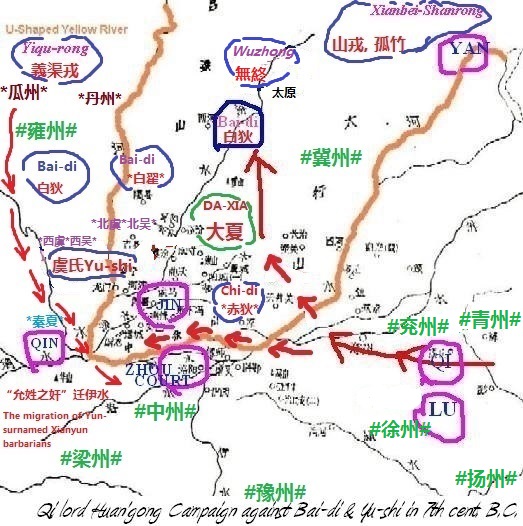 This webmaster never thought the people of the Central Asia or in Chinese Turkestan were an intermediary form of human evolution,
which was the basis of calling the Siberian origin of the Koreans a 'moo' point.
This webmaster had pointed out that in the collective memory of the Sino-Tibetans, that passed down by generations through millennia,
the Sinitic Chinese had forgot that they had travelled north from today's Burma-Vietnam while claiming to have walked down Mt Kunlun.
Previously, this webmaster checked into the historical context as well as the geo situation to find out about when the east met with the west,
and believed that the 3rd century B.C.E. Hun-Yuezhi War could be the start of the contact between Sinitic China and the West, i.e., the trigger that led to the chain reaction of the Yuezhi attacking the Wusun, and the Wusun attacking the Scythians, and so on.
With the new archeological findings, this webmaster would add that about 5000 years ago, the proto-Tibetan Qiangs had indeed penetrated into Chinese Turkestan,
to the north side of Mt Tianshan, from perhaps the southeastern rim of the Taklamakan Desert, 2000 years ahead of the Hun-Yuezhi War.
This webmaster never thought the people of the Central Asia or in Chinese Turkestan were an intermediary form of human evolution,
which was the basis of calling the Siberian origin of the Koreans a 'moo' point.
This webmaster had pointed out that in the collective memory of the Sino-Tibetans, that passed down by generations through millennia,
the Sinitic Chinese had forgot that they had travelled north from today's Burma-Vietnam while claiming to have walked down Mt Kunlun.
Previously, this webmaster checked into the historical context as well as the geo situation to find out about when the east met with the west,
and believed that the 3rd century B.C.E. Hun-Yuezhi War could be the start of the contact between Sinitic China and the West, i.e., the trigger that led to the chain reaction of the Yuezhi attacking the Wusun, and the Wusun attacking the Scythians, and so on.
With the new archeological findings, this webmaster would add that about 5000 years ago, the proto-Tibetan Qiangs had indeed penetrated into Chinese Turkestan,
to the north side of Mt Tianshan, from perhaps the southeastern rim of the Taklamakan Desert, 2000 years ahead of the Hun-Yuezhi War.
Now, this webmaster made a hypothetical claim here that the Huns could have encountered the Yuezhi at the "Great Lake" ("da ze"), namely, the Juyan Lake.
In the Juyan-ze Lake area, the bamboo strips (slips) were discovered, with evidence of the existence of names of the [famed] nine Zhaowu clans, 80 years or 3-4 generations after the first Hunnic attack against the Yuezhi: K'ang (Samarkand), An (Bukhara), Shih (Tashkent, i.e., Kishsh [Kashana]), Mi (Maymurgh [Penjikent]), Ts'ao (Kaputana), Ho (Kushanik [Kusanya]),
Mu (Murv, ? Huoxun [Khwarezmia]), and Su (Sudi, Bilinmemektedir). Here, the likely event was that the nine clans invaded Central Asia, where they mutated their [possibly Sinitic] names to the multiple-syllable statelet names, before the descendants of the nine clans returned to the east in the subsequent half millennium.
See Wang Guowei's theory of invaders coming from the East while traders from the West for understanding the nature of the nine Zhaowu clans of the Yuezhi.
Note the difference of one year in the chronicling, as seen across the history writings on the Han dynasty, which was the result of the wholesale misunderstanding of the Qin Empire's Zhuanxu-li calendar and the virtual Yin-li (Shang dynasty) calendar, something covered in this webmaster's book The Sinitic Civilization.
All history books had error in the Han dynasty's reign years, including the Hunnic chronicling years.
The Huns’ military activities could have happened any time between 209 B.C. and 202 B.C.
Nicola Di Cosmo (Ancient China and its Enemies: The Rise of Nomadic Power in East Asian
History, Cambridge University Press (2002)) claimed that the attacks of Donghu and Yuezhi happened in
208 B.C. and 203 B.C, respectively.
Thomas Barfield (The Perilous Frontier,
Cambridge, MA: Basil Blackwell (1989)) stated that the Han founder-emperor's October-November 201 B.C. Baideng
debacle happened in year 200 B.C., not knowing that the early Han emperors' reign years started in
October of a prior year and ended in September of the consecutive year.
Professor Gernet hedged himself in pinning the Hunnic-Han War, namely, Emperor Liu Bang's defeat at the Baideng mountain, to the period "201-200 B.C.", which should be November 201 B.C. when strictly observing the Zhuanxu-li calendar's ordinal months.
Click on the below picture for the enlarged map showing the first Hunnic attack at the Yuezhi possibly around the ancient Juyan Lake
(later known as the
Kharakhoto [Blackwater] Lake, Ejina or Juyan - before this 'West Sea' concept was applied to today's Qinghai-hu Lake by the usurper-emperor Wang Mang when he set up the Xi-hai-jun commandary using the imaginary four-seas' concept in Shan Hai Jing (The Legends of Mountains & Seas).
The reason that this webmaster made this hypothesis is that the Huns were more subsequently recorded to have fought another war against the Wusun, Loulan, Hujie and etc., i.e., the twenty-six statelets of Chinese Turkestan, at the place somewhere near Yiwu in the 2nd century B.C.,
to the east of Turpan, which then triggered the Wusun migration to Ili where they further drove the Yuezhi towards
today's Afghanistan.
(See Barbarians.htm for more discussions on the Yuezhi migration timeline.)
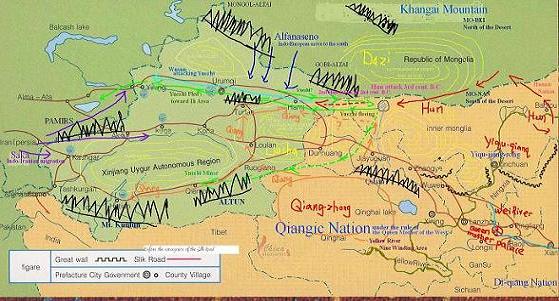
|
|
|
|
|
|
|
Sovereigns & Thearchs;
Xia-Shang-Zhou dynasties;
Zhou dynasty's vassalage lords;
Lu Principality lords;
Han dynasty's reign years
(Sexagenary year conversion table-2698B.C.-A.D.2018; 247B.C.-A.D.85)
|
|
The Sinitic Civilization - Book I is
available now at
iUniverse,
Barnes & Noble,
Amazon,
Google Play|Books
and
Nook.
The Sinitic Civilization - Book II is available at
iUniverse,
Amazon and Barnes & Noble.
Check out the 2nd edition preface that had an overview of the epact adjustment of the quarter remainder calendars of the Qin and Han dynasties, and the 3rd edition introductory that had an overview of Sinitic China's divinatory history of 8000 years.
The 2nd edition, which realigned the Han dynasty's reign years strictly observing the Zhuanxu-li calendar of October of a prior lunar year to September of the following lunar year, also cleared this webmaster's blind spot on the authenticity of the Qinghua University's Xi Nian bamboo slips as far as Zhou King Xiewang's 21 years of co-existence with Zhou King Pingwang was concerned, a handicap due to sticking to Wang Guowei's Gu Ben Bamboo Annals and ignoring the records in Kong Yingda's Zheng Yi.
Stayed tuned for Book III that is to cover the years of A.D. 86-1279, i.e., the Mongol conquest of China, that caused a loss of 80% of China's population and broke the Sinitic nation's spine.
Preview of annalistic histories of the Sui and Tang dynasties, the
Five Dynasties, and the two Soong dynasties
could be seen in
From the Khitans to the Jurchens & Mongols: A History of Barbarians in Triangle Wars and Quartet Conflicts
(The Barbarians' Tetralogy - Book III: available at iUniverse;
Google;
Amazon;
B&N).
(A final update of the civilization series, that is scheduled for October 2022, would put back the table of the Lu Principality ruling lords' reign years, that was inadvertently dropped from Book I during the 2nd update.)
|
|
Book II - Table of Contents:
Section Seven: The Han Dynasty
Relationship with the Huns 392
Chapter XXXIII: The Hunnic Empire 409
Origin of the Huns 409
The Rong & Di Barbarians in the Context of Relation to the Fiery Thearch, the San-miao Exiles and the last Xia Dynasty King 413
The Zhou, Qin and Jinn's Zigzag Wars with the Barbarians & the Construction of the Great Walls 417
Mote's Hun Empire, the Yuezhi People, and the Early Han Dynasty 424
The Huns & the Eastern Hu Barbarians 430
The Hunnic Government Structure & the Dragon Reverence 431
Chapter XXXIV: The Han Dynasty's Wars with the Huns 435
Chapter XXXVI: The Western Expedition, The Kunlun Mountain & Shan Hai Jing 489
Han Emperor Wudi Seeking Elixir from the Immortals on the Kunlun Mountain 491
Credible Geography Book on the Mountains Possibly Expanded to Include the Legendary Kunlun Mountain 493
Unearthly Things in the Mountains' Component of The Legends of Mountains & Seas 501
The Divination Nature and Age of the Seas' Component of The Legends of Mountains & Seas 506
Chapter XXXVII: Shan Hai Jing & The Ancient Divination 520
Chapter XL: The Latter Han Dynasty's Chronological History 560
The Relation with the Southern Huns 561
|
|
On the modern map, there was a tiny sand bridge between Chinese Turkistan and China, which was the narrow strip of desert sand to the east of Hami.
However, this corridor, today's Kumul line, could be a recent event.
There was the historical Da-qi4 blackhole desert to the east, nowadays called by the generic name GOBI. Specifically, near today's Hohhot, there was an ancient Chinese geological name called "qi4 kou", namely, the entry point into the Da-qi4 Desert.
The ancient Sino-Tibetan migration into the Tianshan Mountain could have come north from south, i.e., the Tibetan Plateau/Ruoqiang direction to the south --though this webmaster hesitated about the
passibility of the "Liu-sha" [quick sand] desert between Ruoqiang and Loulan (Lop Nur), which was another tiny sand bridge noticeable on the modern map.
Judging from Han Dynasty emissary Zhang Qian's change of mind on his return trip to go home along the Hami strip rather than going straight east across the Qiang-zhong [i.e., the middle Qiang nation land], we could tell that the northern strip was perhaps the most traveler-friendly.
(Could Zhang Qian had changed his mind in the hope of sneaking into the Hunnic territory to see the child he had with a Hunnic woman?)
That was Han Emperor Wudi (commonly-taken wrong reign 140-87 B.C. or 140-86 B.C.; nominal Oct 141-Dec 87 B.C.; actual Jan 141-Feb 87 B.C.)'s reign of B.C. 141-87, i.e., 141 BC and later, much later than Hun-Yuezhi wars.
Now, let's talk about the human migration.
There were widespread discussions of the 'Caucasoid' mummies in Chinese Turkestan, with the 'Loulan Beaty' purportedly dated 2000 B.C., while the southern 'cousins' in the Khotan area dated 100-300 B.C.
The timeline suggested a move from north to south, not west to east.
The 2000 B.C. Caucasoid mummies found in Loulan, in the Turpan Depression/Kumtag Desert, in-between Altaic/Tianshan Mountains and the Altun Mountain (Ruoqiang), could be the Indo-European people coming from the north of the Altaic Mountain [the Mongol Altaic Mountain of today], near the Alfaniesevo (Alfanesevo) bronze culture.
Though, Yuezhi might not be of this group of people coming from north.
Further diggings in the Loulan area, i.e., the ancient Salty Lake and Salty River (Peacock Rover), led to a site called by Xiaohe or the Little River, next to the Salty River (Peacock Rover), where the Mongoloid Mummies were discovered.
It appears to this webmaster that there was indeed good carbon dating on the Xiaohe excavation, which stated that "The entire necropolis can be divided, based on the archeological materials, into earlier and later layers. Radiocarbon measurement (14C) dates the lowest layer of occupation to around 3980 +/1 40 BP (personal communications; calibrated and measured by Wu Xiaohong, Head of the Laboratory of Accelerator Mass Spectrometry, Peking University), which is older than that of the Gumugou cemetery (dated to 3800)." The article claimed that the 'Mongoloid' mtDNA had similarity to some present South Siberian population. (For details, check http://www.biomedcentral.com/1741-7007/8/15 for the full article "Evidence that a West-East admixed population lived in the Tarim Basin as early as the early Bronze Age".)
The linking of this certain mtDNA in the Xiaohe/Loulan area to a modern Siberian population could be said to be circumvential at best since a lot of things might had happened in the past 4000 years.
That is, the linkage to the Siberian population could be actually an effect, not a source.
This area kind of had the same timing as the Mongoloid mummies that were discovered to the north and east of the Tianshan Mountain.
More than what was found about the mtDNA at Xiaohe/Loulan, there were mummies of the Khams-Tibetan type found to the further north,
in the Tianshan-Altaic mountain areas, which presented a much more convincing point that the proto-Tibetan Qiangs, from the south, had indeed crossed over the strip of the sand desert near Loulan to reach the north side of Tianshan.
Possibly, the Khams [proto-]Tibetan, after reaching the Tianshan Mountain Range, moved towards Hami (Qumul) to the east, where there were the Hami (Qumul) Mongoloid mummies excavated.
Note that today's Kham Tibetans were not far away from the historical Sanxingdui (three star) Excavations in western Sichuan, that was discovered by Gaway Hann (an American professor of the former Hua-xi [west China] University),
a Neolithic/Bronze culture dating from about 4800 to 2800 years ago, as well as a bridge providing Southwest China's tin to the Shang dynasty
and the Zhou dynasty.
This webmaster's reasoning was that the Qiangs had a dominance in the area since China's prehistory, like 5000 years ago, at least the time of the Yellow Emperor [Huangdi (? BC 2697 - 2599; reign 2402-2303 with rule of 100 years per Zhu Yongtang's adjustment of
The Bamboo Annals], and they controlled the southern rim, southeastern rim and eastern rim of the Taklamakan Desert, and somehow around 2000 B.C., penetrated northward to reach the two sides of the Tianshan mountain range, while the so-called Caucasoid oases in their path, namely, the Loulan area, might have risen and fallen numerous times in history -- if they ever existed there prior to the penetration by the Khams [proto-]Tibetans.
Or the other way around, the Khams [proto-]Tibetans could be speculated to have penetrated to the two sides of the Tianshan mountain range earlier than the Indo-Europeans, and subsequently encountered the Indo-Europeans near the Tianshan Mountain, and ultimately the Indo-Europeans gradually dominated over the area and eliminated the trace of the Khams [proto-]Tibetans, pressing them back to the southeastern rim of the Taklamakan Desert.
(See Barbarians.htm for more discussions on the ancient human migrations.)
There could have been a striking similarity between the Mongol attack at the Tanguts in the 13th cent. A.D. and the Hun attack at the Yuezhi in the 3rd cent. B.C.
Both took the desert road towards the Blackwater Lake.
It kind of gives you a picture how the Huns first raided to the west against the Yuezhi, forcing the Yuezhi Major to flee west while the elderly and the children, i.e., the Yuezhi Minor,
crossed the Qilian mountain to seek asylum with the Qiangs, and per Yu Taishan, continued to move on towards the southeastern rim of the Taklamakan Desert,
towards
Khotan where the people were recorded to be Chinese or Hua-xia-looking, throughout China's Han and Tang dynastic records, till annihilated sometime during the Islamic invasion of the
Buddhist stronghold of Khotan or possibly during the earlier Turkic-Uygur conquest of the Chinese Turkistan.
Note the discovery of the so-called 100-300 BC Caucasoid in Khotan, which matched with the escape timeframe of the Yuezhi Minor.
(Another recent writing on Zhou King Muwang's travelogue at the imperialchina.org blog, is available in pdf format [Mu-tian-zi.pdf], exhibited the westernmost extent of the ancient Chinese kingdom to be no more than the edge of the Kumtag Desert and right at the Black Water Lake.)
This webmaster tried to reconcile Sima Qian's statement in regards to the migration of the Lesser Yuezhi,
in the aftermath of the Huns' attack in the last years of the 3rd century BCE,
to give the Yuezhi people some credit of living a bit further to the east, i.e.,
staying somewhere near the Blackwater Lake [i.e., the Ejina Lake].
By making this assumption, this webmaster assumed that the Lesser Yuezhi people, namely, the sick, the elderly and the young,
climbed the Qilian-shan Mountain [today's Qilian-shan, not what Yu Taishan et al had postulated to be the Tianshan
or the Heavenly Mountain Range in Turkestan] to live among the Qiangs
--unless Sima Qian actually meant that the Huns had raided deep into the Chinese Turkestan in the first place,
driving the Greater Yuezhi into a flee towards the Ili area to the west and the Lesser Yuezhi into a move across today's Tianshan
or the Heavenly Mountain Range to live with the Qiangs in Khotan, at the southeastern rim of the Taklamakan Desert,
a historical dwelling place of the Qiangs since the late 3rd millennium BCE.
In conclusion, there were two points of contact between the west and the east, one time around the 2000 BCE, and another time in the 4th century BCE (or more exactly the 3rd century BC when the Huns attacked the Yuezhi, triggering the chain reaction to the west).
The demarcation point of the 4th century BCE or the 3rd century BCE was important in determining the second point of contact between the Mongoloid and the Caucasoid,
after the first Mongoloid-Caucasoid mummy contact around 2000 BCE near today's
Tianshan or the Heavenly Mountain, known as Bei-shan or the Northern [Turkestan] Mountain at Han Emperor Wudi (commonly-taken wrong reign 140-87 B.C. or 140-86 B.C.; nominal Oct 141-Dec 87 B.C.; actual Jan 141-Feb 87 B.C.)'s timeframe.
There were widespread discussions of the 'Caucasoid' mummies in Chinese Turkestan, with the 'Loulan Beaty' purportedly dated 2000 B.C., while the southern 'cousins' in the Khotan area dated 100-300 B.C.
The timeline suggested a move from north to south, not west to east.
The 2000 B.C. Caucasoid mummies found in Loulan, in the Turpan Depression/Kumtag Desert, in-between Altaic/Tianshan Mountains and the Altun Mountain (Ruoqiang), could be the Indo-European people coming from the north of the Altaic Mountain [the Mongol Altaic Mountain of today], near the Alfaniesevo (Alfanesevo) bronze culture.
Archaeologically speaking,
the admixture mummies in Chinese Turkestan pointed to the west-east interbreeding around 2000 B.C., after an interruption of contacts for like 6,000 years, as seen in the spread of the North China microlithic stone tools to the west about 10,000 years ago, including today's Chinese Turkestan, and its replacement of the European Paleolithic bladelet tools. About 3500-2500 B.C., the proto-Indo-Europeans, with the haplogroup R1b-M269, arrived at Minusinsk where they founded the Afanasevo chalcolithic culture and bronze culture (3200-2000 B.C.). People of the Afanasevo culture spread southward to today's Chinese Turkestan with the patented grey sand-textured (coarse) round-bottom pottery jars with engraved and embossed patterns.
Direction-wise, the Q-haplogroup people, i.e., cousins of the Caucasoid R-haplogroup people, likely arrived in today's Siberia heartland before the Last Glacial Maximum, while within the last 10,000 years, the C-haplogroup people pushed west and south from the northeastern direction and the N-haplogroup people pushed west and north from the southeastern direction. The patented Sinitic gourd-shaped colored and red potteries with a beam neck were seen to have penetrated to Central Asia. It could be the O3-haplogroup ancient Qiangs who brought the Sinitic colored (painted) potteries to today's Chinese Turkestan in late 3rd millennium and the early 2nd millennium B.C. While the millet and sorghum (as seen in the Begash site in Kazakhstan) could have spread westward to Central Asia with the colored potteries, the wheat products, sheep and goats, and the spoke-wheeled carts might have spread to China through this east-west contact along the two sides of the Tianshan Mountain.
The 'Tokharai' Yuezhi people, however, might not be the misnomer Indo-European as they could be part of the
barbarians whom Zhou King Muwang resettled at the origin of the Jing-shui River in the 11th century
B.C., among them, the later known five Rong groups of Yiqu, Yuzhi, Wuzhi, Xuyan (Quyan) and
Penglu, or the later Yiqu-rong barbarians as noted in the Warring States time period --which could
be the origin for the misnomer 'Indo-European' Yuezhi. The recent DNA analysis of the remains of
the ancient tombs had found the trace of the Q-haplogroup people at Pengyang of Ningxia, next to the
Western Yellow River Bend, and along the routes that the Yuezhi people had dwelled.
According to the recent DNA studies, before the emergence of the Indo-Europeans, the proto-Indo-Europeans, who had origin in southwestern Siberia approximately 38,000 years ago, relocated to the Volga area about 28200-22800 years ago, where they split into R1a (i.e., ancestors of modern Eastern Europeans, Indians) and R1b (i.e., ancestors of Basques, Celts and modern Western Europeans).
The Scythians, or the purportedly Indo-European 'Tokharai' Yuezhi, and majority stocks of the later Central Asians, belonged to the R1a offshoot.
There was the spread of North China's microlithic stone tools towards the west over 10,000 years ago.
The 6000-year-old Lingjiatan piglet-bird-head jade octagram could imply an ancient transfusion of the 10,000-year-old double-head emblem to Central Asia from China.
It would not be farfetched to state that the Sumerian cuneiform's speedy transformation to logophonetic, consonantal alphabetic and syllabic signs among different groups of the Central Asia and Middle Eastern people could imply the Sumerian script's likely origin as an out-of-area and imported product from let's say North China.
Here, with the existence of the obscure pre-2000 B.C copper-based metallurgy in northern China, such as the controversial brass pieces of the fourth and third millennium B.C., there was no rebutting the spread of ancient metallurgy technology to China from the west.
A tentative conclusion could be made in that the ancient world(s) did have some unknown form of discrete, disparate and non-continuous links between the East and West. However, this kind of East-West links were disrupted numerous times, with the consequence of loss of such links amounting to thousands of years in-between, as seen in the westward spread of the microlithic tools, the octagram, the double-head eagle emblem, the pictographic characters, and the red potteries.
http://www.sino-platonic.org/complete/spp115_chinese_proto_indo_european.pdf provides another perspective of looking at things of the past from the perspective of language cognates. Rather believing that the Indo-Europeans ever invaded China and gave the Sinitic people the language, we could actually deduce that "Old Chinese", for its 43% correlation with the Proto-North-Caucasian, rather 23% with the Proto-Indo-European, was the source for both the cognates of the Proto-North-Caucasian and the Proto-Indo-European. This is because our cousins, i.e., the N haplogroup people, relocated to North Asia and then to Latvia, Estonia, Finland and Scandinavia, bringing along the Sinitic language to the Proto-North-Caucasian who in turn gave it to the Proto-Indo-European.
Linguistically, the proto-Caucasian should fall under the umbrella of the Dene-Caucasian (Sino-Caucasian) Language Family that encompassed the [Proto-North-]Caucasian, Yeniseian and Sino-Tibetan languages.
In 2012, Li Hongjie of Jirin University published a paleogenetic study of the ancient DNA of prehistoric people dwelling in northeastern China, northern China, and northwestern China, with the results showing that the predominant population in Niuheliang of southwestern Manchuria, Dadianzi of Inner Mongolia and Hami of northeastern Chinese Turkestan over 3000-5000 years ago, that roughly matched with the Xiajiadian Culture and Hongshan Culture's timeframe, belonged to the Y-chromosome people of the N-haplogroup type, namely, people related to ancestors of the Finnish, Sami and Hungarian people. And it would be about 2000-4000 years ago that the R-haplogroup and Q-haplogroup people began to be seen in Chinese Turkestan and northwestern China. Following this timeline, it is more plausible that people of the Xia and Shang dynasties of ancient China had the company of the N-haplogroup people, with both the Sinitic O-haplogroup and the N-haplogroup people actually sharing the same origin for over 20,000 years, and the Zhou people could be interfacing with the Q-haplogroup people towards the northwest, which implied that the northern barbarians or the Huns' composition could have changed through history. The Huns, for their position and timeline of appearance, more likely belonged to the Q-haplogroup people than the N-haplogroup people, with both groups plus the ancient Sinitic Chinese likely falling under the same proto-Borean (Northern) language family.
This webmaster, possessing the amber-colored or hazel eyes with a greenish ring, had been found to possess about 15% ancient Euro-Asian hunters' gene, specifically, N1a (N-M96 (N-CTS7095, N-P189), a branch of the Finno-Ugrian people.
It would be in the 4th century BCE that Shi-zi first wrote down the sentence speculating that 2000 years earlier, at the time of the
Yellow Overlord, there were the deep-eyesocket people living to the north.
This brilliant piece of work by Shi-zi apparently adopted some then-current information available as of the 4th century BCE, in a similar fashion to
the later forgery Guan Zi which, relying on the then-current information available as of the 1st century AD, claimed that
Qi Hegemony Lord Huan'gong had crossed the 'Kumtag Desert' to conquer the Yu-shi [or misnomer Yuezhi] people.
Here, mark this webmaster's words: Yu-shi, having absolutely nothing to do with the Yue-zhi people [as erudite Wang Guowei claimed --a No. 1 blunder of the most famous Chinese scholar of the 20th century], could be taken as either the western Yu [Wu] or the northern Yu [Wu] remnants from the descendant of one of the two elder brothers who 'emigrated' to the Yangtze River and the Taihu Lake 3000 years ago.
(Shi-zi could be a latter-day add-on as well since half of the original texts were lost in the Three Kingdom time period, and the majority of the re-compiled texts were lost again in the Soong Dynasty. One important fact about Shi-zi that this webmaster wants to emphasize is that it could be on the same par as the classics Shan Hai Jing, i.e., the Book of Mountains and Seas, and the author or the authors of some of the contents of the two books of Shi Zi and Shan Hai Jing could be of the same origin.
Note that the seas or overseas' components of Shan Hai Jing, i.e., The Legends Mountain and Sea Legends, though carrying the names of countries like in today's Korea, Chinese Turkestan and India, etc., were not about geography at all but divination. The divination materials, similar to those in Shi1 Fa, Gui-cang Yi, the Wangjiatai divination script, and the divination in Mu-tian-zi Zhuan, served the same augury purpose of the late Warring States time period, albeit possessing their separate freelance or freewheeling traits.
For example,
The one eyed son of Lord Shaohao in the "great northern wilderness" (Da Huang Bei Jing) section of Shan Hai Jing, like the one-hand and one-eye 'shen-mu-guo' (the deep eye socket) state in the "Northern Outer Seas" section, which was speculated to be the legendary one-eyed state Arimaspi that was described by Herodotus in Histories as located north of Scythia and east of Issedones and linked to the three-eye stone statutes of the Okunev Culture in Minusinsk, could have its source in some one-eye bird in the northern mountain range of Shan Hai Jing, and the one-eye and three-tail 'huan' foxlike animal on Mt. Yiwang-zhi-shan in the western mountain range.)
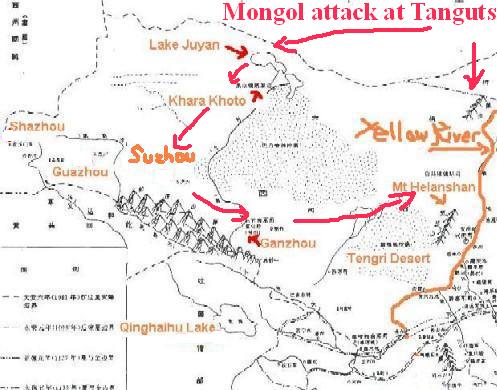
|
|
(For further details, check into this webmaster's "Extrapolation of prehistoric people using the mitochondrial and nuclear DNA analysis, as well as cranial analysis, on the ancient remains extracted from the archaeological sites" on basis of the Jirin University DNA analysis.)
The Assertions By Luo Xianglin & Wang Zhonghan
There long appeared the directional designation of four barbarian groups, namely, Man-of-the-South, Di-of-the-North, Yi-of-the-East and Rong-of-the-West.
Scholar Luo Xianglin, in History of the Chinese Nationalities (Chinese Culture Publishing Enterprise Co, Taipei, Taiwan, May 1953 edition), stated that ancient China possessed five tribal groups: Xia, Qiang, Di[1], Yi, and Man[2].
Per Luo Xianglin, the Xia people first originated in Mt Minshan and the upperstream River Min-jiang areas of today's Sichuan-Gansu provincial borderline. The Xia people then split into two groups, with one going north to reach the Wei-shui River and upperstream Han-shui River of today's Shenxi Province and then east to Shanxi Province by crossing the Yellow River.
The second group, per Luo Xianglin, went south to populate the southern Chinese provinces as the 'Yue' people.
Luo Xianglin's linking the Yue people to the Xia people was based on the common lexicon 'yue' which meant for the excavated ancient "stone axe".
Luo Xianglin stated that the five tribal groups of Xia, Qiang, Di[1], Yi, and Man[2] shared the same origin.
Man, Di(2), Yi & Rong, in fact, all mean one word, barbarians. The Man-of-the-South
will be the natives called San-miao (i.e., the Three Miao Tribes), Man(2) and Lao barbarians, and the Zangke, Qiongdu, Yelang and Dian-Yue people in southern and southwestern China.
Rong-of-the-West are the nomadic people in China's northwest and west, including Xirong, Quanrong, Rongdi and Jiangrong. In southern Manchuria, there existed the so-called Shanrong or Mountain Rong (aka: Beirong or Northern Rong and one more name called 'Wu Zhong' to mean Wuzhongshan Mountain in southern Manchuria, with its capital at Yuyang County, Beijing).
Di-of-the-North would be specifically denoting the Huns and Turks, with their forerunners including Rongdi which split into Chidi and Baidi.
Yi-of-the-East will include people in Manchuria, Korea and Japan. In early times, the Yi was associated with the word 'niao' for bird, and there were eight to nine different 'niao-yi' people in the east. Shang Dynasty people were recorded to have treated 'Xuan Niao' (i.e., Black bird, possibly sparrow) as the totem. Manchu legends as to the birth of their founder had something to do with swallowing the red fruit dropped by a bird. In later times, the Yi designation would be associated with a word 'dao' for island, pointing to the barbarian people in East China Seas. (Both the character 'niao' and 'dao' looked quite close and might have corrupted consecutively during the course of history.)
Scholar Wang Zhonghan pointed out that the character 'Yi', having appeared as Shi-fang statelet in Shang Dynasty's oracle bones, would still exist in Shangdong-Jiangsu provinces and around Huai-shui River by late Spring & Autumn time period of Eastern Zhou Dynasty.
Wang Zhonghan, after analyzing the wars between Zhou people and numerous Yi people, had concluded that "Eastern Yi" [in Shandong Peninsula] had declined as a result of expeditions by Duke Zhou-gong and King Cheng-wang in early Western Zhou time period; that "Huai-yi" [around Huai-shui River] emerged from middle to late time periods of Western Zhou Dynasty; that "Nan-yi" [in southern or southeastern direction] rose up in influence at time of Zhou King Liwang;
and that by the time of Qin-Han Dynasties, 'Dong-yi' would be designation for people in northeastern China, including Korea and Japan.
The character 'Yi', as shown above, was originally a neutral people denoting the people living in today's eastern China and along the coast,
but later mutated the meaning to mean for barbarians in the east, and
later again expanded to be more an inclusive word to mean all aliens or barbarians.
Yi is more an inclusive word to mean aliens, and the Qiangs and Di(1) people could be called Xi Yi, i.e., Yi in the west, while some southern barbarians would be called Xi-Nan Yi, namely, southwestern Yi.
Quanrong or Doggy Rong of the west were also named Quan-yi-shi (Doggy alien tribe) or Hunyi / Kunyi (Kunlun Mountain aliens?, but was commented to be the same as character 'hun4' for the meaning of mixing-up). Shan Hai Jing stated that Huangdi bore Miao-long, Miaolong bore Nong-ming, Nongming bore Bai-quan (White dog) which was the ancestors of Quanrong. Shan Hai Jing also stated that Quan-yi had human face but beast-like body. An ancient scholar called Jia Kui stated that Quan-yi was one of the varieties of Rong people.
The differentiation, between the true barbarians and those ancient Chinese who were exiled to the borders, is hard to depict. Lord Shun suggested to Lord Yao to have four evil tribes exiled to the borders. This would include Hundun, Gonggong (Qiongqi), Gun and San-miao.
Gonggong was exiled to the northern post of Beijing to counter the northern Di(2) nomads; Hundun was exiled to southern mountains to counter the southern barbarians; San-miao people was exiled to San-Wei-Shan Mountain in Gansu's Dunhuang to counter the Xirong or Western Rong people; and Gun was killed on Mountain Yushan (Feather mountain) to detente the Eastern Yi people.
Kong An'guo of Han Dynasty claimed that Hundun were the unfilial descendants of Huangdi the Yellow Lord. Gun was an unfilial son of Lord Zhuanxu. The 'San-miao' people were said to be the unfilial descendants of Yandi the Fiery Lord. (Wu Qi claimed that the San Miao country was located between Lake Dongtinghu and Lake Pengli.) Hence, those four tribes should be considered members of the big family. The book 'Xu Hou Han Shu', i.e., 'Continuum To Hou Han Shu', stated that the Qiangs were the alternative race of the Jiang surname tribes of San Miao. Hence, it should be safe to claim that the 'San-miao' people were the descendants of the big family of Yandi and Huangdi. In the Qin section, a tentative exploration into the nature of Rong & Di people, Qiang, San-miao & Yuezhi was given.
In separate sections, we touched on the hair style of the barbarians, including the pigtail style of Tuoba, the cut hair style of the Xianbei and Wuhuan, and the cut hair and pigtail style of the Jurchens and Manchus, to state that both the Huns and the later Turks had in fact shared a similar hair style as the Sinitic Chinese, namely, no hair cut plus the bundling of hair. The difference between the Huns and the Sinitic Chinese was "hu2 [Huns] fu2 [clothing] ZHUI1 [back of the head] jie2 [bundling the hair]", while the Sinitic Chinese bundled the hair at the top of the head. As commented by historian Huang Wenbi, the Qiangic people in western China, who had been exiled there from the east as this webmaster had repeatedly said, shared the same customs as the ancient Yi people along the eastern Chinese coast, namely, they did not bundle hair and further had an opposite direction as far as wrapping the clothing was concerned, namely, "bei4? pi1?[dangling] fa1 [hair] zuo3 [left] REN4 [overlapping part of Chinese gown]".
* In Commemoration of China's Fall under the Alien Conquests in A.D. 1279,
A.D. 1644 & A.D. 1949 *
U.S.S.R./Comintern Alliance with the KMT & CCP (1923-1927)
Korean/Chinese Communists & the 1931 Japanese Invasion of Manchuria
American Involvement in China: Soviet Operation Snow, IPR Conspiracy, Dixie Mission, Stilwell
Incident, O.S.S. Scheme, Coalition Government Crap, Amerasia Case & The China White Paper
* Stay tuned for "Republican China 1911-1955: A Complete Untold History" *
|
|
Zou Rong's Revolutionary Army;
Shin Kyu Sik's
Shrine (Spirit, Kunitama) of Korea
|
This snippet is for sons and daughters of China:
Heed the sons & ministers' agony and sorrow of our ancestors who died or lived through the Mongol, Manchu and Soviet-Chicom conquest
and
the Yongjia, Jingkang and Jiashen cataclysms !
Jeanne d'Arc of China:
Teenager girl Xun Guan breaking out of the Wancheng city to borrow the relief troops in the late Western Jinn dynasty;
Liu-Shao-shi riding into the barbarian army to rescue her husband in the late Western Jinn dynasty;
teenager girl Shen Yunying breaking into Zhang Xianzhong's rebels on the horseback to avenge on father's death in the late Ming dynasty.
China's Solitary and Lone Heroes:
Nan Jiyun breaking out of the Suiyang siege and charging back into the city in the Tang dynasty;
Zhang Gui & Zhang Shun Brothers breaking through the Mongol siege of Xiangyang in the Southern Soong dynasty;
Liu Tiejun breaking through three communist field armies' siege of Kaifeng in the Republican China time period;
Zhang Jian's lone confrontation against the communist army during the June 3rd & 4th Massacre of 1989.
|
|
|
In the section on the northern barbarians, Wang Zhonghan pointed out that the northern barbarians and western barbarians were similar [i.e., Qiangs] at Spring-Autumn time period, but by the time of late Warring States, Chinese began to see the northern barbarians as different from the western barbarians. Northern barbarians would be ancestors of later Huns to the north and northwest, and the Donghu [Xianbei & Wuhuan] to the north and northeast, who were to evolve into so-called Altaic speaking nomadic people.
Wang Zhonghan's points are: western barbarians, i.e., the Qiangs, originated from Mt Longshan [Gansu], while the northern barbarians originated from north of Mt Yinshan [Inner Mongolia] and beyond. What is important here is the speculation that those northern barbarians from north of Yinshan [i.e., Khing'an Ridge of Manchuria] might be related to the Shang Chinese refugees who fled to northeast after a defeat by Zhou Dynasty, not to mention the historical record in regards to dispatching of Shang Prince Ji-zi to Manchuria and Korea as a Zhou vassal.
Wang Zhonghan touched upon the mixing-up between the western barbarians [Qiangs] and the northern barbarians [Hu], which was was similar to the mix-up of Xianbei and Xiongnu [Hun] in later Han Dynasty and Three Kingdon time periods.
http://www.meet-greatwall.org/gwmz/wen/mzs/mzs21.htm
" 传说与姓族说明春秋时的北狄与西戎在族类方面比较接近。考古文化也可与这种情况相印证。追溯到新石器时代,今河套、阴山以南及燕山以南的广大地区,都属仰韶文化分布范围,在龙山文化时期,又属不同地区的龙山文化。到了青铜时代,除燕山以南今北京市北部及长城沿线河北北部的一些地方有夏家店上层文化分布,说明山戎人已南达这些地区,其它如阴山河套以南,今山西中部与北部,河北中部与北部以及陕北、河套等地区的游牧民族青铜文化,虽有一定的地区差别,但共同的特点占优势,并且受商周青铜文化的影响比较深。①从上述传说,姓族及考古文化的面貌与内涵推测,春秋时的北狄源出于商周时期的鬼方、猃狁,属于羌戎族系。他们南面与诸夏往来,接受商周及春秋时期诸夏的文化影响,他们固然不断华化,也有一些诸夏贵族与人众融入其中,成为北狄的一种来源。另一方面,阴山以北的青铜文化具有明显的商文化影响,而且与陕北、山西、河北等地的戎狄青铜文化有较多的共同因素,说明春秋时的北狄与山戎、东胡及阴山以北的胡人也存在交往和彼此吸收的关系。战国时胡人南下,陕北、山西、河北等地的赤狄。白狄应有相当多的部分已被同化于胡人之中。因此,春秋时的北狄与胡人、东胡族系既有区别,也有联系。区别在于胡人起源于阴山以北,东胡人起源于大兴安岭山原,与羌戎起源于陇山地区不同;联系在于鬼方、猃狁及春秋时的北狄,有相当多的部落融化于胡人之中,成为胡人的重要来源之一。"
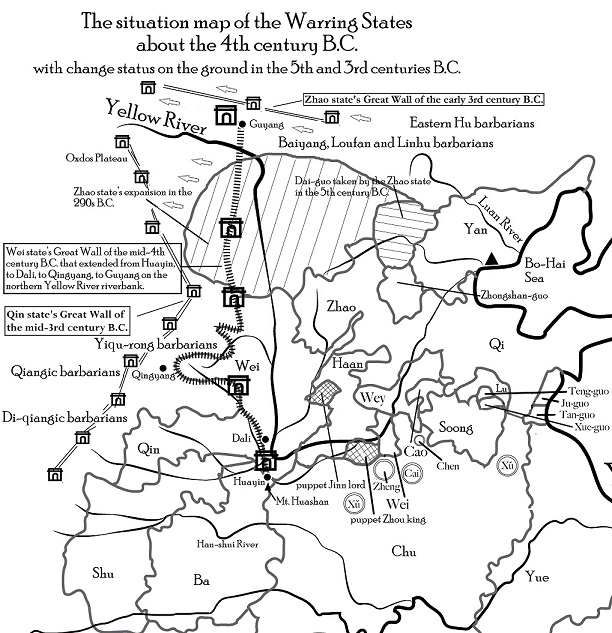 Wang Zhonghan stated that there was NO united Hu nomadic statelet in the north by the late Spring & Autumn. But by the late Warring States time period, the Huns began to pose a threat to China. However, General Li Mu of Zhao Principality still managed to defeat over 100,000 Hun cavalry at the time of King Zhao Xiaochengwang [reign 265-245 BC], to the extent that the Huns dared not get close to the border for over ten years. The various statelets launched their separate wars against the northern barbarians and built their separate Great Walls, till Qin Emperor Shihuangdi united China and linked up all the walls.
Continuing Zigzags With the Barbarians
Reading through the ancient records, this webmaster could locate less than a dozen 'Rong' statelets across the Yellow River line in the 6th century B.C. and later.
As to the barbarian groups, by the later Zhou Dynasty, there were Mianzhu, Gun-rong, Di[1], and Huan-rong to the west of the Qin Principality, Yiqu-Dali-Wuzhi-Xuyan to the north of the Qin Principality, Linhu-Loufan to the north of the Jin (Jinn) Principality, and Donghu-Shanrong to the north of the Yan Principality.
Mianzhu could be pronounced Raozhu. Gun-rong (Quanrong) was known as Kunrong or Hunrong or Hunyi. The character 'hun4' for Hunyi or Hun-yi is the same one as Hunnic King Hunye or Kunye and could mean the word of mixing-up.
Wuzhi [not Wushi, the same as Yuezhi not Yueshi] was originally part of the Zhou land, but it was taken over by the Rong people. Qin King Huiwang took it back from the Rongs later, and launched the Wuzhi county [i.e., in today's Pingliang area].
Xuyan was in today's Yanchi [salt pond] of Ningxia.
Summarized by Tong Dian, there were four barbarian groups at the origin of the Jing-shui River, with Di-rong and Huan-rong in the later Longxi-jun Commanday and Gui-rong and Ji-rong in the later Tianshui-jun Commandary.
Yiqu was one of the Xirong or Western rong statelets in the ancient Qingzhou and Ningzhou areas. Dali-rong dwelled in today's Fengxu County.
Dali-rong dwelled in today's Fengxu County.
Tong Dian further pointed out that the Li-rong barbarians dwelled to the south of the Wei-shui River, the Yangju-rong and Quangao-rong dwelled around the Yi-shui and Luo-he Rivers, and the Man-shi-zhi-rong (Manshi-rong, i.e., some barbarians possibly related to the southern or the Pu group) dwelled to the west of the Ying-shui and Luo-he Rivers.
Linhu was later destroyed by General Li Mu. Li Mu (?-229 B.C.), a Zhao Principality general who was counted as one of the four famous [together with Bai Qi, Wang Jian and Lian Po) during the Warring States time period, in mid-240s B.C. induced the Huns into invading south and thoroughly defeated about 100,000 Huns in the Yanmen area. Loufan belonged to today's Yanmen'guan Pass area (Ningwu of Shanxi).
The wars on record would be between Qin and the Xi-rong, Doggy Rong and various other Rong people, and between the Zhou Chinese and the Rong-di (which split into the Bai-di and Chi-di) including: i) between Qin and the Xi-rong, ii) between the Quan-rong/Jiang-rong and Zhou, iii) between Qi/Yan and the Shan-rong (i.e. Bei-rong/Wuzhong), iv) between the Chang-di and Wey/Xing, v) between the Chi-di/Bai-di and Jinn, vi) between the Dali-rong and Qin, vii) between the Lin-hu and Zhao, viii) between the Yiqu-rong and Qin, and ix) between the Zhou Chinese and the Rong-di (which split into the Bai-di and Chi-di) etc. Other wars would be with the Maojin-rong, Li-rong, Gui-rong, Ji-rong, Lunhun-rong & Wan-rong etc.

The barbarians would remain in northern Shanxi Province till the times of Qin Shihuangdi.
Qin State founded the first united empire of Qin in 221 BC. After Qin unification of China, Emperor Shihuangdi, in 215 BC, ordered General Meng Tian on a campaign that would drive the so-called Hu nomads or the Huns out of the areas south of the Yellow River. The Huns under Mote's father, Dou-man (Tou-man), fled northward and would not return till General Meng Tian died ten years later. Details about barbarians were also covered at prehistory section.
Wang Zhonghan concluded that the Huns had comprised of Qiangs [Rong2], Di [2], and Hu. However, the Huns were weak in comparison with Dong-hu to the east and the Yuezhi to the west. Huns were restricted to the territory of Mt Yinshan and Sheath area of the Yellow River till first Hunnic Chanyu Mote (often wrongly pronounced as Maodun) killed his father in 209 BC, ruled the tribe and expanded its domain.
The rest of Hun history was clear. The Huns first defeated the Eastern Hu nomads in 206 BC, then attacked the Yuezhi to the west,
which triggered the Yuezhi's chain reaction against the Wusun, killing the Wusun king,
and the Huns possibly took control of the Western Corridor [He-xi Corridor] by that time.
The Huns' attack against the Yuezhi to the west triggered a chain reaction, with the Yuezhi attacking the Wusun, killing Wusun king Nandou-mi.
Mote Chanyu took custody of the Wusun prince and allocated the land in western territories to Wusun.
The new Wusun king, after growing up, distanced himself from the Huns.
The Huns made peace with Han Emperor Wendi's Han China, and punished their rightside virtuous king for disturbing peace at the border with China.
The punishment was the order to attack to the west around 176 BC, hence defeating Loulan, Wusun and Hujie etc, in a battle near today's Yiwu per Yu Taishan, and taking control of 26 statelets in Chinese Turkistan.
In 174 B.C. (Qian-yuan Era 6th year), Emperor Wendi replied to Chanyu Mote (Modu), emphasizing the wish for peace. The Huns attacked to the west around 176 B.C., defeating Loulan, Wusun and Hujie, etc., in a battle near today's Yiwu per Yu Taishan. This would be about the timeframe of 176-174 B.C. as Han Shu recorded the war as happened after the king disturbed peace at the Chinese border in the 3rd year of the Qian-yuan Era.
The newly-enthroned Chanyu Laoshang mounted another campaign against the Yuezhi, killed the Yuezhi king, and made the king's skull as a drinking utensil.
The Yuezhi queen acted as a regent and led her people in a further move to the west.
Yuezhi, in turn, attacked the Scythians in Ili River area, hence dwelling at the Ili River and the Chu-he (Oxus) River.
At the time of Junchen Chanyu, the Yuezhi, under the attack of possibly the Wusun-Hun alliance, relocated south to today's Afghanistan.
Zhang Qian, who took the 138-126 B.C. trip to the west, met the Yuezhi people at the Amu Darya before the Yuezhi crossed the river to defeat Bactria.
Before 160 B.C. (Hou-yuan Era 4th year), about 161 B.C., when Laoshang Chanyu was still alive, the Wusun king, Liejiao-mi, defeated the Yuezhi and took over today's Ili area. The Wusun people, who were previously attacked by the Yuezhi, went on a revenge against the Yuezhi. The Yuezhi people were driven away from the Scythian land by the Wusun. Under the attack of the Wusun, the Yuezhi migrated southwest in about 141-128 B.C. to the Oxus Valley, i.e., the Fergana area, pushing out the Scythians again. This touched off another wave of 'chain reactions'.
"月氏原在匈奴之西,曾与匈奴多次发生冲突。公元前215年,秦始皇派蒙恬北击匈奴。当时,月氏比匈奴强大。匈奴头曼单于遣太子冒顿至月氏作质子。头曼为了诱使月氏杀死冒顿,以便自己另立小儿子为太子,曾突然袭击月氏。前209年冒顿杀父自立为单于。约在前206年匈奴大破东胡以后,冒顿又向西击走月氏。时大部分月氏人从今甘肃省西部,进入今新疆维吾尔自治区东部。前176年(汉文帝四年),冒顿单于致书汉文帝,告已派右贤王至西方寻找月氏,并予以击破;于是楼兰、乌孙、呼揭及其旁26国均归附匈奴。当时乌孙尚在河西走廊西北部,楼兰在今新疆东部罗布泊至若羌一带,呼揭在阿尔泰山至斋桑泊之间。月氏则更向西撤,大概己抵达准噶尔盆地。公元前174年,匈奴老上单于继位。又西击月氏,杀月氏王,以其头为饮酒之器。月氏继续西迁至今伊犁河流域,进攻当地塞人,塞王率部南逃。此后,大月氏在伊犁河流域停留了10多年。这是月氏西迁的第一阶段,当时仍在中国疆域范围之内。"
Where Were the Yuezhi, Wusun & Sai-ren [Scythians]?
The Yuezhi people, however, might not be the misnomer Indo-European as they could be part of the
barbarians whom Zhou King Muwang resettled at the origin of the Jing-shui River in the 11th century
B.C., among them, the later known five Rong groups of Yiqu, Yuzhi, Wuzhi, Xuyan (Quyan) and
Penglu, or the later Yiqu-rong barbarians as noted in the Warring States time period --which could
be the origin for the misnomer 'Indo-European' Yuezhi. The recent DNA analysis of the remains of
the ancient tombs had found the trace of the Q-haplogroup people at Pengyang of Ningxia, next to the
Western Yellow River Bend, and along the routes that the Yuezhi people had dwelled.
According to the recent DNA studies, before the emergence of the Indo-Europeans, the proto-Indo-Europeans, who had origin in southwestern Siberia approximately 38,000 years ago, relocated to the Volga area about 28200-22800 years ago, where they split into R1a (i.e., ancestors of modern Eastern Europeans, Indians) and R1b (i.e., ancestors of Basques, Celts and modern Western Europeans).
The Scythians, or the purportedly Indo-European 'Tokharai' Yuezhi, and majority stocks of the later Central Asians, were said to belong to the R1a offshoot.
Note that limited entries on the Zhi-surnamed Yuezhi people in the Chinese history annals showed that the Yuezhi had dark skin and yellow iris, which could mean that those Yuezhi, who most likely either belonged to the N or Q haplotype genes rather the misnomer R1a or R1b Indo-Europeans, could have interbred with the D-haplotype Tibetan natives with the high plateau genes.
To the west of Qin would still remain the remnants of the Qiangic barbarians. Beyond those relatively "raw [uncooked] Qiangs" would be those people who may share nothing with the Sinitic Chinese at all, i.e., Wusun and Sai-ren [the Scythians].
In the early Zhou Dynasty time period, Zhou King Muwang resettled the barbarians at the origin of the Jingshui River, among them, later-known Yiqu, Yuzhi, Wuzhi [not Wushi], Xuyan [not Quyan] and Penglu, namely, the five Rongs as noted in history.
As to the barbarian groups, by the later Zhou dynasty, there were Mianzhu (Jiaozhu per Kuo Di Zhi),
Gun-rong (Kun-rong), Di [2] or Di[2]yuan[2] (Di[2]-wan/Di-huan), and Wan-rong (Huan[2]-rong/Yuanrong)
to the west of the Qin Principality, Yiqu, Dali, Wuzhi and Quyan (Xuyan per Xu Guang) to the
north of the Qin Principality, Linhu (Danlin) and Loufan to the north of the Jinn Principality, and
Dong-hu and Shan-rong to the north of the Yan Principality. In 623 B.C., i.e., during the 37th year reign,
Qin Lord Mugong, using You Yu as a guide, campaigned against eight Xi-rong barbarian states and
conquered Chi Ban's Rong state [i.e., likely the historical Yiqu-rong statelet]. The eight Xi-rong barbarian
states of the West, per Shi-ji, included Mianzhu, Gun-rong, Di [2] or Di[2]yuan[2] (Di[2]wan/Diyuan),
Wan-rong (Huan[2]-rong/Yuan-rong), Yiqu, Dali, Wuzhi and Quyan (Xuyan). Alternatively speaking,
Qin Lord Mugong conquered 12 Western Rong tribes.
(The naming here could be the source of the later name for the Yuezhi people, should the Yuezhi be counted as being related to the Sinitic Chinese and dwelled there from the beginning.
For details, see the Hundreds of Years of War between Qin and the Yiqu-rong.)
Two more groups of people would be situated to the west and north of the Qin Chinese, namely, the Yuezhi and the Western Rong barbarians. The relationship of the Yuezhi to the Rong people was not clear.
There was no record of the characters "Yuezhi" in Qin's foreign relations other than the Yiqu-rong. It could be a bold proposal to state that the later Yuezhi were in fact the same group of people as the Yiqu-rong --a group of people noted in Mo Zi to have a custom of burning their dead.
The Yuezhi were said to be some misnomer 'Indo-European' [or 'Indo-Iranian'?]. The Yuezhi, after a defeat by the Huns, relocated to Central Asia. To the west of Yuezhi would be what the Chinese recorded as the 'Sai' people, aka 'Sai Zhong' or 'Sai Ren', i.e., the Scythians - a name noted in Sima Qian's Shi Ji, but not earlier than that.
In-between the Scythians and the Yuezhi would be the Wusun people who were attacked by the Yuezhi in the aftermath of the chain reaction, i.e., the Hunnic attack against the Yuezhi in the 3rd century B.C.E.
(Also note that the unconventional Chinese legends also touched on the Chinese migration to the West:
According to "New Tang History", a junior son of Changyi [son of Huangdi the Yellow Lord], by the name of An, had relocated to the Western Rong area and designated his state as 'Anxi', a name that later would be used for Persia or Parthia.)
As for the Scythians, some archaeological discoveries claimed that the 'animal' motif of the Scythians were noted in the Caspians in the 7th century BCE and earlier, about the Altaic around the 5th century BCE and near the Ordos in the 3rd century BCE.
This meant the east and west were closing in at the time of the 5th to 3rd centuries B.C.E. But, it might not one directional move. It could be two directional movements. The possible reason that this motif was found closer to China in the 3rd century, however, had to do with the Hun-Yuezhi War that saw the Yuezhi being pushed west, who in turn attacked the Wusun and the Scythians.
This webmaster's point is that there was no definite link between the Schythians [or the Wusuns] and the Yuezhi.
Bactria, translated as 'da xia' in Chinese, was also mistaken by Wang Guowei as some validation of his extrapolation of Xia's You-yu-shi clan as equivalent to Yuezhi.
Or, as this webmaster finally figured out, Wang Guowei was linking the Yuezhi to some Yu-shi people mentioned in Guan Zi, something like 2700-2800 years ago, which was different from the You-yu-shi clan of 5000 years ago.
This webmaster's conclusion was that this was erudite Wang Guowei's No. 1 blunder as Yu-shi, which could be taken as either the western Yu [Wu] or the northern Yu [Wu] remnants from the descendant of Zhou-zhang's brother, had absolutely nothing to do with the Yue-zhi people.
Wang Guowei speculated that the Yuezhi people, after their defeat in the hands of the Huns, fled to Bactria [to defeat the Tu-huo-luo Da-xia] and found a similar Yuezhi 'xia' kingdom.
Wang Guowei took the 'Tu-huo-luo' kingdom (Tokharistan) in today's Afghanistan as some mutation of the ancient pronunciation for 'da xia'. (This webmaster expounded on Wang Guowei's blunder earlier in this section. Note that Bactria existed at the time of Alexander the Great's invasion which was before the Yuezhi migrated to the west.)
In the subsequent dynastic annals, about the timeframe of the South-North Dynasties, Chinese historians still called the people in the Afghanistan area by the same name 'Yuezhi'.
See Wang Guowei's theory of invaders coming from the East while traders from the West for understanding the nature of the nine Zhaowu clans of the Yuezhi.
In the Juyan-ze Lake area, bamboo strips were discovered, with evidence of existence of names of the same nine Zhaowu clans 80 years or 3-4 generations after the first Hunnic attack against the Yuezhi: K'ang (Samarkand), An (Bukhara), Shih (Tashkent, i.e., Kishsh [Kashana]), Mi (Maymurgh [Penjikent]), Ts'ao (Kaputana), Ho (Kushanik [Kusanya]),
Mu (Murv, ? Huoxun [Khwarezmia]), and Su (Sudi, Bilinmemektedir).
* In Commemoration of China's Fall under the Alien Conquests in A.D. 1279,
A.D. 1644 & A.D. 1949 *
U.S.S.R./Comintern Alliance with the KMT & CCP (1923-1927)
Korean/Chinese Communists & the 1931 Japanese Invasion of Manchuria
American Involvement in China: Soviet Operation Snow, IPR Conspiracy, Dixie Mission, Stilwell
Incident, O.S.S. Scheme, Coalition Government Crap, Amerasia Case & The China White Paper
* Stay tuned for "Republican China 1911-1955: A Complete Untold History" *
|
|
Zou Rong's Revolutionary Army;
Shin Kyu Sik's
Shrine (Spirit, Kunitama) of Korea
|
This snippet is for sons and daughters of China:
Heed the sons & ministers' agony and sorrow of our ancestors who died or lived through the Mongol, Manchu and Soviet-Chicom conquest
and
the Yongjia, Jingkang and Jiashen cataclysms !
Jeanne d'Arc of China:
Teenager girl Xun Guan breaking out of the Wancheng city to borrow the relief troops in the late Western Jinn dynasty;
Liu-Shao-shi riding into the barbarian army to rescue her husband in the late Western Jinn dynasty;
teenager girl Shen Yunying breaking into Zhang Xianzhong's rebels on the horseback to avenge on father's death in the late Ming dynasty.
China's Solitary and Lone Heroes:
Nan Jiyun breaking out of the Suiyang siege and charging back into the city in the Tang dynasty;
Zhang Gui & Zhang Shun Brothers breaking through the Mongol siege of Xiangyang in the Southern Soong dynasty;
Liu Tiejun breaking through three communist field armies' siege of Kaifeng in the Republican China time period;
Zhang Jian's lone confrontation against the communist army during the June 3rd & 4th Massacre of 1989.
|
|
|
More detailed accounts about the Yuezhi would come after Zhang Qian's visit to Central Asia, unfortunately.
"Kuo DI Zhi", written by Li Tai of Tang Dynasty [AD 705-907], stated that the Yuezhi country included ancient Liangzhou, Ganzhou, Suzhou, Yanzhou and Shazhou, i.e., today's Gansu and Shenxi Provinces.
Hence there was the speculation that in the area west of today's Eastern Yellow River Bend area, i.e., the area of the Yiqu-rong and Bai-di barbarians, could also be found the Yuezhi people, which might not be true.
The place names like Liangzhou, Ganzhou, Suzhou, Yanzhou and Shazhou were all products of late Han Dynasty.
"Kuo DI Zhi" was a much later book that could have error in extrapolating the presence of Yuezhi beyond the Western Corridor 1000 years ahead of its time. ("Kuo DI Zhi" could have the valid point about those 'zhou'-suffixed places should we adopt Zou Yan's school of thought about the Greater Nine Prefectures or should we examine the 7th century B.C.E. records in regards to the Qin people's relocating the Yun-surnamed Xianyun barbarians to the heartland of China from Gua-zhou.
It was noted in history that Jinn had relocated the Yun-surnamed Xianyun barbarians (i.e., the Jiang-rong-shi people as called by Fan-xuan-zi) to the Luo-shui River area, saying that they were pressured by the Qin people to leave Guazhou [which was wrongly taken to be some place on the Western Corridor and in the Dunhuang-Jiuquan area but could be right inside of the Yellow River Sheath, with the character 'gua' in Guazhou being possibly a corruption from the character 'Hu' for fox].
--According to Zou Yan's school of thought about the Greater Nine Prefectures, Guazhou had to be one of the nine prefectures among another cluster of the nine Greater prefectures of the world.)
Further, this webmaster, after hiccup in thoughts that the Yuezhi country more likely centered around Turpan [Urumqi] as evidenced by Lake Koko Nor [Lop Nur, i.e., Luobupo] mummies, had doubts about Sima Qian's "Shi Ji" as far as the sentence in regards to Yuezhi's original dwelling place is concerned: Sima Qian claimed that Yuezhi, before the migration, lived between the Qilian Mountain and the Dunhuang hill [i.e., possibly the later Tianshan Mountain Range], and that the satellite Yuezhi statelets, after migrating to Central Asia, still adopted as their clan name the ancient city of 'Zhaowu' [??? said to be today's Zhaowu-cun Village in Linze-xian (bordering the lake) County, which was renamed in Jinn Emperor Wudi's era from Zhaowu-xian County under the Zhangye-jun Commandary that was set up in 111 B.C.E.].
Alternatively, it could be said that when Han Dynasty in 111 B.C. set up the Zhaowu county, they were acknowledging some historical sayings from before the 200 B.C., when the Huns were said to have expelled the Yuezhi.
Also refer to this webmaster's discussion of the geography related to the 3rd century B.C. Hunnic-Yuezhi War.
http://www.meet-greatwall.org/gwmz/wen/mzs/mzs37.htm
"分布在河西走廊和今新疆维吾尔自治区有乌孙、月氏、塞种等,其中月氏在战国末已建国称王。"
This webmaster tried to reconcile Sima Qian's statement in regards to the migration of the Lesser Yuezhi,
in the aftermath of the Huns' attack in the last years of the 3rd century BCE,
to give the Yuezhi people some credit of living a bit further to the east, i.e.,
staying somewhere near the Blackwater Lake [i.e., the Ejina or Juyan Lake].
 According to excavated bamboo strips from the Lake Juyan area, the original Yuezhi people, after 80 years or 3-4 generations since the first Hunnic attack against them [at prior to 200 B.C.E.], still dwelled in large numbers at the Lake Juyan.
Wang Zhonghan pointed out that Shang China might have mentioned the term 'Yuezhi' in a different pictograph, and that subsequent Zhou Dynasty had contained the similar Yuezhi names. -- Just similar names but not necessarily the same name as Yuezhi, in this webmaster's opinion. (Shang Dynasty's records had to be the so-called Shang[-Dynasty] Shu which redundantly listed the barbarian tribes with names as known during Han Dynasty Emperor Wudi's eras, and Zhou Dynasty's record could be the misnomer Yu-zhi name which was listed as a place that Zhou King Muwang visited around the area to the east of today's northeastern Yellow River inflexion point.)
However, Wang Zhonghan, as well as predecessor Wang Guowei, could be wrong here.
Both were assuming that the ancient book Guan Zi was an authentic book.
The bare truth is that it was a forgery in the 1st century A.D.
Qi Lord Huan'gong's 7th cent. B.C. campaign against Bai-di and Yu-shi, a military action that the hegemony lord conducted to win the respect among the Zhou vassals on the ground of defending the Zhou Dynasty court, was an obscure record in the Chinese history. Around Xin (New) Dynasty (A.D. 6-23), there occurred
a forgery movement by the Chinese scholars, possibly with the intention of substantiating the mandate of the usurper Wang Mang's dynasty. The classics which were proved forgeries
include Guan Zi, which historian Ma Feibai pierced sentence by sentence.
This webmaster has to reserve judgment.
Guan Zi could be very much a forgery written in Han Dynasty or in another sense a book with numerous forged chapters on top of the original chapters.
Guan Zi, in the Feng Shan Pian section, made the Qi lord's action sequential and lively, to the effect that the lord crossed the 'quick sand', fastened up the horse and hung up the chariots to climb the Bei'er mountain.
The campaign was against the historical Great Xia land, where the Nine Huai-surnamed clans dwelled, as well as where the Northern Wu/Yu statelet [a name that 20th century erudite Wang Guowei mistook as the soundex for the later Yuezhi people] was.
Qi Yu of Guo Yu had similar discourse as Xiao Kuang of Guan Zi, except for writing Bei'er as Pi'er and Xi-yu as Xi-wu --which Sima Qian named by Bei-wu or the northern Wu state in Shi Ji, with an exclamation that he was surprised to learn that this northern Wu state and the Wu State of the Yangtze were brothers.
Sima Qian could not have been said to have cited Guan Zi in claiming that Qi Lord Huan'gong a) had campaigned against Da-xia and b) stepped onto the Kumtag Desert -- which appeared to me to be a latter day add-on, as well.
Otherwise, why would Sima Qian call Zhang Qian's trip to the West by piercing the vacuum?
There is no chance for Qi Lord Huan'gong to ever travel beyond the central land of today's Shanxi-Shenxi provinces, i.e., today's Eastern Yellow River Bend. (Imagine: Would the Qin statelet allow the Qi army to pass their domain to go against the Kumtag desert to the west?)
Alternatively, Qin Emperor Shihuangdi ordered stone inscription to be erected, stating that he had reached as far as the land of Da-xia to the north, which was ascertained to be in today's central Shanxi Province. It would be after Zhang Qian's trip to the Central Asia that Chinese records began to designate today's Afghanistan as Da-xia (Bactria), which alternatively substantiated this webmaster's claim that Guan Zi was a forgery, and similar statements in Sima Qian's Shi-ji could be later insertion.
(See Preliminary Discussions on Forgeries in Chinese Classics
for this webmaster's rebuttals on the additional forged books of Guan Zi.)
Using Ma Feibai's same logic, this webmaster had found the two other books, "Yi-zhou-shu" or "Zhou-shu" (Zhou Dynasty) book, not the Zhou-shu from the South-North Dynasty A.D. 557-581) and "Shang[1]-shu" (Shang Dynasty book, not Shang[4]-shu, i.e., remote ancient book which was said to be abridged by Zuo Qiuming),
to be written in the exact same style and could be forgeries by possibly the same person or the same group of people. In the apparently forged Yi-zhou-shu and Shang-shu books, you could find sentences redundantly listing the names
of barbarian tribes and vassals as known in the Han Emperor Wudi's reign of B.C. 140-86, including the name of Yuezhi to be some alien tribe to have surrendered
tributes as early as Shang Dynasty (1765 B.C.E. - 1122 BC per Shao Yong; or 1559 - 1050 per the forgery contemporary version [Jin Ben] of The Bamboo Annals), which was quite an irony, not to mention the forgeries in conveniently penning a boundary of the
central kingdom as well as the positions of various alien tribes and vassals per then-known knowledge as of the 1st century A.D.
The book Guan Zi was very much a political economy book which centered around the statesmen's leverage of economic policies in the rule of a country, in which
extensive citations were made, albeit using the Han Dynasty and Xin Dynasty terminologies and incidents unwittingly, such as the theme of the salt-iron debates of the early Han Dynasty.
More Disputes on the Locality of Yuezhi: Da-xia, not necessarily Bactria which was ruled by Bessus (?-329 BCE), a satrap under Persian King Darius III, and conquered by Alexander the Great around the 330s B.C.E., did have an entry in The Legends of the Mountains and Seas, in the section Hai Nei Dong Jing (i.e., Legends of the eastern area within the seas), to the effect that Da-xia, Jian-sha, Ju-yao and Yue-zhi were beyond the Kumtag Desert. Further, it also could confirm the point that the Yuezhi had not penetrated the northern Kumtag Desert to reach the Juyan Lake - where the excavated Han Dynasty bamboo strips were found to have contained the nine Zhaowu clan names dating from around the 130s-120s B.C.E. era -- with a caveat that this book on the seas' part was not a made-up from the post-Hun-Yuezhi War.
Should we buy the above records in The Legends of the Mountains and Seas to be authentic, then we could say that in the 4th century B.C.E., i.e., the approximate date that the book was written, the ancient Chinese did possess the knowledge that beyond the Kumtag Desert, there were the statelets such as Da-xia, Jian-sha, Ju-yao and Yue-zhi [if this book from about the 4th century B.C.E. was not a latter-day forgery or the statement was not a latter-day insertion]. Note that this statement was inserted into the section on the "eastern" within-sea-border area, not the "western" direction, where the Kumtag Desert was located. Could this be a mis-placed statement by later scholars?
Unfortunately, the "seas" component of The Legends of the Mountains and Seas was not likely written in the 4th century B.C.E. or earlier than the original "mountain" component of The Legends of the Mountains and Seas.
That is, the "seas" component could be possibly written after the 3rd century B.C.E. Hun-Yuezhi War, and when re-classified into two styles, distinctly showed as half compiled by Liu Xin (50 B.C.- 23 A.D.) at the turn of the Han dynasty and Xin dynasty, another half compiled by Guo Pu (A.D. 276-324) in the late 3rd century A.D.
Why? In the Bei Shan Jing (i.e., northern mountain range) of Wu Zang San Jing (i.e., the mountain part of The Legends of the Mountains and Seas, there was a statement to the effect that the water from the Dunhong mountain flew west to feed into the You-ze Lake (i.e., commonly taken as the Salty Lake or the Puchang-hai Sea), which was the source of the Yellow River.
Here, the ancient Chinese had the same erroneous deduction about the source and origin of the Yangtze River and the Yellow River, with the latter's traceable point being no more than Dunhong and Youze.
This 'You-ze' concept was on surface not linked with any geographical concept beyond the Kumtag Desert, i.e., what this webmaster claimed to be the Outer Limit of Sinitic China.
There were numerous interpretations, with some claiming that the Dunhong water first flew west into today's Bositeng Lake and then the overflowing water exited the Bositeng Lake (i.e., west sea) to go east to enter You-ze the Salty Lake or today's Luobupo Lake - which was taken by the [later] ancient Chinese to be the underground source of the Yellow River for the lake's unchanged water level. The other claim would be to state that the Dunhong water could be the ancient Shule River, which is to the south of the Qilian Mountain, that once flew west into the Salty Lake, or the Blackwater River (i.e., Ruo-shui or weak water) on the northern slope of the Qilian Mountain flowing westward into the Kumtag Desert.
All deduction that could only become possible after Zhang Qian's trip to the west.
In any case, the ancient Chinese, with the San-miao people exiled to the Western Corridor in the late 3rd millennium BCE, had apparently penetrated into Chinese Turkestan to leave the mummies there around 2000 B.C.E., and could have re-gained the geological knowledge about Chinese Turkestan around the 4th century B.C.E., about the time the Huns and Yuezhi came into conflict.
This discourse is to make the point that the ancient Chinese in about the 4th century B.C.E. [or more likely later, post the Hun-Yuezhi War], did have detailed information about the areas beyond the Kumtag Desert, as exhibited in the copious polemic discourse on the origin of the Yellow River that started at minimum from the book Shan Hai Jing (The Legends of Mountains & Seas).
Again, the unfortunate thing was that Bei Shan Jing (i.e., northern mountain range) of Wu Zang San Jing (i.e., the mountain part of The Legends of the Mountains and Seas) could actually mean the You-ze Lake to be some possibly former marshland along the whole segment of today's Northern Yellow River Bend - the area that ancient overlord Yu had been said to have started the flood control by first repairing the river course at Jishi [the mountain of piled-up rocks].
Jishi [the mountain of piled-up rocks], however, could be merely a form of ancient burials, not a real mountain of piled-up rocks.
See this webmaster's exposition of King Muwang's travelogue.
This webmaster has doubt about the ethnic nature of the Yuezhi --who could be one variety of the Yiqu-rong barbarians who in turn derived from either one of the original exiled barbarians in the 3rd millennium B.C.E.
While there was definite description about the Wusun, there was no such description about Yuezhi till the Three Kingdom time period when the Yuezhi, who had dwelled in Central Asia for 300-400 years already, were described by the Chinese to possess the "chi [red] bai [white] se [color]". This webmaster at most would treat the Yuezhi as admixture by that time.
(Note that alternative records pointed to at least some Yuezhi as being of the black skin with yellow iris, which this webmaster deduct had something to do with the D-haplogroup people marginalized to the Tibetan plateau.) Records related to Yuezhi would praise them as a country of "good horses" that was equivalent to Rome as a country of "treasures" and China as a country of "people".
Do note that when the ancient Chinese, using a traditional parallel syntax, equated Yuezhi as the country of "good horses" to China and Rome, it was at a much later time period, i.e., during the Three Kingdom time period and after Zhang Qian's 2nd century B.C. travel to the west, which was eulogized in history as an act of "piercing the vacuum".
* In Commemoration of China's Fall under the Alien Conquests in A.D. 1279,
A.D. 1644 & A.D. 1949 *
U.S.S.R./Comintern Alliance with the KMT & CCP (1923-1927)
Korean/Chinese Communists & the 1931 Japanese Invasion of Manchuria
American Involvement in China: Soviet Operation Snow, IPR Conspiracy, Dixie Mission, Stilwell
Incident, O.S.S. Scheme, Coalition Government Crap, Amerasia Case & The China White Paper
* Stay tuned for "Republican China 1911-1955: A Complete Untold History" *
|
|
Zou Rong's Revolutionary Army;
Shin Kyu Sik's
Shrine (Spirit, Kunitama) of Korea
|
This snippet is for sons and daughters of China:
Heed the sons & ministers' agony and sorrow of our ancestors who died or lived through the Mongol, Manchu and Soviet-Chicom conquest
and
the Yongjia, Jingkang and Jiashen cataclysms !
Jeanne d'Arc of China:
Teenager girl Xun Guan breaking out of the Wancheng city to borrow the relief troops in the late Western Jinn dynasty;
Liu-Shao-shi riding into the barbarian army to rescue her husband in the late Western Jinn dynasty;
teenager girl Shen Yunying breaking into Zhang Xianzhong's rebels on the horseback to avenge on father's death in the late Ming dynasty.
China's Solitary and Lone Heroes:
Nan Jiyun breaking out of the Suiyang siege and charging back into the city in the Tang dynasty;
Zhang Gui & Zhang Shun Brothers breaking through the Mongol siege of Xiangyang in the Southern Soong dynasty;
Liu Tiejun breaking through three communist field armies' siege of Kaifeng in the Republican China time period;
Zhang Jian's lone confrontation against the communist army during the June 3rd & 4th Massacre of 1989.
|
|
|
Historian Lü Simian had attempted to explain the relationship of Yuezhi, Wusun and the Huns by piercing the historical statement that Wusun and the Huns shared the same customs of "xing guo" [i.e., seasonal migration palaces], and concluded that although Yuezhi and Wusun might be kinsmen, Wusun was the only non-Mongoloid exception in sharing the same lifestyle as the Mongoloid Huns.
Lü Simian's view was that the Yuezhi and the Wusun, who were possibly related, did not share the same customs - because the Yuezhi built the fixed place while the Wusun adopted the migratory path as the Huns. (This webmaster's gut feeling was that the Yuezhi did not come out of nowhere but part of the Yiqu-rong people. Note that the Yiqu-rong barbarians, descendants of the original five Rong groups exiled to the Jingshui River [from Long-xi or west of today's Gansu] by Zhou King Muwang (r. 1,001 - 947 B.C. per Shao Yong's divinatory chronicling; 1006-952 B.C. per Zhang Wenyu; 962-908 per [forgery] The Bamboo Annals) in the 11th or 10th century B.C.E., had hundreds of years of war with the Qin people in the latter part of the 1st millennium B.C.E.
See the trajectory of the 'animal' motif of the Scythians noted in the Caspians the 7th century BCE and earlier, about the Altaic around the 5th century BCE and near the Ordos in the 3rd century BCE and this webmaster's belief that the Schythians and the Yuezhi might not be related at all.)
Scholar Wang Guowei, interestingly, believed that the Yuezhi and the Huns were indeed the split-off groups of the Sinitic Xia Chinese since prehistory.
Wang Zhonghan concluded that the Huns had comprised of the Qiangs [Rong2], Di [2], and Hu. The Huns were historically restricted to the territory of Mt Yinshan and Sheath area of the Yellow River till first Hunnic Chanyu Mote killed his father in 209 B.C., ruled the tribe and expanded its domain. The Huns first defeated the Eastern Hu nomads in 206 BC, then attacked the Yuezhi to the west, and possibly took control of the Western Corridor [He-xi Corridor] by that time. The Huns again attacked the Yuezhi to the west around 176 BC, hence driving the Yuezhi further away and taking control of 26 statelets in Chinese Turkistan. The newly-enthroned Chanyu Laoshang mounted another campaign against the Yuezhi, killed the Yuezhi king, and made the king's skull as a drinking utensil, a treasure that passed on to the descendants for the next several hundred years.
Huang Jianhua's "Ancient Civilizations On the Silk Road" and Yu Taishan's "Research On the 'Western Territories' From the History Annals" are good references for the subject of Yuezhi. When time allows, this webmaster will continue the exposition and give some interesting examples of records on the ancient Chinese with genetic mutation.
Though, this webmaster will refute Yu Taishan as having possibly inherited the Wang Guowei line on the matter of the ancient Chinese's race and ethnicity.
(Yu Taishan, using the unscientific soundex approach, had over-blown himself in extrapolating King Muwang's travelogue to state that Zhou King Muwang had travelled to Chinese Turkestan, for example.
Following his soundex, you would have the misnomer Yu-zhi living directly in today's Shanxi Province during King Muwang's time of 1000 B.C.E. around, which was fallacious on numerous fronts, including the false reading of the said book to be written in the 1000 B.C.E., not the more likely date that was just prior to the burial of the said book in Wei King Xiangwang's tomb in the 3rd century B.C.E.)
This webmaster tried to reconcile Sima Qian's statement in regards to the migration of the Lesser Yuezhi, in the aftermath of the Huns' attack in the last years of the 3rd century BCE,
to give the Yuezhi people some credit of living a bit further to the east, i.e., staying somewhere near the Blackwater Lake [i.e., the Ejina Lake].
By making this assumption, this webmaster assumed that the Lesser Yuezhi people, namely, the sick, the elderly and the young, climbed the Qilian-shan Mountain [today's Qilian-shan,
not what Yu Taishan et al had postulated to be the Tianshan or the Heavenly Mountain Range in Turkestan] to live among the Qiangs
--unless Sima Qian actually meant that the Huns had raided deep into the Chinese Turkestan in the first place,
driving the Greater Yuezhi into a flee towards the Ili area to the west and the Lesser Yuezhi into a move across today's Tianshan or the Heavenly Mountain Range to live with the Qiangs in Khotan, at the southeastern rim of the Taklamakan Desert, a historical dwelling place of the Qiangs since the late 3rd millennium BCE.
In the 4th century BCE, Shi-zi (Shi Zi) first wrote down the sentence speculating that 2000 years earlier, at the time of the
Yellow Thearch (i.e., the Yellow Thearch, ? 2697 - 2599 BC; reign 2403-2304 B.C.E. with rule of 100 years per Zhu Yongtang's adjustment of [the forgery contemporary version Jin Ben of] The Bamboo Annals), there were deep-eyesocket people living to the north.
This brilliant piece of work by Shi-zi apparently adopted some then-current information available as of the 4th century BCE, in a similar fashion to
the later forgery Guan Zi which, relying on the then-current information available as of the 1st century AD, claimed that
Qi Hegemony Lord Huan'gong had crossed the Kumtag Desert to conquer the Yu-shi [or misnomer Yuezhi] people.
Alternative historical accounts validated an important characteristics of the ancient Yuezhi people, i.e.,
a trade profession entity having a long term relationship with ancient China, from Han Emperor Wudi's China onward,
as the supplier of horses [not jade in prehistoric China, as there was an apparent misnomer in equating the ancient Yu-shi tribe to the Yuezhi people by soundex].
(For details, see http://www.imperialchina.org/Barbarians.htm.)
Click on the below picture for the enlarged map showing the first Hunnic attack at the Yuezhi around the ancient Juyan Lake
(also known as the West Sea in Chinese classics, and later known as the
Kharakoto [Blackwater] Lake) in the 3rd century B.C.;
the subsequent Hunnic attack at the Wusun/Loulan near Yiwu in the 2nd century B.C. (approx 176 B.C.?),
to the east of Turpan, which later triggered the Wusun migration towards Ili where they further drove the Yuezhi towards
today's Afghanistan;
the consecutive Huns' scouting for and attacking against Yuezhi in today's Chinese Turkestan under the leadership of Chanyu Laoshang, which
killed the Yuezhi king;
and a final assault against the Yuezhi by possibly the alliance of the Wusun and the Huns under the leadership of Junchen Chanyu, which forced the Yuezhi into
relocating south to today's Afghanistan.
|
|
|
|
|
|
|
|
|
Sovereigns & Thearchs;
Xia-Shang-Zhou dynasties;
Zhou dynasty's vassalage lords;
Lu Principality lords;
Han dynasty's reign years
(Sexagenary year conversion table-2698B.C.-A.D.2018; 247B.C.-A.D.85)
|
|
The Sinitic Civilization - Book I is
available now at
iUniverse,
Barnes & Noble,
Amazon,
Google Play|Books
and
Nook.
The Sinitic Civilization - Book II is available at
iUniverse,
Amazon and Barnes & Noble.
Check out the 2nd edition preface that had an overview of the epact adjustment of the quarter remainder calendars of the Qin and Han dynasties, and the 3rd edition introductory that had an overview of Sinitic China's divinatory history of 8000 years.
The 2nd edition, which realigned the Han dynasty's reign years strictly observing the Zhuanxu-li calendar of October of a prior lunar year to September of the following lunar year, also cleared this webmaster's blind spot on the authenticity of the Qinghua University's Xi Nian bamboo slips as far as Zhou King Xiewang's 21 years of co-existence with Zhou King Pingwang was concerned, a handicap due to sticking to Wang Guowei's Gu Ben Bamboo Annals and ignoring the records in Kong Yingda's Zheng Yi.
Stayed tuned for Book III that is to cover the years of A.D. 86-1279, i.e., the Mongol conquest of China, that caused a loss of 80% of China's population and broke the Sinitic nation's spine.
Preview of annalistic histories of the Sui and Tang dynasties, the
Five Dynasties, and the two Soong dynasties
could be seen in
From the Khitans to the Jurchens & Mongols: A History of Barbarians in Triangle Wars and Quartet Conflicts
(The Barbarians' Tetralogy - Book III: available at iUniverse;
Google;
Amazon;
B&N).
(A final update of the civilization series, that is scheduled for October 2022, would put back the table of the Lu Principality ruling lords' reign years, that was inadvertently dropped from Book I during the 2nd update.)
|
|
Book II - Table of Contents:
Chapter XXXI: The Han Dynasty's Chronological History p.367
Invasion into the Korean Peninsula p.391
Chapter XXXVI: The Western Expedition, The Kunlun Mountain & Shan Hai Jing p.489
Han Emperor Wudi Seeking Elixir from the Immortals on the Kunlun Mountain p.491
Credible Geography Book on the Mountains Possibly Expanded to Include the Legendary Kunlun Mountain p.493
Unearthly Things in the Mountains' Component of The Legends of Mountains & Seas p.501
The Divination Nature and Age of the Seas' Component of The Legends of Mountains & Seas p.506
Chapter XXXVII: The Legends of Mountains & Seas (Shan Hai Jing) & The Ancient Divination p.520
The Divination Nature and Age of the Seas' Component in The Legends of Mountains & Seas - Debunking the Theory of "Asiatic Fathers of America"
Shan Hai Jing, in the "within-seas" and "great [overseas] wilderness sections, contained three interesting matters, namely, an alternative history of the thearchs that differed from the five thearchs' lineage in Shi-ji and Da-dai Li-ji; the wind gods that had the trace from the oracle bones of the Shang dynasty time period; and the divination topics such as Xia King Qi3's bestriding the flying dragons to rise to the heaven.
It could be speculated that the mythic writings in the seas' components of Shan Hai Jing were the result of the emperor's seeking the panacea or elixir. Note that dozens of diplomatic missions were sent to the west, with an apparent side order for ascertaining the locality of the legendary Kunlun Mountain where the immortals lived. If the mountain sections of Shan Hai Jing was written before Zhang Qian's trip to the west, the writer(s) of the sea sections, possibly following the "mountains" component of Shan Hai Jing (i.e., The Legends of the Mountains and Seas), expanded the writings on Kunlun, the Queen Mother (old woman), and the origin of the Yellow River, etc., into the chapters known as "The Book on the Within-Seas", "The Book on the Inner Seas", "The Book on the Outer Seas", and "The Book on the [Overseas] Wilderness" --a highly speculative book that talked about the panacea, the immortals, the various gods, as well as the ancestral human gods like Tai-hao the Senior (i.e., wind or phoenix-surnamed ancestor), Huang-di the Yellow Thearch, Yan-di the Fiery Thearch, Shao-hao the Junior (i.e., Ji3-surnamed ancestor), Overlord Zhuanxu, Overlord Di-ku, Overlord Yao, Overlord Shun, the founder-kings of the Xia, Shang and Zhou dynasties, as well as mythical figures like Lord Di-jun, et al. (Depending on the coverage of the overlords in different sections of the sea components of Shan Hai Jing, there were unfounded claims among the modern historians that those particular sections of the book were from some particular past dynasties like Xia or Shang.)
The mountain part of Shan Hai Jing, while having its geographical layout built on top of Yu Gong (Lord Yu's Tributes), was not written as a geography book but with possibly two purposes, namely, a proclivity for expounding sacrifice and primitive prophecy conducted on the mountains and hills, and a description of the treasures and wealth of the mountains. The second purpose was similar to the forgery Han dynasty political economy book Guan Zi --which, like the "Salt & Iron Debate" of the Han dynasty, contained chapters on the mountains such as 'Shan-guo Gui' (mountain nations' track, i.e., finance management), Shan Quan Shu (mountain's whimsical mathematical strategy), and Shan Zhi Shu (mountain's utmost mathematical strategy), containing similar description of the treasures and wealth of the mountains. The writings sharing the common geographical data or similar raw materials with the mountain part of Shan Hai Jing included Qu Yuan's poems like Tian Wen (asking heaven); Mu-tian-zi Zhuan (Zhou King Muwang's travelogue); and Lv-shi Chun-qiu.
(The four eastern mountain ranges were mistakenly appropriated to North America by Henriette Mertz in the 1958 book Pale Ink, which was the author's overzealous pursuit of the topic of Asiatic fathers of the Amerindians. Henriette Mertz also had the wild imagination about the deep gully beyond the east sea, stating that it was the Grand Canyon of Arizona. Henriette Mertz, who had erroneously appropriated the mountains and valleys in Shan Hai Jing to North America, had some validity as to the link of monk Hui-shen to Quetzalcoatl.)
In contrast, the seas or overseas' components of Shan Hai Jing transcribed the unearthly animals, human-faced animal gods and strange-looking people in the mountain part of Shan Hai Jing into the names of countries or tribes as seen in Lv-shi Chun-qiu and Han dynasty book Huai Nan Zi, exhibiting the seas or overseas' components to be later than the mountain part. The seas or overseas' components could be further separated into two groups, namely, the "inner seas" and the "outer seas" sections that were compiled by Liu Xin of the Han dynasty and the "within-seas" and the "overseas wilderness" sections that were collected by Guo Pu of the Jinn dynasty, with the former two sections possibly synchronizing with the Han empire's military expansion, and the latter two sections sharing similar contents seen in the divinatory books Lian-shan Yi and Gui-cang Yi, including the Wangjiatai excavated divination texts of the 3rd century B.C. and possible materials from the Ji-zhong tomb excavation materials that were possibly a few decades earlier than the Wangjiatai texts.
Gui-cang Yi, like what the seas' component of Shan Hai Jing did in extensively copycatting Qu Yuan's and the other Chu Principality poems, had taken some of the poems' concepts as part of the divination texts, such as the "Feng-xue" (wind cave) in poem Bei Hui-feng [feeling sad about the percolating wind], and the "Yun-zhong[-jun]" (god in the cloud) and "Dong-jun" (eastern god) deities in poem Jiu Ge (nine songs), for example. While the divination in the seas or overseas' components of Shan Hai Jing could be relatively old, like the age of the Ji-zhong tomb and Wangjiatai excavation texts, the materials had apparently undergone revision through the Zhou, Qin, Han and Jinn dynasties, for about half millennium's time, as seen in Guo Pu's citation of eight polars in Qi3-shi1 of Gui-cang Yi to describe Xi-he2's reign in the empty mulberry land under the 'cang-cang' blue sky, as well as in the erroneous interpretation of Xia King Qi3's rising to the sky to be a high lord's guest as some theft of heavenly music, not an award from the high lord.
Simply speaking, the seas or overseas' components of Shan Hai Jing, though carrying the names of countries like in today's Korea, Chinese Turkestan and India, etc., were not about geography at all but divination. The divination materials, similar to those in Shi1 Fa, Gui-cang Yi, the Wangjiatai divination script, and the divination in Mu-tian-zi Zhuan, served the same augury purpose of the late Warring States time period, albeit possessing their separate freelance or freewheeling traits.
For example,
The one eyed son of Lord Shaohao in the "great northern wilderness" (Da Huang Bei Jing) section of Shan Hai Jing, like the one-hand and one-eye 'shen-mu-guo' (the deep eye socket) state in the "Northern Outer Seas" section, which was speculated to be the legendary one-eyed state Arimaspi that was described by Herodotus in Histories as located north of Scythia and east of Issedones and linked to the three-eye stone statutes of the Okunev Culture in Minusinsk, could have its source in some one-eye bird in the northern mountain range of Shan Hai Jing, and the one-eye and three-tail 'huan' foxlike animal on Mt. Yiwang-zhi-shan in the western mountain range.
Some conclusive statement could be made about the alternative divination methods other than Zhou Yi (i.e., Yi-jing). No matter Gui-cang Yi, Shi1 Fa, the Wangjiatai divination script, Mu-tian-zi Zhuan, or the mountain part and seas' part of Shan Hai Jing, they served the same augury purpose of the late Warring States time period, that possessed their separate freelance or freewheeling traits in the land of the Wei Principality in the case of the Ji-zhong tomb's type of Gui-cang Yi divination or in the land of the Chu Principality in the case of Shi1 Fa and Wangjiatai divination bamboo slips. The line augury objects in Shi1 Fa under the stalk numbers "eight", "five" and "four", with similarity to the augury topics in Zhou Yi and Gui-cang Yi's four trigram images or diagrams, could be said to be like what was seen as the primitive prophecy in the mountain part of Shan Hai Jing. Roughly, Shi1 Fa matched the primitive prophecy in the mountain part of Shan Hai Jing, while Gui-cang Yi, namely, the Wangjiatai scripts or the Ji-zhong tomb's type of Gui-cang Yi divination, matched the seas' part of Shan Hai Jing as far as divination was concerned.
For details, refer to
THE SINITIC CIVILATION Book II, available on Amazon,
B&N.
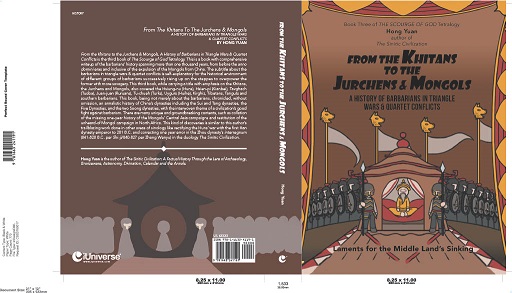
Epigraph|Preface|Introduction|T.O.C.|Afterword|Bibliography|References|Index
(available at iUniverse|Google|Amazon|B&N)
|
|
Ethnicity of the Chinese Nation, Melting Pots & Barbarian Invasions
China had been a united country or possessed inertia for unity because of the same origin of the Sinitic ruling cliques, the ancestor worship system, the rituals and customs, as well as the invention and adoption of the pictographic written language.
In another sense, China was a country united by culture, not bloodline.
In regards to the difference of the Sinitic people from the barbarians, there were discourses
throughout history. Confucius was cited in The Analects to have made a statement in regards to the
barbarians' lack of lords ('Yi-di zhi [whereof] you-jun [possessing a lord]'); Mencius claimed that he only
heard of the Sinitic people's transforming the barbarians ('yong [utilizing] Xia bian [transforming] Yi'),
not the other way around; Tang dynasty Confucian Haan Yu, in Yuan (fundamentalist) Dao (preaching),
commented on Confucius' objective of abridging Chun-qiu, i.e., treating the vassals as barbarians
with 'Yi li' [barbarian rituals] if the vassals adopted the barbarian rituals and customs, and treating the vassals as the 'zhong-guo' [Sinitic] people if the vassals wanted to be part of 'zhong-guo' (the
central state) [to observe the Sinitic rituals and customs]; and Soong dynasty Confucian Cheng Yi had a
discourse on the distinction between the Sinitic people and the barbarians ('Hua Yi zhi [whereof] bian
[distinction]').
Revolutionary forerunner Zhang Taiyan [Zhang Binglin] pointed out in the early 20th century that a Nation like China is unique in its continuity for three important characteristics, i.e., language, customs, and history. Though the Manchu had changed our customs, i.e., haircut and clothes, our language, i.e., written language, had continued.
Revolutionary forerunners, in the early 20th century, had undergone stages of cognizance as to "social Darwinism" but finally adopted for the Republic of China the "Five Color National Flag" [1912-1928], which was symbolic of the union of five ethnic groups of Han, Mongol, Manchu, Tibetan & Hui Muslim. The difference in "language, customs and history", e.g., those between the Uygur Turks and Chinese Dungans, would be a good case to exhibit the importance of trinity in "language, customs and history" for understanding the historical context of Chinese nationalities and Chinese ethnicities.
Conventional history claimed that the Chinese were monotonous ethnically.
Note that Hucker's China's Imperial Past did not shake off the old-fashioned stereotyped description of China and its land, topology, people, language and other "themes that pervade Chinese life and history", such as China proper and its purported insulation from "other major centers of civilization until the advent of modern communication and transport techniques" or China taken to be the "only major nation of Asia that is racially homogeneous".
This claim does not take into considerations of the Uygurs who had exhibited different physiques from the Mongolians, a feature that had been acquired after the ancestors of the Uygurs [i.e., Huihe] migrated to Chinese Turkistan per Albert von Le Coq's observations. For Westerners, they certainly could not tell the difference between Chinese, Manchus, Vietnamese, Koreans, Mongolians, and Hui or Muslim Chinese. They look the same on the surface. A careful perusal of China's 24 Histories, however, showed that the ancient and modern Chinese might not be that monotonous at all.
As we know, the Mongolians have their particular characteristics. The eyes are usually black or chestnut-colored, and the hair is mostly brown, dark-brown to dark, in contrast with southerners who usually possess darker skins, hairs and eyes.
The description of different physique among the alienized Chinese and the barbarians pinpointed the fact that the Chinese nation was never in isolation but in contacts with different groups of people.
* In Commemoration of China's Fall under the Alien Conquests in A.D. 1279,
A.D. 1644 & A.D. 1949 *
U.S.S.R./Comintern Alliance with the KMT & CCP (1923-1927)
Korean/Chinese Communists & the 1931 Japanese Invasion of Manchuria
American Involvement in China: Soviet Operation Snow, IPR Conspiracy, Dixie Mission, Stilwell
Incident, O.S.S. Scheme, Coalition Government Crap, Amerasia Case & The China White Paper
* Stay tuned for "Republican China 1911-1955: A Complete Untold History" *
|
|
Zou Rong's Revolutionary Army;
Shin Kyu Sik's
Shrine (Spirit, Kunitama) of Korea
|
This snippet is for sons and daughters of China:
Heed the sons & ministers' agony and sorrow of our ancestors who died or lived through the Mongol, Manchu and Soviet-Chicom conquest
and
the Yongjia, Jingkang and Jiashen cataclysms !
Jeanne d'Arc of China:
Teenager girl Xun Guan breaking out of the Wancheng city to borrow the relief troops in the late Western Jinn dynasty;
Liu-Shao-shi riding into the barbarian army to rescue her husband in the late Western Jinn dynasty;
teenager girl Shen Yunying breaking into Zhang Xianzhong's rebels on the horseback to avenge on father's death in the late Ming dynasty.
China's Solitary and Lone Heroes:
Nan Jiyun breaking out of the Suiyang siege and charging back into the city in the Tang dynasty;
Zhang Gui & Zhang Shun Brothers breaking through the Mongol siege of Xiangyang in the Southern Soong dynasty;
Liu Tiejun breaking through three communist field armies' siege of Kaifeng in the Republican China time period;
Zhang Jian's lone confrontation against the communist army during the June 3rd & 4th Massacre of 1989.
|
|
|
Largely due to the double destructions to the ancient Chinese literature at the time of First Qin Emperor Shihuangdi's book burning and consecutive arson in the hands of General Xiang Yu, the prehistoric contexts of the Chinese are very much blurred.
Though, this webmaster's interpretation of ancient classics did prove that the Chinese civilization, since the time of Huangdi, had been continuous.
To corroborate the ethnicity of Huangdi the Yellow Thearch, this webmaster had cited Prof Wei Chu-Hsien who had provided ancient classics Shi-zi (approx 338 B.C. works) in authenticating the ethnicity about barbarians in four directions: Guan-xiong-guo in the south, Chang-gu-guo (Chang-gong? long arm) in the west, Shen-mu-guo (deep eye socket) in the north, and Yuhu and Yujing as east-sea and north-sea seagods. Once and for all, we could settle the issues in regards to Huangdi or the Yellow Thearch, i.e., i) semantic error in translating the overlord for 'di4' into emperor; ii) Nordic racist appropriation in attaching Caucasian tag to Huangdi. This webmaster will use Shi-zi's record of deep eye socket people to the north of Huangdi as a corroboration that Huangdi people were not of deep-socket eyes at all. Likewise, in the section above, this webmaster had expounded the ethnic nature of various Rong people and cleared the dispute in regards to the ethnicity of 'Rong' people.
The early Chinese people had been moving around the country many times in the past.
The Yao-Shun-Yu legends clearly testified to the fact that the Yi and Hua-xia people had co-existed on the Chinese continent, with very possibly the same origin,
and the two groups of people had exerted power over each other, successively. Here, Lord Yao was said to belong to the Hua tribes,
but his power was yielded over to Shun who, being revered by the Shang Dynasty as ancestor, was misconstrued as a Yi tribal leader, with his power yielded back to the Hua-xia people led by Lord Yu --who was
historically named Rong-yu, a characteristic to pinpoint the later Xi-rong [western Rong] land of today's Sichuan-Hubei/Shenxi provincial borderline.
Lord Shun's brother, by the name of 'xiang' (elephant), mutated into a story about Lord Shun's subduing the elephants in the sophistry-nature Confucian book Mencius. The elephant taming was taken to be a profession of the Eastern Yi barbarians, i.e., the cause that Mencius called Lord Shun a 'Dong-yi'. The unfounded elephant story further evolved into a fable in sophistry Lü-shi Chun-qiu that the Shang tribe had tamed elephants and used them as weapon against the Eastern Yi people.
Interesting will be the fact that ancestors of the later Qin Empire had migrated to Shaanxi (Shenxi) Province in the western-most China of the time, from the traditional Yi playground of today's East China and Shandong Province.
Records showed that the Qin ancestors had migrated westward and participated in Lord Yu's master plan for quelling the floods.
Qin's ancestor could be traced to Bo Yi (aka Da-fei) under Lord Shun. Bo Yi's father was called Da-ye (Gaoyao). Da-ye was born by Nu-xiu who swallowed the egg of a sparrow, while Nu-xiu, in turn, was a descendant of Lord Zhuanxu.
The story of sparrow totem shows that ancestors of the Qin people belonged to the so-called Yi [misnomer Eastern Yi] people,
which we repeatedly stated to be a misnomer since the original inhabitants in Yi's land were the orthodox Chinese from the ancient Tai-hao-shi epoch,
earlier than the known Sino-Tibetan legacy dating from the Yellow Thearch era.
According to Zuo Zhuan, the Qin people's ancestors dwelled in the Great Xia land in today's southern Shanxi.
Tai-dai, the water irrigation minister in charge of managing the Fen-shui River and Tao-shui River, and one of two sons of descendent Mei of the Jin-tian-shi clan, received the Fen-chuan fief from Lord Zhuanxu.
(Further, during the time period of the Five Nomadic Groups Ravaging China, Hunnic rebel Liu Yuan claimed that the Zhou Dynasty royal house had origin in the Yi people to the east.
Both the Qin and Zhou groups of people, who dwelled in western China and had thousands of years of inter-relationship, for the duration of the Xia-Shang dynasties, could have ancestry in the original Chinese
who participated in Lord Yu's flood control projects in the late 3rd century millennium.)
Ethnicity of the Early Chinese People
There is no such thing as today's Chinese being the same as the ancient Chinese.
The peleoanthropological studies showed that the three dynasties of Xia, Shang and Zhou had different origin, with the Shang people exhibiting the majority paleo-North-China components and minority paleo-Northeast-China components in contrast with the Xia and Zhou people who could be of the paleo-Northwest-China type. The Xia people, with origin in the You-Xia-zhi-ju land along the Yi-shui River and Luo-shui River, expanded across the Yellow River to have taken over the Da-xia land before they were defeated by the Shang people hundreds of years later. Between the Xia and Shang people's reigns, the natives in the Da-xia land could belong to the paleo-Central Plains people whose presence was seen on the two sides of the southern segment of the East Yellow River Bend. The paleo-Central Plains people are now seen in far southern China. Zhu Hong of Jirin University claimed that the paleo-Central-Plains people were displaced beginning from the Soong dynasty (A.D. 960-1279), not at the time of the Zhou conquest of the Shang dynasty in the 12th-11th centuries B.C. Though, Zhu Hong separately pointed out that the differences between the paleo-Central-Plains and the paleo-North-China types from the Xia-Shang times were merely the relative measures of the same mid-size and high forehead crania, which could mean that the paleo-Northwest-China Sino-Tibetans, when expanding to the east, could have mixed up with the northern and southern natives to become the paleo-Central-Plains and the paleo-North-China types that exhibited features of slight difference.
Scholar Luo Xianglin, in "History of Chinese Nationalities" (Chinese Culture Publishing Enterprise Co, Taipei, Taiwan, May 1953 edition), stated that ancient China possessed five tribal groups: Xia, Qiang, Di[1], Yi, and Man[2].
In Luo Xianglin's viewpoint, four other tribal groups of Qiang, Di[1], Yi, and Man[2] went through a process of conversion and diversion with Xia people.
Per Luo Xianglin, Xia people first originated in Mt Minshan and upperstream River Min-jiang areas of Sichuan-Gansu provincial borderline. Xia people then split into two groups, with one going north to reach Wei-shui River and upperstream Han-shui River of Shenxi Province and then east to Shanxi Province by crossing the Yellow River.
The second group, per Luo Xianglin, went south to populate southern Chinese provinces as the 'Yue' people.
Luo Xianglin's linking Yue people to Xia people was based on the common lexicon 'yue' which meant for excavated ancient "stone axe".
In the west, Qiangic people spread across Tibet-Qinghai-Sichuan-Gansu-Shenxi provinces to become Xi-Rong & Xi-Qiang; in the east, Yi [meaning the people with bows semantically] spread across Jiangsu-Anhui-Shandong-Henan-Hebei-Manchuria to become Dong-Yi; in the south, Man[2] spread across Hubei-Hunan-Jiangxi-Guizhou-Guangxi-Fujian-Zhejiang to become Nan-Man; and in the north, Di[1] spread across Xinjiang-Ningxia-Mongolia-Shanxi-Hebei provinces to become Bei-Di.
Here, Xi-Rong or Western Rong meant for later Rong people (Sino-Tibetan speaking Qiangic people) in northwestern China, Bei-Di or Northern Di meant for later northern Di[2] people, Dong-Yi or Eastern Yi people meant for later Yi people in the east, and Nan-Man or Southern Man2 meant for the southern barbarians.
For further discussions on Barbarians & Chinese, please refer to
Incorporating Rong & Di people
According to Sima Qian, the northern nomads were called by 'Shanrong' (mountain Rong) or Xunyu or Xianyun at times of Lord Yao and Lord Shun, Chunwei tribe at times of Xia Dynasty, Guifang (ghost domain) at times of Shang Dynasty, again Xianyun at times of Zhou Dynasty, and Hsiongnu (Huns) at times of Han Dynasty. Further, the Huns were said to be descendants of Xunyu, the son of last Xia Lord Jie who was banished to Henan Province by Shang. Xunyu fled to norther plains to become ancestors of later Huns. They would attack the ancestors of Zhou founder. Zhou kings had zigzag wars with the Huns. But inter-marriage was also rampant.
Count of West, Xibo, namely, Zhou Ancestor Ji Chang, once attacked the Doggy Rongs (said to be same as Xianyun barbarian on the steppe). Dozen years later, Zhou King Wuwang exiled the Rongs north of the Jing & Luo Rivers. The Rongs were also called Huangfu at the time, a name to mean their 'erratic submission'. 200 years later, Zhou King Muwang (r. 1,001 - 947 B.C. per Shao Yong's divinatory chronicling; 1006-952 B.C. per Zhang Wenyu; 962-908 per [forgery]
The Bamboo Annals) attacked the Doggy Rongs and history recorded that he captured four white wolves & four white deers (white deer and white wolf being the titles of ministers of Rongdi barbarians) during his campaign. The Huangfu (Doggy Rong) people then no longer sent in yearly gifts and tributes. Zhou King Yiwang (Ji Jian, reign approx 934 - 910 B.C. per Shao Yong's divinatory chronicling; 916-894 B.C. per Zhang Wenyu; 895-871 per [forgery] The Bamboo Annals), the grandson of King Muwang, would be attacked by the Rongs. The great grandson, King Xuanwang (Ji Jing, reign 827-782 B.C. per Shi-ji; 826-782 B.C. per Zhang Wenyu/Lai2 Ding), finally fought back against the Rongs. Shi Jing eulogized King Xuanwang's reaching Taiyuan and fighting the Jiangrong. Thereafter, King Youwang (reign 781-771 B.C.) was killed by the Doggy Rongs at the foothill of Lishan Mountain and capital Haojing was sacked. Quanrong & Xirong had come to aid Marquis Shenhou (father-in-law of King Youwang of Western Zhou, c 11 cent - 770 B.C.) in killing King Youwang of Zhou Dynasty in 770 BC. Rongs who stayed on at Lishan were called Li-rong. The Rongs moved to live between the Jing & Wei Rivers. Lord Qin Xianggong was conferred the old land of Zhou by Zhou King Pingwang (reign 770-720 B.C.). Zhou King Pingwang encouraged the Qin Lord to drive out the Quanrongs.
Qin warred with various Rong people over a time span of over 600 years. When Zhou King Liwang was ruling despotically, the Xi Rong (Xirong or Western Rong) people rebelled in the west and killed most of the Daluo lineage of Qin people. Zhou King Xuanwang (Ji Jing, reign 827-782 B.C. per Shi-ji; 826-782 B.C. per Zhang Wenyu/Lai2 Ding) conferred Qin Lord 'Qin Zhong' (r. B.C. 845-822 ?) the title of 'Da Fu' and ordered him to quell the Xirong.
Qin Lord Zhuanggong's senior son, Shifu, would swear that he would kill the king of the Rong people to avenge the death of Qin Zhong before returning to the Qin capital. Zhuanggong's junior son would be Qin Lord Xianggong (Ying Kai) who assisted Zhou King Pingwang (reign 770-720 B.C.) in cracking down on both the Western Rong and the Doggy Rong. Shifu was taken prisoner of war by Xi Rong during the 2nd year reign of Qin Lord Xianggong and did not get released till one year later.
During the 7th year reign of Qin Lord Xianggong, i.e., 771 BC, Doggy Rong barbarians sacked Zhou capital and killed Zhou king at the invitation of Marquis Shen (i.e., Shenhou).
Qin Lord Xianggong (Ying Kai) died during the 12th year of his reign (766 B.C.) when he campaigned against the Rong at Qishan.
Qin Lord Wengong (r. B.C. 765-716), during his 16th year reign, Wengong defeated Rong at Qishan. Wengong would give the land east of Qishan back to Zhou court.
Qin Lord Ninggong (r. B.C. 715-704) would defeat King Bo and drove King Bo towards the Rong people during the 3rd year reign, i.e., 713 BC. Ninggong conquered King Bo's Dang-shi clan during the 12th year reign, i.e., 704 BC.
Qin Lord Wugong (r. B.C. 697-677), during the 10th year reign, exterminated Gui-rong (Shanggui of Longxi) and Ji-rong (Tianshui Commandary), and the next year, exterminated Du-bo Fief (southeast of Xi'an), Zheng-guo Fief (Zheng-xian County) and Xiao-guo Fief (an alternative Guo Fief, different from the Guo domain conferred by Zhou King Wenwang onto his brother, Guo-shu). Xiao-guo Fief was said to be a branch of the Qiang people.
Meanwhile, lord of the Jinn Principality, Jinn Xian'gong (r. 676-651 B.C.), attacked Li-rong (Xi Rong) barbarians during his 5th year reign, i.e., 672 B.C. approx, and captured a Li-rong woman called Li-ji.
After the defeat in the hands of Jinn Lord Wen'gong, the Di barbarians, who lived in the land of Xi-he (today's east segment of the Yellow River loop or bend), between the Yin (Yan'an/Yenan, Shenxi) and the [northern-]Luo River, where they were called by the White Di and Red Di barbarians.
Prince Chong'Er of the Jinn Principality, during his long years of exile, had travelled across the whole China domain of the time. He lived for many years in the state of Di[1] where his mother-in-law was from and later married with a woman of Chi Di (Red Di) State, a woman captured by the lord of Di [White Di] State.
Baidi (White Di) dwelled in ancient Yanzhou (today's Yan'an), Suizhou (today's Suide) and Yinzhou (today's Ningxia on west Yellow River Bend). Zuo Shi Chunqiu stated Jinn defeated Baidi and the remnants were known as Bai-bu-hu later. Chidi (Red Di) dwelled in a place called Lu(4), near today's Shangdang. Zuo Shi Chunqiu stated that the Jinn Principality destroyed the Lu(4) tribe of the Chidi, and the remnants were known as Chi-she-hu nomads later.
* In Commemoration of China's Fall under the Alien Conquests in A.D. 1279,
A.D. 1644 & A.D. 1949 *
U.S.S.R./Comintern Alliance with the KMT & CCP (1923-1927)
Korean/Chinese Communists & the 1931 Japanese Invasion of Manchuria
American Involvement in China: Soviet Operation Snow, IPR Conspiracy, Dixie Mission, Stilwell
Incident, O.S.S. Scheme, Coalition Government Crap, Amerasia Case & The China White Paper
* Stay tuned for "Republican China 1911-1955: A Complete Untold History" *
|
|
Zou Rong's Revolutionary Army;
Shin Kyu Sik's
Shrine (Spirit, Kunitama) of Korea
|
This snippet is for sons and daughters of China:
Heed the sons & ministers' agony and sorrow of our ancestors who died or lived through the Mongol, Manchu and Soviet-Chicom conquest
and
the Yongjia, Jingkang and Jiashen cataclysms !
Jeanne d'Arc of China:
Teenager girl Xun Guan breaking out of the Wancheng city to borrow the relief troops in the late Western Jinn dynasty;
Liu-Shao-shi riding into the barbarian army to rescue her husband in the late Western Jinn dynasty;
teenager girl Shen Yunying breaking into Zhang Xianzhong's rebels on the horseback to avenge on father's death in the late Ming dynasty.
China's Solitary and Lone Heroes:
Nan Jiyun breaking out of the Suiyang siege and charging back into the city in the Tang dynasty;
Zhang Gui & Zhang Shun Brothers breaking through the Mongol siege of Xiangyang in the Southern Soong dynasty;
Liu Tiejun breaking through three communist field armies' siege of Kaifeng in the Republican China time period;
Zhang Jian's lone confrontation against the communist army during the June 3rd & 4th Massacre of 1989.
|
|
|
The Shan-rong barbarians, i.e., the Mountain Rong barbarians, who were customarily taken to be of the Tungusic stock [per historian Fu Qian], were said by Sima Qian to have gone across the Yan Principality of today's Hebei Province to attack the Qi Principality in today's Shandong Province. Sima Qian, in Shi Ji, stated that this happened sixty-five years after the relocation of Zhou King Pingwang's capital city to Luoyi and Qin Lord Xianggong's campaign against the [western] Rong barbarians at the Qishan Mountain, namely, about 705 B.C. Sima Qian stated that the Mountain Rongs, who attacked the Yan Principality, had intruded to the outskirts of Qi's capital city and fought against Qi Lord Ligong (i.e., Xigong). Sima Qian's Shi Ji stated that another forty-four years later, which would be 661 B.C. [after deduction from 705 B.C.], the Mountain Rongs attacked Yan again. Yan Lord Zhuanggong requested aid with Qi, which culminating in the Yan-Qi joint armies destroying the Mountain Rong Statelet as well as the Guzhu Statelet around 664 B.C. The story of 'old horses knew the way home' would be about the joint army being lost after they penetrated deep into the Shanrong land. Hence, Yan Statelet extended by 500 li to the northwest, in addition to the eastward 50 li which was given to Count Yan for his escorting Marquis Qi all the way into the Qi Statelet. --Sima Qian, who wrote about the [northern] Yan lords' lineage on basis of the Shi Ben book, mentioned the above sensational stories which did not conform with Zuo Zhuan, a book that recorded the Ji2-surnamed South Yan state from 718 B.C. to a Zheng lord's Yan-ji2 wife bearing a son called by orchid around 649 B.C. but did not specifically name the North Yan state matter till 545 B.C. on which occasion the North Yan count visited the Jinn state. Shi Ben, with the only scraps from the post-book-burning times, incidentally talked about North Yan Marquis Huanhou (?-691 B.C.)'s southward relocation of the North Yan's capital city to Linyi[4] (Xiongxian, Baoding, Hebei). This webmaster, checking the Qi marquis' itineraries in year 664 B.C., only found an entry about a diplomatic summit, in the winter of 644 B.C., between the Lu lord and the Qi marquis at Lu-ji, in regards to the campaigns against the Shan-rong or the Shanrong (Mountain Rong) barbarians who attacked the [most likely southern] Yan state. If it was the year 661 B.C., the Qi marquis would be busy dealing with the Chang-di barbarians' invasion of the Xing-guo and Wey states, with no time to take care of the other hot spots.
During the 16th year of Zhou King Huiwang (reign 676-652 B.C.), namely, 661 BC, the Chang Di barbarians who were located near today's Jinan City of Shandong Province, under Sou Man, attacked the Wey and Xing principalities. The Di barbarians, hearing of Qi army's counter-attacks at Mountain-rong, embarked on a pillage in central China by attacking Wey and Xing statelets. The Di barbarians killed Wey Lord Yigong (r. B.C. 668-660 ?) who was notorious for indulging in raising numerous birds called 'he' (cranes), and the barbarians cut him into pieces. A Wey minister would later find Yigong's liver to be intact, and hence he committed suicide by cutting apart his chest and saving Yigong's liver inside of his body.
The invitation of the barbarians to the heartland of Zhou China caused some havoc.
In 636 B.C. approx, the Rong-di barbarians attacked Zhou King Xiangwang (reign 651-619) at the encouragement of Zhou Queen who was the daughter of Rongdi ruler. The Jinn Principality helped Zhou King by attacking the Rongs and then escorted the king back to his throne 4 years after the king went into exile.
In 659 BC, Qin Lord Mugong conquered Maojin-rong.
In 623 BC, i.e., during the 37th year reign, Qin Mugong, using You Yu as a guide, campaigned against the Xirong and conquered the Xirong Statelet under their lord Chi Ban. Once Chi Ban submitted to Qin, the rest of Western Rong nomads in the west acknowledged the Qin overlordship. Qin Mugong would conquer altogether a dozen (12) states in Gansu-Shaanxi areas and controlled the western China of the times. Zhou King dispatched Duke Zhaogong to congratulate Qin with a gold drum.
During the 3rd year reign of Qin Gonggong, i.e., 606 BC, Lord Chu Zhuangwang campaigned northward against the Luhun-rong barbarians and inquired about the Zhou cauldrons when passing through the Zhou capital.
Luhun-rong barbarians, according to Hou Han Shu, had relocated to northern China from ancient Gua-zhou prefecture of Gansu Province. Alternatively speaking, per ancient scholar Du Yu, Luhun-rong barbarians, with clan name of Yun-shi, originally dwelled to the northwest of Qin and Jinn principalities, but Qin/Jinn seducingly relocated them to Yichuan area (i.e., Xincheng, Henan Prov) during the 22nd year reign of Lu Lord Xigong (r. B.C. 659-627), i.e., in 638 BC.
As to barbarian groups, there were Mianzhu-Quanrong-Di-Wanrong to the west of Qin Principality, Yiqu-Dali-Wushi-Xuyan etc., to the north of Qin Principality, Linhu-Loufan to the north of Jin (Jinn) Principality, and Donghu-Shanrong to the north of Yan Principality.
Mianzhu could be pronounced Raozhu. Quanrong was known as Kunrong or Hunrong or Hunyi. The character 'hun4' for Hunyi or Hun-yi is the same as Hunnic King Hunye or Kunye and could mean the word of mixing-up. Wan-rong dwelled in today's Tianshui, Gansu Province. Yiqu was one of the Xirong or Western rong statelets at ancient Qingzhou and Ningzhou. Dali-rong dwelled in today's Fengxu County. Wushi was originally Zhou land, but it was taken over by Rong. Qin King Huiwang took it back from Rong later. Linhu was later destroyed by General Li Mu. Loufan belonged to Yanmen'guan Pass.
During the 13th year reign of King Jianwang, i.e., 573 BC, Jinn Lord Ligong was killed by Luan Shu and Zhongxing Yan, and Jinn dispatched emissaries (led by a Zhi family member) to the Zhou court to retrieve Zi-zhou as Lord Daogong. Jinn Lord Daogong made peace with Rongdi (who attacked Zhou King Xiangwang earlier), and the Rongdi sent in gifts and tributes to Jinn.
Another one hundred years, Zhao Xiang-zi of Zhao Principality took over Bing and Dai areas near Yanmen'guan Pass. Zhao, together with Han and Wei families, destroyed another opponent called Zhi-bo and split Jinn into three states of Han, Zhao & Wei. Yiqu-Rong built castles to counter Qin. Qin King Huiwang took over 25 cities from Yiqu.
In 461 BC, Qin Lord Ligong, with 20,000 army, attacked Dali-rong barbarians and took over Dali-rong capital.
In 444 BC, Qin Lord Ligong attacked Yiqu-rong barbarians in the areas of later Qingzhou and Ningzhou and captured the Yiqu-rong king.
Around 430 BC, Yiqu-rong barbarians counter-attacked Qin and reached south of Wei-sui River.
Qin Lord Xiaogong (r. B.C. 361-338), during the first year reign, Qin Xiaogong made an open announcement for seeking talents all over China in the attempt of restoring Qin Mugong's glories. In the east, Qin Xiaogong took over Shaancheng city, and in the west, he defeated and killed a Rong king by the name of Huan-wang near Tianshui, Gansu Province.
Qin, under Qin King Zhaoxiangwang, continued wars against Wei & Zhao principalities.
King Zhaoxiangwang's mother, Queen Dowager Xuantaihou, adultered with a Rong king from Yiqu Statelet in today's northwestern Shenxi Province. She had two sons born with Yiqu Rong King, but she killed Yiqu King and incorporated the lands of Longxi, Beidi and Shangjun (Yulin, Shenxi Prov) on behalf of Qin.
Qin took over Shangjun from Wei. Qin built the Great Wall at Longxi of Gansu, Beidi and Shangjun of Shenxi land. The two successive Jinn states which bordered the northern nomads, Wei & Zhao, plus Qin and Yan, would be busy fighting the nomads for hundreds of years, and they built separate walls to drive the nomads out. Zhao King Wulingwang adopted reforms by wearing Hu cavalry clothing and he defeated Linhu / Loufan and built Great Wall from Dai to Yinshan Mountain. Zhao set up Yunzhong, Yanmen and Dai prefectures. A Yan Principality General by the name of Qin-kai, after returning from Donghu as a hostage, would attack Donghu and drive them away for 1000 li distance. Yan built Great Wall and set up Shanggu, Yuyang, You-beiping, Liaoxi and Liaodong prefectures.
The Scourges-of-God Tetralogy
would be divided into four volumes covering
Hsiung-nu (Huns), Hsien-pi (Xianbei), Tavghach
(Tuoba), Juan-juan (Ruruans), Avars, Tu-chueh (Turks), Uygurs (Huihe), Khitans, Kirghiz, Tibetans, Tanguts, Jurchens, Mongols and Manchus and
southern barbarians.
Book I of the tetralogy would extract the contents on the Huns from
The Sinitic Civilization-Book II,
which rectified the Han dynasty founder-emperor's war with the Huns on mount Baideng-shan to A.D. 201 in observance of the Qin-Han dynasties' Zhuanxu-li calendar.
Book II of the Tetralogy would cover the Turks and Uygurs.
And
Book IV would be about the Manchu conquest of China.
From the Khitans to the Jurchens & Mongols: A History of Barbarians in Triangle Wars and Quartet Conflicts
, i.e., Book III of
the Scourge-of-God-Tetralogy,
focused on the Khitans, Jurchens and Mongols, as well as provided the annalistic history on the Sui and Tang dynasties, the
Five Dynasties & Ten Kingdoms, and the two Soong dynasties.
Similar to this webmaster' trailblazing work in rectifying the Han dynasty founder-emperor's war with the Huns to 201 B.C. in The Sinitic Civilization - Book II,
this Book III of the Scourge-of-God-Tetralogy
collated
the missing one-year history of the Mongols' Central Asia campaigns and restituted the
unheard-of Mongol campaign in North Africa.
|
The Scourges of God: A Debunked History of the Barbarians" - available at iUniverse|Google|Amazon|B&N
From the Khitans to the Jurchens & Mongols: A History of Barbarians in Triangle Wars and Quartet Conflicts
(The Barbarians' Tetralogy - Book III)
Epigraph,
Preface,
Introduction,
Table of Contents,
Afterword,
Bibliography,
References,
Index
|
|
Table of Contents
(From the Khitans to the Jurchens & Mongols: A History of Barbarians in Triangle Wars and Quartet Conflicts)
Section One: The Barbarians of the Steppes
Chapter I: The Hu (Huns) & Eastern Hu Barbarians ............................................1
The Huns .............................................................................................................3
The Eastern Hu (Dong-hu) Barbarians: Xianbei & Wuhuan ....................................7
The Duan, Murong & Yuwen Xianbei Clans, and the Tuoba Xianbei ..................... 13
The Khitans, Xi, Kuzhen-xi, Shi-wei & Malgal ......................................................15
Section Two: The Sui & Tang Dynasties
Chapter III: The Turks vs. the Sui Dynasty .............................................................25
Chapter IX: The Shatuo Turks ..............................................................................106
Origin of the Shatuo ..............................................................................................106
Shatuo Mercenaries Serving the Tang Dynasty .......................................................109
Shatuo Quelling the Rebellion of Pang Xun, Wang Xianzhi & Huang Chao ............. 110
The Khitans, the Shatuo, the Tanguts vs. the Five Dynasties ..................................170
Chapter XXII: The Mongol Attacks on the Tatars, Naimans, Keraits, Tanguts,
Jurchens, Khitans in Manchuria & Kara-Khitay (from A.D. 1202
to 1219) ....................403
Chapter XXIII: The Mongol Campaigns Against Semiryechye & Central Asia
(A.D. 1216-1224) ................423
The Mongol Campaign against Kuchlug's Kara-Khitay (A.D. 1218) ........................425
|
|
Melting Pots
The migrations in last two thousand years would be from north to south. One interesting thing will be about the Cantonese who refer to themselves as 'Tangyin' (i.e., Mandarin 'Tang Ren') or the Tang dynasty descendants. The Chinatowns across America will be simply named 'Tangyin Ga', namely the 'Tang People Street'. A linguistic comparison shows that the pronunciation of Cantonese and Japanese is almost the same. We certainly could not over-emphasize the inflow of Chinese to the south. Because recent DNA tests conducted on the Hakka and Fujian people across the Taiwan Straits showed that those people, purported to be the descendants of original Chinese, had much more in common with the Southern Yue barbarians than the northern Chinese.
(To better understand the origin of Mongoloid, a study of the topic as to the southern origin of Mongoloid is a must:
Y-Chromosome Evidence of Southern Origin of the East Asian-Specific Haplogroup O3-M122;
Genetic Structure of Hmong-Mien Speaking Populations in East Asia as Revealed by mtDNA Lineages.)
First recorded organized migrations would be that conducted by Qin First Emperor Shihuangdi.
Between 220 B.C. and 214 BC, Qin conquered and annexed territories covering present-day Guangdong, Guangxi and northern Vietnam, and part of Fujian. Qin Emperor Shihuangdi, after conquering the south, set up the commandaries of Guiling, Nanhai (south sea), and Xiangjun (elephant commandary) etc. History recorded that altogether 500,000 people, consisting of the disgraced men (those who lived in wives' houses, e.g.) and the merchants, were relocated to southern China. This explains the fact that today's Guangdong Province still possesses the most variety of ancient Chinese dialects.
Before the time period of 'Five Nomads Ravaging China', various nomadic groups had already dwelled in northern Chinese territories. At the time of Han Emperor Wudi, the Huns under King Hunye (Kunye) and Xiutu (Xiuzhu) were relocated to the northern Bend of the Yellow River from Zhangye and Wuwei of Gansu. Later, Huns under Hunnic King of 'Ri Zhuo Wang' (King of Sun Chasing) were escorted to northern China. In the 1st century, Southern Huns under King Huhanye had been relocated to northern China. In this area, for one hundred years already, the Huns were given privileges of tax exemption. By the end of Ts'ao Wei Dynasty, five Hunnic tribal groups were in existence in Hetao, with Leftside Tribe controlling 10,000 households in Cishi County, Taiyuan, Leftside Tribe 6,000 households in Qixian County, Southside Tribe 3,000 households in Puzi County, Northside Tribe 4,000 in Xingxin County, and Central Tribe 6,000 households in Daling County. After Jinn Dynasty was founded in A.D. 265, more Huns relocated to Yiyang, west of the Yellow River Bend, from north of the Gobi. History of Jinn Dynasty recorded that altogether 19 Hunnic tribal affiliations came to China. 'Five Nomads Ravaging China' would cause northern Chinese to migrate towards the south in hordes for the first time.
Tang Emperor Taizong, rebutting the advice of his minister Wei Zheng (who cited the Hunnic ravaging of China during the late Jinn Dynasty as a result of their dwelling south of the Yellow River, Hatao area), relocated over 100,000 Eastern Turks to the border areas, all the way from Shaanxi-Shanxi to today's Beijing city. Taizong did accept the advice of Yan Shigu, Du Chuke and Li Baiyao in having the Turks settle down north of the Yellow River. Taizong set up four more prefectures, Shunzhou, Youzhou, Huazhou and Changzhou along the Great Wall, and made Khan Tuli governor-general in charge of Shunzhou Prefecture.
After the demise of Tang Dynasty, the Shatuo Turks set up consecutive dynasties in the north. The northern Chinese hence initiated another wave of migrations towards the south. Today's Cantonese would hence call themselves Tang people.
If the Cantonese residing in today's southern China belong to the Tang people, where would be those ancient Chinese before Tang Dynasty (A.D. 618-907),
a unified society after northern China went through hundreds of years of nomadic ruling during the 16 Nations (A.D. 304-420)
and the North Dynasties (A.D. 386-581)?
Compounding it further, today's Beijing would be seceded to the Khitans by Posterior Jinn (A.D. 936-946), and northern China would be lost to the Khitans.
It endured Tangut Western Xia (A.D. 1032-1227), Jurchen Jin (A.D. 1115-1234) and then Mongol conquest (A.D. 1234-1279) and Mongol Yuan (A.D. 1279-1368).
Beijing, back in the Soong Chinese hands for a short duration after Soong promised to contribute the taxes to the Jurchens for their help in defeating the Khitans,
was lost to the Jurchens thereafter and did not return to the Chinese rule till Ming Dynasty reunited China in 1368.
When the first Ming Emperor, Zhu Yuanzhang, retook North China from the Mongols, there was almost no live souls in North China, after the massive killings of the Tanguts, the Jurchens and the Northern Chinese in the hands of
the Mongols and then the raging wars between the Mongols and the Chinese rebels.
Two to three Ming Dynasty emperors initiated a massive human migration in North China, that was known to be the Hongtong Emigration, lasting almost a century and with 18 government-sanctioned moves.
The emigration of the surviving Chinese people out of today's mountains areas in southern Shanxi during the early Ming Dynasty led to a peculiar characteristics among today's northern Chinese, namely, the DNA being
very much similar among the northern Chinese -- as today's northern Chinese traced their ancestry to the locust trees in Hongtong County.
It would be lost to the Manchus in A.D. 1644 again. Today's Chinese call themselves the 'Han' people, and 'Han' is the largest ethnical group in China versus the Mongolians, the Manchus, and the Uygurs and etc. There is a reason for that. The Han dynasty is a unified empire who had extended its influence outside of the prehistoric domains of the Chinese. The Han Dynasty, in its fight against the Huns, pushed all the way to the Oxus and Fergana Valley. It also extended itself to Manchuria and Korea in the northeast and Vietnam in the south. While it was just a designation for the empire in Han's times, the name 'Han' is used as an ethnical group in today's China, sometime people could identify themselves with.
The first identifiable 'alien' [non-Xia-Chinese] elements, in my opinion, should be attributed to those in southern China, instead.
In another sense, the 'alien' people in the mid-Yangtze area were not aliens, but orthodox Chinese who were driven away from the central plains and the Shandong coast, as a result of
the wars between the later-orthodox Yellow Thearch and the original Yi Chinese as represented by the Fiery Thearch (who could be the same person as Chi-you, i.e., the god of agriculture and the god of war), with Chi-you itself being actually a fable figure or a divinatory figure.
At the times of Lords Yao-Shun-Yu, the so-called 'San-miao' (Three Miao) people had been living in the middle Yangtze River, taking Lake Dongting as their very homeland. This place would remain marshlands and lakes till the time of the Chu State of the Warring States period (403-221 B.C.). The State of Chu, 1500 years after Xia Dynasty was first established, would still belong to an alien ethnical group, and they were the first group of people to reject the overlordship of the Zhou Dynasty by declaring themselves as a king of equal footing. According to Sima Qian, the 'San-miao' people, as a punishment for aiding the Danzhu Rebellion, were mostly relocated to western China to guard against the western nomads. This would provide one of the pieces of evidence to link the San-miao to people emerging later in the area, namely, the Qiang people and the Di(1) nomads etc. (The Di nomads had been suspected to be responsible for the so-called 'Sanxingdui Excavations' in today's Sichuan Province.) China's classics, Sea & Mountain Records claimed that San-miao people were derived from the unfilial son of Fiery Lord. Both San Miao in the south and later Quanrong (Doggy Rong) in the west were said to be descended from Pan Hu, the ancestor of the dogs.
In light of the relocation here, this webmaster will speculate as the linguist did about the possibility of the Qiangic people being pressured into a movement towards Tibet which was called 'Zhang', a mutation of Qiang. In late Han times, the Qiangs had been mercenaries of Han emperors in numerous wars, and one family of generals (General Ma Teng and his sons) had joined the Shu Han against the Wei Kingdom during Three Kingdoms Period (A.D. 220-280). The Qiangs as well as the Di nomad would play their part in the later landslide campaigns in northern China, 'Five Nomads Ravaging China' of 4-5th centuries. They joined hands with a branch of Xianbei nomads and created a lasting kingdom called 'Tuyuhun', which competed against the Tibetans proper well into the 7th century. At one time, 'Tuyuhun' was conquered by the Tibetans, but the son of Tibetan prime minister had later brought the 'Tuyuhun' people back to Tang Dynasty. (The name of Tibet was purported to have been a mutation of a branch of western Xianbei called Tufa.) The Dangxiang Qiangs, a branch of the Western Qiangs or Xi Qiangs, would evolve into the later Xixia Kingdom. The Dangxiang or the Tanguts, in this webmaster's opinion, are descendants of the Qiangs, earlier Tuyuhun people and the Tuobas, and they carried Tuoba family name.
* In Commemoration of China's Fall under the Alien Conquests in A.D. 1279,
A.D. 1644 & A.D. 1949 *
U.S.S.R./Comintern Alliance with the KMT & CCP (1923-1927)
Korean/Chinese Communists & the 1931 Japanese Invasion of Manchuria
American Involvement in China: Soviet Operation Snow, IPR Conspiracy, Dixie Mission, Stilwell
Incident, O.S.S. Scheme, Coalition Government Crap, Amerasia Case & The China White Paper
* Stay tuned for "Republican China 1911-1955: A Complete Untold History" *
|
|
Zou Rong's Revolutionary Army;
Shin Kyu Sik's
Shrine (Spirit, Kunitama) of Korea
|
This snippet is for sons and daughters of China:
Heed the sons & ministers' agony and sorrow of our ancestors who died or lived through the Mongol, Manchu and Soviet-Chicom conquest
and
the Yongjia, Jingkang and Jiashen cataclysms !
Jeanne d'Arc of China:
Teenager girl Xun Guan breaking out of the Wancheng city to borrow the relief troops in the late Western Jinn dynasty;
Liu-Shao-shi riding into the barbarian army to rescue her husband in the late Western Jinn dynasty;
teenager girl Shen Yunying breaking into Zhang Xianzhong's rebels on the horseback to avenge on father's death in the late Ming dynasty.
China's Solitary and Lone Heroes:
Nan Jiyun breaking out of the Suiyang siege and charging back into the city in the Tang dynasty;
Zhang Gui & Zhang Shun Brothers breaking through the Mongol siege of Xiangyang in the Southern Soong dynasty;
Liu Tiejun breaking through three communist field armies' siege of Kaifeng in the Republican China time period;
Zhang Jian's lone confrontation against the communist army during the June 3rd & 4th Massacre of 1989.
|
|
|
In "China's Imperial Past" by Charles Hucker, a good point was made about the distinction between the sedentary and nomadic ways of life in China's northern areas, around the Yellow River line, at the time of prehistory. The ancestors of later Huns are not much different from the sedentary Chinese, and Russian archaeological discoveries in Mongolia stated that the Huns had practiced agriculture in ancient Mongolia. Both groups of people had partial agriculture and partial husbandry in the area. It was due to the Chinese building up walled states that led to the polarization of the two ways of life. The Zhou people, counted as kinsmen of the Chinese, were living among the barbaric west. At times of Shang China, the ancestors of the Zhou people migrated to the west and was conferred the title of 'Xi Bo' (Count of the West) as a buffer state against the Western nomads. Even at times of Zhou Dynasty, pockets of nomadic tribes and states still existed in the hearts of the Yellow River Valley, as in the case of Di Statelet, Chi Di Statelet and Chang Di Statelet etc.
There is no solid evidence, written or archaeological, to expound the ethnic nature of the 'Rong(2)' and 'Di(2)' barbarians.
Various literature pointed to 'Rong(2)' and 'Di(2)' as belonging to the Sino-Tibetan Qiangic people, and it is just a riddle
how the Qiangic language had mutated into the Altaic language -unless we completely put aside the convenient classification and adopt scholar Wang Zhonghan's
research which showed that in the first and middle part of Zhou Dynasty, the western barbarians and northern barbarians were the same, i.e., the Qiangs, but by the latter part of the Zhou Dynasty,
the northern barbarians appeared to be different from the western barbarians, namely, having a mix of the people from today's Manchuria.
What is apparent would be the fact that the northern nomads, by the name of 'Shanrong' or Xunyu or Xianyun, had been roaming on at least the Inner Mongolia
east-west steppe over 4000 years ago, prior to the emergence of Xia-Shang-Zhou dynasties.
The demise of Xia Dynasty would see Chunwei, the son of last Xia Dynasty Lord Jie, fleeing to the north and northwest to join the nomads
and becoming the de facto ancestor of the later Huns. Sima Qian's section on Shang Dynasty did not mention too much on the steppe people.
However, after the demise of Shang, records from Zhou Dynasty mentioned a group of the Rong people under King Bo in northwestern China.
This would be a Xirong lord by the title of 'Bo' in a place called 'Dang(4) She'
where the character 'dang' was said to be a mutation of the Shang Dynasty founder, 'Shang-Tang'.
Ancient classics said that this group of people claimed heritage from Shang-Tang and used the ancient Shang capital name 'Bo' for the title of their king.
Later, Qin Lord Ninggong (r. B.C. 715-704) defeated King Bo and drove King Bo towards the Rong people during the 3rd year reign, i.e., in 713 BC.
Ninggong conquered King Bo's Dang-shi clan during the 12th year reign, i.e., 704 BC.
In Zhou King Muwang's travelogue around 1000 BCE, we could tell that descendants of the San-Miao (i.e., three Miao) people were still living along the west bank
of today's western Yellow River Bend and beyond, somewhere between the Blackwater Lake and the Yellow River.
Further, the travelogue carried accounts about Shang Dynasty's descendants living along the North Yellow Bend and in the land of today's Inner Mongolia as the [Yellow] River Guardian.
As to King Bo's Rong, Qin Lord Wengong (r. B.C. 765-716) defeated King Bo's Rong and gave the land east of Qishan back to Zhou court.
The compositions of the Rong are complicated. We had touched upon the categories of the Western Rong, Doggy Rong, and Rongdi Rong in the Hun section. In light of King Bo, we could say that some descendants or affiliates of Shang would be related to the King Bo's Rong people. Huangfu Mi of Jinn Dynasty had doubts about King Bo's ancestry in Shang-Tang. Huangfu Mi of Jinn Dynasty treated King Bo as a branch of 'Xi-yi' or Western Yi aliens.
Yi is more an inclusive word to mean aliens, and the Qiangs and Di(1) people could be called Xi Yi, i.e., Yi in the west, while some southwestern barbarians would be called Xi-Nan Yi, namely, southwestern Yi.
In this sense, some of the Rongs at the time of Zhou Dynasty could be of Qiangic or Di(1) nature.
The Qiangs, in turn, would be the descendants of the Yandi (Fiery Lord or Fiery Emperor) tribal group carrying the tribal name "Jiang". New History Of Tang Dynasty said the Tibetans belonged to the Xi Qiang, namely, the western Qiangic people. There were 150 different groups of Qiangic people, widely dispersed among Sichuan, Gansu, Qinghai and Shenxi Provinces.
Ancient classics stated that the word 'qiang' means the shepherds in the west. The book which was called 'Continuum To Hou Han Shu' stated that the Qiangs were alternative race of the Jiang surname tribes of San Miao.
According to Sima Qian, the 'San-miao' people, who resided in the land where the later Chu Statelet was, were mostly relocated to western China to guard against the western nomads. Lord Shun, who took over the overlord post from Lord Zhi (reign 2366-2358 B.C. ?, the son of Lord Diku), relocated them to western China as a punishment for their aiding Dan Zhu (the son of Lord Yao reign 2357-2258 B.C. ?) in rebellion.
Waves Of Southern Migrations Of Chinese
In Han times, the ethnicity was a simple issue since the nomadic infiltrations were limited. The early principalities of Zhou Dynasties built various so-called 'walls' to defend themselves against the nomads, and Qin Empire linked and rebuilt it into the famous Great Wall after it drove the Huns out of the Hetao Area. Han Dynasty had inherited the domain of the Qin Empire, and it would wage zigzag warfare with the Huns for centuries, but a breach similar to the Visigoths destroying the Roman Empire would not come till the 4th century when the so-called 'Five Nomads' ravaged China as a result of disintegration of Western Jinn Dynasty (A.D. 265-316). Historians blamed it on General Ts'ao Ts'ao who relocated the Huns back to their homeland in Taiyuan, Shanxi Province during the Three Kingdoms Period (A.D. 220-280). By A.D. 317, all of China north of the Yangtze River/Huai River had been overrun by nomadic people: the Xianbei from the north; some remnants of the Xiongnu (Huns) from the northwest; and the Qiang people of Gansu and Tibet from the west and the southwest. This situation was last resolved by the Tuobas who united northern China into the Wei Dynasty (A.D. 386-534).
That was a time of the 'melting pot' in northern China. But the separation along ethnic lines did exist. Before Tuoba, the Chinese had limited participation in the wars among the tribal states, and they were used as 'field armies' in later campaigns by the nomads. Except for a few strongholds along the Silk Road, the Chinese city-states like Beijing and others in Shanxi-Hebei-Shandong Provinces would fall into the hands of either Xianbei or Tuoba in a dozen years.
Chinese in Henan, Shanxi and Shaanxi Province had fled to the south in hordes, and they would be ancestors of today's Hakka in Sichuan-Guangdong-Fujian provinces.
For the remnants left in northern China, the Chinese, under the massacre of the barbarians, organized militia for defense. According to excavated books from the Kumtag humming sand dunes ("mingsha shishe yishu", edited by Luo Zhenyu) from the Dunhuang Grotto in the desert of the Western Corridor, there were no more than 40 military leaders building and defending the forts in North China, with the strong ones possessing 4 to 5 thousand families and the weak ones numbering 100 to 500 families. This would yield about less than 1 million ethnic Chinese stranded in North China.
The Chinese refugees, if not fleeing to southern China, would have fled to the Western Corridor or to the Korean peninsula.
The Xianbei and Tuoba nomads were once allies of those city-states in fighting the Huns, Jiehu and the Di-Qiang nomads who ravaged the Central China of Henan Province as well as the western Province of Shaanxi.
After eliminating Northern Yan (A.D. 409-436), the Tuoba Wei army under Tuoba Tao (Emperor Taiwudi, r. A.D. 423-452) sacked Guzang, defeated the Northern Liang Dynasty in A.D. 439 to reunite northern China. Monks and elites were forcefully resettled in the Tuoba capital city of Pingcheng while the Hunnic tribes were scattered across the Yellow River sheath area, which led to proliferation of Bhuddism, development of Confucianism, and later Hunnic rebellion.
The Tuoba capital city Pingcheng had a surge of Buddhists in the aftermath of relocation of 100,000 households of people from Northern Liang after sacking Guzang in A.D. 439.
Chinese, from the south, had staged quite a few northern campaigns. Zu Di, organizing refugees and civilians with minimal Eastern Jinn Court support, would cross the Yangtze to mount a campaign against nomads in the northern China. General Heng Wen would continue the campaigns to the north and he met Wang Meng who later served Anterior Qin ruler (Fu Jian). General Liu Yu re-captured Chang'an during his northern campaigns and destroyed the Posterior Qin Dynasty of Qiangic nomads(AD 384-417) and Posterior Yan Dynasty of Xianbei nomads (A.D. 384-409). When Liu entered Chang'an, the local elderly people said to him that they had not seen Han clothes for one hundred years. Liu Yu would leave his teenage son in charge of Chang'an and ultimately lose Chang'an to the nomads again. Once the whole northern China was overrun, the remaining Chinese would have few alternatives living under alien rules. They would be prohibited from bearing arms in those nomadic states. With time going on, some Chinese intellectuals acted as counsels (or prime ministers as you might call them) for the rulers of those nomadic states. When the Tuoba State (Northern Wei Dynasty) decided to restrict some of the hereditary rights of its army ranks, the so-called Tuoba conservatives staged a rebellion, ending in the slaughter of civilian officials who were mostly ethnic Chinese. The Tuoba turmoil led to the disintegration of Tuoba Wei Dynasty into two separate states of Eastern Wei and Western Wei, to be usurped later by their Xianbei generals, respectively. The famous tribal names, like Murong (Mujong) and Yuwen, were the legacy of those Xianbei nomads who belonged to the group of Donghu or the Eastern Hu nomads.
Unlike the later Jurchens and Mongolians of the 12th and 13th centuries, the early nomads of 4th, 5th and 6th centuries could be said to be "marginal" quasi-Chinese. While the later Jurchens and Mongolians lacked access to minerals and weaponry and could not even count their age before entering northern China, the Huns and the Eastern Hu nomads (like Xianbei who claimed heritage from a son of the Yellow Emperor) were very much living alongside the Chinese from the 3rd century B.C. to the 3rd century AD. They had good access to weaponry as well as innovative ways of warfare.
The physical anthropology studies of the Khitan tomb remains showed that the Khitans belonged to the "North Asia" or the "Siberia-Baikal" type with a low cranial forehead and a higher facial appearance, i.e., people who had no similarity to the East Asia type people. According to Chen Jing of Jirin University, the physical anthropological studies showed that the Zhalairuoer people were a mix of paleo-Siberia, paleo-Arctic and paleo-East-Asia people.
Note that there existed the
fundamental difference in cranial length, width and height among the East Asian population and
the paleo-Siberia/paleo-Mongolian-Plateau population, that could be 181 millimeters versus 175, 138
versus 144, and 134 versus 127, respectively.
According to Chen Shou, the author of San Guo Zhi, several groups of Koreans in Korea, who named their states with a suffix word of 'Han(1)', had apparently worn clothing in the style of pre-Qin empire during the timeframe of 3rd century AD. The statelet of Qinhan in Korea was responsible for producing iron for both Wa Japan and other Koreans. At the end of Eastern Zhou (770-256 B.C.) and Qin Empire (221-206 B.C.), many Chinese fled to the north and the east, together with their weaponry. One good example would be Wei Man of Yan Principality who invaded Korea during the turmoil years of the demise of Qin Empire and overthrew the Korean kingdom of King Ji Zhun who had continued for 41 generations from last Shang prince Ji-zi in 11th century BC. While the Huns had a zigzag warfare with the Han Dynasty, the Eastern Hu nomads (who were driven away by the Huns and later relocated to Liaoning Province by Han Emperor Wudi for sake of segregation from the Huns) had acted as the mercenaries for the Chinese emperors. The areas around today's Liaoning Province were once the hereditary land of a Chinese governor-general (Gongsun Du) for three generations. General Ts'ao Ts'ao had later campaigned against Gongsun Yuan and conquered the Xianbei tribes in that area as well as the Korean peninsula, and he even sent an emissary to the Wa State in Japan in A.D. 247. The Xianbei nomads, famous for wearing a kind of primitive stirrups, had participated in the columns against the Shu State in today's Sichuan Province on behalf of the Wei State.
With the unification of China by Sui Emperor Yang Jian in A.D. 581, the traces of the five nomadic groups had largely melted away. Both Emperor Yang Jian and later Tang Emperor Li Yuan were said to be semi-Tuoba.
Note that the Yang and Li surnames were among the ninety-nine double-character Xianbei surnames that were ordered to be reverted back to the Han ethnic surnames after the demise of the Yuwen's Western Wei Dynasty.
From the paleophysiological perspective, the paleo-Northwestern genes replaced the paleo-North-China and paleo-Central Plains genes of O3a1c-002611 Sinitic people by the Soong dynasty (A.D. 960-1279), which was likely triggered by the multiplication of the Tang dynasty's imperial house that had its origin from the Western Corridor, where there existed the Haplogroup O3a2c1*-M134 and O3a2c1a-M117 people who were known as the historical Qiang and Hu barbarians.
The only remaining trace of Tuoba, a sub-branch of Xianbei, would be the group who had mixed up with Di and Qiang nomads in today's Gansu-Qinghai-Ningxia area. They established a state called 'Tuyuhun' who had been in constant fights with the Tibetans for control of the area called 'Frontal Tibet', namely, today's Qinghai-Gansu Province during the Tang Dynasty. The Tang Dynasty was full of inter-racial exchanges, with Koreans and many other nomads as the generals fighting the Turkic Khanates and the Arabs. One Japanese was given a post as a civil service official in the court. Numerous campaigns had brought the relocation of hundreds of thousands of Turkic tribesmen to the whole northern frontier as well as the capital city of Chang'an. Tang army general Su Dingfang was famous for fighting on both the front in Oxus valley and on Korean peninsula. The Tang army heavily employed nomads, which eventually turned into the An-Shi Rebellion. Famous Tang general Li Guangbi's father was said to be a Khitan. With the weakening of Tang, the alliance of Tibetans and Uygurs had encroached upon the Tang territories, and even invaded the Tang capital several times. Near the end of the Tang Dynasty (A.D. 618-907), Tuoba Sigong, a Dangxiang (Tangut) descendant carrying the Tuoba name of Tuoba, would come to the aid of Tang Emperor during the Huang Chao Rebellion, and hence was conferred the title of Duke Xia and the Tang family name of 'Li'. His descendant, Li Yuanhao, would proclaim himself emperor of Xixia Dynasty (A.D. 1032-1227), namely, Western Xia, with an army of 500 thousand.
The demise of the Tang Dynasty brought about the so-called Five Dynasties (A.D. 907-960) in northern China and 10 Kingdoms (A.D. 902-979), with nine kingdoms in southern China and Northern Han (A.D. 951-979) in Shanxi. As recorded in history, the three dynasties in between Posterior Liang and Posterior Zhou were of alien nature, founded by generals who belonged to a group of nomads called Shatuo (Sha'to, a Turkic tribe). While Posterior Liang (A.D. 907-923) was set up by Zhu Wen (who first betrayed rebel leader Huang Chao and then usurped Tang Dynasty), the leader of later Posterior Tang (A.D. 923-936) and Posterior Jinn (A.D. 936-946) all came from nomadic Shatuo (Sha'to). Posterior Tang leader had once gone into exile in another nomadic group of people called Dadan (to be mixed up with Tartar later) till he was recalled by Tang emperor for quelling the Huang Chao rebellion. When Zhu Wen usurped Tang, General Li Keyong and his son Li Chunxu set up the so-called Posterior Tang. To combat Posterior Liang, Li Keyong, a Shatuo with Tang royal family name, would strike an agreement with the Khitans (a branch of earlier Xianbei nomads) against Posterior Liang. But the Khitans, under Yelu Ahbaoji (Yeh-lu A-pao-chi) and his Uygur wife, would collude with Posterior Liang. The Khitans obtained a Chinese minister called Han Yanwei and quickly conquered in A.D. 926 tribes like Dangxiang (Tanguts) in the west and the Tungusic P'o-hai or Parhae in Manchuria. Khitan became a much larger northern power. Posterior Jinn (A.D. 936-946) was led by a Posterior Tang general called Shi Jingtang, also a Shatuo (Sha'to, ) nomad. Shi, in order to fight Posterior Tang, would secede 16 zhou (a unit larger than prefecture but smaller than province) to the Khitans, including today's Beijing city which was never recovered from the nomads till Ming Dynasty (A.D. 1368-1644) overthrew the Mongol Yuan Dynasty. With the help of Khitans, Posterior Jinn took over Luoyang and destroyed Posterior Tang. However, rifts between Khitan Liao and Posterior Jinn ensued, and Khitans destroyed Posterior Jinn. At this time, Southern Tang (A.D. 937-975) in Nanking, south of the Yangtze River, had contacted Khitans expressing a desire to go to the ex-Tang capital of Chang'an to maintain the imperial tombs. A Posterior Jinn general of Shatuo (Sha'to, a Turkic tribe) tribe origin, Liu Zhiyuan, would rally an army and pressured Khitans into retreat, and hence founded the Posterior Han Dynasty (A.D. 947-950). Guo Wei, a general of Posterior Han Dynasty responsible for the founding of Posterior Han, rebelled after his family were slaughtered in the capital; Guo later staged a change of dynasty by having his soldiers propose that he be the emperor of Posterior Zhou (A.D. 951-960), while the uncle of Posterior Han emperor declared Northern Han (A.D. 951-979) in today's Taiyuan, Shanxi and allied with Khitans led by the nephew of Khitan founder Yelu Ahbaoji. Guo Wei's Posterior Zhou will pass on to his foster son, Cai Rong, to be eventually replaced by his general called Zhao Kuangying who founded the Northern Soong Dynasty (A.D. 960-1127).
The Soong dynasty royals took Tianshui of western China as the ancestral homeland, which was similar to the Tang dynasty royals' origin from the Western Corridor in western China, i.e., the Qin and Zhao states' common ancestral place.
The Soong royal house, however, could be of the Shatuo Turks' Q-haplogroup gene.
Northern China was inevitably mingled with nomads from Manchuria and Mongolia. The city of Beijing would remain in the hands of the Khitans (A.D. 907-1125), and then passed into the Jurchens (A.D. 1115-1234) after a short interim under the Soong administration, Mongol Yuan (A.D. 1279-1368) till Ming Dynasty overthrew the Mongolian yoke in A.D. 1368. For hundreds of years, the Soong Dynasty, built on top of Northern Zhou (A.D. 951-960) of the Cai(1) family, would be engaged in the games of 'three kingdom' kind of warfare. Northern Soong (A.D. 960-1127) would face off with the Western Xia (A.D. 1032-1227) and Khitan Liao in a triangle, and then played the card of allying with the Jurchens in destroying the Khitan Liao. With Northern Soong defeated by the Jurchens thereafter, Southern Soong (A.D. 1127-1279) would be engaged in another triangle game, with the other players being Western Xia and the Jurchen Jin. Southern Soong would then play the card of allying with the Mongols in destroying Jurchen Jin, and it even sent tens of thousands of carts of grain to the Mongol army in the besieging of the last Jurchen stronghold. Soon after that, the Southern Soong generals broke the agreement with the Mongols and they shortly took over the so-called three old capitals of Kaifeng, Luoyang and Chang'an. But they could not hold on to any of the three because what they had occupied had been empty cities after years of warfare between the Jurchens and Mongols. Similar to the times of the Western Jinn (A.D. 265-316) and Eastern Jinn (A.D. 317-420), the northern Chinese would have fled to the south during these conflicts. While Eastern Jinn re-established their capital in Nanking, the Southern Soong, driven away from Nanking by the Jurchens, chose today's Hangzhou as the new capital. Hangzhou, however, had been the capital of Warring Kingdoms in Zhou times.
In the perspective of ethnicity, this webmaster would boldly assert that after the impacts of nomadic invasions for one thousand years, you probably could not designate the dwellers in northern China as the original Chinese as we see it at the times of Han Dynasty or earlier. Certainly, you cannot say the original Chinese are all gone. The Confucius family in Shandong Province still preserve the best family lineage book ever in China and they could testify to the tenacity of survival of their family, even with some kind of slaughter by the rulers in between. When this webmaster visited Qufu in 1984, this webmaster saw a tree bearing the sign saying 'Xian Si Shou Zai', namely, the tree being planted by Confucius himself.
Apparently, it said the tree had survived for 2000 years [?]. Today's Chinese have no memory of the miseries their ancestors had suffered under Mongol ruling for 89 years (from A.D. 1279 to 1368) as well as under Manchu ruling (from 1644-1662 to 1911). They also easily forgot about the slaughters of Yangzhou, Jiading, and Jiangyin city in today's Jiangsu Province in the hands of the Manchus, and they might never know why Pu Songlin had written in early Manchu years the stories of ghosts, spirits and foxes who happened to embody the hundreds of thousands of martyrs who had fallen in waves of resistance against the Manchus on the Shandong Peninsula.
(China's population drop from 51.66 million in 1620 to 10.63 million in 1651, a tragic loss from the Manchu invasion, had only exhibited that China was not a country that could be easily conquered and that China's brave men were always willing to fall martyrdom in the resistance to foreign invasion.)
What today's Chinese identify with would probably be the glory of China's territories in Mongolian and Manchu eras. What is on the theater in Beijing, HK and Taiwan is nothing more than various TV dramas and films depicting the 13 generations of pig-tailed Manchu royal house. Some wise guy had blamed martial arts writer Jin Yong as a skeleton-in-the-cupboard Manchu descendant whose writings had eulogized Manchu rule always. (Manchu had enforced the 'queue order' to massacre both the Han Chinese bodies and their souls, in the physical as well as spiritual sense.)
In today's China, the ethnicity for most groups is blurring, but not for the Tibetans and the Uygurs. Due to the special geographical locations (in case of the Tibetans) as well as physiological differences (in case of Uygurs), the ethnicity would remain an issue for the government. Many people in the west had constantly raised the issue of the Uygurs and Tibetans as far as Han oppression is concerned. The plight of the minorities in China cannot certainly be disconnected with the human rights situation as a whole in China.
Paul Kennedy, in "The Rise & Fall Of The Great Powers", claimed that Europe's mountainous geography had guaranteed the disunity and individuality of European nations, principalities and people. Then, is China lacking the mountains, gorges and deserts that should have precluded the "unification aspiration" of the Chinese people from a continuance? The geographical thesis marks Paul Kennedy's 600-page book invalid automatically.
China, at least from the time of Confucius, repeatedly talked about the term "da [grand] yi [one] tong [unification]". What Confucius argued 2500 years ago was different from the unification agenda of kings or emperors: Confucius was talking about which month of the year should be treated as the first month on the "da [grand] tong [unification] li [calendar]" [i.e., a same term used by Ming Dynasty Emperors in distributing China's calendars to vassals including Japan & Ryukyu]. In Confucius' times, the Soong Principality was using Shang Dynasty's calendar [Dec]; Jinn was using Xia Dynasty's January as the first month; Zhou court used November as the first month of the year; and vassal Qin adopted October as the first month of the year.
China had been a united country or possessed an inertia for unity because of the same origin of our people as well as the invention and adoption of pictographic form of written language.
Further, Confucian school of thoughts upheld the ancient ancestor worship to the apex, leading to the blood affinity of clans and families, a phenomenon that continued till the 1960s when communist China destroyed all tombs, including that of my grandfather.
Our civilization, born out of a mundane society, had survived the impacts and challenges as a result of the establishment of our ancestral belief and morality systems and values.
In past thousand years, our people and clans were used to saying that we, of same last name, were from the same family 500 years ago. From the Soong Dynasty onward, Prime Minister Fan Zhongyan, as a philanthropic activity, had provided a model of purchasing lands for the same clan members. Each and every member of the clan, after success in career or wealth, would usually return to the hometown to rebuild the family ancestral pilgrimage. In early 20th century, the father of diplomat Gu Weijun [i.e., Wellington Koo] did the same in buying large patches of lands on behalf of the Gu clan. After Taiwan opened the visitation to mainland China in 1988, hundreds of thousands of compatriots had visited mainland to do the same. My word of advice for our Chinese brothers: Love your cousins. As Zhang Binglin said, the clan affinity was from fetus. You, as an individual Chinese, could make a change in today's China by spreading the message of love and care for your fellow brothers.
As another ancient Chinese saying goes, it takes 10 years to plant a tree and 100 years to raise a person.
"Raising a person [i.e., an ordinary Chinese person]" is a task that should be undertaken from ground up inside of China. Only after restoring the baseline of China's societal foundations and values [which had been destroyed by the communist regime] would there be possibility of a resurrected Chinese Nation.
|
Written by Ah Xiang
|
|
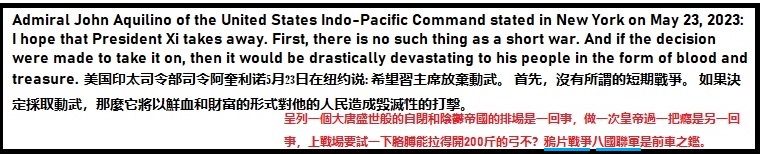
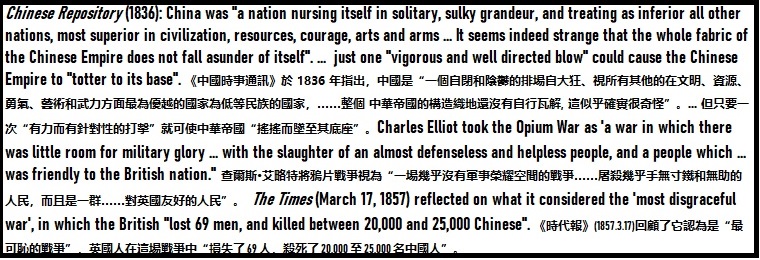



 ***
***


![Though, Anna Wang [Anneliese Martens], in her memoirs, expressed jealousy over Gong Peng by stating that the Anglo-American reporters had flattered the Chinese communists and the communist movement as a result of being entranced with the goldfish-eye'ed personal assistant of Zhou Enlai](GongPeng.jpg)