Sinitic Civilization-Book 1
Sinitic Civilization-Book 2
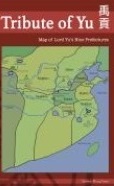
Tribute of Yu
Heavenly Questions
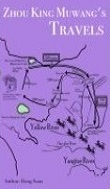
Zhou King Muwang's Travels
The Legends of Mountains & Seas
The Bamboo Annals - Book 1
The Scourge-of-God-Tetralogy:
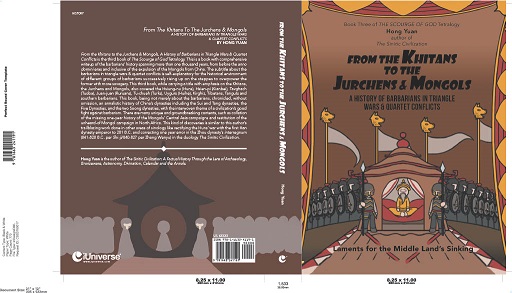
From the Khitans to the Jurchens & Mongols: A History of Barbarians in Triangle Wars and Quartet Conflicts
(available at iUniverse;
Google;
Amazon;
B&N)
|
|
America, i.e., the United States, was and is still shortsighted today, not knowing that Korea, at one time paradise of the American Evangelicals, was delivered into the hands of the Japanese imperialists as a result of the Anglo-American confrontation against Czar Russia, and in this geopolitical process, China, the land of the Great Sinitic Civilization (Barnes & Noble,
Amazon,
Google Play|Books
and
Nook Book), was made into a piggy-backed sacrificial/funereal object --the land ruled by the most evil cult called 'communism' that was an 'import' or an 'export' of Soviet Russia.
America would not learn the lesson that the geopolitical actions it is taking today would yield the 'bad fruit' 50 years or 100 years down the road.
America, and their British cousins, must have forgot the twenty-year Anglo-Japanese military alliance that allowed Japan to develop the warplanes and aircraft carriers to invade mainland China, not to mention the post-WWI ten-year arms embargo against Republic China and George Marshall's post-WWII arms embargo against Republic China 1946-1948.
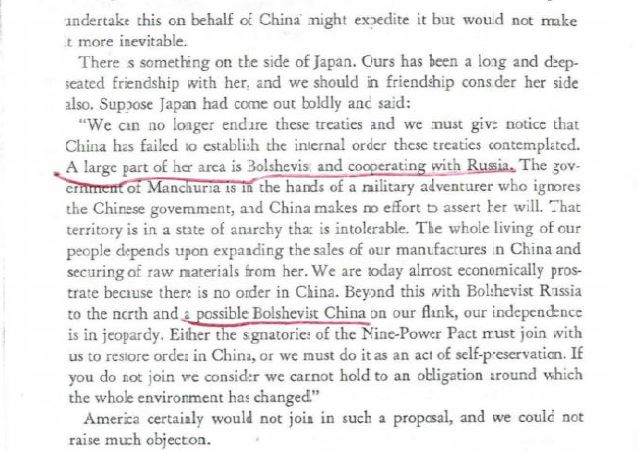
They forgot that in 1931, President Herbert Hoover gave Japan a free hand in the invasion of Manchuria on the pretext that Japan could not tolerate a half-Bolshevik China.
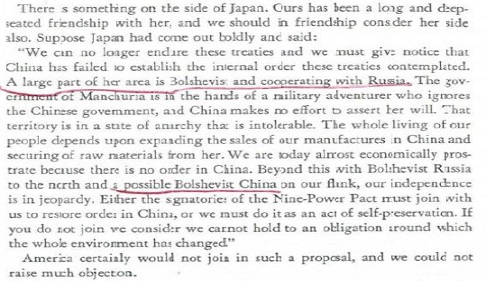 Earlier, in the 1920s, President Hoover, who personally nipped the post-WWI communist uprisings in Germany and Hungary with the grains embargo, fed Lenin the ingenuity, i.e., the [worldwide communist revolution] road to Paris lay through Peking.
They of course forgot that
after the eruption of the 1937 Sino-Japanese War, the Americans, biased towards Japan and against China, adopted a policy of "neutrality" (what Utley called by "unpositive neutrality") against the 'belligerent' countries, namely, Japan and China, which was free and unrestrained arms sale to Japan and de facto arms embargo against China.
Note that the Japanese navy had a full blockade of China's coastline.
Note that the blockade would choke China since China did not have an industrial base to produce the basic weapons while Japan's factories could roll out the warships and airplanes on a wholesale scale.
Also note that in contrast with the Americans, the European powers, being constrained by the mediation role of the League of Nations, dared not openly sell arms to Japan.
Through 1940-1941, prior to the U.S. revocation of the 1911 U.S.-Japan Commerce Treaty, the Americans were the biggest supplier of raw material, oil, aviation oil, and weapons, to the extent that some U.S. senator called by Scott making a claim that out of every one million Chinese killed by the Japanese, 544,000 Chinese were killed by the Americans.
Thirty-one U.S. congressional members made a joint declaration to the effect that the U.S., not NAZI Germany, nor Italy, was the best ally of Japan.
Earlier, in the 1920s, President Hoover, who personally nipped the post-WWI communist uprisings in Germany and Hungary with the grains embargo, fed Lenin the ingenuity, i.e., the [worldwide communist revolution] road to Paris lay through Peking.
They of course forgot that
after the eruption of the 1937 Sino-Japanese War, the Americans, biased towards Japan and against China, adopted a policy of "neutrality" (what Utley called by "unpositive neutrality") against the 'belligerent' countries, namely, Japan and China, which was free and unrestrained arms sale to Japan and de facto arms embargo against China.
Note that the Japanese navy had a full blockade of China's coastline.
Note that the blockade would choke China since China did not have an industrial base to produce the basic weapons while Japan's factories could roll out the warships and airplanes on a wholesale scale.
Also note that in contrast with the Americans, the European powers, being constrained by the mediation role of the League of Nations, dared not openly sell arms to Japan.
Through 1940-1941, prior to the U.S. revocation of the 1911 U.S.-Japan Commerce Treaty, the Americans were the biggest supplier of raw material, oil, aviation oil, and weapons, to the extent that some U.S. senator called by Scott making a claim that out of every one million Chinese killed by the Japanese, 544,000 Chinese were killed by the Americans.
Thirty-one U.S. congressional members made a joint declaration to the effect that the U.S., not NAZI Germany, nor Italy, was the best ally of Japan.
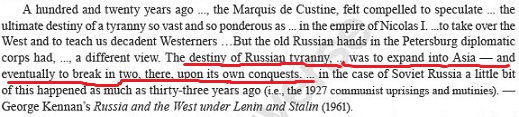 America, the 'stars' that engendered or heralded the rise of the [Japan] 'sun', long ago had the blueprint to make Japan into a stalwart against China the source of the Yellow Peril and Russia the source of the Half-Tartars, respectively, --whom the Americans could not assimilate according to George Kennan.
William Christian Bullitt Jr. (1891-1967) disclosed that the Americans' national policy or strategic aim was to see the Russians and Japanese' holding a balance of power against each other in China rather than seeing either the Russians or the Japanese overpowering the other party in taking control of China.
In making this geopolitical decision, you have victimized the 1 billion humble Chinese peasants.
(Note President Wilson's doctrine that the intactness of China was vital to the white civilization -- in the sense that the nation of China should be managed delicately, that is, should not be allowed to grow too powerful to pose a threat to the white civilization, nor should it be allowed to be hijacked by a non-U.S. power since China's immense human labor could be turned against the white civilization.
The theme of China to the white civilization, morphing superficially into a ***hypocritical*** American national policy of engagement with Communist China for changing the Chinese communists' behavior, rested on the same underlying logic:
"The
China Exception: Russian Communism being wicked, the
Chinese are good communists", which is an inherent fear
of the Yellow Peril,
i.e., billion Chinese would actually enjoy real
democracy, go to college and develop their intelligence.
Now, President Biden, a stooge of Communist China, explicitly abandoned the
hypocritical American policy of engagement to change communist China to his imbecilic communist buddy and dictator Xi Jinping.
Other than the stooge Bidens who ripped communist China's financial coffer (Tony Bobulinski FULL INTERVIEW Tucker Carlson), don't forget that President Roosevelt boasted of his family's ripping the China trade money in the 19th century, i.e., the opium trade;
and President Hoover certainly got the first bin of gold from the Kai-luan coal mine in collusion with the British during the 1900-1901 boxers' incident-related invasion.)
America, the 'stars' that engendered or heralded the rise of the [Japan] 'sun', long ago had the blueprint to make Japan into a stalwart against China the source of the Yellow Peril and Russia the source of the Half-Tartars, respectively, --whom the Americans could not assimilate according to George Kennan.
William Christian Bullitt Jr. (1891-1967) disclosed that the Americans' national policy or strategic aim was to see the Russians and Japanese' holding a balance of power against each other in China rather than seeing either the Russians or the Japanese overpowering the other party in taking control of China.
In making this geopolitical decision, you have victimized the 1 billion humble Chinese peasants.
(Note President Wilson's doctrine that the intactness of China was vital to the white civilization -- in the sense that the nation of China should be managed delicately, that is, should not be allowed to grow too powerful to pose a threat to the white civilization, nor should it be allowed to be hijacked by a non-U.S. power since China's immense human labor could be turned against the white civilization.
The theme of China to the white civilization, morphing superficially into a ***hypocritical*** American national policy of engagement with Communist China for changing the Chinese communists' behavior, rested on the same underlying logic:
"The
China Exception: Russian Communism being wicked, the
Chinese are good communists", which is an inherent fear
of the Yellow Peril,
i.e., billion Chinese would actually enjoy real
democracy, go to college and develop their intelligence.
Now, President Biden, a stooge of Communist China, explicitly abandoned the
hypocritical American policy of engagement to change communist China to his imbecilic communist buddy and dictator Xi Jinping.
Other than the stooge Bidens who ripped communist China's financial coffer (Tony Bobulinski FULL INTERVIEW Tucker Carlson), don't forget that President Roosevelt boasted of his family's ripping the China trade money in the 19th century, i.e., the opium trade;
and President Hoover certainly got the first bin of gold from the Kai-luan coal mine in collusion with the British during the 1900-1901 boxers' incident-related invasion.)
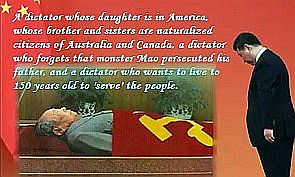 Now you, as the midwife who delivered China into the communist hands, are morally obligated to take China [and North Korea {and Vietnam}] out of communism.
This time, you may feel your hands forced as North Korea, with its nuclear weapons, could become Communist China's cecal appendix in a repeat of history.
(The Chicoms don't understand the urgency of Trump's trade war having the roots in nuclear North Korea, nor the domino effect on North Korea and Russia after the knock-out of communist China.
Putin thought he would reap profits by sitting on the fence of the U.S.-China trade war, i.e., the Zheltorossiya dream - revitalized by Aleksandr Gelyevich Dugin
[, and India would not be satisfied with grabbing South Tibet, Bhutan and Sikkim alone].
Previously, this webmaster thought that the Americans could be hoodwinked by the Chicoms who might just sign any agreement just for sake of getting a red carpet at the White House in lieu of a visit to Mar-a-Lago.
With Trump's war with Communist China flaring up, this webmaster believed that China's dictator would continue to commit blunders and became the tomb digger for the Chinese communist regime.
The thuggery communists, who would not allow the millions of the Hongkong people to have autonomy, could have caused the demise of the regime over the inevitable crackdown, not knowing that the communist ascension to power had its very roots in Churchill's collusion with Roosevelt in selling out the Republic of China for sake of retaining crown jewel Hongkong after hoodwinking Wellington Koo and Chiang Kai-shek that Britain would return Hongkong to China after Japan was to surrender so as not to damage the British wartime morale. --What happened was that Putin first jumped off the fence ahead of communist China in launching an invasion of Ukraine.)
Now you, as the midwife who delivered China into the communist hands, are morally obligated to take China [and North Korea {and Vietnam}] out of communism.
This time, you may feel your hands forced as North Korea, with its nuclear weapons, could become Communist China's cecal appendix in a repeat of history.
(The Chicoms don't understand the urgency of Trump's trade war having the roots in nuclear North Korea, nor the domino effect on North Korea and Russia after the knock-out of communist China.
Putin thought he would reap profits by sitting on the fence of the U.S.-China trade war, i.e., the Zheltorossiya dream - revitalized by Aleksandr Gelyevich Dugin
[, and India would not be satisfied with grabbing South Tibet, Bhutan and Sikkim alone].
Previously, this webmaster thought that the Americans could be hoodwinked by the Chicoms who might just sign any agreement just for sake of getting a red carpet at the White House in lieu of a visit to Mar-a-Lago.
With Trump's war with Communist China flaring up, this webmaster believed that China's dictator would continue to commit blunders and became the tomb digger for the Chinese communist regime.
The thuggery communists, who would not allow the millions of the Hongkong people to have autonomy, could have caused the demise of the regime over the inevitable crackdown, not knowing that the communist ascension to power had its very roots in Churchill's collusion with Roosevelt in selling out the Republic of China for sake of retaining crown jewel Hongkong after hoodwinking Wellington Koo and Chiang Kai-shek that Britain would return Hongkong to China after Japan was to surrender so as not to damage the British wartime morale. --What happened was that Putin first jumped off the fence ahead of communist China in launching an invasion of Ukraine.)
|
President Trump
understood the China situation and the China problem.
Should the American politicians follow the footsteps of Anson Burlingame (1820-1870),
Paul Samuel Reinsch (1869-1923)
and
Patrick Jay Hurley (1883-1963), i.e., three most prominent U.S. statemen who loved China and the Chinese people,
then the Chinese people could have a chance of salvation from the communist tyranny.
Note the historic recurrence and the repetition of similar events:
Anson Burlingame, in opposition to the anti-Chinese discriminatory whirlwinds rampant in the U.S. in the 19th century, authored the Burlingame Treaty for China and
died for China in 1870 in St. Petersburg
while still on the Manchu China's mission to the U.S. and Europe;
Paul Samuel Reinsch, who was disillusioned by President Wilson's betrayal of China over the division of WWI spoils at the Paris Peace Conference, quit the minister-to-China job to work for China and died for China in Shanghai in 1923;
and
Patrick Jay Hurley, who convinced President Roosevelt of the American moral blunders in selling out the Republic of China at Tehran and Yalta, personally travelled to Moscow and London for sake of averting and reverting China's fate of becoming a victim of WWII war spoils (i.e., the loss of Port Arthur and Hong Kong, etc.), but failed to make remedy to the secret Tehran and Yalta agreements in the aftermath of President Roosevelt's death in April 1945.
|
|
For better understanding the head-on collision between the United States and Communuist China,
refer to
the U.S.-China fatalistic conjunction through the hands of the Japanese firepower during WWII, that derived from the American unpositive neutrality;
the U.S.-China fatalistic conjunction through the hands of communist army's firepower during the 1945-1950 civil war, that derived from American-supplied Soviet August Storm weapons; and
the U.S.-China fatalistic conjunction through Joseph Stalin, Kim Il Sung and Mao Tse-ting's hands during the 1950-1953 Korean War.
|
|
|
|
More, refer to the Communist Platonic Club at wartime capital Chungking
and
The American Involvement in China: the Soviet Operation Snow, the I.P.R. Conspiracy, the Dixie Mission, the Stilwell Incident, the O.S.S. Scheme, the Coalition Government Crap, the Amerasia Case, & The China White Paper.
|
|
|
|
CROSSING THE YANGTZE
Continuing from Tragedy of Chinese Revolution, Campaigns & Civil Wars, & White Terror vs Red Terror:
1) World War II, in both the East and the West, was the result of the inducement of the British, American[, and French] interest groups and syndicates, as well as the result of the scheme by Soviet Russia. First there was the October 1925 Locarno Treaties which, per Polish foreign minister Jozef Beck, led to the opinion that "Germany was officially asked to attack the east, in return for peace in the west." Poland, as a country, was anti-Republic of China since birth, as it colluded with Japan at the 1919 Paris Conference, at the post-1931 League of Nations' conference, and at the post-1937 League of Nations' conference, in the attempt at encouraging Japan in the invasion against China to ultimately war with the Soviet Union.
In 1931, President Herbert Hoover gave Japan a free hand in the invasion of Manchuria on the pretext that Japan could not tolerate a half-Bolshevik China.
After the eruption of the 1937 war, the Anglo-Americans, still biased towards Japan and against China, adopted a policy of "neutrality" (what Utley called by "unpositive neutrality") against the 'belligerent' countries, namely, Japan and China, which was free and unrestrained arms sale to Japan and de facto arms embargo against China.
Note that the Japanese navy had a full blockade of China's coastline. Note that the blockade would choke China since China did not have an industrial base to produce the basic weapons while Japan's factories could roll out the warships and airplanes on a wholesale scale.
Thereafter the September 1938 Munich Agreement. For what? Britain, France and the United States wanted Hitler to attack the Soviet Union, and wanted Japan to suppress China's nationalist movement and counter the Soviet Union. In both cases, Stalin out-smarted the Anglo-American and the French. Hitler attacked westward instead, and signed a non-aggression pact with Stalin to halve Poland; and Japan attacked Southeast Asia and the Pearl Harbor after China, not the Soviet Union.
Half a year before the Russo-Japanese Neutrality Treaty of April 1941 and one year ahead of the Pacific War, Japan already reached a secret deal with the U.S.S.R. to halve China, mapping the "Poland partition" scheme by the U.S.S.R. and Nazi Germany, as evidenced by the clauses of the Dec 1940 negotiation and treaty between Wang Ching-wei's puppet R.O.C. government and Japan in regards to the reserved territories for the Chinese communists and the hinted Western China's boundary between the U.S.S.R. and Japan.
(More available at "Changing Alliances On the International Arena", "Century-long American hypocrisy towards China", "Anglo-American & Jewish romance with the Japanese",
"America's Unpositive Neutrality in the Sino-Japanese War",
"Joe Stilwell's Authorization To Assassinate Chiang Kai-shek", and "What Foreign Powers Did To The Flowery Republic Prior To, During And After The 1911 Revolution".)
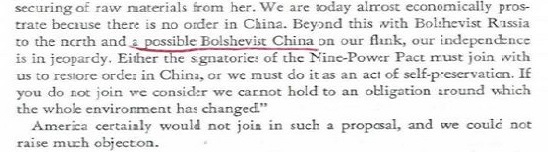
A rather simple explanation for the ultimate American intervention in China in March 1940, i.e., the Americans' hastily giving Chiang Kai-shek a badly-needed loan, would be to prevent Japan and China from reaching a truce since Chiang Kai-shek deliberately spread a rumor that his Chongqing government could merge with the puppet Nanking government.
As Paul Reinsch and Arthur Young repeatedly said, the United States of America could have done just a little to help China in WWI or WWII, but chose to do nothing during WWI other than a Lansing-Ishii Agreement [which was to acknowledge that Japan had its special interests (in the specified areas of China specified by the secret memorandum)], chose to do lip-service to Wu Peifu's ROC government while the Soviets equipped Feng Yuxiang and Sun Yat-sen's military factions with free guns; chose to do nothing after making sure China was to stay in the Second World War by merely granting the currency stabilization loan of 1940; and chose to use the Lend-Lease coercion to force China into throwing the crack troops at northern Burma just prior to the Japanese Ichigo Campaign in 1944.
2) Stalin was the evil genius of the 20th century. Stalin, after the 1929 war against Zhang Xueliang over the Chinese-Eastern Railway [which erupted over the Soviet Russian and Chinese communist agitation in sabotaging Japan's attempt at building five additional railways in Manchuria and Inner Mongolia], quickly divested himself of the railway when Japan invaded Manchuria on Sept 18th, 1931. After initially calling on the world communists to militarily defend the Soviet Union from 1931 to 1933, Stalin subsequently designed the united front and popular front in 1935, and in the time period of 1936-1937 successfully lit the fuse of the Sino-Japanese War by means of repeated G.R.U. operations in northern China and Manchuria.
To thwart the Anglo-American attempts at using Japan against the U.S.S.R., Stalin hijacked the American government policies by utilizing agents, saboteurs, provocateurs and sympathizers from the Institute of Pacific Relations. "16 out of 17 of the AMERICANS that were involved in creating the U.N. were later identified, in sworn testimony, as secret communist agents." The whole United States government was in fact taken over by the Comintern agents, including: Alger Hiss; Harry Dexter White; Lauchlin Currie; Laurence Duggan; Frank Coe; Solomon Adler; Klaus Fuchs; and Duncan Lee."
John Fairbank and Owen Lattimore, i.e., two "Old China Hands" who were repeatedly cited by the Chi-com for substantiation of the cause and success of the Chinese communist revolution, had merely been the Soviet Russian and/or Chicom tools. (Most of the Comintern spies of the European and American background had been recruited during their stay in China during the turbulent 1920s. Note that 95% of the Comintern agents sent to China were American Jews and 100% of the Soviet Red Army G.R.U. agents sent to China were German Jews. Owen Lattimore's belief and orientation should have been shaped during his early years in Peking in the 1920s. John King Fairbank, who had done everything Agnes Smedley had asked him to do other than putting his name on the roster of the G.R.U. (Main Intelligence Directorate of the General Staff of the Armed Forces of the Russian Federation), was a member of the Chinese League for the Protection of Civil Rights in late 1932 and early 1933, and further rafted with Comintern agent Harold Isaacs on the Jehol River in 1934 before the latter switched to the Trotskyite path. Working directly under Lattimore would be two Chicom spies called Chi Chao-ting and Chen Han-sheng who designed America's China policies.)
3) It was the century's misfortune for China to have to see the Anglo-American interest groups and Russian/Comintern agents colluding with each other in subverting Nationalist China
--
the last bastion against the imperialists and colonialists and
the beacon tower
for the independence of all Asian countries and people
, colonized or semi-colonized by the West,
as "...British Ambassador personally suggested to me [Albert Wedemeyer]
that a strong unified China would be dangerous to the world and certainly would jeopardize the white man's position immediately in Far East and ultimately throughout the world."
No matter it was the 1904-05 Russo-Japanese War, or the Japanese invasion of Manchuria in 1931, or the 1937-1945 Sino-Japanese War, the aforesaid parties, plus the Chinese communist henchmen, were the ONLY people who wanted Japan to invade China, albeit for different reasons and agenda at different stages and times.
In another word, the Japanese never realized that they had been brought up and used as a tool since Matthew Perry's timeframe, first as a tool against Russia in 1904-5 and then used by the Soviets as a tool against China.
"When other nations tried to bar ... [Japan] progress or slur ... [Japan] reputation," as commented by Inazo Nitobe:
"America always stood for ... [Japan] ...[America's] Stars heralded to the world the rising of ... [Japan] Sun..."
The warships and planes built and used against China in 1931/2 were the products of twenty years of military alliance between Britain and Japan,
following the American support of the Japanese ventures against Ryukyu and Taiwan in the late 19th century.
(Do not forget the post-WWI ten-year arms embargo against Republic China and George Marshall's post-WWII arms embargo against Republic China 1946-1948, as well as
the synarchists' backing Japan's war against China and Sun Yat Sen.)
4) There is no truth in Stalin and Truman racing against each other as suggested by Tsuyoshi Hasegawa. While Truman was blindfolded as to the making of the Atomic Bomb, the Russians had been receiving ships of the uranium ore throughout the war, which was to make sure that the United States was not to become the nuclear monopoly. Stalin's American proxies already had Truman agree to the terms reached by Roosevelt at Yalta. The United States had utterly no preparation for racing its army to Japan or Korea. "It was after the U.S. dropped two bombs onto Japan, on Aug 6th & 9th, respectively, that Rusk & Bonesteel, drew up the 38th Parallel on the map as an artificial division line separating the U.S. sphere of influence from the U.S.S.R.
(The Japanese, of course, don't know that they were used as a tool against China.
Working as a secretary of the Japanese prime minister Konoye Fumimaro as one of the five brain trusts, Stalin's spy Ozaki,
likening Japanese prime minister Konoe to Alexander Kerenski (head of the 1917 transitionary Russian government),
wanted to turn Japan into a replay of the Soviet revolution.
How brilliant it was to hit two birds (China and Japan) with one stone!
It was the Tokyo Special Higher Police, 'tokko' or 'tokubetsu', who broke the Sorge-Ozaki spy rings in China and Japan, not the Japanese military kempeitai or the Japanese military that was permeated with the JCP and Tobun [same language] Academy spies.
Do you Japanese know that?)
5) Japan already explored with the Soviets for surrender. But the Soviets declined it. Otherwise, what's the need to enter Manchuria and Korea? Since the Russians were eager to invade Manchuria & Korea, Japan had to turn around to request with Sweden for relaying a message of surrender.
Japan was in self-denial over the prospect of the Russian entry into war. Intelligence already poured into Japan as to the Russian complicity at Yalta. Back on June 9th, 1945, Truman officially told TV Soong (Soong Ziwen) that he was to honor the late President's signature on the Yalta Agreement and requested that China dispatch a delegation to Moscow for stamping a Sino-Russian friendship agreement no later than July 1st. The Chinese were busy repairing the damages. Japan knew about it. Japan sent secret negotiators to Chiang Kai-shek multiple times in July-August of 1945 for the peace talks. Looking in hind sight, China, separately, should have struck a partial peace with Japan to ward off the Soviets.
(When the Soviet Red Army invaded Manchuria, Japan, who had issued orders to its armies to surrender across the battlefields of China and Southeast Asia, had to make a special order to the Kwantung Army to resist the Soviet Red Army in Jehol, Manchuria, and the Sakhalin for about 20 days for sake of stopping the Soviets from landing in Hokkaido.)
6) Though, the Japanese emperor played a trick in surrender. He signed a "truce" order to his army and listing Britain, American and China and etc., but when he made the announcement on radio, he changed China to Chungking [Chongqing] the Chinese interim capital. We know Japanese have a problem with saving face. But the truth is known no matter how the professor wanted to discount the atomic bombs and gave weight to the Russian entry into the war. Professor Tsuyoshi Hasegawa, who skipped the name of China in his book title and ignored the death toll of 1 million Japanese on mainland China, should spend more time researching into the fate of half of the 500-600,000 Kwantung Army that had perished in Russian Siberia.
Konoe Fumitaka, i.e., son of imbecilic Japanese prime minister Konoe Fumimaro who designed the policy of "Shokaiseki o aite to sezu", was exiled to Siberia by the Soviets
and just days before repatriation in the late 1950s, could have been killed by the Soviets.
(From the memoirs related to some Taiwan native who joined the Japanese Kwantung Army and was later exiled by the Soviet Red Army to Siberia for the coolie labor, the Soviets, to help Mao Tse-tung and Kim Il Sung, on a wholesale scale, in 1947 repatriated the Korean-ethnic Japanese Kwantung Army prisoners of war to North Korea and the Taiwan-ethnic Japanese Kwantung Army prisoners of war to Manchuria, as fodder of war, which probably explained why there was no accounting of some huge numbers of the Japanese Kwantung Army troops in the later repatriation to Japan and the Republic of China's generals kept mentioning that the Koreans and the Japanese were manning the guns and the tanks of the Chinese communist army.)
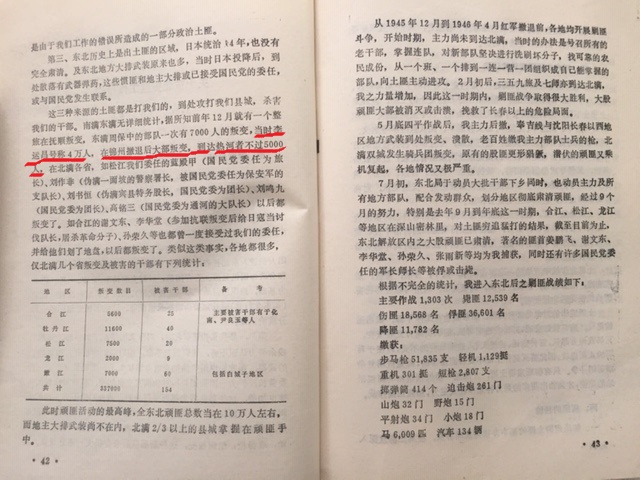
The Soviets sorted out at least 30,000 Japanese artillery troops, medical Kwantung Army staff, a full airforce contingent with generals and crewmen under Hayashi Yayichiro, and no less than two full Korean-ethnic divisions for deployment by the Chinese communists in the civil war against the Nationalist Chinese Government, not to count the Outer Mongolian Cavalry and 100,000 fully-trained Korean mercenaries sent to China in 1947, with about 60,000-70,000 remnants [out of the total headcount of 250,000 Korean mercenaries] shipped back to Korea prior to the Korean War of June 1950. According to Kim Il-sung, altogether 250,000 Korean mercenaries took part in the 1945-1950 civil war against the Nationalist Government, with 60,000-70,000 remnants surviving the bloody Chinese civil war to return to Korean for the 1950 Korean War.
Note the fundamental difference between the 250,000 ethnic-Korean Japanese Kwantung Army diehards and the ethnic-Korean Chinese living in China.
The communist statistics claimed that altogether 65,000 ethnic-Korean Chinese minority people, or the Korean migrants living in China, joined the communist army, with approximately
60% coming from the Jirin subprovince,
21% from the Sungari subprovince, and
15% from the Liaodong subprovince.
7)
Stalin and the Soviets were behind each step of monster Mao Tse-tung in making sure that no peace could have a chance from the day Japan surrendered. Cumulatively, the Soviet Russians acknowledged in the 1970s that they had given the Chinese communists 700,000 guns, with North Korea's arsenals open for free pickup throughout the Chinese civil wars. (On the 1947 anniversary date of the Russian Revolution, the Soviet Russians already disclosed that they had given the Chinese communists massive military aid - which the Americans refused to acknowledge.) At about the same time the Republican Party forced through the China Aid Act in 1948, Stalin officially stamped a loan for the Chinese communists of an equivalent amount allocated by the China Aid Act, with no strings attached.
Stalin understood that the generations of brave Chinese during first part of the 20th century were the flower that China ever had in the whole history of 5000 years, a force that must be destroyed so that the Soviet Russian scheme at world domination could succeed.
Didn't know the Russian cold-bloodedness? Read into the Katyn Murder of 20,000+ Polish officers, and Stalin's plan to shoot 50,000 German officers- which Roosevelt echoed by lessening to 49,500.
Separately, Stalin disclosed to the son of Chinese president that he wanted to imprison 500,000 to 600,000 Japanese lower-level officers and 12,000 Japanese generals for preventing the Japanese from rising up again to pose threat to the Soviet Union.
Likely, Stalin passed on a suggestion to McArthur to arrest 8000 to 12,000 Japanese generals.
(Numerous nationalist army generals, who survived the valiant wars against the Japanese invasion, would be imprisoned and executed by the communists from 1949 to 1975. E.g.,
Lu Shiyang was executed by the communists in 1951 simply because he was a former Nationalist Army company commander even though he left the army after the VJ (victory over Japan) day in 1945 and never ever fought against the communist army.
Wu Dehou, released by the CCP's amnesty on Dec 15th, 1975, returned to his impoverished Shanxi Province countryside as a peasant.
Du Yuming, the war hero on the Burma Theater, was released from over 10-year long prison sentence on Dec 4th, 1959 in accordance with the CCP's 17 Sept 1959 First Amnesty Order for sake of having him show off at a diplomatic meeting in April 1960 with former British General Montogomery as well as for sake of instigating the return of his son-in-law, i.e., noble prize winner Yang Zhenning.
The Nationalist Army colonel-level officers, about one tenth of the total captives rounded up in the communist provincial quasi-prisons since the 1950s, survived the execution, torture and hunger to get amnesty in 1975.
It would be in 1985 that the CCP first declared the title of 'national heroes' for 85 Nationalist generals who sacrificed their lives in the Resistance Wars Against Japan.)
As this webmaster had elaborated on the battles and campaigns in Civil Wars section,
the Chinese Civil War of 1945-1950 [using the Korean War as a breakpoint rather than the PRC's proclaimed date of founding] is the "Last Duel of the Middle Earth"
involving millions of the fighting-to-death Yellow Men,
with the outcome determined on the battlefields by means of a) the military tactics and strategies,
b) political conspiracy and plots, c) economic manipulation and sabotage, c) societal disruption and coercion,
and d) international alliance and betrayal, never ever the free choice of the Chinese people or the 'Mandate of Heaven' as John Fairbank and Owen Lattimore
[and their student-sinologists in the American colleges and universities] wanted you to believe in.
|
The brave R.O.C. soldiers against the armed-to-the-teeth Japanese Army
After squandering the 1st tier troops of 1st-20th Shidans and 2nd tier troops of 100th-120th Shidans in the "yocho" (penalizing) action against China, the Japanese sent the demoralized Shidans
to the Pacific War graves, to the extent that by the time Japan surrendered, the Japanese homeland soldiers of 1-2 million new recruits possessed bamboo sticks and spears
for defense, while the Soviet/Comintern agents inside of the Japanese government/military, in the name of moving the duel battlefield to the mainland, hoarded large cache of weapons in Manchuria/Korea for free pickup by the Soviets and the
Chinese/Koreans.
Working as a secretary of Konoye Fumimaro the Japanese prime minister as one of five brain trusts, Stalin's spy Ozaki,
likening Japanese prime minister Konoe to Kerenski (head of the 1917 transitionary Russian government),
wanted to turn Japan into a replay of the Soviet revolution.
(It was the Tokyo Special Higher Police, 'tokko' or 'tokubetsu', who broke the Sorge-Ozaki spy rings in China and Japan, not the Japanese military kempeitei or the Japanese military that was permeated with the JCP and Tobun [same language] Academy spies.
Do you Japanese know that?)
|
|
|
The brave and victorious National Revolutionary Army (NRA) of the Republic of China chased the remnant communists to the north bank of the Sungari River.
|
|
The Americans sold out China in Tehran, Yalta and Potsdam. In late 1944, American navy general Leahy was probing China about the Soviet demand for Dairen, Port Arthur and the railways. Roosevelt locked up the secret treaties in his drawer till his death. Both Hurley and Leahy merely knew part of the Roosevelt's secret deals with Stalin. Truman pressured China numerous times demanding that China sign an agreement with the Soviets no later than July 1st, 1945. Late 1945, George Marshall and the Americans continued to sell out China on the matter of the Soviet pillage of Manchuria, and held a U.S.-U.K.-U.S.S.R. three-country foreign ministers' meeting, to demand that the Republic of China must talk peace with the communists --namely, the imposition of a worldwide arms embargo against the Republic of China.
Marshall, in the spring of 1946, flew back to China to stop the Chinese army from moving beyond the Sungari River.
As disclosed by the documents at the George Marshall foundation, George Marshall, possibly the most hideous agent working on behalf of Stalin and the Soviet Union, saved the ass of the Chinese Communists with a threat to withhold the economic aid that was supposedly coming from the U.S. export-import bank, which never materialized.
|
|
|
|
G Marshall, from 1946 to 1948, repeatedly probed numerous Chinese officials and generals as to who could be Chiang's successor.
The U.S. Department of State, run by the Russian agents, were repeatedly sending out rumors about getting a successor for Chiang. Marshall's hands had the blood of millions of Chinese killed in the civil wars.
G Marshall, as Wedemeyer said, first armed China and then disarmed China.
This was what Wedemeyer, after taking over Stilwell's job, began as the 30-division training place in the spring of 1945 --that did not get fully started before it was scrapped, with Shi Jue's 13th Corps going into Manchuria in the spring of 1946 with one third of the American-supplied training ammunition, for example.
The U.S. arms embargo continued till the China Aid Act of 1948, and ammunition did not get released till Nov of 1948.
After weapons were shipped
out, Acheson and the undercover Russian agents further attempted to order the ships to turn around at Guam, Saipan and Okinawa.
In Oct 1949, Acheson pleaded with the British, where the Cambridge Soviet Spy Ring was at work, for recognition of Communist China, which Britain did on Jan 1st, 1950.
After that, Acheson declared the Aleutian curvature, which directly led to the eruption of the Korean War.
The Korean War and the Vietnam War, invariably, were the extension of the Chinese Civil War of 1945-1950.
|
The Crossing-Yangtze Campaign
On Jan 1st, 1949, Mao Tse-tung issued a call in "Exerting the revolution to the end" in the New Year Day's speech.
Meanwhile, the underground communists in the government-controlled areas, in collusion with American ambassador Stuart Leighton, had been spreading the rumors that should Chiang Kai-shek resign the presidency then the Americans would begin to provide aid to the Chinese National Government.
Chiang Kai-shek, under pressure, resigned the presidency but tricked deputy president Li Zongren by making the resignation a matter like an absence of leave and having the announcement made to make Li Zongren tack on the acting presidency.
In his memoirs, Chiang Kai-shek stated that he was holding out the whole winter in order not to resign to demoralize the troops at the front line.
Contrary to the Chinese communists' befuddled claim that Stalin had ordered the communist army to stop at the northern Yangtze bank, Ledovsky, i.e., Stalin's China matter advisor, pointed out that Stalin repeatedly asked Mao and the Chinese communists to cross the Yangtze and attack south.
Mao's reply was that the Chinese communists did not have enough city-born cadres to take care of the metropolitan city of Shanghai once it was to be taken.
Stalin countered Mao with the Soviet experience in managing the cities in the Russian civil wars.
Certainly, the entire sinologists' world was immersed in the simplistic and idiotic interpretation of the Soviet embassy's relocation to Canton [while John Stuart Leighton and the American embassy stayed behind in Nanking to greet the communist conquest army].
So naive !!! [This 'naive' was an epithet of the communist traitor-son party secretary Jiang Zemin, by the way.)
From mid-Jan to early March, the communist troops converged around Zhoukou of Henan Province for one month long political studies. The Communists re-organized the fighting flanks by naming the CCP Central Plains Field Army to the People's Liberation Army 2nd Field Army [2FA]. The former organization of "zong dui", which could be as less as 10,000 men or as many as 100,000 men, was officially converted to the army corps. Qin Jiwei's 9th "zong dui", at Suxian of Anhui Province, was renamed to the 15th Corps under the 4th Army Group of the PLA 2FA. In late Feb, the PLA command center designated the 15th Corps as the 2FA's herald troops for the Yangtze crossing. Departing Zhoukou on March 5th, Cui Jian'gong's 45th Division, Zhang Xianyang's 43rd Division, and Xiang Shouzhi's 44th Division made a stealthy march towards the Yangtze riverbank through Mt. Dabieshan, i.e., a former Red Army enclave of the 1930s but no longer a pro-communist citadel after the Red Army vacated the place in the aftermath of massive bodily purge conducted by Zhang Guotao's Red Army 4th Front Army. 23 days later, on March 27th, the 15th Corps, after a trek of 750 kilometers, arrived on the riverbank and, en route, routed the cities of Yingshan and Luotian in Hubei Province and Taihu and Wangjiang in Anhui Province.
The R.O.C. government troops, after the calamity from the Xu-Beng Campaign which saw thousands of Soviet-supplied communist artillery blanket-bombing the government troops to death, had basically abandoned the positions north of the Yangtze Bank. Chiang Kai-shek claimed that he had delayed the resignation of presidency because he was too concerned with the fate of Du Yuming's army group to shake up the soldiers' will.
More available at YangtzeCampaign-v0.pdf.
In the spring of 1945, the Chinese communists, prior to the Soviets' non-renewal or nullification of the 13 April 1941 neutrality treaty with Japan, had debated among themselves as to the next move but were split about Stalin's possible move, namely, whether the Soviets would renew the treaty with Japan or not, with communist Chen Yi giving Jack Service a so-called [explorative] "Manchuria Plan", a document that some undercover American communist in the American military delegation had destroyed to help cover up the so-called communist masterplan --something Jack Service cited as his loyalty before the McCarthy inquisition committee in the 1950s.
It would be at the turn of September-October of 1945, when Mao was in Chungking for the peace talks, that communist deputy chief Liu Shaoqi changed Mao's southern advance masterplan to the Manchuria plan.
The Communist party committee for the Hebei-Rehe-Liaoning regions, at a meeting held in the Fenglunxian County, purportedly made a decision to dispatch to Manchuria 8 regiments, 1 battalion, and two contingents, totaling 13,000 men or 2/3rd of the regional force, to be commanded by four commanders for military sub-districts, four CCP regional secretaries and 2500 cadres.
Li Yunchang, i.e., commander-in-chief of the Hebei-Rehe-Liaoning district, was put in charge of the "Eastward March Work Committee".
In late Aug, the 14th, troops of the 15th & 16th military sub-districts under Li Yunchang exited the passes of the Great Wall for Manchuria.
Zeng Kelin & Tang Kai, with the 12th & 18th regiments, the Korean contingent & Lin Fuchang's contingent, circumvented the Shanhaiguan Pass by exiting the Jiumenkou gate.
Zeng Kelin had only four companies' strength, not a regiment.
Upon meeting the Soviet Red Army, Zeng Kelin's ragged communist army herald troops were disarmed by the Soviets as bandits.
Li Yunchang, in late 1945, suffered a complete debacle in the hands of the nationalist 52nd Corps and the 13th Corps, with his 40,000 strong communist army reduced to 5000 men after the Battle of Jinzhou. (Don't get obfuscated by the fake number of 1.2 million communist troops [such as Li Yunchang's ragtag puppets-staffed 40,000 troops which were reduced to 5000 men after the 1945 Battle of Jinzhou], that Mao wanted Chiang Kai-shek to reorganize into 16th corps or 48 divisions at the Chungking peace conference.)

Zeng Kelin joined the Red Army as a sixteen-year kid in the late 1920s.
Li Yunchang was a Hebei-Jehol native who was recommended to the Whampoa Academy by Li Dazhao, lost contact with the communists after a brief arrest during the KMT-CCP split of 1927, and returned to the hometown where he reconnected with the communists prior to the 1937 Japanese invasion.
In another word, Li Yunchang was part of the communist cells related to the 1936 Japanese "anti-communist" puppet government in Tongzhou.
Li Yunchang, like communist Tao Zhu, was rounded up as part of the communist elements in the Whampoa Academy.
It appeared that the communists safely left the Whampoa Island rather than being machine-gunned down as the communist propaganda stated.
Before the communists launched the Canton Mutiny, over one hundred communist Whampoa cadets, including Tao Zhu, escaped prison after some clandestine manipulation to get the hundred plus captives transferred to the city from the Whampoa Island.)
The Korean contingent, which was later renamed to the Li Hongguang Detachment, was named after a Korean communist who died in 1935, possibly hinting at the members of this force to be consisting of part of the Korean Restoration Army that was steered to the communist side by the American O.S.S.
What could have happened was that the cadres of the Korean Restoration [Liberation] Army, now controlling the "Li Hongguang [Korean] Detachment", were to become the military leaders of
250,000 Korean mercenaries,
i.e., 250,000 ethnic-Korean Japanese Kwantung Army diehards or the prisoners of war
repatriated to North Korea from Siberia,
with 60,000-70,000 survivors to return to Korea in 1950 to be the driving force for the invasion of South Korea, namely, the ultimate Yenan faction that Kim Il-sung destroyed in the late 1950s for consolidating the Kim Dynasty.
Stalin, in addition to sorting out the 250,000 Korean puppet army troops, had sent all Taiwan-ethnic Japanese Kwantung Army soldiers to Mao Tse-tung.
The end result was that the Korean-ethnic and Taiwan-ethnic Japanese army manned the artilleries and tanks against the Republic of China.
How ironic it was.
Note that the Jehol area used to be the guerrilla army under Youth Party leader Zhao Tong who fought against the Japanese since 1931-1932. To prevent Zhao Tong's Jehol Vanguard Army, about 200-300 men and women, from returning to Jehol from Chungking, the communist armies, with advance information from communist leader Zhou Enlai who superficially participated in the farewell ceremony for the march of the vanguard army in Chungking, pooled resources all over the military districts including Heh Long's communist army from northwestern Shanxi and Suiyuan area, and ambushed and eliminated the vanguard army in the tri-provincial area of Shanxi-Henan-Hebei around the turn of 1939-1940.
The communists, in the Chahar-Suiyuan area and around Mt. Daqingshan [the great green mountain], had conducted similar horrifying campaign against the patriotic guerrilla forces, including the fire attack that killed a 90-year-old former Northeastern Cavalry Army corps commander and his guerrilla army, and furthermore attacked and eliminated KMT party operator Chen Jianzhong's party-directly-controlled guerrilla forces and all couriers who were sent through the communist-controlled territories of Shanxi-Shenxi, with Chen Jianzhong being the sole survivor to return to Chungking in disguise.
According to Liu Tong, a professor at the Chinese Communists' army college in Peking, the CPC troops, when exiting the Sea and Mountain Pass at the end of 1945, possessed the following weapons: 39641 rifles, 1139 light machine guns, 105 heavy machine guns, 59 grenade launchers, and 64 mortar, and almost no heavy weapons such as howitzers, tanks, aircraft, ... nothing. A few months later, the communist army acquired 160,881 rifles, 4033 light machine guns, 749 heavy machine guns, and a variety of artillery pieces numbering 556.
(The number of 39641 rifles, being like one fourth of the total 140,000 broken guns that Mao Tse-tung initially said he had at the Chungking peace talks, were not for the Jehol military district but the total communist armies sent to Manchuria, including the 8RA and N4C armies that crossed the sea to Manchuria from the Shandong peninsula.
After eight years' war, what a sham the communist army was in merely possession of 39641 rifles.)
In late September of 1945, when Zeng Kelin's herald communist troops, a small force of four companies from the Jehol district, exited the Sea and Mountain Pass and arrived in Shenyang [Mukden], the Soviet Army had transferred arsenals in Shenyang, Fushun, Liaoyang, Benxi and other places, in addition to the military clothing warehouses. The Soviets handed over to Zeng Kelin's communist army the largest of the Japanese Kwantung Army depot in Sujiatun. After a protest from the R.O.C., the Soviet Army in late September had a temporary freeze order on these warehouses. However, Zeng Kelin's communist army still managed to ship out of the warehouses 20,000 rifles, 1000 light machine guns, and 156 various artillery pieces.
Zeng Kelin's forerunner Communist force, i.e., four companies, developed into 4000 soldiers in a matter of one week after arrival at the Shenyang city, and moreover, absorbed over 10,000 puppet constabulary forces; about 10000-20000 coolies, who were formerly captives from the Chinese armies, were organized into the guerrilla columns for entry into the Changchun city; in Shenyang, Zeng Kelin reported that weapon depots were packed with 100,000 guns and thousands of cannons; and the puppet Manchukuo forces were in waiting mode for re-organization.
(The communist army, of course, was totally destroyed after the Battle of Siping-jie, with the puppet Manchuria army and constabulary troops defecting to the government side en masse.
The communists had to launch a bloody land reform to reorganize an army in 1947, plus requesting for reinforcements with Kim Il-sun [who in his memoirs claimed to have supplied altogether 250,000 Koreans to the Chinese civil war].)
In a matter of months, the various communist units, before and after, had a net gain of more than 120,000 rifles, 3,500 light machine guns, thousands of grenade launchers, and a variety of artillery in the amount of 492 pieces.
The continuous Soviet military supplies not only equipped the communists in Manchuria, but also lent support to the follow-up communist forces, local communist guerrillas, as well as the communist army units in the "liberated" areas [in China proper].
Zeng Kelin's communist army in October 1945 pulled out of the warehouses for delivery to [Wang Zheng's] 359th Brigade [in Yenan - should be part of Li Xiannian's Central Plains communist army in Henan, that got wiped out in early 1947 while attempting a breakout under the kmt-ccp-u.s.a. truce monitoring], the communist army in central Shandong and eastern Shandong, the 1st Teaching Brigade from Yan'an and other troops.
Over the sea, the communists shipped to Longkou of Shandong a batch of weapons, ammunition, of which there were 500 million rounds of ammunition, and artillery shells.
On September 21, 1945, the CCP Central [in Yenan] reported to the Chongqing delegation [i.e., Mao Tse-tung], stating that Nie Rongzhen's Jin-Cha-Ji District had telegrams stating that the Soviet-Mongol armies, before pulling out of Chahar [[and of course Jehol - my addition]] that was scheduled for the end of the month, had transferred and would transfer some military goods to me [i.e., the communists], and promised to provide assistance to me [i.e., the communists] in the future.
There were quite some telegrams from Nie Rongzhen's Jin-Cha-Ji District and the Shanxi-Suiyuan communists to the effect that they had acquired weapons from the Soviet Army.
As Zeng Kelin recalled, in September and October 1945, his [communist] unit had more than once shipped massive amount of weapons and ammunition, from Shenyang and Jinzhou [in Manchuria], to the communist brotherly forces within the Sea and Mountain Pass and the communist forces of Shandong [i.e., Chen Yi and Su Yu's communist army].
TEN TRAINS EQUIVALENT AMERICAN LEND-LEASE WEAPONS THAT STALIN & RUSSIANS GAVE TO MAO & CHINESE COMMUNISTS;
FORTY SHIPS EQUIVALENT QUANTITY OF TANKS & CANNONS, BOTH AMERICAN-MADE & JAPAN-MADE
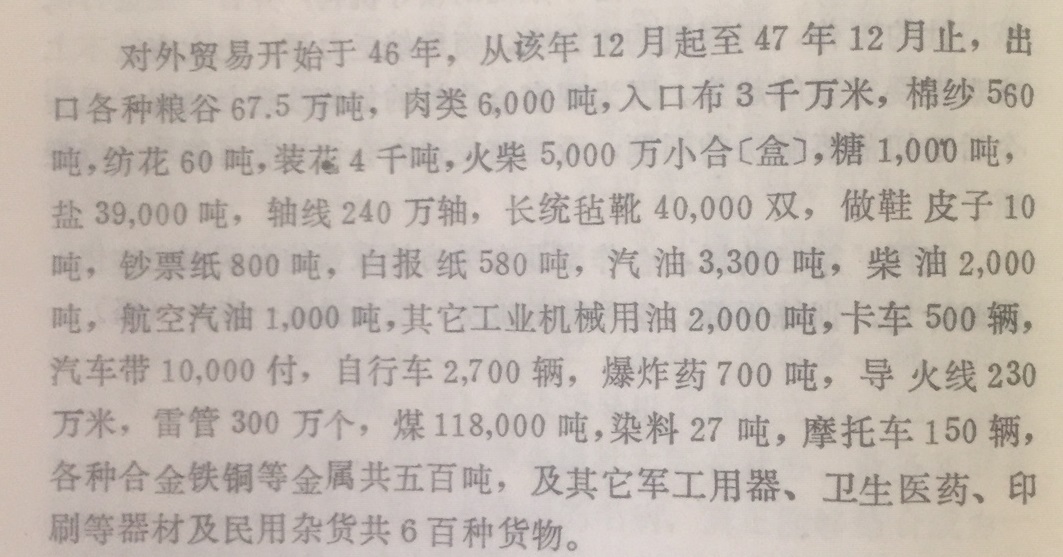
3300 TONS OF PETROL FROM RUSSIANS IN 1947 ALONE; PLUS 2000 TONS OF DIESEL, 1000 TONS OF PLANE FUEL, 700 TONS OF EXPLOSIVES & 2000 TONS OF MACHINERY OIL
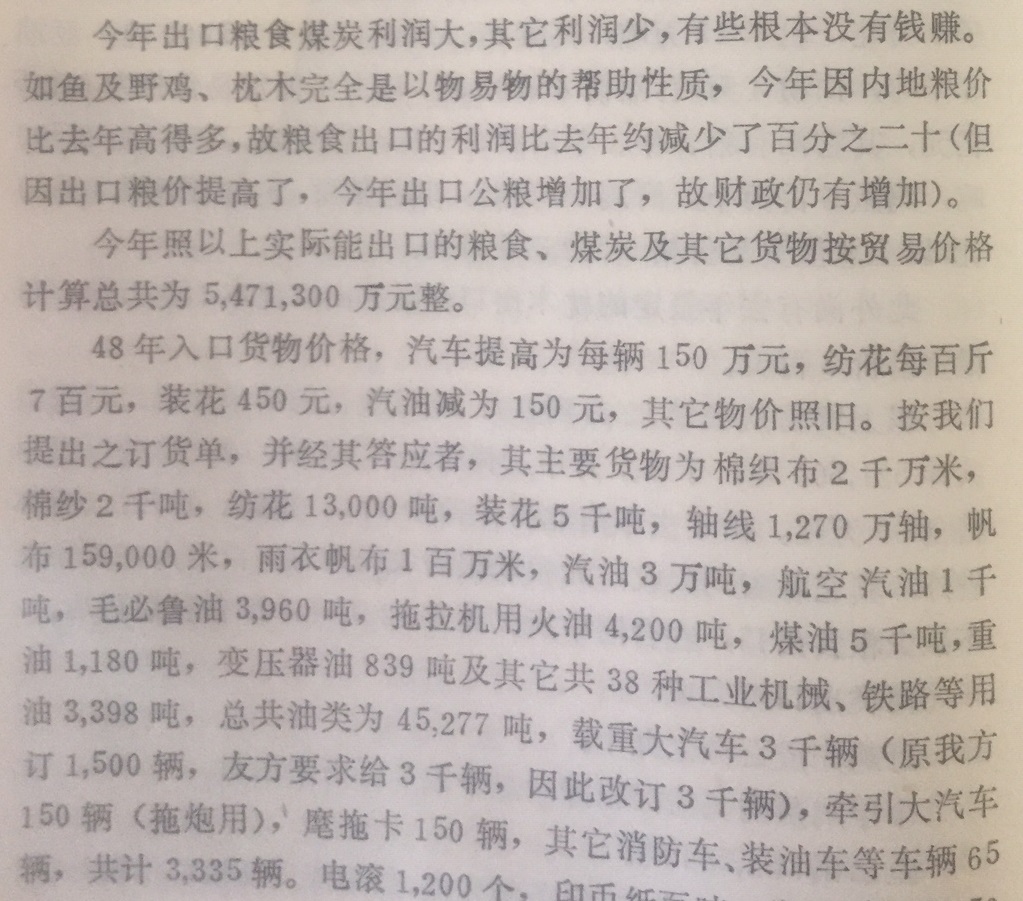
30000 TONS OF PETROL FROM RUSSIANS IN 1948; PLUS 1000 TONS OF PLANE FUEL, 5000 TONS OF KEROSINE, 3000 HEAVY WEIGHT TRUCKS & 150 ARTILLERY TRACTORS
DEATH OF MILLIONS OF YELLOW MEN, & POSSIBLY MORE IN THE FUTURE WAR AGAINST TAIWAN !!!!!
Reference: see the writing by James Perloff China Betrayed Into Communism on Friday, 24 July 2009 at
http://www.thenewamerican.com/index.php/history/world/1464
August Storm lend-lease weapons ended up in Mao's hands.
"At the Teheran and Yalta wartime conferences, however, Roosevelt asked Stalin if he would break his pact with Japan and enter the Far East war. Stalin agreed, but attached conditions. He demanded that America completely equip his Far Eastern Army for the expedition, with 3,000 tanks, 5,000 planes, plus all the other munitions, food, and fuel required for a 1,250,000-man army. Roosevelt accepted this demand, and 600 shiploads of Lend-Lease material were convoyed to the USSR for the venture. Stalin's Far Eastern Army swiftly received more than twice [should be 5-10 times] the supplies we gave Chiang Kai-shek during four years as our ally.
"General Douglas MacArthur protested after discovering that ships designated to supply his Pacific forces were being diverted to Russia. Major General Courtney Whitney wrote: 'One hundred of his transport ships were to be withdrawn immediately, to be used to carry munitions and supplies across the North Pacific to the Soviet forces in Vladivostok.... Later, of course, they were the basis of Soviet military support of North Korea and Red China.'
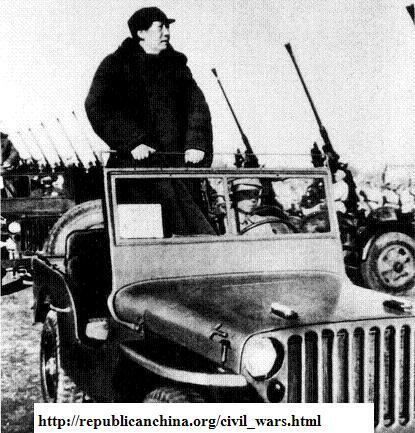
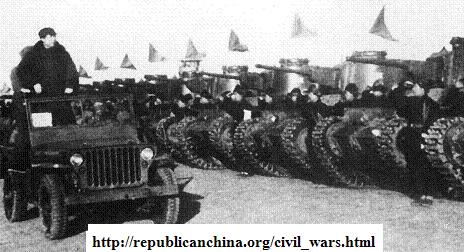
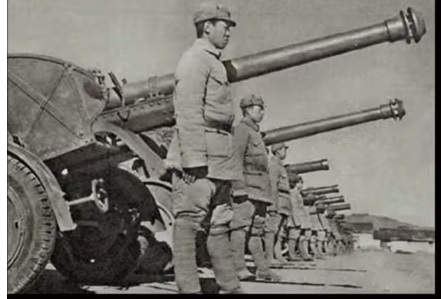
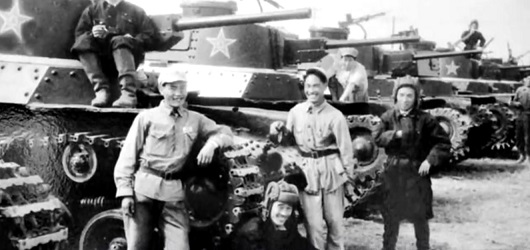
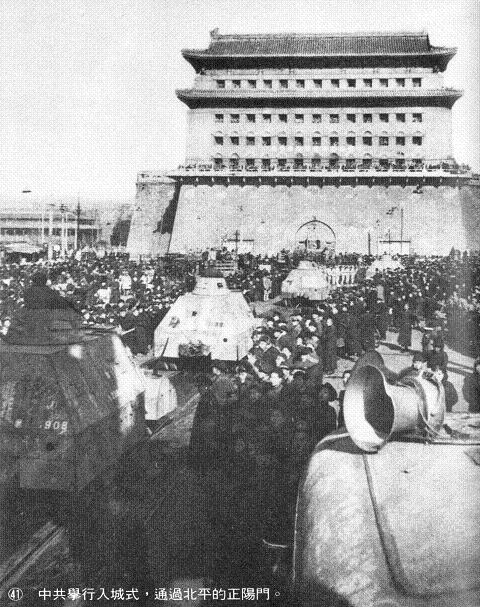
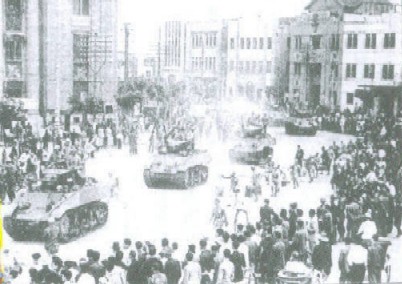 The pseudo-encyclopedia website like wikipedia also made the fallacious claim that would make the Chinese communists laugh to the teeth:
"However, the nearly nonexistent Soviet help proved not to be a problem for the Communists; in the meantime, the huge Communist need was filled by an unexpected source: their adversaries, the Nationalists. Due to the fatal mistake the Nationalists made in their demilitarization, the Communists were able to pinpoint nearly every Japanese secret depot with the help of former Nationalist troops in their ranks, and the total amount of Japanese weaponry recovered was enough to sustain the Communists for 2 years before relying on captured American weaponry from the Nationalists in the later stage of the war. For example, a single secret depot typically contained as much as 150,000 artillery rounds. By February 1947, hundreds of artillery pieces were recovered by the communists, including: 49 howitzers, 300 heavy mortars, 137 anti-aircraft artilleries, 141 anti-tank guns, 108 mountain guns, 97 cannons, and many other smaller artillery pieces, almost one-third of the Nationalist weaponry."
The pseudo-encyclopedia website like wikipedia also made the fallacious claim that would make the Chinese communists laugh to the teeth:
"However, the nearly nonexistent Soviet help proved not to be a problem for the Communists; in the meantime, the huge Communist need was filled by an unexpected source: their adversaries, the Nationalists. Due to the fatal mistake the Nationalists made in their demilitarization, the Communists were able to pinpoint nearly every Japanese secret depot with the help of former Nationalist troops in their ranks, and the total amount of Japanese weaponry recovered was enough to sustain the Communists for 2 years before relying on captured American weaponry from the Nationalists in the later stage of the war. For example, a single secret depot typically contained as much as 150,000 artillery rounds. By February 1947, hundreds of artillery pieces were recovered by the communists, including: 49 howitzers, 300 heavy mortars, 137 anti-aircraft artilleries, 141 anti-tank guns, 108 mountain guns, 97 cannons, and many other smaller artillery pieces, almost one-third of the Nationalist weaponry."
During the peace talks, Mao Tse-tung initially mentioned that he had 140000 to 150000 broken guns --which was exactly what VLADIMIROV DIARIES had repeatedly tallied about the communist strength of a little over 300,000 men at the time Japan surrendered.
After receiving the telegrams from Liu Shaoqi in regards to the massive Soviet military assistance, Mao Tse-tung changed tune about the communist army's real strength at the Chungking peace talk meetings.
Mao Tse-tung also concurred with Liu Shaoqi about changing Mao's grand strategy of re-launching the Soviet enclaves in southern China to go full in to Manchuria.
Mao Tse-tung, at one time, agreed to contract to 28 divisions instead of 12 divisions [which they possessed on paper only, as we already pierced the myth that the Communists ever possessed 300,000+ troops at the time of the
Japanese surrender], but later demanded that he maintained 48 divisions and that the Nationalist Government provide the funding.
Mao Tse-tung further demanded that in the CCP-"liberated" areas, the CCP had the right to recommend their men for the jobs like provincial governor, county magistrate and city mayor.
Without reaching agreements on the "united military command" and the "united administrative orders", Chiang Kai-shek and Mao Tse-tung reached a "Double Tenth" (Oct 10th, 1945) Agreement requiring that the KMT discontinue "xun zheng' (i.e., the KMT supervised administration) and convene a political consultative meeting for "xian zheng" (i.e., the constitutional government).
Later, when the national assembly was held to return the rule to the constitutional government, the Chinese communists refused to join the election.
(FYI: Mao Tse-tung's claim of 1.2 million Communist forces was a crap. The Communists did not have a third of it until well after the Japanese surrender in 1945. The only motive of exaggerating the fake number would be to claim a non-existent Mandate, i.e., support from the peasants, which was fallacious since the Jiangxi Soviet of the 1930s. The popular claim of 900k regular and 2 million irregular was made up as well.
At the end, when Japan surrendered, the communists possessed an army of merely 300,000 and the total number of 140,000 rotten guns --Mao's words.
Don't get obfuscated by the fake number of 1.2 million communist troops [such as Li Yunchang's ragtag puppets-staffed 40,000 troops which were reduced to 5000 men after the 1945 Battle of Jinzhou], that Mao wanted Chiang Kai-shek to reorganize into 16th corps or 48 divisions at the Chungking peace conference.
The Soviet archives, which tracked the actual Chinese communist army headcounts throughout the 1920s to 1940s, had the real numbers that pierced the fabricated myth.)
The Communists declined Chiang Kai-shek's demand for the "united military command" and the "united administrative orders", claiming that they were for the 'peace' and 'democracy' while Chiang Kai-shek intended for the 'civil war' and 'dictatorship'. Mao Tse-tung merely agreed to concession of the Communist-controlled untenable guerrilla enclave areas of Guangdong Province, Zhejiang Province, southern Jiangsu Province, central Anhui Province, southern Anhui Province, Hunan Province, Hubei Province and Henan Province. Militarily, Mao Tse-tung agreed to compress to 48 and consecutively 43 divisions, so that the Communist forces would be amounting to 1/6th and consecutively 1/7th the size of 263 government troops divisions. Chiang Kai-shek stated that they intended to compress the army to 120 divisions, but the Communists refused to lower to 20 divisions.
While Marshall was scheming to impose an arms embargo against the Republic of China, the Soviets hastened up their military support for the Chinese communists.
On May 20, 1946, the CCP Northeast Bureau reported to the CCP Central that the Soviet Russian Army firmly supported the communist Northeast Field Army to make a stand at Siping, for a duel, and they had directed the Soviet Army in [North] Korea to render the immediate emergency shipment of ammunition [to the Chinese Communist armies], and further suggested that the Chinese Communists, for taking off the pressure of the government troops' assault [on Siping and] within the Northeast, [proactively - I added] launch the battlefields within the China proper, organize the maritime transport for the delivery of weapons and ammunition to the Shandong peninsula from the northeast. The Soviets claimed that no matter how much weapons and ammunition the Chinese Communists demand, they would be satisfied. Immediately afterwards, the Soviet Army in Communist North Korea provided the first batch of weapons and ammunition to the communist North China Field Army. On May 28, 1946, the first batch of 82 light machine guns, 32 heavy machine guns, 43 million rounds of ammunition and one million boxes of explosives and a large number of electrical materials, were shipped to Shandong over the sea. Already in early June to late in the month, there were three deliveries. Afterwards, the delivery became more frequent, the numbers even greater. By August, the rifles had reached tens of thousands, up to thousands of machine guns, and at the height [until August 1946], the Soviet Army in North Korea provided hundreds of train carriages of weapons and ammunition.
|
|
Two American Loans Prior to the War:
The Roosevelt government, which was hijacked by the leftists and communists, deliberately avoided helping China on the excuse that any aid to China would be to help Chiang Kai-shek with fighting the civil war against the Red Army.
Throughout the 1930s, there were only two loans:
In 1931, there was a customs-revenue-securitized loan of 9 million USD dollars to purchase wheat [Young, p. 49] for alleviating the Yangtze Flood disaster; and
in 1933, there was a cotton and wheat loan of US$50 million, actually a credit offered by the Americans for boosting the American Agricultural Price, which China had to cut down to 10 million from the original 40 million on the cotton component due to hyper-price set in the unfavorable terms of trade.
Throughout the first part of the 20th century, the Americans never bothered to provide aid to China, with Paul Reinsch, i.e., American minister to China, circumventing the Morgan house-controlled consortium to liaison with the Chicago banks for loaning money to China. The Morgan house, a lackey of the Japanese imperialists, had deflected the China financing on the pretext of not offending Japan.
Note that Paul Samuel Reinsch, who was disllusioned by President Wilson's betrayal of China over the division of WWI spoils at the Paris Peace Conference, quit the minister-to-China job to work for China and died for China in Shanghai in 1923.
(There are many kinds of Americans, like those sharing the British colonial and colonoialist sentiments, like those who were Soviet spies, like those who unconsciously worked as the communist fellow travelers, and like those [Kerr] who despised Chiang Kai-shek's background and personality. There are last two categories, i.e., missionary Americans and true sympathizers of the Chinese cause, including John Birch who devoted his life to the missionary duty in China and whose aspiration was to preach Lord Jesus Christ's gospels in Tibet and Chinese Turkestan.
Till we fully appreciate the help of good-hearted and sympathetic Americans such as
Anson Burlingame,
Paul Samuel Reinsch,
Patrick Jay Hurley,
Claire Lee Chennault, Milton Miles and Albert Wedemeyer,
Arthur Young, and John Birch,
and build the ever-lasting and eternal monuments in remembrance of them, there would not be another American who would follow their footsteps.)
|
President Trump
understood the China situation and the China problem.
Should the American politicians follow the footsteps of Anson Burlingame (1820-1870),
Paul Samuel Reinsch (1869-1923)
and
Patrick Jay Hurley (1883-1963), i.e., three most prominent U.S. statemen who loved China and the Chinese people,
then the Chinese people could have a chance of salvation from the communist tyranny.
Note the historic recurrence and the repetition of similar events:
Anson Burlingame, in opposition to the anti-Chinese discriminatory whirlwinds rampant in the U.S. in the 19th century, authored the Burlingame Treaty for China and
died for China in 1870 in St. Petersburg
while still on the Manchu China's mission to the U.S. and Europe;
Paul Samuel Reinsch, who was disillusioned by President Wilson's betrayal of China over the division of WWI spoils at the Paris Peace Conference, quit the minister-to-China job to work for China and died for China in Shanghai in 1923;
and
Patrick Jay Hurley, who convinced President Roosevelt of the American moral blunders in selling out the Republic of China at Tehran and Yalta, personally travelled to Moscow and London for sake of averting and reverting China's fate of becoming a victim of WWII war spoils (i.e., the loss of Port Arthur and Hong Kong, etc.), but failed to make remedy to the secret Tehran and Yalta agreements in the aftermath of President Roosevelt's death in April 1945.
|
|
For better understanding the head-on collision between the United States and Communuist China,
refer to
the U.S.-China fatalistic conjunction through the hands of the Japanese firepower during WWII, that derived from the American unpositive neutrality;
the U.S.-China fatalistic conjunction through the hands of communist army's firepower during the 1945-1950 civil war, that derived from American-supplied Soviet August Storm weapons; and
the U.S.-China fatalistic conjunction through Joseph Stalin, Kim Il Sung and Mao Tse-ting's hands during the 1950-1953 Korean War.
|
|
|
|
Pre-lend-lease Amounts:
On Oct 25th, 1938, the U.S. approved a barter trade in loaning China a loan of 20 million U.S. dollars after dispelling any doubt of a quick fall of Chiang Kai-shek's government. U.S. finance minister Morgenthau pressured the State Department, which were hijacked by the British hands and the Soviet agents, into accepting this barter by emphasizing the need of becoming China's friend like the [Soviet] Russians --who schemed to provoke the Sino-Japanese War to make China into a blood pool to tie down Japan, an exact word used by Vasily Ivanovich Chuikov in his memoirs to describe the effect of the Sino-Japanese War on the Soviet Union.
On Dec 15th, the U.S. Import & Export Bank officially cut the loan of 25 million to China. Five days later, Britain followed through with an offer of 500,000 pounds equivalent of amount from a credit line to China for purchasing trucks in the transport of tung oil on the Sino-Burmese Highway. After the eruption of the European War, China obtained a second batch of the "tung oil" loan on March 7th, 1940, with the collateral requirement of China's tin ore.
From March 1939 to Aug 1941, China exported tung oil via the primitive transport tools to Haikou for selling to the U.S. as a means of exchanging 33 million U.S. dollars worth of machinery parts.
In Feb 1940, the U.S.-China signed a second barter agreement for Yunnan-Guangxi Provinces' tin ore in exchange for a loan of 20 million U.S. dollars.
In Feb 1940, the U.S.-China signed a second barter agreement for the Yunnan-Guangxi Provinces' tin ore in exchange for a loan of 20 million U.S. dollars.
The "tin" barter agreement was valued at 20 million U.S. dollars at 4% interest rate, with the collateral of 40,000 tons of tin to be sold to the U.S. with a timeline of seven years.
The designated purpose of the 'tin' agreement was non-military.
China also exported Guizhou Province's mercury to the U.S.
The ultimate American intervention in China in March 1940, i.e., the Americans' hastily giving Chiang Kai-shek a badly-needed loan, would be to prevent Japan and China from reaching a truce after Chiang Kai-shek deliberately spread a rumor that his Chongqing (Chungking) government could merge with the puppet Nanking government.
On April 1st, 1940, a promise of 50 million U.S. dollars for balancing the foreign exchange rate with the Chinese currency
Plus another loan of 50,000,000 US dollars.
In September 1940,
the tungsten was also included in the barter trade with the U.S., with a 25 million U.S. dollars' barter agreement signed, in exchange for the U.S. selling to China 45000 pistols.
Unpositive Neutrality
Through 1940-1941, prior to the U.S. revocation of the 1911 U.S.-Japan Commerce Treaty, the Americans were the biggest supplier of raw material, oil, aviation oil, and weapons to Japan, to the extent that some U.S. senator called by Scott making a claim that out of every one million Chinese killed by the Japanese, 544,000 Chinese were killed by the Americans.
Thirty-one U.S. congressional members made a joint declaration to the effect that the U.S., not NAZI Germany, nor Italy, was the best ally of Japan.
(From 1937 to 1945, 21,000,000 Chinese lost their lives, among whom about 3.8 million were soldiers, officers and generals. General consensus of total death toll could amount to 38 million, including possibly millions of Chinese prisoners of war who were killed by the Japanese army.)
From 1937 to 1938, the U.S. provided 290 million U.S. dollars worth of war materials to Japan under the Neutrality Act, with 190 million alone in year 1939.
After the outbreak of the 1937 war, the U.S. supplied 18 million U.S. dollars worth of war planes to Japan, seven times more than the planes' sale in 1937.
Another 190 million U.S. dollars worth of war materials were sold to Japan in 1940.
Prior to the U.S. revocation of the U.S.-Japan commerce treaty on Jan 26, 1940, Japan organized six procurement delegations to the U.S. and obtained 500 million U.S. dollars worth of supplies from the U.S., including 36 million U.S. dollars' moulding-tool "master machine" equipment for manufacturing the artillery and other heavy military equipment.
In August 1940 alone, over 300,000 tons of U.S. scrap irons and raw irons were sold to Japan.
In 1941, the U.S. sold to Japan 131% more petrol oil to Japan than in 1940, which was to say that the Japanese planes that bombed the Pearl Harbor used the U.S.-made petrol oil.
Altogether, prior to the Pearl Harbor attack [which ensued from the U.S. freezing the Japan assets and ordering the oil embargo on July 25, 1941, i.e., the Soviet Snow Operation orchestrated by Harry Dexter White], the U.S. provided at least 1 billion U.S. dollars worth of supplies to Japan, including scrap irons, steel, special steel (alloy steel), nickle, cabalt, tungsten, chemicals, etc., with 70% for the military purpose.
Before the war, the U.S. provided Japan with 181 million U.S. dollars worth of weapons and arsenals to meet Japan's purported 1937-1942 six-year war plan against the Soviet Union.
The Lend-lease, & the Inverse Lend-lease
The actual American lend-lease amounts:
US$26 million (1941, mostly squandered in Burma in the aftermath of the Japanese invasion),
US$100 million (1942),
US$49 million (1943), and
US$53 million (1944). (Numbers were from Arthur Young, economic adviser to the Republic of China and one of the few Americans who harbored true sympathy with China and the Chinese people.
The total pre-1944 lend-lease amounts were less than the Soviet aid of 250 million, a generosity from Stalin who designed the strategy to provoke the Sino-Japanese War to make China into a blood pool to tie down Japan, an exact word used by Vasily Ivanovich Chuikov in his memoirs to describe the effect of the Sino-Japanese War on the Soviet Union.)
The American aid to China was completely sabotaged by i) the colonialists and ii) the communists inside of the U.S. government. The American Production Mission to China was not set up until September '44. Per Edwin Locke, "Well, the problem had just never been attended to before, for one thing; and for another, we were just getting into a position where militarily we could supply a lot more help to China. You see, China was at the end of the line before; she was almost an orphan, and we didn't do very much more than maintain Chennault and his hundred airplanes there in South China, until we began building big bomber bases in China for bombing Japan. China then began to assume a great deal more importance. I think this is your reason..."
Rather receiving any benefits from the lend lease, the Chinese side had spent enormous resource on supporting the American operation.
The airfields completely bankrupted China's wartime finance and led to spiraling inflation from 1942 to 1945, which replayed again from 1947 to 1949 when George Marshall left China.
Wellington Koo's memoirs often talked about some amount related to the INVERSE LEND LEASE, an amount that the Americans owed to China.
Wellington Koo, throughout the late 1940s and early 1950s, were constantly working with the Americans to balance out the dollar amount of aid from the Americans and the dollar amount of the support that R.O.C. provided to the Americans.
Communist China's Social Science Academy chief Liu Da'nian acknowledged that Chiang Kai-shek received no more than 0.6 billion in aid. The actual number won't be more than 0.2 to 0.3 billion, including the 0.125 Billion from the 1948 China Aid Act which rolled over to the "China Area Aid", to be squandered in Indochina in the 1950s and 1960s, instead.
For the year 1945 to the V-J Day: US$642 million.
(This is on basis of Utley's citation of the U.S. number of
approximately $870,000,000 up to V-J Day, deducted by Young's numbers of $228 million from 1941 to 1944.)
For the time period from the V-J Day to the end of February 1946: US$600 million (mostly the transportation costs).
(This is on basis of Utley's citation of the U.S. number. Out of the above ambiguous post-1944 U.S. numbers, Utley deducted:
$335.8 million represented by the cost of repatriating the Japanese and accepting their surrender;
$100 million worth of the "surplus" United States stocks sold to China in 1946, 40 per cent consisting of the quartermaster supplies, and only $3 million consisting of the small-arms and ammunition.
As pointed out by Utley,
the largest single item in Acheson's total of $797.7 million of military aid was the "services and expenses" amounting to $335.8 million, and listed under the heading of "Postwar Lend-Lease.")
The American Involvement in China: the Soviet Operation Snow, the IPR Conspiracy, the Dixie Mission, the Stilwell Incident, the OSS Scheme, the Coalition Government Crap, the Amerasia Case, & The China White Paper
[Modified : Monday, 25-Feb-2013 22:00:00 EST]
|
|
The PDF articles listed below were dated via the unix server functions "flastmod" and "timefmt".
Manchu New Army and Manchu New Administration - 1899-1911
(Modified : Wednesday, 28-Mar-2007 00:58:40 EDT)
Second Revolution - 1913
(Modified : Wednesday, 28-Mar-2007 00:58:22 EDT)
WWI & Japan's Twenty-one Demands - 1914-1915
(Modified : Wednesday, 28-Mar-2007 00:58:35 EDT)
Reinstatement of 'Interim Agreed-upon Laws' - 1916
(Modified : Wednesday, 28-Mar-2007 00:58:25 EDT)
Guangdong-Guangxi_War & Sun Yat-sen's Return To Canton - 1920
(Modified : Wednesday, 28-Mar-2007 00:58:17 EDT)
Chen Jiongming Rebellion Against Sun Yat-sen - 1922
(Modified : Monday, 26-Mar-2007 02:59:01 EDT)
Anti-Imperialist-Movements - 1922-1927
(Modified : Tuesday, 27-Mar-2007 01:44:35 EDT)
Russians & Sun Yat-sen 1918-1923
(Modified : [an error occurred while processing this directive])
USSR / Comintern Alliance With KMT & CCP
(Modified : Saturday, 31-Mar-2012 04:10:20 EDT)
KMT First National Congress - 1924
(Modified : Friday, 30-Mar-2007 20:31:36 EDT)
Whampoa Military Academy - 1924
(Modified : Friday, 30-Mar-2007 20:31:15 EDT)
Sun Yat-sen's Northern Trip - 1924-1925
(Modified : Tuesday, 27-Mar-2007 01:45:08 EDT)
Tang Jiyao's Downfall From Power - 1925
(Modified : Friday, 30-Mar-2007 15:21:23 EDT)
University for Toilers of the East - 1925
(Modified : Sunday, 13-Jan-2013 02:35:10 EST)
Succession of Wang Jingwei & Assassination of Liao Zhongkai - 1925
(Modified : Tuesday, 27-Mar-2007 01:44:12 EDT)
Zhongshan Warship Incident - 1926
(Modified : Monday, 26-Mar-2007 02:59:03 EDT)
Northern Expedition - 1928
(Modified : Thursday, 29-Mar-2007 00:28:31 EDT)
Nanchang Mutiny -1927
(Modified : Wednesday, 10-May-2006 12:01:49 EDT)
Battle Of Xuzhou - 1927
(Modified : Tuesday, 09-May-2006 01:50:40 EDT)
Battle Of Longtan - 1927
(Modified : Tuesday, 09-May-2006 01:50:39 EDT)
Canton Commune -1927
(Modified : Wednesday, 10-May-2006 12:01:51 EDT)
2nd Northern Campaign - 1928
(Modified : Tuesday, 09-May-2006 01:50:38 EDT)
Anti-Bolshevik League Purge - 1929-1930
(Modified : Thursday, 29-Mar-2007 00:42:37 EDT)
Purge of Socialist Democratic Party - 1931
(Modified : Wednesday, 10-May-2006 12:01:48 EDT)
The Murder of Gu Shunzhang Family - 1931
(Modified : Friday, 21-Mar-2008 01:03:50 EDT)
KOREAN COMMUNISTS & THE JAPANESE INVASION OF MANCHURIA - 1930-1931
(Modified : Saturday, 31-Mar-2012 04:14:16 EDT)
The Japanese Invasion of Manchuria - 1931
(Modified : Saturday, 31-Mar-2012 19:29:38 EDT)
First Shanghai Provocation By Japanese - 1932
(Modified : Monday, 18-Jun-2007 10:47:05 EDT)
The Air Battle over Shanghai-Suzhou-Hangzhou & Western Power Intervention - 1932
(Modified : Tuesday, 27-Dec-2011 22:27:06 EST)
Battles of Miaohang, Qianjingying & Loutang - 1932
(Modified : Tuesday, 27-Dec-2011 23:01:21 EST)
ErYuWan Soviet - 1932
(Modified : Tuesday, 09-May-2006 01:50:37 EDT)
Invasion of Jehol & Battles of the Great Wall - 1933
(Modified : Sunday, 06-May-2007 14:27:56 EDT)
Ho-Umezu-Agreement - 1933
(Modified : Saturday, 04-Nov-2006 20:26:46 EST)
Chinese Communists & Feng Yuxiang’s Chahar Allied Army - 1933
(Modified : Tuesday, 23-Oct-2007 01:06:37 EDT)
Chinese Communists & Feng Yuxiang’s Chahar Allied Army - 1933: The Final Demise
(Modified : Monday, 10-Oct-2011 14:14:51 EDT)
Chinese Republic In Fujian Province - 1933
(Modified : Monday, 04-Aug-2008 02:22:40 EDT)
Battle Of Baizhangguan Pass - 1935
(Modified : Tuesday, 09-May-2006 01:50:36 EDT)
Communist Ningxia-Yinchuan Campaign - 1935
(Modified : Tuesday, 09-May-2006 01:50:35 EDT)
Communist Instigation in Southwest_China - 1936
(Modified : Thursday, 29-Mar-2007 00:28:19 EDT)
Changing Alliances In International Arena - 1930s
(Modified : Sunday, 22-Apr-2007 15:10:57 EDT)
On the Eve of Japanese Invasion - 1936
(Modified : Sunday, 22-Apr-2007 15:10:59 EDT)
Xian Coup - 1936
(Modified : Wednesday, 10-May-2006 12:01:45 EDT)
Marco Polo Bridge Incident - 1937
(Modified : Sunday, 26-Aug-2012 17:43:23 EDT)
Battles-of-Peking-Tientsin - 1937
(Modified : Sunday, 08-Apr-2007 18:28:29 EDT)
Second Japanese Provocation In Shanghai - 1937
(Modified : Sunday, 08-Apr-2007 19:28:33 EDT)
Battle Of Shanghai - a - 1937
(Modified : Thursday, 23-Nov-2006 20:52:10 EST)
Battle Of Shanghai - b - 1937
(Modified : Monday, 04-Dec-2006 01:18:50 EST)
Battle Of Shanghai - c - 1937
(Modified : Monday, 04-Dec-2006 01:18:51 EST)
Pingxingguan Battle & Pingxingguan Campaign - 1937
(Modified : Sunday, 08-Apr-2007 18:28:20 EDT)
DEFENSE BATTLE AT NANKING - 1937
(Modified : Monday, 29-Jan-2007 00:39:05 EST)
Wang Ming's Return From Moscow - 1937
(Modified : Wednesday, 10-May-2006 12:01:46 EDT)
Battle Of Mingguang & Bengbu - 1938
(Modified : Sunday, 22-Apr-2007 15:10:54 EDT)
Battle of Taierzhuang & Xuzhou Campaign - 1938
(Modified : Wednesday, 14-Feb-2007 01:21:45 EST)
Evacuation From Xuzhou - 1938
(Modified : Sunday, 22-Apr-2007 15:10:52 EDT)
Japanese Yangtze Campaign - 1938
(Modified : Sunday, 25-Nov-2007 04:02:03 EST)
First Changsha Campaign - 1939
(Modified : Sunday, 06-May-2007 14:28:58 EDT)
Campaign Of Gui-nan & Battles At Kunlunguan Pass - 1939-1940
(Modified : Sunday, 06-May-2007 19:27:11 EDT)
Puppet Nanking Government & Japanese Foreign Exchange Manipulation - 1940
(Modified : Sunday, 22-Apr-2007 15:10:50 EDT)
THE ENEMY FROM WITHIN: CHINESE COMMUNIST ATTACKS AT GOVERNMENT TROOPS - 1940
(Modified : Wednesday, 28-Nov-2007 00:27:55 EST)
Campaign Of Zaoyang-Yichang - 1940
(Modified : Saturday, 12-May-2007 18:25:41 EDT)
Wan-nan Incident - 1941
(Modified : Wednesday, 02-Jan-2008 01:30:37 EST)
Jin-nan Campaign & Battle Of Mt Zhongtiaoshan - 1941
(Modified : Saturday, 12-May-2007 18:25:39 EDT)
First Burma Expedition - 1942
(Modified : Sunday, 14-May-2006 19:25:53 EDT)
American Relationship with Chinese Communists - 1944
(Modified : Monday, 25-Feb-2013 22:00:00 EST)
CCP Attacks on Government Troops - 1945
(Modified : Thursday, 11-May-2006 01:16:34 EDT)
Race-for-Manchuria - 1945
(Modified : Tuesday, 16-May-2006 02:45:20 EDT)
Russians Pillaging Manchuria - 1945-1946
(Modified : Thursday, 11-May-2006 01:16:31 EDT)
George Marshall's Dupe Mission To China - 1946
(Modified : Thursday, 11-May-2006 01:16:33 EDT)
Xu-Beng Campaign - 1948
(Modified : Saturday, 05-May-2007 17:13:41 EDT)
Ping-Jin Campaign - 1948-1949
(Modified : Friday, 12-May-2006 11:47:47 EDT)
Yangtze Campaign - 1949
(Modified : Friday, 12-May-2006 11:47:41 EDT)
|
Wu [no] Wang [forgetting] Zai [at] Ju [the Ju fort]
* In Commemoration of China's Fall under the Alien Conquests in A.D. 1279,
A.D. 1644 & A.D. 1949 *
 U.S.S.R./Comintern Alliance with the KMT & CCP (1923-1927)
 Korean/Chinese Communists & the 1931 Japanese Invasion of Manchuria Korean/Chinese Communists & the 1931 Japanese Invasion of Manchuria
American Involvement in China: Soviet Operation Snow, IPR Conspiracy, Dixie Mission, Stilwell
Incident, O.S.S. Scheme, Coalition Government Crap, Amerasia Case & The China White Paper
* Stay tuned for "Republican China 1911-1955: A Complete Untold History" *
|
|
Zou Rong's Revolutionary Army;
Shin Kyu Sik's
Shrine (Spirit, Kunitama) of Korea
|
This snippet is for sons and daughters of China:
Heed the sons & ministers' agony and sorrow of our ancestors who died or lived through the Mongol, Manchu and Soviet-Chicom conquest
and
the Yongjia, Jingkang and Jiashen cataclysms !
Jeanne d'Arc of China:
Teenager girl Xun Guan breaking out of the Wancheng city to borrow the relief troops in the late Western Jinn dynasty;
Liu-Shao-shi riding into the barbarian army to rescue her husband in the late Western Jinn dynasty;
teenager girl Shen Yunying breaking into Zhang Xianzhong's rebels on the horseback to avenge on father's death in the late Ming dynasty.
China's Solitary and Lone Heroes:
Nan Jiyun breaking out of the Suiyang siege and charging back into the city in the Tang dynasty;
Zhang Gui & Zhang Shun Brothers breaking through the Mongol siege of Xiangyang in the Southern Soong dynasty;
Liu Tiejun breaking through three communist field armies' siege of Kaifeng in the Republican China time period;
Zhang Jian's lone confrontation against the communist army during the June 3rd & 4th Massacre of 1989.
|
|
|
The communists had conquered China owning to the key battle success in Manchuria, which was the result of treacheries on the part of Wei Lihuang, i.e., the government troops' commander-in-chief in Manchuria, a treachery that was comparable to Soong Dynasty prime minister Jia Sidao's abandoning to the Mongol the Xiangyang city [which was under siege for 4-5 years] and Ming Dynasty general Wu Sangui's betrayal of the Mountain and Sea Pass to the Manchus.
Wei Lihuang, with the communist mole by his side from the days of the resistance war, overrode General Wang Tiehan's proposal and made the government army into the sitting ducks in the isolated pockets and cities of Manchuria, for the communist army to attack.
Namely, Wei Lihuang allowed the communist army to take the transcendental secret manoeuvre to ship thousands of artillery to the foot of the Jinzhou city wall under the assistance of the Soviet railway army corps.
General Wang Tiehan suggested that the Changchun garrison troops could break out towards Mukden to the south as intelligence had shown that the communist army had disappeared along the trunk line of Changchun-Jirin-Mukden.
Only the 52nd Corps, that was hoodwinked by Wei Lihuang into attacking towards Shenyang [i.e., Mukden] as the relief troops but impeded by the communist army halfway for lack of coordination between Wei Lihuang and the communist army, managed to return to wrestle back the Yingkou port to escape the Manchurian battleground via sea.
A part of the Youth Army division, which broke out of the Mukden siege, fought its way along the Liao-xi Corridor to arrive at the Mountain and Sea Pass.
We don't need to remind the readers that the communist army was a motley group of mercenaries including about 250,000 ethnic-Korean Japanese Kwantung Army diehards per Kim Il-sun plus the Japanese 8th Route Army (i.e., the Japanese medical staff, airforce staff, officer corps, and tank and artillery operators), the ethnic-Taiwan Japanese Kwantung Army, the Outer Mongolian cavalry army, not counting the Soviet railway army corps.
According to the Soviets, the 'railway' tag was a guise for intervening in the Chinese civil wars, namely, the cloak of secrecy under which the Soviets orchestrated the historical Soviet conquest of China to fulfill Stalin's mantle that pro-Soviet regimes must be established in all territories that the Soviet Red Army ever stepped on, no matter Europe or Asia.
That is, Soviet military staff, not merely Soviet military advisers, fought the Chinese civil wars in Manchuria as the railway staff.
Ivan V. Kovalev, as Stalin and All-Union Communist Party (Bolsheviks)'s plenipotentiary to the Chinese Communist Party (CCP), was sent to China for directing the civil war as a railway czar.

George Kennan's Fallacious Disclaim of Soviet Instigation and Bankrupt 'Long' Containment View:
George Kennan
naively discounted
the Chinese communist revolution as "part of the Soviet system" and asserted its victory to be an
exception to the Soviet "military intimidation or invasion" and not a result that could be ascribed
"primarily to Soviet propaganda or instigation" (American Diplomacy, p. 119. The U of Chi Press 1951,
expanded edition).
George Kennan's bankrupt 'long' view as to communism was "a long-term, patient but firm and vigilant containment", which was to seek solutions in the "historical"
context, namely,
the "Russian or the oriental mind" of the "Russian-Asiatic world", something the communist China twin shared, that was
seemingly perceived as an innate matter that could not be overcome.
|
|
|
|
Written by Ah Xiang
|
|
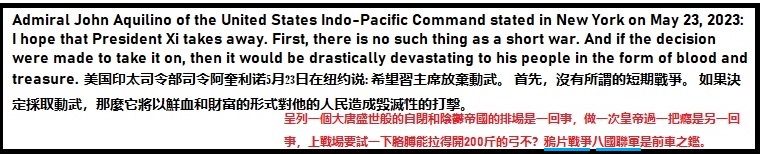
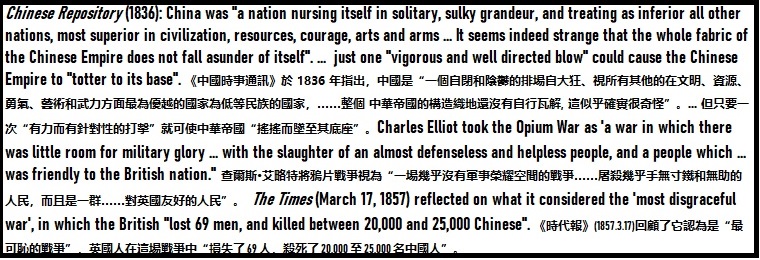
 ***
***
![Though, Anna Wang [Anneliese Martens], in her memoirs, expressed jealousy over Gong Peng by stating that the Anglo-American reporters had flattered the Chinese communists and the communist movement as a result of being entranced with the goldfish-eye'ed personal assistant of Zhou Enlai](GongPeng.jpg)